

When work stalls between providers: agreeing useful handoffs
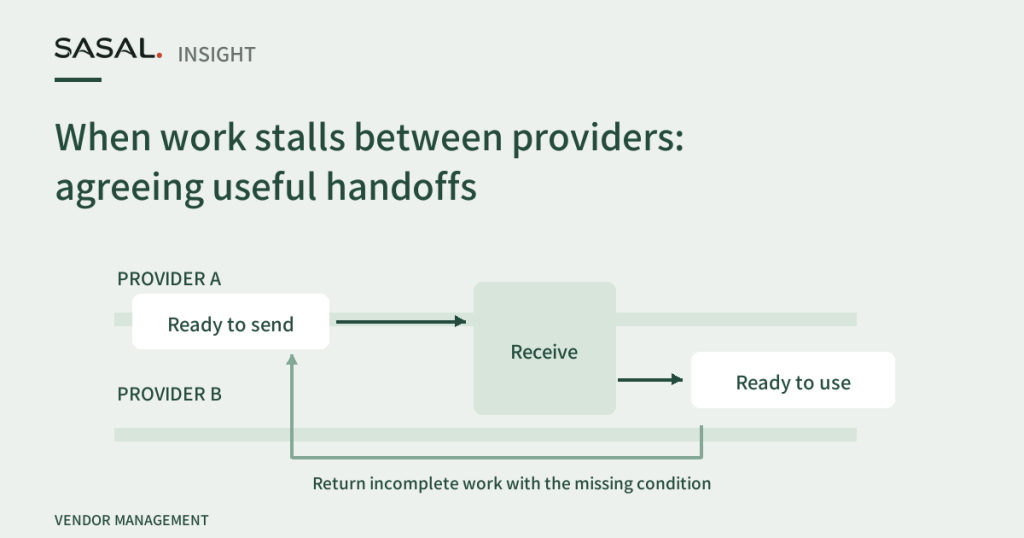
A translation is finished, the production team is waiting, and the local reviewer says the package is incomplete. Each provider can explain what it has done, yet the business still lacks something it can use. Resolving that situation requires more than another round of progress reports. Someone must establish what the next person needs, which version is valid and who can decide the unresolved point. For an established international operation, these questions belong to everyday management of the work between providers. This article follows a hypothetical content assignment to explain how to define those boundaries, record a usable handoff and deal with exceptions. The aim is a process that supports direct working relationships and keeps the company's decisions with the people authorized to make them.
Why each provider can be finished while the work is still blocked
Suppose a company commissions a translated product presentation, asks a second provider to prepare its production files and uses a local specialist to review the result for an intended audience. This is a hypothetical assignment. The translator has returned the text specified in its brief. The production provider needs to know which changes have been approved before laying out the final version. The local reviewer has commented on an earlier file and does not know whether its comments were accepted. A progress report showing three completed activities would conceal the central problem: nobody has established a single version that the next person is authorized and able to use.
Begin by asking what each completion statement describes. It might mean that an individual has finished an assigned task, that a file has been submitted, that a recipient has checked it or that the business has approved its use. These states can differ even when everyone has followed their own instructions. The translator should not have to infer a commercial decision from silence, and the production provider cannot settle an unresolved specialist question simply to meet a deadline. The client needs a shared description of the outstanding dependency and a person responsible for obtaining the decision. Draw the boundary between the outputs rather than immediately evaluating the providers. Ask the sender what it believes it has supplied and the recipient what prevents the next task from starting. Preserve the actual file references and the reason given. The gap may be a missing input, an inconsistent instruction, a decision that has not been made or a requirement introduced after the original brief. Those causes need different responses. Repeating the work could be wasteful when a short client decision would resolve the issue; pressing for a decision would be premature when essential specialist evidence is missing.
This diagnosis also protects useful differences between providers. A translator, production specialist and local reviewer need not use identical internal methods. They do need compatible information at the point where one person's output becomes another person's input. Agreeing that boundary can leave the existing companies and their expertise in place. The management change concerns how the work connects. If the company introduces an outside coordinator, that person can follow the dependency, assemble records and seek the required answer. The coordinator does not gain authority to approve the content, change the contract or replace a specialist's judgment through that coordination role.
Choose one blocked assignment for the first review. A broad complaint that communication is poor does not show which condition needs changing. A precise statement does: production cannot use the submitted translation until the named client reviewer identifies the approved wording and records the unresolved local-review question. That statement identifies the next decision, the information required and the work that depends on it.
Follow one assignment from request to usable output

Trace the selected assignment through the records that already exist. Start with the request and agreed brief, then identify when the required inputs were available, when work began, which version was submitted and what happened next. Emails, task records and shared-file histories may each reveal part of the sequence. The purpose is to reconstruct the work, including uncertainty, rather than build a retrospective account that makes every status appear clear. If a timestamp establishes that a file was uploaded but not that the recipient saw it, record that limit.
Separate active effort from elapsed time. A file that spent several days between submission and the next action was not necessarily being worked on throughout that interval. It may have been waiting for review, missing a required input, outside the recipient's working calendar or awaiting a decision about scope. Conversely, a quick transfer can conceal repeated clarification work by several people. Ask participants to describe the reason for the interval and point to any supporting record. Where the reason cannot be confirmed, leave it unknown instead of assigning responsibility from the dates alone.
A simple sequence can use states such as inputs requested, inputs ready, in progress, submitted, returned for clarification and ready for the next activity. These are proposed operating labels, not contractual conclusions. In the presentation example, submitted means the file has been delivered to the agreed location. Ready for production means the production recipient has the version and decisions needed for its task. A separate record may still be necessary for the client's contractual acceptance of the translator's work. Making those distinctions explicit prevents one status from carrying several incompatible meanings.
Include the work performed by the client. If a provider is waiting for the company's product owner to confirm an expression, that decision belongs on the same sequence as the external activities. A map that shows only provider turnaround time could misdiagnose an internal approval wait as slow delivery. Likewise, record a return caused by a new client requirement separately from a return caused by missing agreed material. Both create work, but they suggest different improvements and may have different contractual implications.
Use the reconstructed case to locate a boundary worth testing. One example can reveal a missing receipt confirmation or an unclear approval route; it cannot establish how frequently the problem occurs across the business. Check further comparable assignments before making claims about typical performance. For the immediate work, the useful result is narrower: a sequence showing where the assignment stopped, what information was available and whose next action could move it forward. That gives the discussion a factual starting point without turning a small sample into a provider score.
Ask recipients what they need before work can start
Define inputs with the people who will use them. A sender may consider a file complete because it contains every requested page, while the recipient needs an editable format, a confirmed audience or a clear decision about one disputed term. Ask the recipient to name the conditions that make its task executable. For the hypothetical production assignment, these could include the approved text version, the intended output format, the permitted treatment of images and any unresolved item that must remain visibly provisional. The answer should reflect the actual assignment, not a generic document checklist copied from another project. Examine why each proposed input is necessary. Some information is essential to beginning the task; other information can arrive later; some is convenient but does not affect the work. Distinguishing these categories prevents the receiving team from requesting a complete history simply because it is available. It also reveals possibilities for sequencing. Layout preparation might proceed using a clearly identified provisional text, while release of the finished presentation remains dependent on approval. That is workable only if the involved parties understand the limitation and the applicable agreement permits the proposed approach.
Have the sender confirm whether it can supply the requested input in the form and timing required. A file format that the sender cannot export, a decision it does not own or background information it is not allowed to share cannot be treated as a routine delivery obligation without further agreement. The coordinator can separate these obstacles and identify the responsible person. A technical export issue may need the two providers to speak directly. A missing commercial decision needs the client. A sharing restriction needs the relevant information owner and, where appropriate, specialist review.
Record the agreed input conditions next to the receiving activity. Describe the resource and its relevant state: approved wording referenced by version, rather than merely text; images cleared for the intended use, rather than merely image folder. Avoid placing passwords, confidential contents or unnecessary personal information in the handoff record. A reference to the controlled location and the person who can authorize access can be sufficient. The recipient must still be able to obtain the information through the agreed route; a link it cannot open does not establish readiness.
Test the proposed conditions against a recent assignment before making them a standing requirement. Ask whether each condition would have prevented a real ambiguity and whether collecting it creates unnecessary work. If an input is required only for particular uses, mark that condition instead of demanding it every time. The result should tell the sender what to provide and give the recipient a defensible basis for starting, requesting clarification or holding a dependent activity. It should not become an expanding wish list with no owner.
Define completion in terms the next person can use
Completion needs a recipient and a purpose. A provider can finish its internal task without producing an output that is ready for the client's next use. Agree what the recipient will check at the handoff and what that check establishes. In the presentation example, the production provider needs to identify the current approved wording, the required working files and the status of outstanding comments. It does not necessarily need to repeat the local specialist's review or make the client's final publication decision. Those are different responsibilities and should remain visible.
Describe a complete package in terms that can be observed. Identify the files or records, their version, the purpose for which they may be used and any required confirmation. If a decision is intentionally still open, state how that affects the next task. An unresolved wording choice might allow preliminary layout to continue while final release remains on hold. A missing right to use a particular image could require excluding it from the working package until the issue is resolved. These examples illustrate possible arrangements; the appropriate action depends on the actual scope, rights and instructions.
A provisional handoff deserves its own status. It can be useful where the next activity can proceed without treating unsettled information as final. The sender should identify what is provisional, and the recipient should confirm the limited purpose for which it can be used. Name the person who will supply the final decision and the downstream action that must wait. Without that record, a temporary working assumption can travel through several providers and emerge as an apparently approved instruction. Changing a status label later may then require checking which work relied on it.
Keep operational readiness separate from contractual acceptance. Receipt of a package, a successful file check, the recipient's ability to begin work and the client's acceptance under the contract may occur at different points and have different effects. Establish the actual contractual procedure with the people responsible for it. The working handoff record can reference that process without pretending that its own ready status settles payment, warranty or amendment questions. This avoids asking a production contact to make a decision that belongs to an authorized client reviewer.
Use a small readiness test with the receiving team. Can it locate the agreed version, open the permitted files, identify the next task and distinguish settled instructions from open questions? If one condition fails, record the specific gap and its effect. The package may need correction, a narrower permitted use or a client decision. A handoff that does not pass should not disappear into an ambiguous complete category. Its status should tell the next person what can proceed, what must wait and who is resolving the difference.
- Agree inputsThe recipient identifies what its task requires.
- Submit a named versionThe sender identifies the output and any unresolved items.
- Confirm receiptThe recipient can locate and access the package.
- Check readinessConfirm what can proceed. Readiness for the next task does not establish contractual acceptance.
Record both delivery and receipt
A delivery record should let the recipient identify exactly what changed hands. Include the assignment reference, sender, intended recipient, submitted version, controlled location and any stated omissions. The record can be a short entry in an existing work system or an agreed message linked to the assignment. It does not need to duplicate the contents of the file. In the presentation example, a message saying the translation is finished gives less usable information than a message identifying the approved wording file, the working layout and the unresolved comment that remains excluded from production. The recipient can then check the correct package rather than search several folders and infer which file the sender meant. Where several outputs are delivered together, the sender should distinguish the ones that are final for the agreed purpose from those still awaiting a decision.
A handoff card for the hypothetical presentation could use the assignment reference Production preparation and identify the translation lead as sender and the production lead as recipient. Its material field points to the named wording version and editable working file. Its open-item field identifies the local-review wording question. The proposed next action is preliminary layout only, subject to the appropriate client agreement; final release remains dependent on the authorized wording decision. The recipient confirms that it can access the named files and perform that limited task. The decision owner is the named client reviewer, and the return route is the coordinator responsible for obtaining the missing answer. This worked structure connects the material, its permitted current use and the unresolved dependency instead of merely listing contacts. Actual dates, people and permissions must be completed for the assignment concerned.
Receipt confirmation establishes a different fact from submission. The sender can show that a package was sent, while the recipient can confirm that it reached the agreed destination and can be accessed. A delivery notification from a system may provide part of that evidence, but it need not establish that the intended reviewer has checked the material. Agree what the confirmation means and who supplies it. If the recipient cannot open a file, lacks permission or receives a version that differs from the stated one, record that obstacle directly. Avoid resetting the whole assignment to a vague pending status. The original submission reference and the reason for the return are needed to understand what happened and what must be supplied next.
When the sender corrects or replaces a package, connect the new version to the earlier handoff. The return record should identify the missing or inconsistent input, the person asked to resolve it and the affected next activity. The replacement should explain which issue it addresses and whether anything else changed. This protects the recipient from assuming that a new file contains only the requested correction when other material has also been revised. It also prevents a reviewer from returning to an obsolete version because that is the one linked in an earlier message. Retain the relevant history under the organization's record rules, while making the current working reference easy to identify.
Agree how an unanswered handoff will be followed up. The right route depends on the activity and the commitments at risk. The sender might first contact the named recipient, then use the agreed alternate or coordinator if a decision is needed before the next working window. The purpose is to locate the missing action, not to treat every unacknowledged message as poor performance. A confirmation method that nobody owns is little better than no method. Equally, requiring several people to acknowledge every routine file can create work without improving control. Use the record to establish the handoff facts and reserve additional checks for the circumstances in which they affect the next decision.
Translate time zones and calendars into working arrangements
A deadline is usable only when the people involved interpret it the same way. Specify the relevant date and time zone where time matters, and confirm the receiving team's actual working calendar. A phrase such as by the end of the day can refer to different windows for the sender, coordinator and recipient. A provider's office location alone does not establish which hours the assigned person covers. Ask about the arrangement for this work, including known closures, alternate contacts and the language needed for a decision. That is more reliable than inferring availability or communication preferences from nationality. Work backward from the activity that depends on the handoff. If the recipient must obtain a client decision before proceeding, a submission immediately before that person's absence may leave no realistic review window. The apparent transfer deadline and the effective readiness deadline are then different. Identify the review that must occur between them and the information it requires. Where the sequence does not fit the available windows, discuss a smaller agreed package, an earlier provisional submission, a different reviewer with the necessary authority or a revised downstream date. Each option changes something concrete; merely marking the original request urgent does not create capacity or authority.
Keep planned availability separate from a commitment to respond. An overlapping working period offers an opportunity for direct discussion, but it is not automatically a contractual response obligation. Confirm any required service or response terms through the actual agreement. For ordinary coordination, agree practical contact expectations and explain when the next person can reasonably act. If the assignment needs coverage outside normal hours, identify who will provide it and whether additional arrangements or fees are required. A coordinator should not promise round-the-clock delivery on behalf of providers whose engagement does not include it.
Language can affect the handoff even when participants share a working language. A specialist may need to review a source document in its original language, while the decision-maker needs a concise explanation of the issue and options. Identify which version governs the relevant work and who can resolve a discrepancy between versions. A translated summary can support coordination without replacing the underlying record or specialist interpretation. The handoff should distinguish the documents needed for technical work from the explanation needed for the client's decision.
Review the calendar when the assignment changes. A new review round, a different specialist or a revised recipient can invalidate the original sequence even if the final date has not changed. Update the next decision window and tell the affected participants which assumption moved. The useful output is a working arrangement that connects availability, necessary review and the downstream task. It is not a league table comparing providers by how quickly they respond to messages sent outside their agreed working conditions.
Decide which exceptions need an internal decision
An exception route should distinguish a problem that the working team can resolve within the agreed assignment from a choice that changes commitments or exceeds its authority. A missing file reference might be corrected directly by the sender. A proposed substitution that changes the deliverable, increases the fee or affects a customer commitment may require a client decision. The distinction depends on the actual scope and delegation. Ask what consequence the exception creates and who is authorized to accept it, rather than using the word urgent as a substitute for that assessment.
For a decision request, assemble the smallest set of facts that lets the authorized person compare options. Identify the affected assignment, current version, missing condition, consequence for dependent work and date by which a decision is needed. Include the available alternatives and the relevant provider or specialist assessment. The coordinator can explain, for example, that production could continue with an agreed provisional section, wait for the full review or use a narrower package. It should also identify what remains unknown. A request that simply forwards a long email chain transfers the work of reconstructing the issue to the decision-maker and increases the chance that an important condition is missed.
Set escalation triggers around the work. A trigger might be an unresolved input that prevents the next activity, a conflict between approved instructions, a proposed cost change or a specialist question affecting intended use. The trigger needs a route, an owner and a reason for acting at that point. Avoid a universal elapsed-time threshold that treats every assignment alike. A short wait can matter when a dependent commitment is imminent; a longer wait may be compatible with an agreed schedule. Keep routine follow-up separate from escalation, and distinguish both from any formal notice required by the contract.
Prepare for absence without creating informal authority. Name an alternate contact or the process for obtaining a decision when the usual approver is unavailable. Confirm what the alternate can decide. If nobody with the required authority is available, record the limitation and determine which activities can safely and lawfully continue under the existing instructions. The coordinator cannot resolve the gap by approving a trade-off simply because the work is delayed. The same principle applies when a provider asks for a quick verbal answer: the urgency may justify a faster authorized decision route, not an undefined transfer of decision rights.
After the decision, record what was authorized, the conditions attached and the people who need the result. Close the loop with the recipient whose work was blocked. A decision in a meeting has limited operational value if the next provider continues using the earlier assumption. If the question remains unresolved, make the remaining hold and next review event visible instead of treating escalation itself as completion.
Let the coordinator connect advice without replacing it
Coordination becomes especially valuable when different specialists are reasoning from different premises. In the hypothetical presentation assignment, the production provider may be following a brief approved before the local review, while the local specialist is commenting on a later intended use. Their answers can conflict because they are answering different questions. Before asking anyone to choose between the answers, identify the version, purpose, audience and assumptions behind each. The coordinator's first contribution is to make that difference visible and obtain a response to a shared question.
Preserve the distinction between a factual mismatch and a professional disagreement. A wrong file version can be corrected through the document owner. A disagreement about a specialist requirement may need the relevant qualified people to explain their reasoning and limits. The coordinator can arrange that exchange, record the questions and identify the decision it affects. It should not turn two qualified opinions into a single apparently settled answer by removing the conditions that made them different. The client needs to understand which matters are established, which remain uncertain and which choice it is being asked to make.
Prepare decision materials in a form the authorized client can use. A short issue note can identify the operational consequence, the specialist inputs, the feasible alternatives and the assumptions attached to each. Where a provider's proposed response changes cost, timing or scope, link that implication to the appropriate approval route. The decision-maker may ask for more evidence, choose an option within its authority or narrow the intended use. A management partner can support this process while the original providers continue their work. If that partner is also asked to perform new operational delivery, the work requires its own agreed scope and fees; it is not automatically included in coordination.
Keep direct technical communication available where it helps resolve the issue. Requiring every file-format question or clarification to pass through a coordinator can add another boundary to an already complicated workflow. The role should make the decision trail clearer, not become an exclusive owner of every conversation. Agree when providers may discuss the work directly, what information may be shared and which decisions must be brought back to the client. The coordinator needs the outcome and any changed assumption, rather than attendance at every exchange.
Check the final record against the advice it summarizes. Does it preserve a specialist's condition about the version or intended use? Does it identify the client's actual decision rather than implying that a discussion settled it? Does the receiving provider know which instruction now applies? Those checks protect both the usefulness of the coordination and the responsibilities of the people involved. The result is an executable next step with its limits visible, rather than a smooth-looking summary that hides the unresolved issue.
- Record the mismatchIdentify the versions, purpose and assumptions that differ.
- Define the questionState what the dependent activity needs to know.
- Obtain relevant adviceThe responsible specialists explain their findings and limits.
- Client decision and instructionThe authorized client confirms the next instruction and conditions for the dependent work to resume.
Carry changes to the providers whose work depends on them

A change can affect more than the provider receiving the request. In the hypothetical content workflow, a revised audience may alter the translator's terminology, the local review and the production files. Informing only the person editing the document leaves the other participants working from an obsolete assumption. Start with the changed requirement and identify the outputs or decisions that depend on it. Use the assignment map to find those dependencies rather than sending every document to every provider.
Ask each affected recipient to assess the impact within its responsibility. The translator can identify wording that needs reconsideration; the production provider can identify completed work that would need alteration; the local specialist can explain whether its earlier advice still applies to the revised use. Keep these assessments distinct. A statement that a change is easy to implement does not establish that it is commercially approved or suitable for the intended purpose. Likewise, a specialist's approval of one aspect does not automatically approve the entire revised package. Separate affected activities from work that can continue on the existing basis. A change to one section may leave other preparation valid, but that needs confirmation from the relevant people. Record the version each participant is using and the limit of any instruction to continue. If preliminary work proceeds while a decision is pending, make its provisional status visible. The client should understand potential rework or cost implications before authorizing that approach. The coordinator can assemble the options and follow the decision; it should not promise that all earlier work remains usable.
Connect any additional fee or amended scope to the established change-approval process. The handoff record needs a reference to the authorized instruction, not a second unofficial approval route. A provider's impact assessment may be a quotation or a request for clarification rather than authorization to begin. Preserve that distinction when sharing it with downstream participants. Once a change is agreed, identify the effective version, the work it supersedes and the people who need to act. Leave the detailed contractual interpretation with the responsible commercial or legal reviewer.
Close the loop by checking the dependent work, not merely the message distribution. A notification can be sent successfully while a provider continues using its locally saved copy of the earlier file. The receiving team should confirm which version now governs its task and whether any completed output needs review. Retain the relevant earlier record under the applicable rules so that the reason for rework can be understood. If the proposed change is declined or postponed, communicate that decision too. Otherwise, some participants may wait for a revision that will not arrive, while others assume that the requested change was accepted.
Use exception meetings to unblock specific handoffs
An exception meeting needs a decision to resolve or a focused coordination problem to work through. A routine progress presentation is a different activity. Before convening the relevant people, identify the blocked handoff, the known facts, the consequence for dependent work and the question requiring attention. If the sender and recipient can resolve a file-location problem directly within the agreed scope, a wider meeting may add little. If a change affects several providers and requires the client's choice, bringing the right people together can shorten the path to a usable instruction.
Prepare a concise issue record. For the hypothetical production hold, it might identify the submitted version, the unresolved local-review comment, the work that cannot proceed and the alternatives already assessed. The client decision-maker needs to know what each option changes in purpose, timing, scope or cost. The providers need to know which assumption to use next. Include a specialist when its reasoning is necessary, rather than asking a coordinator to speak beyond the advice it has received. People whose work is unaffected may only need the resulting instruction.
Use the discussion to test the missing premise or choose between executable alternatives. If a proposed option relies on information nobody has verified, name that gap before treating the option as available. If the participants discover that they are discussing different versions, correct the factual basis before debating preferences. The meeting may legitimately end with a request for further specialist input rather than an immediate decision. Its output should then state who will obtain the answer, what is being held and when the question returns to the authorized decision-maker.
Record the result in operational terms. Identify the decision, any attached conditions, the person responsible for the next action and the affected output version. A statement that the teams discussed the issue is not enough for someone who was absent to resume the work. If a decision was not made, distinguish the open question from the actions already agreed. The handoff record and the relevant contract or approval record should remain connected, with neither silently replacing the other. Where a formal amendment is needed, completion of the meeting does not dispense with that procedure.
Review whether the meeting itself solved the right problem. If the same participants repeatedly spend time locating missing inputs, improve the submission package or its ownership. If they repeatedly debate a choice that no attendee can approve, fix the decision route. If direct specialist exchanges are working, preserve them and capture their conclusions. The purpose of an exception forum is to resolve dependencies that need joint attention. Keeping that purpose clear prevents another standing meeting from becoming a new handoff that everyone must wait for.
Try the conditions on one bounded assignment
Test the proposed handoff conditions on an assignment whose participants and intended use are clear. The hypothetical translated presentation provides one example. The sender identifies the package and current version; the production recipient checks the agreed inputs; the local specialist's unresolved issue is visible; the authorized client reviewer knows which decision is required. Define what the test is intended to establish before running it. It may be whether the recipient can identify a usable version, whether a return reaches the right owner or whether a client decision is carried through to the next activity. Walk through a complete package first. The recipient should be able to find the identified files, access them through the permitted route, understand their status and begin the agreed next task. Check whether the recipient needs to reconstruct key context from an unrecorded conversation. If it does, the package is not yet self-explanatory for its intended purpose. The improvement may be a short decision reference or a clearer statement of the open item, rather than a larger document bundle. Ask the recipient what information actually enabled the task and what was unnecessary.
Then examine a package that does not meet one of the conditions. This can be a controlled review of a hypothetical exception rather than withholding something from live work. Suppose the local-review conclusion is missing while the working files are otherwise available. The recipient should identify the missing condition, the affected activity and the route for obtaining the decision. The process should also show whether any agreed preliminary work can continue. A failed condition is useful evidence about the handoff design when it leads to a clear hold or limited continuation; concealing it under a completed status defeats the purpose of the test.
Observe what the participants actually do with the record. A well-written instruction may still be hard to use if the named contact cannot receive the request, the file reference points to the wrong version or the alternate approver lacks authority. Record those specific failures and the correction required. Avoid a readiness score that combines unlike problems into a reassuring percentage. The test should demonstrate particular capabilities: locating an output, confirming receipt, identifying a missing input or carrying an authorized instruction to the dependent provider.
Decide what can reasonably be learned from the trial. One bounded assignment can show that the revised handoff works under those conditions. It does not prove a general reduction in cost, delay or rework. Keep the relevant differences visible before extending the method to another workstream, including its recipients, specialist questions and contract arrangements. Agree which conditions to retain, which to change and which require another test. This gives the next rollout a concrete basis without assuming that every provider relationship needs the same package or the same approval sequence.
Use recurring exceptions to improve the next handoff
Once the process is running, review the reasons work is returned or held. Keep the categories specific enough to suggest an action: missing agreed input, changed requirement, inaccessible file, conflicting version, unresolved specialist question or unavailable authorized decision. The same visible delay can have different causes, so preserve the explanation and its basis. A return caused by a new client request should not be automatically grouped with a provider's failure to supply an agreed file. The distinction matters to both improvement and a fair assessment of the work.
Look for a repeated mechanism before rewriting the standard. If recipients repeatedly need the same missing context, add it to the agreed input description. If the input was clearly specified but omitted, discuss the delivery process with the sender. If requirements change after work begins, examine the request and approval process. If a necessary specialist answer arrives too late, revisit the sequence and availability assumptions. These responses address different problems. Adding another approval to every assignment may increase waiting without resolving any of them. Consider the cost of the proposed control. A new confirmation step needs an owner and a reason for being there. Ask what decision it enables, which error or ambiguity it addresses and whether a lighter method would provide the same assurance. Equally, do not remove a check simply because it creates work. A review needed for a customer commitment, professional judgment or agreed contractual procedure may need better scheduling or clearer inputs. The aim is a usable arrangement with necessary responsibilities intact, not the smallest possible number of steps.
Maintain the current method and the reason for changes. When an input requirement, receiving role or exception route changes, tell the affected providers which version applies and how active assignments will be handled. Work already in progress may need a specific transition decision. The organization should be able to explain why an earlier route was used for one assignment and a revised route for another. Keeping that history avoids blaming a participant for following instructions that were valid at the time.
End each improvement review with a bounded next commitment. Name the handoff being changed, the responsible participants, the evidence to observe and the point at which the arrangement will be reconsidered. The client retains the decisions about scope, spend and wider application; a coordinator can maintain the record and bring the evidence back. Useful evidence includes whether the recipient could begin the intended task, whether exceptions reached the right person and whether the resulting instruction was used. Those observations can support the next adjustment while keeping the existing providers focused on the work they are engaged to perform.