

Managing extra requests: scope, approval and acceptance
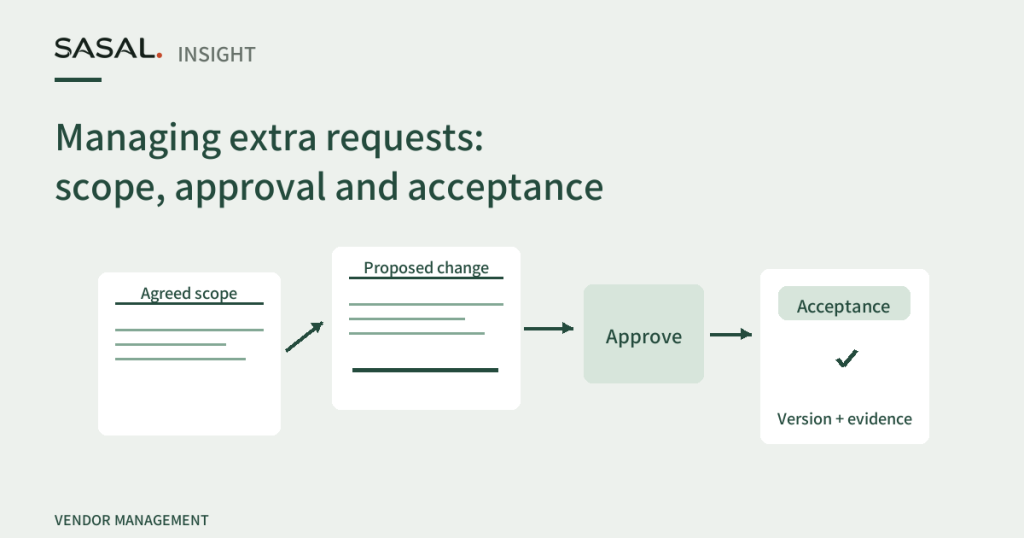
A request to adapt commissioned work can arrive through a review comment while the original assignment is still running. The requester may need a different result, the provider needs to assess the work involved, and the person controlling the budget may not have seen the exchange. Unless those decisions are connected, the parties can discover different expectations only when delivery or billing occurs. A workable change process links the agreed baseline, proposed outcome, assessment, approval, delivered version and checks. The aim is to make that sequence usable in daily work, including when part of a request is disputed or urgent. Existing contractual obligations and the authority to authorize additional work remain part of the decision throughout.
Small extra requests can leave the least reliable record
A useful way to understand scope changes is to follow a hypothetical request rather than start with contract language. Assume a presentation has already been commissioned and is progressing against an agreed brief. During review, a stakeholder asks whether the same presentation can be adapted for a different market. The requester views the change as a minor edit because much of the content already exists. The delivery team sees new research, localization decisions and additional review cycles. The buyer later receives an invoice that appears unrelated to the original approval discussion. At that point, each participant may have a reasonable explanation, yet the decision trail connecting the request to the invoice is incomplete.
The missing record is often not the technical work itself but the sequence of decisions. A change record should identify the existing scope, the newly requested outcome, the reason for the request, the intended recipient or use of the revised material and the requested timing. In the presentation example, the record might show that the original assignment supported one audience while the adaptation targets another market segment. That information does not determine whether the work is chargeable, but it gives reviewers a shared description of what was requested and why.
Different people also perform different roles in the process. The person asking for help may not have authority to approve spending. A project coordinator may gather information and obtain an assessment from the provider, yet still lack authority to authorize the work. The provider may estimate effort, staffing implications and delivery timing without having authority to decide whether the client wishes to proceed. Recording who requested, assessed and approved the change helps prevent later assumptions that a conversation automatically created authorization.
The record must also preserve the difference between asking for an assessment and instructing delivery. For the hypothetical adaptation, a requester could ask the provider to identify the work, timing and fee implications before an authorized person considers proceeding. The coordination record would then show assessment requested and identify who must receive the response. If the scope is later approved, it can link the approval to the resulting version and checks. If discussion remains open, it should show that status and the next decision date. These internal labels help colleagues understand what they are doing; they do not determine the legal effect of communications with the provider. The wording of an instruction and the actual agreement still need appropriate review.
Return to the agreed version of the scope

When a request appears to change ongoing work, the first operational task is to identify the current baseline. That baseline is not automatically the newest email, the latest meeting note or the most recent draft. It is the version of the scope that the governing documents currently establish. Depending on the engagement, that may require reviewing the contract, purchase order, approved specification, statement of work, approved brief and any recorded amendments. The objective is not to win an argument about wording but to establish which documents currently define the assignment.
A project team can be working from a briefing document that differs from the purchase order. An amendment may update part of the work while leaving other provisions unchanged. Review comments can introduce ideas that were discussed but not approved. Record the disputed point precisely: whether a new audience was included, which file format was promised, or whether a later date replaced the original deadline. Then attach the relevant versions and approval references. This is more useful than sending a folder of documents with a general request to clarify scope. The person responsible for contractual interpretation can see the exact question, while the operating team retains a factual record of the discrepancy.
The contract itself may contain an order-of-precedence clause describing how conflicting documents are interpreted. Someone with appropriate contractual responsibility, often supported by legal or commercial review where necessary, should check the actual wording rather than assume that any particular document controls. The existence of a newer document does not by itself establish priority. Likewise, a widely circulated email may provide useful context without altering the agreed scope. Separating document collection from amendment authority helps keep factual observations distinct from contractual conclusions.
Preserve the approved baseline as a reference and maintain a separate view of proposed changes. For the presentation example, the base brief might identify an intended audience and an agreed deliverable, while a later comment requests another use. If the only change accepted so far concerns the delivery date, the current record should not imply that the new use was also agreed. A short amendment index can identify the affected provision, approval reference, effective date and clauses that remain unchanged. The next reviewer can then reconstruct the current position without treating an accumulated collection of drafts as one agreement. Where the documents still leave a genuine ambiguity, retain it as an unresolved question for the appropriate reviewer.
Distinguish clarification, correction and additional work
Classification is often the point where operational discussions become contentious. A practical framework is to compare three possibilities. A clarification explains how an already agreed requirement should be delivered. A correction addresses a shortfall against an agreed requirement that was already part of the scope. An additional work request introduces a new requirement, purpose or deliverable that was not previously included. These categories help structure discussion, but they are working labels rather than legal determinations. The agreement and amendment process still govern the parties' rights and obligations.
Evidence matters because the same request can be interpreted differently. If the original scope required a presentation in a specified format and the team simply needs confirmation about slide order, the issue may be a clarification. If an agreed section was omitted from a submitted draft, the issue may be a correction. If the presentation is now intended for a different market and requires new adaptation work, reviewers may consider whether the request introduces a new purpose or deliverable. The answer depends on the documented scope and supporting records, not on the preference of either party.
Disputed classifications should be documented rather than forced into a category prematurely. The buyer may point to language suggesting that adaptation was already contemplated. The provider may point to assumptions, exclusions or deliverable descriptions indicating that only one market version was included. Both sides benefit from identifying the specific records supporting their interpretation. An internal project label such as 'minor change' or 'bug fix' may assist coordination, but it does not automatically determine payment responsibility, entitlement to additional fees or entitlement to free work.
A disputed request can contain separable elements. In the presentation example, an omitted section may need correction under the existing requirements, while a new market-specific analysis remains under review. The parties can identify those elements independently and determine which work may proceed under the actual agreement. Record the accepted description, disputed description, supporting documents, effects on timing and person responsible for the next decision. This prevents an internal label from hiding the difference between an undisputed obligation and an unapproved addition. It also gives the decision-maker practical options: clarify the original requirement, agree a limited addition, revise the proposed outcome or defer the additional use. None of those options should be recorded as agreed until the relevant decision and contractual process support it.
- ClarificationExplains how an agreed requirement should be delivered.
- CorrectionAddresses a shortfall against an agreed requirement.
- Additional workProposes a new requirement, purpose or deliverable.
Record the reason and intended use of a change
A change request is easier to assess when it explains the business need separately from the proposed solution. In the hypothetical presentation assignment, the requester may want material suitable for a new audience. That need could be met by a short approved supplement, a revised presentation or a more extensive adaptation. Asking for the whole deck to be rebuilt before explaining the purpose can make the provider estimate a solution that the company does not actually need. State the intended use, the recipient and the decision or activity the revised output is meant to support. Identify the baseline being changed. Reference the current agreed output and describe what should be different: content, format, volume, audience, location of use, delivery timing or some combination. These distinctions help the provider assess the work and help the client understand what it is being asked to approve. A request described only as an update leaves too much to interpretation. If the requester does not yet know the necessary scope, ask for an assessment or options rather than recording an undefined delivery instruction.
Include the reason for the requested timing. A date attached to a genuine downstream commitment has different implications from a date chosen for convenience. Explain which activity depends on the revised output and whether a partial or provisional result could serve that purpose. The provider can then identify feasible alternatives and the conditions attached to them. The client still needs to decide which trade-offs it is willing and authorized to accept. Neither urgency nor a preferred date establishes that the proposed work is already within the agreed scope.
Keep the original request and subsequent clarifications connected. A brief initial message can develop into a different assignment after the provider asks questions. Record the version that is being assessed and show which earlier assumption it replaces. If a new recipient introduces another use, make that change visible rather than folding it silently into the original request. The assessment, quotation and eventual approval should all refer to the same proposed scope; otherwise each person can believe they have agreed to something different.
Use a compact proposed-change record. For the presentation example, it could identify the current approved version, the intended new audience, the requested adaptation, the reason for the date and the person who will receive the result. An open field can record whether the adaptation needs additional specialist review. This is a hypothetical working structure, not a universal form. Its value is that the provider can assess a defined question and the client can distinguish a request for information from a proposed commitment. A completed record should make the next decision easier, not require the requester to invent technical answers before seeking help.
Assess effects on timing and other assignments as well as price
Ask the provider to explain the operational effect of the proposed change alongside its fee assessment. The response should identify what new work is required, what existing work remains valid and what would need to be revisited. For the hypothetical adaptation, the provider might need to revise wording, obtain a new review or rebuild an output that was already prepared. Those are matters to establish for this assignment, not assumptions that every change creates additional chargeable work. Keep any disputed classification visible while the impact is assessed.
Examine the sequence. An additional request can affect an existing delivery if it needs the same people or depends on a decision that has not yet been made. Ask which dates would move and why. The client may be able to defer the new use, narrow the adaptation or separate a later version from the original delivery. These options should be evaluated against the business purpose and the actual agreement. A lower fee is not necessarily the most useful option if it leaves the original commitment unsupported; an earlier date may be unnecessary if the downstream activity can change.
Identify the other participants affected by the revision. A translator, production team or local specialist may be working from the earlier scope. Their completed work, assumptions and availability need to be considered before the requester treats the revised output as a simple substitution. The coordinator can gather the relevant assessments and show which activities can continue unchanged. It should not assume that one provider's agreement to a revised date establishes that all dependent work can meet it.
Include consequences after delivery where they are relevant. A changed format may require a different update process. A new recurring report may create ongoing preparation or review work. A broader intended use may require additional permission or specialist confirmation. Ask the responsible people to identify those implications and the limits of their assessment. The decision should distinguish a one-time modification from a continuing commitment. That distinction affects the next budget and operating arrangement as well as the immediate quotation.
Present alternatives on a comparable basis. For each, state the proposed output, timing, additional work, client inputs and unresolved conditions. Do not combine a price for one scope with a schedule for another. The client can then decide whether to request a formal quotation, clarify a remaining point or decline the proposed addition. If the assessment itself requires work outside the existing agreement, clarify that before commissioning it. The process should not create an unexamined charge merely because everyone is trying to understand the change.
Separate requesting help from authorizing spending
Identify who can request an assessment and who can commit the company to the resulting work. A project participant may understand the business need without holding the relevant budget or contracting authority. The provider also needs to know which communications are requests for information and which are authorized instructions under the engagement. The operating process should make that distinction clear, while the legal effect of any particular communication depends on the actual circumstances and agreement. Map the roles around the proposed change. The requester explains the purpose. The operational reviewer assesses whether the proposed output will meet it. The budget owner considers the expenditure within its authority. The contractual approver handles the commitment through the appropriate process. One person may hold several roles, but the record should still show which judgment was made. An approval that the proposed work is useful does not necessarily establish that the fee, contractual amendment or new information-sharing arrangement has also been authorized.
An outside management partner can collect the request, obtain the provider's assessment and prepare the decision package. Those coordination tasks do not automatically give it authority to approve its own operational work or commit the client's budget. If the partner is proposed as the delivery provider for an additional assignment, describe that work and obtain a separate quote and agreement. Keeping the roles distinct lets the client evaluate the recommendation with a clear view of who will perform the work and on what terms.
Prepare a route for time-sensitive requests. The responsible team should know whom to contact when the usual approver is unavailable and what authority any substitute actually has. The solution may be a delegated approver, an adjusted decision date or a narrower instruction that is already within an authorized scope. It should not be an informal assumption that the person answering messages can approve the whole change. Record any limitation and tell the provider which decision remains outstanding.
After approval, communicate the authorized scope accurately to the people doing the work. A budget approval for a limited adaptation should not be summarized as permission to complete every item discussed during the assessment. Reference the agreed version, conditions and any remaining exclusions. If the decision is to defer or decline the addition, communicate that outcome too, together with the position on existing work. A clear decision trail helps both parties understand the next action without relying on an internal label to determine their legal rights.
Carry quotation assumptions into the approval
A quotation is useful for approval only when its assumptions travel with the amount. Identify the proposed output, included work, exclusions, relevant quantities, required client inputs and intended timing. Record the currency, expenses and other commercial conditions actually stated. If the fee depends on a particular scope or input being supplied, that condition belongs in the decision package. Otherwise, the approver may believe it is authorizing a result that the provider has not offered on those terms.
Read the quotation against the assessed change. A provider may respond with a narrower adaptation, a different delivery sequence or an option that retains part of the existing material. That can be a useful proposal, but it should not be treated as a price for the request unchanged. Ask the requester and operational reviewer to confirm whether the offered scope meets the intended use. Resolve material differences before presenting the option as ready for approval. Where an assumption remains open, show its possible effect and the decision still required.
The UK Government's Contract Management Professional Standards, version 2.0 published in 2019, offers a relevant professional reference. Its change-control capability area describes reflecting implemented changes in contractual documentation, the risk register, business case and financial model. The document concerns people managing government contracts; it does not establish the legal effect of a private company's communications in every jurisdiction. The useful operating point here is to connect an approved change with the records on which later decisions depend, rather than allowing the quotation, budget and delivery instructions to describe different assignments.
Create a reference that links the decision to the specific quotation version and agreed scope. Record who approved what, any conditions that remain and the instruction that should follow through the applicable contractual process. If only one option was approved, identify it. If the approver imposed a limit or required further confirmation, keep that condition visible. Approval of a budget amount alone may leave scope or contract steps unfinished. The relevant owners should confirm when the provider can be instructed to proceed under the actual arrangement.
Update the affected working records after the change is authorized. The current brief, delivery sequence, expected output and internal budget view should reflect the same decision where applicable. Notify people whose work depended on the earlier assumption. Keep the history of the original position and the change, so a later reviewer can explain why the instruction differs from the first request. If the proposal is not approved, record that outcome without quietly deleting the work already required under the existing agreement. A coherent record shows both what changed and what remains in force.
Use the approval reference when the output is reviewed and the invoice is checked. It should make the relevant scope and conditions easy to find, not require the recipient to reconstruct them from every previous discussion. That connection is particularly useful when the requester, reviewer and finance contact are different people or when the assignment continues after a personnel change.
- Assess the changeIdentify the intended use, affected work and remaining questions.
- Review the quotationCarry scope, timing, fees, assumptions and exclusions together.
- Obtain client approvalThe authorized people decide the scope and commitment within their roles.
- Record the instructionConnect the agreed version and conditions to the relevant working records.
Bound urgent work without discarding existing obligations
An urgent request needs a clear view of the work already owed and the additional work being proposed. A provider may have an existing duty to respond to a problem, while the client also wants a new analysis or a broader improvement. Those elements should be identified separately. Uncertainty about the new request does not settle the position on existing obligations. The people responsible for the agreement need to confirm what must continue, what can be changed and what requires a further commitment. Explain the consequence of waiting. The requester should identify the affected customer commitment or operating activity, the decision deadline and the information currently available. Ask the provider and relevant specialists what can realistically be done within the existing scope and what alternatives require additional work. This creates a basis for an authorized decision. It avoids treating urgency as either unlimited permission to spend or a reason to stop considering the obligations already in place.
Where an interim instruction is appropriate under the actual arrangements, define its limits. It might authorize a specified assessment or a limited modification while leaving a broader proposal undecided. State the permitted work, the person authorizing it, the conditions, the next review point and what remains outside scope. Confirm how the instruction reaches the provider and how its result will be checked. The wording should be reviewed by the people who hold the relevant authority, rather than relying on an internal status to determine the contractual effect.
Keep the effect on other work visible. An urgent addition can consume resources needed for an existing delivery or require a dependent provider to change its sequence. The client should understand that trade-off before issuing an instruction. If the existing commitment cannot be maintained under the proposed approach, identify the alternatives and the person authorized to agree a change. A coordinator can gather the facts and keep the participants aligned, but cannot create available capacity or waive a commitment through a scheduling note.
After the immediate action, reconcile what was authorized, what was performed and what remains unresolved. Do this while the relevant records and participants are available. A temporary arrangement can otherwise become the assumed basis for further work without an explicit decision. If additional scope is still needed, return it to the normal assessment and approval process with the information gained. Preserve any continuing duty, limitation or follow-up action. The objective is an urgent response that can later be explained, including its boundaries, rather than an informal exception that leaves the next person guessing.
Agree the checks before the output is submitted

Define how the changed output will be checked while the scope is being agreed. Identify the intended use, the requirements to be assessed, the evidence needed and the person responsible for the check. The provider should understand what it is expected to submit, and the recipient should understand what it is expected to confirm. A requirement introduced only after submission can create a new scope discussion rather than demonstrate that the original work was deficient.
In the hypothetical presentation adaptation, the review might compare the delivered version with the approved audience, agreed content and required format. A specialist may confirm a particular point within its responsibility, while the client's reviewer assesses whether the output supports the intended business use. Keep the scope of each check clear. The specialist's answer on one issue does not automatically approve the whole output, and a successful file-format check does not establish that the business has accepted a commercial commitment.
Separate receipt, operational checking, contractual acceptance and payment obligations. These can be linked under an agreement, but their relationship should be established from the actual terms. A message confirming that a file arrived may serve a different purpose from the client's formal acceptance. An unresolved review comment may or may not affect an invoice under the arrangement. The operating record should identify the relevant process and refer questions about its effect to the responsible commercial or legal reviewer. It should not invent a universal deadline or treat silence as having the same effect in every engagement.
Record findings precisely enough for the provider to respond. Identify the affected requirement, the delivered version, the observed issue and the expected clarification or correction. Distinguish a shortfall against agreed requirements from a new preference. If the reviewer wants another use or a wider output, return that proposal to the change process rather than adding it to the correction list by default. Where the parties disagree, preserve the issue and supporting evidence without forcing an internal label to resolve their contractual rights.
Follow the agreed treatment of resubmission and closure. The new version should identify what was changed and any remaining limitation. The reviewer needs to know whether it replaces the earlier output entirely or only addresses a specified issue. Record the result of the agreed check and any further decision required. This provides a usable basis for handover and invoice reconciliation even when different people perform those later tasks. It also leaves a clear distinction between the output that was received, the checks actually completed and the obligations that still need attention.
Connect invoices to the change and delivered version
An invoice check should be able to trace the charge to the relevant agreement, approved change and delivered work. The finance contact may not have participated in the original discussion, so the reference needs to make the basis of the charge accessible. Identify the change number or other agreed reference, the quotation version, the covered service period and the output or activity to which the line relates. These links support review; they do not replace the contract's actual payment terms.
Check the boundary between the base scope and the addition. A revised quotation may include work already covered elsewhere, or an invoice may describe the original output and the added adaptation using similar wording. That does not by itself prove an error. Ask the responsible people to reconcile the scope and explain the line items. If the provider has separately charged an expense, locate the condition and support relevant to that charge. Use the same currency and tax treatment when comparing the records, following the company's actual finance arrangements. Keep different types of uncertainty separate. Missing internal approval evidence, an unclear invoice description, an unresolved output issue and a disputed fee are not the same problem. Identify the question, the supporting record and the person authorized to resolve it. A coordinator can collect the documents and follow the response, while the appropriate finance, commercial or legal owner decides the implications. Do not turn an administrative mismatch into an automatic conclusion that payment can be withheld or that a charge must be accepted.
Check the effect of changes made after the original approval. A later instruction may have narrowed the adaptation, added another agreed deliverable or changed the sequence. The invoice reviewer needs the current authorized position and any relevant agreement about unfinished work, cancellation or rescheduling. A superseded quotation may still be useful history, but it should not be presented as the sole basis for the current charge. Preserve the connection between the instruction actually issued and the work being billed.
Close the operational record when the relevant questions have been resolved through their proper routes. Record the confirmed basis of the charge and any continuing action, rather than using paid or unpaid as the only status of the work. A payment can occur while a separate follow-up remains due, and an accepted output may still have an outstanding invoice query. Keeping those records connected but distinct makes the engagement easier to hand over and prevents a later manager from inferring that one event settled every other obligation.
Follow a hypothetical adaptation for another market
Return to the presentation example and follow the records as one assignment. The original brief identifies a presentation for an agreed audience and use. During review, a client stakeholder asks for an adaptation for another market. The requester explains the intended audience and why the revised material is needed, while the coordinator records the current version and the proposed difference. The request is initially for an assessment. That status makes the next internal action clear without claiming to determine the legal effect of every communication.
The provider identifies the material it can reuse and the questions that require further review. One requested correction concerns a section already included in the original requirements. Another request adds a new analysis whose scope is disputed. The parties record those elements separately. The correction follows the process applicable to existing work, while the analysis is assessed against the actual scope and supporting records. The coordinator does not resolve the dispute by describing all changes as minor or by treating every new comment as chargeable.
For the proposed adaptation, the provider offers a defined option with its inputs, exclusions, timing and fee conditions. The client reviewer confirms whether that option serves the new purpose. The authorized people consider the expenditure and contractual commitment through the company's actual process. If the decision is to proceed with a narrower adaptation, the approval record identifies that version and the remaining exclusion. The resulting instruction is shared with the provider and any other participant whose work depends on the change.
The agreed checks are then applied to the delivered version. The reviewer records which requirements were checked, the issue requiring clarification and the version returned for correction if needed. The output is not silently expanded to cover another requested use during that review. When the invoice arrives, the finance contact can follow the approved change to the relevant scope, delivery record and commercial conditions. Any unresolved question is assigned to the appropriate owner instead of being hidden by a general completed status.
The example can end with a legitimate open issue. The client may still be deciding whether it needs the additional analysis for a later use. That unresolved proposal should remain distinct from the adaptation already agreed and delivered. Its next decision, any quoted conditions and the position on existing obligations remain visible. A useful process does not require every question to disappear at the same time. It lets each participant identify the current commitment, the evidence behind it and the action needed for the remaining question.
Use recurring additions to revise the next scope
Review additional requests by their reasons and patterns before the next scope is set. Repeated requests can indicate that the operating need has changed, that the baseline was unclear or that the client is asking for work it does not consistently need. These possibilities lead to different responses. Use the change records to identify the actual requested output, the intended use, the assessment and the decision. A count of change requests alone does not reveal whether the arrangement is poorly designed. Distinguish a genuine recurring requirement from several unrelated exceptions. A monthly reporting package that now serves an additional agreed recipient may need a revised standing scope. A one-time adaptation for a specific event may remain a separate assignment. A sequence of proposed additions that the client declined should not be treated as evidence that the provider must include them in the next contract. The review should show what was actually used and committed, alongside the ideas that remained optional.
Examine the client-side process as well as the provider's scope. If requests are repeatedly assessed before anyone has identified their purpose or approval owner, a better request route may reduce unnecessary work. If the same clarification is needed each cycle, improve the baseline description or the handoff of relevant information. If the provider's quotation repeatedly relies on exclusions the client does not understand, address those conditions directly. The next scope should respond to the observed mechanism rather than simply absorb every historical request into a larger package.
Prepare a proposed baseline with its decision trail. Identify the outputs to include, the client inputs they depend on, the checks and recipients, the remaining exclusions and the situations that would return to change control. Explain why each recurring addition is proposed for inclusion and what supporting record shows its use. The authorized client and provider can then assess the scope and commercial terms. An updated internal summary is not itself a contractual amendment, and renewal or replacement is not the inevitable outcome of the review.
Keep the current and proposed positions separate until the relevant decision is made. Ongoing work still needs a clear instruction, while the next arrangement may be under discussion. When a revised scope is agreed, identify its effective position and how unfinished requests will be handled. Retain the record of why the change was made so that a new manager can understand the boundary without reopening every past conversation. The result is a current agreement that reflects the work the parties have chosen to undertake, supported by a usable route for the next additional request.