

How can you reduce approval delays across overseas companies?
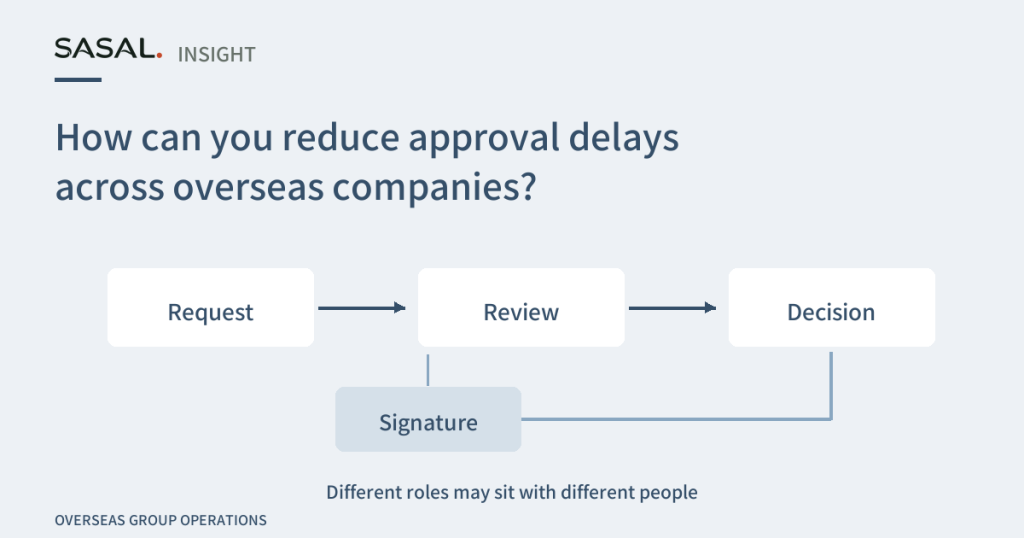
A request that appears to be trapped in approval can be delayed for several different reasons. Authority may be unclear, supporting information may be incomplete, reviews may repeat the same question, a required signature may be waiting on availability, or the result may not have been communicated to the people who need to act. Changing the authority table before identifying the actual source of delay can create new risks while leaving the bottleneck untouched. A more reliable approach is to follow one recent request from submission through review, decision, signature and communication, recording who acted, when they acted, what information changed and what business deadline the request was trying to meet. That record provides evidence for deciding which part of the route should change.
Follow one request from submission to execution
Start with a single recent request that travelled through the existing process. Record the submission date, the business objective, the requested decision, the affected company or companies, the requested completion date and the consequence of missing that date. The purpose is to reconstruct what actually happened rather than relying on participants' recollections. A request that remained open for ten calendar days is not automatically evidence of approval delay. The business may have required additional facts, the requesting team may have revised the proposal, or an external dependency may have prevented execution even after approval. Distinguishing these events prevents the organization from treating all elapsed time as governance friction.
The reconstruction should follow the request through each observable stage. Record when the request was first submitted, when clarification questions were raised, when revised information was provided, when reviewers responded, when a decision was made, whether a signature was required, when that signature was completed and when the result was communicated to the people responsible for execution. If a request moved between headquarters and an overseas company, record each transfer rather than collapsing the history into a single approval date. Time-zone differences, meeting schedules and handoffs between entities can affect elapsed time without changing who ultimately decides.
A useful record includes both dates and content changes. For example, a hypothetical request to approve a new internal support arrangement may initially contain a budget estimate but omit capacity implications for the receiving company. If reviewers request capacity information and the submitting team provides it three days later, those three days belong to information development rather than approval waiting. Without that distinction, management may conclude that reviewers are slow when the actual issue is that requests arrive incomplete.
Responsibility should remain visible throughout the timeline. Each step should identify the person performing the work and the person accountable for moving the request forward. Where roles are combined, the record should still show which responsibility was exercised at each point. This becomes particularly important in smaller overseas entities where one manager may review, decide and communicate outcomes. The same individual can perform several functions, but the functions themselves should still be distinguished to reveal where work accumulates.
The business deadline also deserves separate treatment. Some requests become urgent because they were submitted close to the desired execution date. Others encounter genuine processing delays despite early submission. Recording both the requested deadline and the actual timeline allows management to identify whether the process itself is creating delay or whether planning assumptions need adjustment. A route change is more likely to succeed when it addresses the specific source of waiting revealed by the reconstructed request rather than a general perception that approvals take too long.
- Submit requestState the decision sought, affected entities, evidence and business deadline.
- Check completenessIdentify missing information and return only specific clarification questions.
- Review and decideSpecialists assess defined issues and the authorized decision-maker records an outcome.
- Signature and communicationComplete any required signing step and communicate status, conditions and next action.
Distinguish a decision, a review, a signature and a notification

Check what each step labelled “approval” actually does before counting the number of approval stages. A reviewer may be checking a defined issue, such as financial capacity or operational feasibility. A decision-maker may be choosing whether the organization will proceed. An authorized signatory may be completing a formal execution step. Another person may simply need to be informed of the result. Treating all four activities as interchangeable obscures where authority actually sits and where waiting occurs.
A review should have a defined purpose. If a finance reviewer is expected to assess affordability and budget alignment, the review record should identify those questions. If a legal or specialist reviewer is asked to assess contractual or technical matters, that scope should also be explicit. Problems arise when reviewers begin making decisions that belong elsewhere or when decision-makers repeat detailed specialist analysis that has already been completed. Clarifying the expected contribution of each participant helps preserve challenge while reducing unnecessary circulation.
Decision authority requires separate identification. The person who decides whether a commitment should proceed may not be the person who reviews specialist issues or signs final documentation. In a hypothetical group structure, a subsidiary manager may decide that a proposal should proceed within an approved mandate, while an authorized signatory completes a required execution step. In another situation, headquarters may retain the decision while a local executive signs implementation documents. The workflow should reflect actual responsibilities rather than assumptions based on job titles.
Notification is frequently overlooked even though execution depends on it. A request may be approved, yet the operational team may not receive a clear statement of the outcome, any conditions attached to it or the next required action. An effective record identifies who receives the result, what status was assigned and who owns the next step. Without that clarity, people continue seeking confirmation even after a valid decision exists.
A practical test is to review one completed request and assign every participant to one or more of four categories: reviewer, decision-maker, signatory or recipient of the result. If several participants appear in categories that do not match their intended authority, the organization has evidence of role confusion. That evidence supports targeted changes such as narrowing review scope, clarifying decision ownership or improving communication, rather than automatically escalating or decentralizing authority.
Locate the waiting time before changing the authority table
Moving approval authority closer to local operations is one option to consider. That may be appropriate in some situations, but the first task is to determine where waiting actually occurs. Trace active work separately from idle time. Record how long people spend reviewing information, how long requests wait in queues, how long they sit pending clarification and how long they remain inactive because a required participant is unavailable. Different causes require different responses.
Missing information is one common source of delay. A request may lack supporting evidence, omit alternatives considered, fail to identify the affected company or leave the desired decision unclear. In those situations, reducing approval levels may not improve speed because the next decision-maker will need the same information. A useful diagnostic is to count how many times a request returns to the submitter for clarification and which information fields are most frequently missing.
Queues create a different pattern. Requests arrive complete but accumulate because a reviewer or decision-maker is handling multiple responsibilities. Absence creates another pattern in which progress stops despite adequate information. Meeting-dependent processes produce visible gaps between readiness and discussion dates. Inconsistent criteria create rework because participants apply different standards at different stages. Each pattern suggests a different operational response, and none can be diagnosed reliably from elapsed time alone.
Before changing authority levels, compare the observed bottleneck with existing governance requirements. Some matters may already be delegated locally, while others may be reserved to a board, a specified authority holder or an authorized signatory. Entity rules, budget limits, contractual conditions and related governance arrangements may affect which routes can change. Questions about those requirements should be reviewed with appropriate specialists before a revised mandate is adopted. Accelerating workflow does not create authority that does not already exist.
A practical analysis compares active effort against waiting. If reviewers spend a short period assessing requests but the file spends much longer awaiting meetings, availability or clarification, changing approval thresholds may not address the dominant cause. Conversely, if multiple levels repeat substantially the same assessment, there may be evidence for simplifying the route while preserving necessary challenge and accountability.
- Information gapThe request lacks evidence or a clear decision request and returns for clarification.
- QueueThe request is complete but waits for reviewer or decision-maker capacity.
- Unclear mandateParticipants are uncertain who has authority and delay action while seeking confirmation.
- Duplicate reviewSeveral stages revisit the same question without a distinct responsibility.
Check the existing mandate before creating a faster route
A long approval route can create pressure to delegate decisions more widely, yet the first question is whether the existing mandate already permits the desired action. A request can wait because participants do not know the existing mandate, even where authority has already been delegated. Before proposing a new route, collect the current delegation records, any board-reserved matters, authorized signatory lists, budget authorities and any conditions attached to recurring commitments. The objective is to establish which decisions already belong to local management, which require head-office involvement and which are reserved to a specific governance body. A route cannot be accelerated responsibly if the organization has not first identified the authority it is trying to exercise.
Entity boundaries deserve particular attention. A manager may supervise activities across several companies while only holding authority in one legal entity. A request affecting multiple companies can therefore require several decisions even when the commercial objective appears unified. For example, a hypothetical shared-services arrangement might involve spending by one subsidiary, personnel commitments by another and oversight by a parent company. If the workflow treats the matter as a single approval, participants may wait for authority that no individual actually possesses. Mapping each decision to the relevant entity helps explain apparent delays that are in fact governance requirements.
Authorized signatories should also be examined separately from decision-makers. Some organizations discover that a proposal has already been approved in principle but remains pending because nobody confirmed who is permitted to execute the resulting documents. In such cases, shortening review stages may have little effect. A useful record entry identifies the decision date, the responsible decision-maker, any required signatories, the expected execution document and the conditions that must be satisfied before signing. This allows teams to distinguish an unfinished decision from an unfinished execution step.
Budget limits frequently create confusion because people use them as a substitute for authority analysis. An approved budget may support a proposed action, but that does not automatically determine who can authorize the commitment. Conversely, a commitment may fall below a spending threshold while still triggering another governance requirement because of its duration, strategic significance or contractual structure. Reviewing budget authority together with other mandate conditions prevents false assumptions that a lower-value item is automatically eligible for local approval.
When uncertainty remains, specialist questions should be resolved before changing the mandate. Contractual conditions, signing requirements and entity-specific governance arrangements can vary. The practical outcome is a documented authority map showing the decision type, approving role, escalation conditions and required records. Once that map exists, management can assess whether waiting time is being caused by the mandate itself or by uncertainty about how the existing mandate should be applied.
Use risk and reversibility alongside financial thresholds
Financial thresholds are often the first tool considered when redesigning approval routes because they are easy to explain and record. However, the amount involved rarely captures the full risk of a decision. Two requests with the same monetary value can create very different consequences. One may be reversible within days if circumstances change, while another may establish a long-term obligation that is difficult or costly to unwind. Approval design becomes more informative when financial value is assessed alongside risk characteristics and reversibility.
Duration is one factor that can change the approval requirement even when spending remains modest. A recurring commitment extending over several years may create obligations that exceed the significance suggested by a single payment. Similarly, related commitments should be viewed together rather than in isolation. A series of individually small requests can represent one broader initiative. If each request is assessed independently, the organization may underestimate the total exposure being created. A review record can therefore include fields for related commitments, expected duration and recurring obligations rather than relying exclusively on a monetary amount.
Non-financial consequences also deserve attention. A decision may affect staffing capacity, customer commitments, operational resilience, intellectual property, brand positioning or another strategic consideration. These effects do not automatically require centralized approval, but they provide information that financial thresholds alone cannot capture. A local manager may be fully capable of approving a reversible expenditure while preferring escalation for a decision that changes delivery commitments across several locations. The relevant distinction is the nature of the commitment, not simply its cost.
A worked hypothetical example illustrates the difference. Consider two requests with similar expenditure. The first concerns a short-term specialist engagement that can be ended according to agreed terms if priorities change. The second concerns a new contractual commitment requiring continuing service obligations across multiple entities. Although the financial value may be comparable, the second request creates longer-term dependencies and coordination demands. Management could reasonably conclude that the first falls within delegated authority while the second requires additional review. The reasoning is visible and can be recorded for future consistency.
Reversibility provides a practical test when approval levels are being reconsidered. Ask what would be required to reverse the decision if assumptions prove incorrect. If the answer involves limited operational disruption and clearly bounded commitments, wider delegation may be appropriate. If reversal would affect multiple entities, ongoing obligations or significant stakeholder relationships, additional scrutiny may remain justified even at relatively modest spending levels.
When a request contains several related commitments, identify which decision the threshold is intended to control. Splitting one planned commitment into smaller submissions does not make its aggregate consequences disappear. Conversely, unrelated purchases should not be grouped merely because their requests arrive together. The policy owner needs a defined basis for recognizing related work, and submitters need examples showing when to disclose the connection. Record the rationale so the next reviewer can assess scope without guessing from the payment amount.
Define the minimum complete request
Approval speed is strongly influenced by the quality of information arriving at the first reviewer or decision-maker. A request that lacks essential information typically generates clarification cycles, rework and waiting time. The objective is not to collect every possible detail. Instead, define the minimum information required for a responsible decision. This creates a shared standard for submitters and recipients while avoiding unnecessary documentation burdens.
A practical request record identifies the decision being sought in explicit terms. Recipients should not need to infer whether the submitter wants approval, advice, confirmation of authority or escalation. The record can also identify the affected company or companies, the business deadline, the proposed action and the person responsible for implementation if approval is granted. These elements allow the recipient to understand the operational consequence of the decision rather than reviewing disconnected information.
Supporting evidence should be tied directly to the decision. Evidence may include demand forecasts, capacity assessments, budget references, risk considerations or specialist opinions, depending on the subject. However, information should be included because it informs the decision, not because it appears on a historical template. Some approval forms accumulate fields over time that are rarely used. Reviewing requests that required no clarification can help identify which information genuinely contributes to decision quality and which fields mainly create preparation effort.
Alternatives deserve a place in the minimum package because they reveal whether the submitter has considered realistic options. A concise statement such as 'proceed now', 'defer until capacity is available' or 'use an existing arrangement' can improve decision quality without generating lengthy reports. In a hypothetical example, a manager requesting additional headcount might include two alternatives: redistributing work internally or delaying a project. Even if those options are rejected, their consideration helps decision-makers understand the tradeoffs involved.
A minimum request can still be proportionate to the issue. In the hypothetical headcount proposal, the reviewer needs to know which work remains unstaffed and what would happen if the role is not filled. A full market study would add little if the question concerns replacing an established role whose responsibilities are unchanged. Where the proposal introduces a new function, further information may be justified. Ask the decision owner to identify what could change the answer before adding another required field to every submission.
Once a minimum complete request has been defined, organizations can test it against recent submissions. If most delays occur after complete requests are received, attention should shift toward review capacity, authority or workflow design. If delays arise before a complete package reaches decision-makers, the request standard may need refinement. The value of the exercise lies in creating a shared understanding of what constitutes a decision-ready request while resisting the tendency to demand information that does not affect the decision being made.
Remove duplicated review without removing necessary challenge
Repeated review becomes visible when a request receives the same questions from multiple functions after those questions have already been answered. The first step is to identify the distinct decision contribution expected from each participant. A finance reviewer may assess affordability and budget implications. An operations reviewer may assess delivery capacity. A legal or specialist reviewer may assess a defined technical or contractual issue. If a later participant repeats the same assessment without a different responsibility, the organization should record the duplication and determine whether it adds value or merely extends waiting time.
A useful analysis starts with one completed request. List every review stage, the question assigned to that stage, the information consulted and the output produced. If two reviewers produce substantially the same conclusion from the same evidence, management has a basis for redesign. By contrast, similar conclusions reached from different responsibilities may remain necessary. Two functions can support the same recommendation while examining different risks. The goal is to remove redundant activity, not independent challenge.
Consider a hypothetical internal proposal affecting several group companies. Operations confirms that staff capacity exists. Finance confirms that the commitment fits approved budgets. A senior manager then requests another operations assessment because the proposal appears significant. If the second operations review does not introduce a new criterion, the workflow may be creating delay without improving the decision. A better record could state that the senior manager reviews the operational conclusion and either accepts it or requests investigation of a specific unresolved question. The challenge remains, but the work is not repeated blindly.
Accountability should stay attached to the original reviewer. Eliminating duplication does not mean transferring specialist responsibility to a decision-maker. If a technical review is required, the technical reviewer should still record the assessment. The decision-maker then decides whether to proceed in light of that assessment and other considerations. When removing a review stage, document the duplicate activity being removed and where each necessary responsibility remains. This prevents later confusion about who is expected to answer specialist questions.
One practical test is to compare review comments across several requests. If comments repeatedly restate earlier conclusions without requesting new evidence, there may be an opportunity to streamline the route. If comments routinely identify issues that earlier reviewers could not reasonably have assessed, the additional review is serving a distinct purpose. The distinction should be based on observable records rather than assumptions about hierarchy.
Changes should be documented with the same care as authority decisions. A revised workflow record might state: operations review completed, finance review completed, decision-maker responsible for final approval, no second operational review unless capacity assumptions materially change. Such wording preserves scrutiny while reducing avoidable circulation. The result is a route where each participant answers a defined question and where challenge remains available when new information justifies it.
Give each response a status and a next step

An unclear request status leaves participants uncertain about whether to act, wait or provide more information. A message asking for a small clarification can be interpreted as a rejection, a pending review or a conditional approval. To reduce uncertainty, every response should assign a defined status and identify the next action. The status does not need to be complex, but it should be consistent across entities and functions.
A proposed status structure can distinguish approved, conditionally approved, more evidence required, declined and escalated. Record approval only when the authorized decision-maker has made the relevant decision. Separate that status from readiness to execute: a signature, another entity’s approval or a specified implementation step may still be required. A conditional approval must state the conditions and whether any action is permitted before they are met. A request for evidence is not a decision, and escalation should identify the authority or forum that will decide next. Define what closes a declined request and what would require a new submission.
The next step should always have an owner. A response requesting evidence should specify exactly what evidence is needed and who must provide it. A conditional approval should identify who verifies that the condition has been satisfied. Without named ownership, requests can remain in circulation while participants assume somebody else is acting. A simple record entry such as 'capacity forecast required from subsidiary operations manager by Friday' is more useful than a general statement that further information is needed.
Hypothetically, consider a hiring request within a group company. The authorized decision-maker agrees that additional capacity is justified and, where their mandate permits, approves subject to confirmation of reporting responsibility before implementation. Recording the authorized outcome as conditionally approved identifies the decision and the issue that remains open. If only a reviewer has recommended approval, retain that as a recommendation instead. If the same response were sent as an informal comment, the requesting team might incorrectly believe that approval is still being debated. Clear status labels reduce unnecessary follow-up and duplicate discussions.
Escalation deserves special attention because it is frequently used without explanation. If a request is escalated, the record should identify why existing authority is insufficient, who will decide next and what information accompanies the escalation. This allows the submitter to distinguish a governance requirement from simple inactivity. Escalation also creates a visible handoff that can later be analyzed when reviewing workflow performance.
Do not read silence as approval unless a valid, expressly agreed rule establishes that outcome for the specific decision category. A colleague covering an absence should see the recorded status, owner and next action rather than infer them from unanswered messages. For later review, separate requests awaiting evidence from those awaiting an authorized decision, and note how long each remained in that state. A high number of evidence requests points to a submission question to investigate; prolonged waiting after the required evidence is complete points elsewhere. Check the underlying cases before changing the workflow: a status count identifies a pattern, not its cause.
Prepare cover for absence and urgent decisions
If a route stops when one reviewer, decision-maker or signatory is absent, identify which responsibility lacks cover. Agree qualified delegates, bounded temporary authority and emergency contacts before the absence occurs. The required arrangement depends on the role: finding another person to communicate a decision is different from authorizing that person to make it.
The first step is to identify which responsibilities require cover. Review authority, decision authority, signing authority and communication responsibility may belong to different people. Each role should have a documented alternative where appropriate. A delegate should understand the relevant criteria, records and escalation conditions. Merely naming a replacement is insufficient if the replacement lacks access to the information needed to act.
Temporary delegation should be bounded. A delegate may be authorized to decide routine matters within an existing mandate while referring unusual commitments to the original authority holder or a higher forum. The record should specify the effective period, scope and any exclusions. This prevents emergency arrangements from unintentionally changing the organization's governance structure.
Urgent requests require particular discipline because urgency can create pressure to bypass established authority. A request may need faster communication channels, an emergency meeting or direct contact between headquarters and the affected company. However, urgency alone does not create authority. If a commitment requires approval from a designated role, the organization still needs a valid route to that role or to an authorized delegate. Treating urgency as a substitute for authority can create confusion about accountability after the event.
A useful operational record includes the request, reason for urgency, participants contacted, decision reached, authority relied upon and any follow-up review required. For example, a hypothetical operational interruption might require rapid approval of temporary support arrangements. The organization could activate an emergency contact route, obtain a decision from an authorized delegate and record the rationale. The speed comes from preparation and clarity, not from suspending governance requirements. Absence planning also benefits from shared records. When responsibilities are documented consistently, another qualified person can see what has already been reviewed, what remains unresolved and which deadlines matter. This reduces dependence on individual memory and supports continuity across locations and time zones.
Organizations should test these arrangements using real requests that resemble normal work. Compare outcomes before and after introducing delegated cover. If waiting time decreases while decision reversals and missed checks remain stable, the arrangement may be functioning as intended. If urgent requests still stall, the analysis should determine whether the obstacle is authority, information availability, communication routes or workload concentration.
Test a revised route on matched requests
A revised approval route should be tested against requests that are genuinely comparable. If one period contains routine staffing decisions and another contains new multi-entity commitments, elapsed time differences reveal little about the workflow itself. Create a test set using requests with similar scope, affected entities, information requirements and decision consequences. For each request, record the submission date, first-time completeness, clarification cycles, active review time, waiting time, final decision date and any later resubmission. The purpose is to determine whether the revised route changes how work moves rather than simply benefiting from an easier request mix.
A hypothetical comparison illustrates the need for matching. Consider a delegated hiring request within an existing budget and an established reporting structure. The revised route may allow the local company to obtain a decision after a defined review and local approval. Now compare that with a proposed contractual commitment creating continuing obligations across several companies. Even if the monetary value is similar, the second request may require additional specialist review, signatory checks or entity-level approvals. Measuring both requests as though they belong to the same category could incorrectly suggest that the revised route failed. The more useful question is whether each category now reaches the appropriate decision point with less avoidable waiting.
The test record should also distinguish delays caused by missing information from delays caused by the route itself. For example, if five requests in a hypothetical trial still require repeated clarification about affected entities or alternatives considered, the authority path may not be the primary issue. A practical log can include fields such as decision sought, completeness at first submission, clarification requests, reviewer comments, status changes and execution date. Reviewing these records often reveals whether a revised route is reducing queue time while leaving submission quality unchanged.
Decision quality must remain visible during the trial. Record whether approvals are later reversed, whether conditions were misunderstood and whether specialist concerns emerge after implementation. A faster route that increases rework may simply relocate effort rather than reduce it. Equally, a route that produces the same decisions with fewer handoffs may justify wider use. The assessment should therefore examine waiting time, rework and decision outcomes together before extending the revised workflow to additional request categories.
Explain the change to people submitting and receiving work
Even a well-designed approval route can create confusion if participants receive only an updated authority table. People preparing requests need to understand what information is required, how decisions are classified and where branch points occur. People receiving requests need to understand the limits of their review role, escalation conditions and expected response format. The communication task is therefore operational rather than administrative. The objective is to help participants apply the route consistently to real requests.
Examples are often more effective than abstract descriptions. A guidance note might show how a routine hiring request differs from a request involving a new recurring commitment, identifying who reviews, who decides and what records are required at each stage. Another example might illustrate conditional approval by showing the exact wording of a decision that permits progress once a defined requirement is satisfied. These worked examples allow staff in different locations to compare their interpretation against a concrete case rather than relying on assumptions.
Direct discussion also helps reveal ambiguities before they become delays. When headquarters and local companies review the revised route together, participants can identify situations that do not fit neatly into a category. A manager may ask how to handle a request affecting two entities with different budget owners. A reviewer may question whether a recurring commitment should be grouped with similar existing arrangements. These questions expose practical decision points that may not be obvious from written guidance alone.
Language deserves attention in multinational groups. Terms such as review, approval, endorsement, signature and notification can be interpreted differently by different teams. A shared glossary linked to the workflow record helps reduce inconsistent application. The same approach can be used for status labels such as approved, conditionally approved, more evidence required, declined and escalated. Consistent terminology allows another person to understand the state of a request without reconstructing prior conversations.
After implementation, collect examples of requests that followed the new route successfully and examples that generated uncertainty. Those observations provide evidence for refining instructions. If the same misunderstanding appears repeatedly, the route description, examples or request template may need adjustment. The communication process therefore continues beyond the initial announcement and becomes part of maintaining a usable approval workflow.
Review speed together with decision quality
Elapsed approval time is an important measure, but it does not provide a complete view of performance. A route may become faster because reviewers spend less time examining requests, because information requirements were reduced or because challenge was removed. Those changes may be appropriate in some situations and harmful in others. To evaluate the revised workflow, review speed alongside indicators showing whether decisions remain understandable, supportable and suitable for execution.
One useful measure is first-time completeness. If more requests arrive with the required evidence, fewer clarification cycles should occur. Another measure is the rate of resubmission. Frequent resubmissions may indicate unclear criteria, incomplete requests or decisions that participants could not implement as originally approved. Decision reversals provide another signal. A reversal does not automatically mean that the original decision was wrong, but a pattern of avoidable reversals may suggest that important information is not reaching decision-makers at the right stage.
Local workload should also be examined. A route that reduces waiting at headquarters by transferring extensive preparation or review work to overseas companies may change where effort occurs rather than reducing it. Review records can therefore include the number of review stages, the people involved, clarification requests and the time spent preparing decision-ready submissions. This helps management understand whether the workflow is becoming simpler overall or merely redistributing work between locations.
Missed controls deserve explicit review. If specialist questions are being overlooked, signatory requirements are being discovered late or entity-specific conditions are repeatedly missed, the organization may need to reinstate a check or clarify responsibilities. The goal is not to maximize the number of reviews but to ensure that each required review answers a defined question. Observing where missed checks occur provides evidence for targeted adjustments rather than a return to a slower process.
Include requests still open at the end of the review period. Looking only at completed approvals can make a route appear quicker if difficult cases are left waiting outside the measure. Show their current age and status separately, using the same start point before and after the change. Compare similar request categories and distinguish a pause requested by the submitter from a queue awaiting review. With completeness, active effort, waiting, outcomes and workload visible, the owner can choose the next adjustment for a specific remaining problem instead of attributing every delay to authority.