

Who owns the work? Building a usable vendor work register
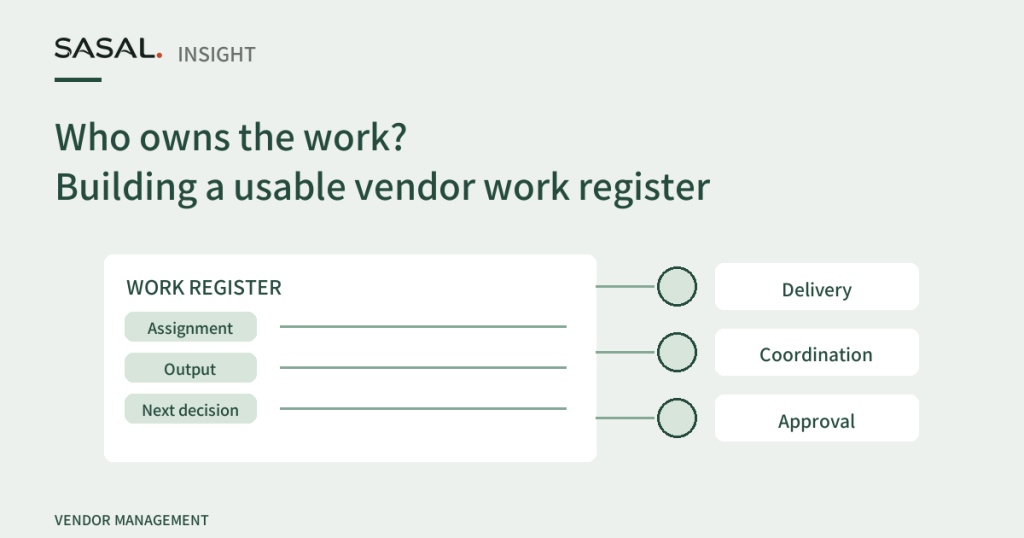
A manager preparing for a customer decision needs to know which external output is due, who will check it and what remains unresolved. The vendor master identifies suppliers; the contract folder records agreed obligations; the invoice ledger tracks charges. Those records may still leave the current assignment difficult to follow. A vendor work register connects them around a piece of work with an identifiable recipient and next action. It can support a management handover while the existing providers continue delivering their assignments. The design problem is deciding how much detail makes the work traceable without creating another record that nobody maintains. That requires careful choices about the unit of work, the evidence behind each entry and the person responsible for keeping it current.
A provider list cannot explain the work in progress
Consider a hypothetical manager preparing for an upcoming customer decision. The manager is asked which provider output must arrive before that decision can be made. The vendor master can identify approved suppliers and contact details. The contract repository can show negotiated terms, scope descriptions and renewal dates. The invoice ledger can confirm what has been billed and paid. Each record is useful, but each answers a different question. None necessarily reveals the current assignment that is moving toward the customer decision, the latest output already delivered, or the next action waiting on that output.
The operational question is narrower and more immediate: what specific piece of work is currently in motion, who receives it, and what decision changes when it is completed? A provider list groups activity by supplier. Actual operations often cut across that structure. One provider may deliver several unrelated assignments, while a single business process may depend on outputs from multiple providers. Following work through supplier names alone makes it difficult to understand dependencies, priorities and handover requirements.
A work register therefore begins with a traceable work item rather than a provider record. The work item should correspond to a recurring assignment or deliverable that another authorized person can recognize and follow. It becomes the reference point connecting the contracting entity, operational contacts, internal owner, recipient, current output and next decision. Instead of asking which vendor is involved, the register first asks which assignment is being advanced and what evidence shows its current state.
For the opening example, the manager needs a chain of evidence rather than another assurance that the provider is working on it. The current request establishes what was asked for. A dated output or progress record shows what exists. The recipient can confirm whether it is usable for the decision, while an unresolved-issue entry explains what is missing. A mismatch does not by itself mean someone has misrepresented the work: an invoice may cover an earlier period, or a completed draft may still await the client's review. The register should preserve that distinction. A status such as submitted for internal review is more informative than complete when the business decision still depends on that review.
Choose the initial coverage around a decision that the business already needs to make. The manager could ask the operational owners to identify the assignments whose outputs are needed for the next agreed review, together with the evidence supporting each status. This creates a bounded first pass through the records. It also reveals assignments that were left out because they sit between purchasing categories or are coordinated informally. The first register need not describe every historical interaction. It should let the manager identify the relevant work, its current state and the person who can resolve the next question. Broader coverage can follow once those entries can be maintained.
Choose a work item that someone can hand over

The most important design choice is the level of detail represented by a work item. A useful register entry describes work that can be handed from one authorized person to another without requiring reconstruction of the assignment. A hypothetical example is a monthly distributor-review package prepared by an external provider and delivered to a regional commercial manager. The recurring deliverable has a defined recipient, a predictable cycle and a decision that depends on it. That makes it suitable as a primary work item.
Supporting activities can be linked beneath that item without becoming separate register entries. Data gathering from distributors and verification of submitted figures may be tracked as related tasks when they contribute to the same deliverable and share the same recipient and approval path. Separating every supporting step into an independent record would create unnecessary fragmentation and make operational review harder rather than easier.
The opposite problem appears when a register entry becomes too broad. A row labelled regional support may include reporting, customer communication, market monitoring and issue escalation. Different recipients may rely on different outputs, and decisions may occur at different times. In that situation the record no longer describes a handover-ready assignment. Splitting the work into distinct deliverables creates clearer accountability and allows progress to be evaluated against identifiable outputs.
Excessive granularity causes different difficulties. A register that records individual emails, routine reminders or minor status exchanges can become impossible to maintain. Communication is evidence of work, not necessarily the work item itself. If multiple messages contribute to one recurring deliverable, the deliverable usually remains the better register unit. The goal is operational traceability, not communication archiving.
A practical test is whether another authorized person could follow the assignment, locate the latest output, identify the recipient and understand the current decision without interviewing the original owner. If the answer is no because the record is too broad, split it. If the answer is no because hundreds of tiny entries must be reconstructed into a meaningful assignment, merge or link them under a larger work item. The register becomes usable when each entry corresponds to work that someone can realistically receive, review and continue.
A recurring assignment also needs a way to distinguish the standing requirement from its current occurrence. In the distributor-review example, a parent entry can describe the agreed monthly package, usual recipient and governing contract. A linked current-period entry can point to this month's submitted report, outstanding verification and decision date. Otherwise, a completed report from the preceding month can make the recurring assignment appear current when the new period has not been delivered. Carry forward unresolved matters explicitly: a disputed inventory definition may remain open even after one monthly report is accepted for a limited purpose. This structure preserves continuity without requiring a new copy of the whole contract and role description every month.
Reconcile the contracting entity, invoice issuer and delivery contact
Once a work item has been defined, the next challenge is identifying who is actually connected to it. A contract may be signed with one legal entity, invoices may be issued by another entity within the same corporate group, and operational communication may occur through a specific delivery contact. Treating those references as interchangeable can create confusion during audits, renewals, approvals and handovers. The register should therefore contain separate fields for contracting entity, invoice issuer and operational contact rather than assuming they are always identical.
A hypothetical example illustrates the distinction. An agreement may identify Company A Ltd. as the contracting party. A purchase order references the same agreement. Recent invoices, however, arrive from Company B Services Ltd., while daily coordination occurs through an account manager employed by Company C in the same group. The brand name used in presentations may be shared across all three entities. Operationally, the work may still be proceeding correctly, but the register should record each reference exactly as observed rather than normalizing them into a single name.
The next step is reconciliation. Existing records are compared against one another. The agreement identifies the legal counterparty. The purchase order shows what was authorized for procurement. The invoice identifies who is requesting payment. Contact records identify who coordinates delivery. If the relationships between those records are documented and supported, the register can show the explanation. If the explanation is not yet confirmed, the difference remains visible as an open question.
Not every discrepancy indicates a problem. Some organizations legitimately centralize billing, reorganize legal entities or use shared service structures. Those explanations still require confirmation from the appropriate parties. Recording an assumption as established fact creates future risk because a later reviewer may rely on an interpretation that was never validated. The register should distinguish confirmed information from pending verification.
Responsibility for resolution should also be explicit. An internal procurement manager may be assigned to verify invoicing arrangements. Legal or contract administration personnel may confirm the contracting entity. The operational owner may confirm the delivery contact. Each question therefore has a named resolver and a status rather than remaining an informal observation.
Keep the reconciliation result usable by recording the evidence and its effective period. An explanation that Company B now handles billing may apply only after a documented change, while older invoices still belong to Company A. The register can link the confirmation and distinguish the periods rather than overwriting the history. Similarly, the account manager's contact details establish a communication route, not necessarily the person's employer or authority to change terms. Mark those facts separately if they matter to the assignment. When an explanation remains unverified, name the question and the person obtaining confirmation; do not present an unqualified relationship diagram that later users could mistake for an approved contracting arrangement.
Compare the contract with what people actually request
A work register becomes more reliable when it records both the agreed scope and the work that can be observed in current operations. Consider a hypothetical assignment in which a provider supplies a recurring monthly market report. The contract describes the report, identifies the recipient and establishes the commercial arrangement. Several months later, internal emails show a request for a new competitor analysis that was not previously listed in the agreed deliverables. The register should not immediately treat the additional analysis as either authorized scope or unauthorized work. Instead, it records the observed request, links the relevant documents and shows the relationship between the original assignment and the newly requested activity.
The distinction matters because several explanations may be possible. The new analysis may already fit within a broadly written statement of work. It may be a one-time accommodation provided without changing the underlying agreement. It may represent a recurring service that operational teams have started relying on even though the contract was never updated. Each possibility has different implications for budgeting, performance review, renewal discussions and future handover. The register therefore documents what has been requested and delivered before attempting to classify the request as contractually settled.
Neutral wording helps prevent the register from becoming an unofficial amendment process. Rather than stating that the provider's scope has expanded, the entry can state that recent requests include a competitor analysis not yet reconciled against the current agreement. The documentary basis may include the contract version, the request email, a meeting note and the delivered analysis. The operational owner can be identified as responsible for confirming whether the activity belongs within existing scope, requires a change order or remains an exceptional request. The wording describes observable facts and assigned follow-up actions rather than legal conclusions.
This approach also preserves a useful boundary between operational administration and contractual authority. A coordinator may gather evidence, summarize differences and prepare a recommendation. The coordinator can show that recurring requests differ from documented scope and can identify the decision owner who must review the issue. The coordinator does not convert repeated practice into approved scope simply because the work has been occurring. Contractual amendment remains a separate process involving the appropriate authority and records.
An open question should identify its effect on the next action. In the example, the original monthly report may still be due under the existing instructions while the proposed analysis needs clarification. Record the two positions separately and ask the authorized owner to confirm the appropriate course. A single scope pending label could otherwise hide work that remains agreed or imply that disputed additional work has been approved. Before a renewal or handover, review unresolved items with their evidence and responsible people so that the next manager can distinguish known commitments from questions still awaiting a decision.
- Work IDThe assignment being tracked, with recipient, owner and current decision.
- ContractAgreed scope, parties and formal obligations associated with the assignment.
- Request and OutputRecent instructions and delivered work showing current operational activity.
- InvoiceBilling records linked to the assignment and reviewed against observed work.
Separate execution, coordination, checking and approval
Role clarity is easiest to understand when applied to one live assignment. Apply it to the hypothetical monthly market report requested by a business unit. The requester identifies the need and supplies background information. A provider analyst prepares the agreed analysis. A receiving reviewer examines the output for operational suitability. A coordinator tracks status, gathers records and follows dependencies. An authorized decision-maker approves changes that affect spending, commitments or business direction. The register distinguishes these roles even when communication flows through a single contact.
The operating arrangement should assign authority explicitly rather than infer it from frequent communication. A coordinator may speak with the provider every day, maintain schedules and circulate updates. Those activities support progress, but they do not transfer approval rights from the person designated to make management decisions. If a change requires additional spending or alters an agreed objective, the register should identify the decision-maker whose authorization is required. Otherwise later reviewers may incorrectly assume that operational discussions constituted approval.
Specialist judgment should remain visible as well. In assignments involving legal, tax, engineering or regulatory analysis, the register benefits from identifying who supplied the substantive judgment. The coordinator may summarize recommendations and connect them to business decisions, but the source of the specialist conclusion remains attributable. This improves accountability and helps future reviewers understand which conclusions came from qualified expertise and which came from operational coordination.
Where a smaller team combines roles, the register should reflect that arrangement instead of forcing artificial separation. One individual may act as requester and receiving reviewer, or a department head may also serve as the authorized approver. The record remains useful as long as the combined responsibilities are explicit. Clarity comes from documenting who currently performs each function, not from requiring a fixed organizational structure.
Temporary cover arrangements deserve similar attention. If a reviewer is absent, another authorized person may receive outputs for a defined period. Recording that substitution prevents confusion when delivery confirmations, comments and approvals appear under different names. The register can show the effective dates of the temporary arrangement and the person responsible for restoring normal ownership when the absence ends.
A missing approval owner should be treated as an operational issue rather than hidden by convenience. If work continues but no authorized decision-maker has been identified for scope changes or spending decisions, the register should flag the gap. The coordinator can continue collecting information and preparing recommendations, yet the unresolved authority question remains visible until management assigns responsibility. That record protects continuity during handover and reduces the risk that important decisions become attached to informal communication patterns.
Connect each output to its location and permitted use
A work register should help people find outputs without becoming a repository for confidential material. An effective entry therefore points to the approved output, the working version, the record owner and the process for obtaining access. The register acts as a map rather than a storage location. Someone reviewing an assignment can identify where the relevant files reside, who maintains them and which version is considered authoritative for operational use.
The distinction between approved and working material is important during handover. A draft spreadsheet, collaborative document or working file may contain assumptions that are still under discussion. The approved output represents the version that recipients are expected to rely upon. Linking both references helps future reviewers understand how the work evolved while avoiding confusion about which version currently supports decisions. Dates, authors and open questions provide additional context when multiple revisions exist.
An outdated link creates a different problem from a missing output. A register entry may reference a shared folder that has been reorganized, a document management system that changed structure or a file path that no longer exists. Rather than replacing the broken reference with an assumption, the register should identify the issue, note the last verified location and assign an owner to restore traceability. Maintaining the history of the problem can be useful because it shows whether the output itself is missing or only the reference mechanism requires correction.
A file can also exist without sufficient context to use it. A presentation may be available, yet reviewers cannot determine who prepared it, which request it answered or whether a newer version superseded it. In that case the register can flag missing metadata and identify the person responsible for confirming status. The objective is not to perfect every historical record immediately but to make uncertainty visible so future users know what remains unresolved.
Rights and permitted use require separate attention. Some outputs may be delivered under terms that allow internal use but do not grant editing rights, redistribution rights or unrestricted reuse. A company may possess a final report while lacking permission to modify the underlying source file. The register should note the relevant usage position and point reviewers to the governing agreement or record. Doing so helps prevent assumptions that possession of a file automatically includes every possible right associated with it.
Keep the uncertainty attached to the resource and its intended use. If the current location is verified but editing rights are unclear, the register can distinguish those facts instead of marking everything unavailable or everything cleared. The responsible owner then resolves the specific question through the relevant record or agreement. Identifying the gap does not grant access or authorize reuse. For handover, ask whether the incoming person can obtain the information needed for the agreed management role, and show any limitation that affects that task.
Find the next person waiting for the work
An assignment can appear complete from the provider side because a deliverable has been submitted. Operationally, however, the more useful question is who is waiting for that deliverable and what happens next. A work register becomes more informative when each item identifies the recipient of the output, the decision or activity that depends on it, and whether another person is currently blocked. This shifts attention from the act of delivery to the flow of work through the business. An assignment with no identifiable recipient is difficult to evaluate because it is unclear whether the output is being used, stored for reference or waiting for review.
A practical method is to trace one output forward rather than one provider backward. Consider a hypothetical report prepared by an external analyst. The report feeds two recipients. A regional sales manager uses it to prepare pricing recommendations before a monthly review meeting. A supply planning manager uses the same report to adjust forecasting assumptions later in the cycle. Both recipients depend on the same output, but their deadlines, review criteria and consequences differ. The register should record both dependencies because they represent distinct operational uses of the work.
Not every dependency deserves equal treatment. The register becomes difficult to maintain if every possible reader, observer or copied recipient is listed. Record only meaningful dependencies that affect ongoing work or decisions. In the hypothetical example, the sales manager cannot finalize a pricing recommendation until the report arrives, making the dependency material. A manager who merely receives a copy for background awareness does not necessarily need to appear as a dependency. The purpose is to identify where work would stall, not to recreate an email distribution list.
Tracing recipients also exposes unowned receipt points. A report may be delivered on schedule, yet nobody is explicitly responsible for confirming that it was received, reviewed and incorporated into the next action. In that situation the provider has evidence of submission, but the organization lacks a clear owner for operational acceptance. The register should identify the missing ownership rather than assigning one retrospectively without confirmation. A named review owner can then be designated through the appropriate management process.
Dependency mapping can reveal two different kinds of checking. One review may confirm technical accuracy, while another confirms suitability for business use. These checks serve different purposes and can both be legitimate. The register should distinguish them instead of treating the second review as duplication. The purpose is unclear when two people perform similar-looking reviews without a documented difference in objective. Recording the purpose of each check helps future reviewers understand why both exist.
The same analysis clarifies which activities can continue independently. The supply planning manager in the example may be able to proceed with inventory reconciliation while waiting for the report, whereas the pricing recommendation cannot move forward without the missing input. The register should identify the blocked decision rather than marking the entire department as waiting. That level of precision helps coordinators follow up on meaningful constraints while allowing unrelated work to continue. Detailed handoff procedures can be maintained elsewhere; the register's role is to show who is waiting, what they are waiting for and which decision changes once the work arrives.
Link renewal and payment dates to the relevant assignment
Dates become misleading when they are collected without context. A work register should connect renewal decisions, service periods, invoice cycles and contractual notice requirements to the specific agreement that governs the assignment. Simply recording a future date does not explain why the date matters, who must review it or what evidence supports it. Each date should remain attached to the underlying record so that future managers can understand its significance without relying on institutional memory.
Do not assume that operational activity, payment commitment and contract duration always end at the same time. They may not. A recurring assignment can stop because the business no longer requires the output, while a payment obligation continues through an agreed service period. Conversely, a renewal decision may be required months before work would otherwise stop. The register should therefore record the relationship between the assignment and the governing agreement rather than compressing several different dates into a single field.
A practical structure includes a verified date, the source of that date and a responsible reviewer. The verified date records the current understanding. The source identifies where that understanding came from, such as a signed agreement, purchase order, amendment or renewal notice. The reviewer field identifies the person responsible for confirming continued accuracy. Together, these fields help future users distinguish verified information from inherited assumptions.
Uncertainty should remain visible. Imagine a hypothetical assignment where invoices arrive monthly, but the team cannot immediately determine whether the service renews automatically, renews through a separate procurement process or expires unless renewed. Rather than filling the gap from memory or repeating an unverified statement from an email chain, the register should show that renewal terms remain under review. The reviewer can be assigned responsibility for obtaining confirmation from the relevant records or stakeholders.
The same principle applies to notice requirements. Contracts sometimes require action before a renewal decision becomes effective. The register can reference the existence of a notice requirement and the record containing it, but should not invent deadlines that have not been verified. Management gains a clearer picture when uncertainty is explicitly recorded than when unsupported dates create a false sense of certainty. Escalation becomes a defined activity rather than an emergency discovered shortly before a commitment changes.
Linking dates to assignments also improves operational prioritization. A renewal review becomes more meaningful when connected to the work item that depends on the agreement, the current output being delivered and the internal owner receiving that output. Reviewers can then evaluate whether the assignment is still required, whether the existing arrangement supports current needs and whether unresolved scope questions should be addressed before any renewal decision. The register remains an operational reference rather than a standalone contract calendar because every date points back to an identifiable assignment and documented source.
Test whether another person can follow one live item

To assess the register for handover, ask whether another authorized person can follow a live assignment without relying on the departing contact's memory. A practical test is a rehearsal using an active work item. The colleague performing the rehearsal should attempt to identify the current request, locate the latest usable output, understand any unresolved issue and determine the next authorized decision. Each step reveals whether the register contains enough information to support continuity.
The exercise should begin with the request itself. Can the colleague find the originating instruction, identify the recipient and understand the purpose of the assignment? If the answer requires searching multiple mailboxes or contacting the departing owner for basic context, the register has exposed a documentation gap. Identify the missing reference, ownership information or document link and assign its correction. Record whether the gap prevents handover of that assignment or can remain as a clearly accepted limitation.
The next step is locating the latest usable output. A failed lookup may reveal a specific problem. A register may reference a folder that no longer exists, a file name that changed or a location accessible only to the departing contact. In that situation the rehearsal has achieved something valuable: it has identified a specific record defect. The appropriate response is to repair the reference, confirm ownership and document access conditions. The issue becomes a concrete correction item rather than a subjective concern about readiness.
Status information deserves equal scrutiny. A colleague may discover contradictory records indicating that an assignment is simultaneously complete and awaiting review. One status may appear in a project tracker while another appears in recent correspondence. The register should not hide the contradiction by selecting one version without investigation. Instead, it should identify the discrepancy, assign responsibility for resolution and update the record once the current state is confirmed. The test succeeds when inconsistencies become visible and actionable.
Some failures reveal knowledge that has never been recorded. During a rehearsal, a colleague might ask why a recurring exception is accepted, why a particular reviewer is consulted before release or why one deliverable is routed through an alternate process. If only the departing contact can answer, the issue is not a lack of effort by the colleague. The register needs an additional note, reference or decision record that explains the exception and its current status. The objective is to capture operational knowledge in a form that remains usable after personnel changes.
The final outcome should be evidence-based. Rather than assigning a readiness percentage, the organization records specific corrections: missing request references, inaccessible outputs, unresolved status conflicts, undocumented exceptions or absent decision ownership. As records improve, another rehearsal can verify whether the same assignment can be followed from request through output to the next authorized decision. The test evaluates the register through observable work, while approval authority remains with the designated decision-makers and provider execution remains separate from management review and coordination.
Verify management handover through a real operating cycle
A record-tracing rehearsal tests whether someone can find and understand the information. An operating trial asks a further question: can the incoming coordinator use that information to carry out the next agreed management action? Choose a bounded assignment that includes a real follow-up, a decision request and a subsequent delivery or event. The outgoing internal owner remains available to explain the established arrangement and identify any proposed action that exceeds the incoming role. Existing providers continue their operational responsibilities. The trial should distinguish a usable record from demonstrated ability to manage the next step, without changing provider contracts or decision rights merely to run the exercise.
The handover cycle becomes meaningful when it includes a pending decision. If the assignment is already finished, important coordination activities may be hidden. A live item forces the incoming coordinator to identify the latest request, locate the current output, determine which unresolved matters remain open and understand who must make the next decision. During this stage, gaps should be recorded exactly as observed. If a dependency cannot be confirmed, if a status is unclear or if an output location cannot be verified, the issue remains visible in the register. The purpose is not to create a perfect historical reconstruction but to establish whether current operations can be followed without relying on personal memory.
The internal approver plays a distinct role in the cycle. That person confirms the decision route rather than repeating the coordinator's work. The approver checks whether recommendations, escalations and approval requests reach the correct authority. In some assignments the approver may confirm spending authority. In others the approver may confirm a scope interpretation, risk acceptance or business priority. What matters is that the route from information gathering to decision remains traceable. A coordinator can prepare summaries, collect evidence and organize follow-up actions, yet the register should still identify the person authorized to make the relevant management decision.
The final stage of the cycle occurs when the next deliverable arrives or the next operational event takes place. The assignment is reconciled against the register. Reviewers compare the observed request, the delivered output, the recorded dependencies and the outstanding questions. Any discrepancy becomes a maintenance item. For example, a recipient may have changed, a supporting document may have been superseded or an exception may have become recurring enough to require formal review. The register is updated to reflect what was observed rather than what participants assumed would happen. This step converts handover testing from a theoretical exercise into operational evidence.
Acceptance should be defined through demonstrated capability and documented unresolved matters. A handover is not automatically accepted because a predetermined number of weeks or months has elapsed. A stronger approach is to identify specific tasks that the incoming coordinator can perform, such as tracing requests, preparing follow-ups, identifying decision owners and reconciling delivered outputs. Unresolved matters should remain documented rather than being hidden to achieve an appearance of completion. Management can then evaluate readiness using observed performance and known exceptions. Providers may continue delivering the same services throughout the transition, while management responsibility becomes demonstrably transferable through one complete operating cycle.
- Observe Live WorkOutgoing owner demonstrates the current assignment using existing records and references.
- Prepare Follow-upIncoming coordinator identifies actions, dependencies and pending decisions.
- Confirm Decision RouteInternal approver verifies that requests reach the correct authority.
- Reconcile Next DeliveryThe next operational output is compared with the register and updated.
State what an outside coordinator is authorized to do
A vendor work register becomes easier to use when coordination authority is written down separately from management authority and specialist responsibility. One practical tool is a coordination brief linked to the register. The brief identifies what the coordinator may do without further approval and which matters must be escalated. Typical authorized activities include collecting status information, following up on agreed actions, preparing meeting materials, maintaining assignment records and distributing reports to designated recipients. These activities help work move without transferring spending authority, contractual authority or final management responsibility.
The brief should also specify communication permissions. Where providers need one clear route for routine coordination, identify it in the brief. That does not require eliminating direct working relationships. A technical specialist may continue discussing technical matters with a provider. A finance contact may continue discussing invoice questions. A business owner may continue discussing priorities. The coordinator's role is to maintain visibility across those interactions and reduce uncertainty about next steps. The register can therefore identify the coordinator as the primary tracking point while still recording other authorized contacts who participate in the assignment.
Reserved authority deserves equal clarity. Approval of new spending, acceptance of contractual changes, investment decisions, risk acceptance and specialist judgments should remain assigned to the relevant internal decision-makers or qualified specialists. If a legal conclusion, tax interpretation, engineering assessment or regulatory opinion is required, the register should identify the responsible specialist. The coordinator may organize inputs and connect them to business decisions, but should not be recorded as the origin of specialist judgments that belong elsewhere.
Meeting preparation often illustrates the value of explicit boundaries. A coordinator can assemble status updates, summarize open issues, identify pending decisions and circulate agendas before a review meeting. The coordinator can also track agreed actions after the meeting. None of those activities automatically authorizes the coordinator to approve a recommendation. The register should therefore connect each decision item to the person who retains authority. Future reviewers can then distinguish preparation work from approval work, reducing confusion during audits, handovers and personnel changes.
Operational delivery requires separate treatment. Sometimes an organization wants the coordinating party to perform additional execution tasks, such as processing customer orders, producing commissioned research or carrying out a defined delivery process. Those activities may be entirely appropriate, but they should be described through a separate scope, quotation and agreement rather than being assumed as part of coordination. The register benefits from recording that distinction because delivery obligations are evaluated differently from coordination responsibilities. A reviewer can then see which assignments involve coordination only and which include separately authorized execution work.
The result is a clearer instruction structure for providers. Instead of receiving overlapping requests from multiple directions, providers can understand how information is gathered, how issues are escalated and where decisions originate. Direct specialist discussions remain possible where needed, while management authority stays with the designated client representatives. The register supports that arrangement by documenting permissions, decision ownership and the boundaries between coordination, specialist contribution and any separately agreed operational delivery.
Keep the register current when the work changes
Combine updates triggered by operational changes with a review appropriate to the work and its risks. Event-based updates keep known changes current; a review can find changes that were never reported. Assignment ownership changes are one example. When responsibility for receiving, reviewing or coordinating a work item moves to another person, the register should record the new owner, the effective date and the reason for the change. The purpose is not merely administrative. Future reviewers need to understand when accountability shifted and which records support the transition. Maintaining a traceable reason helps distinguish a planned organizational change from temporary coverage or emergency reassignment.
Provider personnel changes deserve similar attention. A contract may remain unchanged while the operational contact, delivery lead or specialist contributor changes. If the register continues pointing to an inactive contact, continuity deteriorates quickly. Updating the operational references allows future users to locate the correct communication route without modifying contractual records that remain valid. The update should indicate what changed and where confirmation was obtained. This preserves a factual history instead of replacing old information without explanation.
A new document version is another update trigger. New approved versions of procedures, reports, specifications or recurring deliverables can alter how an assignment is understood. The register does not need to store those documents. It should update the references, identify the current approved version and retain enough context for reviewers to trace the change. Open questions should remain visible when a new version introduces unresolved issues. A clean version reference is valuable, but the operational reasoning behind the update can be equally important during later reviews and handovers.
Contract renewal and amendment activity should also prompt maintenance. The register should connect renewal outcomes to the relevant assignment rather than updating contract information in isolation. If a renewal confirms existing arrangements, that fact can be recorded. If a renewal changes scope, reporting expectations or usage rights, the affected work items should be reviewed. Operational records and contractual records do not always change simultaneously. Maintaining explicit links between them helps prevent outdated assumptions from remaining attached to active assignments.
Different organizations can maintain ownership with different levels of formality. In a small team, one designated owner may update the register directly after reviewing changes. In a distributed business, ownership may be divided across departments, with coordinators collecting updates and designated record owners confirming them. Either approach can work if responsibility is explicit and inactive entries are periodically examined. An inactive row may represent completed work, a suspended assignment or a record that no longer reflects reality. Reviewing those cases prevents the register from becoming a historical archive disguised as a current operating tool.
Evidence of maintenance should come from actual usage. A practical first cycle is to select one active assignment, trace it from request to current output, update any ownership, personnel, version or renewal changes discovered during the review and record the reason for each modification. When the next participant can follow the same assignment and understand what changed, why it changed and which questions remain open, the register has demonstrated ongoing maintenance through operational evidence rather than through a one-time documentation project.