

How can learning become part of the work employees actually do?
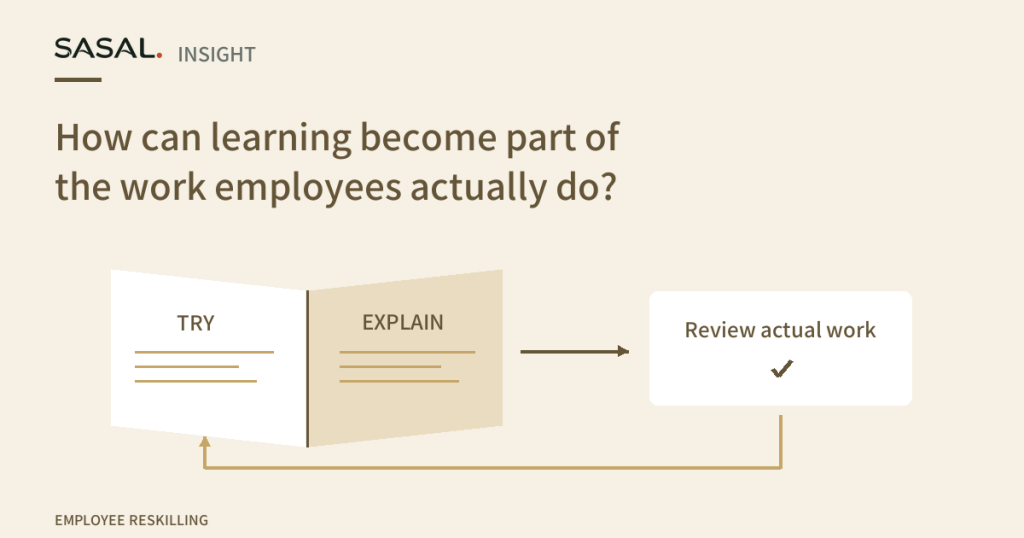
A training activity can finish before the company has decided how employees will use it. The next question is practical: which work will the employee perform, what will make the result acceptable and who will help them develop the decisions that the task requires? A course, a demonstration and an approved live assignment provide different kinds of evidence. Connect them through actual work rather than treating completion as permission to act. This approach starts after a department has identified useful work for existing employees and agreed the assignment. It develops the practice, feedback and review needed to perform that work, while keeping operating approval and management decisions with the company. Progress is assessed within a defined scope that can change as the evidence develops.
Check what changed after the course
A course record establishes that an employee attended or completed an activity. To understand what happens next, identify the work the employee is now expected to perform. Name the output, its recipient and the reason the business needs it. If the person's assignment has not changed and there is no opportunity to use the learning, the absence of a visible operational change does not establish that the employee failed to learn. The company may not yet have connected the course to work. Begin the review with that connection rather than requesting another completion report or asking the employee to demonstrate general enthusiasm for development.
Compare the assignment before and after the learning activity. The change might concern a task the employee has not previously performed, a different way of producing an existing output or greater responsibility for recognizing and preparing exceptions. Those changes require different evidence. An employee may understand a new method while continuing to receive instructions that require the old one. A supervisor may accept the new output while another recipient rejects it against an outdated expectation. Resolve such differences with the people who own the work before interpreting the result as a question of individual competence. Learning can operate only within the assignment and conditions the company actually provides.
The manager's first practical decision is whether the intended change has a usable place in ordinary work. Confirm that the necessary inputs, tools, review and retained approvals will be available. Establish which existing duties change so the new assignment is not merely an additional expectation with no operating owner. Detailed workload planning belongs to a separate capacity decision, but the learning assignment still needs a credible opportunity to be performed. A statement that employees may apply the material whenever they find time leaves both the opportunity and the evidence uncertain. Make the initial task and the person who receives it explicit.
Use the course material as one resource in this arrangement. It may provide concepts, procedures or exercises that help the employee perform the selected task, but it does not define the company's approval authority or customer commitments. Identify which parts apply directly and which need interpretation in the actual business context. Keep questions about that interpretation visible. This gives the coach a clear starting point and gives the employee a reason to use the learning. The review can then ask whether the assigned work is being performed differently and under what conditions, instead of treating attendance as a proxy for every subsequent operating result.
Describe capability through an output

Describe the capability through work someone can accept. A statement such as understand the process is difficult to evaluate because different people may attach different meanings to understanding. Specify what the employee should produce, the information they should use and the conditions the result must meet. Include the recipient's next action: an output useful for internal discussion may require different checks from one prepared for customer release. Agree that distinction before practice begins. Otherwise, the employee may receive inconsistent feedback from reviewers who are each applying a reasonable but different view of what the assignment was supposed to achieve.
Acceptance should address the reasoning required by the task as well as its final appearance. A complete-looking document can contain an unsupported assumption, omit an important exception or depend on a correction that another person supplied. Decide which of those matters the reviewer needs to observe. Ask the employee to identify the basis for a decision and the conditions under which they would choose differently. The depth of that explanation should fit the work. A routine preparation task does not require the same professional judgment as a decision reserved for a specialist, and learning criteria should not quietly transfer the specialist's responsibility to the employee.
Make the criteria usable by the people who give feedback. Terms such as good quality or sufficiently independent need an explanation tied to the output. Identify the information that must be present, the decisions that must be justified and the circumstances that require referral. Where more than one method is acceptable, say so. A reviewer should not reject sound work simply because the employee used a different permitted route from the demonstration. Equally, a familiar-looking result should not pass if it was reached through an unauthorized shortcut. The criteria connect the intended capability with the company's actual operating requirements.
Record what the current assessment will leave unresolved. The first assignment may cover ordinary inputs while unusual cases remain under closer review. It may establish that an employee can prepare work without establishing authority to release it. Those limits are part of an accurate learning decision. Keeping them visible helps the department expand responsibility when further evidence becomes available rather than treating the first accepted result as a blanket qualification. The employee should be able to explain the boundary too, so that later requests do not create a broader assignment merely because someone assumes that training has covered the whole role.
Select work that can be practised safely
Choose practice material that resembles the task closely enough to exercise the relevant decisions. Familiar information can help someone begin, but it may omit the ambiguity that makes the real work difficult. Identify which features matter: incomplete inputs, variations in requirements, a handoff between functions or a choice that needs approval. Preserve those features where appropriate while controlling the consequences of the exercise. The company should decide which material may be used and who may see it. A useful learning example does not automatically justify copying a customer record, employee information or confidential content into a new place or tool.
Separate the practice environment from the authority to act on the result. An employee can prepare a draft, reconstruct a completed task or work on a current item with the required review still in place. These arrangements provide different opportunities and limits. Reconstructing completed work can reveal reasoning, but the employee may already know the outcome. A live item provides real conditions, but it must not become an unreviewed customer commitment simply because it serves a learning purpose. Choose the arrangement according to the task and its consequences, and make the employee's permitted actions clear before the exercise begins.
Prepare the conditions around the material as carefully as the material itself. The employee needs access to the instructions, source records and tools that the task permits, while the reviewer needs enough information to assess how the result was produced. If the exercise depends on information that would not normally be available, state that limitation. If a necessary record is missing, decide whether discovering the omission is part of the assignment or whether the omission makes the exercise unusable. This prevents a practice result from being interpreted as evidence of readiness under conditions that the employee has not actually encountered.
Define what happens to the output after practice. A draft should not enter a live process by accident, and a learning copy should not become an uncontrolled alternative to the current working record. Identify who can authorize its further use, where feedback is kept and which material should be retained under the relevant arrangements. These choices need not create a complicated administrative process. They establish a clear boundary around an exercise that uses real business work. Once that boundary is in place, the coach and employee can focus on the decisions being learned without leaving the status of the output uncertain.
- Define accepted workAgree the output, recipient, required decisions and retained approvals.
- Demonstrate and practiseExplain the reasoning, then let the employee perform permitted work.
- Review the resultExamine output, decisions, exceptions and assistance involved.
- Agree the next scopeExpand, revise or retain support according to the evidence.
Demonstrate the reasoning behind the work
A demonstration is more useful when the coach explains the decisions that a finished output hides. Start with the inputs: how the coach knows that the information is sufficient, what they verify and what would stop the work. Explain why one source is used, why a field matters or why an exception is referred. The employee can then connect the visible steps with the purpose they serve. Simply showing a polished result leaves the learner to infer that connection, and the inference may be wrong even when the employee can reproduce the layout or sequence accurately.
Choose the amount of explanation according to the task. Explaining every minor action can obscure the decisions that deserve attention, while moving too quickly can make important judgment appear automatic. Ask the employee which part of the method is familiar and which part needs clarification. Use their existing operational knowledge where it is relevant. An employee who knows the customer, record or process may already understand a constraint that the coach must take time to learn. The demonstration should make the agreed work clearer rather than require the employee to abandon useful experience in favor of the coach's preferred vocabulary.
Discuss an alternative response where it helps explain the choice. The point is to identify the condition that makes one response appropriate, not to present every conceivable option. If a different input would require referral, show where that difference would be noticed. If another method would also meet the acceptance conditions, distinguish a preference from a requirement. This helps the learner understand which elements must remain consistent and where judgment or permitted variation exists. It also exposes any disagreement between the coach's method and the company's actual procedure before the employee is asked to apply the method independently.
End the demonstration by asking the employee to describe the next action and the evidence they would use. Their explanation can reveal a misunderstanding while it is still easy to address. A correct verbal answer is useful evidence of understanding, but it is not yet evidence that the employee can complete the task under ordinary conditions. Use it to choose the next practice opportunity. Keep unresolved questions attached to the work rather than smoothing them over to make the session appear complete. A demonstration can succeed by identifying the specific point that needs more practice or clarification.
Let the employee perform the task
During supported execution, let the employee perform the decisions the assignment is intended to develop. The coach can remain available without taking over every uncertain step. Agree when the employee should continue, ask a question or stop for review. That boundary depends on the work and its consequences. A learner preparing an internal draft may have room to explore an alternative that would be inappropriate in a live commitment. The arrangement should make room for useful practice while retaining required controls, rather than equating learning with unrestricted freedom to act or with constant intervention by the coach.
Record assistance accurately enough to interpret the result. The employee may have gathered the information independently while the coach selected the response, or may have completed the reasoning while a reviewer corrected the presentation. Those are different forms of progress. An accepted output should not conceal the contribution that made acceptance possible. Nor should a request for appropriate help erase evidence of what the employee did well. Use the record to identify the next responsibility the employee can attempt, the support that still matters and the part of the work that needs further observation.
Give feedback at a point where it can affect the next decision without making the task impossible to follow. Some questions need immediate attention because continuing would create an unacceptable consequence. Others can be reviewed after the employee completes a coherent portion of work. Agree that distinction in advance where possible. Interrupting every minor action may prevent the employee from connecting steps into a complete process, while waiting until the end may allow a misunderstanding to spread through the whole output. The useful timing is the timing that makes the relevant reasoning visible and permits a proportionate correction.
Keep responsibility for the live result clear throughout. The company decides who reviews and authorizes work that reaches a customer, another department or an operating system. A coach's involvement does not automatically give the coach that authority, and the employee's learning role does not remove the recipient's legitimate acceptance requirements. When a result needs correction before release, identify who makes the correction and how the employee will understand it. Otherwise, the business may receive acceptable output while the learner receives little usable feedback about why their own version was not yet ready.
Check performance when the inputs change
A repeated demonstration using the same inputs can establish familiarity without revealing whether the employee understands the conditions behind the method. Choose subsequent work that contains a relevant variation. The variation might concern information quality, the recipient's requirement, an ordinary exception or a different point in the process. It should address a real uncertainty about the assignment. Changing details for their own sake can add difficulty without teaching a useful distinction. The aim is to see whether the employee recognizes what has changed and adjusts within the permitted scope, rather than simply producing the same sequence again.
Ask the employee to identify the difference before judging the final answer. Someone may reach an acceptable result by habit without noticing a condition that would matter in the next case. Conversely, an employee may identify the right exception but need help to prepare the information for the authorized decision maker. Those observations support different next steps. Review the explanation, the action taken and the assistance involved together. A task that appropriately ends with referral can demonstrate progress; it should not be treated as incomplete solely because the employee did not resolve a decision that belongs elsewhere.
There is no universal number of successful repetitions that establishes readiness for every assignment. Consider the variations covered, the consequences of error and the review that will remain in normal operation. If the work is infrequent, it may take longer to observe a relevant condition. A permitted exercise can help, but its limits should be recorded. Do not claim that simulated work proves performance under every live circumstance. The company can authorize a narrower scope, retain support for unobserved conditions or wait for better evidence, depending on what the intended operating change actually requires.
Keep the employee informed about why the next assignment differs from the previous one. A new input should not function as a hidden trick designed to expose failure. Explain the kind of judgment being examined and the controls that still apply. This allows the employee to focus on reasoning and makes feedback easier to interpret. When the variation reveals a gap, connect the next practice to that gap rather than repeating the entire course. The resulting learning sequence can become more demanding where the work requires it without turning into an arbitrary ladder of tasks unrelated to the employee's agreed responsibilities.
Review an error before prescribing the remedy
An error identifies work that needs attention; it does not explain the cause by itself. Before prescribing more instruction, ask the employee how they understood the task and what information they used. Compare that account with the request, the guidance and the feedback criteria. The employee may have misunderstood a concept, followed an outdated instruction or received inconsistent direction from different people. Those explanations should lead to different remedies. Treating every error as a missing skill can leave the operating cause unchanged and make additional practice repeat the same problem under a different label.
Review the point where the reasoning departed from the intended approach. A late correction in the final output may originate in an earlier assumption, an unchecked input or an approval the employee believed had already been given. Identify the first point at which the relevant information or decision could have changed the path. This makes the feedback more usable than a general instruction to be more careful. It also helps distinguish an action the employee can change from a condition the manager or process owner must resolve. Keep those responsibilities separate while agreeing how the corrected work will proceed.
The employee should be able to question feedback when the acceptance condition is unclear or the proposed correction conflicts with another instruction. Ask for the underlying work and the competing requirement, then involve the person who can resolve the difference. This does not make every preference a reason to disregard a procedure. It creates a route for identifying a real inconsistency before it becomes part of the learned method. Avoid judging the discussion through assumptions about personality, confidence or motivation. The useful question is whether the evidence and the company's requirements support the proposed change in how the work is performed.
Once the cause is understood sufficiently to act, agree a focused next step. It may be another explanation, a revised instruction, practice on a particular variation or a change in the conditions surrounding the task. Name who will make that change and what subsequent work will show whether it helped. If the cause remains uncertain, state which observation is needed next. A record of the correction should preserve the reasoning without collecting unnecessary personal information. The learning review can then distinguish a resolved issue from an open question, rather than counting every corrected output as either complete success or general failure.
Turn answers into usable work guidance
Questions during practice can become a useful part of the operating guidance when their context is preserved. Record what was asked, which condition prompted the question and what decision or explanation followed. A short answer separated from its context can be misapplied later. A response appropriate to one customer's terms or one unusual input may not belong in a general instruction. Before sharing it more widely, identify the scope in which it is valid and the person who can confirm that interpretation. This lets the next employee use the answer without assuming that every answer supplied during coaching is a company-wide rule.
Ask the learner to apply the answer to the next relevant piece of work or explain when they would use it. This checks whether the response has become usable knowledge rather than an item the employee has merely saved. If the same question returns, investigate why. The answer may be difficult to locate, may not address the real uncertainty or may conflict with the workflow. Repeating the answer more firmly does not resolve those conditions. A maintained instruction, a clearer input requirement or a different decision route may be needed alongside continued practice.
Choose a manageable place for current guidance and a person responsible for keeping it accurate. The company does not need to introduce a new platform merely to record learning questions. It needs a way for authorized employees to find the current answer, see its limits and know who can clarify it. Avoid preserving unnecessary customer or employee details in a widely shared explanation. Retain access and use conditions attached to the original material. Where a useful example cannot be shared in its existing form, obtain an appropriate alternative rather than assuming that a learning purpose authorizes broader distribution.
Not every question needs a permanent record. Some concern a single transaction and belong with that transaction; others reveal a recurring decision worth adding to the task guidance. Make that distinction so the guidance remains usable instead of becoming a transcript of every exchange. The owner should also retire answers that no longer apply and explain material changes to people who use them. This connects learning with a maintained way of working, while leaving formal operating decisions with the company. The coach contributes to the explanation but does not become the owner of every future interpretation.
Keep coaching and operating approval distinct
Identify the coach, the work reviewer and the person who authorizes operating consequences. They may sometimes be the same person, but the responsibilities still need to be clear. A coach can explain a method and assess a practice result without being authorized to approve a payment, change a customer commitment or determine an employment matter. The employee should know which kind of response they are receiving. Otherwise, an encouraging comment about learning can be mistaken for permission to use the output in live work, or an operating approval can be mistaken for a broader assessment of the employee's capability.
Use the company's existing decision arrangements when assigning these roles. The department leader agrees the employee's responsibilities and should involve another owner where the change affects that owner's work or authority. External support can provide advice, observation and practical help within its agreed scope. It does not automatically acquire line-management powers because it participates in learning. Make the route from a coach's recommendation to the company's decision explicit. This helps the employee understand what they can act on immediately and what still needs confirmation from the person responsible for the operating outcome.
Agree how learning evidence will be used before collecting it. A note intended to support coaching may need a different audience and level of detail from a department's process-improvement report. If the company intends to use information for a separately explained employment decision, identify the applicable arrangements rather than treating that use as implicit. Name the record owner, permitted readers and retention approach appropriate to the context. The purpose is to make feedback usable for the assignment without turning ordinary practice into undefined monitoring. Check local requirements where responsibilities or information use make them relevant.
When the coach and the operating reviewer disagree, return to the work and the acceptance condition. One may be examining the employee's reasoning while the other is responsible for a consequence that the exercise did not cover. Clarify whether the disagreement concerns quality, authority, scope or the conditions of live use. The appropriate company owner decides how that issue affects the assignment. Record what the employee should do next so the disagreement does not remain as two conflicting instructions. A clear division of responsibilities makes the learning safer to apply and prevents informal authority from growing through repeated coaching conversations.
- EmployeePerforms the assigned work, explains decisions and raises appropriate questions.
- Coach and reviewerSupport practice and assess the output and reasoning within the agreed scope.
- Company decision ownerAuthorizes operating consequences and changes to responsibility.
Support employees across places and schedules
Employees in different locations or working patterns need access to feedback when the task requires it. Begin with the points at which a question can block progress or create a consequence if answered too late. Identify when the coach and the authorized reviewer are available and what the employee can do while waiting. A session scheduled at a convenient headquarters time may not provide usable support for the person performing the work elsewhere. Design the response route around the actual task rather than assuming that a shared meeting invitation establishes equal access to learning.
Asynchronous feedback can help when people do not work at the same time, provided the question and the work are understandable without an immediate conversation. Agree what information accompanies a question, where the response appears and how unresolved matters are followed up. Distinguish a question that can wait from one that requires the task to pause or move to an authorized alternative. Do not rely on employees or reviewers being continuously available outside their agreed working arrangements. Where the business needs a response at a particular time, the company should make a real coverage decision rather than leave that need as an informal expectation.
Make the instructions and learning materials usable for the employees involved. Confirm that they can access the format, understand the working terminology and raise questions without being judged by presentation style alone. Clarifying terms or providing an appropriate version of a work instruction is different from making language acquisition the purpose of the service. Keep the task and the required decisions central. If a person has an accessibility need or another practical constraint, identify the relevant arrangement with the appropriate company owner. Do not infer a learning limitation from the way someone speaks, reads or participates in a group session.
Compare support conditions before comparing progress across locations. Employees may receive different kinds of work, have different access to reviewers or encounter different customer requirements. Those differences can affect which opportunities they have to demonstrate capability. A common learning objective may still be appropriate, but its practice conditions and assessment need to reflect the actual assignment. Preserve the same standard where the work is genuinely comparable and record the differences where it is not. This allows the company to learn from experience across locations without turning a progress report into a ranking of nationalities or working styles.
Align daily requests with the learning assignment
The employee's daily instructions should reflect the agreed learning assignment. A manager may encourage a new method while continuing to request exactly the old volume, timing and output format. That combination leaves the employee to decide privately which expectation to disappoint. Identify what changes during practice and who can resolve competing requests. Detailed time allocation belongs in the capacity plan, but the learning plan should state the priorities the employee is meant to follow. An opportunity to practise is credible only when the people assigning ordinary work recognize it as part of the employee's responsibilities.
Discuss how the supervisor will interpret output during the learning period. A task may take longer while the employee checks unfamiliar decisions or seeks appropriate review. That observation needs context; it is not automatically evidence of poor performance, nor is every delay justified by the fact that learning is taking place. Examine what the additional effort is doing and whether it is helping the employee perform the agreed task. If the work still depends on a missing input or conflicting approval, address that condition. If the practice needs a different focus, revise it rather than allowing an open-ended exception to ordinary accountability.
Keep the output recipient involved when the assignment changes. They need to know what they will receive, which checks remain and who can authorize a change in timing or scope. The employee should not make a customer promise to protect a learning schedule or quietly deliver a reduced output to preserve an old deadline. Those are operating decisions for the company. Where several recipients request incompatible work, the department leader should set the priority and explain it to those affected. This makes the learning assignment part of a workable operating arrangement instead of an agreement that exists only between the learner and coach.
Review whether daily practice is occurring as intended. Missed opportunities, repeated interruptions and questions that remain unanswered can indicate a problem in the arrangement rather than a lack of willingness. Use the work and the employee's account to identify what happened. Avoid measuring support only by scheduled session attendance, because much of the useful learning may occur while handling an actual task. The next decision should address the obstacle that prevents that work from being performed and reviewed. Sometimes the right response is a clearer priority, a different reviewer or a narrower initial assignment, rather than another general training activity.
Decide when to expand the assignment

Expand an employee's responsibility from evidence about the work they have performed. Identify accepted outputs, the conditions represented and the assistance that remained necessary. Include the employee's explanation of relevant decisions and their handling of exceptions. A single correct result may be encouraging without covering the scope the manager proposes to assign next. Likewise, an early mistake does not establish that the person cannot learn the task. The useful review asks what has been demonstrated and what uncertainty remains about the next operating responsibility. It should produce a defined decision rather than an overall label of capable or incapable.
Choose the next scope in relation to that evidence. The company may permit employee-led preparation while retaining release approval, broaden the range of ordinary inputs or keep closer support for a particular exception. These are different changes. State which one is being authorized and which controls remain. The coach can recommend a step, but the company decides the assignment and the relevant authority. If another department must receive or review the work, obtain its agreement before treating the new scope as operational. Capability demonstrated in an exercise does not remove the need for those receiving arrangements.
Record the limits in terms that a future requester can understand. If the evidence covers complete records and ordinary cases, say so. If a changed requirement has not been assessed, retain the appropriate route for it. The employee needs that information too, because requests can expand informally once colleagues hear that training is complete. A precise statement of scope helps the person respond without either accepting every new request or refusing useful work unnecessarily. It also makes later review more informative: the company can compare what was authorized with what was actually requested and performed.
Set a reason to revisit the decision when conditions change. New inputs, repeated corrections, unavailable review or a different operating requirement may justify additional support or renewed practice. This need not erase the progress already demonstrated. The company can preserve the part that works while adjusting the part that does not. Keep the response connected to the task and avoid presenting responsibility expansion as an irreversible graduation. Reliable operation comes from the employee's capability together with the information, authority and support the company continues to provide. Each of those conditions remains relevant after the initial learning review.
Revise a learning plan that is not working
When a learning plan is not producing usable work, identify the decision that needs to change. The target task may still be valuable while the practice material, feedback or review arrangements are unsuitable. Alternatively, the business may have changed and no longer need the output originally selected. Those situations should not receive the same response. Return to the assignment, its recipient and the evidence collected during work. Determine which part of the explanation is supported and which remains an assumption. This keeps the next action focused on a real operating problem instead of treating additional training as the default answer.
Consider whether the employee has had a fair opportunity to perform the intended task. Missing information, unavailable review, conflicting instructions or repeated reassignment can prevent useful practice. Resolve the condition with its owner or narrow the plan to work that can be performed and assessed. Where the difficulty is a specific gap in knowledge or reasoning, target the next explanation and exercise to that gap. Do not infer that a person must change their personality or move into a role contrary to it. Existing knowledge and the employee's stated interests and constraints remain relevant when deciding how the assignment should develop.
Make any revision explicit to the employee, coach, manager and affected recipient. State what changes, why the available evidence supports it and what subsequent work will be reviewed. Preserve useful accepted work and unresolved questions so the revision does not restart the entire process unnecessarily. A pause may be appropriate where essential conditions are unavailable, but identify what would allow the work to resume. If the original task no longer has a business use, change the assignment decision rather than asking employees to complete practice solely because it was once scheduled.
The final record should connect learning to a continuing piece of work. It should show the current assignment, the employee's demonstrated scope, the support and approval that remain, and the next decision the company expects to make. Course completion can still be recorded, but it is only one part of that account. The operating value lies in employees being able to perform agreed work, explain relevant choices and obtain the right help when the task exceeds their scope. A learning plan remains useful when it can be revised around those conditions, with the company retaining responsibility for how the work is assigned and used.