

What should employees learn to do in an AI-supported workflow?
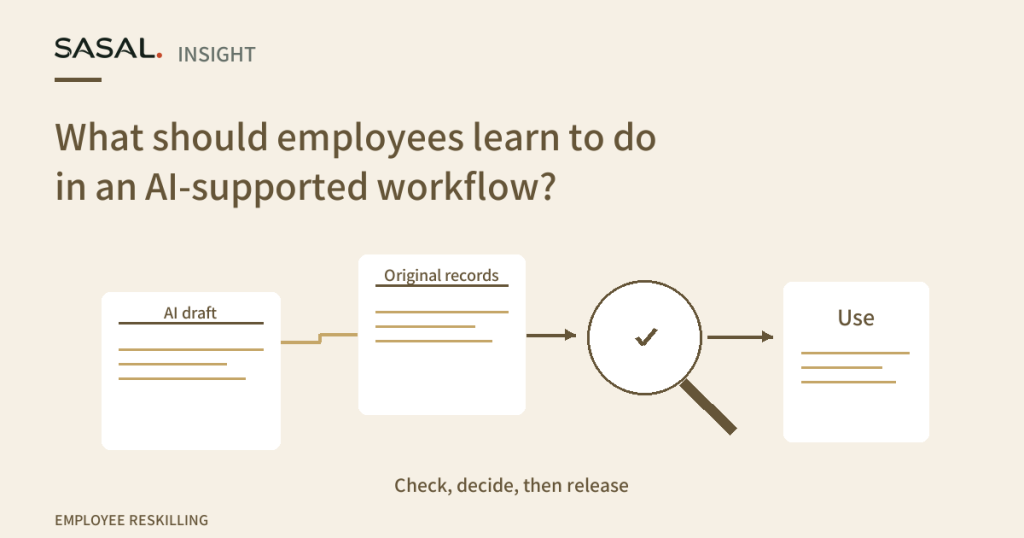
An employee can learn how to request a draft from an AI tool before the company has decided who will check it, what information may be supplied or when the result is safe to use. That gap belongs in the learning assignment. The employee needs to practise obtaining a useful output, finding unsupported content and deciding what to do when the available evidence is insufficient. Managers also have work to do: approve the operating scope, provide review capacity and preserve the decisions that belong to authorized people. This article develops a task-level approach for established international operations. It assumes that the organization has approved the relevant tool and proposed use; it does not recommend a product or authorize a new information-processing arrangement. The practical outcome is a defined assignment that connects employee learning with an output the business can accept.
Tie AI use to a specific employee task
Start with an output that someone already needs. Identify its recipient, purpose and acceptance conditions, then describe the part of the work that the approved tool may assist. Preparing a draft operating summary, identifying possible inconsistencies in a supplied record and suggesting questions for an internal review are different assignments. They require different source material and different checks. A general instruction to use AI more often gives the employee little basis for deciding whether a proposed use is relevant. It also makes training success difficult to interpret: increased activity in a tool could coexist with unchanged delivery or more work for the recipient.
Describe the current work before proposing a new sequence. Which information arrives, which judgments the employee makes, what they produce and what happens to the output next are useful starting points. Include corrections and clarification requests, since these may explain the burden more accurately than the first draft does. The employee may discover that the longest delay comes from an unresolved business question rather than document preparation. In that case, faster drafting will leave the dependency intact. The learning assignment can still be worthwhile, but the manager should narrow the expected benefit and address the separate decision with its owner.
Use a task boundary that the employee and reviewer can observe. For an illustrative assignment, a team might permit assistance with drafting an internal account of already approved actions, while keeping interpretation of contractual commitments outside the tool-assisted work. This is a hypothetical boundary, not a recommendation for every company. The relevant distinction is between describing an existing decision and creating a new one. A useful brief identifies which source establishes the decision, who may clarify ambiguity and who receives the final account. The employee then practises a recognizable piece of work rather than an abstract collection of prompt techniques.
Write down the intended improvement in terms of the accepted output. It might concern clearer organization, fewer omissions from a specified set of records or less effort preparing a first version. Treat each as a proposition to examine during practice, not an assured result of adopting the tool. Keep the employee's development objective separate from a procurement decision or a staffing proposal. Learning to perform a defined task with appropriate checks does not establish that the organization should purchase another system, remove a review role or reduce headcount. Those decisions need their own evidence and authority.
Map inputs, outputs and human decisions
Draw the sequence from the original record to the action that follows the finished work. Mark where the employee selects information, where the tool assists, where someone verifies the result and where an authorized person approves its use. The same person may hold more than one responsibility, but the responsibilities should remain distinguishable. Permission to operate a tool does not necessarily include permission to release a customer communication, accept a financial commitment or change an approved policy. The learning brief should make those boundaries visible before practice moves into ordinary delivery.
The NIST Artificial Intelligence Risk Management Framework, AI RMF 1.0, is a voluntary framework published in January 2023. Its GOVERN provisions describe training personnel and partners for their AI risk-management duties and defining distinct human–AI and oversight roles; its MAP provisions address operator proficiency and documented human oversight. Its MEASURE provisions also call for assessment under conditions similar to deployment and recording limits to generalization. These are framework recommendations, not evidence that a particular reskilling service produces a specified return, a worldwide legal training requirement or certification of an organization's workflow. The task design developed here is an operational recommendation informed by those distinctions.
For each decision, name the role that may make it and the information it needs. An employee might be responsible for checking that a summary includes every approved action, while a department manager decides whether the resulting communication may be sent. A specialist might resolve a question about the meaning of a contract clause. Passing the output through all three people without specifying their checks can create duplicate work and still leave a gap. Assign the question as well as the person: completeness, factual support, specialist interpretation and release authority are separate concerns even when they appear in one document.
Include the return route. If the approver requests a correction, the employee needs to know whether they may revise the draft within the agreed task or must return to the original source owner. A request to make uncertain language sound more definite should not silently become permission to change the underlying commitment. Keep the distinction between a corrected draft and a changed business decision visible in the record. This gives the learner a way to respond constructively to feedback without assuming authority they do not hold, and gives the approver a clearer view of what remains unresolved.
- Confirm the inputThe employee checks the approved purpose, information and task boundary.
- Assist the defined taskThe approved tool produces working material within the permitted assignment.
- Verify and resolveThe employee checks sources and completeness, correcting or referring unresolved issues.
- Authorize useThe responsible company approver decides release within their actual authority.
Teach employees to check permitted information
Access to a document and permission to provide it to a particular tool are different questions. An employee may be allowed to read customer information for their ordinary work while the organization limits where that information may be processed or shared. Training should use the company's actual approved arrangements, including relevant customer commitments, confidentiality conditions and applicable requirements. The employee needs a practical way to determine whether the proposed input and purpose are permitted. A broad instruction to avoid sensitive information is difficult to apply when an apparently routine operating document combines public facts, customer details and internal judgments.
Teach the employee to identify the information needed for the task before copying a whole file. If the task only requires approved action dates and owners, unrelated personal notes may add exposure without adding value. Reducing unnecessary input can also make the work easier to check, provided essential context is preserved. It is not a universal permission rule: removing names does not by itself establish that the remaining information is authorized for processing. Commercial terms, unusual circumstances or combinations of details may still be restricted under the actual arrangement. The responsible information owner should resolve uncertainty about permitted use.
Make the approved route concrete. The brief should identify the relevant tool or environment, the permitted purpose, any input restrictions and the person to ask when material falls outside them. Avoid assuming that a personal account, a different product tier or a newly enabled feature has the same approval as the arrangement used during training. Employees should practise recognizing a changed condition and pausing that part of the work. Their task is to apply a usable company rule and seek a decision where necessary, rather than independently interpret every contract or country-specific information requirement.
International work can involve records from several companies and people operating in different places. Map the actual participants, information and authorized recipients instead of treating overseas information as one category. The location of headquarters, the employee's reading language and the tool's interface language do not resolve those questions. Where a review is required, supply the facts to the responsible legal, privacy, security or contractual owner. Keep the article's learning objective focused: an employee should be able to identify the boundary and use the escalation route. They are not expected to substitute personal confidence for an unresolved organizational approval.
Specify the work requested from the tool

A useful request explains the purpose, the supplied material, the intended recipient and the output needed. It can also state important limits, such as using only the supplied approved records or leaving unresolved questions visible. Teach employees to connect each instruction to the work rather than memorize a universal prompt formula. A recipient who needs a list of pending decisions has a different need from one who needs a narrative explanation of completed actions. Clear instructions may improve the usefulness of the draft, but they do not establish that its contents are accurate or complete. Verification remains a separate part of the assignment.
Ask the learner to distinguish information in the source from information they are adding as context. If a record lacks an owner, a date or the reason for a decision, they should preserve the gap or obtain clarification through the agreed route. Filling the gap with a plausible assumption can make the output look more complete while weakening its basis. The employee also needs to recognize conflicting instructions: a request for certainty may be incompatible with tentative source material, and a demand for brevity may remove a qualification the recipient needs. Those are editorial or business choices that require judgment beyond operating the interface.
Practise revising a request in response to a specific observed problem. If the draft mixes completed and proposed actions, the employee can separate those categories in the instructions and check the revised result against the source. If it omits a material condition, adding more general wording may be less useful than identifying the condition and its location directly. Preserve the original acceptance criteria during iteration. Otherwise the employee may gradually change the task to match what the tool produces comfortably, then report success against a different requirement from the one the recipient actually approved.
Record reusable instructions together with their conditions of use. A request that works for one standardized internal record may depend on headings, terminology or completeness that another record lacks. The learner should be able to explain why the instruction is suitable for the current input and when it would need adjustment. A collection of successful prompts can be a helpful aid, but it needs the surrounding task definition and checks. Without that context, the next employee inherits words to paste and little guidance on whether the output is fit for the current purpose.
Check the output against usable evidence
Make checking observable. Instead of asking whether the answer looks reasonable, ask the employee to connect a material claim to the record that supports it, confirm the scope of that support and identify anything the output leaves unresolved. A claim may reproduce the source's wording accurately while omitting a condition that changes its meaning. A statement about one company or period may appear as a claim about the whole group. The reviewer should be able to see how the learner distinguished a supported statement from an inference, a recommendation and an unanswered question.
Source references need their own examination. A displayed title, link or citation-like string is a route to a potential source, not proof that the source exists or supports the claim. The employee should open the underlying material when authorized, locate the relevant passage and check that it applies to the entity, period and question at hand. If the source cannot be accessed or its relevance cannot be established, the output should retain that limitation or be returned for clarification. Counting references or accepting a confident explanation of a reference does not complete the verification.
For numerical work, identify the original values, definitions and calculation. Totals may be internally consistent while combining different periods, currencies or categories. Teach the learner to check the business meaning of the numbers as well as arithmetic, using an appropriate independent method. A proposed saving measured against a changed workload is not directly comparable with the former cost. A percentage without a clear denominator cannot support a reliable comparison. These are ordinary analytical disciplines that remain necessary when a tool prepares the draft; the presence of an automated calculation should not cause the employee to abandon them.
Completeness also needs a reference point. Comparing the draft with a known list of approved actions is different from asking whether every possible issue has been identified. The former can have a bounded check; the latter may remain open-ended and require specialist review or a narrower claim. Define what the employee can demonstrate with the available records. If the task cannot be checked adequately within the proposed method, management may need to limit the tool-assisted portion, obtain better source material or retain a different process. A nominal human check cannot make an inherently unverifiable assignment dependable.
Use existing business knowledge during review
Employees who understand the work can notice inconsistencies that a generic reading misses. They may recognize that an action depends on a customer decision, that a reported status uses a different definition or that a proposed sequence skips a required handoff. Design practice so they can explain those observations and connect them to current records or responsible owners. Their experience helps identify what deserves scrutiny. It does not make every recollection current, or establish that an unusual result must be wrong. The learning task should reward an evidence-seeking question as well as a correct correction.
Choose representative examples that expose the judgment the employee will need in ordinary work. A clean record can establish the basic sequence, but it may not show whether the learner recognizes an unresolved commitment or a mismatch between a group's shared definition and a local reporting practice. Use authorized material, or clearly identified constructed examples, without presenting them as customer cases. Explain which features are relevant to the exercise. Avoid making the exercise so artificial that success depends on spotting obvious traps rather than following the same source and approval checks required in real delivery.
Pay attention to terminology across companies and languages. Similar labels may refer to different approval stages or operating events, while different words may describe the same underlying fact. An employee should know when to consult a maintained definition or source owner instead of accepting a fluent translation as evidence of equivalence. Where specialist language review is needed, arrange it through the appropriate route. This article concerns judgment in an approved workflow, not a promise that tool use or this reskilling service supplies language proficiency. The recipient still needs an output whose meaning is dependable in its intended context.
Use differences between experienced staff as learning material carefully. Two employees may reach different conclusions because they received different inputs, apply different definitions or hold different delegated responsibilities. Ask them to locate the difference before choosing a preferred answer. That discussion can reveal a process clarification needed from management, rather than a skill deficit in either employee. Keep responsibility for resolving the business rule with its owner. The coach can help make the disagreement explicit and practise the agreed method after a decision, without creating a new rule merely to make the training example easier to mark.
Practise rejecting or pausing an output
The employee should be able to complete the task without accepting every result the tool produces. Define conditions that require correction, referral or a return to an appropriate alternative process. Missing source material, an unsupported material claim and a proposed action outside the employee's authority are different reasons to pause. Naming the reason helps the next person resolve it. A message that only says the AI result is unreliable provides little direction; a message identifying the unsupported commitment and the person who can clarify it makes the interruption usable.
Practise the alternative route as part of the assignment. The employee may need to prepare the work manually from approved records, request a revised deadline or send the unresolved question to an authorized specialist. Confirm that the alternative is actually available and that someone owns the resulting decision. If management removes access to the former process before the new one can handle ordinary exceptions, an instruction to stop may be difficult to follow in practice. A usable pause condition connects the employee's judgment with a feasible next step, including who informs the recipient when delivery is affected.
Treat consequential decisions according to their actual operating context. A tool-assisted draft that informs a financial commitment, an employee matter or a regulated activity may need review by someone with particular authority and expertise. The employee should identify that need and route the work accordingly, rather than infer permission from a generic human-review label. The exact requirements depend on the work and applicable arrangements; this article does not establish a universal legal approval sequence. Retaining an authorized professional decision also does not mean that every earlier factual check can be skipped or left for that professional to reconstruct.
During feedback, examine a decision to reject an output with the same care as a decision to use it. Ask what evidence was missing, why it mattered and whether the employee chose a proportionate response. Automatically rejecting every unusual result may prevent useful work; accepting it to avoid delay may create a different problem. The aim is a defensible decision within the agreed scope. If the rules do not help resolve a recurring case, record the gap for the process owner. Do not require the learner to turn an unresolved policy question into personal discretion simply to complete the exercise.
- Proceed to approvalThe required checks are complete and the output meets the defined acceptance conditions.
- Correct and recheckA specific defect can be resolved within the existing task and authority.
- Pause or referEssential evidence, permission or specialist judgment is missing; use the agreed alternative route.
Allow enough time and access for review
A named reviewer needs a workable assignment. Identify the material they will receive, the checks they must perform and the time available before the output is used. If the reviewer sees only a polished draft, they may be unable to trace its claims without repeating the employee's preparation. If they receive every working version and all source material without a clear question, the review may become unnecessarily burdensome. Agree a proportionate handoff that exposes the relevant evidence, the employee's completed checks and the remaining uncertainties. The reviewer can then spend attention on the responsibility actually assigned to them.
Account for review demand when defining the practice cohort. More employees producing drafts can create a queue at a shared reviewer even when each draft is prepared quickly. Ask the manager to consider the arrival pattern, the reviewer's other commitments and the time needed for corrections. Staggering practice, narrowing its scope or arranging additional competent cover may be appropriate. These are capacity decisions for the company. An external coach can identify the demand and support learning within the agreed assignment, but cannot assume that another department has spare time or silently take over an approval that the company has retained.
Check access before the review is needed. The reviewer may require a current contract, a definition owned by another company or a record unavailable in their usual working environment. Resolve the authorized access route or assign the check to someone who can perform it. Sending more information broadly is not automatically an acceptable solution. Where access is deliberately limited, the workflow may need a bounded confirmation from the responsible source owner. The learner should understand the limits of that confirmation and retain any unresolved qualification rather than describe a restricted check as a complete independent verification.
Review time should remain visible after the learning period. A workflow that appears efficient while a coach provides intensive checking may behave differently when that help reduces. Track who supplies the continuing review, how exceptions will be handled and whether ordinary deadlines leave enough time for the work. The company can accept a task with a retained review requirement if that arrangement is deliberate and feasible. It should avoid treating the end of a course as evidence that review effort has disappeared. Human oversight remains an operating activity whose effectiveness depends on the actual people, information and conditions.
Separate practice from approved live use
Define what may happen to a practice output. It might remain an internal exercise, be reviewed alongside the existing process or enter live work after a specified approval. These arrangements have different consequences for recipients and reviewers. Make the boundary visible to the learner and anyone who may receive the draft. A practice label alone is insufficient if someone can mistake the result for an authorized instruction. The company should decide the handling method that fits its existing process, including who releases the final version and how superseded working material is distinguished from the approved output.
Use examples that represent the agreed task without extending its permission. Authorized historical material can provide useful context, but its age, original purpose or information restrictions may affect whether it is suitable. Constructed material should be identified as such and include the features needed to examine the intended skill. Neither choice automatically demonstrates performance under every live condition. Record what the learner actually encountered: the input type, the required checks, any assistance and the unresolved limitations. That record makes a later decision about scope more precise than a general statement that the employee has completed AI training.
Move into live work through an explicit company decision. The responsible manager should understand the proposed task, the available evidence, the review arrangement and the alternative route. Success on a draft internal summary does not authorize the employee to use the same approach for a customer promise or a different company's records. If scope expands, review the new inputs, consequences and approvals. The decision can remain narrow while the company learns more. Retaining boundaries is compatible with useful progress; it allows the manager to specify what is ready now and which proposed applications still need assessment.
Give the employee feedback on work they can influence. If a practice attempt fails because the source is incomplete, distinguish the learner's handling of that gap from the source owner's responsibility to correct it. If the reviewer changes the acceptance condition after delivery, discuss whether the brief needs revision. This prevents process defects from being recorded as individual learning failures. It also preserves a meaningful standard: employees remain responsible for performing the agreed checks and seeking clarification, even when they cannot control the condition that caused the difficulty. Practice should reveal those boundaries, not conceal them.
Record meaningful corrections and unresolved issues

Keep a proportionate record of what required correction and why. Useful categories might distinguish an unsupported claim, an omitted condition, a wrong source interpretation and a formatting issue that impeded use. The purpose is to identify what learning or process adjustment is needed. A count of edits alone can mislead because a minor wording change and a material change to a commitment have different significance. Explain the consequence in relation to the task, while avoiding unnecessary personal or confidential detail. The record should help the employee and process owner understand the issue without reproducing every draft.
Separate a resolved correction from an open question. The employee may fix a draft's date against an approved record, while a conflicting instruction still awaits a management decision. Recording both as completed feedback hides the remaining dependency. Assign an owner and an appropriate follow-up point for the unresolved question, and state how the current work should proceed while it remains open. Some work may continue within a narrower scope; other work may need to wait. The decision depends on what the missing answer affects, rather than on a universal rule that every uncertainty must stop the whole process.
Explain how learning records will be used, who can see them and how long they are needed under the applicable company arrangements. Detailed prompts, employee comments and customer records may contain information unrelated to that purpose. Do not assume that retaining everything improves learning or that individual tool activity is an adequate performance measure. Discuss the employee's work with enough context to distinguish a new skill, an unclear brief and an unavailable input. Where evaluation has employment consequences, management needs to address the relevant process and local requirements separately from an informal coaching note.
Use recurring issues to revise the right part of the workflow. Repeated omissions may call for a clearer acceptance check; repeated source conflicts may require the information owner to maintain a better record. A recurring question about approval may need a management decision rather than another prompting lesson. The coach should identify the pattern and the proposed response, while the responsible company owner decides any operating change. When the record leads to a change, explain the changed condition to employees who use the guidance. Otherwise the organization collects lessons while the next assignment continues under the old instructions.
Keep usable instructions for the next employee
Maintain a task guide that someone other than its original author can use. It should explain the purpose, permitted inputs, relevant tool arrangement, expected output, source checks, approval and exception route. Include the conditions that limit the assignment and a named owner for questions or updates. Reusable wording for a request can sit within that guide, but it should not carry the whole procedure. A new employee needs to understand why a check exists and which business decision it protects, particularly when the current input differs from the example used during training.
Test the guidance with an authorized colleague who has the necessary background. Ask them to explain how they would complete a representative task, identify a missing source and obtain release approval. Observe where they need clarification from the original author. This is a review of the guidance and its assumptions, not a claim that one exercise establishes general competence. Distinguish missing instructions from knowledge the role is already expected to possess. The company can then decide whether to improve the document, provide additional practice or retain support for a part of the work.
Preserve ownership when people or assignments change. The guide should have a current version and an accessible location under the company's approved arrangements. Identify who can change it, who approves a change affecting operating scope and how affected employees learn about the revision. A coach's working notes or personal account should not become the only route to essential instructions. At the same time, handing over guidance does not imply transferring credentials, customer material or third-party content without permission. Confirm the rights and access needed for continued use through the relevant owners.
Make retained support explicit. An employee may perform the routine task independently while referring unusual source conflicts or specialist questions. That is a valid operating arrangement when the route is available and its scope is clear. The readiness decision should describe the work the employee can undertake, the review that continues and the situations requiring help. Avoid declaring complete independence merely because the learner can reproduce one example. The useful handover is an arrangement that another manager or employee can understand and maintain when the original coach is no longer present.
Recheck the assignment when conditions change
Prior learning evidence applies to the conditions under which it was obtained. A change in the tool, the approved environment, the input population or the business rule can affect the checks needed. Identify who notices each type of change and who decides whether the assignment needs reassessment. Do not depend on every employee recognizing an unannounced technical change. The responsible operating or tool owner should communicate relevant changes through the company's established route, with enough detail for the task owner to assess the effect on permitted use and review.
Describe the actual difference before repeating training. A new source format may require the employee to locate information differently while leaving the business judgment unchanged. A new customer commitment may change what the output is allowed to say even though the interface looks identical. The first calls for a review of handling and completeness; the second may need a substantive decision about scope and authority. Keeping those differences visible helps the company choose a focused response. It also avoids treating every change as a reason for a generic refresher course that never addresses the altered condition.
Use a bounded reassessment appropriate to the change. The task owner can identify representative authorized material, the acceptance checks that may be affected and the people who need to review the result. Earlier successful examples can provide a comparison, but they do not establish that new conditions are covered. Record the limits of the assessment and any work that remains outside the approved assignment. If there is not enough evidence to continue safely within the existing scope, use the agreed alternative or narrow the task until the responsible person makes a decision.
Give employees a route to report unexpected behavior without requiring them to diagnose its technical cause. They can describe the input, the observed problem, its effect on the work and the checks already performed, while handling the underlying information within approved boundaries. The relevant owner can then decide whether the issue concerns the tool, the instructions, the source or the business process. A change record should lead to an operating response, such as clarified guidance, restored support or a revised permission. It should not leave the learner carrying an unresolved condition while management assumes the earlier approval still answers it.
Measure the whole work including checking
Compare the effort required to obtain an accepted output, including input preparation, drafting, verification, correction, approval and exception handling. Time saved in the first draft may be valuable, but it is only part of the sequence. If the reviewer must reconstruct the source comparison, some effort has moved to another person. Count that work where it occurs and identify whether the new arrangement changes who supplies it. Keep comparison periods and task types sufficiently similar to support the conclusion, and state relevant differences rather than presenting every observed change as an effect of tool use.
Examine quality alongside effort. A shorter completion time has a different meaning if it excludes unresolved items, omits a recipient's required condition or depends on an additional review that was not counted. Define the usable output before measuring it. Corrections discovered during practice can support learning, but they are not equivalent to defects reaching a recipient. Keep those observations separate. Similarly, a reduction in a recurring error can be useful without proving a financial return. Explain what the evidence establishes and leave broader claims about profitability or staffing to the decisions and evidence that support them.
Distinguish early learning effort from the recurring operating arrangement. Initial practice, guidance preparation and close coaching may be necessary to establish the task. Continuing checks, update work and specialist referrals may remain after familiarity improves. Report these categories separately so the manager can see what is likely to recur and what has only been observed during setup. Avoid assuming that every current difficulty will disappear with experience, or that every first attempt represents permanent performance. The next decision may be to continue a bounded trial, change the task design or stop a use that does not justify its operating burden.
Keep the evaluation connected to work, rather than making individual usage volume the target. An employee who appropriately declines an unsupported output may use the tool less while protecting the agreed standard. A high volume of generated drafts may create little value if recipients do not need them. Discuss accepted work, meaningful corrections and unresolved dependencies with the people responsible for delivery. The purpose of measurement is to choose a feasible operating method and learning scope. It does not require continuous personal surveillance or a ranking that ignores the difficulty and circumstances of each assignment.
Authorize a defined human-and-tool assignment
Bring the learning evidence and operating conditions together in a short decision record. Identify the employee task, permitted tool and input, required output, source checks, reviewer, release authority and alternative route. State what the employee has demonstrated, under which conditions, with what assistance and with which limits. The record should allow the responsible manager to approve a specific next step. A broad label such as AI-capable cannot tell a recipient whether an employee may release this output or whether a specialist question still requires referral.
Make unresolved conditions part of the decision. If review capacity is unavailable, access remains unapproved or an acceptance criterion is disputed, identify the owner and what can proceed in the meantime. The manager may authorize a narrower task, arrange additional practice or defer live use. An external adviser can recommend an approach and explain the evidence, while the company retains responsibility for assignments and acceptable operating conditions. Neither a training completion nor a positive practice result silently transfers that authority. The decision should also preserve any required employment, professional or local approval steps relevant to the actual work.
Set a practical review trigger tied to the assignment. A changed input, a material recurring correction, an unavailable reviewer or a change in the approved tool arrangement may reopen the decision. Name the person who receives that signal and the route employees should use while it is considered. This turns learning into a maintained part of the workflow. Employees know what they are equipped and authorized to do, managers can see the support that remains, and recipients receive work under stated conditions. The arrangement still requires judgment; its value is that the judgment has an owner, usable evidence and a clear place in the work.