

Which work should employees learn to do differently?
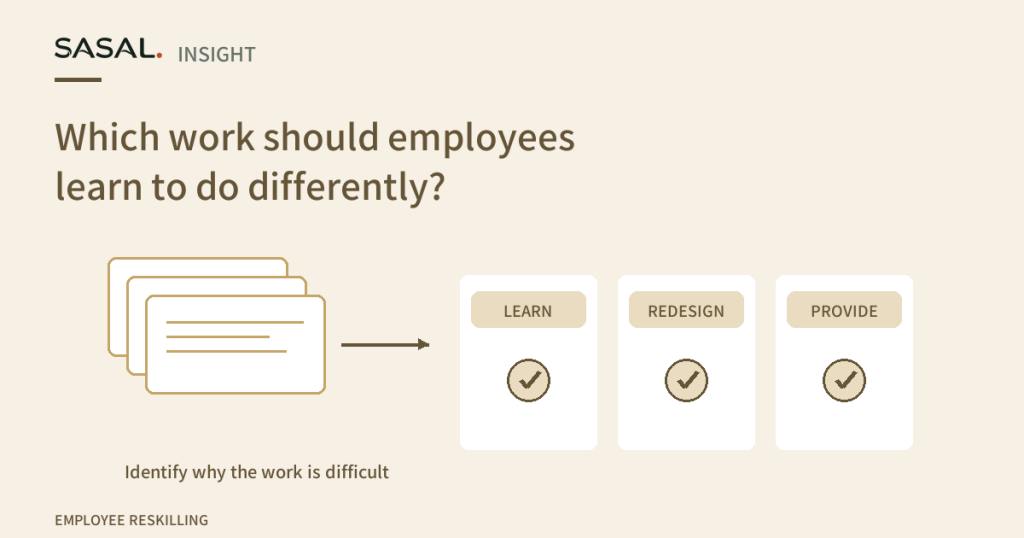
A training request can leave a department choosing courses before it has agreed which work needs to change. Start further back: identify the output that is late, repeatedly corrected or difficult to produce, then examine the conditions under which the employee prepares it. Missing information, unclear acceptance, an unavailable approver and a specific skill gap call for different responses. Several may be present in the same task. The selection decision should explain what learning can change, what the work owner must resolve and how the redesigned output will be used. For an established international business, that also means checking whether similar job titles cover comparable work across locations. The resulting task brief lets managers, employees and reviewers agree where practical learning can begin.
Trace the problem to a piece of work
When a manager requests training to address a recurring business issue, separate three roles before selecting the work: the person requesting change, the employee performing the work, and the recipient who accepts or rejects the result. Those roles may agree on the symptom while disagreeing on the cause. A report recipient may return a document because key assumptions are missing, while the employee believes the delay came from unclear instructions. Before selecting any task for redesign and learning, identify the actual output, the named recipient, and the acceptance conditions used in practice. Without that distinction, a department-level concern can be mistaken for an individual capability gap even when the rejection occurs elsewhere in the workflow.
Start from a recent piece of work that arrived late or was returned, then reconstruct the sequence using records rather than relying only on retrospective explanations. Note what triggered the task, when required inputs became available, when handoffs occurred, and where approvals were requested. Reported delay and recorded delay are not always the same. An employee may describe a task as taking a long time, yet the timeline shows most elapsed time was spent waiting for information, review, or authorization. The key observation is the first avoidable decision that changed the outcome. If critical information was available but not incorporated, that decision deserves attention before examining the final rejection, because later corrections may only reflect an earlier preventable choice.
When several teams contribute to one business result, define a practical output boundary instead of attempting to analyze the entire chain at once. The useful boundary is usually the smallest segment that still has a recognizable deliverable, a recipient, and observable acceptance conditions. If one team gathers inputs, another prepares a recommendation, and a third grants approval, the learning decision may concern only preparation of the recommendation. Expanding the boundary too far can mix unrelated constraints, making it difficult to determine whether learning is relevant. Narrowing it too aggressively can hide essential context needed to judge quality. The chosen boundary should therefore include the decisions the employee can influence while retaining visibility of the conditions that recipients use to accept or return the work.
Use this review to establish how different work performance could affect the outcome and which other conditions would need to change. A suitable task for reskilling has a clear trigger, known inputs, a defined output, and a recipient capable of reviewing results against observable criteria. Discussion with employees remains important because records alone may not reveal missing information, duplicated checks, or system limitations. However, evidence should distinguish capability questions from constraints that training cannot remove. If a task repeatedly waits for an unavailable approver, remains blocked by required information that never arrives, or exists mainly because of an unresolved process dependency, document those conditions explicitly. In those circumstances, another intervention may need priority before selecting learning work.
Inventory tasks below the job-title level

An inventory built from job titles leaves the activities inside each role unresolved. A title such as coordinator, analyst or specialist often combines recurring processing, exception handling, stakeholder follow-up and review activity that occur under different conditions. The inventory should trace tasks to outputs: what starts the work, which records or requests enter it, who receives the result and what conditions make it complete. Capture recurring tasks separately from infrequent control activities such as audit preparation, contract checks or escalation reviews. Those less frequent duties may occupy little calendar time yet require knowledge that strongly affects which work can be reassigned for learning. Without that distinction, the selected task may look simpler than operational reality.
The next decision concerns how much observation is enough. The purpose is to understand work patterns, not to monitor individuals or rank speed. Begin with work samples, existing records and structured discussion, adding observation where the sequence of activities, handoffs or review points remains unclear. Check that the material covers the work being considered rather than assuming a short observation period is representative. Record approximate active effort separately from waiting. A task may involve only brief handling but remain open because information, approvals or upstream corrections are missing. Treating waiting time as employee effort can lead managers to choose training when the constraint actually sits elsewhere. Conversely, a task with substantial active judgment may be a better learning candidate even if elapsed completion time appears similar.
Hidden work deserves explicit treatment because it is often omitted from recollection. Ask employees to identify corrections they routinely make before submitting outputs, interruptions that require context switching, and batches of work processed together rather than one item at a time. These observations help explain why a task consumes attention even when formal procedures appear straightforward. Avoid cataloguing every keystroke or assigning minute-level precision that the evidence cannot support. Broad ranges and descriptive notes are usually sufficient for a selection decision. If staff repeatedly reconcile inconsistent records, clarify which fields are checked, who owns the source information and whether the issue reflects a capability gap, duplicated effort or an unresolved process dependency.
Before the inventory is used to choose redesign work, allow employees and relevant supervisors to review the task map and correct omissions. They can often identify seasonal responsibilities, exception paths or approval obligations that are invisible in system records. Review responsibility should remain a distinct field because available reviewers affect whether a task can safely support learning. Note who examines the output, what acceptance conditions they apply and whether review capacity exists in practice. The resulting inventory is not a permanent catalogue of everything people do. It is evidence for deciding whether a bounded task or workstream is suitable for learning, or whether unresolved constraints mean training is not yet the appropriate intervention.
Separate the reasons work takes time
A manager may describe a task as slow while the employee reports that it is straightforward once the necessary inputs arrive. Those explanations can both be true. Start with a recent piece of completed work and trace elapsed time by stage: intake, execution, review, approval and release. If the employee spends little active time on the task but the overall cycle remains long, training is unlikely to address the full delay. If active work consumes most of the elapsed time, examine what requires that effort. Legitimate complexity or additional checks can explain it; a capability gap becomes a stronger explanation only when comparable work and the employee’s decisions support that conclusion. The useful observation is not whether the task felt difficult but where work actually waited, who owned that stage and what condition prevented progress.
Missing information and execution skill need different evidence, particularly when the employee and recipient offer conflicting explanations. A recipient may say the employee repeatedly submits incomplete work, while the employee may say requests arrive without the details needed to finish the task correctly. Review recent records rather than relying on memory. Check whether required fields, source documents, scope definitions or acceptance conditions were available when work started. If the employee received complete inputs yet consistently omitted necessary steps, a skill gap may be contributing. If different reviewers provide different interpretations of what completion requires, the issue may be unclear scope rather than capability. In some cases the employee needs both a better intake process and additional skill, but the order matters because training against ambiguous requirements can reinforce inconsistent practice.
Approval delays require a different diagnosis because the employee may perform the work competently and still miss expected timing. Examine whether outputs sit awaiting specialist review, management authorization or another decision boundary. The key observation is whether completed work accumulates in a queue regardless of who prepared it. When that pattern appears across multiple employees, the constraint is unlikely to be solved through reskilling alone. A manager may be able to clarify escalation routes, adjust sequencing or confirm delegated authority within existing responsibilities. Changing approval ownership, regulatory controls or specialist review requirements usually requires action from the relevant process owner or authorized decision maker rather than the employee assigned to the task.
Duplicate work can be mistaken for poor productivity because employees spend time producing outputs that already exist elsewhere. The employee may describe necessary checking, while the recipient may see unnecessary repetition. To separate those explanations, identify the recipient of each output and confirm its purpose. A report, review step or data entry activity that appears redundant may still satisfy a contractual obligation, control requirement or operational dependency. Conversely, two teams may maintain similar records because ownership boundaries were never clarified. Managers can often authorize investigation, evidence gathering and recipient confirmation immediately. Removing a control, changing a required record or redefining ownership generally needs agreement from the responsible function that depends on the output.
Investigate a system constraint when employees with different experience encounter the same point of delay. Similar timing is a reason to inspect the system record, not proof of a technical cause. Look for repeated waiting caused by application limits, batch processing schedules, unavailable integrations or access restrictions. An employee may request training because the task feels difficult, yet recent work can show that most elapsed time occurs after information has already been entered correctly. That does not mean learning has no role. An employee may still need new skills once the system issue is addressed, or may need better understanding of available workarounds within approved procedures. Document which barriers a manager can address now, which require specialist intervention and which readiness conditions must exist before training becomes the primary response.
- Observed capability gapInputs and permissions are available; observed work shows a specific learning need.
- Missing process conditionRequired data, scope definition or handoff information is unavailable or inconsistent.
- Approval boundaryWork waits for specialist review or authorization regardless of employee effort.
Check which work can stop
Before teaching a recurring report, reconciliation or status package, confirm how its output is used. “Unused” can mean several different things. The direct recipient may no longer read it, yet another owner may rely on the same record during audits, customer reviews, contract administration, or internal oversight. In other cases the information is genuinely inactive because the original request disappeared while the task remained on a schedule. Before selecting the work for redesign or learning, trace the output to named recipients, identify the decision it supports, and review when that decision was last made using the information. The answer changes whether the task should be retained, simplified, or considered for retirement.
Another decision branch arises when the information is still needed but is duplicated elsewhere. Compare parallel reports containing orders, inventory positions, defects, receivables or service records, including any differences hidden by their formats. The key question is not whether two documents look similar but whether they originate from the same source, use the same definitions, and trigger the same actions. If one report merely reproduces data already available in an accepted record, the originating request may need revision. That discussion should involve the recipient who asked for the report and the owner accountable for the process. Otherwise, the team may stop producing one output only to discover that downstream reviews, approvals, or exception handling depended on a field that was never documented elsewhere.
Repeated checks require similar examination because a duplicated review is not automatically unnecessary. A second check may exist because information changes after the first review, because different owners accept different risks, or because a handoff creates uncertainty about completeness. By contrast, some checks remain in place long after the specific issue that justified them has been corrected through process changes or improved records. The observation that distinguishes these situations is whether the check currently prevents a known failure mode or simply confirms information already verified under the same acceptance conditions. Managers choosing work for reskilling should avoid removing controls based only on cycle-time pressure, especially when the person requesting removal is evaluated primarily on speed rather than control effectiveness.
When a task appears eligible to stop, the decision should include a review trigger rather than treating the change as permanent. Record the output being withdrawn, the owner approving the change, any contractual, regulatory, customer, or governance obligations that remain, and the conditions that would justify reinstatement. This is particularly important when dependencies are indirect. A monthly report may seem unused today because another team has built a substitute view, yet future changes to systems, ownership, or reporting definitions could alter that position. Agreement from responsible owners establishes that the organization understands the tradeoff. Resolve an uncertain purpose with the owner before asking employees to learn a revised version of the task.
Identify repeatable steps and remaining judgment
A task can contain routine preparation and a decision reserved for an expert; assigning one label to the whole task hides that division. For reskilling decisions, the more useful analysis separates the actions that follow known acceptance conditions from the points where a person must interpret context, balance competing concerns or authorize a consequence. Trace one task from its trigger to its completed output and identify what evidence is collected, which fields are checked, what information is prepared and when another role becomes involved. If employees are told only to learn the whole process, reviewers cannot easily observe progress. If the task map instead identifies specific repeatable steps, managers can determine whether difficulty comes from execution, missing inputs or a decision that was never delegated.
Recognizing an exception is often a different capability from resolving it. An employee may be able to compare an order, request or record against established criteria and correctly identify that something falls outside normal handling. The specialist’s role begins when the exception requires interpretation, approval or a choice among acceptable responses. That distinction matters when selecting work for learning because preparation can usually be practised more frequently than final decision making. A useful task description therefore states what evidence must be assembled, how the exception is documented and who receives it. Reviewers can then assess whether the employee identified the correct issue even when authority for the final judgment remains with another role.
Some steps appear routine until context changes the authority boundary. Updating a customer record, modifying a delivery date or correcting a product specification may follow a standard procedure in ordinary circumstances. The same action can require higher review when it affects a contractual commitment, financial exposure, quality obligation or cross-department dependency. For that reason, managers should not classify work solely by the visible activity. They should identify the conditions under which authority changes and make those conditions observable. A learner may prepare the change request, gather supporting records and explain the impact, while a designated owner decides whether the organization will accept the consequence. The work remains valuable practice even when approval ownership does not move.
Review steps should be examined carefully rather than treated as unnecessary delay. Some reviews exist because another function holds responsibility for legal terms, quality acceptance, credit exposure or operational risk. Removing the review and improving the preparation work are different decisions. When choosing a task for reskilling, ask whether the reviewer primarily checks completeness, validates facts or exercises retained judgment. Completeness and factual preparation are often suitable learning opportunities because acceptance conditions can be described clearly. Retained judgment may still belong to a specialist after the employee develops greater capability. This approach preserves important controls while creating meaningful work that employees can perform repeatedly and discuss with reviewers using shared evidence.
The task-selection brief becomes more useful when it distinguishes three categories: work standards, acceptable variation and retained decision authority. A work standard describes actions that should be performed consistently, such as collecting required inputs or recording defined information. Acceptable variation covers situations where several responses may satisfy the objective, provided stated conditions are met. Retained authority identifies decisions reserved for specific roles regardless of who prepared the analysis. In established international operations, these boundaries often cross sales, finance, legal, quality and support functions. Documenting who performs each activity and who decides allows learning assignments to expand preparation, investigation and explanation work without creating confusion about ownership of the final decision.
Build on what employees already know
A new name or departmental owner does not establish how unfamiliar an assignment will be to the employee. The more reliable test is to review actual work samples and ask the employee to explain how a result is produced, checked and handed off. Completed records, exception notes, review comments and customer correspondence often reveal undocumented competence that never appears in a role description. An employee may already understand why certain requests require additional verification, which inputs are routinely incomplete and which recipients reject ambiguous information. That operational knowledge can support a redesigned task even when the employee has never held formal responsibility for the final output.
Managers also need to separate task familiarity from a genuinely missing skill. Someone may recognize the process, understand the business purpose and accurately describe decision points, yet lack a specific capability required to perform part of the work. In another case, the employee may be capable of the underlying analysis but unfamiliar with the workflow, approvals or customer commitments surrounding it. The distinction changes task selection. If the gap concerns context, a neighboring workstream may be appropriate because existing knowledge supports review and practice. If a prerequisite capability is absent, assigning the redesigned task too early can obscure the real issue. Record which element is missing rather than assuming that any difficulty indicates a broad need for retraining.
Employee discussions provide evidence that work records alone cannot capture, but they should focus on stated interests, practical constraints and observed experience rather than inferred personality. An employee may express interest in handling customer-facing issues, investigating exceptions or maintaining operational records. Another may identify schedule limitations, accessibility considerations, travel restrictions or existing responsibilities that affect when practice can occur. Those statements help determine whether repeated opportunities to perform the work actually exist. Interest does not automatically justify assignment, and a lack of enthusiasm does not prove inability. The useful question is whether the proposed task fits real operating conditions and whether sufficient exposure exists to develop competence through normal business activity.
Existing business knowledge should be preserved even when the organization wants capability in a new area. Strong performance in a current role does not guarantee readiness for every future task, yet customer understanding, process awareness and knowledge of accepted outputs often transfer across related work. Before selecting a task, summarize what knowledge is already demonstrated, what evidence supports that assessment, which controls and approvals remain unchanged and what prerequisite conditions are still missing. Ask which changed input or customer condition would alter the employee’s approach. An explanation tied to that condition reveals more about usable knowledge than repeating a familiar sequence. Where the employee cannot yet make that distinction, name the specific reasoning to develop rather than treating all previous experience as either sufficient or irrelevant.
Find a recipient for the redesigned work
Before selecting a skill, identify who will use the resulting work and what they will do with it. The practical question is not whether a report, review, recommendation or customer response could be useful. It is whether a named recipient has an existing decision, approval, service obligation or operating activity that will change because that output arrives. Ask what the recipient currently does without the redesigned work. If the answer is unclear, demand may be aspirational rather than operational. A recipient who will stop compiling information, stop performing an initial check, supply data for another process or make a decision earlier creates a clearer destination for released capacity than general enthusiasm for additional capability.
Demand must also be examined alongside frequency and queue conditions. A task that appears important may arise too rarely to provide meaningful opportunities to practise and refine the new responsibility. Conversely, a recipient may request more output than they can realistically review. In that situation, the bottleneck is not employee capability but downstream capacity. Identify who will review the work, what makes it acceptable and how exceptions are handled. If reviewers already have unresolved backlogs, assigning employees to produce more material may simply extend queues. Under those conditions, a different bounded task with regular demand and available review support is often a stronger first assignment than a prestigious but intermittently used activity.
Several recipients may have legitimate but incompatible uses for an employee's new work. One may need an early provisional view while another accepts only a fully checked result; combining those requests without stating their different conditions leaves the employee to reconcile expectations. Ask each recipient what they will use, when they need it and which decision follows. The department leader can then choose a primary assignment, distinguish the versions or conclude that separate tasks are needed. Confirm that the recipients accept the resulting priority before treating their requests as demand for a single learning assignment. Employees should not have to infer the company's choice from whichever requester contacts them most often. A recipient's agreement concerns how the output will actually enter their work, not merely whether they like the idea.
Choose a bounded starting task
Frequent work provides opportunities to practise, but its output still needs a current business purpose. Start by asking what triggers the task, who receives the result, and what acceptance condition determines completion. If the recipient rarely uses the output, repeated practice may only reinforce activity that contributes little to operational performance. By contrast, a modest task tied to a current customer, compliance, production, finance, logistics, or support process gives employees exposure to real requirements and visible consequences. The goal is not to identify the department’s hardest assignment. It is to select a bounded piece of work whose result has a clear purpose and whose quality can be judged against actual operating expectations rather than a training exercise.
Repeat opportunity changes the practical value of an assignment. A consequential task with a capable reviewer may appear attractive, but if it arises only occasionally, feedback cycles become slow and employees cannot test adjustments under varying conditions. Regularly occurring work allows observation of patterns, exceptions, and recurring decisions without waiting long periods between attempts. However, frequency alone is not decisive. Some highly repetitive activities have little connection to future responsibilities or contain almost no transferable judgment. Managers should therefore compare both dimensions together: how often the task appears and whether the work develops understanding that remains relevant beyond a single transaction. The selected task should provide enough recurrence for feedback while still connecting to meaningful operational outcomes.
Observable output is often the factor that determines whether supervision is workable. Review becomes easier when the task leaves a record that can be examined before the result spreads through later processes. Examples include completed case notes, reconciled records, draft responses, categorized requests, documented checks, or structured recommendations. The important feature is not the document format itself but the ability to compare completed work against agreed acceptance conditions. Tasks whose quality becomes visible only months later can still be valuable, yet they usually require stronger supporting evidence before they are suitable as an initial learning assignment. Where managers cannot identify what was done, what decision was made, or why it was accepted, coaching becomes dependent on memory rather than observable work.
Risk and review capacity should be assessed together rather than as separate scoring categories. Some work has significant business consequences but remains suitable because outputs can be checked before approval, release, payment, commitment, or customer communication. In those cases, existing controls can remain with experienced staff while employees perform defined portions of the process. Other tasks appear simple yet become poor starting choices because reviewers lack time to inspect results consistently. Before assigning work, identify who will review it, what evidence they will examine, and when intervention remains possible. If review cannot occur within normal operating conditions, the limitation should be recorded as a readiness issue. Training does not remove bottlenecks created by unavailable approvers, missing information, or insufficient supervisory attention.
There are situations where the best starting task is not the most visible one but a preceding activity that creates reliable inputs for later judgment. For example, a department may ultimately want employees to handle more complex evaluations, yet inconsistent records or unclear classifications make meaningful review difficult. In that circumstance, a bounded task that establishes complete records, validates required information, or documents decision context may be the better first assignment. This is not a universal maturity ladder. The choice depends on what currently prevents reliable assessment of later work. Specify how the preparatory task connects to the later responsibility and when that connection will be reviewed. Otherwise, employees may become proficient at preparing information without ever receiving the work that the original development decision intended.
Agree assignments and the operating boundary
Agreement on a new activity leaves an important question open: which existing obligations remain with the employee? The useful discussion is not whether a person can attempt additional work; it is how that work fits alongside existing obligations that continue to generate deadlines, approvals and service commitments. A practical assignment record identifies added tasks, reduced tasks, unchanged duties, expected outputs and the recipient of each output. Managers should also identify the condition that makes the new task complete, because completion standards often differ from effort. If a redesigned assignment competes with a retained responsibility for the same time or information, the conflict should be resolved before learning begins rather than during operational delivery.
Ask department leaders, employees and recipients to identify dependencies that the task description leaves out; each sees a different part of the work. A workstream may rely on a person to answer customer questions, maintain records, provide specialist context or coordinate handoffs even when those activities occupy only a small part of the day. During assignment discussions, incompatible instructions from different requesters should be surfaced explicitly. One manager may expect rapid turnaround while another expects additional review steps, creating a conflict that training cannot solve. The decision is therefore not simply who performs a task. It includes who sets priorities when requests compete, who receives escalation questions and which owner can redefine scope when operational conditions change.
Approval ownership deserves separate treatment because performing work and authorizing decisions are different responsibilities. An employee may prepare analyses, draft responses, gather evidence or recommend actions while formal authority remains with a designated manager, specialist or control function. Recording that distinction prevents reviewers from assuming authority has shifted when only task execution has changed. It also clarifies what evidence should be used to evaluate the learning assignment. Review of work quality, adherence to process or completeness of outputs is not the same as a formal performance decision about employment status, compensation or promotion. Keeping those processes distinct helps participants understand the purpose of observations collected during the redesigned assignment and the limits on their use.
The selected task also determines what learning evidence is needed. Begin with the work output and the reviewer's explanation of any correction; collect additional observations only when they help judge this assignment. Before collecting them, agree whether the record supports coaching, process improvement or a separately explained employment decision, and identify its permitted readers. The task brief should name the record owner and reference the applicable retention arrangements. Check any local requirements if the intended use changes. This gives the person running the assignment a defined basis for sharing evidence, without treating a general request for progress updates as permission to circulate individual feedback for other purposes.
Employees should have a clear route to challenge an inaccurate task brief without being described through personality labels or assumed attitudes. If the documented work omits a recurring obligation, misstates required inputs or ignores a practical constraint, the employee can provide examples from observed work, records, handoffs or customer commitments that change the assignment decision. That discussion focuses on the work itself rather than personal traits. Department-head agreement remains important, but it does not replace any employment consultation, review or other local process that may apply when responsibilities change. Where additional steps are required, readiness conditions should be recorded before implementation so that assignment changes, communication plans and access to learning opportunities remain aligned.
Compare work across locations carefully
Matching task names across countries are a starting point for comparison, not sufficient grounds for one shared learning assignment. The useful comparison starts with the work itself rather than the title. Map what event starts the task, which records are required, who receives the output, and what conditions define completion in each location. Customer onboarding, order review, or quality documentation may carry the same label while serving different obligations. One team may receive complete data from another function, while another must obtain missing information before work can proceed. Those differences change the knowledge employees apply and the decisions they are expected to make, so they must be documented before selecting learning work.
The next decision concerns whether employees are handling the same case mix. Differences in incoming conditions can affect apparent speed, error rates or workload, so examine them before drawing a conclusion about capability. A location serving direct customers may manage exceptions, contract variations, or disputed information that never reaches a location supported by distributors or regional service centers. Review actual work records to determine which inputs arrive, which issues require investigation, and how often employees must seek clarification. If one location completes only a defined segment while another resolves the task from beginning to end, a shared learning design may still cover common elements, but the assignment boundaries should remain separate until responsibilities are genuinely comparable.
Check customer commitments and local operating arrangements before sharing a learning assignment across countries. A review step that appears unnecessary from another location may exist because of a contractual obligation, a required control, or a local approval structure. Working-hour coverage also matters. A task performed near the end of one location's business day may require different escalation handling than the same task performed where decision makers remain available. Compare who owns approvals, which authority limits apply, what response expectations customers receive, and where supporting data can be accessed. Shared learning work is most appropriate when these conditions align; otherwise employees may require different assignments despite similar task names.
Some differences remain unresolved after investigation. Rather than forcing standardization, record the uncertainty and continue comparing observable work. A practical task-selection brief can note variations in inputs, approvals, customer commitments, review responsibility, data availability, and scope completed elsewhere, together with the owner responsible for clarifying each point. This keeps the comparison focused on learning design rather than ranking countries, locations, or employees. Where common outputs, acceptance conditions, and review arrangements are confirmed, a shared assignment may be appropriate. Where material differences remain, create separate assignments and identify what evidence would justify future alignment. That approach preserves operational accuracy while allowing learning decisions to proceed.
Record why some work is deferred

A deferred task should be classified by the reason it is not being selected, because different reasons require different follow-up. One category is a missing prerequisite: the work cannot be practised meaningfully until a required input, access right, review arrangement, or upstream task exists. A second category is work that should remain with a specialist because the organization currently relies on expertise, authorization, or oversight that cannot yet be provided in the learning setting. A third category is work with no established operational use, where the output is not clearly required by a recipient or owner. Those cases should not be treated as temporary learning delays until the business purpose is confirmed. Recording the category prevents future reviewers from assuming all deferred work needs the same response.
The record should identify the condition that would justify reopening the decision and who can remove the barrier. If the obstacle is missing review capacity, name the role responsible for providing review coverage rather than writing a general note that supervision is unavailable. If access to information is required, specify the approval path or operational change that would permit appropriate access. Where authorization boundaries are the issue, document which decisions remain reserved and which parts of the process could later be separated for learning. This creates a monitored operational dependency rather than an informal judgment about employee readiness. Define the change that would justify reopening the decision, such as new review coverage or clarified responsibility. A scheduled check can establish whether the responsible owner has resolved the dependency; the passage of time alone does not make the task ready.
Recurring low-volume work deserves separate treatment because it may remain unsuitable even when employees are interested in learning it. Reliable development usually requires repeated opportunities to perform, receive feedback, and apply corrections. If a task appears only occasionally, managers should examine whether another task uses similar knowledge, inputs, or judgment but occurs often enough to support practice. The original work can stay with the current owner while the related higher-frequency task becomes the learning candidate. A different decision applies when the work lacks an established use altogether. In that situation, the question is not how to train for it, but whether the output should continue to exist. Reopening depends on a confirmed operational need, not on training availability.
Write a task brief that permits learning to start
A task brief is the handoff point between task selection and later decisions about learning support, review effort and scheduling. It should name one existing task or bounded workstream, the output to be produced, the recipient who uses it and the reason this work was selected instead of other candidates. Record the current barrier in operational terms: missing information, repeated corrections, approval bottlenecks, duplicated checks or a capability gap supported by observed work. The brief should also describe the agreed redesign and its boundary, including what remains unchanged. If the task depends on another owner, identify that person explicitly so reviewers can see who performs the work, who receives it and who retains decision authority.
Disagreement should be handled as a work-definition issue rather than treated as resistance. If the employee believes the selected task is not the real constraint, capture the alternative explanation and compare it with available evidence such as returned work, process records, recipient feedback or observed delays. If the recipient disputes the redesigned output, confirm the purpose of the work before reducing steps or removing checks. Some briefs can be approved conditionally when a prerequisite is still missing. Examples include pending access rights, unavailable review capacity or unresolved questions about retained approvals. In those cases, state what must become available before learning starts and assign a named owner for confirming readiness.
The brief should contain enough evidence to justify the assignment without expanding into a training plan or workforce program. Include the employee's relevant existing knowledge, the materials or information sources required, the reviewer responsible for feedback and any limits on live work, practice material or operating conditions. Retained controls deserve explicit treatment. If a manager, specialist or designated reviewer keeps approval authority, record that boundary so responsibility is not assumed to have transferred. This document then becomes a common reference for downstream decisions about learning design, workload allocation and review arrangements, while preserving the agreed task scope and the evidence that supported selecting it. Reference the agreed owner and use of learning evidence in the brief, so the person running the assignment does not invent a new feedback-sharing arrangement.
- Observed work problemStart with a delayed, returned or difficult output and examine the task involved.
- Inspect conditionsReview inputs, process constraints, authority boundaries and employee capability.
- Assign other changesAgree action for data, approvals and unnecessary work; establish which changes must precede learning.
- Select or deferChoose a task with demand and safe review conditions, or record why learning must wait.