

Can employees keep the new work running when coaching is reduced?
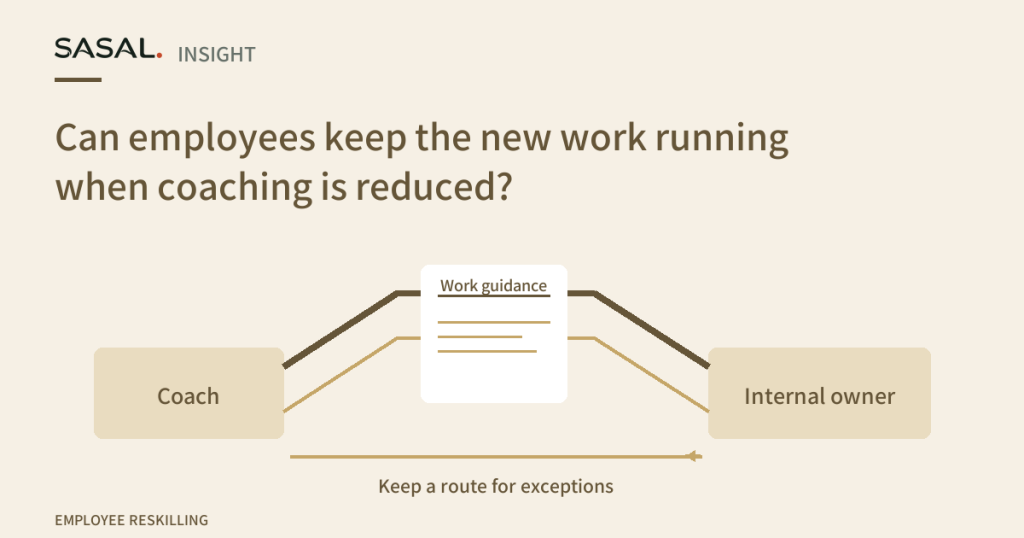
A new task can appear to run smoothly because a coach is still supplying decisions, correcting work and connecting the employee with the right reviewer. Before reducing that help, establish what the company will need to maintain internally. The decision reaches beyond whether one person can complete an assignment: it includes ordinary inputs, approval, usable guidance, absence cover and a route for exceptions. Different tasks can be ready for different levels of support. The company may reduce routine coaching while retaining appropriate specialist advice. This review concerns existing employees taking on agreed work, with department leaders retaining responsibility for assignments and decisions. Its purpose is to identify a workable internal arrangement and the conditions under which that arrangement should be revisited.
Distinguish individual performance from department readiness
An employee may complete a new assignment successfully while an external coach is still choosing the inputs, answering questions and correcting the result before anyone else sees it. That is useful progress, but it leaves several questions about ordinary operation unanswered. Who identifies the next assignment? Can the employee obtain the necessary information? Who reviews work when the coach is absent? Before reducing support, identify what the coach actually contributes during a normal task. Include preparation and intervention outside scheduled meetings. A record of the final accepted output can conceal the decisions and corrections that made acceptance possible, so examine how the result was reached as well as the result itself.
Individual capability and departmental readiness require different evidence. A person can know how to perform a task while the department lacks an available approver, a maintained procedure or a colleague who can cover ordinary absence. Conversely, a department can possess excellent instructions without having anyone who can apply them to the work now arriving. Review these conditions together when deciding whether support can change. Otherwise, a capable employee may become the place where unresolved operating problems accumulate. The resulting delays would say little about the quality of the learning, because the employee would be working within an arrangement that cannot supply what the task needs.
Start with one defined piece of work and follow it through an ordinary operating period. Ask the employee and coach separately where help was needed, then compare those accounts with the working records. A coach may regard a short intervention as incidental while the employee depends on it to distinguish acceptable work from an exception. A manager may believe approval is immediate while completed outputs routinely wait. Differences between these accounts are useful questions to investigate. They should not become a contest over whether the employee is independent. The decision concerns which responsibilities have a reliable internal owner and which still depend on support that must remain available.
This assessment retains the company's people and decision-making authority. Reducing coaching does not mean asking employees to absorb the coach's work without a change in assignments, time or access. Some support can become a normal internal review responsibility; some can be reduced because the employee can now perform it; some may appropriately remain external. Department leaders should agree that division with the people who will operate it. The practical starting point is a list of the work being done and the assistance it currently requires. That list gives the later readiness review something more specific to examine than confidence, course attendance or a general statement that the team is ready.
Name the work from which support may step back

Name the task from which support may step back before choosing an end date for coaching. Specify its usual inputs, expected output, recipient and retained approval. Identify the variations included in that scope and the circumstances that still require help. An employee might be ready to prepare a routine recommendation from complete records while needing assistance with disputed or incomplete information. Those are different operating conditions. Treating them as one capability can lead either to withdrawing support too early or continuing intensive support where it is no longer needed. A task-level decision allows the company to adjust assistance without pretending that an entire role has reached a single state of independence.
Use the actual work rather than an inventory of course subjects to define this boundary. A course may cover several concepts that appear in different tasks, and a task may require knowledge acquired through more than one activity. Neither course completion nor the number of sessions tells the manager which work can proceed with less help. Identify the outputs that have been accepted, the conditions under which they were produced and the assistance involved. If all accepted work used one familiar input or one customer's requirements, the evidence supports that scope. It does not automatically establish readiness for every assignment carrying the same job title.
Distinguish support for execution from support for decisions that the company intends to retain elsewhere. An employee can become more capable at assembling evidence, explaining an exception or preparing a recommendation while a manager or specialist continues to approve the consequence. Continued approval is not proof that the learning failed. It may be part of the intended operating arrangement. Likewise, retaining professional advice for an unusual legal, technical or financial matter does not make all routine work dependent on an external coach. State what kind of help remains, who provides it and how a request reaches that person. Avoid making independence synonymous with never asking a question.
A useful scope decision also identifies what has not been assessed. Work that has not occurred, a recently introduced tool or a changed customer requirement may remain outside the observed evidence. Record that limitation alongside the accepted tasks so a later manager does not infer a broader authorization from an optimistic handover note. The company can choose to keep support available for those cases, arrange appropriate practice or leave them with their current owner. The choice depends on the work and its consequences. A universal number of months cannot resolve it, and a commercial engagement date should not be treated as a substitute for the operating decision.
Preserve the decisions behind a procedure
A procedure should help an employee make the next decision in the work. Begin with the information and conditions that must be present before the task starts. Then describe the steps, checks and outputs in the order in which someone uses them. Screenshots can help a person locate a control, but they cannot explain why a particular choice is permitted or when the ordinary route no longer applies. Include the reason for the decisions that commonly need interpretation. The goal is a usable instruction for the agreed task, not a record of every conversation that occurred during coaching. A reader should be able to identify what applies to today's assignment.
Give the instruction a clear boundary. Explain which inputs it covers, what makes an output acceptable and which situations require referral. If several responses are permitted, describe the conditions that distinguish them rather than presenting one example as the only correct answer. If a decision belongs to another role, identify that role and the information it needs. This helps preserve a meaningful difference between a step the employee performs and a consequence the employee can authorize. Without that distinction, a detailed procedure can accidentally appear to grant powers that the company never intended to transfer. More pages do not compensate for an unclear approval boundary.
Review the document with someone who can perform the work but did not write the latest version. Ask that person to locate the relevant instruction, identify the required inputs and explain what would make them stop. Their questions reveal assumptions that the author may no longer notice. A missing definition, an inaccessible source or a reference to an outdated form is an operating defect worth fixing before coaching is reduced. The review should use material the person is permitted to see, and any exercise should preserve the controls required for live work. It is possible to test whether guidance is understandable without exposing a customer to an unreviewed decision.
Assign maintenance before treating the document as a completed deliverable. Name who can approve a change, who updates the working copy and how users learn that an instruction has changed. Preserve enough of the reason for a revision to explain why an old method should no longer be used. Remove or clearly retire superseded copies at the places where employees actually obtain them. A folder labelled current is insufficient if a team normally works from an attachment saved elsewhere. The company should also confirm its rights to retain and reuse material produced during external support. Possessing a file does not by itself settle every contractual or information-use question.
- Employee executionPerform the agreed task, check inputs and recognize exceptions.
- Internal review and coverReview outputs, maintain guidance and provide normal absence cover.
- Retained decisionsManagers and appropriate specialists keep the decisions assigned to them.
Ask employees to explain how the work is done
Ask an employee to explain a decision from a piece of work they have performed. Focus on the information they used, the alternatives they considered and the condition that made the chosen response appropriate. This reveals more than asking whether they understand the procedure. Someone can repeat a sequence accurately without recognizing why the sequence changes when an input is missing. Equally, an employee may explain a task clearly without using the coach's terminology. Evaluate the reasoning against the work, rather than treating vocabulary, presentation style or confidence as a direct measure of competence. The discussion should help identify what can be entrusted to the employee and what still needs support.
A useful follow-up asks what would cause the employee to take a different route. The answer should refer to an observable condition: an incomplete record, a conflicting request, a result outside an agreed limit or a decision reserved for another role. Ask where that condition would be checked and what the employee would do next. This tests whether the person can connect guidance to action. It does not require inventing a trick question or designing an unrealistic failure. Use variations that matter to the assigned work. If the necessary variation has not yet arisen, acknowledge that the evidence is limited instead of describing a successful explanation as proof of every future response.
Where an explanation is incomplete, identify the missing element before deciding on a remedy. The employee may understand the reasoning but lack access to the relevant record. The instruction may use a term with different meanings in two departments. The person may know that approval is required but not know who currently holds the role. Those findings call for different changes from a genuine knowledge gap. Record the specific question and the agreed response so it can be checked in subsequent work. Avoid translating a hesitant answer into a personality judgment, a claim of low motivation or a recommendation to change the person's character.
Observe work under ordinary operating conditions
Readiness should be observed under conditions that resemble the work the employee will actually receive. A task completed with unusually clean inputs, uninterrupted time and immediate coaching establishes something useful, but its operating conditions should remain visible. Examine whether ordinary requests contain the same information, whether the required tools and records are available and whether the normal reviewer can respond. Where the conditions differ, decide whether to improve the arrangement or retain assistance. Do not attribute every later difficulty to the employee simply because the demonstration was successful. The demonstration may have removed a constraint that still exists in everyday operation.
Keep the required safeguards during this observation. Testing independence does not justify bypassing an approval, withholding a needed specialist or allowing a learner to make a consequential customer commitment without review. Define the employee's task and the reviewer's task separately. An employee can prepare and explain work independently while the authorized person still approves its release. Record any help given before acceptance, including a correction the reviewer made directly. Otherwise, a clean final output may be reported as independent work even though important reasoning was supplied by someone else. The purpose is an accurate account of the support needed, not a staged performance in which nobody is allowed to help.
Look across representative work rather than selecting only the easiest accepted result. The relevant variation depends on the task: different inputs, ordinary exceptions, changes in volume or the presence of a less familiar recipient may matter. There is no universal number of repetitions that establishes readiness for every kind of work. Choose observations that address the uncertainty in the proposed operating change. If the manager is concerned about incomplete requests, more examples with complete information will not settle that question. If the concern is access during another shift, a demonstration during the coach's normal hours does not establish that the needed support will be available later.
Define who will interpret the observations and authorize any change in responsibility. The coach can explain the evidence and recommend a narrower or wider scope. The employee can point out conditions missing from the review. The department leader remains responsible for the assignment and should involve any other owner whose authority or workload is affected. Record accepted work, remaining limits and the next action in language that the receiving manager can use. A statement such as ready for routine work needs the routine conditions attached to it. If the evidence remains mixed, the company can reduce support for one part while preserving it for another.
Keep an available route for exceptions
A capable employee should know when a task has moved beyond the agreed scope. Build that recognition into internal operation rather than treating every question as dependence on the coach. Identify the kinds of issue that return to a manager, a process owner or an appropriate professional. A missing source document, a conflict between instructions and a decision about accepting a commercial consequence may require different recipients. The escalation route should show what information accompanies the request and what the employee may continue while waiting. A list of names without those boundaries can leave work stalled even though every participant knows whom to contact.
Check whether the person receiving the question can act. They need the relevant authority, enough information and time to respond within the operating conditions of the task. If they can only forward the question, identify the next decision owner before withdrawing the coach who previously made that connection. This is particularly relevant where departments or locations work different hours. The employee should know whether the work can wait, whether a permitted alternative is available or whether a customer or internal recipient needs an updated expectation. Do not make an informal assumption that a colleague will remain available outside agreed working arrangements to preserve the appearance of independence.
Keep referral quality visible in the readiness review. An employee who detects a genuine exception early and provides the required evidence may be performing the task well even though another person makes the final decision. By contrast, repeatedly sending ordinary questions without the information needed to answer them may show that the guidance or learning needs attention. Examine which of those situations is occurring before trying to reduce the number of questions. A target that rewards fewer escalations can hide unresolved problems if employees learn that asking for help is treated as failure. The useful outcome is an appropriate decision at the right level, supported by enough information to act.
Retained specialist support should have a defined place in the arrangement. Agree how it is requested, the scope it covers and the internal person who owns the resulting decision or action. Do not assume that an external coach can absorb work outside the agreed service simply because the employee encounters it. Some matters will remain with the company's existing advisers or other authorized providers. Clear boundaries let the employee operate confidently within the work they have learned while preserving access to expertise where it is needed. The readiness record should therefore describe both what can now proceed internally and the support that intentionally remains available.
Check normal absence cover
Ordinary absence is a practical test of whether the department can maintain a task. A backup named in a staffing chart may lack the information, access or experience required to perform it. Identify which work must continue when the main employee is on leave and which work can wait under existing commitments. Then determine who can cover the retained scope. This does not require every colleague to learn every task. It requires an arrangement that matches the actual work and the consequences of delay. A narrow, clearly supported backup role can be more usable than a broad designation that nobody has had time to prepare for.
The backup needs an opportunity to use the guidance and perform relevant work before being relied upon. Confirm that permissions, records and review routes are available to that person rather than tied only to the main employee's account or informal contacts. Where access is restricted for a legitimate reason, obtain an appropriate arrangement through the authorized owner; do not share credentials to make the handover appear complete. Ask the backup to identify unfamiliar decisions and the support they would need. Those questions can reveal a dependency on the original employee's memory that the current procedure does not yet explain. Resolve the dependency or retain a stated limit on the cover.
Covering active work also requires a record of its present state. A procedure explains how a task should be performed; it does not tell the backup which request is awaiting a decision, what has already been promised or which information remains unconfirmed. Agree how the main employee leaves those facts available before an ordinary handover. The backup should be able to identify the next permitted action without reconstructing the entire history from messages. If the handover occurs before a pending approval, make that limit explicit so continuity is not mistaken for authority to decide. When the employee returns, reconcile the changes made during cover and restore a clear owner for unfinished work.
Coverage also requires time. A colleague who can perform the task may already be responsible for work that peaks at the same moment. Review the combined commitments with the department leader and agree what changes when cover is activated. Transferring a task to someone else does not remove its workload. If only part can be covered, identify the part and the person who manages the remaining commitments. Keep this review focused on ordinary operation after learning. Wider disruption and crisis recovery require their own arrangements; the immediate question is whether normal absence will recreate the coaching dependence that the company is preparing to reduce.
Avoid concentrating every question in one person
An internal colleague who helps others learn can become a new bottleneck if every question, review and procedure update is assigned to them. Before reducing external coaching, identify what the internal support role will involve. Separate questions about a current assignment from maintenance of guidance, interpretation of an exception and approval of a consequence. These activities do not always need the same person. Assign them according to the company's operating responsibilities and the knowledge required. This makes support easier to maintain than an informal instruction to ask the most experienced employee whenever something is unclear.
Give the internal coach a defined workload and a route to reset priorities. Preparation, reviewing work and answering questions consume time even when they happen outside a scheduled session. Examine which existing duties remain with the person and who can reduce or cover them. A successful learning program can otherwise transfer external support costs into unrecognized internal effort. That does not mean the transfer is inappropriate; it means the company should understand what it is assigning. The department leader should agree the balance and review it when demand changes, rather than leaving the coach to decide privately which obligations will receive less attention.
Use recurring questions to improve the work guidance where appropriate, but avoid turning every answer into a permanent rule. Confirm the circumstances of the question and whether the answer applies beyond that instance. A response based on one customer's terms or one unusual record may need a narrow note rather than an amendment to the standard procedure. Assign a person who can approve the interpretation before distributing it widely. This prevents the internal coach from becoming an unofficial policy maker simply because they answer questions quickly. The company retains ownership of operating rules and authority even when a knowledgeable colleague helps others apply them.
Support should also be able to continue when the internal coach is unavailable. Identify which questions can be answered through maintained guidance, which can wait and which need another authorized person. Make that route visible to employees who may hesitate to interrupt a senior colleague. Review whether the resulting arrangement actually reduces unresolved work, rather than measuring success only by the number of questions answered. If the coach spends increasing time correcting the same issue, examine the task, the guidance and the available practice. More internal coaching time is one possible response, but it should follow diagnosis of what is preventing the work from becoming reliable.
Maintain materials and access internally
Internal operation requires access to the materials people use, not simply possession of a final report. Identify the working instructions, examples, source records and decisions that the employee needs to perform the agreed task. Confirm where each is maintained and which version should be used. A handover can look complete while the only useful explanation remains in the coach's notes or an account the company cannot access. Resolve those dependencies before relying on the new arrangement. If some material cannot be transferred, explain the restriction and agree a usable alternative within the relevant information-use and contractual conditions.
Rights and permissions need to be considered at the level of the material and its intended use. A document prepared during support may contain third-party content, customer information or material shared for a limited purpose. Do not assume that making it available to one employee authorizes distribution across every location or to another provider. Identify who can decide the permitted use and record any practical limits. The aim is to give the people doing the work an appropriate, current resource while respecting the conditions attached to it. Unclear ownership should become a question for the relevant owner, rather than an invitation to copy everything into a shared folder.
Keep access arrangements aligned with the internal roles. Employees should obtain the records required for their assignment through the company's approved routes, and changes in responsibility should reach the person managing those permissions. Confirm how the working instruction is updated and how a user recognizes that an older version has been replaced. Avoid relying on a particular platform feature unless it is actually available in the organization's tools. The operational requirement is that authorized people can find and use the current material. How the company implements that requirement can vary without changing the learning or readiness decision.
Record maintenance as continuing work rather than a one-time handover task. A named owner should review changes in the process, decide whether guidance needs revision and communicate the result to affected users. The owner also needs a route for questions that exceed their authority. This keeps the document connected to the business instead of leaving it as evidence that a project once finished. The readiness decision can then refer to a maintained body of guidance, with known access and use conditions, rather than a large collection of files whose status is unclear.
Review after coaching involvement changes
Reduce coaching in a way that lets the company observe the resulting operating arrangement. Name the task and the support being changed: fewer routine checks, employee-led preparation, a narrower external review scope or another clearly described difference. Keep the assistance that remains necessary visible. If several forms of help disappear together, a later problem may be difficult to diagnose because the company cannot tell which change mattered. A task-level adjustment is easier to examine against accepted output, review effort and exception handling. It also gives employees a clear account of what they are expected to do differently.
Agree what the internal reviewer will watch after the change. The relevant evidence may include whether work reaches the recipient in usable form, where corrections occur, whether exceptions reach the right person and how much support internal colleagues now provide. The purpose is to understand the arrangement under normal conditions, not to create a new layer of unnecessary reporting. Use existing work records where they answer the question. If an additional observation is needed, define its purpose, owner, permitted readers and appropriate retention. Individual learning feedback should not acquire unrelated uses merely because it is convenient to collect during the transition.
Interpret difficulties before deciding that support must either end or return in full. A problem limited to one exception may justify retaining help for that condition while ordinary work continues internally. An inaccessible record may require an access decision rather than more teaching. Repeated correction of the same reasoning may call for renewed practice or a narrower assignment. State which explanation is supported by the work and which remains uncertain. Employees should be able to raise these issues without treating the request as a confession of failure. Restoring suitable help can be an appropriate operating decision when the evidence shows that the arrangement needs adjustment.
A support change should have a practical route back to the people who can act. Name who can request additional help, who authorizes a change in scope and how current commitments are handled while the matter is resolved. This does not guarantee that an external provider can immediately supply any requested work; availability and scope still need agreement. It does make the company responsible for deciding what happens next. Record the outcome of the review so a later manager can distinguish a temporary support adjustment from a permanent expansion of the employee's responsibility. The employee's learning and the surrounding arrangement can then improve together.
- Adjust defined supportSpecify the task and the assistance that changes.
- Observe ordinary workCheck accepted output, corrections and internal review effort.
- Resolve the causeAddress guidance, access, practice or retained support as the evidence requires.
- Update the arrangementRecord owners, limits and the next conditions to review.
Apply the revised arrangement to the next work
Revisit competence when the work changes

Evidence of readiness belongs to a defined version of the work. A new tool, changed customer commitment, revised input or different approval rule can alter what an employee needs to know. Identify the owners who learn about those changes and how they notify the people performing the task. The employee should not be expected to discover every change through an error in live work. This is especially relevant where information passes between functions or locations before reaching the person who uses it. A maintained procedure needs a connection to the decisions that change the procedure, as well as an owner who can edit the document.
A changed instruction also needs a clear application point. Decide whether it affects work already in progress, only new requests or a narrower set of conditions. Employees can otherwise use different versions while each believes they are following the current method. The appropriate owner should resolve that boundary and any effect on existing commitments before asking people to apply the change. Record what happens to pending work and how the reviewer will distinguish the old and new conditions. This is part of maintaining the assigned task; it does not give the guidance owner permission to alter contractual commitments or approval rights that belong elsewhere. Where a decision remains open, preserve that limitation in the instruction.
Assess the effect of a change on the agreed task before prescribing another broad training program. Some changes require a revised instruction and confirmation that the employee understands it. Others alter the judgment, evidence or authority involved and may need supported practice or retained specialist review. Compare the new condition with what was actually demonstrated earlier. A strong record of previous work helps here because it shows the scope of the earlier evidence rather than relying on a general label of competence. Keep the response proportionate to the change while preserving any safeguards required for the work now being performed.
The company should also review guidance when employees repeatedly create workarounds. A workaround may reveal an instruction that no longer fits the task, but it may also bypass a necessary control. Ask what prevents the ordinary route from working and which consequences the alternative creates. The person responsible for the process should decide whether to revise the method, restore the required route or obtain further specialist input. Do not let an informal improvement become the accepted procedure solely because several people use it. The learning can contribute to a better method while the company retains responsibility for authorizing how that method will operate.
Record internal ownership and retained support
The final readiness record should support a specific operating decision. Identify the tasks that can proceed with less coaching, the conditions included in that scope and the evidence supporting the change. Name the employee performing the work, the internal reviewer, the backup and the owner of maintained guidance. Retain the decisions that remain with management or specialists, together with a usable route for questions. This record should describe an arrangement that exists, rather than list roles the company hopes to fill later. Where a necessary condition is still pending, keep the relevant part of the decision conditional.
Connect the decision to the work that internal people will now absorb. A department may need to allocate review time, maintain instructions or cover a colleague's absence after external involvement changes. Those are real assignments, even when they do not create a new invoice. Department leaders should agree them with the affected people and check any relevant employment or local requirements where responsibilities change. Retaining the same headcount does not make all capacity interchangeable. The company should understand both what employees have learned and what the department must continue providing for that knowledge to be usable.
Confirm that the receiving owners have actually accepted their continuing responsibilities. Sending a document to a distribution list does not establish that someone has time to review work, maintain an instruction or answer an exception. Ask each owner to confirm the task they will perform, the information they need and any unresolved condition. A partial acceptance can be useful when it makes the remaining limit clear: routine preparation may proceed internally while a specified review stays in place. Keep responsibility for the unresolved part visible rather than treating the handover meeting as an automatic transfer. The company can then implement the accepted arrangement without losing track of the work that still needs a decision.
State which external help remains appropriate without treating its continued use as an incomplete outcome. Specialist advice, occasional review or support for a different task can coexist with reliable internal operation of the work already learned. The useful question is whether each responsibility has an owner who can perform it under the actual conditions. An employee who completes agreed work, recognizes its limits and obtains the right decision on an exception is contributing to that arrangement. Complete isolation from outside expertise is neither a necessary description of capability nor a sensible substitute for the company's existing authority and professional responsibilities.
Finally, record what would reopen the decision. A change in the work, repeated quality problems, unavailable cover or a material increase in internal review effort may justify another assessment. Name the person who receives that information and the action they can authorize. This keeps the readiness record useful after the initial review meeting has ended. The company can reduce assistance where the work supports it, retain help where it is still needed and revise the arrangement as responsibilities develop. The decision rests on observed work and maintained operating conditions, rather than on a promised date or a broad declaration that the entire department is now self-sufficient.