

How do you measure reskilling when headcount stays the same?
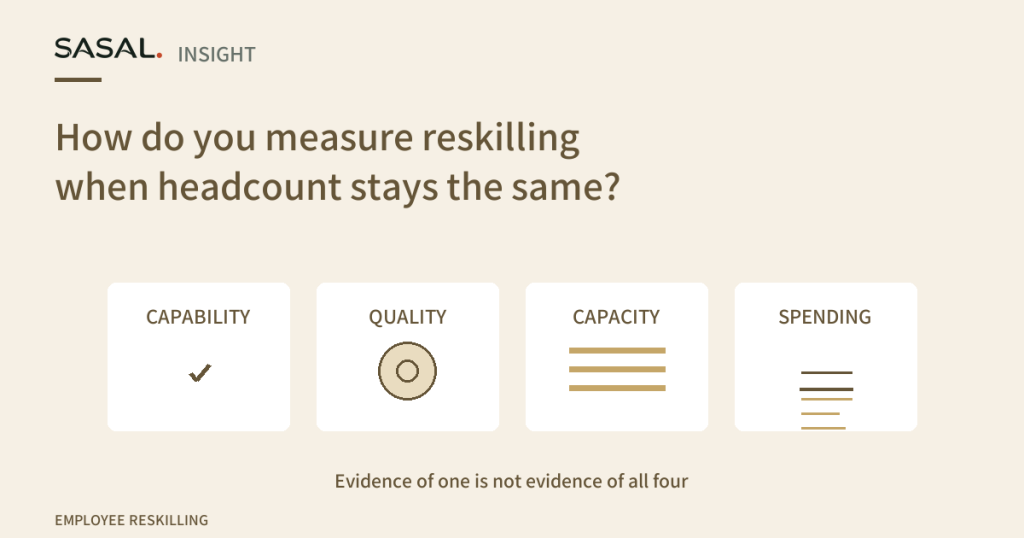
A reskilling report can show completed learning, faster tasks and a large estimated saving without establishing that the company has more cash or more useful work. These are different conclusions. When existing employees remain in place, the review needs to show what changed in their assignments, what happened to quality and how any available time was used. It also needs to include the effort required from coaches, reviewers and colleagues. The purpose is to decide whether to continue, change or extend the work on evidence the business can explain. Start with comparable tasks and an explicit decision, then trace capability, operating results, capacity and financial consequences separately. A result can be useful without supporting every type of benefit.
Define the change the next investment decision needs
Start with the commitment the review will decide. A manager considering another learning period needs different evidence from a manager considering a wider rollout, a revised task assignment or a reduction in external support. Identify the choice, the person authorized to make it and the uncertainty that matters. This prevents the report from becoming a collection of available measures with no clear use. Attendance, completed exercises and employee feedback may all be relevant, but they do not answer every operating question. Select the evidence because it helps the company decide what to do next, not because it is easy to extract from a learning system.
Separate four questions. Has the employee demonstrated the relevant capability? Has the work changed under actual operating conditions? Has the change made time available for another purpose? Has that time or another operating change produced a financial effect? Each question requires evidence that the previous one cannot supply by itself. An accepted exercise does not establish performance under all live conditions. A shorter task does not establish that useful time has been reassigned. Reassigned time does not establish additional revenue or reduced spending. Keep those distinctions visible so a positive result at one level does not become an unsupported claim at another.
Agree which change would justify the next commitment before interpreting the results. The company may value better quality, a dependable internal capability, less reliance on an external task or the ability to complete work that was previously postponed. The relevant outcome need not be a reduction in payroll. Existing employees remain part of the operating model, and their compensation can continue unchanged while their assignments become more useful. A review should explain what the business intended to gain and what it actually observed. It should not invent a cash saving simply because the original purpose is difficult to express in financial terms.
Define the boundaries of the assessment. State the tasks, people, period and operating conditions included, and identify related activity outside the scope. If the review covers one department, do not present the result as evidence for every location. If it covers a learning period, distinguish temporary practice conditions from ordinary operation. The boundaries make the conclusion interpretable for a later reader and provide a basis for comparing another period. They also help the company identify what further evidence it needs before making a larger decision rather than repeatedly collecting more information about the same narrow result.
Define comparable work

Choose a unit of work that corresponds to a usable output. The unit might be a completed request, an accepted analysis or a defined review, depending on the assignment. Describe what must happen before it counts as complete. A draft awaiting substantial correction is not necessarily comparable with an output already accepted for use. If the team changes the completion definition during the learning period, record the change and decide how the comparison should be interpreted. Otherwise, the report can show an apparent improvement simply because it starts counting work at an earlier point in the process.
Specify the included steps as well as the output unit. An employee may now finish preparation faster because another person performs a check that used to be included. That is a change in the division of work, not evidence that the entire task requires less effort. Trace preparation, review, correction and approval to the roles that perform them. Decide whether the measure concerns the employee's part or the combined work, and label it accordingly. Either can be useful for a particular decision, provided the report does not shift between them while preserving the same name for the result.
Check whether the work being compared has similar demands. A period with straightforward requests can differ from one with missing information, unusual requirements or more exceptions. The same job title and the same number of completed items do not establish comparable work. Identify the characteristics that materially affect effort or quality, then separate or explain them in the review. Avoid creating a complicated classification that the records cannot support. The aim is enough distinction to prevent a misleading conclusion, not a model that gives uncertain observations an appearance of precision through a large number of categories.
State the denominator whenever a rate or average is used. Explain whether the measure covers all items received, all items completed or only the items selected for review. Those populations can differ, particularly when difficult work remains unfinished. A faster average among completed tasks may coexist with an increasing backlog of exceptions. Read the completion measure alongside the work still waiting and explain the selection of any sample. This allows the decision maker to see whether the improvement concerns the actual operating load or only the portion that was easiest to finish during the observation period.
Record a usable baseline
A baseline describes the work before the change well enough to support the intended comparison. Begin with records the company already keeps: accepted outputs, review comments, timestamps, corrections and relevant workload information. Determine what those records actually establish. A system timestamp may show when an item changed status without showing how long someone worked on it. A manager's recollection may identify a recurring problem without supporting a precise average. Use each source for the question it can answer and record limitations instead of turning incomplete historical information into an exact measurement through assumption.
Include ordinary variation in the baseline. Period-end activity, recurring peaks, absence cover and differences in case mix may affect the work. A short, unusually quiet period can be useful for understanding a particular task but may not represent the conditions the company intends to maintain. Explain why the chosen period or sample is relevant and which conditions it omits. Where another period is available, compare the context before combining results. The objective is a defensible starting point for the decision, rather than a search for the historical period that makes the new arrangement appear most favorable.
If direct observation is needed, keep it proportionate to the question. A bounded review of work and employee discussion may establish where effort occurs without continuous monitoring. Explain the purpose, who can use the information and how it will be handled. Ask employees to correct omissions such as hidden rework or interruptions that the formal record does not show. Those contributions help interpret the task; they should not be used as a pretext for creating unexplained individual speed rankings. More detailed data is useful only when it improves the decision enough to justify the burden and the conditions attached to collecting it.
Where no reliable baseline exists, say so. The company can document current work and begin a forward comparison, or use the available information for a narrower conclusion. It may be able to establish that an employee now performs a task without establishing the exact amount of time saved against the past. That finding can still inform an operating decision. Distinguish what is demonstrated from what remains estimated, and identify the next observation that would improve the assessment. Inventing a retrospective baseline would make the report look complete while weakening the reasoning on which the next commitment depends.
Separate working time from elapsed time
Working time and elapsed time answer different questions. Working time concerns the effort people devote to the task; elapsed time concerns the interval between agreed starting and finishing points. A request can spend little time in active handling and remain open while waiting for information or approval. Reducing preparation effort may create capacity without changing the completion date if the same queue remains. Conversely, a shorter wait may improve service without reducing the employee's active work. State which change the company is trying to achieve so the measure does not confuse a faster process with a reduction in labor effort.
Break the task into stages where that distinction affects the decision. Identify preparation, waiting, review, correction and release without assuming every stage has a separate owner or system record. Ask what information is available for each stage and where an estimate is necessary. The analysis should reveal which part of the process changed and which part still constrains completion. It should not become a detailed map maintained for its own sake. If the next decision concerns reviewer availability, more precise measurement of typing or document formatting will not resolve the uncertainty that actually matters.
Do not add overlapping elapsed periods as though they were employee hours. Two people may work together during the same meeting, or one request may wait while the employee handles another task. The meeting has one duration but consumes time from each participant. Waiting can affect the customer's experience without occupying the employee continuously. A report should preserve those distinctions when moving from process timing to resource planning. Otherwise, it can overstate or understate the effort associated with a task and produce an unreliable estimate of the capacity available for new assignments.
Read time changes alongside the operating constraint. If the employee's preparation is faster but approval remains the limiting step, the department may need a different decision about review capacity. If elapsed completion improves because requests arrive with better information, the result may reflect a process change as well as employee learning. Explain that relationship without forcing all observed progress into a single reskilling measure. The decision maker can still value the combined improvement while understanding which part depends on continued capability, which part depends on the surrounding process and what another department would need to reproduce it.
- Working timeEffort devoted by the people performing, checking and correcting the task.
- Elapsed timeTime between defined starting and finishing points, including waits.
- Usable outputWork accepted for its intended purpose at the agreed quality.
- Cash expenditurePayments that actually change, kept separate from time allocation and unpaid obligations.
Review quality alongside speed
Speed has value only in relation to the work the company intends to receive. Define the quality conditions alongside the time measure: necessary information, correct reasoning, retained controls and suitability for the recipient's next action. Keep those conditions consistent when comparing periods. If the organization deliberately changes the standard, explain the decision rather than presenting the resulting speed change as an improvement at the same quality. A shorter output, fewer checks or a narrower responsibility may be appropriate, but the comparison needs to acknowledge that the work itself has changed.
Look at the path to acceptance. An output corrected by the reviewer can be suitable for the business while providing different learning evidence from an output the employee completed without that correction. Record where rework occurs and who supplies it. A reduction in the employee's visible time may be offset by additional checking or repair elsewhere. The review should not hide that contribution simply because the customer receives a satisfactory final result. Equally, a small presentation correction should not automatically be treated as equivalent to a decision error with a material consequence. The kind of correction matters to the interpretation.
Choose quality observations that fit the assignment. Some work permits a direct check against a defined record or rule. Other work requires a reviewer to explain why a recommendation is usable under the stated conditions. Where judgment is involved, make the acceptance basis explicit and examine differences between reviewers before treating them as differences in employee performance. Use feedback from the output recipient where it helps establish whether the work served its purpose. Satisfaction alone is not a complete quality measure, but an output that meets an internal checklist and cannot be used by its recipient also needs investigation.
A review may find that quality improved while task time remained similar. That can still be a meaningful result if the company needed more dependable work, fewer consequential errors or less uncertainty at a retained decision point. Explain the benefit in its own terms and the evidence supporting it. Do not force the result into a time-saving claim merely because time is easy to compare. The next commitment should reflect the business purpose of the assignment and the cost of maintaining the improved work. A balanced assessment can recognize useful progress while leaving its financial consequence unquantified where the evidence is insufficient.
Include the effort needed to learn
Include the effort required to establish the new way of working. Employee practice, coaching preparation, output review and correction all consume time, including work that happens outside scheduled sessions. Identify who performs it and the period it relates to. Distinguish the initial effort to learn or redesign a task from the support expected to continue in ordinary operation. This does not mean that initial effort should be ignored. It allows the decision maker to understand why a learning period and a later operating period may have different resource requirements and why one should not automatically be projected as the other.
Temporary duplication needs similar treatment. The company may continue an existing method while reviewing a new output, or retain closer supervision until the employee has demonstrated a defined scope. Record that overlap and the condition under which it can change. Do not assume it will disappear merely because a calendar date has arrived. The decision may depend on accepted work, an available reviewer or another operating prerequisite. At the same time, avoid treating all temporary effort as a permanent cost if the company has evidence and an agreed plan for reducing the overlap under the appropriate conditions.
Measure internal time and external spending in forms that remain understandable. Staff hours, provider fees, tool charges and other expenses are different inputs. The company may convert some time into an estimated cost for a particular analysis, but it should explain the basis and keep that estimate distinct from an additional payment. A coaching meeting can use both an external provider and internal employees; the provider's invoice does not include every internal resource consumed. Conversely, an internal cost allocation should not be added again as if the same hours created a second cash expense. State the perimeter and calculation basis before combining the figures.
The review should also capture support that remains after the initial learning activity. Guidance needs maintenance, some outputs still require approval and new conditions can create further questions. Those responsibilities belong in the continuing operating arrangement. If the apparent improvement depends on unusually intensive attention from a manager, explain that dependence before presenting the result as ready for a wider team. The company can decide that the support is worthwhile, adjust it or narrow the scope. What matters is that the next commitment is based on the work required to sustain the result, rather than only on the work performed by the employee whose task is being measured.
Trace how available time was used
A reduction in effort creates a possibility for another use of time. Establishing that possibility is different from showing that the time has been assigned and used. Identify the work the company intended employees to take on, the person responsible for assigning it and the recipient who will use the result. A general aspiration to spend more time on improvement leaves those decisions unresolved. The measurement review should trace whether a concrete reassignment occurred and what work followed. If the business has not yet chosen that use, report available capacity separately from any benefit attributed to the new assignment.
The form of the available time matters. Short intervals spread across a day may not support a task that needs sustained attention, access to another person or a particular operating window. A reduction in one step can also leave the employee waiting for the next obligation rather than able to begin different work. Examine the schedule and dependencies before treating the estimate as immediately usable capacity. The company may need to combine tasks, change priorities or arrange a suitable window. Those are operating choices, and their feasibility should be assessed rather than assumed from the subtraction of one time estimate from another.
Confirm that the reassigned work has an actual use. Ask whether its output was accepted and what decision or activity it supported. An employee can spend the newly available time producing material that nobody has capacity to review, in which case the company has moved the bottleneck rather than established the intended benefit. Compare the recipient's expectations with the work delivered and identify any remaining dependency. This does not make the original time reduction worthless. It shows that another decision is needed before the company can describe the released capacity as a contribution to useful new work.
Keep the result separate from a revenue or profit claim unless additional evidence supports that claim. An accepted analysis, improved process or completed backlog item can be valuable without a directly observed financial effect. If the company estimates a future benefit, identify the assumptions, the owner responsible for realizing it and the conditions that remain uncertain. Do not describe an estimate as an observed return. The next review can then examine whether the expected use occurred and update the decision. This is more useful than treating every available hour as if it automatically generated a fixed amount of money.
- Demonstrated capabilityThe employee performs and explains the agreed work under observed conditions.
- Changed operating workComparable output improves with quality and support effort accounted for.
- Capacity put to useAvailable time is assigned to work with an actual recipient and accepted result.
- Supported financial effectActual or credibly avoided spending and other outcomes are assessed separately.
Distinguish payroll allocation from cash savings
Retaining employees means their payroll can remain unchanged while the distribution of their work changes. A smaller share of time spent on a routine task can be shown as a change in allocation, but it is not necessarily a reduction in cash paid. Explain that distinction in the report, especially when a chart uses payroll-associated amounts to describe time. The company may gain capacity, quality or a different internal capability without lowering salary expenditure. Those benefits should be assessed honestly rather than translated into an implied headcount reduction that is outside the intended reskilling arrangement.
An allocated labor cost can still be useful for comparing uses of resources if its purpose is clear. State which compensation and related amounts the estimate includes, the period and the time basis used. Do not compare a fully priced external service with only a portion of internal effort while describing the result as an equal-scope cost comparison. Nor should an allocated internal amount be presented as money that becomes available to spend when a task is shortened. The estimate can inform a resource decision while the cash budget follows its own commitments and payment obligations.
Opportunity cost addresses what the company forgoes by using resources in one way rather than another. It is not automatically an additional cash payment. If an analysis considers both salary allocation and the value of alternative work, explain how the terms relate so the same burden or benefit is not counted twice. Avoid assigning a confident monetary value to alternative work that has no established demand, delivery capacity or usable output. The decision may still need that comparison, but the uncertainty belongs beside the estimate. A precise-looking amount does not remove an uncertain assumption about what the employee could otherwise have accomplished.
For operations across countries, preserve the scope and currency basis of any comparison. Different working arrangements, compensation structures and time periods can affect allocated amounts. Currency movements can alter a reported total without representing a change in employee capability. Explain the basis used and keep the operational observation visible alongside the financial conversion. The review still needs to establish what changed in the work and what the company can reasonably infer from it. A financial presentation should help that judgment rather than allow an exchange-rate effect, an allocation change or a different accounting perimeter to appear as a reskilling result.
Assess changes in hiring and external support carefully
A claim about avoided hiring or outsourcing needs a credible alternative. Identify the work that would otherwise have required the additional resource, its expected scope and the basis for the company's plan. A vague intention to hire someday does not establish a saving when that hire does not occur. The company should distinguish an approved or otherwise well-supported requirement from an option that was only discussed. Where the alternative remains uncertain, describe the result as a possibility or scenario rather than a realized financial effect. The credibility of the comparison depends on the decision record, not on the size of the amount assigned to it.
Compare equivalent work and conditions. Existing employees may now perform a defined portion of an external assignment while the provider continues to supply another part. A difference in spending could reflect reduced scope, changed demand or a different level of service. Identify those changes before attributing the whole difference to reskilling. Include the internal review, maintenance and exception work required by the new division. This is an evaluation of the resulting arrangement, not a rule that bringing work inside is always preferable. Professional or local expertise may appropriately remain external even when employees have developed related capability.
Separate a decision to defer spending from evidence that spending has actually been avoided over the period being reviewed. Timing can matter. An external commitment may continue until its agreed end, or a hire may be delayed while the company tests whether internal capacity is sufficient. Record the actual cash consequence and any obligation that remains. Do not book the same anticipated reduction repeatedly in successive reviews. If the company counts a reduced provider payment, explain how that result relates to the time reassigned internally so the same effect is not presented as two independent financial benefits.
Review whether the alternative remains workable as demand changes. A team may cover the current assignment internally but need additional support when volume, complexity or response requirements increase. That does not invalidate what was achieved under the earlier conditions. It limits the scope of the conclusion. State which work and period the assessment covers and what would reopen the resource decision. The company can then recognize an evidenced reduction or deferral of spending while maintaining an accurate view of future capacity needs, rather than treating one operating period as proof that external support or hiring will never be needed.
Identify other changes affecting the result
Several changes can occur during the same period as employee learning. The company may improve inputs, adjust approval rules, introduce a tool, change supervision or receive a different mix of requests. Record these changes alongside the result. A before-and-after comparison can show that the combined arrangement produced different work without establishing how much of the difference was caused by learning alone. This distinction does not make the review unusable. It helps the decision maker understand what must continue and which conditions another team would need before expecting a comparable result.
Where comparable evidence is available, use it to examine alternative explanations. Look at work under similar conditions, changes in the surrounding process and the assistance provided. Explain the limits of the comparison. A team that did not participate may handle different tasks or have different access to information, so its result is not automatically a valid control. The company should not create an artificial impression of causality by labeling any other team a comparison group. Nor should it withhold necessary support merely to make a measurement design look cleaner. The assessment must fit the operating and employment context.
Distinguish the strength of the finding from the attractiveness of the explanation. The employee may now produce accepted work with less help, which directly supports a capability conclusion within the observed scope. A subsequent increase in departmental output may have several contributing causes. Additional revenue or profit is further removed and needs evidence about demand, delivery, pricing and cost. Preserve that sequence when reporting the result. The company can make a practical continuation decision from limited evidence while being explicit about what the evidence does and does not establish.
Use uncertainty to define the next observation. If the main question is whether the new method works under a normal level of supervision, review it under that arrangement while preserving required safeguards. If the concern is case mix, examine the relevant variation rather than collecting more examples of the easiest case. Name the person responsible for obtaining the evidence and the decision it will inform. This keeps evaluation connected to action. A report that merely lists many possible causes without identifying what to examine next leaves the company with caution but little basis for its next commitment.
Use measurement for its agreed purpose
Decide the purpose of the record before collecting individual learning information. Coaching, process improvement and a separately explained employment decision can require different evidence and different readers. State the intended use in terms the employee and reviewer can understand. A request to demonstrate progress does not automatically define who may access detailed feedback or how long it should be kept. Use the company's applicable arrangements and check the relevant local requirements where the activity calls for them. The measurement method should fit the legitimate decision rather than expand simply because a tool can collect more information.
Use aggregated process information where it is sufficient for the decision, while recognizing that aggregation does not always eliminate the possibility of identifying someone. Small groups, unusual tasks or detailed examples can reveal an individual even when a name is removed. Consider what the intended reader actually needs. A department leader may need to understand a recurring input problem without receiving every personal coaching note. A coach may need detail about one assignment that has no place in a wider management report. Keeping those uses distinct improves the relevance of the report as well as the handling of the information.
Employees should have a way to clarify an inaccurate account of their work. A time record may omit an interruption, a correction may have been caused by a changed instruction or an output may have waited for another person's decision. Examine those explanations against the available evidence rather than treating the original record as automatically complete. This is part of measuring the process accurately, not an exception that prevents meaningful review. Avoid inferring personality, motivation or general capability from a single result. The conclusion should remain tied to the observed task, its conditions and the question the review was designed to answer.
Name the owner of the measurement record and the arrangements for updating or retiring it. A finding can become misleading when copied into later reports without its original period, scope or limitations. Preserve the connection to the source evidence and identify changes in the conclusion. Where the purpose of use changes, review whether the existing handling arrangements still apply before redistributing individual information. The company can maintain useful learning evidence without turning every observation into a permanent judgment about the employee. The practical aim is a current, interpretable record that supports the agreed operating decision.
Read the evidence before extending to another team

Before applying a result to another team, compare the conditions that made it possible. Identify the task, the input quality, the employee's existing knowledge, the reviewer, the available practice and the use of any released time. Another department may share the task name while differing in several of those conditions. The earlier result provides a reason to investigate, not a guarantee of the same effect. Establish which elements can be reused, which need adaptation and which remain uncertain before multiplying an observed improvement by a larger number of employees or locations.
Check the receiving team's capacity as well as its need. A method that worked with close review may require attention that is not available at a larger scale. The coach or internal reviewer can become a constraint when more employees begin at once. Include that effort in the next scope decision and identify how it will be provided. Do not assume that a successful smaller assignment proves that support effort will fall in proportion as participation grows. The company may choose a narrower start, a different sequence or a retained support arrangement to make the next stage feasible.
Examine whether there is useful work for the capacity the next team might release. Demand that existed in the first department may not exist elsewhere, or the next team may face a different operating constraint. The intended benefit should be defined locally enough to be tested. A common learning method can still support different business uses, but those uses need an owner and an actual recipient. This avoids extending a program solely because the first report contained an attractive time estimate. The decision concerns what the next team can do differently and how that change will serve its work.
Choose a review point that addresses the uncertainty of the proposed extension. It may depend on seeing a relevant task variation, a complete operating cycle or work performed with the intended support arrangement. Explain the choice rather than prescribing one universal duration. Keep the commitments bounded by what the company can sustain, and state what evidence would justify continuing, changing or pausing the extension. This preserves the useful finding from the first team while preventing a limited result from becoming an unqualified promise about the whole organization.
Record the next commitment and its conditions
Write the review around the next commitment. State the scope assessed, the baseline used, the observed changes and the quality conditions that remained in place. Explain the support effort, any reassigned time and any financial effects with their separate evidence. Include important limitations, such as incomplete data, changed case mix or simultaneous process changes. The decision maker should be able to see why the recommendation follows without reconstructing the analysis from a collection of figures. A concise decision record can reference detailed material while keeping the essential reasoning available to the people responsible for acting.
Keep one measurement-register entry for each proposed benefit. Record its definition, baseline and comparison period, the owner of the data, the quality condition that must remain satisfied, relevant confounding changes and the decision the observation will inform. For a proposed reduction in rework, for example, the entry should identify the accepted output being assessed, the corrections included, the source of the earlier and current observations, and whether the input mix or review method changed. It should then state what result would support continuing, adjusting, widening or stopping the assignment. This is a suggested recording structure, not a numerical threshold or evidence that a benefit has occurred. Link the entry to the supporting work records so another reviewer can examine the basis and its limits.
Allow the evidence to support a change in plan. Good attendance and positive feedback do not require the company to expand a task that still lacks a usable output or adequate review. A quality improvement may justify continued work even where cash savings have not been demonstrated. A time reduction with no agreed use may call for a reassignment decision before further learning investment. State which condition matters and who can resolve it. This turns mixed results into specific choices rather than forcing the whole program into a single success or failure label.
Distinguish commitments already made from the additional work now proposed. The company may continue the accepted scope, revise a learning assignment, change the support arrangement, extend to another team or pause until a prerequisite is available. Describe the resources and evidence needed for the chosen next step without treating past effort as a reason to spend indefinitely. At the same time, preserve the capability and useful work already established. A decision to narrow or pause one part does not erase what employees have learned or require the company to abandon an arrangement that is working within its demonstrated scope.
Name the owner of the next action and the condition that will bring the matter back for review. Keep the record of assumptions with the decision so future readers can understand why it was reasonable at the time. As the work changes, update the conclusion from new evidence rather than repeating an old return claim. Measuring reskilling with retained headcount means following the sequence from capability to work, from work to usable capacity and from there to any supported financial effect. The value of the review is the quality of the operating decision it enables, including an honest account of effects that have not yet been demonstrated.