

How do you make group policies usable in each company’s language?
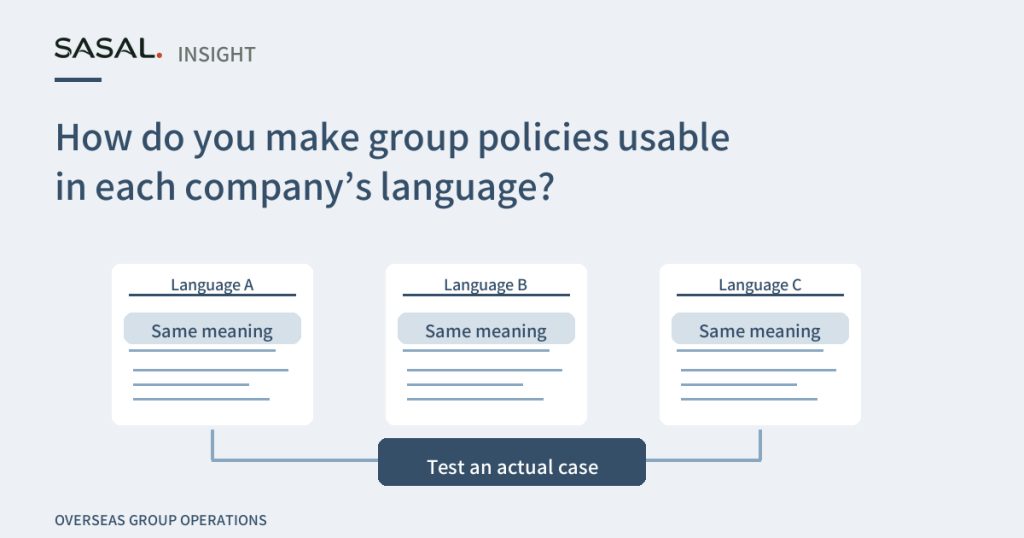
A policy can appear consistent across a group while producing different decisions in practice. One company may treat manager review as approval, another may view it as consultation, and a third may assume local HR decides. The resulting problem is rarely translation quality alone. Before release, organizations need evidence that readers can identify the applicable rule, the next action and the responsible decision owner in real situations. After release, they need records that show how questions, revisions and local applications are being handled. The objective is not identical wording everywhere. It is consistent interpretation of the decisions the policy is intended to support, while keeping approved company-specific differences visible and controlled.
Choose the action the translated policy must support
The starting point is the operational decision the policy is expected to influence. A translated document becomes useful when a reader facing an actual situation can identify which rule applies, what action should occur next and who has authority to decide. Policies that describe principles without connecting them to decisions often leave local teams filling gaps through custom or assumption. Before discussing language, the policy sponsor should therefore define the specific actions that must be performed consistently across companies. For example, a policy concerning approval authority may need readers to determine whether a request can proceed, who reviews it and which escalation path applies when normal approval is unavailable.
That decision focus should be documented in a short policy-purpose record. Useful entries may include the business process affected, the intended decision owner, the expected evidence supporting a decision and any known exceptions. The record helps reviewers evaluate whether a translation preserves the operational meaning. It also gives local companies a reference when questions arise after release. Without such a record, teams may debate wording while overlooking the underlying decision the wording is meant to support.
A practical test before publication is to use a small set of hypothetical cases that resemble routine work. One case might involve a standard request that follows the normal path. Another might involve an exception requiring additional review. Readers of different language versions can be asked to identify the applicable rule, the next action and the responsible role. If answers differ materially, the issue may lie in the wording, in the policy design itself or in an unresolved question about authority. The exercise helps distinguish these possibilities before conflicting practices become established.
Tradeoffs sometimes emerge at this stage. A highly detailed policy may reduce ambiguity but become difficult to maintain across several languages. A shorter policy may be easier to update yet leave too much interpretation to local managers. An organization can address this by keeping the policy focused on decisions and responsibilities while placing examples, explanations and process guidance in controlled supporting materials. The policy owner remains responsible for deciding where that boundary sits, while local companies contribute evidence about how the policy is likely to be used in day-to-day operations.
Agree the source meaning before translating

Translation cannot resolve policy questions that have not yet been decided. When the source document contains unresolved issues, different language versions may inadvertently embed different assumptions. Before any translation begins, the policy sponsor and affected companies should review the draft to identify open decisions. Examples include uncertainty about who approves an exception, whether a requirement applies to all entities or only some, and how reporting obligations interact with local operating arrangements. These substantive questions should be settled through normal governance rather than delegated to language work.
A useful review meeting separates wording issues from policy decisions. Participants can maintain a decision log containing the topic, alternatives considered, chosen interpretation, responsible approver and date. Suppose a draft states that managers must be informed before a particular action occurs. One interpretation might require notification after approval, while another might require notification before approval. The translation team should not choose between those meanings. The policy owner should record the intended interpretation and ensure that every language version reflects it.
Records become especially important when several companies participate. Teams working in different locations often need to understand why a particular formulation was chosen and whether further decisions remain open. Maintaining current versions, dates, authors and unresolved questions allows later reviewers to trace changes rather than reconstruct them from memory. This reduces the risk that an older draft or informal explanation becomes the reference point for one company while another company follows a newer interpretation.
There are situations where complete agreement cannot be reached before a target release date. In such cases, delaying publication of the affected section may be preferable to releasing text that invites conflicting application. Another option is to publish an approved interim position together with a clearly recorded review point. The key requirement is transparency about what has been decided and what remains under consideration. Language versions should communicate the same status. They should not create the appearance of certainty where governance decisions are still pending.
The review process should also identify who is authorized to approve future revisions. Without named ownership, local teams may respond to operational questions by editing translations independently. A controlled revision route preserves consistency and allows head-office and company representatives to discuss substantive changes directly rather than discovering them after divergent practices have already emerged.
Identify the audiences and working languages
Identify the audiences that must make decisions under the policy and the languages they actually use for that work, alongside any official company-language designation. Employees, line managers, HR personnel and head-office reviewers may all interact with the same policy differently. A manager approving a request may require precise definitions of authority, while an employee may need clear instructions on what information to submit. Understanding these audiences helps determine where explanations, examples or supplementary guidance are required.
Working language can also differ from legal entity language, reporting language or meeting language. A company may conduct daily operations in one language while reporting to the group in another. Specialist terminology may already exist in a third language through contracts, industry practice or professional training. Identifying these realities early reduces the risk that a technically accurate translation becomes difficult for intended users to apply. The objective is operational comprehension, not merely linguistic completeness.
A structured audience record can help coordinate this work. Fields might include the audience group, primary working language, typical policy-related decisions, required terminology and preferred document format. For instance, HR teams may require detailed definitions concerning approval, consultation and notification, while general employees may benefit from scenario-based explanations. Recording these distinctions makes later revisions easier because policy owners can evaluate which audiences are affected by a change.
Review should involve both policy owners and representative local users. A translation that appears clear to central reviewers may reveal practical ambiguity when read by people who perform the relevant work. If a manager and an HR representative reach different conclusions about authority in the same hypothetical case, the organization has discovered a useful signal before release. The solution may involve revising wording, expanding definitions or clarifying responsibilities in an annex. What matters is that the issue is identified through observation rather than assumed away.
Keep the company map separate from the language map. In a hypothetical group, two companies may read the same language while operating under different approved annexes; one company may need two languages for the same rule. A record with only one row per language would conceal that distinction. List the company, user role, shared policy version, applicable annex and language version together. A reviewer can then tell whether different answers are explained by company-specific application or by wording. This also identifies which readers need an update when one annex changes but the common policy does not.
Create a term record for high-consequence words
Certain policy terms carry operational consequences that extend beyond language preference. Words such as approval, consultation, notification, exception and effective date determine who may act, who must be involved and when a requirement becomes active. If each language version relies on a direct word-for-word substitution, readers may attach different procedural expectations to the same instruction. A term record provides a controlled reference for these expressions. Rather than storing only translated equivalents, the record can include a definition, the intended decision effect, the role responsible for acting and one or more examples drawn from real policy situations. The purpose is to preserve operational meaning when different languages offer several plausible expressions.
The policy owner should decide which terms enter the record because not every word justifies formal governance. A practical criterion is whether misunderstanding the term could change a decision, delay an action or alter accountability. For example, a policy may state that a manager must be consulted before an exception is granted. The term record can clarify whether consultation means obtaining advice, providing advance notice or securing agreement. Those possibilities represent different operating models. Recording the chosen meaning reduces the likelihood that reviewers interpret the translation through local custom. When revisions occur later, the organization can verify whether the approved definition itself changed or only the surrounding wording.
Examples are especially useful because readers apply policies to situations rather than dictionary entries. A term record entry for effective date might include a hypothetical example explaining how a request submitted before publication but approved afterward should be handled. Another entry for notification might specify whether informing HR satisfies the requirement or whether the employee must also be informed. Such examples do not replace the policy text. They demonstrate how the approved meaning works in practice and provide a reference when local teams raise questions during implementation. The examples should remain controlled documents so that future revisions update them together with the policy.
The record also becomes part of the organization’s knowledge trail. Maintaining current versions, revision dates, responsible owners and unresolved terminology questions allows reviewers in different companies to understand why a definition exists and whether it remains under review. A useful entry may contain fields such as term, approved definition, example scenario, approving role, date adopted and related policies. When disagreement emerges after release, the discussion can begin from the recorded meaning rather than from competing memories of earlier conversations. That approach helps distinguish a genuine policy question from a language question and supports more consistent interpretation across companies.
Where a word refers to a legally significant procedure, an internal terminology record cannot redefine that procedure for convenience. For example, employee consultation may require a different review from an informal request for a manager’s advice. Ask the appropriate specialist what the term means for the particular policy and entity, then preserve that distinction in the explanation. A term record should show the question referred and the approved meaning, rather than assigning every use of a familiar word to the same internal workflow.
Separate translation differences from approved local differences
Groups operating across several companies frequently need both consistency and legitimate variation. Difficulties arise when those two categories become mixed together. A translation difference exists when different wording expresses the same approved meaning. A local difference exists when a company is intentionally permitted or required to apply the policy in a different way. Readers should be able to identify which situation applies. If a language version quietly introduces a new approval step, removes a reporting obligation or changes the scope of an exception, the document is no longer functioning purely as a translation. The organization then risks operating under multiple policies without realizing it.
One practical method is to separate policy content into identifiable layers. The common text contains the shared requirements approved for all relevant companies. A company annex records authorized variations in application. Additional local requirements can be referenced where they are genuinely necessary for that entity's operation. Review responsibility should follow the same structure. The policy owner reviews common meaning, designated company representatives review annex content and appropriate specialists review matters that depend on specific legal, employment or contractual contexts. This structure makes it easier to see whether a proposed change belongs in the shared policy, the company annex or neither.
A worked hypothetical example illustrates the distinction. Assume a group policy requires managerial approval before certain HR actions proceed. Company A and Company B both follow that requirement. In one language, the text may use a phrase equivalent to managerial authorization, while another language uses a phrase equivalent to manager approval. If both direct readers to the same decision point, the difference is linguistic. Suppose, however, that Company B has an approved annex stating that a second reviewer must participate because of that entity's established governance arrangement. The additional reviewer is a local difference and should be visible in the annex rather than embedded inside the translation. Readers can then trace why the difference exists and who authorized it.
Change control is important after publication because informal editing often creates hidden divergence. A reviewer noticing an ambiguity may be tempted to improve wording locally. Some changes genuinely clarify expression. Others alter responsibility, timing or scope. Organizations can reduce confusion by requiring proposed revisions to identify whether they affect translation, common policy meaning or local application. Recording the category, reviewer, decision owner and approval date creates a transparent history. When operational questions emerge later, teams can determine whether they are dealing with an authorized local variation, an approved policy change or an unintended difference introduced during maintenance.
- Common meaningApproved policy intent, responsibilities and decision logic shared across companies.
- Local annexAuthorized company-specific applications, conditions or documented differences.
- Language versionReader-facing wording that expresses the approved meaning in each language.
- Live caseActual employee or manager situation used to test interpretation and application.
Review meaning with policy owners and local users
Policy review is most effective when it tests understanding among the people who will actually rely on the document. A translator may identify language ambiguities. A policy owner understands the intended decision logic. Local users understand how the process works in day-to-day operations. Each perspective reveals different risks. If review occurs only within the translation function, operational misunderstandings can survive until after release. Bring these participants together to check whether each reader identifies the intended application for their company, including any approved local difference.
The review should focus on decisions rather than stylistic preferences. Participants can work through routine and exceptional scenarios and explain what action they would take, who would decide and what evidence would be required. Consider a hypothetical request for an exception under a group HR policy. A reviewer might be asked to identify the approval path, the notification requirement and the point at which the exception becomes effective. Differences in answers provide concrete evidence of ambiguity. The resulting discussion can reveal whether the issue lies in wording, an incomplete definition, an unclear annex or an unresolved policy choice. This approach generates more useful feedback than asking reviewers simply whether the translation appears correct.
Back-translation can contribute to that process, but its role should remain limited. Translating a document back into the source language may help identify lost meaning, unusual phrasing or unexpected interpretation. However, a successful back-translation does not prove that readers will apply the policy correctly. Operational understanding depends on context, definitions, examples and organizational responsibilities as well as linguistic accuracy. For that reason, back-translation works best as one diagnostic tool among several review methods rather than as the final test of adequacy. Questions involving legal, employment, contractual or other specialist matters require review by appropriate specialists within the relevant context rather than assumptions based solely on language comparison.
Review records should capture more than approval status. Useful entries may include the scenario tested, participants involved, interpretations observed, issues identified, decision owner, required revision and completion date. Maintaining those records helps future reviewers understand why wording changed and which concerns were resolved. It also creates continuity when personnel change. The objective is not to collect signatures but to build evidence that readers across language versions can identify the applicable rule, responsible role and next action. That evidence provides a stronger basis for publication than attendance at a meeting or circulation of a document alone.
For a language test, first ask a representative user to work from the target-language text without showing the expected answer. If the reviewer explains the intended result before the user responds, the exercise tests agreement with that explanation rather than the document’s usability. Record the user’s reasoning and the phrase they relied on. The policy owner can then compare it with the intended application, and the language reviewer can investigate where the meaning changed. This is a proposed diagnostic method, not a certification that a translation is legally adequate or that every employee will apply it correctly.
Test routine and exception scenarios before release
A policy should be tested in the form in which people will use it: by applying it to decisions. Before publication, prepare a small set of scenarios that represent both routine activity and situations that fall outside the normal path. Each participant should explain three points without prompting: what action occurs next, who has authority to decide and when the action becomes effective. Compare answers with the intended application for the relevant company; an approved local annex may legitimately produce a different route from another company’s. The exercise is particularly valuable when the policy affects approval authority, reporting obligations or HR decisions because small wording differences can alter accountability. If readers cannot consistently identify the responsible role, publication may simply transfer ambiguity into daily operations.
The scenarios should be grounded in work the companies actually perform. A hypothetical example might involve an employee request that clearly falls within the standard process, followed by a second example involving an exception, an unavailable approver or a request that spans two entities. Reviewers should describe the records they would create, the notifications they would send and the approvals they would seek. Those observations provide evidence that can be compared across languages. When one group escalates a matter while another group proceeds directly, the organization has located a practical difference that deserves investigation before release.
Differences in answers do not automatically indicate a translation problem. Sometimes the test exposes an unresolved policy question. Suppose one language version appears to require approval before consultation while another implies consultation before approval. The two teams may have resolved the same ambiguity differently because the underlying policy never settled the sequence. In that situation, revising translation alone would conceal the real issue. The policy sponsor and relevant company representatives should decide the intended process, record the decision and then update all language versions accordingly. Language work should communicate approved meaning rather than create it.
A structured test record helps prevent repeated debate. Useful fields can include the scenario identifier, language version reviewed, participant role, observed interpretation, agreed interpretation, required change, decision owner and completion date. Recording disagreements is important because unresolved questions may affect multiple policies. If a term such as notification produces inconsistent answers in several tests, the organization may need to revisit its terminology record rather than adjust each document separately. The resulting record becomes part of the evidence available to future reviewers when revisions occur.
Exception scenarios deserve particular attention because they reveal whether responsibilities remain clear under pressure. A routine request may appear straightforward in every language, yet an unusual case can expose hidden assumptions about authority or timing. Testing both categories before release gives policy owners a clearer basis for deciding whether the document is ready, requires revision or should be delayed until remaining governance questions are resolved.
Prepare the expected interpretation before the test and identify who approved it. For an absence case, the expected response might be to pause and contact a named authority because no delegate exists, rather than to produce an approval. Keep recognition of that limit distinct from inability to understand the document. Record both an answer and the reason behind it: two users may choose the same action, but one may rely on an outdated instruction. Retest the corrected passage with a relevant case so closing a wording issue means more than confirming that someone edited the file.
Plan a release that does not leave conflicting instructions

Even a well-reviewed policy can create confusion if publication leaves multiple instructions active at the same time. Release planning therefore needs to address version control as carefully as language quality. Readers should be able to identify the current version, the effective date, the reason for revision and the point of contact for questions. If different language versions display different dates or revision histories, employees may reasonably conclude that different rules apply. Consistency across versions helps establish a common operational starting point.
A practical release record can include the policy identifier, approved language versions, publication date, effective date, superseded versions, approving authority and locations where the current documents are stored. These records support traceability when questions arise months later. Teams working across several companies often need to understand whether a decision was made under a previous version or under the current one. Maintaining dates, authors and open questions allows reviewers to reconstruct the decision context rather than rely on memory.
Open cases that cross the effective date require explicit treatment. Consider a hypothetical approval request submitted before the new policy takes effect but still awaiting a decision afterward. One approach may be to complete the request under the earlier version. Another may be to apply the new requirements from the effective date forward. The appropriate choice depends on the authorized transition approach and applicable obligations; confirm it with the relevant owners and specialists, then communicate it consistently. Leaving the issue unaddressed encourages local interpretation and increases the likelihood of divergent practice between companies.
Access management also matters. Publishing a revised document while older copies remain in active circulation can undermine the effort invested in translation and review. Policy owners can reduce that risk by identifying where current versions are located, where historical versions are archived and which repositories employees are expected to use. Archived documents remain valuable because they preserve context and support investigation of past decisions, yet they should be distinguishable from active instructions. The objective is not to erase history but to prevent uncertainty about which text governs current operations.
Release planning should assign named responsibility for post-publication maintenance. Questions will emerge once employees begin applying the policy to real situations. Knowing who owns the language versions, who evaluates proposed revisions and who communicates approved changes allows companies to respond consistently. That ownership structure also supports direct dialogue between head-office and company representatives when interpretation issues arise rather than encouraging informal local edits that gradually create competing instructions.
If one required language version is unfinished, decide the consequence before the planned release. Possible responses include postponing the affected rollout or using a specifically approved interim explanation within a permitted scope. Do not assume that employees can work from another language or that a delayed translation has no operational effect. The company owner should confirm how users will access the current instruction and where unresolved cases will go. Align dates across versions for the same application, while keeping deliberately different company adoption dates visible; matching language does not mean matching effective date across every entity.
Run briefings as two-way clarification
A policy briefing should test understanding rather than merely announce publication. Employees, managers, HR personnel and head-office participants often approach the same document from different responsibilities, so questions raised during a briefing can reveal practical ambiguities that formal review missed. Effective sessions use examples expressed in the working language of the audience and invite participants to explain how they would handle a situation. The discussion focuses on actions, responsibilities and timing rather than on abstract wording preferences.
Company-specific examples are particularly useful because they connect policy language to real operating decisions. A hypothetical scenario might ask a manager how an exception request would be handled under the new policy, while an HR participant explains what record would be created and what notifications would follow. If different participants reach different conclusions, the discrepancy becomes visible while correction is still manageable. The purpose is to surface interpretation differences, not to assign blame to a location, language group or business unit.
Direct communication between head-office policy owners and company representatives remains important throughout this process. Questions that affect policy meaning should travel to the people authorized to interpret or revise the policy rather than being filtered exclusively through informal intermediaries. At the same time, local users provide observations about how the wording is functioning in practice. Those observations may reveal that a term is technically correct but operationally confusing. Maintaining this two-way route helps preserve shared meaning while respecting company-level experience.
Attendance records have value because they document who received information, but attendance alone does not establish comprehension, agreement or consent. A participant may attend a session and still misunderstand the approval path or effective date. For that reason, organizations can capture operational questions raised during briefings, classify them and record how they were resolved. Some questions will require only a wording clarification. Others may expose a policy issue requiring a formal decision. Treating these categories differently helps maintain control of the policy while still responding to practical concerns.
One useful approach is to maintain a controlled question log after release. Entries might record the question, affected language version, interim guidance, responsible owner, final decision and revision status. Over time, the log shows whether recurring issues stem from language, examples, policy design or local application. It also creates a disciplined route for improvement instead of allowing unofficial explanations or personal translations to become the de facto policy.
Turn operational questions into controlled corrections
Questions arising after publication are valuable evidence because they reveal where readers encounter uncertainty in actual work. The objective is not to eliminate questions but to ensure that each question follows a controlled route. When an employee, manager or HR representative reports uncertainty, the organization should record the issue together with the affected policy, language version, business process and operational situation. A useful record distinguishes between the wording that triggered the question and the action the user was attempting to take. This helps reviewers determine whether the problem concerns language, policy meaning or application to a specific circumstance. Without that distinction, discussions about translation can conceal unresolved governance questions or company-specific operating issues.
Each question should have a named response owner. Some organizations route every inquiry through a central mailbox, yet responsibility still needs to be visible. The record can identify the person responsible for coordinating the response, the policy owner responsible for substantive interpretation and any company representatives who must be consulted. Interim guidance may sometimes be necessary while a decision is pending. In that situation, the guidance should be recorded together with its status and review date so that temporary explanations do not become permanent instructions through repetition. Maintaining current versions, dates, authors and open questions also allows later reviewers to trace how an interpretation developed and whether a matter remains unresolved.
A worked hypothetical example illustrates the difference between a wording issue and a policy issue. Suppose employees in two companies ask whether notification must occur before or after managerial approval. If the approved policy already defines the sequence but one language version expresses it ambiguously, the correction belongs in the wording. If reviewers discover that the policy never formally decided the sequence, the matter requires a policy decision before any translation change is approved. Treating both situations as translation problems would create inconsistent results because different language teams might resolve the gap differently.
Organizations should also identify which versions and supporting materials are affected by a correction. A change may require updates to examples, annexes, briefing materials and question logs in addition to the policy text itself. Allowing unofficial translations, presentation slides or personal explanations to remain uncorrected can reintroduce the very inconsistency the revision was intended to remove. Controlled correction therefore means recording the disputed meaning, assigning responsibility, preserving a decision trail and synchronizing every affected version once an authorized decision has been made.
A correction may also affect work already completed under the previous explanation. Identify the type of decision involved and the period and versions potentially affected, then ask the authorized owner what review is needed. Avoid assuming either that all past decisions must be reversed or that a wording-only change has no past consequences. A misunderstanding about who could approve an action can matter even when the shared policy never changed. Record the assessment and route any employment or other specialist issue appropriately. The language-version owner coordinates the correction; that role does not acquire authority to alter individual decisions.
- Employee questionA user raises a concern about meaning, responsibility or application.
- Classify issueDetermine whether the matter concerns wording, policy meaning or application.
- Authorized decisionThe responsible owner provides clarification or approves a change.
- Synchronize versionsUpdate guidance, records and affected language versions consistently.
New operational questions are captured through the same route
Report adoption through actual application
Adoption is best evaluated through decisions made under the policy rather than through distribution statistics or attendance counts. A multilingual policy can appear fully deployed while different companies continue applying different interpretations. Reporting should therefore examine actual cases. Relevant observations may include whether users identified the correct decision owner, whether approvals followed the intended route and whether routine requests were handled consistently across language versions. The purpose is to understand how the policy functions in operation, not simply whether communication activities occurred.
One practical reporting method is to review a sample of completed cases. The review can record the scenario involved, the interpretation applied, any escalation required and whether the outcome matched the approved policy intent. A hypothetical example might involve exception requests submitted by different companies. Reviewers compare how each request was classified, who approved it and which records were created. If comparable situations produce materially different interpretations, the organization gains evidence that further clarification may be required. The resulting report should describe the observed difference rather than assume its cause. Some differences originate in wording, while others arise from training materials, local procedures or unresolved policy questions.
Reports become more useful when they include unresolved exceptions and support needs. A company may understand the policy correctly yet lack resources, examples or process documentation needed for consistent execution. Recording those observations helps policy owners decide whether additional guidance is necessary. Similarly, recurring requests for clarification around a particular term may indicate that the terminology record requires revision. Adoption reporting therefore creates a feedback channel between daily operations and policy maintenance without assuming that every operational difficulty represents noncompliance or misunderstanding.
A balanced adoption report can contain entries such as successfully handled cases, differing interpretations identified, unresolved exceptions, pending policy decisions and requested support. This approach avoids reducing adoption to a single score. It also respects the limits of available evidence. Observing several correctly handled cases demonstrates that the policy can be applied as intended in those circumstances. It does not prove that all users everywhere interpret every provision identically. By grounding reports in actual application, organizations obtain more reliable information for future revisions and cross-company discussion.
State what the reviewed cases cover. A sample containing only completed routine requests says little about unresolved exceptions, absent approvers or people who could not use the document. Add the relevant open cases and explain any limitations in access or coverage. The report can distinguish understood rules with missing resources from misunderstood instructions, since those require different responses. Keep personal or confidential details limited to the permitted purpose. A useful report names the observation, the proposed response and its owner without presenting a small selection of cases as proof of group-wide adoption.
Assign ongoing ownership of the language versions
Long-term consistency depends on ownership that survives personnel changes and routine revisions. Each language version should have a named employee owner responsible for coordinating updates, maintaining records and ensuring that approved revisions reach the correct documents. Ownership does not necessarily mean authority to change policy content. The policy owner retains responsibility for substantive meaning, while language-version owners help maintain alignment across translations, annexes and supporting materials. Recording these responsibilities reduces uncertainty when operational questions arise months or years after publication.
Revision triggers should be defined before they are needed. Common triggers include a policy amendment, a change to an approved company annex, recurring interpretation disputes, a terminology update or an organizational change affecting responsibilities. A simple revision record may identify the trigger, affected versions, responsible reviewers, approval route and implementation date. When revisions occur, organizations benefit from updating all related records together so that examples, definitions and question logs continue to reflect the current interpretation. This creates continuity for future decision-makers who need to understand why a particular wording or application was adopted.
Ownership should also include access to appropriate specialist support when questions extend beyond policy administration. Some issues involve employment, contractual, data-handling or other context-specific matters that require review by relevant specialists. The language-version owner's role is to route those questions through the approved process rather than provide independent conclusions. Maintaining contact details, escalation routes and decision records helps companies respond consistently while preserving direct dialogue between head-office policy owners and company representatives. The objective is traceable decision-making, not centralization of every discussion.
It is useful to distinguish policy maintenance from individual capability development. Employees may require training or practice to perform their roles effectively, yet policy ownership concerns the integrity of the rule itself. A policy can remain stable while employees develop new skills, and a policy revision can occur without any broader reskilling initiative. Linking the two only where necessary helps organizations manage each responsibility clearly. Named owners, documented revision procedures and maintained records create the conditions for language versions to remain aligned as companies, personnel and operating circumstances change over time.