

What should a group HR policy standardize across countries?
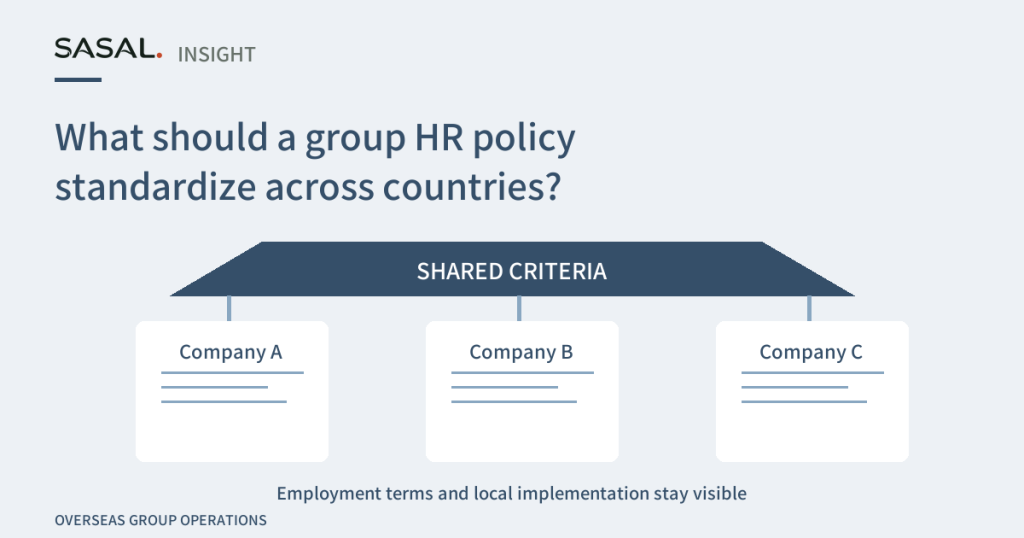
Two managers describe an employee as showing strong ownership. One means that the employee resolves problems independently; the other means that assigned work is completed reliably. A common rating label has hidden different expectations. A group HR policy can address that difference, but it needs to identify the decision being governed and the evidence managers should use. Hiring, evaluation, compensation and access to development each raise a different question. Start with the one that needs attention, then separate shared reasoning from company-specific employment arrangements. This article examines that separation through role records, manager discussions and policy trials, with decisions and line management remaining with the authorized people in each entity.
Choose the people decision that needs a shared principle
A group HR policy becomes easier to govern when it starts with one recurring decision rather than an attempt to standardize every aspect of employment. The practical question may concern hiring justification, consistency in performance evaluation, the rationale used for reward decisions, or access to development opportunities. Each of these decisions requires different evidence, different participants and different records. Combining them into a single reform effort can make disagreements difficult to diagnose because participants may be discussing separate problems under one policy label.
For hiring, the decision requiring consistency is often the reasoning used to select a candidate rather than the employment conditions ultimately offered by each company. A useful shared principle could require managers to document role responsibilities, required capability, evidence considered and the reasons alternatives were not chosen. A hypothetical record entry might identify the role purpose, key tasks, evidence from interviews or work samples, and the hiring manager's explanation of how the selected candidate met the role requirements. Such a record supports comparability across companies without assuming identical contracts, titles or benefits.
For performance evaluation, the policy question is usually whether managers interpret contribution using a common logic. Before creating a group rule, decision makers can review a small number of completed evaluations from different companies and ask whether similar language reflects similar expectations. If one manager describes independent problem solving as exceptional while another treats it as baseline performance, a shared principle may be needed to improve interpretation. The resulting policy can focus on observable contribution and documented reasoning rather than prescribing identical rating scales.
Reward discussions require particular discipline because compensation decisions involve local market conditions, company economics and specialist considerations that vary by entity. A group principle can still define the rationale expected from decision makers. For example, managers may be required to explain the business reason for a proposed pay action, the evidence considered and the approval route used. The principle governs how a decision is justified, while the actual compensation outcome remains grounded in local circumstances.
Development policy presents a different challenge. Attendance at training is not itself evidence that a development decision was well designed. A shared principle can require managers to consider business need, opportunity to apply learning and available support after participation. If employees in several companies report difficulty using newly acquired skills, the policy issue may concern access and application rather than course availability. Selecting the specific people decision first helps the group avoid expanding policy scope before the underlying problem is understood.
Identify the employing entity and actual decision rights

Once the target decision is clear, the next task is identifying who actually holds authority. In a multi-company group, headquarters may sponsor a policy while the employing entity remains responsible for employment decisions. A reference to “HR approval” can conceal different activities: recommending, reviewing, authorizing and implementing the decision. A workable policy records which party proposes a decision, which party reviews it, which party approves it and which party communicates it to employees.
A practical mapping exercise can clarify these distinctions. For a hiring decision, the local manager may define the operational need, local HR may review process requirements, a group function may review alignment with shared criteria and the employing entity may issue the employment offer. The record should identify each role and the conditions under which escalation is required. This reduces uncertainty when similar cases occur in different companies.
The same approach applies to performance and development decisions. Managers remain responsible for explaining evidence and outcomes within their teams, while group-level participants may examine consistency of interpretation. A calibration discussion, for example, can challenge inconsistent reasoning without transferring day-to-day line management to headquarters. Where authority has been delegated, the group benefits from common definitions and records so that another reviewer can understand what has been decided and what remains unresolved.
Before a cross-company review begins, confirm which records participants are authorized to see and for what purpose. A group role does not by itself establish access to every employee file. For an initial comparison of evaluation reasoning, appropriately prepared cases may be sufficient without names or unnecessary personal detail. The responsible HR and information-handling specialists should determine the permitted arrangement for the actual entities. That decision also shapes the review: if necessary context cannot be shared, acknowledge the limit instead of ranking cases from incomplete evidence.
A useful governance record may contain fields such as decision type, employing entity, recommending manager, reviewing HR role, approval authority, required supporting evidence and communication responsibility. When disagreements arise, participants can examine whether the dispute concerns authority, evidence quality or policy interpretation. That distinction often leads to a more targeted revision than rewriting the entire HR framework.
Compare current practice before drafting a group rule
Before drafting policy language, compare how companies currently operate. Formal documents provide only part of the picture. Review existing policies, employment terms, guidance notes, employee-representation arrangements where applicable, approval workflows and examples of completed decisions. Then compare those records with what managers and employees believe actually happens. Record any gap between documented procedure and observed practice before deciding whether the rule itself needs to change.
A structured review can focus on one decision type. Suppose the group wants greater consistency in performance evaluation. Collect several completed evaluations from different companies and examine the role responsibilities, available resources, review period and evidence used. Ask managers to explain specific cases. The discussion may reveal that the same performance label is being applied to very different circumstances. In that situation, the problem is interpretation rather than the absence of a policy. Drafting a new rule before understanding those differences may simply reproduce the inconsistency in new language.
Current-state comparison should also distinguish shared principles from local arrangements. Two companies may both evaluate employees using job-relevant evidence and documented reasoning while operating different review calendars, job-title structures or employment conditions. Those differences do not automatically indicate a governance problem. The design question is whether the group needs consistency of reasoning, consistency of records or consistency of outcomes. Each choice creates different administrative burdens and different benefits for cross-company comparison.
Compare like decisions under understood conditions. An evaluation completed after a role change may use different evidence from one covering a stable assignment. Ask who set the expectations, when they were communicated and whether they changed during the period. Where the record is incomplete, identify the missing information as a limitation. It would be premature to describe either manager’s approach as inconsistent before knowing whether they were evaluating the same responsibilities under the same expectations.
A comparison framework can help decision makers determine what belongs in a shared rule. Record three categories for each observed practice: the criterion that should remain common across companies, the employment arrangement that may legitimately differ by entity and any issue requiring specialist review. When repeated observations show that managers can explain decisions using consistent evidence while local arrangements remain appropriate to their context, the group may need only a focused policy principle rather than a broad standardization program.
- Shared criterionJob-relevant evidence, documented reasoning, consistent decision principles and defined approval records.
- Local employment arrangementPay structures, titles, employment terms, operating calendars and company-specific practices.
- Specialist questionConsultation procedures, data handling and jurisdiction-specific employment requirements.
Separate a shared principle from identical conditions
Visible employment features can draw attention during a group comparison because they are easy to place side by side. Pay bands, titles, review dates and contract formats can appear inconsistent when viewed from headquarters. The more useful starting question is whether the group is trying to solve inconsistent reasoning or merely visible variation. If the concern is that similar hiring or evaluation decisions are justified differently from one company to another, the policy should focus on decision criteria and evidence. If the concern is a local employment arrangement that serves a legitimate business or employment need, forcing uniformity may create additional administration without improving decision quality.
A practical drafting method is to write the shared principle and the local implementation statement separately. For example, a hiring principle may require that managers assess candidates using role-related evidence and document the reasons for selection. The company-specific implementation can then describe how interviews are conducted, who participates and which records are retained. This structure allows different employing entities to operate within a common reasoning framework while preserving arrangements that fit their circumstances. The distinction should be visible in the policy itself rather than left to interpretation after publication.
A worked hypothetical example illustrates the difference. Assume three companies recruit project managers. One company uses panel interviews, another relies heavily on work-sample exercises and a third combines manager interviews with internal stakeholder review. A group policy does not need to eliminate those differences if each company can show role responsibilities, required capability, evidence reviewed and decision rationale. The comparable element is the reasoning process. The local process remains open to variation when it still produces documented, job-relevant evidence.
The same separation is important in performance and reward discussions. A shared principle may require managers to explain how observable contribution was assessed, what information was considered and how differing interpretations were resolved. That principle does not automatically require identical performance labels, salary structures or review calendars. Treating every difference as a governance problem can obscure the actual question of whether decisions are understandable and supportable when reviewed across companies.
Check whether a clause describes a principle or promises an outcome. “Explain decisions using job-related evidence” leaves room for different supported judgments; “the same role receives the same reward” makes a different commitment whose meaning and implications need review. Ask the drafter to identify the decision, intended population and local arrangements each statement affects. If a sentence mixes criteria, procedure and employment conditions, separate those parts before asking companies to approve it. The responsible people can then assess the actual proposed change instead of agreeing to a broad phrase with different meanings.
Define comparable role evidence for hiring
Hiring comparisons across companies become unreliable when decision makers compare candidates before they compare roles. A group policy can improve consistency by requiring evidence about the position itself before individual selection begins. Useful records include the purpose of the role, principal responsibilities, expected decisions, key tasks, required capability and the support available to the person who will be hired. Those records help reviewers understand whether apparently similar vacancies are actually comparable.
Responsibility deserves particular attention because job titles rarely provide enough information for cross-company review. A role called manager in one company may supervise a team, control a budget and approve operational changes, while the same title elsewhere may describe an individual contributor position. A hiring justification record can therefore require a description of decision authority, reporting relationships and operational scope. Reviewing those elements before recruitment reduces the risk that selection standards drift because the underlying roles have been described too broadly.
Groups also benefit from separating headcount demand from candidate choice. The decision to create or replace a position addresses business need, workload, succession planning or capability requirements. The decision to select a specific individual addresses evidence about that person. Combining the two decisions can make later review difficult because managers may defend a candidate by restating the need for the role. A cleaner record identifies why the position exists and then documents how each candidate was assessed against the role requirements.
A hypothetical example demonstrates the value of this distinction. Suppose two subsidiaries request approval for additional sales positions. One request is driven by expansion into a new customer segment, while the other is intended to reduce workload concentration after a departure. The group may conclude that both requests are justified even though the successful candidates eventually possess different backgrounds and experiences. The comparable evidence concerns the role's business purpose, responsibilities and capability requirements rather than the appearance of identical candidate profiles.
Comparable hiring evidence should also account for the environment in which the employee will operate. Available training, managerial support, team resources and existing processes can affect what capability is required at entry. A policy that ignores those contextual factors may incorrectly treat different hiring decisions as inconsistent. Recording available support allows reviewers to understand why one company seeks an immediately experienced employee while another can recruit someone with greater development potential.
Define headquarters’ role in hiring review explicitly, including whether it tests reasoning, exercises an agreed approval right or receives information after the decision. Shared records make that review more productive because participants can discuss responsibilities, evidence and assumptions using a common structure. The resulting comparison is based on role requirements and documented observations rather than title matching or informal impressions.
Make performance criteria interpretable across companies
Performance policies become difficult to use across a group when broad terms such as leadership, ownership or impact are left undefined. Managers may apply the same word to very different situations. A shared framework can improve interpretation by requiring reviewers to explain contribution in relation to role scope, available resources, the relevant period and observable outcomes. The objective is not to eliminate judgment but to make the reasoning visible enough for comparison.
Role scope is particularly important. An employee responsible for a small specialist activity and an employee coordinating a large cross-functional operation may both be described as high performers, yet the evidence supporting those assessments will differ. A useful evaluation record therefore includes the responsibilities carried during the review period, significant changes to those responsibilities and any major constraints that affected execution. This information allows reviewers to understand performance in context rather than treating ratings as self-explanatory.
Resources and operating conditions also shape interpretation. A manager assessing project delivery should be able to explain the staffing, budget, tools and support available during the evaluation period. Without that context, comparisons across companies can encourage misleading conclusions. The goal is not to excuse poor performance through circumstances, but to ensure that contribution is examined against the actual environment in which work occurred.
Define how changes during the review period will be handled. In a hypothetical case, an employee moves from individual delivery to coordinating a team partway through the year. A single unqualified target could mix two different assignments. The manager should record the dates, responsibilities and expectations that applied to each period, then explain how the assessment accounts for the change. This gives a later reviewer a basis for questioning the reasoning without assuming that one rating label makes the work comparable.
Records should emphasize observable contribution. Examples may include delivery of agreed responsibilities, resolution of operational issues, development of team capability, quality of decision making or completion of defined objectives. The precise evidence will vary by role. What matters is that reviewers can trace an assessment to identifiable observations rather than relying primarily on reputation, visibility or generalized impressions.
A criterion also needs a boundary around what counts as supporting evidence. A visible presentation may demonstrate clear communication, but it does not establish every aspect of a broad leadership judgment. Ask the manager to identify the observed behavior, its relevance to the role and the period it covers. Where evidence is missing, record the gap and the appropriate next step rather than filling it with reputation. That distinction prepares managers for calibration without predetermining the outcome of an individual review.
Use calibration to examine evidence and interpretation
Calibration is most useful when a group has already agreed the purpose of performance review and the evidence expected in evaluation records. The discussion then focuses on interpretation rather than on redesigning the entire performance system. Managers bring specific cases, explain the role scope, the objectives assigned, the resources available during the review period and the observations supporting their conclusions. A calibration meeting becomes difficult when participants arrive with only ratings or labels because others cannot see how the judgment was formed.
A practical agenda can require each manager to present a small number of completed evaluations using a common record structure. For example, the record may identify major responsibilities, material changes in workload, significant constraints, observed contributions and the reasoning behind the proposed assessment. Other managers can then ask whether the same evidence would have been interpreted similarly in their own companies. The purpose is to test consistency of reasoning, not to produce identical outcomes. If two employees faced different responsibilities, different conclusions may remain appropriate even after a rigorous discussion.
A worked hypothetical example illustrates the distinction. Assume two managers each describe an employee as demonstrating strong ownership. During calibration, one manager explains that the employee independently resolved recurring operational issues affecting multiple teams. The other explains that the employee reliably completed assigned tasks on time. Both descriptions may be positive, but the discussion reveals that the same word is being used for different standards. The group can clarify future guidance and assess whether the inconsistency also requires review of affected earlier decisions under the appropriate local process. Clarifying a term does not itself authorize changing an employee’s completed assessment.
Calibration also provides a structured way to preserve local context. A manager can explain circumstances that influenced performance, such as team size, available budget, support functions or changes in business priorities. Participants should examine whether those factors genuinely affected the evaluation rather than accepting or rejecting them automatically. This creates a more disciplined review than comparing scores alone. It also reduces pressure to standardize every local operating condition simply to make reports easier to read.
The meeting record should distinguish observations, interpretations and resulting decisions. One section may capture the evidence presented, another the questions raised by reviewers and a third any agreed clarification to future guidance. If a recurring disagreement appears across several cases, the group may decide to revise definitions, examples or manager instructions. If disagreements are isolated, additional manager coaching may be sufficient. That distinction helps prevent policy expansion when the issue lies in application rather than design.
Calibration should not become a forced ranking exercise. The objective is to challenge inconsistent weighting of evidence, improve transparency and create a shared understanding of evaluation language. Managers continue to own performance judgments within their teams, while group participants examine whether similar evidence is being interpreted through a sufficiently consistent lens to support credible cross-company discussion.
Treat pay decisions as locally grounded commitments

A compensation comparison needs to establish what each proposal changes and which entity will make the commitment. A group policy can still establish expectations about decision quality. The policy may require decision makers to document the purpose of a pay action, the evidence reviewed, the approval route followed and any specialist questions identified. Those requirements create transparency without assuming that companies should reach identical compensation outcomes.
The first record worth standardizing is the decision rationale. A compensation proposal can include fields such as the business reason for the change, the employee population affected, the manager's recommendation, supporting evidence, required approvals and implementation timing. This allows reviewers to understand why a decision was made. A group comparison based on reasoning is generally more informative than a comparison based only on amounts, titles or percentages because the latter can obscure the conditions that influenced the decision.
A hypothetical example demonstrates the approach. One company proposes a pay adjustment linked to a substantial expansion of role responsibilities. Another proposes a different adjustment connected to retention concerns for a critical capability area. Headquarters may review whether both cases are supported by evidence and follow the agreed approval route. It does not need to require the same compensation outcome. The shared question is whether the decision can be explained and reviewed, not whether every company must produce matching results.
Specialist review becomes important when compensation decisions intersect with employment arrangements, consultation requirements, taxation, benefits design, data handling or other jurisdiction-specific matters. The policy should identify when those questions must be referred for appropriate advice rather than attempting to provide universal answers. A record entry such as 'specialist review required before implementation' is often more useful than policy language that assumes one procedure applies everywhere.
Governance also benefits from clarity about authority. Local managers may recommend compensation actions, local HR may review supporting information and the employing entity may retain final approval responsibility. Group functions can examine consistency of rationale across companies, but that role should be described precisely. Ambiguity about who decides can create delays, duplicate reviews and uncertainty about accountability when questions arise later.
Keep the proposed, approved and implemented states distinguishable. A manager’s recommendation may depend on a specialist review or an approval that has not yet occurred. Recording it as implemented could mislead both employees and group reviewers. A company-level owner should confirm the authorized decision and the communication and implementation steps that apply. If a condition remains unresolved, the group report should show that status instead of presenting the proposal as a completed pay action.
Connect development policy to access and business need
Development policy becomes more useful when it addresses who can access opportunities, why those opportunities are offered and how learning connects to business needs. An attendance record shows participation; it does not explain the allocation decision or the support available afterward. A group policy can instead define the criteria used to allocate development opportunities and the responsibilities managers hold in supporting application of learning after participation. The result is a framework that can be applied across companies without prescribing identical programs or schedules.
One approach is to require a short development justification before significant learning activities are approved. The record may identify the capability to be strengthened, the business need involved, the expected opportunity to use the learning and the manager responsible for supporting application. This encourages decision makers to examine whether the development activity relates to actual work. It also creates a record that can be reviewed later when assessing whether the original reasoning remains valid.
A hypothetical example illustrates the distinction. Suppose two companies request access to the same leadership program. In one company, participants are expected to assume broader coordination responsibilities within the coming year. In the other, managers cannot identify any foreseeable opportunity to use the new capability. A shared development principle may support approval in the first case and deferment in the second. The difference arises from business need and application opportunity rather than from the identity of the company involved.
Manager responsibility deserves explicit treatment. Employees may complete development activities successfully yet still lack opportunities to apply what they learned. A policy can therefore require managers to discuss expected application, available support and practical barriers before participation begins. Follow-up records might capture observations about use of learning, additional support requested and any conditions that changed after the original approval. This moves the discussion beyond course attendance toward operational relevance.
Communication also matters. Employees should be able to understand how development opportunities are allocated, how questions can be raised and how disagreements will be reviewed. Explanations should be provided in the language used by the relevant company so that expectations are understood consistently. Where consultation processes or data-handling questions apply, the relevant entities should determine appropriate procedures with specialist input rather than assuming a single global approach.
Check who is missing from the opportunity before interpreting low participation. A shared eligibility criterion can be applied unevenly if a company cannot release staff at the scheduled time or provide the agreed support. Ask its manager whether the constraint changes the business case, requires another delivery arrangement or calls for a later opportunity. Record that explanation beside the access decision. This keeps the group-policy question focused on allocation and support; the design of individual practice and skill assessment is a separate task.
- Role evidenceBusiness need, capability gap, expected responsibilities and opportunity to apply learning.
- Judgment recordReason for approval or deferral, supporting observations and responsible decision makers.
- Review and communicationManager support, employee questions, follow-up observations and explanation route.
Plan consultation, documentation and data handling
Before issuing a group HR policy, identify which companies are affected, which decision types are covered and whether any consultation, communication or review steps may apply in the relevant employment contexts. A policy team can create a coverage register listing the employing entity, policy topic, intended effective date, responsible manager, HR reviewer and any open specialist questions. This register does not determine legal obligations by itself. Its value is operational: it prevents participants from assuming that the same process applies everywhere and helps separate confirmed requirements from unresolved questions.
Documentation should be designed around the decision being governed. For a performance-evaluation policy, records might include role responsibilities during the review period, key evidence considered, manager interpretation, calibration observations and final approval. For a hiring policy, the record may instead focus on role purpose, required capability, evidence reviewed and selection rationale. For each requested item, state how it will help explain the decision and who needs access. Information that might someday be useful is not a sufficient operational purpose for adding it to every case file.
Data handling deserves separate attention because HR records frequently contain personal information. A practical policy annex can identify the categories of information required for each process, the people who may access them, the business purpose for that access and the retention review owner. If a calibration discussion requires performance evidence, participants should know which documents may be shared and which should remain restricted. Questions involving cross-border transfers, employee information, retention obligations or other jurisdiction-specific requirements should be referred to appropriate specialists based on the entities and locations involved rather than resolved through a generic global rule.
A worked example can help clarify record design. Suppose a group introduces a shared principle requiring managers to explain evaluation decisions using observable evidence. The record could contain fields for major responsibilities, significant changes in role scope, evidence cited, questions raised during calibration and final communication responsibility. If a reviewer later challenges the decision, the group can examine the documented reasoning instead of reconstructing events from memory. That approach also helps when managers change roles and another person needs to understand what has already been decided.
The ILO’s Tripartite Declaration of Principles concerning Multinational Enterprises and Social Policy, sixth edition (2022), provides international guidance rather than a country-specific implementation procedure. Paragraph 7 recommends its principles on a voluntary basis without limiting obligations arising from ratified ILO Conventions. Paragraph 63 recommends consultation systems established by mutual agreement in accordance with national law and practice, and states that consultation should not substitute for collective bargaining. For a particular HR policy, ask the appropriate specialists what consultation, negotiation, explanation and documentation the actual entities and changes require. Record the answers and unresolved questions separately. Attendance at a briefing or receipt of a document does not by itself establish contractual change or employee consent.
Explain what changes for employees in their language
An employee reading the policy needs to understand its effect on everyday decisions. Communication therefore becomes more effective when it explains concrete changes. If a group introduces a shared evaluation principle, employees may want to know what evidence managers will consider, how discussions will be documented and whether disagreement routes remain available. A communication plan that focuses only on governance terminology may leave these practical questions unanswered.
Explanations should be prepared in the working language of each company. The objective is not merely linguistic translation but consistent understanding of the decision process. Terms such as performance, development opportunity, role scope or job-related evidence can be interpreted differently by managers and employees. Before release, policy owners can test draft explanations against routine scenarios. For example, employees may be asked how they think a promotion discussion, hiring decision or development request would be handled under the new approach. Record misunderstood terms and revise the explanation before relying on it in live decisions.
Concrete examples are particularly useful. A hypothetical communication note might explain that managers will continue to evaluate employees within the local company, but evaluations must now include documented observations linked to responsibilities and review-period conditions. Another example might show that development opportunities remain based on business need and available support rather than on attendance alone. These illustrations help employees understand what is changing and what is not changing, reducing the risk that a group principle is mistaken for a promise of identical treatment across all companies.
Employees also need a clear route for questions, concerns and requests for clarification. The route may involve the local manager, local HR, a designated policy contact or another established channel, depending on the organization. The important point is that responsibility is visible. Questions raised during implementation can reveal where policy language is being interpreted differently across companies. Recording those questions and the resulting responses creates useful evidence for future revisions.
Communication records should distinguish explanation from acceptance. A useful implementation log may record the audience, language version, communication date, responsible presenter and key questions received. That log demonstrates what information was provided and what issues were raised. It does not automatically establish agreement with the policy, contractual variation or legal consent. By maintaining that distinction, organizations can communicate clearly while preserving appropriate treatment of employment, consultation and contractual questions in the relevant contexts.
Pilot one policy area and review unintended effects
Choose whether the first trial will use prepared cases or live decisions. Prepared cases can reveal inconsistent interpretation without changing an employee’s current outcome. A live pilot requires the applicable approvals, communications and employment-process checks before it begins; calling it a pilot does not remove them. Select one question, such as whether managers can explain evaluation judgments against the same criteria. Expanding into hiring, reward and development at the same time would make it harder to identify which change produced an observed issue.
The pilot should begin with a defined question. A group evaluating performance consistency, for example, might ask whether managers can explain decisions using comparable evidence across several companies. The review record can capture completed cases, manager explanations, employee questions, calibration observations and unresolved disagreements. By defining the question in advance, the group creates a basis for judging whether the pilot produced useful information rather than merely generating activity.
Operational burden is an important review criterion. A policy that improves consistency but requires extensive additional administration may need refinement. During the pilot, participants can record the time required to prepare evidence, conduct reviews, answer employee questions and maintain records. They can also identify steps that add little decision value. This information helps distinguish necessary governance from documentation that exists only because it was copied from another process.
A worked hypothetical example illustrates the approach. Assume three employing entities pilot a shared evaluation principle requiring managers to document role scope, key observations and reasoning. After one review cycle, managers report that discussions are clearer, but they also note recurring disagreement about how to describe contributions made under very different resource conditions. The group may decide to add guidance on contextual evidence rather than redesigning the entire evaluation framework. The review focuses on the specific issue revealed by practice.
Fairness concerns deserve explicit examination. Employees and managers may identify cases that appear difficult to explain under the new policy. Rather than treating these cases as exceptions to be ignored, the review team can categorize them: unclear definitions, insufficient evidence, local-process conflict, specialist question or unresolved policy choice. This creates a structured basis for revision and avoids attributing every difficulty to resistance from participants.
At the end of the pilot, the organization can decide whether to extend the policy, revise it, limit its scope or withdraw it. That decision should be based on documented observations about decision quality, employee understanding, administrative effort and unresolved issues. Individual employment decisions remain the responsibility of the relevant employing entities and managers. The pilot evaluates the policy design and its application, not the personal merits of employees who happened to be included in the trial period.