

How can group companies coordinate beyond one expatriate?
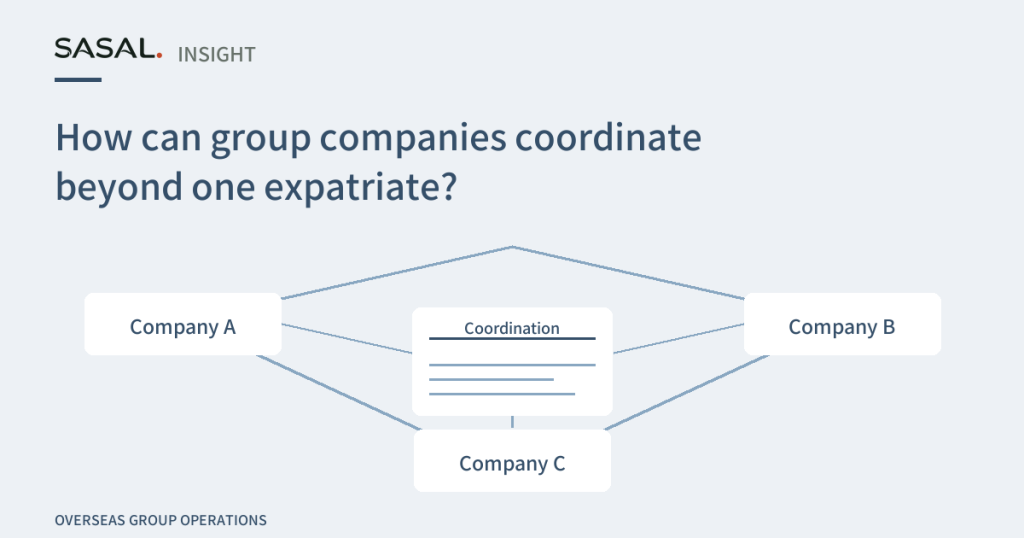
When questions, approvals, meeting preparation and historical context all pass through one expatriate, regional manager or long-serving contact, a routine absence can leave colleagues unsure how to continue. That person may be providing valuable support that the organization has never described as work. Replacing the contact without understanding those activities would leave the gap intact. Start by identifying the explanations, relationships and follow-up that keep matters moving, then separate them from decisions held by authorized managers. A coordination office can support that work across companies, provided its remit is clear, direct dialogue continues and records remain usable when the people involved change.
Map the work hidden behind one person’s relationships
Describe the work that depends on the contact before deciding whether a different role or support arrangement is needed. A person who appears to be a communication hub may actually be carrying several distinct responsibilities: explaining background circumstances, clarifying terminology between teams, negotiating meeting agendas, reminding owners about pending responses and recalling earlier decisions. If these activities are treated as personal knowledge rather than operational work, replacing the individual becomes difficult because the organization has never defined what needs continuity.
A useful exercise is to follow several recent cross-company requests from beginning to end. Record who initiated the request, which companies were involved, what decision or response was sought, who followed up, and how prior discussions affected the outcome. Check where the request needed an explanation of context or an earlier agreement rather than simple forwarding. The objective is not to centralize every interaction but to understand which coordination activities repeatedly appear across different topics.
Consider a hypothetical reporting question involving a subsidiary, a regional finance lead and head office. The visible activity may be a request for figures. The hidden work may include explaining which definition should be used, clarifying whether prior exceptions still apply, identifying the correct reviewer and confirming when an answer is needed for a meeting. If these supporting actions are absent, the formal request alone may not produce a useful response. Recording those recurring coordination steps helps determine what should become part of a shared process.
Historical continuity deserves separate attention. When one person remembers why an earlier decision was made, other participants may repeatedly revisit settled questions. A practical record can include the issue context, the decision requested, the responsible owner, any agreed deadline and the next expected update. Such records do not need to contain every conversation or confidential detail. Their purpose is to allow another authorized person to understand the status of an open matter and continue coordination during absence or role changes.
Ask the existing contact which exchanges would be hardest for a colleague to continue and why. The answer may distinguish a missing record from a relationship that needs a personal introduction or a decision route that only works informally. Those gaps need different treatment. Documenting a contact list will not create missing authority, while replacing the contact may discard a relationship without addressing the underlying gap. Use the account of recent work to agree what needs support and what the person can continue doing effectively.
Separate the coordination problem from a decision problem

After identifying coordination activities, the next question is whether delays originate from coordination itself or from unresolved authority, capacity or priority issues. A coordination office, shared mailbox or designated contact can improve visibility, but it cannot authorize decisions that nobody has been empowered to make. Treating every delay as a communication issue may create more reporting activity while leaving the underlying obstacle unchanged.
A practical review examines stalled items individually. For each issue, ask what outcome is awaited, who is authorized to decide, what information is missing and whether resources exist to implement the decision. If a company is waiting for approval that has no defined owner, adding reminders will not resolve the uncertainty. If two entities disagree about priorities, tracking progress may make the disagreement visible, but it does not replace the need for an authorized decision.
A hypothetical example illustrates the distinction. Suppose a subsidiary requests approval to change a reporting process. The coordination function records the request, identifies the owner, schedules discussion and follows up on deadlines. If the responsible executive has not been granted authority to approve the change, or if another department must first provide analysis, the delay reflects governance or resource constraints rather than coordination failure. Recording this distinction prevents the coordination function from being judged responsible for outcomes beyond its mandate.
Authority mapping is particularly important where responsibilities are shared between head office and local teams. Decisions regarding contracts, spending, hiring, reporting definitions or policy changes may follow different approval paths. Groups benefit when those paths are explicit and when participants understand which matters can be resolved locally and which require escalation. Without that clarity, coordination staff can become informal decision-makers simply because they are the easiest people to reach.
The review should also identify situations where workload rather than authority causes delay. An owner who is accountable for several companies may need prioritization support, cover arrangements or revised reporting expectations. Coordination can make those capacity pressures visible and help sequence work, but the decision to allocate resources remains with management. Separating these causes improves diagnosis and prevents the organization from expecting administrative structures to solve strategic or operational conflicts.
Keep head office and companies in direct conversation
A coordination structure becomes most useful when it supports communication without replacing it. The people authorized to make decisions and the people responsible for local operations should continue speaking directly when issues require discussion. Coordination can prepare agendas, identify participants, track commitments and record outcomes, yet it should not become a mandatory gate through which every interaction must pass.
This distinction protects accountability. When a head-office manager discusses a policy question directly with a company representative, both parties can clarify assumptions, challenge interpretations and confirm responsibilities in real time. If all communication is routed through an intermediary, nuance may be lost and ownership can become blurred. Direct dialogue also allows local circumstances to be explained by the people closest to the work rather than through repeated summaries.
A practical model is to define the coordination office as responsible for preparation, tracking and follow-up. Before a meeting, it confirms the decision sought, gathers relevant background and identifies unresolved questions. During the process, it records owners, deadlines and next actions. Afterward, it monitors progress and highlights stalled items. The substantive discussion and decision remain with the authorized participants from head office and the relevant company.
Records should reinforce rather than replace direct communication. For example, an issue log might contain the requesting company, topic, decision required, current owner, target date and next update. Another person can understand the status of the matter, yet the record does not attempt to substitute for the actual conversation that produced the decision. Sensitive information can remain with the appropriate participants while the coordination record tracks progress at a level consistent with permitted access.
The arrangement should be reviewed periodically. If participants begin waiting for the coordination office to relay questions that could be discussed directly, the office may be creating a new bottleneck. If information reaches decision-makers more reliably and open issues remain visible despite absences or personnel changes, the balance is closer to its intended purpose: supporting communication while preserving authority and direct relationships.
- Head office decision ownersDiscuss policy, approvals and unresolved issues directly with the relevant company representatives.
- Company representativesProvide local context, operational facts and responses through direct participation.
- Coordination officePrepares meetings, tracks owners, records status and follows up on agreed actions.
Give the coordination office a bounded mandate
Once direct communication paths have been preserved, the next design question is scope. A coordination office is most effective when its mandate is explicit and limited to defined categories of group activity. In an established international group, those categories may include approval routing, reporting and meeting coordination, and selected HR-policy coordination. The office can identify owners, monitor response dates, maintain issue visibility and prepare discussions. It should not be assumed to hold authority over every operational matter simply because it can see information moving across companies. Defining the boundary at the start reduces later disputes about responsibility.
A useful mandate statement identifies three elements for each topic in scope: what type of request may enter the coordination process, what outcome the office is expected to support, and which person or entity retains decision authority. For example, a reporting-definition question may be logged, assigned and tracked by the coordination office, while approval of the definition remains with the authorized finance leaders. An HR-policy adoption question may be coordinated across companies, while each employing entity retains responsibility for decisions that belong to its own management structure. Recording these distinctions in the operating description makes escalation easier because participants know where coordination ends and decision-making begins.
Boundaries are especially important when delays occur. Participants may ask the coordination office to settle disagreements, allocate resources or direct employees because it is already involved in the discussion. Those requests should be separated from the office's assigned role. A coordination function can document competing positions, identify the required decision-maker and arrange discussion. It does not automatically acquire authority over budgets, employment relationships, contracts or company management. Expanding the mandate informally may create short-term convenience while making accountability harder to trace later.
A hypothetical example illustrates the distinction. Suppose three companies are discussing a revised approval path for travel spending. The coordination office collects current practices, schedules meetings, records alternatives and tracks open questions. One option is to keep existing local approvals. Another is to require additional head-office review for defined situations. The office can present both alternatives and record the final choice. The coordination role does not itself approve the policy. If an internal employee also holds a separate management authority, record the capacity in which that person makes the decision; external coordination support does not take over the client’s decision rights. The decision record might note the decision owner, participating companies, implementation date, unresolved exceptions and next review point.
The same principle applies to line management. Employees may cooperate across several group companies, yet reporting lines and employer responsibilities remain where management has assigned them. Coordination can support communication and policy adoption, but it does not transfer supervision, performance management or employment authority. Where specialist legal, employment, data-handling or contractual questions arise, the relevant qualified advisers and authorized company representatives remain responsible for those determinations. A bounded mandate keeps the coordination office focused on helping information reach the right people without becoming an unofficial substitute for company governance.
Define the company contact and group-level roles
Role design should begin with work rather than job titles. After mapping recurring cross-company activity, organizations can identify which responsibilities belong close to each company and which require a broader group view. Company contacts usually maintain awareness of local circumstances, ongoing requests, operational constraints and upcoming decisions. Group-level coordination roles, by contrast, help connect issues that affect several entities at the same time. Describing these responsibilities before creating positions reduces the risk of overlapping ownership.
A practical structure often contains at least two distinct perspectives. The company contact follows developments inside a specific entity and can explain local context when questions arise. An overall manager or equivalent group-level coordinator monitors matters that span several companies, such as shared reporting requirements or policy discussions. Neither role replaces the authority of local management or head-office decision-makers. Their value lies in helping the right participants engage with the issue before deadlines are missed. The distinction is especially useful when one company assumes that another company has already responded or accepted ownership of a task.
Check whether additional kinds of work need their own responsible person. Some people contribute strategic input by assessing how a proposal affects broader group objectives. Others provide operational workflow support by organizing meetings, maintaining records and monitoring progress. Combining all these responsibilities into a single contact can recreate the dependence problem the organization is trying to reduce. Separating responsibilities makes cover arrangements easier because another person can understand which part of the process requires attention during absence.
A hypothetical role description can illustrate the difference. A company contact receives a request concerning a proposed reporting change, confirms the local impact and identifies the local decision owner. The overall manager checks whether other companies face the same issue and whether a group discussion is needed. A policy specialist explains implications for the existing policy framework. The authorized executives then decide. Each participant contributes a different type of knowledge, and the record shows who provided context, who coordinated the workflow and who made the final decision.
Clear ownership also improves continuity. When responsibilities are defined, a handover note can identify active issues, expected updates, regular meeting responsibilities and key relationships. A successor does not need to reconstruct the role from scattered emails or personal memory. The record can include recurring interactions, pending decisions and the purpose of important contacts. Such information supports continuity without implying that all details should be centralized.
Role definitions should be reviewed against actual work. If company contacts spend most of their time coordinating issues across several entities, the structure may need adjustment. If group-level coordinators are routinely expected to make decisions that belong elsewhere, the mandate may be unclear. Reviewing responsibilities against observed activities helps the organization strengthen coordination while preserving direct dialogue and established authority.
Use a shared issue record without centralizing every detail
A shared issue record should let an authorized participant identify the request, its next owner and the unresolved point. Begin with those fields rather than copying every exchange into a central file. Record the company, issue, decision or response sought, current owner, target date and next expected update. If a detail does not help the intended recipient continue the matter, consider whether it belongs in a restricted supporting record or needs to be collected at all. The record’s purpose determines the appropriate detail.
The quality of the record depends on how clearly the requested outcome is described. Entries such as “follow up with headquarters” provide little operational value because they do not explain what response is awaited. A stronger entry might state that a subsidiary seeks approval of a revised reporting definition, that the finance director is the decision owner, that supporting analysis has been submitted and that the next update is expected after a scheduled review meeting. Another authorized participant can then understand the status without reconstructing the entire history from separate conversations.
Access boundaries deserve equal attention. Cross-company coordination sometimes involves commercially sensitive information, employment matters or specialist advice that should not be broadly distributed. A shared issue record does not require every participant to see every detail. The coordination record can reference the existence of restricted material while keeping substantive content within the appropriate channel. Organizing records by purpose and permitted access helps preserve continuity without creating unnecessary exposure.
The record should also support absence cover. If a company contact becomes unavailable, another authorized person should be able to identify pending decisions, recent updates and expected next actions. A practical test is to select one live issue and ask a colleague who has not been involved recently to explain the current status using only the documented record. If essential context remains inaccessible, the organization has identified a continuity gap that can be addressed before a critical absence occurs.
Specialist channels remain important. Legal, employment, tax, data-protection or other professional topics may require separate handling according to the relevant circumstances and permissions. The shared issue record can note that specialist review is pending, who owns the next action and when an update is expected. It should not become a substitute for specialist records or advice.
Over time, the issue register becomes a management tool for observing coordination patterns. Repeated delays linked to unclear ownership, recurring escalation points or persistent information gaps become visible across companies. Management can then decide whether to clarify authority, adjust reporting expectations or narrow the coordination office's involvement. The record supports those decisions by preserving factual status information rather than relying on individual memory or informal updates.
Build relationships from recurring working exchanges
A coordination structure becomes durable when people learn how colleagues in other companies understand the work they are jointly responsible for. A recurring working exchange lets participants check their understanding against what happened after the previous discussion. When a reporting definition, approval request or HR-policy question is discussed several times over a period, participants begin to see which information the other side needs before responding, what constraints affect timing and which assumptions create confusion. A coordination office can support this process by keeping issues visible and arranging follow-up, yet the relationships themselves develop through substantive discussions between the people who own the work. The practical observation to capture is not whether participants had contact, but whether later exchanges required less reconstruction of context because prior discussions remained understood.
Role expectations deserve explicit discussion because disagreements often arise from different interpretations of responsibility rather than from disagreement about objectives. A useful conversation asks each participant what decisions they believe they can make, what information they require before responding and how they expect concerns to be raised. The resulting record can be brief. For example, a note may state that a company finance contact can explain local reporting practice but cannot approve changes to group definitions, while a head-office manager can approve the definition but depends on local explanations before deciding. Recording such expectations allows future participants to understand why questions travel to particular people and reduces the risk that coordination staff become informal decision-makers.
Recurring exchanges are also an opportunity to understand obstacles without relying on assumptions about national culture or personality. One company may respond slowly because data must be gathered from several internal owners. Another may require additional review because definitions remain disputed. A third may answer quickly but provide information in a format that others cannot interpret. These are observable operating conditions. Treating them as process questions encourages practical solutions such as clearer definitions, earlier preparation or revised meeting agendas. Inferring motives from nationality provides little operational guidance and may obscure the actual cause of delay.
A hypothetical example illustrates the difference. Suppose three companies participate in a quarterly HR-policy discussion. During several cycles, the coordination record shows repeated clarification requests concerning the same policy term. Rather than concluding that one company is resistant, participants compare how each organization interprets the term in practice. The discussion reveals that different managers are using the same phrase to describe different approval thresholds. The parties can agree a shared definition and confirm who can approve exceptions, then check how the next request is handled. Explaining the different interpretations gives them a concrete issue to resolve; it does not guarantee that confidence in the relationship will improve.
Agree how participants can raise a disagreement, including when they need time to check the wording or consult a colleague. A person who does not challenge a proposal during a meeting may still have an unresolved concern; do not infer agreement from silence or nationality. The meeting owner can invite a response by an agreed time and distinguish a factual question from a decision the authorized manager must make. Record the resulting position without requiring everyone to express the same preference. This gives future contacts a usable route for disagreement rather than a claim that relations were good.
Make questions travel both ways

Dependence on a single coordinator often develops when information flows primarily in one direction. Head office sends requests, subsidiaries respond and the intermediary interprets both sides. A more resilient arrangement treats coordination as a two-way process. Local companies need a route to request clarification, resources, policy interpretation or approval support. Head office needs visibility into local concerns, implementation obstacles and requests for changes. When both directions are treated as legitimate coordination work, the office becomes a facilitator of communication rather than a transmission point for instructions.
One practical method is to record not only what head office is waiting for but also what support commitments have been requested from head office. An issue record might show that a subsidiary requires clarification of a reporting definition before a deadline can be met. Another entry might record a request for guidance on applying a group HR policy. Tracking these commitments alongside local obligations prevents coordination from becoming a one-sided monitoring exercise. It also helps management identify situations where delays stem from unanswered questions rather than from inaction by the requesting company.
Direct accountability should remain visible. If a head-office policy owner answers a company's question, that response should remain attributable to the policy owner rather than being rewritten by the coordination office. Similarly, when a company provides local information, the explanation should remain associated with the people responsible for that information. Coordination can organize, schedule and follow up, but preserving attribution matters because future questions may require the same expertise. Participants need to know who provided the reasoning, not only who tracked the workflow.
Company-to-company learning can also benefit from structured coordination. A recurring issue in one subsidiary may already have been addressed elsewhere in the group. The coordination office can identify the potential connection and arrange discussion. The companies themselves then exchange experience directly. For example, a company seeking a practical meeting-report format may learn from another entity that recently revised its approach. The resulting discussion remains between the relevant operating teams, while coordination tracks whether the exchange occurred and whether any follow-up decision is required.
A hypothetical record illustrates the approach. An entry may identify a request from Company A for clarification on approval criteria, note that the head-office finance lead owns the response, record an expected update date and indicate that Company B has previously addressed a similar issue. The coordination office arranges a discussion involving the relevant participants. The finance lead provides the interpretation, Company B explains its experience and Company A decides how to proceed within its own responsibilities. Questions move in multiple directions, expertise remains attributable and decision authority stays with the authorized parties.
When communication travels both ways, the organization gains a more complete picture of coordination demands. Management can observe whether repeated requests indicate unclear policies, insufficient resources or genuine differences in operating circumstances. Those observations support future decisions about mandates, reporting expectations and authority boundaries without requiring every exchange to pass through a single individual.
Set cover and escalation for stalled exchanges
Even well-designed coordination arrangements encounter situations where progress stops. Common examples include absence of a key contact, disagreement over ownership, unanswered decision requests and urgent issues that do not fit normal review cycles. Preparing for these situations in advance reduces dependence on personal relationships because participants know what happens when the usual path is unavailable. The objective is continuity of communication and visibility of status, not transfer of authority to the coordination office.
Cover arrangements begin with records that another authorized person can understand. Shared records are particularly valuable when an owner is absent. Information about the request, the decision sought, current status, next update and relevant contacts allows another coordinator or manager to continue follow-up without reconstructing the matter from fragmented correspondence. A useful test is to select an active issue and ask a colleague who has not recently participated to identify the next required action. If the answer cannot be determined, additional documentation may be needed.
Escalation requires equal clarity. Some issues are stalled because nobody knows who owns the next step. Others are stalled because the responsible person lacks authority or resources. These situations should be distinguished in the record. A disputed ownership issue may be escalated to the relevant managers to assign responsibility. An unanswered approval request may be escalated according to the established authority route. An urgent operational exception may require use of a designated emergency contact path. Recording the reason for escalation helps management identify recurring structural problems rather than treating all delays as equivalent.
A hypothetical example demonstrates the process. A subsidiary requests approval for a change to a reporting practice. The issue remains open after the expected review date. The coordination record shows that the designated reviewer is on leave and that no alternate reviewer has been assigned. Rather than seeking approval itself, the coordination office activates the agreed cover route, informs the responsible manager and updates the record with the new owner and expected decision date. Authority remains unchanged, but the stalled exchange becomes visible and actionable.
Periodic review is important because a coordination office can unintentionally become another bottleneck. Useful measures are qualitative: whether information reaches the rightful decision owner, whether follow-up responsibilities are understood and whether companies can continue working during personnel changes. If escalation routes are invoked repeatedly for the same category of issue, management may need to revise ownership definitions, authority arrangements or the office's scope. The goal is to reduce dependency while preserving direct communication and decision accountability.
- Company contactMaintains local context, identifies the issue and confirms operational status.
- Overall managerCoordinates cross-company follow-up, cover arrangements and escalation routing.
- Policy expertiseProvides interpretation or specialist input when the issue concerns a shared policy.
- Decision authorityMakes approvals and resolves ownership questions within assigned authority.
Distinguish coordination from taking over operational work
An office involved in policy coordination may also be asked to produce the underlying operating work. Before accepting it, compare the request with the agreed service scope. Meeting preparation, progress tracking, policy development and adoption support can all form part of that scope; the boundary is not simply whether an activity changes the substance of a document. Taking over company-specific operational tasks creates a different delivery commitment and needs an explicit owner, expected output and acceptance arrangement.
Separate shared-policy work from producing individual operating materials. Agreeing a reporting definition, explaining it to employees and reporting on adoption are different from compiling each company’s underlying monthly dataset. Similarly, reviewing common HR-policy criteria differs from preparing individual employment documents. The latter may require particular professional review and company authority, which a coordination mandate does not supply. Label the requested output and the purpose it serves before deciding whether it is included, belongs with a client function or needs separately agreed operational delivery.
Consider a hypothetical meeting about a shared reporting policy. The coordination team helps the companies agree a definition and checks questions arising in its use. Participants then ask the team to reconcile every company’s source records and produce the individual monthly schedules. That is a request to undertake operational work, beyond explaining the common definition. Name the producing owner, the inputs each company must supply, the person accepting the schedules and the time required. The fact that the request arose during a policy meeting does not settle those commitments.
Where an external provider is involved, additional operational work should have a separately agreed scope and fee. Preserve the distinction between work already included in policy development or adoption support and additional tasks the provider takes over. Included progress and adoption reporting should not be confused with producing the client’s underlying business reports. If a proposed task is outside the current agreement, clarify the boundary before assigning a deadline. The companies retain decisions and line management regardless of who prepares the materials.
Keep this distinction visible when work moves back to employees. For a particular operating task, record what the provider is producing, what the company is now able to take over and when the external delivery ends or narrows. Coordination or advice may continue within its agreed scope without implying that the provider still performs the transferred task. Check the task record against actual work at the next review so the same output is not produced twice and a discontinued service is not silently assumed to continue.
Transfer the operating record when people change
Personnel changes test whether coordination depends on individuals or on usable operating records. A handover succeeds when a successor can understand why contacts exist, what decisions remain open and which responsibilities require attention during the next operating period. Documents alone cannot replace relationships, but they can preserve enough context to prevent work from stopping while new relationships develop.
The most valuable handover information is often practical rather than extensive. A contact list becomes more useful when it explains the purpose of each relationship. Instead of recording only names and titles, the record can identify which person approves reporting changes, who explains local HR-policy implementation, who coordinates meeting logistics and who should be informed when an issue affects several companies. These descriptions help successors understand when and why communication occurs.
Pending decisions deserve their own section. A useful entry may include the issue under discussion, the decision sought, current status, expected next update and any commitments already made. If alternatives have been considered, the record can briefly explain why one option remains under review and why others were set aside. This prevents new owners from reopening settled discussions simply because earlier reasoning was not preserved. Where supporting documents exist, the handover can reference them rather than duplicating detailed content.
Language and communication practices require attention as well. In some groups, instructions, meeting notes or policy explanations are maintained in more than one working language. A successor benefits from knowing which version is used for which purpose, where approved instructions are stored and who can clarify terminology when questions arise. The objective is continuity of meaning. The handover record should identify authoritative references and update responsibilities rather than assuming that all participants interpret terms identically.
A hypothetical example illustrates the approach. A company contact leaves a role while several approval and reporting matters remain active. The handover package includes the purpose of key contacts, open issues, next meeting commitments, record locations, update responsibilities and any agreed escalation routes. During handover conversations, the successor meets the principal participants and confirms expectations. The written record supports continuity, while the conversations provide context that documents alone cannot fully convey.
Before completing the handover, let the successor handle a defined live exchange with the relevant participants while the outgoing contact remains available for context. Confirm that the successor can locate the current decision record, reach the right person and explain which question remains open. If a relationship introduction or access permission is still missing, record who will resolve it instead of marking the handover complete because files were transferred. Keep any restricted background in its permitted channel; continuity does not require distributing every note the outgoing contact held.
Review whether the office reduces dependence or creates another bottleneck
A coordination office should be reviewed against the problem it was created to solve. The central question is whether information reaches the people who can act on it more reliably than before. If requests remain dependent on a single individual, but that individual now sits within a coordination office rather than in an expatriate role, the organization may have changed structure without reducing dependence.
Reviews work best when they examine actual cases. Select several recent cross-company issues and trace their path from request to outcome. Identify who initiated the matter, who owned the next action, whether the correct decision-maker became involved and how much follow-up was required. This examination can reveal whether the office is improving visibility or merely adding another step between participants. The evidence comes from observable workflow rather than from assumptions about coordination quality.
One useful observation concerns follow-up burden. If company contacts and head-office managers still spend substantial time identifying owners, reconstructing history and locating prior decisions, the coordination process may not yet be preserving enough continuity. Conversely, if participants can quickly identify status, ownership and next actions through shared records, the office may be reducing reliance on individual memory. These observations are more informative than counting messages or meetings because they relate directly to the purpose of coordination.
Management should also assess whether company capability is increasing. If participants can handle routine interactions directly because expectations, authority routes and reporting requirements are clear, the office can review how much support those interactions still need. In that situation, the coordination office may narrow its involvement to complex cross-company matters. If every question continues to require intervention regardless of its complexity, the office risks becoming a permanent gatekeeper rather than a support function.
A hypothetical review illustrates the decision process. Management examines ten recent issues. Most reached the correct decision owners, and absence cover worked as intended. However, routine reporting questions are still routed through the coordination office even when the relevant teams already know each other. One option is to retain the existing process. Another is to encourage direct exchanges for recurring operational questions while keeping coordination support for escalations, policy discussions and multi-company matters. The second option may better align effort with purpose because it preserves visibility where needed without creating unnecessary waiting.
Scope adjustments are therefore a normal part of governance. As companies establish their own working relationships and records become more reliable, some coordination activities may be reduced, delegated or removed. Where recurring confusion, ownership disputes or continuity risks remain visible, support may continue to add value. Periodic review helps ensure that the office remains a facilitator of communication rather than becoming a new concentration point for information and delays.