

Which group policies should be shared across countries?
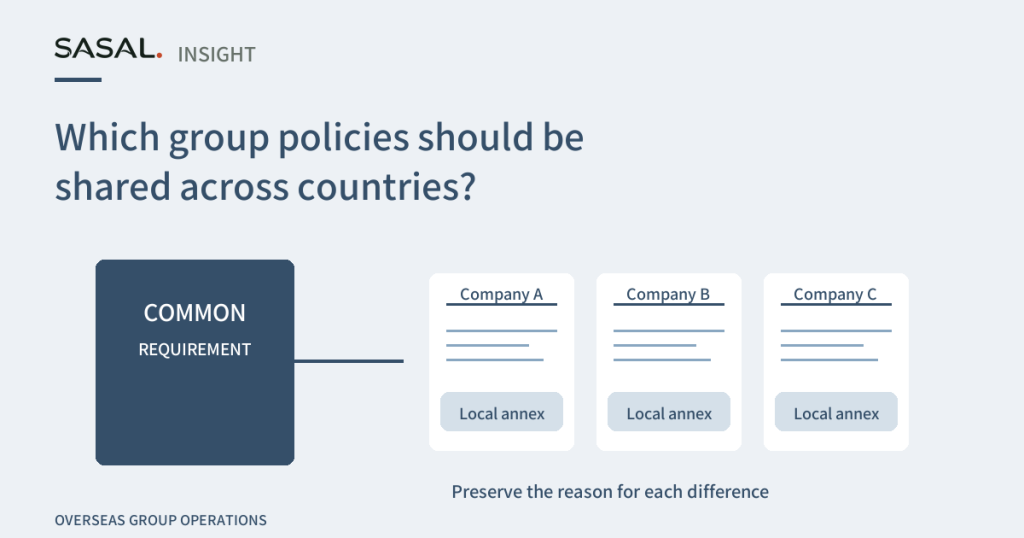
Consider a hypothetical staffing request that returns to a company because the reviewer expected a business case; another company receives approval using only a budget reference. A shared policy could resolve the inconsistency, but it could also impose work that the decision does not need. Before writing a rule for overseas group companies, identify the problem that crosses company boundaries and the evidence required to address it. Then decide which requirements should be common, how each entity can meet them and which differences need specific review. This article develops that decision through policy clauses, company application records and the treatment of exceptions, while keeping entity adoption and local authority explicit.
Choose the recurring problem a shared policy should solve
A shared policy should start with a recurring coordination problem that can be described in operational terms. Consider a hypothetical group in which several companies submit monthly staffing requests for approval. One entity sends a business case, another sends only a budget reference, and a third relies on meeting discussion without a durable record. Requests move back and forth because reviewers ask for different information each time. Before drafting a new policy, the group should determine whether the problem is actually inconsistent evidence requirements, uncertainty about authority, unclear reporting expectations, or something else entirely. The distinction matters because different causes lead to different policy responses. A policy written without identifying the underlying issue may standardize activity that was not causing difficulty while leaving the real source of repeated clarification untouched.
Not every difference justifies a shared rule. Suppose one company reviews staffing requests in a weekly management meeting while another uses written circulation. If both approaches produce the information required for a decision and create a reliable record, the variation may be operationally neutral. By contrast, if one company records the approved role, budget impact and responsible manager while another records only the final decision, the inconsistency affects later oversight, comparison and follow-up. The review should therefore distinguish harmless variation in working methods from variation that creates a cross-company consequence. The objective is not procedural similarity for its own sake. The objective is to address a recurring coordination cost that can be observed and described.
Evidence of recurrence should be documented before proposing a policy change. A requestor can assemble examples of approval queries that were returned for missing information, reporting submissions that required reclassification before review, or personnel decisions that could not be explained consistently because supporting criteria were absent. The record does not need speculative estimates about frequency. It should instead identify concrete cases, the date, the parties involved, the question raised and the consequence for decision-making. Reviewing several examples together often reveals whether the issue stems from policy wording, local implementation, unclear ownership or simple non-compliance with an existing requirement.
Responsibility for defining the problem should involve both the group function that experiences the coordination issue and the people operating the process locally. A central team may observe repeated questions arriving from multiple entities, while local managers may know that a required document contains ambiguous instructions. Examining only one perspective can lead to an incomplete diagnosis. A useful workshop reviews actual requests and traces how decisions were made, what information was available and where uncertainty entered the process. The resulting policy problem statement might read: "Management staffing approvals require inconsistent supporting evidence across entities, creating repeated clarification before review." That statement identifies the specific issue to solve and provides a basis for judging later revisions.
Inventory the rules people actually use

After defining the problem, the next task is to establish what instructions people currently rely on. The formal policy repository may be only one source of direction. An employee processing a staffing request may consult a group policy, a local procedure, an old management memo, guidance distributed by email and examples from previous cases. If the review examines only approved policy documents, it risks redesigning a process that employees are no longer following. The inventory should therefore focus on operational reality rather than documentation status alone.
A practical exercise is to trace one request from beginning to end. Using the staffing example, reviewers can collect the original request, the policy clause cited by the requester, any local procedural guidance, email instructions supplied by managers and the final approval record. Each document should be logged separately rather than merged into a single interpretation. The purpose is to identify where direction originated, how it was communicated and which instruction actually influenced behaviour. Check whether participants believe different documents control the same decision and record which documents they name.
Control of interpretation also needs to be examined. Policy owners can explain the purpose of a requirement, but local managers and employees can explain how work is completed in practice. If an old memo appears to contradict a newer policy, someone must confirm which instruction remains effective. If a manager routinely asks for information that is not mentioned in any formal guidance, that observation should be recorded as observed practice rather than treated as an approved requirement. The distinction is important because reviewers need to know whether a step is mandatory, customary, temporary or merely assumed. Labeling an observed workaround as authorized can conceal the very problem the review is trying to understand.
Evidence should come from records wherever possible. Completed approvals, meeting papers, reporting packs, decision logs and personnel review documents can show what actually happened. Comparing records against written requirements allows reviewers to identify differences between claimed practice and observed practice. For example, a manager may state that all staffing approvals include budget justification, yet several completed records may contain no such evidence. That discrepancy is a finding in its own right and may indicate training, wording or governance issues.
The inventory stage should also identify gaps in knowledge. If reviewers cannot determine who approved a particular instruction, whether a document remains active or why a deviation emerged, those questions should be recorded for further investigation rather than resolved through assumption. The output at this stage is not a redesigned policy. It is a structured picture of the rules, practices, records and uncertainties currently shaping behaviour, providing the factual basis for later decisions about what should be shared and what should remain local.
Separate a shared requirement from its local implementation
Once current practice is understood, the policy can be rewritten so that common requirements are distinct from local execution methods. A useful structure separates four elements: purpose, required outcome, required evidence and local implementation. Consider a hypothetical clause concerning management hiring approval. The purpose is to support accountable hiring decisions. The required outcome is that specified hires receive documented authorization. The required evidence is a record showing the role, business rationale and approving authority. Local implementation describes how each company gathers and routes that information. Keeping these elements separate reduces the risk that employees confuse a preferred method with the requirement itself.
Two companies may legitimately satisfy the same clause through different methods. One entity might prepare a standardized approval memorandum reviewed during a scheduled management meeting. Another might use a written workflow because decision-makers are dispersed and meet infrequently. If both methods produce the required evidence and authorization record, both comply with the shared requirement. The policy remains stable even if one company later improves its internal process. Operational flexibility exists because the common requirement is defined by outcome and evidence rather than by a single route through the organization.
A superficially similar method may nevertheless fail the shared requirement. Imagine a manager receives verbal agreement from relevant stakeholders and records only that hiring may proceed. Although a decision occurred, the record does not show the basis for approval or who exercised authority. The method resembles the compliant examples because approval took place, but it does not produce the required evidence. The deficiency should be treated as failure to meet the shared requirement, not as a permissible local variation. Distinguishing these situations helps reviewers avoid debates about style when the real issue is evidential completeness.
It is also important to distinguish a permitted local method from an exception. A permitted method is one of several ways to satisfy the policy as written. An exception exists when a company cannot currently meet part of the shared requirement and a difference has been formally accepted. For example, if a company temporarily cannot capture a specified record because of a documented operational constraint, that situation requires separate recording, ownership and review. Treating every local method as an exception creates unnecessary administration and obscures genuine deviations that require oversight.
A practical governance record can therefore compare the common requirement, local method and any approved exception side by side. Reviewers can immediately see what must be achieved everywhere, how each entity achieves it and where a documented difference remains. Adoption decisions become easier because entities are not asked to copy identical procedures when multiple compliant methods are possible.
- Common requirementPurpose, required outcome and evidence expected from every covered entity.
- Local methodEntity-specific process used to create the required evidence and decision record.
- Documented exceptionApproved difference with a stated reason, responsible owner and review condition.
Define the companies and activities the policy covers
A coverage decision should identify exactly which entities and activities are expected to apply a shared approval, reporting or HR requirement. If a rule applies simply to “the group,” a reader may not be able to identify which companies were assessed, their relationship to the group or the reason for inclusion. A practical scope exercise can start with three different situations: a wholly controlled operating company, a minority-held company and a shared-service team supporting several entities. The policy sponsor should create a coverage record listing the entity name, management contact, relevant activities, current process owner and the basis on which adoption is being considered. That record becomes the reference point when questions arise about whether a company was intended to be within scope.
Ownership alone does not answer the policy question. A wholly controlled operating entity may appear straightforward, yet the sponsor still needs to verify who currently approves the relevant activity, which local procedures exist and whether the entity can maintain the records required by the proposed policy. The practical decision may be that a shared approval standard applies immediately while company-specific procedures remain in place. The important point is that inclusion follows an explicit review rather than an assumption that group ownership automatically determines operational adoption.
The analysis is different for a minority-held company. The sponsor should document what authority, access rights or governance arrangements actually exist before adding that company to the policy scope. A hypothetical example illustrates the distinction. If the group receives reports through agreed governance channels but does not control day-to-day management processes, the practical outcome may be that the policy is provided as a coordination framework rather than adopted as an internal mandatory rule. The coverage record should state that limitation clearly so readers understand what implementation can reasonably be expected.
Shared-service teams require a separate decision because they may participate in a process without owning the final decision. For example, an HR support team may collect information used by several employing entities. The coverage record should identify whether the team provides administration, review support, record maintenance or another function. If that distinction is omitted, employees may incorrectly assume that a support function can authorize actions on behalf of operating companies.
Unresolved boundaries should also be recorded before rollout. The sponsor may discover uncertainty about access to records, responsibility for maintaining evidence or the extent to which a team can follow a common process across entities. Those questions do not automatically block all adoption. They do, however, define the limits of implementation until the issue is clarified. A useful coverage map therefore records each company or team assessed, the activities covered, the practical adoption decision, open questions and the person responsible for resolving them. That creates a defensible scope rather than a broad statement that later requires interpretation.
Check who can approve the rule in each entity
Once scope is defined, the next task is to determine how a shared policy becomes effective within each covered entity. Agreement on the content of a policy and approval of adoption are related but separate events. A useful adoption record contains at least four stages: sponsor agreement that a common rule should exist, specialist review where required, entity approval by the appropriate authority and the actual effective date. Recording these stages separately prevents readers from assuming that circulation of a policy document means implementation has already occurred.
A worked example shows why the distinction matters. Imagine a group introduces a shared HR requirement concerning documented evidence for promotion decisions. Group leadership approves the principle and HR specialists review the proposed wording. One operating company has completed the necessary reviews and approvals and can adopt on its agreed effective date. Another company identifies an unresolved employment-contract question that requires specialist assessment. In that situation, group approval establishes the intended direction, but it does not change existing contractual arrangements. The adoption record should show the policy status as pending entity implementation rather than fully effective.
The record should also identify who can authorize each step. A policy sponsor can coordinate the process, collect comments and track progress. Specialists can provide opinions within their areas of responsibility. Entity management may approve adoption where that authority exists. By contrast, a project coordinator or administrator may record that a review occurred but cannot create authority simply by updating a tracker. Separating administrative actions from approval authority becomes especially important when multiple entities are progressing at different speeds.
Progress reporting should distinguish substantive pending issues from missing paperwork. If all required reviews and approvals have occurred but a filing or publication step remains incomplete, the adoption record should note that implementation is awaiting documentation. If an unresolved question affects whether the policy can operate as intended, the record should identify the issue, the responsible reviewer and the next decision point. Treating both situations as identical delays obscures risk and makes oversight harder.
Authority reviews should also clarify which decisions remain local after adoption. A shared policy may require consistent records or reporting definitions while leaving routine decisions within entity-level authority. The adoption record can include a field describing what remains local, what requires escalation and what information must be shared. This preserves accountability at the operating-company level while making the approval path visible. The result is a documented route from group agreement to entity effectiveness, supported by evidence rather than assumptions about who approved what and when.
Record why a difference needs to remain
After adoption discussions begin, some companies may request a continuing difference from the shared approach. The quality of the review depends on classifying the reason accurately rather than treating all differences as equivalent. A practical assessment can distinguish a mandatory legal requirement, a contractual obligation, an operating dependency, a temporary capacity limitation and a preference. The person requesting the difference should provide supporting documentation appropriate to the category. That requirement creates an evidence-based discussion and reduces repeated debate about the same issue.
For a claimed legal requirement, ask the appropriate specialist to confirm its applicability to the entity and activity; record the question and conclusion without treating an internal preference as law. A contract-based explanation should identify the relevant obligation and the aspect of the policy affected. An operating dependency should describe the process, relationship or resource on which the activity depends. A temporary capacity issue should explain what constraint currently prevents adoption. A preference should be recorded honestly as a preferred method rather than presented as a mandatory condition. These distinctions matter because each category leads to different management decisions. A documented dependency may justify a continuing variation, while a preference may simply inform future process design.
Specialist review should answer a defined question rather than provide a general endorsement. For example, if a manager claims that an existing arrangement prevents use of the proposed HR process, the review request should identify the specific point requiring assessment. The specialist's role is to clarify the issue within their area of expertise, not to decide whether the business prefers one method over another. Recording the question and response helps later reviewers understand why the difference remained.
Unverified assertions require careful treatment. Suppose a local manager states that a reporting requirement cannot be implemented because of a contractual restriction but cannot yet provide supporting records. The organization does not need to accept or reject the claim immediately. Instead, the difference can be logged as unverified, ownership assigned and evidence requested. During that period, policy status should reflect the uncertainty. This approach avoids forcing premature conclusions while ensuring that unsupported statements do not automatically become permanent exceptions.
A useful difference register includes the shared requirement, the claimed reason for variation, evidence received, outstanding questions, responsible owner and current decision status. Consider a hypothetical approval-policy clause requiring documented authorization records. One company supplies documentation showing that an external commitment affects how records are maintained. Another cites convenience and existing habits. The register allows reviewers to assess both cases consistently because the basis for each position is visible. Decisions become easier to explain, personnel changes have less impact on continuity and future reviews can revisit the evidence without reconstructing the original discussion from memory.
Build a company-specific application table
A company-specific application table should answer a practical question that the policy text cannot answer by itself: how does a particular entity apply a particular clause today? The table is most useful when it is read alongside the shared policy rather than replacing it. A reader starts with the common requirement, then checks the row for the relevant company to see the local method, any approved exception, the responsible reviewer and the effective date. This structure prevents local instructions from being scattered across emails, meeting minutes and separate annexes that are difficult to reconcile later.
Consider a hypothetical reporting requirement stating that monthly management information must contain documented definitions for key measures and must be available for review by an agreed reporting date. Company A may satisfy the requirement through a reporting guide attached to every management pack. In the application table, the common requirement remains unchanged, the local method is recorded as the attached guide, the exception field is blank because the requirement is fully met, the reviewer is the company finance lead and the effective date is listed. Under this hypothetical policy, the method needs no exception because it meets the requirement; any separate sign-off required for the local procedure still applies.
Now consider Company B. The same reporting requirement applies, but a business unit cannot currently provide one category of information by the group reporting date because data is received later from an external process. In this case, the local method alone is insufficient because part of the shared requirement is not being met. The table therefore records an exception describing the delayed information, the reason for the difference, the authority that approved the arrangement and any dependency that must be resolved before the exception can be removed. The reader can immediately distinguish a compliant local method from a genuine departure requiring oversight.
Dependencies deserve their own entry because they explain why a company applies a clause in a particular way. A reporting requirement may depend on a local definition guide. A hiring approval clause may depend on an existing authority schedule identifying who can approve particular decisions. Recording these links reduces future disputes about whether a company is following the policy correctly or simply operating under a documented dependency that was already reviewed.
Before using the table, check what a blank field means. In the hypothetical Company A row, a blank exception field means the reviewer confirmed that none is needed; it should not look identical to an unresolved assessment for another company. Record a status such as “no exception required” or “review pending” so the next reader can tell the difference. Check the policy version linked to each row as well. A row assessed against an earlier clause cannot establish conformity with a requirement that changed afterward.
Decide when an exception needs expiry or review

Exception management is primarily a continuity decision. Once a difference has been approved, the organization must decide whether it is expected to disappear, remain indefinitely under defined conditions or operate as a controlled experiment. Treating all three situations the same creates confusion because reviewers cannot tell whether they are managing a temporary accommodation, a continuing constraint or a trial adaptation.
A temporary difference normally benefits from a defined review point. Imagine a hypothetical company that cannot yet implement a new approval record because a key role remains vacant and recruitment is underway. The exception record can identify the operational condition, the responsible owner and the event that will trigger reassessment. The review event may not have occurred yet, but documenting it prevents the arrangement from becoming an unnoticed permanent practice. The purpose is not to predict a result. The purpose is to identify when the question must be revisited.
An enduring difference requires a different approach. If a company operates under a continuing obligation or contractual arrangement that affects implementation, repeatedly issuing short-term extensions may add paperwork without improving governance. In that situation, the exception record can remain active while identifying the specific event that would justify reconsideration, such as amendment, replacement or expiry of the underlying arrangement. Review remains important, but the logic differs from a temporary capacity issue.
Experimental differences need particularly careful handling. Suppose the existing policy requires complete figures by the reporting date, but a company proposes provisional figures on that date and a reconciled report later. That changes a shared requirement, rather than merely choosing another permitted method. The exception can be structured as a time-limited trial with named decision makers, defined observations and a review date. At the review point, the organization decides whether to adopt the revised method, extend the trial or return to the previous arrangement. The exception should not simply expire without a replacement decision because employees may otherwise be left uncertain about their current obligations.
When an expiry date arrives, responsibility should be explicit. The owner of the exception prepares the supporting information, the relevant authority reviews whether the original condition still exists and a decision is recorded. Extension, replacement or closure should be documented rather than assumed. This is particularly important when personnel have changed since the exception was first approved.
Some matters remain outside discretionary waiver. An internal exception process can document how a shared policy operates under a mandatory requirement, but it cannot remove that requirement through managerial preference. The review therefore focuses on application, timing and continuity rather than treating every difference as something the business is free to waive.
Negotiate differences with the people who operate the rule
Policy negotiations become more productive when both sides examine a specific operating case rather than debating general principles. Consider a hypothetical reporting dispute. A company states that it cannot meet a group reporting cut-off because some underlying records are unavailable by that date. Head office explains that an investment decision depends on receiving information before the current cut-off. Both positions may be reasonable, but neither identifies a solution until the parties review the actual timing, records and decisions involved.
The discussion should begin with observable facts. Which records are unavailable? When do they become available? Which decision depends on the earlier report? What information is known at the cut-off date and what remains uncertain? Recording those facts separately from interpretation helps participants understand whether they are facing a data-availability issue, a process issue or a misunderstanding about the purpose of the report.
Several alternatives may then be evaluated. One option is provisional reporting that clearly labels incomplete figures and requires later reconciliation. Another is adjusting the timing of the decision so that more complete information is available before approval. A third is limiting comparison between entities until the missing information has been confirmed. Each alternative involves tradeoffs. Provisional information may support timely decisions but requires later review. Delayed decisions may improve completeness but reduce responsiveness. Restricted comparison may avoid misleading conclusions but reduces immediate consistency across companies.
The negotiation should also identify what cannot reasonably be inferred. If provisional data is used, reviewers should not assume that later reconciled figures will necessarily confirm the initial picture. If a company reports later than others, that timing difference alone does not prove stronger or weaker performance. Separating verified observations from interpretation helps prevent policy discussions from becoming debates about assumptions rather than evidence.
Direct dialogue matters because the people operating the process can explain details that do not appear in the policy text. A coordination function may help organize information, but it should not replace conversation between those responsible for reporting and those responsible for oversight. Walking through the case lets the recipient ask the operator directly which record is unavailable and what can be supplied, instead of relying on several intermediaries’ interpretations.
The result of the negotiation should be a recorded application decision. The record identifies the facts reviewed, the alternative approaches considered, the agreed arrangement and any future review trigger. That creates a durable explanation of why the policy is applied in a particular way and what evidence would justify changing the arrangement later.
- Evidence of differenceCollect records showing how the local process differs from the shared requirement.
- Authority reviewConfirm who can evaluate the issue and whether specialist input is needed.
- Agreed applicationRecord the requirement, local method and any approved exception.
- Review triggerIdentify the event that would justify revisiting the arrangement.
Test the policy against routine and awkward cases
Policy testing should be conducted before wider adoption and should be based on cases that employees are expected to handle, not only on a reading of the written clauses. A practical review can use four case types: a routine request, an absence of a key approver, a situation involving a potentially conflicting requirement, and a cross-company request. The purpose is to determine whether readers identify the intended decision and evidence for their entity, including any permitted local route. Different local methods can pass when they meet the same shared requirement. If a policy appears clear yet produces materially different answers during testing, the issue may lie in the policy design, the application guidance or the terminology used in different entities. Testing identifies those weaknesses before they become operational disputes.
Consider a hypothetical approval policy requiring documented authorization for specified management hiring decisions. In a routine case, the reviewer should be able to identify the applicable clause, confirm the required evidence, record the approving authority and reach a decision without additional interpretation. The expected record might contain the position, business rationale, approving authority, decision date and supporting documents. If participants disagree about whether the evidence is sufficient, the policy may require a clearer statement of mandatory records. Agree the expected outcome before running the case, then mark it as passed only if the participant can explain the authority, evidence and permitted route. Familiarity with the task does not make the test pass automatically.
The second case tests continuity when a designated approver is unavailable. Participants should identify who may act, what authority applies and how the decision is recorded. If the answer depends entirely on personal knowledge of the organization, the policy may be incomplete. A hold outcome can be appropriate if no approved alternate authority exists. The value of the test is not forcing a decision. It is confirming whether the policy clearly distinguishes circumstances requiring escalation from circumstances permitting delegated action.
A third case examines an apparent conflict with another requirement or obligation. The objective is not to resolve every possible specialist question within the policy itself. Instead, reviewers should confirm that employees can recognize the issue, document the concern, identify the responsible authority and route the matter correctly. A hold outcome is often appropriate until the relevant review occurs. The resulting record should show the competing requirements, supporting evidence and next action rather than an unsupported assumption about which requirement prevails.
The fourth case should involve a request crossing entity boundaries. A hypothetical example might involve one company seeking approval, information or support from another company under the shared policy. Participants should identify who initiates the request, which records travel with it, who reviews it and how the outcome is documented. Compare the actions proposed in each entity and check whether any difference is permitted by the policy or exposes an unresolved interpretation. Reviewers should also distinguish a translation ambiguity from a policy-design defect. If two language versions express the same requirement differently, the issue may be wording. If readers working from the same wording reach different conclusions because the policy omitted a decision rule, the issue lies in the policy design. Testing should record both findings separately so revisions address the correct problem.
Maintain one policy history without erasing local context
A shared policy requires a controlled history that allows readers to determine what changed, when it changed and why. The challenge is preserving one authoritative record without removing the context that explains local application. A useful approach separates three categories of change. The first is a meaning-preserving wording correction, such as clarification of language that does not alter the requirement. The second is an approved requirement change that alters what covered entities must do. The third is a local annex or application-table update that affects how a particular entity applies the policy while leaving the shared requirement unchanged. Recording these categories separately prevents routine maintenance from being mistaken for substantive policy revision.
Version records should identify the current effective version and any future version that has been approved but is not yet active. This distinction becomes important when implementation dates differ from approval dates. Employees reviewing an upcoming change need to know whether they should continue following the current requirement or prepare for a future requirement. A version history should therefore state the effective date, the nature of the change and the reason the change was made. The reason matters because future reviewers may otherwise reintroduce language that previously caused confusion or inconsistency.
Open cases that span a cutover date require explicit handling. Imagine a hypothetical approval request submitted before a revised policy becomes effective but decided afterwards. The policy history should specify whether the request is completed under the earlier version or transferred to the new version. The answer may differ with the change and applicable obligations. The authorized owner should confirm the transition treatment and document it, rather than assuming either version can govern every open case. Without that guidance, reviewers may apply different standards to comparable cases merely because timing happened to fall near the transition point.
Local context should remain linked to the central history rather than absorbed into the shared policy text. A company may update a local procedure, retire an exception or revise an application-table entry without changing the common requirement. Those actions belong in local records connected to the central policy. Readers can then understand both the group-level requirement and the current entity-level application. This structure supports consistency while preserving the operational reasons behind local decisions.
Historical instructions also require deliberate treatment. When a requirement changes, affected guidance, memoranda and legacy instructions should be classified as current, superseded or retained for reference. Merely storing old documents alongside active ones can create uncertainty about which direction governs current decisions. The history record should identify what was replaced and why. A reviewer investigating an old decision can still understand the basis that applied at the time, while current users can identify the governing requirement without reconstructing the sequence of earlier communications. The result is a traceable policy history that supports accountability and continuity without erasing entity-specific operating context.
Decide whether to extend, revise or withdraw the shared rule
A mature policy review begins with evidence from actual operation rather than a presumption that wider adoption is desirable. The original problem statement should be revisited and compared with observed experience. If the rule was introduced because approval requests generated repeated clarification, reviewers should examine completed cases, escalation records and rework patterns. If the purpose was consistent reporting definitions or clearer HR decision criteria, the review should focus on whether those decisions now require less interpretation. The objective is to assess whether the policy remains useful for the problem it was intended to address.
Evidence should be interpreted carefully. A reduction in reported questions may indicate that the policy is clearer, but it may also indicate that employees have stopped raising issues. Reviewers should therefore inspect the underlying records. Are decisions being made with appropriate supporting evidence? Are unresolved issues appearing elsewhere, such as informal communications or delayed approvals? A review that relies only on the volume of questions risks mistaking avoidance for understanding. Examination of actual cases provides a more reliable picture of how the policy operates in practice.
Extension to additional entities should be considered only after reviewing comparable cases. Decision-makers can compare how existing entities handled routine requests, unusual situations and approved differences. If the policy depends on authority structures, reporting relationships or records that are absent elsewhere, broader adoption may require adaptation rather than simple replication. The review should therefore document what conditions made the policy workable in the current scope and whether those conditions exist in the proposed new scope. Extension becomes a reasoned decision rather than a default response to apparent success.
Revision is appropriate when the core objective remains valid but specific clauses create unnecessary rework or ambiguity. A hypothetical example might involve a policy that successfully standardizes approval evidence yet creates uncertainty during approver absences. In that case, the review can compare alternatives. One option is retaining the existing wording. Another is adding a documented alternate-authority process. A third is requiring escalation in all absence situations. The chosen revision should be linked to observed cases and recorded rationale, allowing future reviewers to understand why one option was preferred over the others.
Withdrawal should be treated as a legitimate governance outcome when the shared rule no longer addresses a meaningful coordination need. The withdrawal record should identify the reason, the affected entities, the status of related application records and the instructions that replace or retire the policy. Responsibility does not end with the withdrawal decision. An accountable owner should record the next commitment, such as monitoring a replacement arrangement or reviewing whether local procedures remain adequate. Name the person who will answer remaining questions after withdrawal and the record that employees should use. Retiring the central document without that replacement leaves the original operating decision unresolved.