

How do you make time for reskilling while keeping operations running?
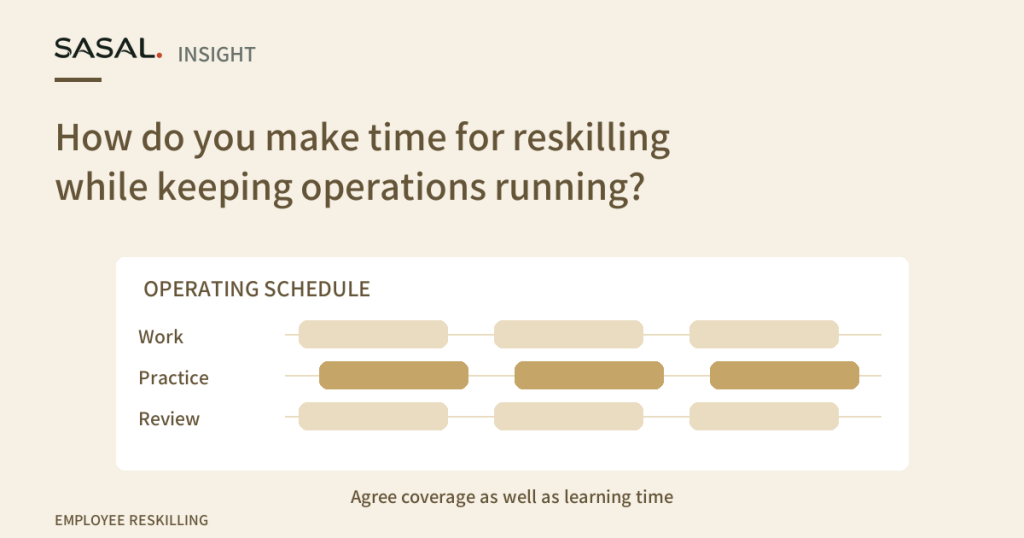
Approving a learning activity does not by itself reserve the time needed to complete it. A manager may approve a course or practical assignment while customers, colleagues and other departments continue to expect the same availability. The resulting conflict needs an operating decision: which work will stop, which will continue, who will cover it, and who will make time to teach and review. In existing international operations, the work owner must settle these questions while retaining employees and meeting current service commitments. The available time depends on those commitments and the work being learned; a fixed learning-time percentage or standard programme duration cannot establish it. The aim is a feasible workload for a defined period, with clear conditions for changing the scope, staggering participation or deferring a start.
Start with the work already promised
Begin with the employee's actual commitments for the proposed learning period. Include customer delivery dates, recurring internal outputs, necessary checks, meetings and work that arrives without an appointment. Identify the recipients and what they rely on. A task that occupies little time may still determine whether another team can proceed; a lengthy activity may be a candidate for reduction if its recipient no longer uses it. The starting question is what must remain dependable while the employee learns, rather than where an empty space appears on the calendar.
Ask the employee and their manager to trace a recent operating period together. Compare the planned workload with work that actually arrived, including requests from outside the department. This can reveal commitments the manager did not see or supporting work that was absent from the schedule. Use existing task records and discussion to obtain a proportionate picture. The purpose is to understand the workload, not to require a minute-by-minute account of personal activity. Explain how the information will be used and who needs to see it so that identifying a scheduling problem does not become an unexplained exercise in individual performance monitoring.
Distinguish the owner of a commitment from the person currently completing it. An employee may be able to change the order of their tasks while lacking authority to stop a report requested by another department or alter a customer's deadline. The capacity plan needs a route to the person who can make that decision. Where the work supports a contractual obligation or necessary control, ask the responsible owner what flexibility exists. Neither the employee nor an external coach should have to infer that an approved learning assignment silently overrides those obligations. Record unresolved priority conflicts before the start rather than leaving the learner to absorb them during delivery.
Also identify the level of service that is being preserved. Maintaining essential responses and agreed delivery may allow some lower-priority requests to wait, but those expectations need to be communicated and accepted by the appropriate people. If every existing deadline, immediate response and optional request must continue at the same level, the manager needs to explain where learning capacity will come from. A narrower initial task, a different starting period or additional agreed coverage may be feasible. The commitment inventory makes those alternatives discussable: each proposed change has an affected recipient, a responsible owner and a consequence that can be considered before the schedule is approved.
Compare available time and demand on the same basis

Choose an operating window that matches the work being planned. A weekly view may suit frequently repeated tasks, while a reporting cycle may be more informative for work concentrated around period end. Compare demand and available time within that same window. An annual average can conceal a week in which the employee is expected to handle a deadline and undertake substantial practice at once. Show known absences, working arrangements and variations in demand rather than treating the nominal number of staff as a complete description of capacity.
Distinguish scheduled time from time that can realistically be assigned to the work under review. Existing obligations, required supporting activity and agreed breaks or absences still need to be accommodated. Some work also needs uninterrupted attention, while other tasks can be completed in shorter intervals. Five scattered gaps are not necessarily equivalent to a single block when an employee must assemble information, perform a new procedure and obtain feedback. Record the assumptions behind the estimate. An apparent residual of time is a planning observation, not a measure of effort, motivation or the proportion of paid time that ought to be productive.
Consider a hypothetical period in which an employee has 24 hours that can be assigned to the specified work, after other scheduled constraints have already been allowed for. Retained assignments are estimated to require 18 hours, and three further hours are required for existing coordination that is not included in those assignments. The residual is three hours. It must cover any new practice and related activity allocated to that employee, along with whatever allowance the plan needs for variation. It is not evidence that three uninterrupted learning hours will be available. If the 18-hour estimate already included the coordination, subtracting it again would understate capacity; if routine checking was omitted, the estimate would overstate it.
Apply the same clarity to demand. Define which outputs and ordinary checks an estimate includes, then identify additional review or correction associated with the new way of working. Use ranges or explicit uncertainty where the team lacks a reliable estimate, and identify what observation will improve it. Do not turn the first estimate into a fixed target against which employees must compensate personally for every variation. The manager is deciding whether a plausible arrangement can start under stated conditions. That requires compatible definitions and visible uncertainty, not a spreadsheet whose precise-looking totals hide different periods, missing work or double-counted effort.
The same hypothetical plan changes if the retained assignments require 20 hours instead of 18. Only one hour remains after the three hours of existing coordination. The two-hour difference needs an operating response: reduced practice, different coverage or a revised commitment. It should not be hidden by keeping the original learning allocation and expecting the employee to make the totals fit. Identify which estimate needs checking first and who will decide the adjustment. This makes the arithmetic useful for a decision without presenting the initial estimates as reliable forecasts.
- Retain commitmentsName the outputs, checks and service conditions that must continue.
- Reduce or move workObtain the owner’s decision and trace any transferred work to its new responsible person.
- Reserve practiceMatch suitable tasks and usable time to the employee’s learning assignment.
- Provide teaching and reviewInclude preparation, feedback, correction and the support team’s retained obligations.
Agree which work will reduce or stop
Look first at tasks whose purpose or level of effort can be reconsidered by the responsible owner. A report may repeat information already available to its recipient, a meeting may no longer support a decision, or a low-priority request may be suitable for a different frequency. Establish the actual use before proposing a change. The employee preparing an output may not see all of its recipients or dependencies. Ask who relies on it and what they would lose if it changed. That conversation can identify a narrower output without assuming that apparently unused work is safe to discontinue.
Describe the proposed reduction precisely. Stopping a recurring output, simplifying its preparation, reducing its frequency and postponing it are different actions. A postponement creates future work unless somebody also changes the obligation. Mark where that work will return in the operating calendar. Otherwise a learning period can appear manageable only because the resulting backlog sits outside the period being measured. For a simplification, identify which steps will disappear and what checks or information remain necessary. The person receiving the output should understand the revised arrangement and the conditions under which it may need to be revisited.
Obtain decisions from the people able to change the work. A department leader may control internal priorities but need another function's agreement to alter a shared process. Where a task relates to a contract or a required control, involve the responsible owner and relevant specialists. Keep the decision record concise: what changes, when it takes effect, what remains, who agreed it and what would justify reconsideration. An external coach can help expose duplication or explain the learning requirement, while the company retains authority to accept the operating change. Treat a requested reduction as unresolved until that authority has actually been exercised.
Check whether the expected time becomes available in practice. Removing a report might release preparation time but create repeated questions from people who previously relied on it. A shorter review may work for routine cases but require more attention for exceptions. These findings do not automatically invalidate the reduction; they show what the next adjustment must address. Agree who will receive feedback and decide whether to restore, amend or continue the change. The resulting time belongs in the learning plan only to the extent that the revised work supports it. A nominal reduction that colleagues quietly reverse through informal requests cannot sustain a dependable practice schedule.
Arrange coverage for work that remains
For every task transferred during learning time, name the person who will perform it and the conditions that make the transfer workable. They need sufficient knowledge, the necessary information and access, appropriate authority and time in their own schedule. The original employee's availability may improve while the department's total effort remains unchanged or increases during handover. Show both sides of that transfer. A coverage arrangement should not rely on a colleague absorbing work invisibly or extending their working time without the appropriate agreement and review.
Define the covered task and its limits. A colleague might respond to routine requests within an agreed scope while referring exceptions to a manager. Another may prepare material but lack authority to approve its release. Explain those boundaries to the people sending work as well as to the person covering it. An instruction to “look after the inbox” is insufficient if incoming requests differ greatly in consequence and required expertise. Identify which requests can proceed, which need a decision and how urgent matters reach an authorized person when the learner is unavailable.
Prepare a proportionate handover. Provide the current status, relevant deadlines, pending decisions and the records needed for the covered work. Clarify how new information will be recorded so the returning employee can continue without reconstructing the period from scattered messages. If the task is unfamiliar to the covering colleague, include the preparation and checking time in the plan. Borrowing a person's name without arranging these conditions does not create effective capacity. It can add a second learning requirement precisely when the department is trying to protect the first.
Agree how long the arrangement will operate and who can change it. Coverage may be needed for particular practice periods rather than the whole programme. The recipient should know when responsibility returns and what happens if a session is postponed or extended. Keep customer or internal contacts informed through the appropriate channels so they do not continue directing every question to the learner. Where temporary external assistance is considered, define its scope, coordination requirements and commercial terms separately. An additional provider also needs briefing and review; its arrival should not be recorded as immediate, unlimited relief for the department.
Finally, examine the work that the covering colleague must move in turn. If their own commitments remain intact, identify the adjustment that prevents the plan merely shifting the overload. Sometimes the feasible answer is a smaller learning group or a different calendar. Sometimes a broader priority decision is required. Make that decision at the level where the competing commitments can actually be changed rather than asking two employees to resolve an impossible allocation between themselves.
Reserve time for the people who teach and review
Identify the activities required from the people supporting learning. They may need to select suitable work, prepare materials, demonstrate a method, observe an attempt, check an output and explain corrections. Questions also arise between planned sessions. An experienced employee who can explain the work may already be the person handling its difficult cases. Confirm their availability alongside their knowledge. Assigning them as the coach without adjusting those responsibilities can concentrate delivery, exception handling and teaching with the same person, leaving all three dependent on an implausible schedule.
Separate time in a joint session from the total effort it requires. An hour spent together uses an hour of the learner's time and an hour of the coach's time. It remains one elapsed hour, but the departmental plan must account for both participants. Preparation and subsequent review are additional where they are not already included. Avoid counting the same work twice under overlapping labels, such as a review meeting and a separately estimated feedback session that are actually the same event. Ask the coach to describe what has to happen before, during and after the interaction so the estimate reflects the proposed method.
Consider when feedback is needed for the employee to continue. Some questions can be collected for a scheduled discussion; others determine whether an output may be used or whether a customer commitment can be made. A plan that provides one weekly conversation may be inadequate for work whose next step depends on timely review. Identify the decision, acceptable waiting and alternative route rather than assuming the coach must be continuously available. Where another qualified person can review specified cases, make their scope and availability explicit. Where no suitable cover exists, restrict the practice or live-work assignment to what the available reviewer can support.
Use early experience to refine the allocation. If the coach is repeatedly correcting missing inputs, the task may need better preparation rather than simply more teaching hours. If several learners ask the same question, clarify the shared guidance while retaining individual feedback where the work differs. If the coach is completing the task on the learner's behalf to meet a deadline, distinguish that delivery work from evidence of learning. The manager can then adjust scope, coverage or timing with a clearer explanation of the demand. The allocation should show who supports the work and how their ordinary obligations will be handled, so coaching remains a responsibility that can be performed rather than a label attached to someone already fully occupied.
Fit learning around the operating cycle
Place the proposed practice beside the events that shape real demand. Customer operating windows, recurring reporting, agreed service commitments and predictable busy periods can affect both the learner and the reviewer. Check which dates are fixed and which can be changed by the appropriate owner. A quiet period for one department may be a peak for another team providing inputs or feedback. Where work spans several countries, confirm the actual calendars involved rather than assuming that everyone shares the same working days, holidays or period-end schedule.
The frequency of the task affects when meaningful practice is available. A frequently repeated activity may provide several opportunities to apply feedback within an ordinary operating period. An infrequent procedure may have only one live occasion in that period, with substantial consequences if it is mishandled. Consider what can be prepared or practised with authorized materials beforehand and what needs supervised exposure when the actual task occurs. Simulation or rehearsal can support preparation, but it should not be presented as proof that the employee has handled every live condition. Leave the necessary review and operating approval in place.
Arrange practice blocks to fit the work involved. Some learning benefits from following an assignment through a complete sequence, including checking and correction. Dividing it into brief gaps may repeatedly require the employee to reconstruct context. Other activities can be practised in shorter periods because each attempt has a clear boundary and the inputs are available. Let the task and feedback needs determine the arrangement. An unqualified instruction to learn only “when things are quiet” leaves neither the learner nor the coach able to plan. Identify actual periods, the work displaced from them and the person who can protect the arrangement when requests compete.
Specify what happens around peaks. The department might narrow live practice during a critical deadline, continue preparation that does not affect delivery, or move the start to a period with reliable review coverage. Record the consequences for both learning and operations. Delaying a start may avoid an immediate conflict while postponing the capability the business needs; starting too broadly may expose commitments the team cannot adequately support. The decision should make that tradeoff visible. Neither a fixed programme duration nor a universal proportion of working time can resolve differences in task frequency, customer timing and review capacity. The calendar is credible when it reflects those conditions and can be revised as they change.
Choose how many people can start together
Determine what limits simultaneous participation. It might be the number of people needed to maintain a service, the availability of suitable practice work, or the time of the person who must review results. These limits can differ by task and period. Count the work and support needed for the proposed group before adopting a convenient cohort size. A department with many employees can still have only one qualified reviewer for a particular activity. A small team may be able to learn together if the new work is tightly connected and its current commitments have been adjusted appropriately.
Compare a staggered start with a shared team start. Staggering may preserve more ordinary coverage and allow guidance to improve after early attempts. It also creates a period in which different people may be using different methods, so handoffs and current instructions need care. A shared start can help a team learn an interdependent process together, but it places more demand on coverage and coaching at once. Explain which feature of the work makes the option useful. Avoid selecting a pilot group merely because those employees appear easiest to release if they do not perform the activity the business intends to change.
Consider the practical dependencies among learners. If one person's new output becomes another person's input, delaying the second person's participation may require an interim receiving arrangement. If several people rely on the same reviewer, practice that appears manageable for each individual can create a queue across the group. Agree how outputs and questions will be scheduled and what the team can do while waiting. Treat the reviewer's capacity as a real operating constraint, with a named owner who can change priorities. Asking employees to complete more practice will not resolve a review stage that cannot receive the work already submitted.
Separate service purchasing decisions from the size of a simultaneous practice group. A commercial arrangement may cover a defined number of participants while their activities are scheduled differently over time. The agreement needs to support the intended approach, but a purchase quantity is not evidence that everyone should begin the same task at once. Review the proposed sequence with department leaders, the people providing support and the employees affected. Record the conditions for bringing the next group into the work: usable guidance, sufficient coverage, review capacity and the required operating approvals. This allows expansion to follow demonstrated readiness in the arrangement rather than an assumption that an initial date commits every participant to the same calendar.
Provide review coverage across work schedules

Map when learners and reviewers can actually communicate under their agreed working arrangements. A manager located in another time zone may be available only during part of an employee's workday; shift patterns can create similar gaps within one location. Identify which stages can proceed independently and which require a response before the next action. State what the employee should do if a question arises while the reviewer is unavailable. They may be able to prepare the next input, move to another approved task, or pause the affected item. Do not leave them to choose between an unauthorized decision and an unexplained delay. Establish a route to an appropriate alternative reviewer where the work requires one, and make the limits of that cover clear.
Make questions answerable without requiring constant live meetings. A useful request identifies the task, relevant evidence, the decision needed, what has already been checked and the effect of waiting. Provide access to the necessary materials through the approved channels so the reviewer does not spend the next available period asking for basic context. The reply should identify what can proceed and any conditions that remain. This does not remove the value of a direct conversation where reasoning or understanding is unclear. It helps reserve that conversation for the issue that needs it. Agree where the answer will be recorded so the learner and any covering colleague can find the current instruction without treating an old message as universally applicable.
Review the cost of the arrangement on both sides. A timetable that repeatedly puts the same people into meetings outside their usual schedule may appear to solve a coordination problem while creating another workload problem. Discuss workable alternatives with the responsible managers and employees, taking account of applicable employment arrangements and accessibility needs. These might include another qualified reviewer, a different practice window, or a smaller live-work scope during periods without cover. Flexibility should be an agreed operating arrangement, not an expectation of permanent availability. If review cannot be provided when the task requires it, change the task or the timing before attributing the resulting delay to the employee's learning ability.
Distinguish feedback on a practice attempt from permission to use its output in live work. A reviewer might say that an approach is sound while still needing to check a consequential detail. The employee should be able to identify that remaining condition in the reply. Use a clear status, the next required action and a named decision owner where the task needs them. Otherwise an encouraging message can be mistaken for completed review, especially when the next opportunity to clarify it falls in another working period.
Check whether learning has become extra work
Review the workload soon enough to change the arrangement while it is still being used. Compare the agreed plan with the work employees and coaches are actually handling. Useful evidence can include unfinished assignments, deferred checks, repeated rescheduling, correction work and questions that remain unanswered. Discuss the pattern with the people affected. Attendance at every planned session does not establish that capacity was protected if ordinary work was moved into another part of the day or transferred informally to colleagues. Ask what changed around the session, not simply whether the session occurred.
Look for displacement as well as visible delay. A learner may continue delivering their most visible outputs while postponing documentation, preparation or maintenance work that others will need later. A covering colleague may keep response times stable by deferring their own assignments. A coach may meet learners by completing review work elsewhere in the schedule. Trace the consequences through the relevant commitments before describing the plan as successful. This should be a focused examination of the work being changed, using proportionate records and conversations, rather than a requirement to rank individual speed or observe employees continuously.
Interpret difficulties before choosing a remedy. An increase in rework may reflect unclear instructions, unsuitable inputs, insufficient review time or a new task that needs more practice. A backlog may be caused by unexpected demand rather than by the learning activity itself. Identify what is known, what is estimated and what needs further checking. Preserve the purpose and access arrangements for individual learning feedback; it need not all be circulated in a departmental capacity report. The manager usually needs enough information to understand the constraint and decide what to change, while detailed coaching feedback can remain with the appropriate participants under the agreed arrangements.
Give somebody authority to resolve competing demands. If another department restores a supposedly discontinued report or a customer deadline changes, the learner needs a route to a decision. The manager may have to renegotiate the commitment, adjust coverage, reduce the practice scope or pause part of the plan. Record what will happen and communicate it to the affected recipients. Telling the employee to “make the time” leaves the original conflict intact. A workable review produces a change in the allocation or an explicit decision that the current arrangement can continue under the observed conditions. It also identifies what evidence should return at the next review, so a temporary difficulty is not repeatedly rediscovered without action.
Change the plan when demand or absence changes
Identify the events that would make the original allocation unreliable. A demand increase, an absence, a changed customer commitment or the loss of review coverage can affect the balance differently. Define who is allowed to reset priorities and how affected employees, coaches and work recipients will be informed. Avoid using a general instruction to prioritize operations as the entire contingency plan. It leaves open which practice can continue, which customer work takes precedence, and whether the employee is still expected to complete the original learning assignment within the same period.
Reassess the remaining work before deciding the response. Some preparation may continue without taking attention from the urgent commitment; some live practice may need supervision that is no longer available. Pause or narrow the affected activity specifically. If an employee has already begun a task, identify the last accepted output, pending checks and the person responsible for completing or holding it. The interruption should not leave work between the learner and coach with nobody knowing its status. Explain any effect on delivery through the company's normal decision and communication routes instead of allowing the employee to make new promises to compensate.
Preserve enough learning context for a realistic restart. Record what the employee has practised, what feedback remains unresolved and what changed during the interruption. When activity resumes, confirm that the inputs, instructions and review arrangements still apply. A task or tool may have changed while practice was paused. The relevant question is what the employee can now undertake under the actual conditions, not whether the original timetable says a particular stage should already be complete. Use a proportionate check to decide where to restart rather than requiring unnecessary repetition or assuming earlier preparation covers every new circumstance.
Set a return condition that someone can evaluate. It might be restored coverage, completion of a specific peak, an available reviewer or a revised commitment agreed with a recipient. Name the person who will check the condition and bring back a decision. Repeated postponement without a review can leave employees uncertain about whether the new responsibility still matters. If the business no longer has a credible use for the proposed learning, reconsider the assignment explicitly. If the use remains important but resources are unavailable, explain the tradeoff and choose a feasible next scope. A pause is an operating decision to manage; it should not automatically become evidence that an employee lacked commitment or was unable to learn.
- Identify the changeDescribe increased demand, absence or unavailable review and the work affected.
- Recheck commitmentsConfirm retained obligations, unfinished work and available coverage.
- Adjust scope or timingDecide what continues, narrows or pauses, and assign pending actions.
- Agree a return conditionName what must be available and who will review readiness to resume.
Confirm the employment context before changing conditions
Separate the operating proposal from the approvals and processes needed to put it into effect. A plan may change duties, work schedules, reporting arrangements, access to information or the location of an activity. Ask the responsible HR and other relevant specialists which employment terms, policies, employee-representation arrangements and local requirements need to be considered. Provide the actual proposed changes and affected people, rather than requesting a general endorsement of reskilling. Department-leader agreement is important for allocating work, but it does not establish that every necessary employment step has been completed. This article offers a planning method; it does not set a universal consent, consultation or working-time rule across jurisdictions.
Discuss practical access to the learning with employees. Check whether the materials, equipment, meeting arrangements and way of receiving feedback can be used within the agreed working conditions. Consider stated accessibility needs and relevant constraints through the appropriate company process. Do not infer capability or availability from age, nationality, personality labels or willingness to speak in a group. An employee may understand the task while lacking access to a required resource, or may need a different arrangement to participate effectively. Changing that condition is different from changing the learning objective. Keep the proposed work connected to actual operational needs and the employee's role, and distinguish discussion of a new assignment from an assumption that any duty can be transferred without further agreement or review.
Clarify how learning and workload information will be handled. Employees should understand the purpose of practical feedback, who will see it and how it relates to decisions about their work. Establish appropriate access and retention arrangements rather than circulating detailed individual records merely because several departments are involved. Where local managers or specialists identify an unresolved issue, keep that condition visible in the start decision. The business may be able to prepare materials or clarify work while another step remains pending, but it should not present preparation as authorization to change the affected conditions. A coherent plan brings the operational allocation and the applicable employment arrangements together before expecting employees to perform against the revised commitments.
Check who can answer employees’ questions about the proposed arrangement. The learning coach can explain the practice, but may not be able to interpret a change to employment conditions or decide how feedback will be used in an existing personnel process. Identify the responsible company contact and make that distinction clear. A question about working arrangements should reach that person without requiring the employee to resolve it through the coach. Keep any necessary individual discussion within the appropriate channel rather than treating a group briefing as an answer to every participant’s circumstances.
Approve a workload that can continue
Put the proposed allocation into a form that the responsible people can use for the next operating period. It should identify the learning task, the work being retained, the approved reductions, the coverage arrangement and the time required from learners and reviewers. Show the important assumptions and unresolved conditions. The document does not need to reproduce every discussion; it needs to let a manager understand what has changed and let employees see what they are expected to do. Connect it to current work records so responsibility for an assignment remains clear when the learning calendar changes.
Check the plan with the people providing the capacity. The covering colleague should recognize the task and its limits. The coach should recognize the preparation, review and question handling required. The work owner should recognize the commitments that remain and the changes they approved. Where those accounts differ, resolve the discrepancy before treating the allocation as available. A total number of hours can appear feasible while depending on the same specialist being in two places or on a recipient continuing to accept an output that has been changed without agreement.
Choose the start decision deliberately. Starting the proposed scope is one option; narrowing the task, staggering participation, changing the period or deferring the start may better fit the available conditions. Record the reason and the event that would justify a different decision. Retaining employees does not remove the need to reallocate their work, and protecting service does not require preserving every historic task in its original form. The decision should connect the capability the business wants with the work it is prepared to reduce, cover or postpone to make that capability possible.
Agree what evidence will return at the first review. The department needs to know whether retained work continued under the agreed conditions, whether learning and review actually took place, and where additional effort or unresolved work accumulated. Select records and conversations proportionate to those questions. Avoid promising a financial benefit from hours that have merely been set aside or from a training activity that has not yet changed usable work. Evidence of learning, operational improvement and financial value belongs to later, distinct assessments; the immediate decision concerns the feasibility of the allocation.
Keep ownership of the plan inside the company. External support can help map the work, explain practice needs and review difficulties, while authorized managers decide priorities, assignments and operating commitments. Make the route for changing the plan accessible to the employees and reviewers who will encounter problems first. With a named decision owner and a defined review point, the department can respond when its assumptions change. Learning then has an explicit place among the commitments the business has chosen to support, with the corresponding work decisions visible to everyone who must make the arrangement function.