

Vendor fees fell, but your team is busier. What improved?
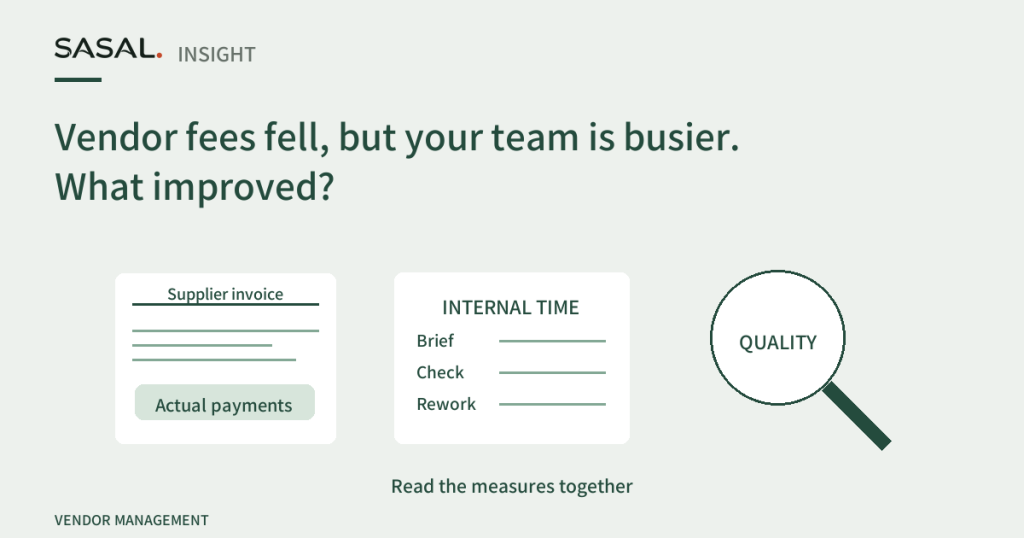
An overseas business changes how it manages an external provider. The next invoice is lower, yet employees spend more time finding inputs, checking drafts and resolving questions. Deliveries may also become more dependable. These observations can all be true, and they do not support a simple verdict without further examination. The decision is whether the new arrangement improves the particular work the business needs, at a cost and workload it is prepared to sustain. A useful assessment separates actual spending, the use of existing employees and the quality of the resulting work. It also explains changes in demand and the effort of transition. The following hypothetical examples show how to assemble that evidence without treating every released hour as cash or attributing every later result to the management change.
Separate a lower invoice from a better operating arrangement
Begin with the result that prompted the review. A provider has reduced its recurring fee after the company simplified the assignment. The invoice is verifiably smaller, but the employee receiving the work now checks material that the provider previously checked. Calling this an improvement in efficiency would require understanding what happened to the work, including the quality of the final output. Calling it a failure would also be premature: the employee may be better placed to perform a particular check, and the resulting arrangement may be more reliable. Establish the question before choosing the measure.
In this hypothetical situation, the company's finance owner can confirm the invoiced amount and its coverage. The operational owner can explain which tasks moved and what the recipient now needs to do. Employees who prepare, review or use the material can describe the additional effort and the consequences of incomplete information. These are different forms of evidence. The invoice cannot establish the time required internally; an employee's account of a busy week cannot establish the recurring cash cost. Keep the records connected to the same assignment while retaining their different meanings.
Specify what the business wanted the change to accomplish. It may have wanted fewer interruptions for managers, faster access to usable analysis, more dependable delivery, or a lower continuing payment for an unchanged service. Each objective requires a different comparison. If the purpose was to free management attention, a fee reduction accompanied by more internal review may miss that purpose. If the purpose was to bring a consequential judgment closer to the company, some additional internal work may have been intended. Write down the original expectation and identify expectations introduced only after the result became visible.
The review should produce a choice about the arrangement, not a single success label. Management might retain the new division of responsibilities, return a specific check to the provider, improve the inputs, or test a narrower change. Explain which observation would distinguish those options. For example, additional checking caused by a temporary documentation gap suggests a different response from checking that will recur with every delivery. Ask the responsible owner to confirm what the company is willing to pay for and what it is willing to perform. That decision gives the evaluation a practical purpose and prevents a favorable invoice from settling a broader operating question on its own.
Specify the work and the change being evaluated

Define the assignment closely enough for another person to recognize it. Record the outputs, intended users, required checks, countries or entities involved, ordinary delivery cycle and work that remains outside scope. A label such as regional support may cover unrelated activities with different economics. A monthly customer analysis and daily handling of urgent questions should not be treated as one undifferentiated unit merely because one provider supplies both. Start with a workstream whose inputs, recipients and responsibilities can be traced, then explain any shared activities included in the evaluation.
Describe the intervention as an observable change. Appointing a coordination partner, removing a review stage and reducing the provider's delivery scope are three different interventions. The first may change how questions reach decision-makers; the second changes which checks occur; the third changes what the company buys. If all three began together, retain that fact. It may be possible to assess the combined arrangement without establishing the separate contribution of each element. Do not present a bundle of changes as proof that the new coordinator alone caused the outcome.
Record when the changed method actually began operating. A contract signature, a new contact's introduction and the first completed delivery under the new responsibilities may occur on different dates. An evaluation based on the signature date can include weeks in which the previous method remained in use. Identify the first relevant cases, the instructions they followed and any overlap. Where parts of the work changed at different times, use those dates explicitly. The start condition should describe a working arrangement that can be observed, rather than an announcement or an intention to change.
State the expected mechanism in terms that can be checked. If the change creates one route for clarifying provider questions, the expectation may be fewer duplicated requests and less time reconstructing context. If it moves approval closer to an authorized business owner, the expectation may be less waiting for a decision. If it removes a required check, however, reduced time alone cannot demonstrate an acceptable outcome. Name the necessary quality or authority condition that must continue. This makes it possible to test the explanation instead of inferring a mechanism from a favorable total.
Assign responsibility for the evaluation and for the resulting operating decision. A coordinator can collect records, reconcile scope descriptions and bring unresolved matters to the relevant people. The company's authorized owner decides priorities, acceptable service and any further commitment. Where the proposed remedy involves taking over operational delivery, specify that work and its fee separately from management coordination. Keep the review's own effort proportionate: a focused assignment needs a usable record of the change, not an extensive new reporting system that becomes an unmeasured part of the cost.
Choose periods that can reasonably be compared
Select the comparison window from the operating cycle. For a recurring monthly output, identify periods with comparable work and enough completed cases to inspect how the arrangement functioned. For irregular assignments, compare recognizable categories of work rather than assuming that two calendar months contain the same demand. Record the number and type of requests, the required service, the recipients and any unusual events. The comparison should show what each period represents. Equal duration is useful, but it does not make the work equivalent when one period contains a major launch and the other contains routine maintenance. Examine the mix as well as the volume. A small number of unfamiliar, multi-country assignments may require more interpretation than a larger set of repeat requests. One destination may require an additional language or a specialist review that another does not. A changed quality requirement can also explain more checking. Use categories that participants can apply consistently to the actual work, and explain why the distinction affects effort. Excessively detailed categories can leave too few cases to interpret. A short classification with visible limitations is more useful than an apparently precise adjustment nobody can reproduce.
Check what the earlier record can support. The company may have reliable invoices but incomplete time records, or delivery dates without evidence of when outputs became usable. Reconstruct missing information from available task records and the people involved, clearly marking estimates and their basis. Do not describe recalled hours as measured hours. If the earlier period cannot support a credible comparison of internal effort, say which conclusion remains unavailable and begin a prospective record. A limited baseline can still identify a question worth testing; it cannot justify an exact improvement percentage simply because management wants one.
Consider whether a comparison workstream adds useful context. Another team may have experienced the same demand increase without changing its management arrangement. Its experience can help explain a shared external event, provided its work and conditions are described. It is not automatically a control group. Differences in clients, staff experience, timing or scope can make direct attribution misleading. Use such evidence to challenge an explanation rather than to manufacture certainty. Where the change was introduced gradually, examine the sequence of cases and the instructions they followed, while acknowledging that learning and other conditions may have changed alongside the rollout.
Agree the limitations before interpreting the results. A note might state that external payments are directly comparable for the defined scope, while internal effort is estimated and the later period contains more complex cases. Preserve those qualifications beside the result, not in a separate file that disappears when the findings are summarized. The owner can then decide whether the evidence supports continuation, whether the comparison needs another operating cycle, or whether a particular effect cannot yet be distinguished from demand. Honest limits help direct the next observation toward the uncertainty that matters.
Include spending outside the main provider invoice
Trace the external spending associated with the defined assignment. In addition to the base fee, relevant items may include approved extra work, specialist charges, translation, travel, subscriptions, local coordination or a separate management service. Include an item because it supports the work being assessed, not because it belongs to a convenient accounting category. A lower main invoice can coexist with higher total external payments if another party now supplies an omitted task. Link the additional charge to the output or responsibility it supports so the comparison explains the change in the arrangement.
Use the finance team's records and accounting treatment. Identify the service period, invoice, payment date, currency and any adjustment relevant to the review. An invoice received later is not evidence that the associated work cost nothing during the operating period. Equally, a prepayment is a cash movement whose timing may differ from the period of service. Keep expense and payment views distinct where that difference matters. Questions about tax recovery, pass-through charges or gross and net presentation belong with the responsible finance specialists and the actual transaction; do not impose one treatment across all entities.
Check bundles before adding separate lines. Suppose the provider's hypothetical fixed fee includes ordinary translation, while an exceptional specialist review is charged separately. The evaluation should not add an estimated translation payment to the fixed fee as though both were incurred. If translation moves to another supplier after the change, record the new payment and whether the original fee was correspondingly revised. Apply the same discipline to a coordinator whose agreed charge already covers specified reporting activities. An analytical breakdown of a bundled price can explain its composition, but it is not another amount to add to the total.
Explain shared charges through a consistent allocation basis when an assignment uses only part of a resource. A subscription may support several workstreams, or one specialist visit may serve more than one purpose. State whether the evaluation includes an incremental payment caused by the change or an allocated share of an existing commitment. Those answers support different decisions. The company may need the allocation to understand the resources supporting the work while recognizing that ending this assignment would not remove the whole subscription or visit cost. Keep the amount and the assumption visible to the decision owner.
Reconcile the proposed total with the underlying records before discussing savings. Ask the finance owner to confirm exclusions, duplicate entries and unresolved charges. Retain notice-period payments, committed minimums or other continuing amounts where they remain payable under the actual agreements. A decision to stop requesting work does not itself establish that payment has ended. The useful result is an explained change in spending for a defined period and scope, with unsettled items identified, rather than a comparison of headline fee cards or the smallest number on the latest invoice.
Trace internal time from briefing through rework
Follow the internal work across the assignment. Employees may define the request, locate records, translate context, answer questions, coordinate participants, obtain approval, check delivery and correct errors before the output can be used. Some of that effort falls outside the named manager's role. A finance colleague may resolve definitions; a sales manager may interpret a customer requirement; an assistant may repeatedly retrieve an old decision. If the evaluation records only the coordinator's time, work transferred to those people can disappear from the comparison. Identify the relevant activities and participants without assuming that every internal interaction is caused by the provider.
Choose a recording method proportionate to the decision. For a bounded review, participants can record the activity, assignment, approximate duration and reason when relevant work occurs, using existing records where suitable. Agree how they distinguish ordinary coordination, a new request and rework caused by an earlier problem. A correction due to a changed customer requirement is not the same event as correction of an unusable delivery. Record enough context to interpret the activity later. Requiring elaborate timesheets for a small improvement can create more measurement work than the decision warrants.
Keep elapsed waiting separate from active effort. A report may sit for two days while awaiting approval, although employees spend only part of that period working on it. Both facts can matter: the delay may threaten the operating deadline, while actual work contributes to resource use. They are different measures. Likewise, a meeting's duration and the total time of its participants answer different questions. If three people attend a one-hour review, that is one elapsed hour and three person-hours, before any preparation or follow-up. Do not add the meeting twice because it appears in both the coordinator's record and participants' accounts.
Review the completeness of the record with the people doing the work. Small interruptions, after-meeting corrections and informal explanations are easy to omit. A change in recording discipline can make the later period look more burdensome even if the underlying work did not increase. Compare the recording method as well as the totals. Where participants estimate an earlier workload, retain the basis and plausible uncertainty rather than turning a rounded recollection into an exact figure. Use a sample of assignments to check whether the recorded activities correspond to visible requests, comments and deliverables.
Explain the purpose and handling of individual information. The review concerns the effort required by an operating arrangement; it should not become an unexplained ranking of employee speed. The management summary may need totals by activity and the cause of repeated work, while detailed personal records remain available only through appropriate company arrangements.
Ask what action the owner could take from each proposed measure. A finding that managers repeatedly reconstruct missing context points toward better briefing or records. A total that cannot be linked to any responsibility or decision offers less help, however carefully it was measured.
Recovered time is different from reduced payroll spending
Present existing employee time separately from changes in cash expenditure. If the same people remain employed on the same terms, fewer hours spent managing a provider do not automatically reduce payroll payments. The company may have gained capacity to perform other work, which can be valuable, but that is a different result. Ask which cash commitment actually changed before calling an amount a cash saving. Where the change avoids approved overtime or another additional payment, confirm the amount and relevant period from the responsible records rather than inferring it from hours alone.
An allocation of existing salary can help describe the resources consumed by the assignment. Use a stated employment-cost basis and a reasonable share of time, consistent with the finance team's method. The resulting allocated cost is not an additional payroll payment to add on top of the same salary. Nor does reducing the allocation establish that the corresponding cash became available to spend elsewhere. Explain what the view is for: understanding the economic resources used by the work, comparing arrangements, or planning actual funding. A reader should be able to identify which kind of amount they are looking at without reconstructing the calculation.
Separate newly incurred internal cash from that allocation. Additional paid hours, newly commissioned support or a new employment commitment may affect spending, depending on the actual arrangement and applicable treatment. A different mix of duties among existing employees may not. Include the employer costs that belong in the chosen calculation and confirm assumptions with finance. Do not build the case on reducing staff: the evaluation can examine whether an existing team handles its responsibilities more effectively while employment remains unchanged. Any employment decision is a separate authorized matter, not an automatic consequence of reporting a time improvement.
Opportunity cost answers another question: what worthwhile alternative could the company pursue with the same people or funds? If managers spend less time chasing clarifications, they may be able to complete an overdue customer analysis. Compare that alternative with continued coordination demands using its expected purpose, effort and uncertainty. Do not add the full value of the alternative to an allocated salary reduction and label both cash savings. The same released capacity underlies both descriptions. Keep the forgone or newly feasible activity visible as a choice, with an explanation of what evidence would establish its actual use.
Build the management summary so unlike units remain distinguishable. Show the change in external payments, any additional internal spending, existing staff time and operating outcomes in separate fields. An optional cost-allocation view can sit alongside them with its assumptions. Avoid a grand total that adds hours, salary allocations and sales expectations together. The owner may accept somewhat higher spending to release constrained management capacity or improve a consequential output. That judgment is easier to assess when the trade-off is explicit than when an apparently precise return calculation conceals how its components were defined.
- Cash and commitmentsShow external payments and additional internal spending, with their periods and continuing obligations.
- Existing staff capacityRecord effort used or released; label salary allocation separately from actual payroll changes.
- Operating outcomesExamine usable outputs, timely decisions, rework and the work completed with available capacity.
Check what the available time enabled the team to do
Establish whether the time was actually released before assigning it a benefit. A task may take fewer minutes while the employee still needs to remain available for unpredictable questions. Several brief gaps may not support a task requiring uninterrupted analysis. Review when the capacity became available, which person had it and what other conditions affected its use. The result may be improved responsiveness or less pressure around a deadline rather than a block of time that can be reassigned. Describe that result accurately instead of forcing every improvement into the same redeployment story.
Separate three states: capacity appears available, management has assigned an alternative use, and the alternative work has been completed. A plan to use recovered time for customer follow-up is not evidence that the follow-up occurred. Ask the work owner to identify the activity, its priority, the person responsible and the record that will show progress. Check that the activity has the required inputs and authority. Releasing an analyst from coordination does not make an overdue analysis feasible if another team has not provided the data. The limiting condition may have moved elsewhere.
Consider a hypothetical team that spends less time correcting recurring provider reports. Management assigns some of the released capacity to explaining existing findings to customer-facing staff. The evaluation can verify that sessions took place, that requested explanations were prepared and that previously unresolved questions were addressed. It can also examine whether managers needed fewer repeat clarifications afterward. These are observable uses of the capacity. They offer a more defensible account of the operating benefit than assigning a notional hourly revenue to every minute no longer spent checking a report.
Treat later commercial results carefully. A sale following those sessions may also depend on the customer's budget, an existing relationship, pricing, the product and work by several other people. Record the management change's plausible contribution without assigning it the whole transaction. If the business wants to evaluate the commercial effect further, specify the chain of events and the evidence needed at each step. The current review may support a narrower conclusion: the team completed agreed customer-support work that had previously been postponed. That is useful evidence even when it does not isolate a financial return.
Unallocated capacity also deserves a decision. The owner may deliberately retain room for variable demand, use it to reduce an unsustainable burden or redirect it to another priority. State the choice and observe whether it remains feasible in subsequent periods. If new informal requests consume the released time, record who accepted them and whether they serve the intended purpose. Otherwise the review may report a time improvement that nobody can locate in the operating arrangement. Responsibility for redeployment stays with management, rather than with the provider whose work changed or the employee expected to make the benefit appear.
Read cost beside usable outputs, timeliness and rework
Define the result the recipient needs before selecting a quality measure. An output may be delivered on time but still require substantial correction before it can support a decision. For the hypothetical recurring report, usable could mean that the agreed scope is covered, required checks are complete, material assumptions are explained and the authorized recipient can use it for its stated purpose. Agree the criteria with the operational owner and provider. Do not change them retrospectively simply because a later version includes additional features or because the team has learned to ask a more demanding question.
If a rate is useful, state its numerator and denominator. A first-submission usability rate might divide outputs meeting the agreed acceptance criteria at first review by all first submissions assessed in the period. Specify how partially completed, withdrawn and unassessed items are treated. Keep the count beside the rate, particularly when there are few cases. One unusual assignment can move a small sample substantially. A single percentage without the underlying workload can conceal a change in scope or suggest a stable pattern that the available cases do not establish.
Timeliness also needs a defined event. The date a file arrives, the date the company accepts it and the date a decision can proceed are not necessarily the same. Identify the agreed due date and whether a change to it was authorized. Where company inputs arrived late, record that dependency rather than automatically assigning the whole delay to the provider. Where an on-time delivery still required correction, preserve both dates. The record should help distinguish late preparation, unresolved decisions and unusable output, because each points to a different operating remedy.
Use rework records to explain the result rather than merely counting errors. Identify the affected output, the reason for correction, the person doing it and the effort involved. Changes in customer requirements, missing company inputs, provider errors and newly introduced checks should remain distinguishable. Fewer reported errors may reflect fewer assignments or less checking. More recorded issues may reflect better detection rather than worse production. Inspect representative cases with the people who use the work before deciding which interpretation fits. Retain unresolved acceptance disputes as unresolved; calling them complete to improve a rate would remove the very evidence the review needs.
The owner can now compare cost with an explicit service result. Lower spending for fewer accepted outputs may be entirely different from lower spending for the same usable work. Additional checking may be justified if it identifies consequential problems, but its cost and responsibility still need a decision. Discuss whether the check belongs internally, with the provider or in a differently scoped assignment. This links the measures to a choice about the operating method instead of allowing a dashboard of unrelated numbers to stand in for evaluation.
Separate transition effort from recurring operation

List the work needed to establish the new arrangement. It may include clarifying scope, organizing records, introducing contacts, preparing guidance, resolving old questions and working alongside the existing method. Identify which activities are expected to recur and which address a bounded transition task. A new coordination role can initially spend substantial effort discovering how the work operates. That does not prove its eventual recurring cost, but neither should the effort disappear from the investment record. Keep the cost of getting to the new method distinct from the cost of maintaining it. Avoid defining transition solely by a calendar date. A documentation cleanup is unfinished if necessary records remain unconfirmed, even when the planned month has ended. Parallel work may continue because the new output has not yet met agreed acceptance conditions. Record the outstanding task, its owner and the condition that would end the overlap. If the condition repeatedly moves, investigate whether the remaining work is genuinely temporary or whether the intended steady arrangement was incomplete. Relabelling recurring effort as setup would make the ongoing method look more economical than the evidence supports.
Explain a comparison window that crosses both states. Suppose the first period includes introduction and duplicate checking, while the next contains only part of the ordinary cycle. Present the actual spending and time in each period, then identify which observations belong to transition and which describe continuing work. An estimate of future recurring effort may be useful, provided its assumptions and missing observations are explicit. Do not subtract all inconvenient early costs and call the remaining figure a demonstrated steady-state result. The new method needs enough ordinary work to reveal its actual dependencies.
Keep parallel spending connected to the responsibilities that still exist. The company may continue paying an existing provider while another party coordinates the work or prepares to take over a defined task. Confirm which outputs each is responsible for, how long the contractual commitments continue and which additional delivery has been separately agreed. The fact that two payments overlap does not establish waste; duplicate effort without a clear purpose deserves examination. The authorized owner should decide whether to continue the overlap, narrow it or defer the transition, using acceptance evidence and the obligations that remain.
For the next decision, distinguish amounts already incurred from future commitments. Past setup effort belongs in the historical account, but it does not by itself justify continuing an arrangement that no longer fits the business. Equally, a viable future method should not be rejected merely because an unavoidable past cleanup was expensive. Compare the remaining costs and expected service of the available choices, including amendment or orderly completion obligations where relevant. This supports a forward decision without erasing the cost of reaching it or promising a standard payback date.
Identify the effects of currency and workload changes
Preserve actual transactions in their recorded currencies and retain the finance team's reporting basis. A payment can change in the company's reporting currency even when the provider's price and delivered work are unchanged. Conversely, an unchanged reporting-currency total can conceal a changed local-currency price. Show the dates, currencies and conversion basis needed to understand the comparison. The evaluation should not overwrite actual records with a convenient exchange assumption. The person reviewing cash requirements needs the amounts and timing actually paid or still payable.
A separate consistent-rate comparison can help investigate currency effects. If used, explain the selected rate or method, the periods to which it is applied and the purpose of the calculation. Use finance-approved information rather than inserting an assumed current rate. Keep the resulting analytical figure distinct from actual payment and expense records. It answers a conditional question about the comparison under a common currency assumption. It does not establish that the difference could have been saved, recovered or spent elsewhere, and it does not remove other differences in the work.
Volume and mix require their own explanation. A higher total fee may purchase more accepted assignments, while a lower fee may follow a reduction in requested work. A cost per output can be helpful only when the output is defined and reasonably comparable. Do not divide one month's mixed specialist projects by a count that treats them as identical routine requests. Where categories differ materially, show the relevant groups separately or explain why the available evidence cannot support a useful unit comparison. Preserve the overall total so a favorable rate does not hide greater aggregate spending.
Consider a hypothetical change that removes duplicate briefing while the business adds another operating destination. Additional language work and unfamiliar cases may increase total internal hours despite an improvement in the original workstream. Compare the traceable briefing activity for similar cases, then show the effort associated with the expanded scope separately where the records permit. If the data cannot separate them, report that limitation. The result can support a narrower finding about duplicate work without claiming that the entire business now requires less effort. This protects a useful operational observation from an unsupported broad conclusion.
Do not stack adjustments as if each independently explains the whole difference. Scope, volume, mix and currency can interact, and an estimate based on one assumption may already incorporate another. Ask the analyst to reconcile the adjusted comparison back to the actual records and identify any unexplained remainder. A simple explanation with a visible residual is preferable to a complete-looking attribution assembled from incompatible calculations. The review should tell the owner which effects were observed, which were estimated and which cannot yet be isolated, so the next commitment rests on an interpretable comparison.
Reassess a hypothetical improvement that only lowered fees
Return to the opening situation with a more complete evidence sheet. The recurring provider fee has fallen. Company employees spend more time checking each submission. The accepted reports now reach the decision owner more reliably, and several previous clarification loops have disappeared. Payroll is unchanged, while a temporary parallel review continues for part of the work. These observations describe different dimensions of the arrangement. Verify which are supported by invoices, task records and accepted outputs, and which depend on participants' estimates. Do not combine them into a numerical success score that implies a conversion between money, time and reliability.
One interpretation is that work has been transferred to a more appropriate owner. Employees may need to confirm commercially sensitive assumptions that the provider cannot decide. Internal checking could therefore be part of a better responsibility model, even though the company uses more of its own time. To test this interpretation, inspect what the employees actually check, who has authority over it and whether the provider supplies the information needed efficiently. If managers are correcting basic formatting or repeatedly requesting agreed inputs, the same argument may not hold. The content of the work matters more than the label attached to it.
A second interpretation is that the fee reduction has hidden an incomplete delivery scope. The provider may have stopped a useful check, leaving the company to perform it without an explicit decision. Confirm the agreed scope before treating that as non-performance. Management could ask for the check to be restored, buy a differently defined output or accept the internal responsibility with suitable capacity. Compare the future cost and service of those choices, including the coordination each requires. The evaluation should expose the choice rather than decide that the smallest invoice is automatically the preferable arrangement.
A third interpretation is that the additional work is mostly transitional. Employees may be checking every item while instructions are clarified, with a defined intention to reduce duplication after acceptable cases demonstrate the method. Examine the unresolved issues and the conditions for ending the parallel check. If no one can state those conditions, the claimed temporary burden is not yet a credible explanation. Ask what a normal recurring period would include and what observation is still needed. Keep the actual overlap visible even if the owner expects the future arrangement to improve.
The reliability improvement also needs examination. Were due dates, acceptance criteria and case difficulty comparable? Did better inputs, a change in demand or a different decision-maker contribute? Select records that test the plausible explanations and preserve uncertainty where the contributions cannot be separated. The owner might continue for a further defined period, revise the checking responsibility immediately, or hold expansion until the overlap ends. Each can be defensible under different evidence. Record the reason, the next authorized action and the result to bring back, so the evaluation changes how the work is managed rather than merely explaining last month's bill.
Prepare evidence for continuing, adjusting or extending the change
Prepare a decision note around the defined work and the choice now available. State the change, comparison scope, periods and intended result. Present observed spending, internal effort and service outcomes separately, followed by estimates and unresolved effects. Include continuing commitments and any unfinished transition work. The owner should be able to see which conclusions follow directly from records and which require assumptions. Attach or reference the supporting detail without turning the note into another account of every meeting and message exchanged during the review.
Continuing unchanged requires a reason tied to the current objective. The method may provide acceptable service at a workload the team can sustain, even if every effect cannot be isolated. Explain which uncertainty can reasonably remain and what would trigger another review. If the new arrangement depends on an employee repeatedly absorbing unplanned work, record that condition rather than treating current delivery as evidence of sustainability. Confirmation from the people responsible for the continuing tasks matters: a method is not settled merely because its first outputs were completed.
An adjustment should target the diagnosed constraint. Missing inputs may call for better briefing; duplicate checks may need a clearer review responsibility; unavailable decision-makers may require an authorized escalation route. Specify the proposed change, who can approve it, who will perform it and which observation will show whether it worked. If the remedy changes provider scope or transfers operational delivery, obtain the corresponding agreement and separate fee treatment as appropriate. Avoid recording a recommendation as an authorized instruction. The next period should begin with responsibilities that the affected parties actually understand.
Extending the method to another workstream is a new decision. Examine whether the second stream has similar outputs, authority, information needs and service consequences. It may require another language, a different specialist or more internal preparation. Use the first review as evidence about the conditions under which the method operated, not as a guarantee that the same result will follow everywhere. Define a manageable scope, the people who can support it and the conditions for pausing or changing the extension. Preserve direct dialogue between the company and relevant providers when it is needed to resolve substantive questions.
Close the review by assigning the next commitment and its evidence. Name the owner of the operating decision, the people responsible for the change and the point at which the remaining uncertainty should return for assessment. Update the comparison when scope, volume or obligations materially change. Lower fees, recovered capacity and improved delivery can each be worthwhile, but they answer different business questions. Keeping those answers distinguishable lets management choose what to continue paying for, what its own team will do and where further observation is worth the effort. The decision remains grounded in the work the company needs to perform.
- Establish the comparisonDefine the work, change, periods, actual records and material differences.
- Interpret the effectsSeparate spending, internal effort and service results; identify estimates and unresolved causes.
- Choose the next scopeCompare continuing, adjusting or extending the method against future commitments and conditions.
- Assign and reviewThe authorized owner approves the next action, responsible people and evidence for the next review.