

Should you consolidate providers? Coordination and dependency
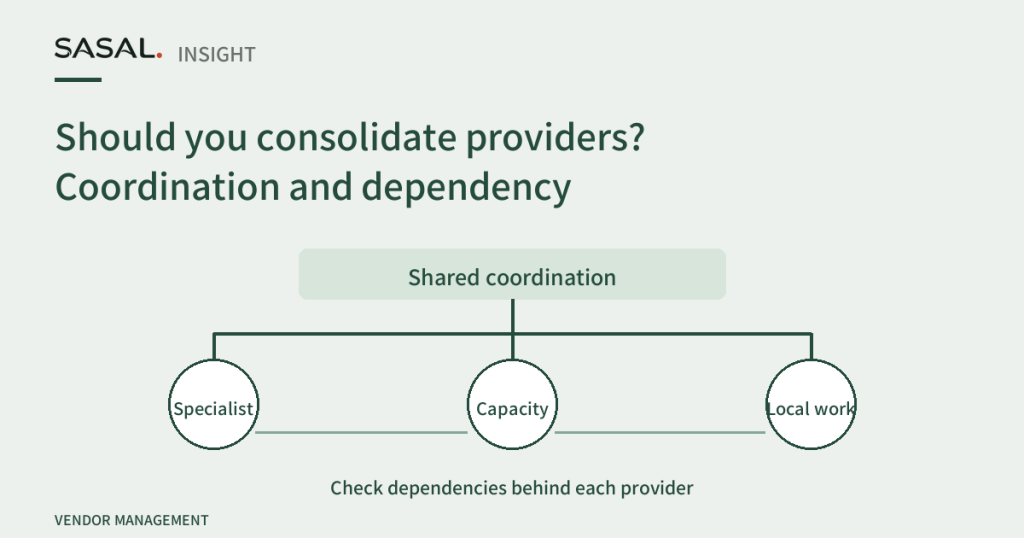
A manager wants fewer provider relationships because briefing, approvals and follow-up are consuming time. Before asking which company should take over, identify the work that consolidation is expected to remove. Several invoices may correspond to distinct expertise, while a single account manager may still rely on the same underlying delivery teams. A useful decision therefore compares operating arrangements for the required work, including the responsibilities that remain inside the company. This article examines three possible structures: retaining separate providers, using a common coordinator and placing a wider delivery scope with a lead provider. It explains how to compare their practical effects, check dependencies and test a change without treating a lower provider count as evidence that the business is better managed.
Identify the management work you want to reduce
Start with a specific operating problem. A team may be preparing the same background brief for several providers, reconciling incompatible reports or repeating approval discussions because the relevant people receive different versions. These are identifiable activities with causes that can be investigated. By contrast, a statement that there are too many vendors does not show what would improve if one name disappeared. Write down the burden, the work it affects and the internal people performing it before choosing a new contracting structure.
Follow one representative assignment through the current arrangement. Identify where information is prepared, where outputs are received and which decisions return to the client. Record duplicated effort separately from necessary review. If two departments both collect the same unchanged company information, a shared brief might reduce that work. If one reviewer checks technical correctness and another authorizes a commercial commitment, the two reviews serve different purposes. Moving both activities under one provider does not remove the client's need to understand and authorize its commitment.
Consider whether the burden comes from the provider structure or the client's own instructions. Several capable providers can be difficult to coordinate when priorities change through separate internal contacts. Conversely, an internally clear brief can still leave a gap between externally delivered outputs. The appropriate response differs. Clarifying the internal decision route may help without changing providers; defining a shared handoff may address a boundary problem; a new lead provider may be relevant when wider delivery responsibility is genuinely needed.
Use the problem statement to define what a proposed improvement must demonstrate. For example, the company might want one maintained background brief, a clear record of the version each provider uses and fewer unresolved questions about who receives the next output. Those are testable conditions. They do not promise a particular time saving or imply that every existing relationship should change. They also give retained providers something concrete to help improve rather than an unexplained instruction to reduce their involvement.
Keep commercial administration visible without making it the only criterion. Fewer renewals or invoice checks may matter to the team, but the value of that simplification depends on the work and responsibilities being combined. An apparently simpler purchasing record can conceal additional review, exception handling or dependency on a lead provider. The decision should explain which management activity is expected to change, where any new activity will sit and how the company will know whether the original problem has been addressed.
Separate duplicated effort from distinct expertise

Map the required activities before grouping provider names. For a hypothetical established international business, the work might include customer research, local specialist review and preparation of recurring commercial reports. These activities can share information while requiring different knowledge, review methods and responsibilities. The example is a way to examine the structure, not a recommended set of providers. For each activity, identify its purpose, output, recipient, required capability and the decisions that depend on it.
Look beneath broad service descriptions. Two providers described as business support may contribute different things: one gathers primary customer information, while another interprets an agreed specialist question. Conversely, differently named packages may contain overlapping desk research or reporting. Compare the work actually commissioned and delivered, using the agreed scopes and current records. Do not classify a function as duplicated merely because two proposals use similar vocabulary or because both teams attend the same meeting.
Distinguish independent review from unnecessary repetition. A second opinion can have a defined purpose, such as challenging an assumption before a significant commitment. It can also become unstructured duplication if nobody has specified the question or how the advice will be used. Ask who requested the review, what it is intended to establish and which decision it informs. The company can then decide whether to preserve it, narrow it or change the arrangement. Consolidation should not silently eliminate a check that management still relies on.
Capacity is another reason that apparently similar providers may coexist. Different availability, location coverage or ability to handle a particular type of assignment can be relevant to the work. Those capabilities need verification for the intended use. A provider's general statement that it can scale does not establish that the required people will be available when needed. Equally, keeping an unused relationship does not automatically reserve capacity. Record the actual arrangement and the information still needed to assess it.
Use the map to separate two questions: which work needs a distinct capability, and which coordination around that work can be shared? A company might retain its specialist relationships while consolidating document preparation and follow-up. It might also discover that one repeated output can be commissioned once for several agreed recipients. These are different decisions from transferring all delivery to one organization. Showing the distinctions makes the later comparison more credible because the options are built around the work the business needs to preserve.
Compare separate providers, a shared coordinator and a lead provider
Compare the same required work under three operating arrangements. In a direct-management arrangement, the client briefs and follows up with the retained providers itself. It can maintain direct access to each specialist and shape each assignment separately, but must supply the internal capacity to connect their outputs. A shared-coordination arrangement leaves operational delivery with the existing providers while assigning agreed tracking, preparation and coordination tasks to a common role. A lead-provider arrangement places a wider delivery responsibility with one organization, which may perform the work itself or use other parties under the agreed structure.
The difference is more than the number of contacts. Ask who prepares the brief, receives each output, resolves an operational question and brings a decision to the client. Identify who holds the relevant agreement and who is responsible for the delivered work. A coordinator may maintain a common issue record without becoming the contracting party or professional reviewer. A lead provider may have broader delivery obligations, but the client still needs to understand the scope, exclusions and retained decisions. If a coordination partner is also asked to undertake operational work, that additional scope and its fees should be separately agreed.
Work through the hypothetical research, specialist-review and reporting activities under each option. Direct management can leave the internal owner responsible for passing the research findings to the specialist and incorporating the answer into the report. A coordinator can follow those connections while the providers retain their assignments. A lead provider can be engaged for a defined combined output, subject to the actual agreement and delivery capabilities. None of these structures automatically produces the best result. Their value depends on what is being coordinated, how the company wants to retain oversight and which obligations each participant can actually accept.
State the proposed change precisely enough for the providers and internal team to assess it. One common contact is not necessarily one contract. One contract is not necessarily one delivery team. A wider scope does not necessarily include every specialist fee or every form of implementation. Show which relationships stay, which instructions change and which responsibilities move. That description gives the company a basis for comparing options without being misled by labels such as integrated support or single point of contact. It also identifies the approvals and further information needed before a proposed structure can become an executable arrangement.
- Client coordinatesSeparate delivery contracts; the client briefs the three providers and connects their outputs.
- Shared coordinatorDelivery stays with existing providers; a separately agreed role manages the connections.
- Lead providerA defined combined output is contracted to the lead, using its team or agreed other parties.
Establish who delivers the work and who holds the contracts
A proposed lead arrangement needs a clear view of the entities involved. Identify the client contracting entity, the lead provider's contracting entity and the parties expected to perform material parts of the work. A brand, account manager or consolidated invoice does not answer all three questions. Use the proposed agreement and delivery explanation to establish what is known. Where the lead has not yet selected a specialist or confirmed a subcontracting arrangement, record that as an open point rather than presenting a complete operating structure.
Trace responsibility for the actual output. Who prepares it, who reviews it and who is answerable under the relevant agreement if it does not meet the agreed requirement? These responsibilities can differ. The lead may manage a specialist contribution while the client retains a separate agreement with that specialist, or it may engage the specialist under its own contract. The implications depend on the actual terms. The coordination diagram should reflect the intended structure, while contractual questions are checked by the people responsible for them.
Confirm how the client can obtain the information needed to oversee the work. A lead provider may offer one contact for routine follow-up, but the client may still need to understand the basis and limits of a specialist conclusion. Agree how those questions reach the relevant person and what records can be received or retained. Direct contact can be useful without bypassing the lead's agreed management role. The important point is that the company should not discover after committing that the advice or working context it needs is inaccessible under the arrangement.
Check the route for additional work and changed instructions. A request made directly to a delivery specialist can create ambiguity if the lead is responsible for managing scope, while routing every minor technical clarification through the lead can add delay. Define the difference between permitted working contact and instructions that require a formal change or client approval. Name the roles and document the route rather than relying on everyone to infer it from the hierarchy of provider names.
Finally, compare the proposed picture with the existing commitments. Moving a contact route does not by itself terminate or transfer a contract. Existing obligations, notice provisions, permissions and payment commitments may still need to be addressed. Keep them in the transition plan with their responsible reviewers. A proposal becomes more reviewable when it separates the desired future arrangement from the steps and agreements needed to reach it, including any period in which both arrangements must operate.
Look for common dependencies behind different company names
Several provider names can conceal a shared dependency. In the hypothetical portfolio, two firms might use the same specialist for a particular review, rely on the same underlying software service or draw on the same small delivery team. These are possibilities to investigate, not assumptions about any provider. The number of contracts alone does not establish how independently the work can continue if one resource becomes unavailable. Ask which resources are material to the service the company is actually buying.
Map the dependency at the level needed for the decision. Identify the affected activity, the underlying resource and the consequence of losing access to it. The company does not need unlimited disclosure of a provider's entire organization to understand a critical delivery dependency. It does need a credible explanation of how the relevant work will be staffed or supported, what alternatives exist and what limitations remain. The information that can be shared should fit confidentiality and contractual conditions.
Distinguish a common dependency from a reason to reject the arrangement automatically. Shared infrastructure or specialist expertise may be an intentional and practical choice. The question is whether the company understands the exposure, the work affected and the available response. If two provider relationships are being retained specifically as alternatives, a shared critical resource matters differently than it does when they deliver unrelated activities. The review should connect the dependency to the purpose of keeping the relationships separate.
Also inspect dependencies created by consolidation itself. A single lead may simplify communication while concentrating access to working records, specialist contacts or task history. That can increase the importance of agreed reporting, client-held current information and a usable handover process. These measures do not eliminate dependency, but they can make its consequences clearer and the arrangement more manageable. Do not assume that a promise of continuity is equivalent to a verified alternative or an agreed right to obtain the necessary information.
Record what was confirmed and what remains uncertain. A diagram can show two providers connected to a known shared resource, with an open note where the intended alternative has not been verified. Avoid a numerical concentration score that suggests more precision than the evidence supports. The useful decision is whether the dependency is acceptable for this work, what conditions are needed and whether the proposed structure should change. That assessment may support retaining several providers, consolidating part of the work or proceeding with a lead arrangement and explicit safeguards.
- Two provider relationshipsHypothetical providers A and B are both considered possible sources for the same review.
- One shared specialistBoth routes rely on specialist X for that review, so the critical resource is shared.
- Alternative to verifyConfirm another usable route, or assess the shared dependency with its limits recorded.
Check capability and permissions in each relevant location
A broad description of international coverage is only a starting point. Identify the work that must be performed in each relevant location and the capability it requires. Some activities can be delivered remotely; others may require local access, language ability, an appropriately qualified specialist or a particular contractual arrangement. The requirements depend on the actual activity and jurisdiction. The portfolio decision needs those questions resolved at the right level, rather than assuming that one provider's global brand settles them.
Ask who would do the work under the proposed arrangement. A lead provider may have its own local team, an established specialist relationship or a plan to source help when needed. These are different states of readiness. Request a description proportionate to the importance of the assignment, including the proposed responsibility, relevant experience and any conditions that must be confirmed. Do not turn a general capability claim into a commitment that the named resources will be available for this specific engagement.
Where professional or regulatory permissions matter, identify the question for the appropriate reviewer. The company might need to know which entity can engage the specialist, who receives the advice and whether the proposed delivery location or use changes the requirements. A coordination partner can assemble those questions and track the answers. It cannot establish compliance by including a country name on a service list. The resulting record should preserve the scope and limitations of any specialist confirmation.
Consider what happens when the intended use changes. A provider that is suitable for research about one market may not cover operational delivery in that market, and a specialist opinion prepared for one purpose may not cover another. The structure needs a route for recognizing such changes and obtaining the right assessment. That is particularly important when a wider lead-provider scope makes the boundaries less visible to the client. Keep exclusions and dependencies attached to the relevant activity rather than buried in a general capability summary.
Use unresolved coverage as a condition on the decision. The company can defer that part of a proposed consolidation, retain an existing specialist or require confirmation before extending the scope. It need not treat uncertainty as proof that the whole provider is unsuitable. Equally, an open question should not be silently converted into an assumed capability because the broader proposal is attractive. The decision record should show which work is covered now, which depends on additional arrangements and who is responsible for confirming them.
Keep the internal decisions that one contact cannot remove
Consolidating contact points does not remove the company's need to decide what it wants to achieve. Someone inside the business must set priorities, consider trade-offs, authorize spending and make the commitments reserved to the client. The exact allocation follows the organization's actual authority arrangements. A lead or coordinating provider can make those decisions easier to prepare by presenting coherent information, but it still needs a client able to receive the work and provide the required instruction.
Map the retained decisions beside the proposed external roles. In the hypothetical portfolio, a coordinator might align research findings and specialist questions before a commercial review. The client still decides whether the resulting evidence supports a proposed business action. A lead provider might recommend a different sequence or a narrower output to meet a deadline. The client must understand and approve any change that falls within its reserved authority. A single account manager cannot make these decisions disappear merely by handling the communication.
Check the internal receiving capacity. The new arrangement may reduce the number of separate updates while making each decision package broader or more complex. The authorized reviewer needs the time, information and relevant support to assess it. If the proposal assumes prompt decisions from a person who is unavailable or not authorized, the work can still queue behind the client. Record the actual review route and alternatives for absence. Do not interpret slow approval as a reason to hand authority informally to the person most available.
Define how disagreement will be handled. An internal owner may reject a recommendation, ask for more evidence or choose to preserve a specialist relationship that the lead provider would prefer to absorb. The arrangement should support that discussion without requiring the client to surrender oversight to obtain coordination benefits. Identify the records and specialist access needed to evaluate the recommendation. Keep direct professional dialogue where it is useful and permitted, while maintaining a clear record of the instruction that follows.
Budget explicitly for the retained work. Briefing, review, approval and exception handling still use internal capacity even when routine follow-up moves outside. A realistic comparison includes that effort and identifies who performs it. This protects the business from approving a structure that looks efficient only because its own responsibilities have disappeared from the estimate. The objective is a manageable division of work with clear decisions, not an assumption that consolidating providers makes the client a passive recipient.
Compare cost and effort for an equivalent scope
Give each option the same work to explain. Define the outputs, required specialist contributions, expected activity levels, recipients and service conditions being compared. A lower proposal may omit work that remains elsewhere, while a wider proposal may include capabilities that the business does not currently need. Neither price can be interpreted properly without that scope. Where the options intentionally provide different levels of service, show the difference and ask whether it is worth the additional commitment.
Separate recurring costs from the work needed to change the arrangement. Recurring items can include provider fees, a coordination role, specialist charges, internal review and agreed supporting tools. Transition items can include preparing usable records, clarifying scope, working in parallel, obtaining permissions and establishing the new operating route. Use actual contractual terms for continuing obligations and possible exit costs. Do not assume that an existing payment disappears on the date a new provider starts.
Show internal effort in its own terms. Existing staff time, additional paid capacity and external invoices are different resources. A reduction in coordination hours does not automatically reduce payroll cash expenditure, and a new external fee should not be compared only with a fraction of base salary while excluding the retained client work. A useful comparison states the activities, time assumptions and cash items separately. It can then explain what capacity might be released and what the company intends to do with it, without claiming that all of that value is already realized.
Check the commercial detail behind the apparent package. Identify exclusions, volume conditions, currencies, expenses, specialist charges and the treatment of additional requests. A shared coordination role can simplify the work without including practical delivery, which may require a separate quote and agreement. A lead-delivery fee may still exclude a particular specialist assessment or implementation task. Ask for the missing scope to be clarified before treating the totals as comparable. Record taxes and currency assumptions consistently with the company's actual finance treatment.
Keep uncertainty visible in the decision. Some retained effort or transition work may only be an estimate until a trial is completed. Explain the basis and the condition that could change it. The comparison should help the client choose which arrangement to test or commit to, not create a precise-looking saving from incomplete inputs. After implementation, assess the observed effect using comparable work and actual records. That later measurement is a separate task from the estimate used to choose the structure.
Distinguish a usable alternative from a name on a list

If independent alternatives are part of the reason for retaining several providers, verify what makes them usable. A contact who has expressed interest in future work may not have current capacity, permission to use the necessary materials or an engagement covering the required activity. The company needs to know the conditions under which an alternative could actually take on the work. That assessment should match the importance of the activity and the purpose for which the alternative is being retained.
Start with the required output and timing. Ask whether the alternative can perform that work, who would do it and what preparation would be needed. Confirm the relevant capability and any location-specific conditions through the appropriate route. Then identify the information it would need to receive. A technically capable provider cannot necessarily use records held by another party or begin an assignment under somebody else's agreement. Rights, access and contractual arrangements are part of readiness, not administrative details to be assumed away.
Assess the client's own role in making the alternative available. Someone may need to approve the scope, supply a current brief, resolve an open specialist question or authorize permitted access. Those tasks take capacity and can affect how quickly work can move. A backup plan that depends entirely on an unavailable internal decision-maker may offer less practical flexibility than its list of contacts suggests. Record the dependency and consider whether a different preparation or approval arrangement is appropriate.
Use bounded verification where it fits the work. A permitted sample assignment, a discussion of current availability or a review of the information required can reveal gaps before the alternative is needed. The method should respect the existing engagement and avoid disrupting active work merely to test a scenario. A successful exercise demonstrates only what was tested under those conditions. It should not be described as a guarantee that the alternative will always be available or can handle every assignment without preparation.
Feed the result back into the portfolio choice. The company may decide that separate providers offer meaningful flexibility, that one retained relationship does not provide the intended alternative or that a consolidated structure needs additional preparation for continuity. Keep the decision about architecture separate from a full interruption-response plan. Here the objective is to verify the assumption that supports the chosen structure and identify the conditions still required. That makes the comparison more useful than counting every potential provider as an equally ready substitute.
Keep information and specialist access available
Review what the client will be able to see and use under the proposed structure. A lead provider may hold the working history, maintain the issue record and coordinate specialist contributions. Those arrangements can support delivery, but the company still needs the information required for its own decisions and continuing obligations. Identify the outputs, underlying explanations and current records the client expects to receive. Confirm their scope and permitted use in the actual agreement rather than assuming that a consolidated fee includes every working file or unrestricted reuse.
Distinguish routine coordination from control of information. One contact can organize updates while the client retains access to agreed current records. Direct specialist discussion can remain available for defined questions without requiring every routine exchange to bypass the lead. The useful design identifies who may request information, who authorizes sharing, which participants need it and how the resulting decision is recorded. It should also state the limits. A provider may hold material it cannot disclose freely, and the client may need to agree a different form of explanation or evidence.
Check whether the proposed reporting is enough to evaluate a recommendation. A polished summary may explain the conclusion while leaving its assumptions, intended use or unresolved questions unclear. Ask how the client can obtain the context necessary for the decision. Where specialist advice is involved, preserve who is responsible for it and the conditions and limits attached to the advice. The coordinator can connect the advice to the business question without presenting a simplified statement as a broader professional conclusion. This matters especially when the client is being asked to change scope or commit additional resources.
Plan for changes in people and relationships while the work is continuing. Identify how another authorized client contact would obtain the current status, how a replacement delivery contact would be introduced and what records support a management handover. A right written in an agreement is not by itself evidence that the information can be found in a usable form. Equally, technical access does not establish a right to use material for a new purpose. Both questions need to be resolved for the intended task.
Turn these requirements into conditions on the proposal. For example, the client could require an agreed current issue record, access to the basis of a specified specialist recommendation and a defined handover package for the work it is entitled to retain. The precise content depends on the engagement. The point is to establish usable oversight before more activities depend on the lead, rather than discovering later that the company cannot explain its own operating position without an informal favor from one contact.
Test a bounded consolidation before extending it
Choose a workstream that can reveal whether the proposed structure addresses the original problem. For the hypothetical portfolio, the company might test common coordination of one research-to-reporting assignment while retaining the existing specialist relationships. Define the starting arrangement, the management tasks that will move and the responsibilities that remain unchanged. A trial of coordination should not be described as a trial of fully consolidated delivery; those structures place different obligations on the participants.
Agree what evidence will support the next decision. The company might need to see that one current brief is used, that outputs reach the correct recipients and that unresolved specialist questions arrive with enough context for the client to decide. Include the effort required from the internal team and any additional provider work. The test should also check what happens when an input is missing or a proposed change exceeds the agreed scope. A smooth routine assignment alone may not reveal how the structure handles its important exceptions.
Keep the trial within the actual agreements and permissions. Identify any temporary additional fee, parallel work, information-sharing arrangement or amendment needed. An informal promise to try a new way of working may be insufficient if the proposed activity changes who performs the work or who receives restricted material. Resolve those questions through the appropriate client and provider routes. A bounded test should reduce uncertainty about an option without silently creating obligations that were never included in the decision to test it.
Observe the work rather than grading the attractiveness of the proposal. Did the common brief remain current? Could the client identify who was responsible for the next action? Did the specialist's conditions survive the reporting process? Did the internal team spend time resolving new ambiguities that the proposal had overlooked? Record the evidence and its limits. A reduction in separate update messages could be useful, but it does not establish a net cost saving or better delivery if other work increased.
Use the result to decide the next scope, not to authorize unrelated consolidation by default. The company can retain the tested arrangement, change the coordination role, return to the prior method where appropriate or extend the test to a materially different workstream. State what supports that choice and what remains unverified. An agreement on how to handle unfinished trial work and retained records will also make the next step clearer. The trial ends with an authorized operating decision and its conditions, rather than a general declaration that consolidation works.
Make a deliberate multi-provider arrangement work
Retaining separate providers can be an active choice when it preserves useful capability, independent review or a manageable division of work. It still requires a defined operating method. The company should be able to explain why the relationships remain separate and how their outputs connect. Otherwise, a decision against consolidation can leave the original briefing and coordination burden untouched. Choose the improvements that address that burden even if no provider is replaced.
In the hypothetical research, specialist-review and reporting arrangement, the internal owner could maintain one agreed background brief and identify the research output the specialist needs to assess. The reporting provider receives the resulting advice with its stated conditions, while the client decides the commercial action. Each provider retains its defined assignment. The common record identifies the current version, recipient, unresolved question and decision owner. This is a proposed way to connect the work, not evidence that a particular company has achieved a saving through it.
Clarify how cross-provider issues are handled. Direct technical discussion may resolve a format or interpretation question more effectively than passing every message through the client. That discussion still needs permitted information sharing and a route for bringing changed assumptions back to the responsible owner. A provider cannot settle the client's spending or scope decisions merely because several delivery teams agree on a preferred solution. Keep routine coordination, specialist advice and authorized instructions distinguishable in the shared record.
Recognize the management capacity this choice requires. An internal owner or separately engaged coordinator must maintain the connections, prepare decisions and follow up unresolved items. The company should know who has that capacity and what happens during absence. If the arrangement depends on unrecorded knowledge held by one person, retaining several providers does not itself make it resilient. The relevant records and handover conditions matter under this structure just as they do under a lead provider.
Review unnecessary work without removing justified differences. Providers may use different internal tools or methods while supplying compatible outputs. Standardizing the information they exchange can be sufficient; forcing all of them into the same process may create new effort. Conversely, a common brief that is never updated does not solve duplicated explanation. The chosen arrangement needs practical maintenance and evidence that the client can still make its decisions. The outcome is a deliberately managed set of relationships, not a provider count defended for its own sake.
Revisit the structure when contracts and capabilities change
Set review triggers that relate to the structure's assumptions. A change in business volume, required capability, location coverage, delivery personnel or contract commitments can alter which arrangement fits the work. A review can also be warranted when the expected coordination benefit does not appear or a critical dependency becomes clearer. Combine these events with whatever regular oversight the work needs. There is no universal provider count or review interval that establishes the correct architecture for every company.
Use a compact option record to keep the comparison concrete. One row describes the current required work and the conditions that must remain true. Each option then identifies who delivers it, who coordinates, which contracts and records are involved, what client decisions remain and which dependencies are unresolved. Add recurring cost assumptions, transition effort and the evidence still needed. This gives the decision-maker a way to see whether the options actually address the same work and whether a supposed benefit depends on an unverified capability.
For the hypothetical portfolio, the direct-management option might retain all three providers and require a named internal owner for the research-to-review handoff. The shared-coordination option could leave those contracts in place while assigning follow-up and decision preparation to an agreed coordinator. The lead-provider option might require a defined combined output, confirmation of the specialist route and a plan for existing commitments. These are examples of entries in a decision record. The preferred option cannot be inferred from their labels; it depends on the verified capability, retained workload, cost and conditions recorded for this business.
Ask what would change the decision. A shared coordinator might be suitable while the internal team retains the relevant commercial review capability. A wider lead scope might become more practical once its delivery team and information arrangements are verified. Separate relationships might remain valuable because the company needs a specialist contribution that the lead proposal does not cover. Recording these conditions avoids turning a temporary choice into a permanent rule or reopening the same discussion without new evidence.
The final instruction should identify the authorized scope and the work needed to implement it. Name the person responsible for contractual steps, the operating owner, the information to transfer and the next review point. Preserve obligations that continue during the change and distinguish a proposal from an approved commitment. A lower number of providers may be one consequence, but the defensible result is a structure whose responsibilities, capabilities and dependencies the company can explain and manage.