

Change your overseas expansion provider—or stay?
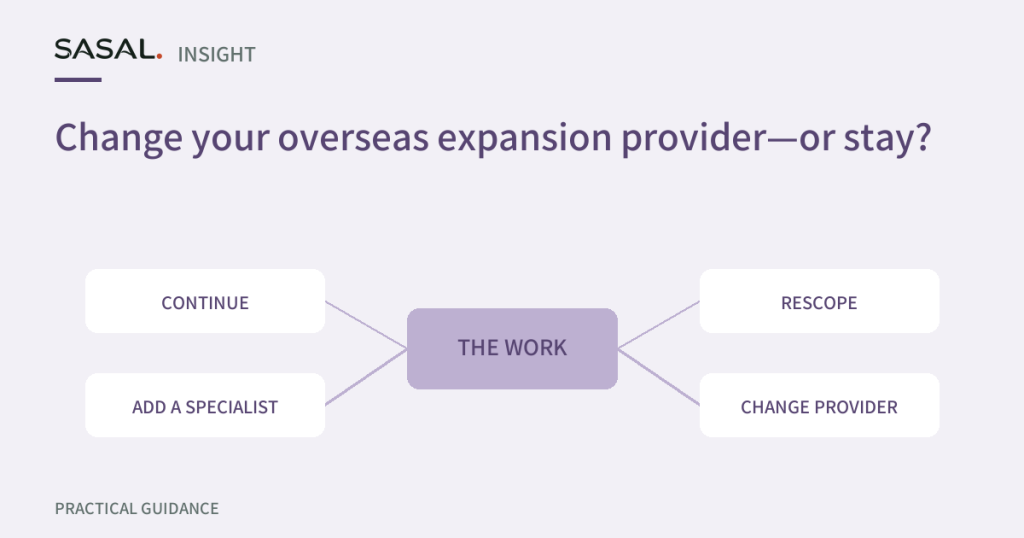
Companies often consider changing an overseas expansion provider after months of research, market conversations, partner outreach or implementation work. The key question is not whether the current provider is good or bad. It is whether the support arrangement still fits the work that now needs to be done. One reason is that the company has accumulated overseas knowledge and can now notice details it could not assess at the outset. Its view of the support has become more specific, even if the provider has not changed. Expansion projects evolve. A company may move from early market investigation into customer acquisition, operational setup or coordination across multiple specialists. Internal staffing can also change. At the same time, some concerns genuinely relate to execution quality, reporting clarity or unresolved delivery problems. A useful decision therefore compares future needs, evidence from the current engagement, successor uncertainty and transition effort. The objective is to choose the arrangement most likely to support the next decision, not to reward activity or react to frustration alone.
Define the work whose provider may need to change

Many discussions about changing an overseas expansion provider begin with a broad question about the relationship. A more useful starting point is the specific work being considered. International expansion support can include market research, strategy development, customer validation, partner identification, coordination of specialists, operational setup or ongoing local activity. Different providers may be strong in different combinations of those tasks even when they use similar descriptions of their services. Before considering replacement, define the exact scope under review. A company may be satisfied with research but concerned about implementation support, or pleased with local introductions while needing stronger coordination. The decision becomes clearer when tied to a defined responsibility rather than a general impression of progress.
The same provider can fit one stage of expansion and be less suitable for another without anyone performing poorly. A team that needed help understanding a target market may now need support managing multiple customer discussions, coordinating legal and operational inputs, or preparing a market-entry rollout. In other situations, internal capability grows and the company prefers to keep strategic decisions in-house while purchasing narrower specialist services. These changes affect the required scope of external support. Evaluating the current arrangement against today's operating needs helps distinguish a legitimate shift in requirements from dissatisfaction created by expectations that were never part of the original engagement.
A useful review also separates external support from management accountability. Providers contribute expertise, research, coordination and local knowledge, but they do not replace the client's responsibility for investment decisions, priorities and internal approvals. If decisions are delayed because authority is unclear, changing providers may leave the underlying obstacle untouched. Similarly, if customer demand remains uncertain, replacing a provider does not automatically create evidence that does not yet exist. Defining the work under consideration means identifying which outcomes depend on the provider's scope and which remain under company control. This distinction prevents unrealistic expectations from influencing a replacement decision.
A hypothetical company exploring a new market may have commissioned research and customer interviews during its first year of investigation. The findings help leadership narrow options, but the next challenge becomes coordinating pilot deliveries and local operational support. In that situation, the company could conclude that research support remains valuable while implementation support requires a different arrangement. Another hypothetical company might discover that its internal team can now manage research directly and only needs occasional specialist input. Neither conclusion implies failure. Both arise from a careful definition of the work now required and the responsibilities attached to it.
- Research and evidenceMarket comparison, customer learning and validation activities.
- Planning and coordinationSequencing work, aligning specialists and supporting decisions.
- Execution supportCustomer outreach, local activity or implementation assistance.
- Client managementInvestment decisions, approvals and accountability retained internally.
Why growing overseas knowledge changes how you assess support
A provider that initially felt like a good fit can later prompt questions because the company itself has learned. At the outset, a team may need someone to explain the market, organize unfamiliar information and make the first introductions. As employees join customer conversations and encounter delivery conditions, they gain reference points of their own. They can ask more precise questions and distinguish an explanation that supports their decision from one that only describes the market generally. The provider's service may be unchanged while the company's ability to evaluate it has developed. Some of that knowledge may have been acquired through the provider's earlier work. Recognizing this contribution makes it possible to reconsider the arrangement without rewriting a useful beginning as a mistake.
The change becomes visible in the details the company notices. Instead of asking only whether a meeting was arranged, it may ask who participated, what authority they had, which buying condition remains unresolved and what should happen next. Instead of accepting a broad market summary as sufficient, it may need an explanation of how the findings apply to its particular product and delivery model. Consider a hypothetical team that initially valued introductions but now wants to understand why interested customers do not advance to a paid trial. Its questions have moved closer to an actual transaction. That does not mean the introductions were worthless. It means the team can now describe a more specific gap between information received and the decision it needs to make.
Greater knowledge can therefore explain why replacement enters the discussion, but it does not by itself establish that replacement is necessary. Separate a newly recognized requirement from a failure to meet an agreed one. Compare what was commissioned, what the provider delivered and what the team now understands it needs. A research assignment can produce valuable learning before revenue appears; it should not retrospectively be judged as a promise to acquire customers. New hires or clearer internal responsibilities may also make broad coordination less useful, while employee departures or more complex delivery may increase the need for assistance. These changes concern the division of work as well as the provider's competence. The question is whether the next assignment still fits the existing arrangement.
Turn the new awareness into a concrete discussion before choosing an outcome. Describe what the team can now handle itself, which detail it needs the provider to explain and which decision that answer would support. For the hypothetical team above, this might mean examining an unresolved buying condition rather than requesting another general market presentation. A provider that can deepen its analysis or revise its role may remain a good fit. If the missing capability lies outside its strengths, a focused specialist or a change in the relevant scope may help. Repeated inability to meet clearly agreed requirements warrants a different assessment from an expectation that was never communicated. The useful consequence of accumulated knowledge is a better-defined choice, rather than an automatic instruction to replace someone.
Recognize repeated gaps that justify considering replacement
Not every problem should be attributed to changing needs. Some situations justify serious consideration of replacement because the relationship no longer supports informed decision-making. The strongest cases usually involve repeated issues that remain unresolved despite a clear brief, reasonable discussion and opportunities for correction. Examples may include persistent confusion about responsibilities, reporting that does not explain the basis for recommendations, or commitments that repeatedly fail to match agreed deliverables. The key element is repetition. Expansion work often contains uncertainty and occasional mistakes. A replacement discussion becomes more credible when concerns are observable, documented and sustained over time rather than based on a single disappointing event.
Transparency is particularly important because international expansion decisions often depend on incomplete information. A provider does not need to report only positive developments. In fact, useful reporting should also describe shortfalls, unknowns, additional requirements and changing assumptions. When decision-makers consistently struggle to understand what was learned, what remains uncertain or how recommendations were formed, the support arrangement may no longer be functioning effectively. The concern is not presentation style but decision usefulness. If repeated requests for clarification produce little improvement, the company may reasonably explore alternatives that offer clearer evidence and accountability within the same scope of work.
Execution concerns may also emerge when agreed actions regularly fail to occur without persuasive explanation. For example, a company may repeatedly receive incomplete handovers, inconsistent records or unclear ownership of ongoing tasks. Before attributing fault, management should confirm that objectives, timing and responsibilities were realistic. However, where expectations were clearly defined and corrective discussions have not resolved the issue, replacement can become a practical option. The decision should focus on future performance and the ability to support upcoming business needs rather than on proving blame. The objective is improved execution, not winning an argument about the past.
Even in these circumstances, replacement is only one possible response. Some issues can be addressed through a revised scope, clearer reporting requirements or the addition of a narrow specialist. Others may genuinely require moving a defined responsibility elsewhere. A hypothetical company might retain an incumbent adviser for market intelligence while transferring customer acquisition support to another organization with stronger delivery capabilities. Another might conclude that persistent transparency problems undermine confidence across the engagement and choose a broader change. The common principle is evidence. Repeated unresolved gaps provide a stronger basis for action than assumptions, frustration or comparisons with an unknown successor.
Recognize companies that benefit from keeping their provider
Many companies considering a change discover that the current provider is still serving the purpose originally commissioned. This is particularly common when the engagement focuses on learning rather than immediate commercial execution. Research, customer conversations and market comparison work may reduce uncertainty, reveal unattractive options or clarify investment priorities without producing near-term revenue. If the provider continues to supply evidence that helps management make decisions, replacing them simply because commercial results have not yet appeared may misidentify the issue. The more useful question is whether the commissioned scope is generating information relevant to current decisions. Where that remains true, continuity can preserve context and accumulated understanding that would otherwise need to be rebuilt.
A company may also benefit from staying with its provider when coordination issues originate mainly inside the client organization. International initiatives often require input from product, finance, legal, operations and commercial teams. If approvals move slowly, responsibilities remain unclear or decisions are repeatedly deferred, changing advisers may not accelerate progress. The underlying obstacle can remain untouched while transition effort consumes additional management time. In such circumstances, management may gain more by clarifying authority, decision ownership and reporting expectations than by seeking a replacement. External support contributes expertise and execution within scope, but responsibility for internal alignment and investment decisions remains with the client organization regardless of provider choice.
Another situation favoring continuity arises when the provider performs a specialist role effectively even though broader needs have changed. A research firm, regulatory adviser or local market specialist may possess knowledge that remains valuable despite new operational requirements. Rather than replacing the entire relationship, a company could retain that expertise within a narrower remit while adjusting other parts of the support model. This approach recognizes that different stages of expansion may require different combinations of capability. It avoids treating every change in requirement as evidence that an existing partner has become unsuitable. Preserving proven specialist contributions can reduce transition risk while still allowing the company to obtain additional capabilities where they are genuinely needed.
A hypothetical manufacturer entering a new market might have worked with a provider that produced customer insights, competitor observations and practical evidence about buying conditions. The company now wishes to execute pilot projects and coordinate local activity. Management could conclude that implementation support should expand elsewhere while retaining the incumbent's research role. Another hypothetical firm may find that the provider's reporting remains useful and transparent, but internal staffing shortages are delaying action on recommendations. In that case, changing providers would not address the actual constraint. Keeping the existing arrangement may be the more credible choice when validated learning, specialist expertise or continuity outweigh plausible gains from disruption.
Compare four possible arrangements on the same scope
When reviewing support, comparing alternative arrangements against the same defined scope helps avoid confusion. Four options commonly deserve consideration: continue with the incumbent unchanged, rescope the incumbent relationship, add a narrowly focused specialist or replace a defined responsibility. Evaluating them on identical objectives makes differences in accountability, management effort and expected outputs easier to understand. Without this discipline, companies often compare a broad current engagement against a much narrower proposed alternative and reach misleading conclusions. The aim is not to identify a universally superior model. The aim is to determine which arrangement best matches the work now required, the organization's internal capacity and the decisions that still need support.
Continuing unchanged can be appropriate when evidence indicates that the existing arrangement remains aligned with business needs. This option often preserves accumulated context and reduces disruption. Rescoping differs because the relationship remains in place while responsibilities change. For example, a provider that previously coordinated multiple activities may shift toward strategy support, research updates or review work. Cost implications can change because commissioned work changes, but the key distinction is functional rather than financial. The company retains an existing relationship while redefining expectations, reporting and deliverables. This can be attractive when the provider remains capable yet the business has moved into a different stage of expansion.
Adding a specialist introduces another path. A company may retain an incumbent responsible for overall coordination while commissioning targeted expertise elsewhere. Examples could include local customer validation, technical review or operational implementation support. The benefit is access to capabilities that the incumbent does not claim to provide. The tradeoff is increased coordination work for the client and a greater need for clear responsibility boundaries. Management should identify who owns decisions, who integrates findings and how information moves between participants. Additional expertise can strengthen an expansion effort, but fragmented accountability can create confusion if roles are not defined carefully and reviewed consistently.
Replacing a defined scope transfers responsibility from the incumbent to another provider. This option may be justified when needs changed substantially or when repeated execution, fit or transparency problems remain unresolved after reasonable attempts at correction. Replacement can improve a specific area without requiring a complete relationship reset. A hypothetical company might retain market intelligence support while moving customer acquisition activity elsewhere. Another might replace only implementation management. The critical comparison concerns future suitability rather than historical judgment. Every option creates different demands on internal staff time, onboarding effort and successor uncertainty. Those factors should be considered alongside expected benefits before selecting a path.
- ContinueKeep the current arrangement when evidence shows ongoing fit and useful decision support.
- RescopeRetain the relationship but redefine responsibilities, outputs or involvement.
- Add specialistKeep coordination while introducing targeted expertise for a defined need.
- Replace scopeTransfer a specific responsibility when another arrangement better fits future requirements.
Test whether the proposed successor solves the actual problem
A replacement proposal becomes more persuasive when it addresses a clearly identified problem rather than general dissatisfaction. Before changing providers, management should articulate what would improve under a successor arrangement. If concerns relate to execution, the proposed provider should demonstrate how responsibilities, reporting or delivery methods differ. If concerns stem from changing business needs, the successor should show relevance to the new stage rather than simply offering similar services under different branding. This discipline helps avoid transitions driven primarily by frustration. Replacing a provider without identifying the mechanism through which outcomes are expected to improve can create activity while leaving the underlying issue unchanged.
The proposed successor should also be tested against the same scope used to evaluate the incumbent. International expansion support covers many activities, and providers often emphasize different strengths. Comparing unlike scopes can create unrealistic expectations about future performance. A company may believe it is solving a delivery problem when it is actually purchasing a different type of service. Reviewing methods, deliverables, exclusions, reporting practices and client responsibilities on a comparable basis helps reveal whether the new arrangement truly addresses the concern. The objective is not to select the most attractive presentation. It is to determine whether the proposed support aligns more closely with the specific requirement under consideration.
Successor uncertainty deserves explicit attention. Even when a proposed provider appears promising, the company does not yet possess direct experience of how that organization communicates, responds to challenges or manages practical execution. Transition work also consumes internal effort. Existing context, historical learning and open questions must be transferred or recreated. A realistic assessment therefore considers both potential improvement and the resources required to achieve it. Hypothetically, a successor may offer stronger implementation capabilities but require significant onboarding time. Management should weigh those demands against the expected benefit rather than assuming that change automatically produces better outcomes.
A final test asks whether the identified problem sits within provider control at all. Weak demand, unresolved product issues, unclear authority or delayed client decisions can limit progress regardless of adviser quality. Replacement cannot create customer interest where evidence remains unconvincing, nor can it substitute for management decisions that have not been made. A hypothetical company frustrated by slow market progress may discover that internal approval delays prevented action on recommendations from both current and prospective providers. In that situation, changing support partners would not solve the actual constraint. The strongest replacement decisions connect observed problems, proposed remedies and future responsibilities through evidence rather than assumption.
Include the work and uncertainty created by a transition
A provider transition is not only a comparison between current and proposed capabilities. It also creates work that must be planned, supervised and reviewed by the client organization. Knowledge about customer discussions, market observations, open questions, assumptions and previous decisions rarely moves automatically from one team to another. Even where documents exist, interpretation and context may require explanation. Management should therefore examine what information needs to be transferred, who will review it and how ongoing activities will continue during the change. A transition can be worthwhile, but the effort involved should be treated as part of the decision. Ignoring that effort can make an alternative appear stronger than it is in practice.
The uncertainty attached to a successor deserves the same scrutiny applied to the incumbent. A proposed provider may present relevant experience and a convincing approach, yet the client has limited direct evidence about how the new relationship will function day to day. Reporting style, responsiveness, escalation handling and practical coordination often become visible only after work begins. This does not mean change should be avoided. It means expected improvements should be weighed against unknowns that remain unresolved. When reviewing alternatives, management can identify which assumptions depend on future performance by the successor and which benefits are already supported by evidence. That distinction helps prevent optimistic projections from dominating the decision process.
Contractual, operational and review commitments can also affect transition timing. A company may need access to research materials, discussion records, decision history or specialist outputs before another provider can continue effectively. The practical question is not whether change is permitted in principle but whether responsibilities can be transferred without disrupting important work. Hypothetically, an organization preparing customer meetings may decide that replacing support immediately before a major engagement introduces unnecessary uncertainty. Another may determine that a defined project boundary provides a natural point for transfer. In both cases, the decision concerns continuity and execution rather than loyalty. A realistic timeline can be more valuable than a rapid but poorly prepared change.
The strongest transition plans acknowledge that some expected gains may not appear immediately. New providers often require briefing, access to prior evidence and time to understand the company’s products, customers and internal decision processes. If management expects instant improvement across every area, the replacement may be judged unfairly or prematurely. A more useful approach is to define the specific responsibility being transferred and the evidence that would indicate improvement over time. This keeps expectations connected to the actual scope. It also reinforces an important principle: changing providers may improve a defined activity, but it does not automatically resolve weak demand, missing authority or unresolved strategic questions inside the client organization.
- Identify scopeDefine the responsibility being moved and the reason for the change.
- Transfer knowledgeReview evidence, records, assumptions and open questions that support decisions.
- Confirm continuityCheck ongoing activities, owners and temporary risks during the change.
- Evaluate resultsAssess whether the new arrangement addresses the original concern.
Consider a focused specialist without fragmenting accountability
Replacement is sometimes framed as a choice between keeping one provider and moving everything elsewhere. In practice, a narrower option may exist. A company can retain an incumbent for responsibilities it performs well while introducing a specialist for a defined requirement. This approach can be useful when expansion activities become more complex or when a new capability is needed for a limited scope. Examples might include technical validation, local operational expertise or targeted customer engagement support. The value comes from obtaining additional expertise without discarding knowledge already accumulated by the existing provider. However, success depends on clear role definitions rather than assumptions that multiple advisers will naturally coordinate themselves.
Adding a specialist changes management requirements because someone must connect the work. Research findings, customer evidence and operational recommendations often influence one another. If responsibilities overlap or reporting lines remain unclear, the company may receive inconsistent guidance without understanding why. A practical method is to define which provider produces information, which provider acts on it and which internal owner decides how it affects the broader expansion plan. The objective is not to create a hierarchy between advisers but to make accountability visible. International expansion frequently involves several experts, yet the client organization still retains responsibility for integrating recommendations and making investment decisions.
The decision to add expertise should also consider internal capacity. A company with experienced planning, finance, legal and commercial teams may be able to coordinate several external contributors effectively. Another organization may rely on external support precisely because internal resources are limited. In that situation, introducing multiple providers can increase complexity even if each specialist is competent. Management should therefore compare the benefit of additional expertise with the time required for briefing, review and coordination. The answer depends on current capability and workload rather than on company size or industry. A specialist arrangement succeeds when responsibilities remain manageable and decision-making becomes clearer rather than more fragmented.
A hypothetical software business may retain an adviser that understands its customer interviews, product positioning and market assumptions while commissioning a specialist to support implementation planning. Another hypothetical manufacturer may continue using a local market researcher but engage separate expertise for technical compliance review. In both situations, the incumbent remains valuable because its knowledge contributes to decisions outside the specialist’s remit. The key question is whether each participant has a defined purpose. When responsibilities are explicit, adding a specialist can solve a narrow problem without creating confusion about ownership. When responsibilities are vague, additional providers can multiply coordination effort without improving the underlying result.
A hypothetical company keeps a capable incumbent

Consider a hypothetical company that engaged an overseas expansion adviser to investigate customer needs, compare market options and support early validation activity. After many months of work, revenue remains limited, and some managers begin questioning whether a replacement is necessary. A review of the evidence reveals that the adviser has consistently documented customer feedback, identified uncertainties and reported both positive and negative findings. The company has learned which customer assumptions were incorrect and which opportunities deserve further investigation. Although commercial results remain uncertain, the original objective was evidence gathering rather than immediate sales generation. In this scenario, replacing the provider solely because revenue has not yet appeared may overlook the purpose of the engagement.
Management then examines operational concerns that initially seemed to support a change. Several recommended actions were delayed, but the delays originated from internal approval processes rather than from missing provider deliverables. Product changes required signoff from multiple departments, and customer follow-up decisions remained unresolved for extended periods. The adviser continued supplying information needed for decisions, yet decisions themselves moved slowly. Once this distinction becomes visible, the diagnosis changes. The company still faces progress challenges, but those challenges are not necessarily linked to adviser performance. Replacing the provider would consume management attention while leaving the internal approval bottleneck untouched. Evidence therefore points toward organizational improvement rather than immediate replacement.
The review also shows that the adviser occupies a specialist role that remains relevant. Team members rely on accumulated customer knowledge, historical interview records and context about earlier market hypotheses. A new provider would need time to rebuild that understanding. Management concludes that future work may require some adjustments in scope, particularly around execution support, but the existing research and strategic contribution remains useful. Rather than replacing the entire relationship, leaders discuss refining responsibilities and defining additional support where necessary. This approach preserves validated learning while acknowledging that business needs evolve. Continuity becomes a deliberate choice supported by evidence rather than by habit or personal preference.
The final decision can be explained clearly. The company is not keeping the incumbent because change feels difficult, nor because the relationship is immune from review. It is staying because the observed problem differs from the assumed problem. Reporting remains transparent, specialist knowledge remains valuable and the original objectives continue to be served. Management also recognizes that any successor would introduce uncertainty and require onboarding effort. Conditions are established for future review, including whether responsibilities change and whether new support needs emerge. By documenting the reasoning, the company creates a decision that others can understand and revisit later as circumstances develop.
A hypothetical company replaces only the delivery scope
Consider a hypothetical company that spent a significant period working with an expansion adviser on market understanding, customer interviews and early validation. The relationship produced useful evidence, and management can explain what was learned from the work. As activity increases, however, the company faces a different challenge. It now needs structured customer follow-up, coordination of pilot activity and day-to-day execution support. The incumbent provider does not claim deep delivery capability and has historically focused on research and planning. Management therefore avoids framing the situation as a failure. Instead, it asks whether the responsibilities required in the next stage differ from those originally commissioned and whether a more specialized delivery arrangement would better match future operational needs.
The review begins by defining the scope under consideration. Research, strategic interpretation and historical customer learning remain valuable. The concern relates specifically to execution activity. Customer conversations are not being translated into coordinated follow-up at the pace now required, and management believes additional delivery capability may help. Rather than replacing every aspect of the relationship, leaders separate the delivery function from the research function. This distinction matters because accumulated knowledge still contributes to decisions. Replacing all support would force a successor to rebuild context that already exists. By isolating the delivery responsibility, the company can compare alternatives more accurately and reduce unnecessary disruption to parts of the engagement that continue to serve a useful purpose.
Management then evaluates a potential successor against the same delivery scope. The proposed provider is asked to explain methods, reporting, client responsibilities and exclusions using the company's existing objectives. Leaders examine whether the new arrangement addresses the identified execution problem rather than offering unrelated services. They also consider onboarding effort, successor uncertainty and the time required to transfer context. No assumption is made that the new provider will automatically perform better. The decision rests on a specific hypothesis: stronger delivery management may improve execution of customer-facing activities. That hypothesis is narrower and more testable than a general belief that changing providers will improve overall expansion performance.
The resulting arrangement retains the incumbent in a defined advisory role while transferring execution support elsewhere. Responsibilities are documented so that management can identify who contributes evidence, who performs delivery work and who owns final decisions. Internal accountability remains unchanged because the company still controls investment choices and commercial priorities. The replacement therefore affects only one part of the support model. This approach acknowledges that providers can contribute effectively within different boundaries. It also recognizes that changing a defined scope may solve a practical problem without requiring a complete reset of relationships, knowledge or historical learning that remains useful to the business.
Make a decision that can be explained from evidence
A provider decision becomes easier to defend internally when it can be explained through observable evidence rather than personal preference. Management should be able to describe the problem being addressed, the responsibilities involved and the expected mechanism of improvement. For example, a company may conclude that reporting remains useful but execution support requires different skills. Another may determine that repeated transparency concerns remain unresolved despite discussion and correction attempts. In both situations, the reasoning can be documented and communicated clearly. A decision that depends only on frustration, optimism or a desire for change is harder to evaluate later because it does not identify what evidence justified the chosen direction.
Comparing alternatives on a common basis supports this process. Continue, rescope, add a specialist and replace a defined scope should all be reviewed against the same objective. If the objective is stronger customer follow-up, each option should be assessed in relation to that requirement. If the objective is clearer reporting, the same principle applies. Consistent comparison helps reveal whether different arrangements genuinely address the issue or simply introduce new activities. It also reduces the risk of comparing a broad incumbent engagement with a narrowly defined proposal and treating the difference as evidence of superiority. The quality of the decision depends on the quality of the comparison being made.
Evidence should include both benefits and costs created by each option. Continuing with an incumbent may preserve context and reduce transition effort. Rescoping may maintain continuity while adapting responsibilities. Adding a specialist may provide targeted expertise but require additional coordination. Replacing a scope may address a persistent concern yet introduce onboarding work and successor uncertainty. These implications do not need to be converted into a numerical score. Some obligations, reporting needs and accountability requirements resist simple averaging. Instead, management can describe how each arrangement affects future decisions, internal workload and operational risk. The goal is informed judgment rather than mechanical ranking.
A well-explained decision also acknowledges what the provider can and cannot influence. Weak demand, delayed approvals, unresolved product issues or unclear authority structures may remain regardless of adviser choice. Recognizing these limits improves decision quality because it prevents unrealistic expectations from becoming part of the rationale. A hypothetical company may decide to replace a delivery provider while simultaneously documenting that customer demand still requires further validation. Another may keep an incumbent but commit to improving internal decision speed. In both cases, the chosen arrangement follows evidence about the actual problem. That clarity helps management review outcomes later and determine whether the reasoning remains valid as circumstances evolve.
Set conditions for checking the chosen arrangement
After selecting an arrangement, management benefits from defining how it will evaluate whether the choice remains appropriate. The purpose is not to create rigid performance formulas but to connect support activities with future decisions. Review conditions should relate to the reason the arrangement was chosen. If a company introduced a delivery specialist to improve execution, the review may examine the quality of coordination, visibility of responsibilities and usefulness of reporting. If the company retained an incumbent because its research contribution remained valuable, the review may focus on whether decision-relevant evidence continues to be produced. Linking review conditions to the original rationale helps prevent discussions from drifting into unrelated complaints or assumptions.
Reviewing support also requires attention to client responsibilities. International expansion often involves multiple departments, external specialists and approval processes. A provider may supply information, recommendations or execution support, but management still determines priorities and commitments. For that reason, review conditions can include internal actions as well as provider outputs. A company might examine whether decision ownership became clearer, whether approvals occur in a timely manner or whether reporting reaches the people responsible for acting on it. Including internal factors creates a more balanced assessment. It reduces the temptation to attribute every difficulty to external support when some constraints remain under company control.
Useful review discussions rely on transparent information. Reporting that covers positive developments, shortfalls, unknowns and remaining questions helps leaders understand whether the arrangement continues to support decisions. This principle applies regardless of whether the company stayed with an incumbent, added a specialist or transferred a scope elsewhere. The objective is not to prove success. The objective is to provide enough information to continue, revise or reconsider the arrangement. A review may confirm that the current structure remains suitable. It may also reveal that business needs have changed again. Either outcome can be valuable when supported by clear evidence rather than assumptions about what should have happened.
A hypothetical company that replaced only delivery support may schedule a future review focused on execution quality, customer follow-up continuity and management workload. Another that retained an incumbent may review whether accumulated learning continues to influence commercial decisions. Neither organization assumes that the initial choice will remain correct indefinitely. Conditions, staffing, customer complexity and strategic priorities can evolve. By defining review criteria at the outset, leaders create a practical mechanism for revisiting the decision without treating every challenge as proof that another change is necessary. The emphasis remains on evidence, accountability and future suitability rather than loyalty, habit or the desire to justify a previous choice.