

Redesign overseas group reports and meetings around decisions
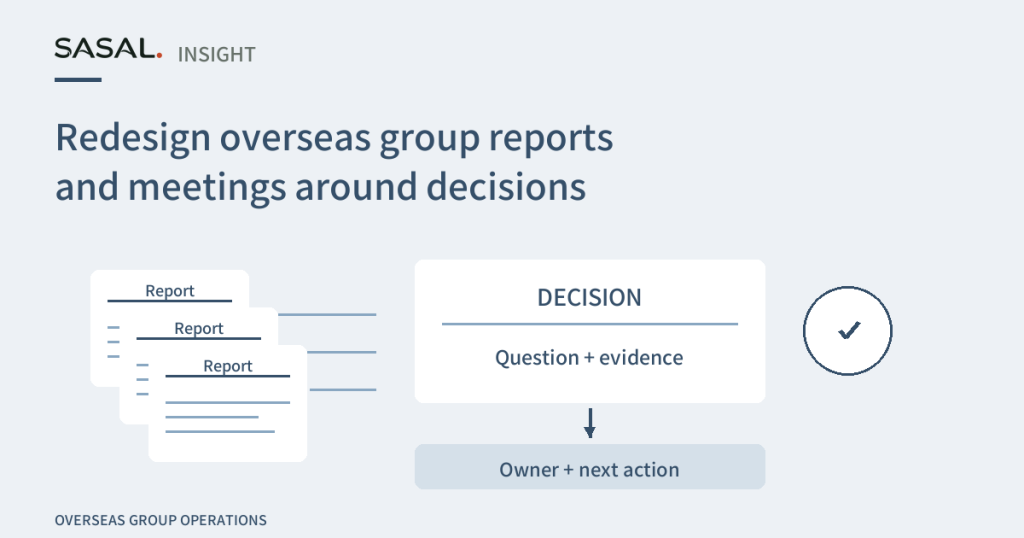
Consider a hypothetical subsidiary that prepares a staffing table for HR, adjusts the categories for operations and answers a separate set of questions for head office. Combining the three requests might remove work, but only if the people using them still receive the information their decisions require. Start a reporting review by tracing those requests: who made them, what they support and what happens after submission. This article examines the records, definitions, timing and participation choices behind monthly reports and meetings. The practical aim is a reporting arrangement whose preparation and follow-up work can be explained by an active decision or obligation, with a clear route for developments that cannot wait until the next review.
Inventory the requests behind the monthly reporting pack
Begin with the chain of requests that produced the document reaching headquarters. A monthly pack may combine finance schedules, operational summaries, staffing updates, project trackers and narrative explanations assembled by different people for different audiences. Each item should be listed with the original requestor, the current user, intended recipient, reporting frequency, primary source and the effort required to prepare or verify it. Trace the preparation of a figure even when it appears simple in the final pack: its source records may require several reconciliations before submission.
The inventory should extend beyond formally approved reports. Unofficial spreadsheets, manually maintained trackers and recurring email requests often consume meaningful effort even though they do not appear in governance documentation. A practical record can include fields such as: report name, requesting function, receiving function, source owner, preparation owner, typical preparation steps and recurring clarification questions. Capturing recurring follow-up matters because repeated requests for explanation may indicate that the underlying report is not providing the information decision-makers actually need.
Preparation effort deserves attention alongside content. A field that takes minutes to extract may impose little burden even if its use is limited. Another field may require manual adjustments across multiple entities every month. A useful inventory therefore records observations about preparation and checking work rather than focusing solely on report length. Where different teams contribute to a figure, the record should identify the handoffs and approvals involved. This helps distinguish information that is expensive to produce from information that is merely lengthy to read.
A hypothetical example illustrates the difference. An overseas subsidiary submits a staffing summary each month. The final table contains only a few lines, yet local HR staff first reconcile payroll records, vacancy trackers and contractor lists because each requesting function applies slightly different categories. The resulting workload is not visible in the report itself. Recording those preparation steps allows headquarters and local management to assess whether every variation remains necessary.
The inventory should also identify who receives results after submission. Some reports continue because people assume they are reviewed, while actual users may rely on other information. Rather than inferring that a field is unnecessary, the review should document known recipients and observed uses. Maintaining this traceability creates a foundation for later decisions about consolidation, frequency changes or removal without disrupting information that still supports a valid responsibility.
Find the decision or obligation attached to each item

Once reporting requests have been inventoried, each item should be linked to the decision or obligation it supports. Different categories deserve separate treatment because their removal carries different consequences. Information required for statutory filings, contractual commitments, governing-body oversight or entity governance should not be grouped together with discretionary management reporting. A field may appear unused during a routine monthly review yet remain necessary because it supports a defined obligation elsewhere in the organization.
Creating a decision map helps expose these distinctions. For each field or report, record the responsible owner, the decision influenced, the timing of that decision and any obligation attached to the information. A management metric might support resource allocation discussions. A governance report might support board review responsibilities. A contract-related report might be required under an agreement with a partner. Treating all reporting items as equivalent can lead to inappropriate consolidation because the apparent format similarity conceals different purposes.
Particular care is needed when a field appears unused. The absence of discussion in meetings does not establish that the information lacks value. A report owner may review it before the meeting, use it for exception monitoring or retain it as part of a required record. Before changing such a field, identify the responsible owner and ask how the information is used. The review should capture the answer in a documented record rather than relying on assumptions formed during a single reporting cycle.
A practical decision record might include: field name, responsible owner, category of obligation or management use, decision supported, review frequency, retention location and proposed change. If the proposed change is removal, the record can also note the verification performed before approval. This creates an audit trail for future reviews and reduces the risk that removed information must later be reconstructed without context.
Consider a hypothetical operating review in which headquarters receives detailed monthly commentary on every project regardless of status. During interviews, managers explain that active intervention occurs only when schedule changes, resource constraints or commercial risks exceed defined internal thresholds. In that situation, the organization may evaluate whether routine narrative updates can be reduced while preserving escalation requirements. The decision is based on documented use, not on the assumption that silence means irrelevance.
When the user cannot identify a current decision, leave the item under review and name the person who will check its obligation or monitoring purpose. Ask to see the last occasion on which it prompted an action or supplied a required record. If the original requestor has left, that check may belong with the successor function rather than the person compiling the report. This avoids making preparers decide which responsibilities headquarters still holds.
- Report itemIdentify the field, metric or narrative currently requested.
- User or obligationDocument the named recipient or obligation requiring the information.
- DecisionRecord the action, review or escalation the information supports.
- RecordMaintain definitions, ownership, dates and unresolved questions for future use.
Separate consistent definitions from identical templates
Changing a template can make the reporting pack easier to read while leaving the underlying figures incomparable. Before standardizing formats, establish the definitions behind the figures being compared. Each reported measure should be accompanied by a documented perimeter, reporting period, unit, recognition event and update owner. These attributes determine whether two values can be interpreted together.
The perimeter identifies what is included and excluded. The reporting period clarifies timing. The unit explains whether a figure represents people, transactions, currency values or another measure. The recognition event defines when an item enters the report. The update owner identifies who maintains the information and can explain changes. When these elements are documented, headquarters can compare information from different entities while allowing local records to remain aligned with operational realities.
This distinction matters because local entities may maintain records differently for legitimate reasons. One business unit may track project activity through operational logs, while another relies on finance-led records. If both can map their information consistently to the agreed reporting definition, comparability may be achieved without prescribing a single accounting or operational system. The objective is interpretability, not uniform data entry processes.
A useful practice is to maintain a definition register alongside the reporting pack. For example, if two regions report customer onboarding activity, the register would specify the event that triggers inclusion, the period covered and the owner responsible for updates. When figures diverge unexpectedly, reviewers can examine definitions before concluding that operational performance differs. This reduces unnecessary clarification work and helps identify genuine exceptions that require management attention.
For a definition change, decide whether earlier periods will be restated, shown on the previous basis or excluded from a particular comparison. In a hypothetical staffing series, bringing contractors into the reported perimeter can increase the total even if no extra people started work. Label that break and retain the earlier definition so a reader can separate a measurement change from a change in operations. The update owner should identify which reports use the measure; correcting the definition in one pack while leaving another unchanged would preserve the original inconsistency.
Ask where the same work is repeated
After definitions have been clarified, the next question is whether the same underlying work is being performed more than once. Repetition is often hidden because requests arrive through different headquarters functions. Finance may request workforce numbers for forecasting, HR may request headcount by employment category, and operations may request staffing availability by site. Local teams can experience these as three separate reporting obligations even when all rely on overlapping source records. A review should therefore trace each request back to its user, decision purpose and preparation steps before concluding that separate reports are necessary.
Similarity alone does not prove that reports should be combined. Two functions may use apparently related measures for different decisions. A staffing report used for budgeting may require a reporting period aligned with financial forecasts, while an operational capacity report may classify personnel according to current assignment status. If the definitions, timing or decisions differ, forcing a single measure can reduce clarity. The practical task is to distinguish duplicate effort from legitimate analytical differences. A comparison record can list the requesting function, measure definition, source owner, update frequency and decision supported. Reviewing these side by side often reveals where preparation work overlaps and where it does not.
A useful workshop involves the report owners rather than only the report preparers. Consider a hypothetical case in which headquarters HR requests monthly vacancy counts and headquarters operations requests monthly recruitment status. Local staff maintain separate trackers because the requests arrived at different times from different functions. When owners compare their actual use of the information, they discover that both rely on the same recruitment pipeline data but require different interpretations. The organization may then decide to maintain one source record with two views rather than two separate preparation processes. The reduction comes from eliminating repeated compilation work while preserving decision-specific outputs.
Recurring clarification requests provide another indicator of duplication. If local teams repeatedly answer similar questions from several headquarters groups, the issue may not be the report itself but fragmented consumption. Recording clarification topics, recipients and outcomes helps identify patterns. For example, three functions may separately request explanations for a project delay. A shared explanatory note attached to the original report may satisfy all three users without changing the underlying decision rights. The objective is not to centralize every discussion but to avoid recreating the same explanation through multiple channels.
Some differences should remain even when they increase reporting effort. A measure linked to entity governance responsibilities may require distinctions that are irrelevant for management planning. Where such differences exist, they should be explicitly documented so future reviewers understand why consolidation was rejected. Keep that justification beside the separate output, together with the owner who can reassess it when the obligation or management use changes.
Choose the reporting rhythm from how decisions change
A monthly report cannot serve every decision at the right time. Some resource decisions can wait for a scheduled review; an issue affecting a near-term commitment may need a response earlier. For each major item, ask the owner to identify the latest point at which information can still change the decision. Compare that point with when the source becomes available and when the report is submitted. The mismatch identifies whether to change the collection rhythm, the decision timetable or the escalation route.
Routine review information and exception reporting should be treated separately. A stable operational measure may only need scheduled review because management action is infrequent. By contrast, developments that materially affect commitments, staffing, customer delivery or financial expectations may need escalation before the next regular meeting. If these two categories are merged into a single monthly process, important issues can wait unnecessarily while routine information receives disproportionate attention. A reporting design can therefore define both a regular review cycle and the conditions that trigger earlier communication.
Historical reporting and forward-looking reporting also serve different purposes. Historical information helps management understand what occurred and whether previous decisions produced expected results. Outlook information supports future choices regarding resources, priorities and interventions. Combining both into one dense meeting often creates confusion because participants switch repeatedly between explanation and planning. A practical structure may circulate historical information in advance while reserving meeting time for developments, assumptions and decisions affecting future periods. The specific arrangement depends on how management responsibilities are allocated rather than on a universal meeting formula.
A hypothetical example illustrates the tradeoff. An overseas business submits a detailed monthly project review. Most projects proceed without management intervention, but schedule changes affecting customer commitments require rapid escalation. The organization could retain a monthly portfolio review while establishing a separate expectation that material schedule risks are reported when identified. The monthly review remains useful for oversight, yet decision-makers are not forced to wait for the next scheduled discussion before evaluating an emerging issue.
Time zones and working calendars also influence reporting rhythm. A meeting that appears efficient from headquarters may create recurring delays if local teams must prepare information outside normal operating hours. Participation design should therefore consider when questions can realistically be answered and decisions made. In some situations, asynchronous review of routine information allows meeting time to focus on unresolved matters requiring interaction across locations.
The resulting reporting calendar should be traceable to decisions rather than habit. Recording the owner, decision purpose, review rhythm and escalation conditions for each major report creates a reference point when circumstances change. If a report's associated decision becomes less frequent or more time-sensitive, the reporting rhythm can be adjusted with a clear rationale rather than through incremental additions.
Make the request proportionate to its use
Once reporting frequency has been aligned with decision needs, attention can shift to the amount of information requested. Reporting packages often expand gradually because each additional field appears reasonable in isolation. Over time, however, local teams may spend significant effort compiling details that receive little review. A proportional reporting design begins by identifying the minimum information required for the intended decision or obligation. Additional detail is then requested only when specific conditions justify it.
One practical method is to define core fields that appear in every submission and conditional fields that are triggered by identifiable circumstances. Core information might include the measures routinely reviewed by decision-makers. Conditional detail could be required when performance changes materially, assumptions shift, deadlines move or unusual events occur. This approach preserves access to relevant information while avoiding the routine preparation of data that has no current user. Each field should have a named recipient and a documented reason for inclusion.
Material explanation deserves separate consideration from raw data volume. Decision-makers frequently need context to interpret changes, yet lengthy narrative sections can become repetitive when contributors feel obliged to comment on every item. A more proportionate approach asks contributors to explain developments that affect decisions, assumptions or obligations. For example, a report entry might record that a forecast changed because a supplier commitment moved, that customer demand remains uncertain pending a specific event, or that an operational constraint is under review. Such explanations help users understand significance without requiring extensive commentary on stable conditions.
A hypothetical reporting rule illustrates the concept. Suppose headquarters receives monthly staffing information from multiple overseas entities. The core submission includes current staffing levels, open positions and notable changes. Additional breakdowns are required only when vacancies exceed an internally defined review condition or when a planned restructuring proposal is under consideration. Local teams avoid preparing extensive supplementary schedules every month, while headquarters retains access to detail when a decision requires it.
Reducing reporting volume should not suppress adverse information. Teams must retain a clear route for raising bad news, uncertainty and unresolved questions even when formal reporting becomes shorter. If contributors believe that only confirmed information is welcome, emerging risks may disappear from discussion until they become more difficult to address. Reporting guidance can therefore explicitly permit the recording of assumptions, open questions and areas where available evidence remains incomplete. Those records support future decisions because they show what was known, what remained uncertain and who owned the next action.
Check the conditional rule with the person preparing the report. An instruction to explain only “material” developments leaves a judgment that may be interpreted differently across companies. Use examples of the kinds of change the decision owner needs, state who can answer a borderline question and permit additional explanation where context matters. In the hypothetical staffing report, a small vacancy count could still warrant attention if the empty role holds a necessary authorization. A numerical trigger should therefore not suppress a consequential issue outside its definition.
Separate preparation from the meeting’s decision work
Reporting redesign becomes more effective when information preparation is treated as a separate activity from the meeting itself. Check how the current meeting divides its time between reading, clarification, identifying issues and deciding. If participants first see the material during the session, a pre-read changes the preparation requirement as well as the agenda. A practical redesign identifies which information can be understood before the meeting and which topics genuinely require discussion among decision-makers. The distinction should be visible in the meeting record rather than assumed. Agenda items can be categorized as information for review, questions requiring clarification and decisions requiring authority.
A readable pre-read is central to this separation. Use the existing report as the pre-read where it already provides the necessary context; avoid asking local teams to produce a second summary with the same content. Pre-read materials should identify significant changes, assumptions, unresolved questions and the owner responsible for answering them. If a participant needs to compare several periods or entities, the definitions and reporting perimeter should already be attached to the figures. Questions raised during pre-reading can be collected in advance so that local teams prepare focused responses rather than reacting to broad requests during the meeting. This also reveals whether some questions are informational and can be answered outside the meeting altogether.
Decision authority should be identified before the discussion begins. Without a named authority holder, participants can discuss options without being able to complete the decision. For each issue expected to reach a decision, the pre-read can record the decision owner, contributors whose input is required and any dependencies that prevent immediate resolution. Consider a hypothetical staffing review. Alternatives might include approving recruitment, redistributing work between entities or postponing action pending additional information. If the authority holder is absent and no delegation exists, the meeting should recognize that limitation rather than generating extended discussion that cannot produce an outcome.
Unresolved issues deserve explicit treatment. Instead of reopening the same topic each month, the meeting record can list the question, current evidence, owner and next expected update. This approach preserves continuity when participants change and helps distinguish genuine uncertainty from forgotten actions. It also provides context for future reviews because participants can trace how assumptions evolved over time rather than relying on recollection.
Company languages and time zones affect access to decision-making and should be considered operational design constraints. A technically complete pre-read has limited value if key contributors cannot review it in time or participate effectively in discussion. Organizations may therefore choose asynchronous review for routine reporting while reserving shared meeting time for issues requiring interaction. In some circumstances, written questions submitted before the meeting allow contributors in different locations to participate without extending attendance requirements. The aim is to use meeting time for decisions and tradeoffs while allowing preparation work to occur through more efficient channels.
Decide who must attend and who needs the result

Decide attendance from each person’s responsibility in the agenda. Over time, recurring group meetings often accumulate attendees because no one wants to exclude a stakeholder who might have an interest in the topic. The result can be a large audience where only a small number of participants contribute to decisions. A more deliberate approach identifies who owns the decision, who provides information needed for the decision and who only requires the outcome afterward. These groups serve different purposes and do not necessarily need the same meeting invitation.
The decision owner should be present when a decision is expected. Contributors attend when their expertise, operational knowledge or analysis is required to evaluate alternatives. Recipients, by contrast, may only need a record of the result. Separating these roles lets the owner assess which attendance is necessary while retaining a route for relevant evidence and challenge. A practical meeting plan can therefore record, for each agenda item, the decision owner, required contributors and distribution list for outcomes. This structure is especially useful when different agenda items involve different functions and entities.
A hypothetical example illustrates the distinction. An overseas subsidiary seeks approval to reallocate personnel between projects. The subsidiary manager provides operational context, finance contributes budget implications and the authorized executive makes the decision. Several other functions may be interested in the outcome but do not influence the choice. Rather than requiring all of them to attend, the meeting record can distribute the approved action, rationale and implementation owner after the discussion. Visibility is preserved without creating mandatory attendance.
Support roles may also be necessary. Interpretation, language support, note-taking assistance or technical coordination can enable effective participation where company languages differ or specialist terminology is involved. These roles should be recognized explicitly rather than treated as informal additions. Their purpose is to facilitate communication, not to become substitute decision-makers. Likewise, participation from a local coordinator may be appropriate when information must be consolidated across entities, but line management and approval authority remain with the responsible organizational roles.
Before removing someone from an invitation, ask what evidence or challenge their role contributes and whether it can be provided another way. Speaking time is a weak proxy: a specialist may say little until an unusual case raises a question only they can answer. The meeting owner can arrange attendance for particular agenda items, invite written comments or retain access to advice during the discussion. Record the choice with the role holder so reduced attendance does not leave an unnoticed gap in the decision.
Check distribution after the change. A person receiving only the outcome needs enough detail to perform the next task, including any conditions or unresolved dependencies. If recipients regularly ask what a decision means for them, revise the result record or their involvement in preparation. Reinstating every recipient as an attendee would restore meeting time without necessarily resolving the missing information.
Close decisions without creating another reporting layer
A reporting redesign can fail if every meeting generates new tracking documents, additional status updates and parallel reporting requirements. Decisions should instead be closed through records that support subsequent work. The essential information is usually the outcome, the reasoning behind it, the responsible owner, the relevant date and any unresolved questions. Recording these elements allows future participants to understand what was decided and why, without requiring exhaustive transcripts of the discussion.
The level of detail should reflect future use. A decision approving a resource allocation may require a brief explanation of alternatives considered and the condition that would trigger reconsideration. A governance matter may require a more formal record because of oversight responsibilities. In both cases, the record is most useful when it helps the next person continue the work. Current versions, dates, authors, sources and open questions make it easier for teams in different locations to trace changes and outstanding actions. This continuity becomes particularly important when responsibilities transfer between individuals or entities.
A practical decision log can distinguish completed decisions from open issues. Consider a hypothetical entry: outcome approved, owner regional operations director, implementation date specified, unresolved question regarding future staffing demand, next review date recorded. Such an entry provides operational direction without requiring participants to reconstruct the meeting conversation. It also reduces repeated clarification requests because recipients can see both the action and the rationale.
Send the result to people who must act, and keep corrections attached to the same entry. In the hypothetical resource decision, “approved” is insufficient if approval depends on confirming availability at the receiving company. The record should name that condition and who will confirm it before implementation. If the condition changes afterward, retain the original decision and add the authorized change rather than silently rewriting history. Formal minutes or other records required by the relevant body or obligation may still need their own treatment; the operating log does not automatically replace them.
Records should therefore focus on enabling action rather than documenting every statement. If a meeting repeatedly revisits the same unresolved topic, the issue is often unclear ownership or missing evidence rather than insufficient minutes. Recording the outstanding question, the person responsible for obtaining information and the expected decision point usually provides greater value than a lengthy narrative account.
Choose one place where the action status is maintained. A company contact can link to that record from the monthly pack instead of creating a second tracker requiring separate updates. When an action closes, record the evidence of completion that the decision owner needs. A sent email establishes that a request was made; it does not establish that the requested decision or work was completed. Keeping those states distinct helps the next meeting focus on what remains unresolved.
Trial removal or consolidation with the report owner
Removing a report field or combining two reporting streams should be treated as an operational trial rather than an assumption that a low-visibility item has no value. Before any change, identify the report owner, confirm the current users and verify whether the information supports a legal requirement, contractual commitment, governing-body responsibility or internal management decision. A field that receives little discussion in routine meetings may still serve a monitoring purpose between reporting cycles. The review record should therefore capture the owner’s explanation of use, the proposed change, the expected effect on preparation effort and the conditions under which the field would be restored.
A practical trial begins with a defined scope. Instead of redesigning an entire reporting package at once, select a specific report, meeting or field and agree the observation period. Record who approved the trial, what information will no longer be prepared, how users will obtain critical information if needed and what signs would indicate that the change is causing problems. These signs might include delayed decisions, repeated requests for missing information or uncertainty about responsibilities. The purpose is to test whether the reporting activity contributes to decisions, not merely whether people notice its absence immediately.
Consider a hypothetical duplicate HR staffing report. Local HR prepares a monthly staffing schedule for the HR function and a separate staffing update for an operations review. Investigation shows that both reports draw from the same underlying records, cover the same organizational perimeter and reach overlapping audiences. However, the review also reveals that the operations meeting occasionally requires commentary on deployment constraints that does not appear in the HR version. The organization could trial a single staffing dataset with an additional narrative section used only when operational issues require explanation. The consolidation removes repeated preparation while preserving decision-relevant context.
Fallback arrangements deserve explicit attention. If a report is removed entirely, users should know where equivalent information can be obtained during the trial. Confirm whether the source information will remain available and whether someone has capacity to reconstruct the output before describing the trial as reversible. If stopping collection would lose information, keeping the underlying record may be necessary during the trial. A fallback should identify the person, required inputs and realistic response time; it should not promise immediate recovery from an untested source.
Observation during the trial should focus on actual effects. If users begin creating private spreadsheets, requesting repeated clarifications or holding additional meetings to replace the removed report, the apparent simplification may simply have shifted effort elsewhere. By contrast, if required information continues to reach decision-makers without replacement work emerging, the organization gains evidence that the consolidation is sustainable. The outcome record should document both the burden removed and any limitations discovered so future reviewers understand the reasoning behind the decision.
- KeepRetain when it supports an active decision or continuing obligation.
- ConsolidateCombine overlapping preparation or discussion where definitions and uses align.
- Change frequencyAdjust review timing to match how often decisions actually change.
- Stop after verificationRemove only after confirming users and obligations remain covered.
Measure the burden on both sides
Reporting redesign should be evaluated using workload evidence from both the producing side and the consuming side. Include the time headquarters functions spend reading, clarifying, correcting and discussing information alongside the work inside subsidiaries. A reporting portfolio that appears efficient because it is easy to prepare may still create substantial follow-up work if definitions are unclear or if decision-makers cannot locate the information they need. Measuring both perspectives creates a more balanced view of operational burden.
Preparation effort includes gathering source data, reconciling differences, validating figures, obtaining approvals and producing explanatory commentary. These activities should be recorded separately where possible because they may have different causes. Reconciliation effort may indicate inconsistent definitions. Approval delays may reflect unclear authority. Narrative preparation may reveal that decision-makers require context unavailable from the reported figures alone. Breaking the workload into components helps identify where redesign is likely to have the greatest effect.
The receiving side requires equal attention. Clarification requests, repeated explanations, meeting attendance and correction cycles consume time even when the report itself is concise. A useful review can track recurring questions, the number of follow-up exchanges required before a decision is reached and whether corrections are needed after submission. If a report generates frequent interpretation disputes, the organization may achieve more by improving definitions and ownership than by removing fields.
In a hypothetical measurement exercise, suppose a monthly operating review requires four regional teams to prepare submissions. Rather than estimating overall effort informally, the organization records preparation activities, clarification exchanges after submission, meeting duration and post-meeting correction work for several reporting cycles. The resulting evidence may show that a seemingly small narrative section generates extensive questions because readers interpret it differently. In that situation, redesigning the narrative structure could be more valuable than reducing the number of reported metrics.
Use comparable periods and work before interpreting a time change. A routine month and a year-end review can differ in required checking, even with the same report format. Keep elapsed waiting time separate from active work time: a report waiting two days for a response does not imply two days of staff effort. For meeting work, distinguish calendar duration from participant time, and avoid counting the same preparation activity twice when one source supports several reports. Record exclusions and changes in workload so the comparison does not attribute every difference to the redesign.
No universal percentage reduction should be promised or expected. The value of measurement lies in revealing tradeoffs. A decision record can therefore compare preparation effort, clarification effort, meeting time and correction work before and after a change, alongside observations about decision quality and information availability. Those records provide a grounded basis for deciding whether a reporting redesign should be retained, adjusted or reversed.
Keep the reporting portfolio current
A reporting portfolio gradually becomes outdated when new requests are added more easily than old ones are removed. Maintaining relevance requires an ongoing review discipline. Whenever a new field, report or recurring meeting is proposed, the request should identify a named user, the decision or obligation supported, the source owner and the expected review rhythm. Recording these elements at the time of creation makes later evaluation significantly easier because the intended purpose is already documented.
The same principle applies to reporting changes arising from reorganizations, leadership transitions or shifts in business priorities. Information requests frequently survive long after the original decision process has disappeared. A quarterly review of the reporting portfolio can therefore examine whether each item still has an identifiable owner and use. Where ownership cannot be established, the appropriate response is investigation rather than immediate removal. The objective is to determine whether the request has become orphaned or whether responsibility has simply become unclear.
A useful portfolio register may contain entries such as report name, owner, decision supported, frequency, recipients, source record and last confirmed use. The register does not need to become a complex governance mechanism. Its value comes from providing traceability. When someone proposes an additional field, reviewers can ask where it fits within the existing portfolio and whether related information already exists. This prevents gradual accumulation of overlapping requests.
Local feedback should remain part of the maintenance process. Teams producing reports often identify changing preparation burdens before headquarters functions notice them. For example, a field that was easy to produce when records were maintained centrally may become difficult after operational responsibilities shift between entities. Recording such observations allows report owners to reassess proportionality. Feedback should be linked to observable preparation steps and decision needs rather than general dissatisfaction with reporting requirements.
Records supporting future decisions should preserve current versions, dates, authors, sources and open questions. When a field changes definition, moves to a new owner or is retired, the reason should be recorded. This allows future reviewers to understand the history of the reporting portfolio and reduces the risk that previously removed requests are reintroduced without awareness of earlier decisions.
When a new request overlaps an existing one, ask the owner to choose: extend the current report, replace part of it or justify a separate output. Record which older request will change and tell its preparers when that change takes effect. Without that final instruction, a redesign can leave both versions in circulation. At the next operating review, confirm that the intended users obtained their information and that preparers actually stopped the retired work.