

When to hire an overseas expansion adviser: From advice to handover
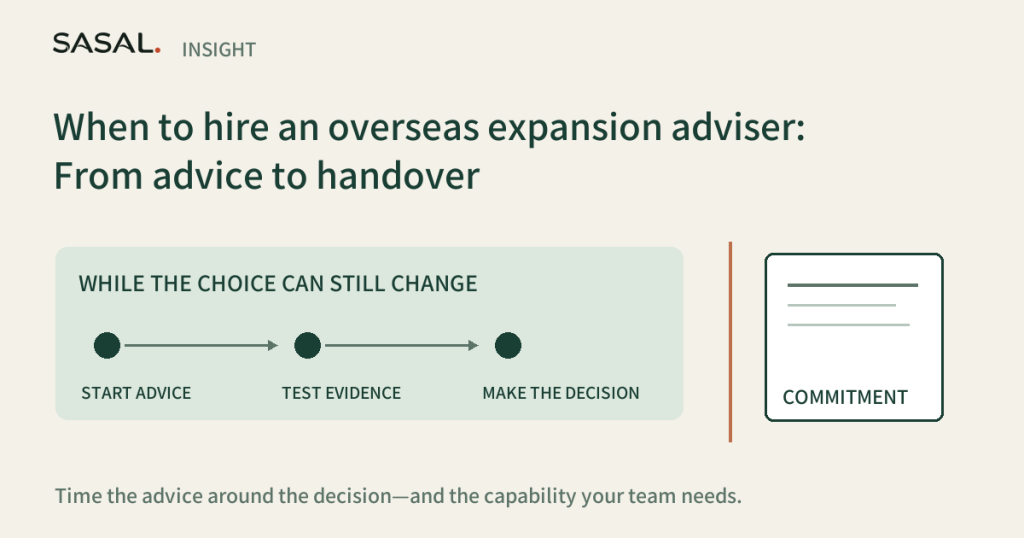
An overseas expansion adviser is most useful when a forthcoming decision could materially shape the options available to the business and the people responsible cannot adequately test the underlying assumptions with the knowledge or time currently available. The timing question comes before provider selection. A company does not need a universal revenue level, team size or expansion stage to justify external support. A solo founder exploring an unfamiliar commitment may need a focused review, while a larger organization may only need a specialist assessment of a narrow issue. The practical objective is to engage while evidence can still influence the decision, define the capability gap precisely, and reduce external involvement as employees become able to evaluate, manage and repeat the work themselves.
Start while advice can still change the decision
The last useful moment to commission advice can arrive before a contract is ready for signature. Look for the point at which changing the proposal would disrupt customer expectations, partner negotiations or an internal investment plan. A formal signature may still be weeks away while the business has already organized people and resources around one assumed outcome. Advice commissioned then has less room to influence the available choices. The starting question is therefore concrete: what are we about to make difficult to change, and what do we still need to understand?
A hypothetical example illustrates the distinction. Suppose a company is discussing an overseas distribution arrangement and is considering an exclusivity promise. The practical review point may occur before draft agreements are circulated. Once the promise has been discussed repeatedly as the expected outcome, changing direction can become harder even if no document has been executed. An adviser engaged before that stage may help test assumptions, gather evidence and identify alternatives. The same adviser engaged later may be limited to reviewing a path that is already difficult to change.
The purpose of early engagement is not to outsource judgement. Management retains responsibility for the decision, budget and priorities. External advice contributes analysis, challenge and specialist perspective. That distinction matters because a company can mistakenly expect an adviser to remove uncertainty entirely. In reality, the adviser helps the organization understand what is known, what remains uncertain and what consequences may follow from different choices.
A useful practice is to create a compact engagement decision card before commissioning substantial work. The card records the next decision and target date, the consequences of delay or premature commitment, the capability that is missing, the person who will review the advice, the specific output required, the spending or time boundary, and the condition that will trigger review or completion. This keeps the assignment connected to a real business decision rather than a general desire for overseas growth.
Work backwards from that practical review point. An adviser may need access to customer requirements, operating costs or a draft proposal; colleagues then need time to assess the findings and obtain any necessary specialist review. A decision date alone is insufficient if those inputs will arrive too late. For example, agreeing a review before a pricing offer goes to a customer is useful only if the team can provide the proposed service obligations and delivery assumptions. Commissioning the work earlier without making those inputs available will not create the same benefit.
There are two timing questions to resolve: when management needs an answer, and when the adviser can realistically obtain the evidence needed to support it. If those dates do not fit, the options include reducing the promised scope, seeking a conditional commitment, postponing the decision or accepting a clearly understood residual risk. An adviser cannot create evidence merely because an approval meeting is close. This is also why an initial conversation can be worthwhile before commissioning a full project: it can establish whether the proposed review is feasible at all.
Identify the capability you need before deciding whom to hire

Companies often begin by searching for advisers, yet the more useful starting point is identifying the capability that is missing. Different gaps require different forms of support. A business may need help challenging market assumptions, reviewing a proposed operating model, interpreting unfamiliar information or examining the consequences of a planned commitment. Treating all of those needs as identical can lead to a poorly defined engagement.
The missing capability should be described in operational terms. For example, a leadership team may be able to gather information but lack confidence in evaluating competing market-entry assumptions. Another team may understand the commercial issues yet lack time to investigate a specific overseas question before an internal approval deadline. The adviser's role depends on the nature of the gap rather than the company's size.
Questions from export-planning guidance can help frame the discussion. The International Trade Administration asks what personnel and company resources will be dedicated to exporting, what the cost in time and money will be, and how results will be evaluated and used to modify the plan. Those questions do not determine whether an adviser is required, but they help management understand what internal resources already exist and where capability is genuinely missing.
An adviser can assess the implications of a channel proposal without being responsible for finding distributors or managing them. An execution provider may be hired to contact prospects and follow up on sales opportunities. An internal commercial lead can own the continuing prioritization of those activities. A qualified local lawyer or tax professional may be needed for a specific legal or tax question. A provider can offer more than one service, but the assignment must name the work and relevant competence. Calling someone an overseas adviser does not establish that all these functions are included.
The UK Consultancy Playbook, although written for UK public-sector procurement rather than private international expansion, notes that consultants may be used to address specific skills and knowledge gaps that internal resources cannot provide. Applied carefully as a planning principle rather than a rule, that observation encourages businesses to define the gap before selecting the provider. It also highlights the importance of avoiding repeated purchases of the same knowledge when employees can learn and retain it.
Consider a hypothetical team preparing an overseas service offer. Its founder can approve commercial terms, its operations lead knows what delivery requires, and its finance colleague can evaluate the cost model. The unresolved question is how the proposed channel would affect control of customer relationships. A focused advisory review can address that question without replacing the internal team. If nobody inside the company can interpret the recommendation or authorize the next step, appoint that internal lead as part of the preparation. Buying advice without arranging access to a decision maker can leave a useful finding unused.
At the first overseas signal, keep the question small
An overseas enquiry, introduction or conference conversation gives the company something to investigate. It does not, by itself, establish a need for continuing paid advice. Before commissioning support, identify the decision immediately in front of the team: whether to answer a prospect, provide a demonstration, quote for a limited order or examine a wider opportunity. The consequences differ. Sending public product information can be manageable internally, while offering an unfamiliar service obligation may raise questions that should be reviewed before the response goes out.
A hypothetical software company receives interest from an overseas prospect. Management could immediately commission a broad market-entry strategy. Alternatively, it could begin with a narrower question: does this enquiry reveal a repeatable customer problem that merits further investigation? The second approach may require only limited external support or even internal review before larger commitments become necessary.
Start with the information already available. Ask the prospect what they want to buy, who will use it, where it must be supplied and what would happen after the first discussion. Compare the request with existing delivery capability. Official trade-support resources, published buyer requirements and the company’s own experienced employees can sometimes resolve the immediate question. Check that any general guidance actually applies to the proposed transaction. A short conversation with an appropriate specialist becomes useful when a consequential uncertainty remains, rather than simply because the enquiry came from another country.
This does not mean delaying all external input. In some circumstances, an early expert review is valuable precisely because the team is small. A solo founder or a team of three people may lack the time or experience needed to test assumptions surrounding an unfamiliar overseas proposal. A focused consultation can provide challenge without creating a large project. The appropriate response depends on the consequences of the next decision rather than organizational scale.
A useful first consultation can end with a small, testable next action. In the hypothetical software example, the adviser might help separate a request for a demonstration from a requirement for ongoing local support. The company could then ask the prospect to confirm service expectations before promising a response time it cannot maintain. That is a different assignment from commissioning a full market study. If the initial conversation instead reveals a specific data-handling or contractual issue, seek the relevant professional review before making that promise; a general commercial adviser should identify the boundary of their competence.
The result of a small starting question is better decision quality about future support. If evidence shows that the opportunity is limited, the company can stop or pause without having built an extensive advisory structure. If evidence reveals a larger decision approaching, management can expand the engagement with a clearer understanding of the capability required. The objective is not to minimize adviser involvement at all costs. It is to match the level of support to the decision that actually exists today while preserving flexibility for what may come next.
Before choosing a market or entry model, challenge the missing assumptions
An adviser can be useful while a company is comparing markets or entry models, provided the work addresses a question that could change the choice. The trigger is an important unresolved assumption: whether customers will buy through the proposed channel, whether the offer can be delivered at an acceptable cost, or whether the company can meet a buyer’s service requirements. Write down what evidence would favor one option over another before commissioning a study. Otherwise a broad report may arrive without helping management choose among the alternatives actually available.
A common timing mistake is commissioning extensive work only after an internal consensus has formed. In a hypothetical example, a company may conclude that one market appears attractive because of inbound enquiries. Those enquiries are evidence of interest, but they may not answer operational questions about customer acquisition, support requirements, decision cycles or management attention. An adviser engaged before a market is effectively chosen can help separate observed facts from commercial assumptions. The purpose is not to delay decisions indefinitely but to ensure that confidence is supported by evidence rather than momentum.
Suppose, hypothetically, that a manufacturer is comparing direct supply to one interested buyer with an approach through a distributor. The unresolved question may be who would carry inventory and respond to service problems, rather than the overall size of the target economy. Advisory work could examine each proposed arrangement against the manufacturer’s operating constraints and identify questions for the counterparties. If both options depend on obtaining the same customer information, gather that information first. This makes the timing of the engagement depend on the decision bottleneck, rather than on a generic sequence of research reports.
The distinction between a market choice and an entry-model choice also affects timing. A company may know where it wants to operate but remain uncertain about how. Alternatively, it may have confidence in its preferred operating model while still debating location. Combining both questions into a single assignment can create unnecessary complexity. A narrowly defined advisory project may be more useful if the immediate decision concerns only one of those variables. Budget limits are relevant here because a focused engagement can concentrate resources on the assumption most likely to affect the next decision.
Set a stopping boundary for this review. If access to buyers is unavailable, the adviser should distinguish what the existing evidence supports from what remains a hypothesis, rather than treating a polished ranking as a settled answer. Management may decide to run a smaller inquiry before selecting a market, compare a narrower set of options, or defer the decision. The assignment is ready to start when its question, usable evidence and route to an internal decision fit together. A preferred destination is not, by itself, a sufficient brief.
Bring advice forward when a commitment will be difficult to reverse
The most important advisory timing point often arrives before a formal agreement is signed. Businesses naturally focus on legal completion dates, yet commercial flexibility may disappear earlier. Customer expectations, exclusivity discussions, delivery promises, investment planning or partner negotiations can progressively narrow the realistic options available. An adviser is usually most effective while those commitments are still provisional and management can meaningfully reconsider them.
The practical method is to identify the last review point at which a proposal could still change without major disruption. From there, work backwards. Information may need to be gathered, competing options evaluated internally and specialist advice obtained where necessary. The relevant period differs across situations. A small team considering a significant overseas obligation may require an early focused review because there are few internal resources available. A larger organization may need only a specialist assessment of a narrow unfamiliar issue. Neither situation is determined by company size alone.
For a hypothetical distributor negotiation, identify when the business would first promise exclusivity, reveal sensitive pricing assumptions or reserve stock for the proposed arrangement. These can be more useful review triggers than the anticipated signature date. Bring the draft commercial offer and the operating assumptions into the review. An adviser may test whether the proposed scope matches the opportunity; the appropriate legal professional should assess legal questions about the agreement. The commercial recommendation and professional legal assessment have related purposes, but one should not be represented as a substitute for the other.
Different commitments create different practical windows. Before taking a lease, a company may still be able to compare serviced space or remote delivery. Before promising a customer a response time, it can check whether staffing and escalation cover are feasible. Before appointing a distributor, it can question territory, duration and performance expectations. These are illustrative commercial review points, not statements about when a promise becomes legally binding. Where enforceability or local obligations matter, obtain qualified advice for the relevant jurisdiction and facts.
If a consequential promise has already been made, begin by establishing what can still change. Do not ask an adviser to pretend the original alternatives remain open. The useful assignment may be to assess remaining options, identify matters requiring legal review and help management decide whether to renegotiate, limit additional exposure or proceed with a supported operating plan. Urgency may justify a tightly bounded review, but it does not justify a sales or investment commitment that management does not understand. The diagram shows one possible route to authorization; pausing or declining the commitment remains a valid outcome.
- Start focused reviewDefine the commitment being considered and identify assumptions that could still change.
- Gather missing evidenceCollect information needed to test alternatives before expectations become fixed.
- Internal choice and checksEvaluate options and obtain any necessary specialist input before authorization.
- Authorized commitmentManagement may authorize a supported commitment, narrow it, defer it or decline it.
Between a pilot and a real contract, check what you are promising
Moving from a pilot to an ongoing customer contract can justify a fresh advisory review because the promise is changing. A pilot may answer whether a customer finds the offer useful without answering whether the company can supply it repeatedly under the proposed commercial terms. Arrange the review before the standard offer, price or service commitment is presented as settled. The question is what changes when an experimental relationship becomes an obligation the business must perform.
A useful review examines exactly what the organization is promising if the relationship expands. During a pilot, teams may rely on exceptional effort, informal workarounds or temporary involvement from senior personnel. Those arrangements can be acceptable for testing assumptions, yet they may not represent a sustainable operating model. Before converting a pilot into a broader commitment, management should understand which activities were experimental and which would become routine obligations.
Compare the proposed contract with what happened in the pilot. In a hypothetical service business, the founder may have personally answered every customer question, while a technical lead handled unusual requests without recording the time involved. The ongoing offer might assume that a routine support team can do the same work. An adviser can help expose that assumption, but employees must provide the actual service records and assess their available capacity. Where the gap is unfilled operating work, identify who will perform it; an advisory retainer does not supply that capacity automatically.
The review should bring commercial and operating colleagues together around the same proposed promise. Check what counts as acceptance, what is included in the price, how changes will be handled, who will address problems and when the company gets paid. These are questions to investigate in the actual agreement, not universal contractual requirements. Refer legal interpretation or regulated issues to the appropriate professional. A helpful output distinguishes changes needed before an offer is made from improvements that can reasonably follow after launch, with management deciding what it is prepared to authorize.
An adviser engaged for this transition should not be judged as though they were an outsourced salesperson unless selling was explicitly commissioned. Their immediate contribution is to help the company evaluate the promise and its delivery implications. They should also be clear about the evidence they could not obtain and the resulting limits of their recommendation. If employees can already perform that review competently, there may be no need for an external engagement. If the pilot has exposed an unfamiliar, consequential obligation, a focused review can be appropriate even before sales become substantial.
When work repeats, distinguish a judgement gap from a capacity gap
Once overseas work repeats, revisit what the adviser is actually being asked to do. Reviewing an unfamiliar partner arrangement requires a different contribution from following up routine customer requests. The same person might perform both tasks under an agreed scope, but the staffing decision should recognize the difference. A useful moment for this review is when the original assignment has ended and colleagues continue forwarding new work to the adviser by default. Before renewing the arrangement, inspect several actual requests and the reason each went outside.
Sort those requests by the obstacle to completing them internally. Some may require expertise the team does not have. Others may require time that employees cannot spare, approval that nobody has been given, or information held by another department. These are different problems. Advisory support can challenge a difficult decision; it cannot by itself create a reporting line, grant an employee approval authority or remove a persistent shortage of delivery staff. If escalation is caused by unclear internal authority, resolve that issue before treating every escalation as evidence that a consultant is still necessary.
For example, consider a hypothetical business that asks its adviser to review every overseas quotation. Early requests concern unfamiliar distributor terms and merit specialist commercial input. Later requests mainly involve checking delivery dates against the operations team’s schedule. Retaining advice for unusual terms may remain sensible, while assigning routine coordination to an employee would address a different need. The transition should follow the work actually being performed. It should not depend on whether the business has reached an arbitrary revenue level or has been abroad for a certain number of months.
An internal hire becomes worth examining when the company needs sustained ownership of recurring work, has a sufficiently clear role and can support that person with authority, budget and management attention. Hiring too early into an undefined role can leave an employee with the same unanswered strategic questions as the founder. Hiring too late can leave senior colleagues or external advisers performing routine coordination indefinitely. Compare the intended role with the expected workload, including quieter periods, and decide which specialist questions would still remain outside after a recruit starts.
External execution support may also be appropriate when the required work is specific, temporary or impractical to staff internally. Compare the real options on availability, supervision, continuity and total cost, rather than hourly fees alone. Internal employment entails its own management and onboarding commitments; outsourcing needs clear responsibilities and access to the information required for delivery. The appropriate contractual and employment treatment depends on the actual arrangement and applicable rules. Describing a person as an adviser does not resolve that question. Seek relevant professional advice where the proposed arrangement raises classification issues.
Adapt the timing to the people you actually have
Company size is a useful prompt for examining resources, not a timetable for buying advice. The following situations are illustrative; headcount does not establish readiness or a formal business classification. What matters is who can investigate the next issue, assess the advice and carry out the resulting decision. A firm with only a few people can face an obligation needing prompt specialist review. A much larger organization can have enough internal experience to proceed without broad external support, while still needing help on one unfamiliar question.
For a solo founder or a team of one to five people, attention is a major constraint. A focused consultation can be practical when it helps answer a question the founder must resolve before responding to an overseas prospect. Prepare the actual enquiry, proposed offer and limits of current delivery capacity so the conversation can address the real situation. If the answer depends on information the prospect has not provided, obtain it before paying for extensive analysis. The founder remains responsible for the business decision, even if there is no separate internal reviewer. Where a judgement is consequential, an additional independent specialist check may be appropriate.
For a growing team with functional leads but no dedicated international manager, the useful trigger can be a decision that crosses departmental boundaries. Sales may propose an overseas delivery condition while operations and finance see different consequences. An adviser can help the team compare assumptions before a commitment is offered, but the company still needs someone empowered to resolve the trade-off. Schedule the work so those colleagues can participate. A report commissioned while the relevant managers are unavailable may miss the actual approval window, regardless of how quickly the adviser can produce it.
For a larger business with an international team, start by checking what knowledge already exists across the group and whether it applies to the proposed activity. Experience in one business unit is not automatically transferable to another product or channel. A narrowly scoped local or technical review may be sufficient. Engage the specialist while the internal team is shaping the proposal, with a clear question and access to the relevant assumptions. Avoid making the external assignment duplicate an internal analysis simply because a familiar provider is available.
The same hypothetical distributor approach shows why headcount alone is a poor guide. A four-person firm with relevant founder experience may need a targeted legal review of the proposed agreement. A larger domestic-focused manufacturer might need help evaluating the commercial model before legal drafting starts. A multinational entering an unfamiliar product category could need a specialist assessment of one service requirement. Each engagement begins at the point where its specific contribution can still change the proposal. The size of the organization affects available people and coordination; it does not prescribe the order, duration or breadth of external support.
Choose an engagement that fits the next decision
Choose the form of engagement after identifying the decision and the information needed to support it. There is a practical difference between obtaining an informed response to a defined question and asking someone to investigate that question. A one-off consultation can address the former when the relevant facts are available. It cannot reasonably promise the conclusions of research that has not been done. Agree what the adviser will read in advance, what the conversation should resolve and what follow-up, if any, is included.
A defined project is more suitable when the next decision depends on gathering evidence, comparing options or bringing several functions into the review. Set a usable completion point, such as delivery of an assessment before management chooses among specified channel options. Define the dependencies as well as the output. If the client cannot provide cost assumptions or access to the relevant people, the timetable may need to change. A project plan should make that consequence visible instead of treating every delay as an adviser performance problem.
Milestone-based support can bridge the gap between a single review and a standing retainer. For example, a hypothetical company may want advice when an initial distributor proposal arrives, when a revised offer is ready and before management authorizes the final commercial position. The adviser need not work continuously between those points. Agree how much notice each review requires and whether availability is reserved. Paying for a short review does not necessarily mean that the adviser can respond immediately whenever a counterparty changes the timetable.
A retainer becomes worth considering when a continuing set of consequential decisions requires access to external judgement and the company can describe the expected demand. Specify what access means: meeting frequency, scope, response expectations, availability during absences and work charged separately. If the business needs operating decisions made every day, examine whether an internal role or explicitly commissioned execution support better fits the need. A retainer for advice should not quietly become a substitute for staffing an operating function without reviewing responsibilities and capacity.
Compare proposals using the cost of the work required, including preparation, research, travel where relevant, follow-up and employee time needed to participate. A small initial fee can be poor value if it buys only a conversation when the decision needs research. A broader package can be unnecessary if the company already has the evidence and needs one specialist assessment. No standard fee or universal budget ratio determines the right answer. Set a spending boundary around the decision, require agreement before scope grows, and establish what happens if the work identifies a question outside the original assignment.
Give the adviser a brief that makes the starting point clear
A brief turns a decision to seek help into work an adviser can assess and schedule. It should state the choice management expects to make and why external input is needed now. If the question is still unclear, a short scoping assignment can be legitimate, provided its purpose and limit are explicit. The company need not know the answer in advance. It does need to distinguish paying for help defining a problem from paying for a recommendation on a problem already defined.
The most useful briefs describe the current position rather than only the desired destination. For example, a hypothetical company considering overseas distribution might already have conversations underway with potential partners. Management should explain what has been discussed, what expectations have been created and which alternatives remain available. Without that context, an adviser may recommend options that are technically possible but no longer practical because earlier discussions have narrowed the realistic range of choices.
Use the engagement decision card introduced earlier as the cover note, then provide the material needed to understand the current position. Separate observed facts, internal assumptions and statements made by counterparties. Include the latest version of the proposal, explain what has changed and identify any earlier promises that affect the available options. Agree appropriate confidentiality and information-handling arrangements before sharing sensitive material. An adviser cannot reliably assess a proposed commitment from a general presentation that omits the conditions the company is actually negotiating.
Ask a prospective adviser how their relevant experience fits this question and whether they can do the work within the useful review window. Experience with introductions is different from experience evaluating a service model or supporting a capability handover. Clarify who will perform the work and whether specialist input is included. Also ask about relationships or incentives that could affect recommendations, such as referral payments from a proposed provider or distributor. An introduction can be useful, but management should understand whether the person recommending a route also benefits from its selection.
External guidance supports this emphasis on clarity. The UK Consultancy Playbook, written for UK public-sector procurement rather than private-sector international expansion, notes the importance of understanding overall project outcomes so deliverables can be specified appropriately. Applied here as a planning principle, that observation helps businesses distinguish between an advisory output and a general expectation that the adviser will solve every uncertainty surrounding expansion.
Agree what will happen if the initial review reveals missing information or a question outside the adviser’s competence. The next action might be a request for evidence, a separate specialist engagement or a proposal to revise scope and cost. It should not become an automatic expansion of work without the client’s decision. Specify who inside the business can authorize changes and when they will be available. This makes the starting point reviewable: both sides can see what is being commissioned now, what depends on further findings and what remains the company’s responsibility.
Review support when the decision or the evidence changes
Review an engagement when its decision context changes, as well as at agreed contractual review points. Useful triggers include a counterparty revising the proposed terms, a customer declining the offer, new evidence undermining an assumption or an internal employee becoming able to perform the next review. These events affect what advice can usefully accomplish. A monthly meeting can provide a place to discuss them, but the calendar alone should not determine whether the assignment continues unchanged.
One common situation arises when evidence narrows uncertainty faster than expected. A company may commission a project to investigate several possible approaches and discover that some alternatives can be ruled out early. In that case, continuing exactly the same work plan may add limited value. Management may decide to redirect effort toward a smaller number of issues or conclude that a focused specialist review is now more useful than broad advisory support. The important consideration is the decision that remains ahead, not the amount of work originally imagined.
The opposite situation can also occur. A business may begin with a narrow question and discover that a forthcoming commitment has wider consequences than initially understood. A hypothetical example could involve an overseas customer discussion that develops into conversations about exclusivity, delivery responsibilities or local operating arrangements. As the consequences become more significant, management may decide that additional evidence or challenge is required before alternatives become difficult to change. Expanding support can be appropriate when the decision itself has changed.
At a review, compare the current decision with the one commissioned. Ask which uncertainty has been resolved, what evidence supports that conclusion and which consequential question remains unanswered. If the original choice has disappeared, a report completing the old brief may no longer help management. Discuss whether to close the assignment, change its scope or preserve a limited piece of work that still matters. Record the agreed change in deliverables, fees and timing so neither side continues under a different assumption about the work being purchased.
Assess the quality of the advisory work within its agreed role. Meeting counts and pages delivered do not establish that management has a better basis for a decision. Equally, declining an unsuitable opportunity can be a useful conclusion even when no overseas sale follows. Examine the analysis, its limits and the decision it supports; do not convert a hypothetical avoided loss into a claimed saving. Where agreed work is incomplete or unsupported, identify the shortcoming directly rather than calling every disappointing result a learning experience.
If support is ending, close the practical dependencies as well as the contract. Confirm which work is complete, what remains unresolved, how working material will be handed over and who will respond to outstanding counterparties. Follow the agreed arrangements for fees, confidentiality, access and termination. The next advisory request should begin from the updated position, with a fresh question when necessary. This prevents an expired assignment from continuing informally because employees are unsure whether they can proceed without the former adviser.
Build the handover into the engagement from the beginning
If the intention is to build an internal overseas business capability, agree that objective when commissioning the adviser. Receiving a report at the end is different from being able to perform the work. Employees need access to the reasoning, opportunities to practise and enough time in their roles to take over. Choose a specific recurring activity to transfer, such as preparing a commercial assessment of a distributor proposal. A defined activity makes it possible to observe progress without claiming that the whole international business has become independent of external expertise.
The first stage is demonstration. The adviser explains the reasoning process, identifies relevant evidence and shows how competing interpretations are assessed. Employees observe not only the conclusion but also the path taken to reach it. This is particularly valuable when overseas expansion decisions involve unfamiliar commercial conditions, because the organization gains a framework for future judgement rather than a single recommendation tied to one situation.
The next stage is joint work. Employees participate directly in gathering information, testing assumptions and reviewing alternatives. A hypothetical company evaluating an overseas operating approach might divide tasks between internal staff and the adviser while discussing the rationale behind each step. Questions can be addressed while decisions are still being made rather than after the project has ended. Knowledge transfer therefore occurs through practical application instead of through a final presentation alone.
Employees can then lead a comparable review while the adviser examines their reasoning before a consequential commitment is made. A useful readiness check is whether they can explain the recommendation, identify missing evidence, handle a material change in the proposal and recognize an issue requiring specialist advice. In the hypothetical distributor example, changing the proposed territory or service responsibility can test whether employees understand the method rather than merely copy the earlier conclusion. Where possible, involve a second colleague so the capability does not depend entirely on one person. Reduce review intensity only when both competence and workload capacity are demonstrated.
The UK Consultancy Playbook notes the value of continually sharing information and working documents so knowledge is retained and the thread of thinking is not lost at project completion. Although that guidance was written for UK public-sector procurement, the principle supports a practical recommendation for overseas expansion work. Reasoning, assumptions and decision records should remain accessible to the organization throughout the engagement, making later internal ownership more realistic.
The final stage is routine internal work with external support for agreed exceptions. Define those exceptions in terms employees can recognize: a proposed commitment outside their authority, an unfamiliar issue with material consequences or a question requiring qualified professional advice. Keep a clear route for obtaining that support and reviewing who can authorize it. Internalization does not mean ending all outside expertise. It means employees can prepare and manage the ordinary decisions while knowing when the situation exceeds their competence. The timing of the next advisory engagement follows from that boundary, rather than from an automatic renewal or an assumption that the company must manage everything alone.
- Adviser demonstratesReasoning, assumptions and evaluation methods are explained while decisions are being prepared.
- Joint workEmployees and adviser share analysis and decision preparation, with active discussion of judgement.
- Employee leads with reviewStaff conduct routine work while the adviser reviews selected decisions and exceptions.
- Internal routine with exceptionsRoutine judgement stays inside the business and external support is used for defined specialist needs.