

What does expansion consulting do? Prevent risks, advance decisions
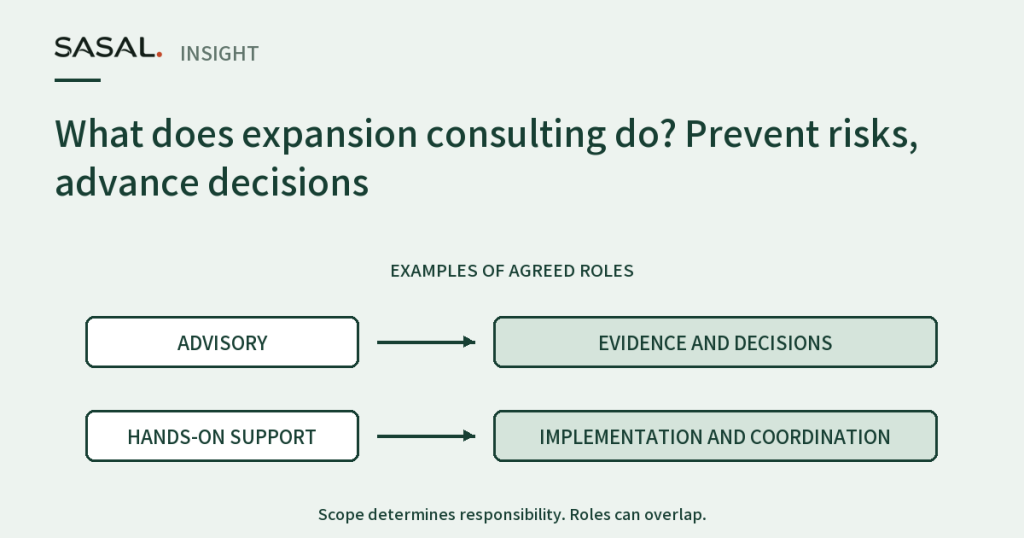
An overseas expansion plan can attract promising enquiries while resting on assumptions nobody has tested: who can approve the purchase, whether the product can be supported locally, or what a partner is actually able to deliver. By the time these gaps appear in sales figures, the company may already have committed money, capacity or contractual obligations. Consulting creates value earlier, by investigating the conditions behind the plan and helping management decide what to do before those commitments become difficult to change. This article explains the work involved, the mistakes it can help prevent and the decisions it should enable. It also distinguishes that role from outsourced sales and shows why hands-on support requires a realistic budget and an explicit division of responsibilities.
Understand the decision and prevention role of consulting
A useful way to understand overseas expansion consulting is to start with a decision that management cannot yet make confidently. Consider a fictional supplier of high-value industrial filtration equipment receiving encouraging enquiries from overseas distributors. The leadership team is considering travel, local representation and product adaptation, yet several assumptions remain untested. It is unclear whether buyers require local service coverage, which stakeholders approve purchases, and whether the company can support installations within expected response times. These uncertainties may not become visible in sales results until after significant commitments have already been made. In this situation, the consulting assignment is not primarily to generate transactions. It is to investigate material unknowns before management commits additional people, time and budget.
The value of that work is connected to foreseeable exposures. A project may examine whether buyer interest has been interpreted correctly, whether the intended customer segment matches actual purchasing authority, whether delivery economics remain workable under overseas operating conditions, or whether a proposed partner can perform the role being assumed. Each question should be linked to evidence and to a decision consequence. If interviews, operational reviews or partner checks reveal a condition that must be addressed before expansion, management gains a clearer basis for deciding what to do next. The purpose is not to remove uncertainty completely. It is to replace untested assumptions with better-supported judgments.
Prevention in this context means making specific mistakes less likely rather than claiming protection from every adverse outcome. A recommendation to delay an office launch, narrow a target segment or conduct additional verification can be a productive result when it is supported by adequate evidence. Equally, a recommendation to proceed may be justified if critical conditions have been examined and management understands the remaining uncertainties. The consultant contributes analysis, coordination and recommendations, but the client retains responsibility for commercial commitments, budgets and execution decisions.
Consulting work should also be judged by whether it advances a decision rather than merely producing documents. A detailed report that does not explain evidence, assumptions, limitations and practical implications may leave management no closer to choosing a course of action. By contrast, a concise decision record that identifies tested questions, unresolved issues, required owners and next commitments can materially improve governance. Decision progress may include narrowing options, sequencing activities, assigning responsibility or identifying specialist work that must occur before expansion proceeds.
The same principle applies when findings are inconvenient. If investigation shows that the original expansion concept depends on service capabilities that do not yet exist, the engagement has still generated useful management information. That outcome does not prove a financial saving because unrealized alternatives cannot be verified after the fact. It does, however, provide evidence that can influence staffing plans, partner selection, market prioritization or project timing. Consulting earns its place when it helps management understand conditions, compare options and move toward an informed decision with a clear record of what has been examined and what remains uncertain.
Consulting and outsourced sales start from different assignments

Confusion often arises when companies compare consulting, implementation support and outsourced sales as though they were fixed categories with identical objectives. In practice, the more important question is what assignment has been contracted. Returning to the fictional industrial filtration equipment supplier, management may first need evidence about purchasing requirements, service expectations and entry options. At a later stage, it may need support building approval processes or coordinating launch activities. It may also decide to engage a sales organization to contact prospects and maintain commercial follow-up. These are related activities, but they begin from different instructions and should not be evaluated as if they were the same job.
A consulting assignment typically focuses on investigation and decision support. The provider may interview prospective buyers, review internal capabilities, compare entry models, examine delivery economics and identify assumptions requiring validation. The expected outputs are findings, tested questions, documented alternatives and recommendations tied to specific decisions. Authority remains with management. The consultant may explain implications and recommend a course of action, but it does not automatically acquire authority to negotiate commercial terms, approve commitments or bind the client organization to agreements.
Hands-on implementation support occupies a different position. Once management has selected a direction, practical work may be required to convert recommendations into operating routines. For the equipment supplier, that could include creating quotation workflows, defining technical approval responsibilities, establishing service-escalation procedures and coordinating specialist inputs. Progress is visible through completed operational tasks, assigned owners and functioning processes. The emphasis is on carrying out agreed work rather than investigating whether expansion should occur in the first place.
Outsourced sales begins from another assignment again. The provider may be asked to identify prospects, qualify opportunities, arrange discussions and support commercial progression within defined limits. Information generated through those activities can inform management decisions, but the primary responsibility concerns commercial engagement rather than market diagnosis. Mixed arrangements are common, and some firms offer multiple services. Even then, responsibilities should be mapped to specific tasks, handovers and decision rights rather than assumed from a provider label alone.
Scope clarity becomes especially important when budgets, staffing and timelines are discussed. Management should identify who investigates customers, who recommends actions, who contacts prospects, who prepares offers, who approves terms and who manages delivery after agreement. Each handover needs a usable output and someone able to act on it. For example, an adviser may identify an unresolved installation requirement, but the client must assign a technical owner to determine what can be promised before the sales team sends an offer. Agreeing responsibilities, exclusions, dependencies and documentation expectations before work begins makes such gaps visible. A fee structure may determine how the work is charged, but it does not by itself define what work will actually be performed.
- AdvisoryInvestigates customers, requirements, risks and options to support management decisions.
- Hands-on implementationBuilds processes, coordinates execution and helps teams carry out agreed actions.
- Outsourced salesEngages prospects, qualifies opportunities and supports commercial follow-up within scope.
Diagnose what is actually preventing overseas growth
Before expanding activity, management needs to understand what is genuinely constraining progress. Different obstacles can produce similar symptoms. The fictional filtration equipment supplier believed overseas growth was being limited by insufficient prospect outreach because enquiries were not converting into projects. A consulting review examined records from the previous nine months rather than assuming the explanation. The objective was to identify which uncertainty most affected the next management decision and which actions were justified by evidence.
Three competing explanations emerged. The first was that the company was targeting organizations that could express interest but could not authorize purchases. The second was that technical responses were arriving too slowly during evaluation stages. The third was that buyers expected local service arrangements that had not been defined. Each explanation implied different interventions, budgets and staffing requirements. Treating them as a single sales problem would have obscured important operational differences.
One opportunity illustrated the issue. An enquiry was received in February from a manufacturer seeking filtration equipment for a production upgrade. Internal records showed that a technical clarification requested during the quotation process remained unanswered for several weeks because responsibilities between product and service teams were unclear. Interviews also revealed that the prospective buyer expected a documented service approach before final approval. The opportunity did not progress, but the evidence did not support a confident conclusion that demand itself was absent. Instead, the record pointed toward process and service-preparation questions that required investigation.
The consulting team reviewed correspondence, interviewed sales, engineering and service personnel, and mapped decision points against documented observations. Some findings were sourced facts, such as response dates and buyer requests. Other statements remained assumptions, including expectations about future market adoption or partner performance. Maintaining that distinction helped management understand which conclusions rested on direct evidence and which required additional testing. As a result, the assignment shifted from broad market expansion planning toward service-readiness assessment and quotation-process redesign.
The diagnosis also changed resource allocation. Rather than immediately increasing outreach activity, management commissioned work to define service responsibilities, establish technical response ownership and verify which stakeholder groups typically approved purchases. These decisions did not guarantee future commercial outcomes, nor did they prove that every lost opportunity could have been recovered. They did, however, connect observed conditions to specific actions. The engagement produced value because it clarified what problem management was actually trying to solve and which commitments were reasonable to make next.
A strong diagnostic process therefore links observation, ownership and consequence. If evidence indicates that buyer authority sits elsewhere, targeting changes. If service expectations exceed current capacity, implementation plans change. If delivery conditions undermine the proposed offer, entry options are reconsidered. The consultant's role is to organize evidence, test assumptions and explain implications so that management can decide which uncertainty to address before making larger commitments.
Test the customer and buying process before expanding activity
Many overseas expansion efforts increase prospecting, travel or marketing before management has verified how a purchase decision is actually made. A consulting engagement can be commissioned to investigate that question directly. The objective is not to forecast future orders with certainty. It is to test whether assumptions about buyer priorities, approval routes and purchase conditions match observed evidence. For a fictional supplier of high-value industrial filtration equipment, management believed strong technical interest signaled readiness to expand activity in a new region. The consulting assignment instead focused on understanding how a capital-equipment purchase progressed from initial interest to final authorization and which conditions repeatedly appeared before a commitment could be made.
A practical investigation examines real purchasing behavior rather than asking whether someone likes a product. Interviews with engineers, procurement personnel and operational managers can be combined with available procurement documents, previous purchase histories and records of stalled opportunities. In the filtration-equipment example, plant engineers responded positively to technical features, but further enquiry showed that supplier qualification was controlled by procurement and capital expenditure approval rested with finance leadership or a plant head. Those findings changed the working assumption. Interest from a technical user remained relevant, yet it was not sufficient evidence that the buying process could advance without additional approvals and supporting information.
Consultants can also test competing explanations for slow progress. Management may assume demand is weak when discussions are actually occurring with people who cannot authorize expenditure. Alternatively, approval may depend on service coverage, validation trials or internal budget timing rather than product capability. The investigation should document where decisions pause, which stakeholder owns the next step and what evidence is still missing. In the fictional case, the team compared several possibilities, including purchase, equipment repair, leasing alternatives and maintaining existing systems. Evaluating those alternatives provided a more realistic picture of the customer's decision process than collecting expressions of enthusiasm alone.
Negative findings can be especially valuable when they are supported by evidence. If multiple organizations identify the same obstacle, management gains information that may justify narrowing the target segment, modifying the offer or conducting further validation before increasing activity. At the same time, the limits of the evidence should be recorded. Friendly referrals may introduce selection bias, and nonresponses may prevent firm conclusions about the wider market. A consultant should explain those limitations rather than presenting partial observations as certainty.
The outcome of this work is decision progress. In the filtration-equipment example, the evidence supported a narrower technical trial with specific buyer groups rather than a broad expansion of selling activity. That recommendation did not prove future commercial success, nor did it guarantee that all important questions had been answered. It did provide management with a documented basis for deciding what to test next, which assumptions remained unresolved and which commitments were justified at that stage of the expansion process.
Check whether a sale can be delivered profitably
Customer interest alone does not establish whether overseas expansion is workable. Before management increases commercial activity, it needs to understand the operational conditions required to deliver what is being offered. Consulting work in this area examines delivery economics, service obligations, coordination requirements and capacity constraints. The purpose is to identify assumptions before commitments are made, not to declare whether expansion will definitely succeed. For a fictional supplier of industrial filtration equipment, the central question was whether overseas orders could be supported consistently under realistic operating conditions.
A useful review follows the path from accepted order to completed delivery. In the equipment example, that path included manufacturing schedules, installation travel, commissioning support, operator training, spare-parts availability, service-response expectations and payment milestones tied to acceptance. Each stage introduced dependencies that were not visible in early customer discussions. The consulting team worked with finance, operations and service specialists to document those conditions and identify where management was relying on estimates rather than verified information. This created a shared record of assumptions instead of leaving critical details dispersed across departments.
The analysis also examined capacity. Several prospective buyers expected local support within response times that exceeded the company's existing service coverage. Management initially considered using distributors to bridge the gap, but the review found that distributor involvement did not automatically provide trained technical capability. The assignment therefore compared requested service commitments with actual staffing levels, partner availability and escalation procedures. The result was not a conclusion that expansion should stop. It was a clearer understanding of what resources, partner arrangements or offer changes would be required before certain commitments could be made responsibly.
A worked assumptions sheet became a practical decision tool. For each major requirement, the review recorded the information source, the responsible owner and any unresolved questions. Installation costs, distributor margins, training responsibilities, warranty expectations and payment timing were evaluated together rather than in isolation. When assumptions changed, management could see how the proposed quotation, service model or investment plan might need to change as well. The value came from making trade-offs visible before additional commitments were approved.
This type of consulting assignment differs from outsourced sales execution because the core question concerns delivery readiness rather than opportunity generation. Management may ultimately decide to revise the offer, narrow the target segment, phase expansion or proceed with additional preparation. None of those outcomes can be judged solely by counting commercial activity. What matters is whether the investigation has clarified the conditions under which the organization believes it can deliver on its commitments and whether remaining uncertainties have been documented clearly enough to support an informed decision.
Choose an entry model and partners without outsourcing judgment
After customer requirements and delivery conditions have been examined, management still faces a separate decision: how to enter the market. Consulting support can help compare alternatives, but it does not transfer responsibility for the final commitment. For the fictional filtration-equipment supplier, management considered two principal routes under the same buyer and service requirements: direct market coverage using internal resources or distribution through a local partner. The consulting task was not to select a winner automatically. It was to identify the assumptions, evidence and consequences associated with each option so leadership could make a documented decision.
A structured comparison starts with required capabilities. The review assessed customer acquisition, technical follow-up, installation support, service coordination and relationship management. Direct entry offered greater control over technical interactions but required additional internal capacity and overseas coordination. A distributor could provide local presence, yet distributor margin alone did not demonstrate technical competence or operational commitment. By comparing both routes against the same customer expectations, management could evaluate whether either model left critical gaps that would need to be addressed before expansion proceeded.
Partner evaluation therefore became a specific workstream. Potential distributors were examined through available references, sample service activities, coverage arrangements and evidence of actual territory engagement. The assignment looked beyond contact lists and introductions to determine whether the proposed partner could realistically perform the expected role. Particular attention was given to dependency risks, exclusivity arrangements and incentive alignment. Where contractual questions arose, management was advised to obtain specialist review. The consulting role was to identify issues requiring attention, not to provide legal determinations or guarantees about future partner performance.
The review also considered phased alternatives. Rather than choosing between full direct entry and broad distributor authority, management evaluated a narrower pilot arrangement with limited responsibilities and clearly defined reporting requirements. This approach allowed additional evidence to be gathered before wider commitments were made. A recommendation to narrow authority or test a smaller scope can represent meaningful progress when supported by documented observations. It moves a decision forward while preserving flexibility if assumptions later prove inaccurate.
Scope clarity remains important when consulting, implementation support and outsourced sales activities overlap. Management should agree who investigates options, who recommends actions, who contacts prospective partners, who approves terms and who remains accountable for ongoing performance. The decision record should explain why the selected route fits the buyer and service requirements, which assumptions have been checked, and which conditions would justify reconsidering it. In the equipment example, a distributor with customer relationships but unverified repair capacity might be considered for a narrower commercial role while technical service remains a separate unresolved task. Recording that distinction prevents the partner appointment from being mistaken for a complete operating model. It also gives internal teams a basis for revisiting the choice when verified capability or customer requirements change.
Turn recommendations into work that someone can perform
An overseas expansion project often loses momentum when findings are accepted in principle but no operating change follows. A consulting engagement becomes more useful when it converts evidence into named responsibilities, decision records, timing assumptions and practical tasks that can be executed within existing authority. Consider a fictional supplier of high-value industrial filtration equipment assessing expansion into a new overseas market. Interviews with buyers suggested that technical response speed influenced confidence during evaluation. That observation alone did not change anything. Management still needed to decide who would answer technical questions, who could approve custom commitments, how exceptions would be escalated and what response standards were realistic with current staffing. The consulting contribution was therefore not limited to identifying an issue. It included designing a workable path from observation to action so leaders could judge whether the chosen approach fit available capacity.
A useful implementation design assigns ownership to the next decisions and tasks. In the filtration-equipment example, enquiry records showed that questions sometimes moved between engineering, service and commercial teams without a clear owner. The resulting recommendation was translated into a routing process, an approved-answer library for recurring questions, an escalation path for proposed custom modifications and a supervised trial on the next live enquiry. Each activity had a responsible person, required inputs and a defined review point. This level of detail matters because management can then observe whether the recommendation is operationally feasible rather than treating implementation as an undefined future step.
Cross-functional coordination is often where expansion plans encounter delays. Sales personnel may hold customer observations, engineers may understand technical limits, finance may control approval thresholds and leadership may own investment decisions. Consulting support can help define how information moves between those groups and which evidence is required before additional commitments are made. In the fictional case, management agreed that no partner proposal would advance to final review until service-capacity assumptions, technical obligations and commercial responsibilities had been documented together. The useful output was not simply a recommendation about partners. It was a decision process that made hidden dependencies visible before further commitments were approved.
Hands-on support can range from coaching internal teams to directly operating agreed activities when funded and explicitly scoped. Not every adviser performs implementation work, and management should not assume that a recommendation automatically includes execution. Where implementation support is commissioned, practical tools often matter more than presentation slides. Responsibility maps, implementation trackers, issue logs, approval records and assumption registers create continuity over a long expansion effort. They also provide a traceable explanation of why decisions were made and what evidence supported them. Progress is therefore observed through completed actions, functioning routines and documented decisions rather than through the existence of a report alone.
Capability transfer deserves explicit attention because expansion initiatives often continue after an engagement ends. The UK Consultancy Playbook, in its public-sector commissioning context, notes the importance of sharing knowledge and reducing repeated dependence on externally purchased skills. Applied carefully to commercial expansion, that does not require eliminating external support. It means ensuring that important reasoning, operating methods and decision records can still be understood internally. In the filtration-equipment example, one practical test was whether internal staff could handle the next technical enquiry using the new process, not whether a folder of documents had been delivered. Commercial outcomes remained uncertain, but management had converted findings into work that identifiable people could perform and supervise.
Budget for hands-on support and define the contract boundaries
Many disagreements about overseas expansion support begin with a mismatch between expected involvement and funded scope. A company may expect continuous coordination across markets, partner discussions and implementation activities, while the engagement only provides periodic advisory input. For that reason, budgeting should start with the work that must be performed rather than the fee mechanism used to charge for it. A retainer, fixed-fee arrangement, hourly engagement or success-based component can each support very different levels of effort. Management needs to understand which people, time commitments, supervisory responsibilities, travel requirements and specialist capabilities are actually included before assessing whether the planned intervention is realistic.
A practical scoping discussion identifies responsibility at task level. The client should understand who investigates market questions, who develops recommendations, who contacts prospective buyers or partners, who prepares commercial materials, who approves terms and who manages delivery after an agreement is reached. Some responsibilities may remain entirely internal. Others may be delegated. Mapping these activities often exposes gaps that would otherwise appear later as performance disputes. If nobody is responsible for a critical activity, expansion risk remains regardless of provider experience or reputation.
Dependencies deserve equal attention because even a capable team cannot operate effectively without required inputs. Consultants and outsourced sales providers may need access to product specialists, internal decision-makers, technical documentation, pricing information or historical records. When those inputs are unavailable, conclusions may become less reliable and implementation may slow. The provider should explain foreseeable limitations and the effect of missing information on its recommendations. The client should be equally clear about available management attention, staffing constraints and approval processes. Transparency on both sides creates a more accurate picture of what can be achieved within the agreed scope.
Consider a fictional industrial filtration-equipment supplier that expects support covering market assessment, partner evaluation and day-to-day coordination with overseas contacts. During planning, it becomes clear that the available budget funds only a small advisory team providing periodic reviews. Management then faces a choice. It can narrow the objective, phase the work so that investigation precedes implementation, increase resources to support broader involvement or postpone selected activities. Expanding expectations without increasing capacity creates a predictable execution problem. Useful consulting support includes identifying that mismatch before commitments are made, not after milestones are missed.
Contract clarity does not guarantee commercial success, but it does improve accountability and decision quality. Before work begins, both parties should agree exclusions, change-approval procedures, additional charges and required client inputs. There is no universal budget floor and no standard staffing model that fits every expansion effort. External conditions, customer decisions and internal execution will still influence results. However, a well-defined agreement allows management to distinguish between the work commissioned, the work delivered and the business outcomes that later emerge. That distinction helps leaders evaluate progress fairly and decide whether additional support, a revised scope or a different implementation sequence is warranted.
Identify avoidable mistakes before investment and contracts
Consulting assignments are frequently commissioned because management wants to reduce the likelihood of foreseeable expansion mistakes before making larger commitments. Examples include approaching the wrong decision-makers, relying on an unverified partner, promising support capabilities that have not been tested or committing to a local presence before important assumptions have been examined. The contribution of consulting work is not a guarantee that problems will never occur. Its purpose is to identify a specific exposure, investigate it using available evidence and help management decide whether the next commitment should change. Judging the work by risks addressed and decisions advanced is more reliable than treating every outcome as proof that a hidden loss was avoided.
A practical evaluation method is to trace an exposure through an intervention and then examine what changed. Consider the fictional filtration-equipment supplier. Early discussions suggested strong interest from potential buyers, and management was preparing to send demonstration units and negotiate broader support commitments. During review, however, the consulting team discovered that a proposed on-site support promise had not been verified against actual service capacity. The intervention was targeted verification involving service personnel, operating assumptions and escalation requirements. The resulting decision was not to abandon the opportunity automatically. Instead, management narrowed the commitment, tested service arrangements and delayed broader promises until supporting evidence was available.
The important observation in that example is the changed commitment rather than an unprovable estimate of money saved. No adviser can demonstrate with certainty what would have happened under an unrealized alternative scenario. It may be reasonable to conclude that a specific mistake became less likely because assumptions were tested. It is not reasonable to claim that every risk identified would certainly have become a loss. Maintaining that distinction keeps recommendations connected to evidence rather than retrospective storytelling.
The same logic applies when findings point toward continuation, modification or termination of an initiative. If partner verification reveals unresolved capability questions, management may continue due diligence, reduce the partner's role or seek alternatives. If delivery assumptions prove weaker than expected, the company may redesign its offer before increasing activity. Conversely, if evidence supports a planned commitment, management may proceed while recording the remaining uncertainties. Preventive consulting is therefore not defined by stopping projects. It is defined by making the reasoning behind a decision more explicit and testing important assumptions before irreversible commitments are made.
This distinction also protects against weak analysis. Not every unsuccessful outcome can be relabelled as learning, and poor research does not become valuable simply because uncertainty exists. Providers remain responsible for explaining their evidence, methods, assumptions and foreseeable limitations. Management retains responsibility for budgets, implementation and final decisions. When that chain of responsibility is visible, leaders gain a clearer view of residual risk and can make expansion choices with a documented understanding of what has been examined, what remains uncertain and why a particular course of action was selected.
- Observed exposureEvidence indicates a specific concern such as unverified support obligations or unclear buyer authority.
- Targeted investigationValidation, interviews or operational review test whether the assumption is reliable.
- Revised commitmentManagement narrows, delays, proceeds with conditions or changes the planned action.
- Residual uncertaintyExternal and execution risks remain and are recorded for future decisions.
Recognize progress through risks addressed and decisions made
Progress in an overseas expansion consulting engagement is best observed through uncertainties clarified, commitments adjusted and decisions recorded, rather than through sales counts. Consider a fictional supplier of high-value industrial filtration equipment evaluating expansion into a new overseas market. Management initially planned to appoint a distributor, approve marketing expenditure and begin regular travel. Before those commitments were authorized, the consulting assignment examined buyer requirements, service expectations and internal delivery capability. The question was not whether future sales would occur. The question was whether management understood the conditions attached to the next commitment.
The review identified a specific issue. Several prospective buyers expected documented local service arrangements before approving equipment purchases, yet responsibility for overseas service support had not been agreed internally. The consultant coordinated evidence from service managers, technical specialists and commercial staff, then documented what was known, what remained uncertain and which assumptions required testing. That work did not eliminate risk. It did change the decision path. Management narrowed the initial market-entry plan and commissioned a targeted investigation led by the internal service lead before approving broader commitments. A justified narrowing decision represented progress because an unresolved condition became visible and received an owner.
A useful record links four elements: the observed exposure, the evidence collected, the owner responsible for addressing it and the decision affected. In the filtration-equipment example, the exposure was an unverified support commitment, the evidence came from buyer discussions and internal capability reviews, the owner was the service function and the affected decision concerned market-entry scope. Without that structure, teams often continue discussing the same issue without changing any operational responsibility. Consulting contributes value when evidence changes the next action, not when it simply produces additional discussion.
The same logic applies when findings support proceeding. If buyer interviews, purchasing-process analysis and delivery reviews indicate that critical assumptions have been tested adequately for the next stage, management may authorize further activity while documenting residual uncertainty. Progress does not mean certainty. It means that a decision can be made with a clearer understanding of conditions, alternatives and foreseeable gaps. Equally, a recommendation to defer, stop or reduce a project can be a constructive outcome when supported by credible evidence and a clear explanation of consequences.
Evaluation therefore needs to reflect the assignment that was actually commissioned. An advisory engagement should be expected to explain evidence, assumptions, limitations and decision implications. If management receives a documented basis for a go, narrow, defer or stop decision, unresolved conditions are identified, and responsibilities are assigned to specific owners, the engagement has advanced decision-making. Whether later commercial outcomes are favorable will also depend on execution, market conditions, customer priorities and choices made by the client after the advisory work concludes. Those later outcomes remain important to the business, but they are not a complete measure of a consulting assignment whose purpose was to improve decisions before larger commitments were made.
Connect consulting and sales teams without losing information
Many overseas expansion programs eventually involve both advisory work and commercial execution, but valuable information is often lost between those stages. Consulting may identify buyer requirements, approval routes, service expectations or delivery constraints, while a sales team or external sales agency later conducts outreach and follow-up. If the reasoning gathered during investigation is not transferred into operational use, teams can repeat avoidable mistakes, revisit already-tested assumptions or pursue opportunities that conflict with earlier evidence. The objective is not to create permanent dependence on advisers. It is to ensure that evidence continues to influence decisions after research activity ends.
The fictional filtration-equipment supplier provides a practical example. During investigation, the consulting team found that target manufacturing plants typically involved technical users early in discussions, but purchasing authority often sat elsewhere. The same work identified an unresolved condition regarding local service support. Before any sales execution activity began, management created a handover package defining the target plant type, verified buyer needs, approved technical claims, quotation limits, confidential-information boundaries and the named internal technical contact. Those details transformed research findings into operating instructions that another team could actually use.
Information flow must also work in the opposite direction. Suppose an external sales agency begins discussions and repeatedly encounters a new objection concerning maintenance-response expectations. A single comment may not justify changing strategy. However, if dated observations from multiple discussions point to the same concern, the agency should return that evidence to management and any advisory team supporting the project. The purpose is to separate isolated feedback from a recurring pattern. Decision-makers can then determine whether the original assumptions remain adequate, whether further investigation is required or whether implementation plans should change.
Information becomes difficult to use when the reason for a recommendation is separated from the action handed to the sales team. A target list alone does not explain why certain plants were selected, which requirements were confirmed or which claims remain unverified. The handover should therefore retain the relevant evidence, its date, permitted use and the person responsible for resolving an open question. When a contact or service assumption changes, the team can update the affected instruction instead of repeating the entire investigation or continuing with an obsolete promise. These records support continuity when personnel change, but they should remain proportionate: a short, maintained brief that staff actually use is more valuable than an elaborate archive nobody can interpret.
A funded owner is usually required to maintain this integration, although that owner may be an internal manager rather than a consultant. In the filtration-equipment example, responsibility for coordinating evidence transfer sat with the client’s expansion lead. When the sales agency reported repeated service-related questions, the expansion lead arranged a review with the service manager and consultant. The resulting decision was to test a revised support model before expanding outreach further. Progress was visible not because more meetings occurred, but because new evidence changed the next action while preserving continuity between investigation, execution and learning.
Commission the intervention your business actually needs
Organizations often begin by asking which provider to hire, when the more useful starting point is identifying what decision, capability gap or execution responsibility requires attention. The source material emphasizes tracing each intervention to a specific exposure and distinguishing advisory work from sales execution. A company uncertain about buyer requirements, delivery economics or partner capability may need investigation and decision support. A company that has already chosen an approach but lacks capacity to contact prospects may need sales execution. Treating these situations as identical can produce an expensive mismatch between expectations and the work actually funded.
The fictional filtration-equipment supplier illustrates this distinction. Management initially believed it needed immediate prospecting support because overseas opportunities were not progressing. A diagnostic review showed that the larger issue was uncertainty about service economics and support obligations after installation. The next decision therefore concerned operational readiness rather than prospect volume. Management commissioned a scoped investigation involving the internal service lead, technical specialists and external advisers. The purpose was to determine whether the proposed offer could be supported under realistic conditions before expanding activity.
That investigation produced a practical decision trail. Buyer discussions highlighted service expectations. Internal reviews revealed unresolved assumptions about response responsibilities. The consultant documented evidence, foreseeable limitations and alternative approaches. Management then chose to narrow the initial expansion scope while testing a service model in a smaller segment. Because the missing condition was identified before broader commitments were approved, the company had a clearer basis for deciding what work should occur next. The engagement advanced a decision instead of simply generating additional analysis.
A separate question concerned implementation capacity. Once management selected a direction, findings still needed to be converted into operational work. Responsibility maps, approval processes, partner-review activities and coordination tasks required time and people. Rather than assuming that advisory recommendations would automatically become reality, management funded a distinct hands-on support phase with defined owners, budget boundaries and deliverables. In a different situation, internal staff might have had sufficient capacity and only a narrow specialist review would have been necessary. The appropriate intervention depends on the actual constraint, not on a generic preference for more external support.
Only after strategy, service conditions and operating responsibilities were sufficiently defined did management consider outsourced sales activity. At that stage, prospect engagement became a separate contracted responsibility with its own scope and reporting expectations. The company did not use sales outcomes to evaluate the earlier consulting work. Instead, it reviewed whether the investigation clarified key uncertainties, whether responsibilities were allocated appropriately and whether decisions moved forward on an evidence-based basis. The final commissioning discussion therefore focused on agreed work, decision authority, required internal participation, budget and exclusions. That clarity does not guarantee commercial success, but it creates a transparent link between the exposure being addressed, the intervention funded and the management decisions the work is intended to support.