

SASAL INSIGHT / DEEP DIVE
Overseas payment terms: a practical receivables plan
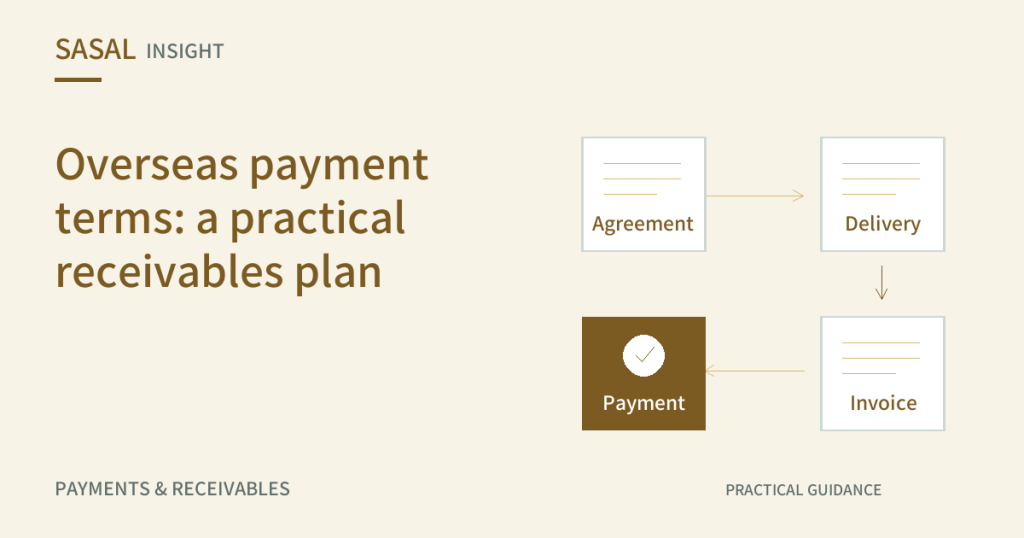
Before accepting an overseas order, a first-time exporter or service supplier should confirm how delivery becomes acceptance, how acceptance becomes an invoice, and how an invoice becomes collected cash. A practical receivables plan identifies the contracting party, the payer, the approval process, the documents required, the expected payment timing, the amount that may remain outstanding, and the actions available if payment is delayed. The objective is commercial planning rather than country-specific legal or banking advice. By mapping responsibilities, milestones, exposure limits and escalation paths before work starts, a company can evaluate whether an order fits its cash capacity and operating priorities while reducing avoidable misunderstandings during performance and collection.
Start with the route from delivery to collection
The most useful starting point is not the invoice itself but the complete route from performance to cash receipt. Before accepting an order, identify what work will be delivered, who confirms completion, what evidence is required, when acceptance occurs, and how invoicing follows. Many collection problems begin when one party assumes acceptance is automatic while the other expects a review process. A receivables plan converts assumptions into explicit steps. That approach helps both sides understand responsibilities and reduces uncertainty around timing, documentation and operational handoffs after delivery.
A company should also examine whether payment depends on a single event or several milestones. Some projects move directly from delivery to invoicing, while others require staged approvals, installation confirmation, testing or administrative review. Each additional step can influence cash timing. Recording these steps before work begins allows the supplier to estimate working-capital needs more realistically. The focus is not predicting exact dates but understanding the sequence that connects performance with payment. A documented sequence is often easier to manage than relying on informal expectations shared during early discussions.
Hypothetical example: a service provider receives an overseas order for a three-month engagement. The customer expects a final report before approving payment, while the supplier expects monthly invoicing. Neither expectation is unreasonable, but the mismatch creates risk. By documenting completion criteria, acceptance responsibilities and invoicing milestones before signing, both parties can follow the same process. The supplier gains visibility over expected cash timing, and the customer gains clarity regarding deliverables. The result is a more predictable collection path without assuming any specific legal mechanism or payment instrument.
A useful planning method is to convert the route from delivery to collection into a responsibility map that identifies the owner of each handoff. For every step, note the triggering event, the evidence produced, the person or team expected to act next, and the condition that allows the process to continue. This exercise often reveals hidden dependencies that are easy to miss during commercial discussions. For example, acceptance might depend on a customer review meeting, while invoice submission might depend on a purchase-order reference generated by a different department. A hypothetical supplier could map a consulting engagement by listing delivery of draft work, customer review, acceptance confirmation, invoice issuance, internal customer approval and payment processing as separate stages rather than treating them as one event. Management can then ask which stage is most likely to influence timing and whether supporting records will be available when needed. The value of the map is not precision but visibility. Teams gain a shared understanding of where delays could occur and which actions are required before cash can be collected. When the sequence is documented in advance, forecasting discussions become more practical because assumptions about timing are tied to observable operational steps rather than general expectations.
- DeliveryWork or goods are provided according to the agreed scope.
- AcceptanceCustomer confirms completion using the agreed process and evidence.
- InvoicingInvoice and supporting documents are submitted as required.
- CollectionPayment is processed and receipt is confirmed.
Confirm who is actually responsible for payment
An overseas order may involve several related organizations, making payer identification a priority. The company receiving goods or services is not always the same entity that signs the contract, receives invoices or sends funds. Before accepting an order, determine the contracting entity, the invoicing entity and the remitting entity. If different names appear across documents, establish how those entities relate to one another. A receivables plan becomes stronger when payment responsibility is understood before work begins rather than investigated after a delay occurs.
Operational teams often focus on delivery details and overlook organizational structure. However, collection becomes more difficult when responsibilities are unclear. Confirm the legal name of the contracting party, verify who has authority to commit that organization, and record who manages invoice approval. These steps do not guarantee payment, but they support informed commercial decisions. Clarity regarding organizational roles also reduces confusion when personnel change. Future discussions become easier when the supplier can identify the relevant entity and the appropriate contacts associated with payment obligations.
Hypothetical example: a buyer introduces a regional affiliate that will receive services while a parent company discusses commercial terms. The supplier assumes the parent will pay. Later, invoices are redirected to another entity that was never clearly identified. A practical receivables review would ask how the entities are connected, which organization contracts, which organization receives invoices and which organization remits funds. Answering those questions before acceptance helps establish accountability and allows the supplier to evaluate exposure using consistent information rather than assumptions.
Beyond identifying names on documents, it can be useful to compare the commercial role of each organization involved in the transaction. A practical review may ask who benefits from the delivery, who has authority to purchase, who receives the invoice and who actually transfers funds. If one entity performs several roles, administration may be simpler. If different entities perform different roles, additional clarification may be appropriate before commitments are made. Consider a hypothetical arrangement in which a regional operating company receives services, a procurement entity issues purchase documentation and a treasury function manages payments. None of these structures is necessarily problematic, but each creates questions that should be answered early. Teams can record the relationship between entities, the expected communication contacts and any approvals needed when invoices are submitted. This information also supports continuity if personnel change during a long project. When a payment question arises months later, staff can refer to the documented structure instead of reconstructing it from email exchanges. The objective is not to investigate corporate groups in exhaustive detail. Rather, it is to establish enough clarity that responsibility for contracting, invoicing and remittance is understood consistently across sales, operations and finance functions.
Check authority and organizational readiness
Payment planning is stronger when the supplier understands how decisions are made inside the customer organization. A promising discussion with a contact may not represent final approval authority. Before accepting an order, identify who approves commercial commitments, who authorizes purchases and who approves invoices for payment. Understanding decision-makers helps estimate practical timelines. It also reduces the chance that agreed terms are later challenged internally. The objective is not to investigate every internal process but to understand whether the people involved can support the commitments being discussed.
Authority matters during both contracting and collection. A company may have enthusiastic project sponsors who support the transaction but lack authority to approve spending or contractual obligations. Clarifying approval routes can reveal additional requirements such as procurement reviews, budget confirmation or management authorization. These factors influence the timing of acceptance, invoicing and payment. Including them in a receivables plan helps create realistic expectations. It also supports communication between sales, operations and finance teams responsible for delivering and collecting the transaction.
Hypothetical example: a customer contact verbally confirms that payment will occur within a specified period. Later, the supplier learns that finance approval was never obtained and procurement requires additional documentation. The issue is not necessarily bad faith; it may reflect an incomplete understanding of authority. By identifying decision-makers and approval stages in advance, the supplier can incorporate those steps into planning. The resulting timeline may differ from initial expectations, but it is based on known organizational processes rather than informal assumptions.
One practical technique is to distinguish between influence and authority. The person championing a project may be highly supportive and essential to successful delivery, yet still lack the ability to approve purchases or release funds. During discussions, suppliers can therefore seek confirmation of who recommends, who approves and who executes each key decision. A hypothetical software-services provider might learn that a department manager selects the supplier, procurement validates purchasing requirements and finance approves payment processing. Knowing this sequence allows the provider to estimate how decisions move through the organization and what documentation may be requested along the way. The same approach can be applied internally. Companies often focus on customer approvals while overlooking their own approval requirements for pricing, exposure limits or resource commitments. Recording both sides of the process can improve planning because teams understand where decisions may pause pending review. The result is a more realistic timeline and fewer surprises after work begins. Authority mapping is not intended to create bureaucracy. Instead, it helps align commercial expectations with the actual decision path inside the organizations involved, reducing the likelihood that operational plans are built on assumptions that later prove incomplete.
- Project SponsorSupports the initiative and coordinates operational needs.
- ApproverAuthorizes commitments according to internal processes.
- Finance FunctionReviews documentation and processes payment steps.
Define acceptance before discussing timing
Payment timing cannot be evaluated meaningfully until acceptance is defined. A customer may intend to pay promptly after acceptance, yet disagreements about acceptance can delay the process significantly. Before accepting an order, determine what constitutes completion, who reviews the work and what evidence is required. Acceptance may involve testing, delivery confirmation, review meetings or document submission. Whatever approach is used, both parties benefit from describing it clearly. A shared definition creates a practical bridge between performance and invoicing and reduces uncertainty around whether obligations have been fulfilled.
Acceptance procedures should be workable in daily operations. Overly complex approval structures can create unnecessary delays even when relationships remain positive. Consider whether the required documents, reviews and approvals can be completed efficiently by both sides. A practical receivables plan identifies responsibilities and expected timeframes for each step. This allows operational teams to prepare necessary records before delivery occurs. When acceptance requirements are understood in advance, collection efforts can focus on execution rather than resolving avoidable procedural disagreements after work has already been completed.
Hypothetical example: a supplier delivers technical services and believes the project is complete. The customer expects a formal sign-off meeting before recognizing completion. Neither side documented the requirement. As a result, invoicing is postponed while schedules are coordinated. If acceptance criteria had been agreed beforehand, the sign-off step could have been planned into the project timeline. The lesson is not that one method is superior, but that payment planning depends on a clear and shared understanding of how completion will be recognized.
When defining acceptance, specificity is often more useful than complexity. A suggested method is to identify the evidence that an independent observer would review to determine whether the agreed work has been completed. Depending on the transaction, that evidence could include delivery records, testing results, meeting minutes, installation confirmation or a signed acknowledgement. The important point is that both parties understand the practical basis on which acceptance will be recognized. In a hypothetical project involving technical support services, the parties might agree that completion occurs when specified reports are delivered and reviewed during a scheduled meeting. By linking acceptance to observable events, operational teams can prepare records as work progresses rather than searching for evidence after completion. Another consideration is timing. If a review period is expected, documenting that expectation can help prevent misunderstandings about when invoicing should occur. Clear acceptance criteria also support internal coordination because sales, project managers and finance personnel can reference the same standard. This approach does not require a particular legal mechanism. It simply creates a shared operational understanding of what successful completion looks like and how that conclusion will be communicated before the collection process begins.
Build invoice requirements into the plan
Invoices are often treated as administrative documents, yet they play a central role in collection. Before accepting an overseas order, identify invoice requirements, submission methods, supporting documents and relevant deadlines. A customer may require purchase order references, acceptance records or specific formatting. These requirements influence how quickly invoices can be processed internally. Including them in a receivables plan helps prevent delays caused by incomplete documentation. It also allows operational teams to gather required materials during delivery rather than attempting to reconstruct records later.
The goal is not to create excessive paperwork. Instead, the objective is ensuring that the invoice matches the process already agreed between the parties. Consistency among quotations, contracts, acceptance records and invoices reduces the likelihood of administrative disputes. When documents align, payment reviews often proceed more smoothly because internal stakeholders can confirm what was delivered and why payment is due. A practical plan therefore links documentation requirements directly to operational milestones rather than treating invoicing as a separate finance activity disconnected from project execution.
Hypothetical example: a supplier completes a milestone and immediately issues an invoice. The customer rejects processing because a required acceptance document is missing. Payment timing then shifts while records are gathered. A stronger receivables process would identify documentation requirements at the outset and assign responsibility for producing them. The supplier can then prepare invoices that align with customer procedures. This does not guarantee collection, but it improves administrative readiness and reduces preventable delays between completion, invoicing and payment review.
Invoice preparation becomes easier when documentation requirements are gathered throughout performance rather than at the end. A practical approach is to create a transaction file containing the records expected to support future invoices. As milestones are completed, teams can add acceptance evidence, purchase-order references, delivery confirmations or other agreed materials to that file. By the time invoicing occurs, much of the required information has already been organized. Consider a hypothetical supplier delivering services across several stages. Instead of waiting until the final week to assemble documents, the project team records each completed milestone and stores supporting evidence in a consistent location. Finance personnel can then verify that the invoice aligns with the agreed process before submission. This method also helps identify missing items early. If a required record has not been produced, the issue may be addressed while the relevant participants are still actively involved. Consistency is equally important. Details appearing in invoices should correspond with the terminology and milestones already used in quotations, contracts and acceptance records. Administrative reviews often proceed more efficiently when documents describe the same transaction using the same references. As a result, invoicing becomes a continuation of delivery management rather than a separate activity performed after the work is finished.
Evaluate payment timing and cash exposure together
Payment timing should be evaluated alongside the amount that may remain outstanding. A long collection period may be manageable for a small transaction but difficult for a larger one. Before accepting an order, estimate how much value could remain unpaid at any point in the process. Then compare that exposure with available cash resources and other commitments. This analysis helps determine whether the transaction fits operational capacity. The purpose is not to reject every delayed payment arrangement but to understand how timing and exposure interact within the broader business context.
Different payment structures create different working-capital demands. Advance payments, post-delivery payments and installments each influence when cash enters the business relative to delivery effort. The most suitable arrangement depends on the transaction and the company’s circumstances. A receivables plan therefore focuses on visibility rather than assumptions. By estimating the maximum outstanding amount and the expected timeline, decision-makers gain a clearer view of potential strain on resources. This information supports balanced commercial decisions that consider both opportunity and financial capacity.
Hypothetical example: two overseas opportunities generate similar revenue. One requires substantial delivery before invoicing, while the other includes earlier billing milestones. If both customers appear attractive, the company may still prefer the arrangement that aligns better with cash capacity. The decision is not necessarily about risk avoidance. Instead, it reflects understanding how outstanding balances affect operations. Mapping timing and exposure together allows management to compare opportunities using practical financial considerations rather than focusing exclusively on projected sales value.
A useful comparison exercise is to evaluate exposure at several points in the transaction rather than considering only the final invoice amount. Management can ask what outstanding balance may exist after each delivery milestone and how that balance compares with available resources. This creates a more detailed view of working-capital demands. In a hypothetical engagement with staged delivery, exposure may rise gradually as work progresses and then decline after invoicing and collection. Another opportunity might involve a larger unpaid balance accumulating before any invoice can be issued. Viewing these patterns side by side can improve decision-making because the timing of exposure becomes visible. The analysis may also support discussions about alternative structures. If a proposed arrangement creates an outstanding balance that appears difficult to accommodate, the parties can evaluate whether different invoicing milestones or delivery sequencing would better align with operational capacity. The purpose is not to eliminate exposure entirely. Commercial activity often requires accepting some level of outstanding balance. Instead, the goal is to understand how exposure develops over time and whether the company can support that commitment while continuing to meet other obligations and priorities.
- Lower ExposureSmaller outstanding balances may be easier to support over time.
- Longer TimingExtended collection periods can affect resource planning.
- Milestone StructureDifferent invoicing points change exposure patterns during delivery.
Assess the buyer before extending exposure

When delivery occurs before payment, the supplier is making a commercial decision about exposure. That decision should be informed by available information regarding the buyer. Relevant considerations include organizational existence, payment history, financial information, transaction size and the authority of key contacts. The objective is not to achieve certainty. Instead, the company gathers enough information to determine whether the proposed exposure is proportionate. A structured review helps avoid situations where commitments grow beyond what management intended simply because payment considerations were discussed too late.
Assessment should be linked to practical limits. Information is most useful when it informs decisions about how much value may remain outstanding at a given time. A company that understands its exposure threshold can evaluate opportunities more consistently. This does not require identical treatment for every customer. Rather, it encourages deliberate choices supported by known information and documented reasoning. Linking assessment to exposure planning also improves internal communication because sales, operations and finance teams can reference the same assumptions when evaluating an order.
Hypothetical example: a supplier receives a large initial order from a new overseas customer. The opportunity appears attractive, but available information about payment performance is limited. Instead of focusing only on potential revenue, management evaluates how much could remain unpaid during delivery. The company then considers whether that amount fits its resources and alternatives. This approach does not predict future payment behavior. It simply aligns commercial decisions with available information and a defined tolerance for outstanding exposure.
Assessment becomes more consistent when the same review questions are applied to new opportunities before exposure is extended. Rather than relying on general impressions, companies can identify the information they consider relevant and evaluate each transaction against that framework. Examples drawn from the guidance include the buyer’s organizational existence, payment history, available financial information, transaction size and the authority of key contacts. A hypothetical exporter receiving an order from a new customer might compare those factors with the proposed amount that could remain outstanding during performance. The exercise is not intended to predict outcomes with certainty. Instead, it helps management determine whether the exposure being considered is proportionate to the information available. It may also reveal areas where additional clarification would improve confidence in the decision. Internal communication benefits as well. When sales, operations and finance teams discuss the opportunity, they can refer to documented assessment criteria rather than personal assumptions. This creates a more transparent basis for approving, modifying or declining a proposed arrangement. Over time, a structured review process can support consistency because similar opportunities are evaluated using similar considerations, even when customer relationships, transaction sizes and delivery models differ from one project to the next.
Use negotiation to balance value and collection
Payment terms are often discussed separately from other commercial terms, but negotiations may be more productive when value is considered as a package. Timing, quantity, delivery arrangements, service scope and other commitments can influence what each side finds acceptable. A practical receivables plan therefore examines how payment timing interacts with broader commercial objectives. The goal is not to maximize one term in isolation. Instead, both parties explore combinations that support sustainable performance while addressing their respective priorities and operational constraints.
Preparation is essential. Before negotiations begin, identify which terms are fixed, which are negotiable and which require internal approval. This structure helps prevent commitments that exceed delivery capacity or financial tolerance. It also encourages consistent decision-making when proposals change during discussions. Payment timing can then be evaluated alongside delivery effort, funding needs and resource allocation. Considering these factors together creates a more complete picture of transaction viability than focusing exclusively on headline pricing or collection timing.
Hypothetical example: a customer requests later payment timing but is willing to adjust order volume, scheduling or service scope. The supplier evaluates the complete package rather than responding to a single term. Depending on circumstances, the revised combination may be more workable than the original proposal. Alternatively, it may not fit operational requirements. The important point is that payment discussions occur within a broader commercial framework. That perspective often reveals options that are not visible when each term is negotiated independently.
Negotiations are often more effective when each proposed concession is linked to a corresponding benefit rather than discussed in isolation. The guidance emphasizes considering the complete package of value exchanged by the parties. A practical method is to identify the customer's priorities and compare them with what the supplier can sustainably provide. In a hypothetical discussion, a customer may seek later payment timing because of internal budgeting cycles. Rather than focusing only on that request, the supplier could evaluate it alongside delivery scheduling, order volume, service scope or other commercial terms. Management can then compare alternative packages and assess which combination best aligns with delivery capacity and cash planning. Another useful step is defining internal boundaries before negotiations begin. Teams can distinguish conditions that are fixed from those that are negotiable or require additional approval. This preparation reduces the risk of commitments being made under pressure without considering broader operational consequences. It also supports consistency when multiple representatives interact with the customer. By examining what each side gives and receives across the entire transaction, negotiations become a process of balancing priorities rather than debating a single term. That broader perspective may reveal workable arrangements that would not be apparent if payment timing were considered alone.
Document terms consistently across operations
Document terms consistently across operations by treating the quotation, contract, acceptance process, invoicing plan and operating procedures as parts of one receivables workflow rather than separate records. Before accepting an order, compare the key details that influence collection: scope, delivery milestones, acceptance requirements, invoicing milestones, payment timing, responsible contacts and any agreed currency or transfer-fee arrangements. The objective is not to duplicate every document word for word, but to ensure that teams rely on the same assumptions. A useful internal review can ask whether operations, finance and account-management staff would reach the same conclusion if each person read only the document used in their role. If different documents produce different answers about responsibilities or timing, clarification is usually needed before performance begins.
Changes require a disciplined process because receivables plans often evolve during negotiations and delivery. Revised dates, scope adjustments, payment arrangements, renewal conditions or exit conditions should be recorded in the documents and procedures that staff actually use. When comparing alternatives, management can consider whether a change affects only scheduling or also influences acceptance, invoicing or outstanding exposure. That distinction helps determine which teams need updated information and approvals. Accurate records support continuity when personnel change, because new employees can understand the agreed path from delivery to collection without relying on informal explanations. Documentation therefore functions as an operational management tool as well as a record of agreed terms, helping teams coordinate decisions using current information rather than outdated assumptions.
Hypothetical illustration: a supplier and customer agree to move from a single final invoice to milestone invoicing after discussing cash-flow needs. The account manager updates meeting notes but the quotation, operating procedures and invoice schedule remain unchanged. Operations continue planning for one acceptance event, while finance expects multiple invoicing milestones. When the first milestone is completed, internal teams disagree about whether an invoice should be issued. A stronger process would compare all affected documents, update the relevant records, obtain any required approvals and communicate the revisions to delivery and finance personnel. Consistency does not guarantee collection, but it helps ensure that acceptance, invoicing and follow-up activities reflect the same agreed commercial framework throughout the transaction.
An additional safeguard is to establish a regular document-reconciliation review during implementation. Even when terms are aligned at the start, changes introduced during delivery can gradually create inconsistencies between operational records and commercial documents. A suggested method is to schedule periodic checks at major milestones, comparing current procedures against the latest agreed terms. In a hypothetical project, a scope adjustment might alter delivery sequencing without changing the overall objective of the engagement. If the related acceptance and invoicing references are not updated, teams may later interpret responsibilities differently. Reconciliation reviews help identify such issues before they affect collection activities. The process can remain simple: confirm the current scope, acceptance approach, invoicing milestones, payment timing and responsible contacts, then record any approved revisions in the documents staff actually use. This approach is especially valuable when several departments interact with the customer, because information can diverge over time as participants focus on their own responsibilities. Consistent documentation supports continuity, enables more accurate forecasting and reduces the likelihood that a collection question will require reconstructing the transaction history from multiple sources. In practice, maintaining alignment is often easier than correcting misunderstandings after delivery has already occurred.
Plan for currency and transfer considerations

Plan for currency and transfer considerations by mapping every currency that affects the transaction, not only the currency shown on the invoice. Before accepting an order, identify the quotation currency, the expected payment currency and the currencies in which major costs will be incurred. Then compare quotation validity assumptions, contract currency choices and any agreed price-adjustment terms so management understands how retained cash could vary between quotation and collection. The objective is visibility rather than prediction. Where receipt and cost currencies differ, exchange-rate movements may affect the amount available after payment is received. A practical review can compare available alternatives, including maintaining the agreed structure or exploring arrangements offered through a financial institution, while recognizing that different approaches may involve different conditions and costs that should be reflected in cash planning.
Transfer arrangements deserve similar attention because collection timing and net receipts can be influenced by the way funds move from payer to supplier. During discussions, confirm any agreed transfer fees, required documents, payment deadlines and the practical steps needed for funds to be processed. If the contracting entity, invoicing entity and remitting entity are not the same organization, clarify how those roles relate to the payment process so assumptions remain consistent across operations and finance teams. A useful internal checklist may record who sends funds, which currency is expected, what deductions could affect receipts and how payment status will be confirmed. The goal is not to prescribe a specific banking solution but to ensure that the cash plan reflects the transaction structure actually being negotiated rather than an assumed one.
Hypothetical illustration: a service supplier quotes in Currency A because that is the customer’s preferred invoicing currency, while staff costs and subcontractor expenses are largely paid in Currency B. The order is accepted, work is completed, acceptance occurs as planned and payment arrives by the agreed date. Even so, the amount retained after collection differs from the original planning assumption because the relationship between the receipt currency and cost currency changed during the period between quotation and payment. A structured review conducted before acceptance would not eliminate uncertainty, but it could compare the contract currency, quotation assumptions and any price-adjustment terms against expected costs. Management could then evaluate whether the transaction remains suitable within its broader exposure and cash-planning framework.
Currency planning can be strengthened by treating exchange and transfer considerations as part of the broader cash forecast rather than a separate finance topic. A practical review may compare the timing of expected receipts with the timing of major costs and then identify where different currencies intersect. In a hypothetical transaction, customer payments may be expected in one currency while suppliers, employees or subcontractors are paid in another. Management can then evaluate whether the transaction assumptions reflected in quotations and contracts remain suitable for the period between acceptance and collection. The guidance notes that companies may compare alternatives, including maintaining the agreed structure or exploring arrangements available through a financial institution, recognizing that different choices involve different conditions and costs. Transfer considerations can be reviewed in a similar way. Teams may record who sends the funds, what documentation may be required and how payment status will be confirmed after remittance. These operational details can influence cash planning even when the customer intends to pay on time. Bringing currency, transfer and exposure information together provides a more complete picture of the transaction. The result is not certainty about future outcomes, but a clearer understanding of the assumptions supporting collection forecasts and resource planning.
Create a practical escalation path
Create a practical escalation path by defining actions linked to milestones before any delay occurs. Start by identifying who owns routine payment follow-up, who reviews supporting documents, and who can involve management if expected dates pass. Record the information that should be checked at each stage, such as acceptance records, invoice status, agreed deadlines, and any customer feedback. This keeps discussions focused on facts already established in the receivables plan. An escalation path should also clarify communication channels and expected response responsibilities so staff do not duplicate efforts or leave issues unattended. The purpose is not to assume non-payment. It is to ensure that when questions arise, the company can respond consistently, maintain visibility over outstanding exposure, and avoid confusion about internal accountability.
A useful escalation structure separates operational issues from broader commercial decisions. Administrative problems such as missing documents, invoice submission errors, or unresolved acceptance requirements may require prompt follow-up without immediately involving senior decision-makers. More significant concerns, including repeated missed commitments or requests to change previously agreed timing, may justify management review. Before accepting an order, determine what information would trigger movement from one level to the next and who has authority to decide on responses. Comparing alternatives in advance can help. For example, one option may be to revise timelines after confirming facts, while another may be to pause additional work pending clarification. Retaining revision, pause, and decline as available options supports deliberate decision-making rather than improvised reactions during a developing issue.
Hypothetical illustration: a supplier completes a project milestone, issues an invoice, and reaches the expected payment date without receiving funds. The customer explains that an internal approval step remains incomplete. Because responsibilities were documented earlier, the finance contact gathers acceptance evidence, the account manager confirms the customer’s revised timetable, and management receives a summary of the outstanding exposure. The team then compares available responses against the agreed escalation plan instead of creating a new process under pressure. If the explanation appears credible, the company may monitor progress and revise expectations. If information remains unclear, management may consider pausing further commitments until questions are resolved. This approach does not guarantee collection, but it provides a structured method for tracking delays, evaluating developments, and communicating consistently throughout the collection process.
An escalation path is most useful when it defines not only who acts but also what information should accompany each escalation. When a payment milestone is missed, decision-makers often need a concise summary of facts rather than a large collection of correspondence. A practical framework may include the relevant acceptance status, invoice details, agreed timing, customer communications and current outstanding exposure. Providing this information in a consistent format allows management to compare situations more efficiently and determine whether further action is needed. A hypothetical supplier could maintain a simple status record that is updated whenever collection activity occurs. If an issue progresses from routine follow-up to management review, the key facts are already organized. Another consideration is feedback. After a delay is resolved, teams can review what happened and decide whether future receivables plans should be adjusted. For example, repeated requests for the same supporting document may indicate that documentation requirements should be clarified earlier in the process. In this way, escalation serves both an immediate and a longer-term purpose. It helps manage current collection questions while also improving future planning by identifying patterns that can inform acceptance procedures, invoicing practices or exposure decisions.
- MonitorTrack milestones, invoices and expected payment dates.
- ReviewConfirm facts, documents and customer feedback.
- RespondApply the appropriate action based on the agreed path.
- ImproveUpdate planning assumptions when recurring issues are identified.
Lessons from resolved issues inform future transaction planning.
Prepare for consultation and internal review
Before seeking external legal, banking or specialist advice, assemble a clear internal summary of the proposed transaction. Include the contracting entity, payer details, acceptance process, invoicing requirements, payment timing, currencies, outstanding exposure assumptions and escalation approach. A concise summary allows advisers to focus on relevant questions efficiently. It also helps internal stakeholders evaluate whether important information is missing. Preparation improves the quality of discussions because participants can review documented assumptions rather than relying on fragmented recollections from negotiations.
A useful worksheet can organize information into practical categories. Record who signs, who pays, who approves acceptance, which documents are required, when invoices are issued and how much may remain outstanding at each stage. Then identify unresolved questions. This process often reveals gaps that can be addressed before commitments are finalized. The result is not a guarantee of successful collection. Instead, it is a clearer understanding of the transaction and the areas that may require further review before acceptance.
Hypothetical example: a first-time exporter prepares a transaction summary and discovers that the remitting entity has not been confirmed, acceptance criteria remain informal and invoice documentation requirements are unclear. Those findings create a focused agenda for discussions with the customer and any advisers. By resolving unanswered questions before work begins, the company strengthens its receivables plan and improves decision quality. The team can bring this completed summary to a discussion with relevant advisers so that outstanding commercial planning questions can be reviewed systematically.
Internal review can be made more effective by distinguishing confirmed information from open questions. When preparing a transaction summary, management may create separate sections for established facts, assumptions and unresolved items. This structure helps participants focus on the areas that most need attention before commitments are finalized. In a hypothetical export opportunity, the contracting entity and proposed payment timing might already be confirmed, while acceptance requirements and remitting-entity details remain unclear. Presenting the information in that format enables advisers and internal stakeholders to concentrate on the gaps rather than revisiting settled points. The summary can also support decision-making by showing how different elements of the transaction connect. For example, an unresolved acceptance process may affect invoicing timing, which in turn influences exposure planning. Seeing those relationships together often improves the quality of discussions. Another benefit is continuity. If negotiations continue over an extended period, the summary provides a current reference that can be updated as new information becomes available. By the time a consultation occurs, participants can spend more time evaluating options and less time reconstructing background details. The result is a more organized review process grounded in documented commercial assumptions and clearly identified questions.