

Pausing overseas operations: Which vendor relationships to keep
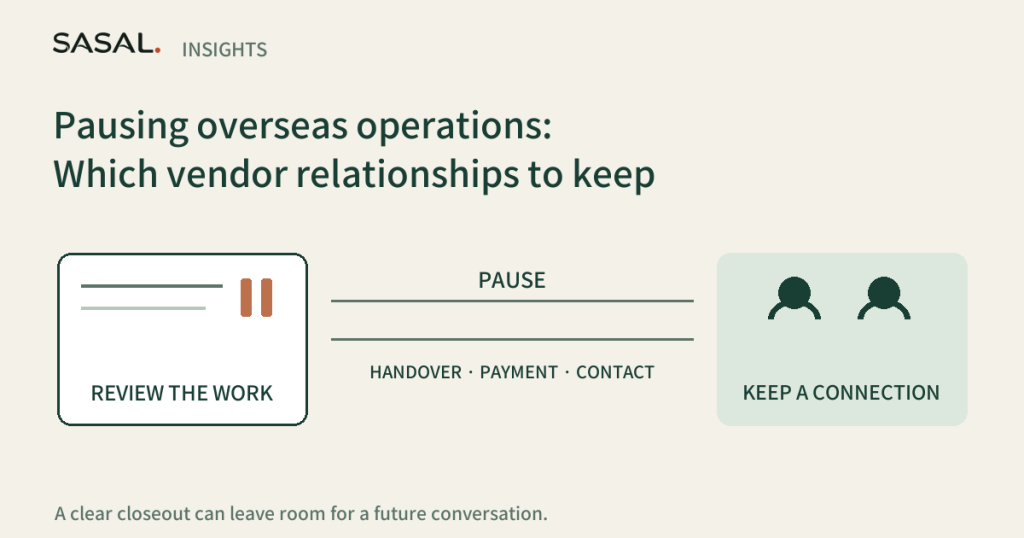
A decision to pause overseas activity is often described as if an entire market, project or operation has been switched off. In practice, different parts of the business stop at different times, and some responsibilities may continue after sales, marketing or expansion efforts have been reduced. Before deciding which vendors to retain, identify the activities that will cease, the commitments that remain in force, and the information needed to support a future review. The central question is not simply how much a supplier costs each month. It is whether ending, reducing or continuing a service leaves the business able to meet remaining commitments and preserve realistic restart options. A respectful pause can include ending contracts, provided expectations, records, payments and communication are handled deliberately and documented appropriately.
Define what is pausing before deciding whom to stop paying
A pause needs a precise operating definition before any supplier decision makes sense. Specify what is changing by geography, product line, activity and decision period. Stopping new sales in one market is different from stopping delivery to existing customers, and both are different from closing a local entity. Consider a hypothetical three-person professional-services business that decides to redeploy a founder to another opportunity. The firm pauses new overseas sales and marketing activity, but two client engagements remain active and must still be completed. In that situation, describing the business as having “paused overseas operations” is too vague to guide action. Some work has stopped, some work continues, and suppliers support different parts of that reality. A vendor that helped generate new leads may no longer be needed, while a vendor connected to ongoing client delivery may still be supporting active obligations.
Defining the boundary also prevents internal confusion. Sales personnel may tell contacts that activity will restart soon, while headquarters intends only to review the market later. A regional representative may describe the pause as temporary, even though no restart date has been approved. Those mixed messages can create unauthorized expectations with customers and suppliers. A vendor may delay reallocating staff because it believes work is about to return. A customer may assume future capacity has already been reserved. The practical remedy is a single internal description of what has stopped, what continues, who can communicate externally and what remains undecided. Clear boundaries reduce the risk that relationship decisions are based on assumptions rather than the actual operating plan.
The next question is not which suppliers to cut but which activities remain in scope. Existing engagements, support commitments, reporting duties and operational responsibilities may continue after new business development ends. In the hypothetical firm, the founder stops pursuing new opportunities overseas, yet two active engagements still require delivery oversight. That distinction matters because the continuing work, not the paused work, determines which external relationships still have a purpose. If an engagement requires ongoing coordination, removing supporting services without understanding that dependency can create disruption that costs more than the savings generated by the cancellation.
A useful review asks a simple operational question for each activity: does it continue, stop entirely or move elsewhere? Once those answers are documented, supplier decisions become easier because each relationship can be assessed against a specific function rather than a broad instruction to reduce spending. The resulting discussion is more concrete. Instead of debating whether a vendor is generally valuable, the business can evaluate whether the vendor supports work that still exists within the defined pause boundary. That approach creates a reliable record of what was intentionally suspended and what remained active, which becomes important if conditions later justify reconsidering the market.
Separate services you can stop from obligations you must still cover

After the pause has been defined, map remaining obligations backward to the resources that support them. Start with the deliverable, then identify what must exist for that deliverable to be completed. An open customer support issue may require continued access to a ticketing system and a named person who can respond. A recurring report may depend on source records, review procedures and someone competent to verify the output. A market with no new sales activity can still contain existing commitments that require attention. Likewise, a legal entity that is no longer pursuing growth may still have responsibilities that do not disappear simply because commercial activity has slowed. Looking at dependencies in reverse order helps reveal services that appear inactive but remain essential to something the business has chosen to continue.
This analysis often changes the sequence of decisions. Before cancelling a service, identify who will cover the function afterward. If customer-facing notices are required for a transition, determine who will issue them and who will answer questions. If a reporting process depends on records maintained by a provider, confirm how that process will continue. The point is operational continuity, not preservation of every supplier relationship. A business may ultimately replace, reduce or remove a service, but understanding the dependency first avoids discovering a gap only after a deadline, customer commitment or internal review has already been missed.
Where a meaningful transition is involved, planning should begin early enough to support an orderly change. The UK Cabinet Office Sourcing Playbook, a source of UK public procurement guidance rather than a worldwide rule for private companies, notes that preparing for exit and knowledge transfer requires sufficient time. That principle is useful here because dependencies rarely disappear instantly. If ongoing obligations rely on information, context or operational knowledge, the transition period should be treated as real work rather than an administrative formality completed at the last moment. The value of the guidance is the planning principle itself, not any claim that private businesses everywhere must follow a specific UK process.
The result of this exercise is a clearer distinction between services that support continuing obligations and services connected only to activity that has ended. A business that pauses overseas sales may discover that lead-generation support is no longer needed while a reporting or operational review function still has a purpose. Another organization may find the opposite. The important point is that dormant sales activity does not automatically mean dormant responsibilities. Decisions become more reliable when they are linked to remaining deliverables, coverage arrangements and actual dependencies rather than assumptions about which suppliers seem important at first glance.
Choose between termination, reduced scope, standby and essential continuity
Once remaining responsibilities are understood, evaluate each service line using four distinct options: termination, reduced scope, paid standby and essential continuity. These are alternatives, not stages in a maturity sequence. The choice should reflect actual workload, expected availability requirements, total remaining commitment and the practicality of restarting later. Importantly, the assessment can occur at the service-line level rather than only at the supplier level. The same provider might lose one stream of work, retain another at reduced scope and continue a third service because it remains operationally necessary. Treating every service from a supplier as a single package can obscure those differences.
Termination fits situations where the underlying activity has genuinely stopped and no continuing support or reserved readiness is required. Reduced scope applies when some work remains but at a narrower level. The boundary between reduced scope and standby is important. Reduced scope involves active, defined work that continues to be performed. Paid standby, by contrast, is primarily about readiness. The business is paying for a defined capability, availability commitment or reserved capacity rather than a continuing flow of operational tasks. Those distinctions affect cost, expectations and resource planning. A supplier performing ongoing monthly work is solving a different problem from a supplier reserving time for a possible future need.
Essential continuity is different again. Here, the service directly supports obligations that remain active during the pause. A support function connected to existing customers may fall into this category even when growth activity has stopped. In some cases, continuity may later be provided through a different arrangement after a transition. The key question is not whether the current supplier must remain forever, but whether the function itself must continue. If interruption would affect active commitments, the continuity requirement should be evaluated explicitly rather than treated as an ordinary discretionary expense.
Consider a hypothetical business that pauses overseas expansion. Its marketing support ends because new customer acquisition has stopped. A reporting service is reduced because only a limited set of ongoing activities remains. A specialist provider is retained on paid standby because a defined readiness requirement exists and the business wants reserved support under agreed boundaries. Customer-facing operational support continues because active obligations remain in place. Each choice reflects a different operational condition, and none is inherently superior. The practical objective is alignment between the service, the remaining workload and realistic restart expectations, without assuming that a terminated supplier will later return on identical terms or with the same available team.
- TerminateEnd the relationship when the supported activity has stopped and no ongoing or reserved service is needed.
- Reduce scopeKeep a smaller amount of active work that directly supports continuing responsibilities.
- Paid standbyPay for defined readiness or reserved capacity rather than ongoing operational output.
- Essential continuityMaintain services that remain necessary for active obligations during the pause.
Read the notice and commitment terms before announcing a pause
Before announcing a pause, read the actual contract structure rather than relying on a general impression of how the supplier relationship works. A common complication is that different commitments sit in different documents. Consider a hypothetical business that uses a marketing platform under a subscription agreement and also buys occasional consulting work through separate work orders. The subscription may already have passed its renewal notice window, meaning the business cannot immediately avoid the associated commitment simply by instructing staff to stop using the service. At the same time, an open consulting work order may still be cancellable or reducible under its own terms. If both arrangements are treated as a single vendor relationship, decision-makers can mistakenly assume that stopping activity automatically stops cost. The practical task is to identify what commitment exists, where it is documented and what event actually changes it.
The review should distinguish operational instructions from contractual effects. Telling a supplier to stop new work is not necessarily the same thing as terminating minimum fees, ending a subscription or changing a statement of work. Where a framework agreement sits above individual work orders, each layer may have different rules. One document may remain in force even after a particular assignment ends. Notice requirements also deserve careful attention. The relevant questions are often mundane but decisive: who must receive notice, what method is required, when is notice deemed effective and does an amendment require written acceptance from both parties? A message sent to a familiar contact may not satisfy the process specified in the agreement. If the pause has commercial significance, verify that the proposed change follows the required procedure rather than assuming that informal discussions have already altered the arrangement.
This is the stage where a compact supplier disposition sheet becomes useful. Keep it short enough to use during supplier discussions. For example, a single row might record: supplier relationship supporting overseas lead generation; proposed choice of reduced activity or termination; responsible person the founder; notice requirement and remaining fees under the subscription terms; handover evidence still awaiting a verified data export and access check; current status awaiting supplier response; review trigger linked to the end of remaining customer commitments. The value is not administrative completeness. It is the ability to see, in one place, what obligation remains, what action is proposed and who is accountable for progressing it. For owner-led businesses and small teams, that visibility can prevent a pause from becoming a collection of disconnected conversations handled by different people.
Material ambiguity deserves specialist review before announcements are made. That does not mean every supplier change requires extensive outside advice. It means uncertainty should be identified rather than ignored. If a contract appears to contain conflicting provisions about renewal, scope reduction or termination consequences, clarify the position before presenting a proposed outcome as settled. A pause often creates pressure to communicate quickly, yet a short delay to verify commitments is usually preferable to retracting statements later. By the time suppliers are contacted, the business should know which obligations continue, which changes are genuinely available and what formal steps are required to implement them.
Have the conversation without promising a restart you cannot guarantee
Once the available options are understood, the discussion with the supplier should focus on the current business decision rather than an imagined future. Timing matters. Where practical, tell the primary relationship contact before sending an impersonal cancellation notice or administrative email. That approach does not create special rights, but it often reduces confusion and gives both sides an opportunity to discuss operational realities. A supplier may already have allocated people, reserved time or planned work based on previous expectations. Commercial sensitivity means acknowledging those circumstances without making commitments that have not been approved internally. The goal is clarity, not reassurance through promises that may never be fulfilled.
A useful conversation explains exactly what has changed. An illustrative script, not an actual quote, might read: “We have paused new customer acquisition activity in this market. Current agreed work continues until its existing end point. We expect to review the market later, but that review is not a promise that activity will restart. We would like your view on a feasible transition from the current arrangement.” This wording separates facts from possibilities. The pause is real, ongoing work is identified and the future remains uncertain. Importantly, requesting a transition proposal is not the same as authorizing new work. Suppliers should understand whether they are being asked for practical input, a formal proposal or implementation of an approved change.
Listening is as important as explaining. A supplier may identify constraints that are not obvious from the customer side. Key personnel may be scheduled onto other projects, certain services may only be reducible at specific milestones or operational dependencies may exist that were not previously documented. Those facts do not dictate the outcome, but they can affect how a pause is implemented. A business that communicates only its own objectives may miss information that changes the cost, timing or practicality of the transition. The conversation becomes more productive when both parties are discussing what can realistically happen rather than defending assumptions about what should happen.
Honesty about uncertainty preserves credibility. Suppose a hypothetical business believes demand could return after a strategic review. Presenting that possibility as an expected restart may encourage the supplier to plan around work that never arrives. A better approach is to identify the review point and leave the result open. The supplier can then make its own resource decisions without assuming future instructions. If circumstances later improve, the parties can discuss fresh work based on current capacity, pricing and priorities. If circumstances do not improve, neither side has been operating under a misunderstanding created by an overly optimistic prediction. Clear communication keeps the relationship professional even when the future of the relationship remains unknown.
Close the work and settle payment without confusing separate disputes
Closing work during a pause requires a more precise reconciliation than simply marking a project complete or cancelled. Several statuses can exist at the same time. An accepted deliverable has been provided and approved under the applicable arrangement. An incomplete scope consists of work that remains unfinished. Pending acceptance describes work that has been delivered but has not yet passed the agreed review process. A genuinely disputed invoice involves disagreement about entitlement, quality, scope or another issue that remains unresolved. Treating all four categories as if they were identical creates confusion because each requires a different operational response. A pause decision does not automatically convert unfinished work into accepted work, nor does it automatically erase existing obligations.
Consider a hypothetical overseas research assignment interrupted by a strategic pause. The supplier has completed a series of interviews and delivered supporting materials. The final analytical report has been submitted but has not yet been accepted because review is still underway. In that situation, the completed interviews, the unaccepted report and any remaining tasks should be recorded separately. Evidence of acceptance should be checked against the actual terms governing the project. If approval requires a defined review process, determine whether that process occurred. If the agreement specifies particular deliverables, compare the work against those requirements rather than relying on informal impressions. The objective is an accurate status record that reflects what has happened, not what either side wishes had happened.
Payment discussions should follow the same discipline. Undisputed amounts should be handled when due through the normal process, while disputed items should move through the agreed dispute mechanism. Combining them into a single argument often delays resolution of matters that are not actually contested. Credit notes, refunds and expense reconciliation deserve separate attention because they may follow different procedures from service fees. Where a supplier incurred approved expenses before the pause, those items may need review independent of questions about later work. Likewise, if credits are available under the agreement, record them clearly rather than assuming they will be remembered during a future restart discussion. Accurate records support continuity of understanding even if different people later review the file.
The final closeout step is to end purchasing authority in a controlled way. Confirm who can still request work, whether any open purchase instructions remain active and what happens to outstanding requests that have not yet been approved. Record decisions carefully, but do not assume that a unilateral spreadsheet or internal itemization changes anyone's legal rights. The record should describe the operational position as understood by the business and identify where disagreements remain. If the research assignment ultimately ends, that may be the correct outcome. The important point is that accepted work, pending acceptance, incomplete scope and disputed charges are each addressed according to their actual status rather than being merged into a single conclusion driven by the pause itself.
Keep the information and access you are entitled to retain
When a service is being reduced or ended, the most useful handover is not the largest collection of files. It is a verified set of records and access rights that allows the business to continue meeting remaining obligations during the pause. Start from the work that still exists. If existing customers must be supported, identify the records needed to understand their status. If reporting or review activity continues, identify the underlying source material and any instructions required to interpret it. A practical distinction helps avoid confusion: customer data may be subject to continuing obligations, supplier-created methods or reusable templates may remain subject to the supplier’s rights, and outputs created for the engagement may be available for retention under the applicable arrangement. The answer is rarely a blanket claim that everything belongs entirely to one side. Instead, document what will be retained, what will not be retained and any conditions that continue after the service changes.
A minimum verification process prevents unpleasant surprises months later. An authorized person should log in using the agreed method, export information in a usable format where permitted, open a sample of the exported material and confirm that it can actually be read and used. Check version information, dates and permissions rather than assuming that an archive is complete because it was delivered. If records depend on third-party tools, identify those tools and any licences that would be needed to view or work with the information in the future. A file that technically exists but cannot be opened without an unavailable platform may have little operational value. Equally important, do not solve access concerns by placing passwords in a shared handover document. Authentication methods should be transferred or updated through controlled processes.
The review should focus on the imminent pause rather than on abstract record management. Consider a hypothetical business that is ending an overseas marketing engagement while continuing to support existing customers. The vendor provides campaign records, exported account data, configuration notes and a list of connected software services. During verification, the business discovers that several reports rely on a third-party analytics tool that will not remain licensed after the engagement ends. Because that dependency is identified before the service stops, the company can decide whether to retain access, export additional information or accept that certain historical views will no longer be available. The important outcome is informed decision-making rather than discovering the issue after a customer question or internal review.
Access changes should be coordinated with continuity needs. Unnecessary permissions can be removed at the agreed time, but active obligations may require temporary overlap while responsibilities shift. If records must be retained because of contractual commitments, legal holds or other continuing requirements, note those conditions rather than applying a blanket deletion schedule. The same care applies to confidential information. People who no longer need access should not keep it merely because a relationship once existed, yet information that must remain available should not disappear simply because a supplier relationship has changed. A documented record of what was transferred, verified and retained gives the business a reliable operating position during the pause and reduces the risk of reconstructing critical knowledge from memory later.
Check pause plans and the commercial terms they preserve
Before terminating every agreement, ask whether the provider offers a pause plan, a lower-scope continuation option or paid standby. These arrangements may retain specified contractual terms, records or access while active work is reduced. Availability depends on the provider and the agreement; a plan described as a pause does not necessarily preserve the former price or reserve a team. Ask what remains in force, what stops and how normal service resumes. The useful distinction is between ending the agreement completely and changing it in a way that preserves something the business may need later.
Ending all agreements does not erase the people’s knowledge of each other, but it can reset the commercial basis of the relationship. A returning customer may need a new proposal, current eligibility or capacity checks, a new minimum commitment and agreement to the provider’s then-current standard rates. Discounts, older prices and priority arrangements attached to uninterrupted service may no longer apply. The former contact may still welcome the conversation while being unable to restore those terms. Treat a future engagement as subject to confirmation, rather than assuming that a previously negotiated price remains available after termination.
Consider a hypothetical provider whose business has grown since the original contract was signed. It now has greater demand, a larger team and higher standard prices, but it has continued serving an established customer at an older rate or with a reserved place in its schedule under their existing arrangement. If that customer ends the agreement entirely, the provider may allocate the capacity elsewhere. A later request can then be assessed under the same current conditions as a new customer, even though the parties still trust each other. Similarly, if the customer’s own business, service requirements or transaction volume has grown, the next proposal may reflect that larger scope instead of the terms originally negotiated. These are possible commercial outcomes, not a rule that every provider raises prices after a pause.
Before choosing a pause plan, obtain written confirmation of the specific conditions that survive. Does the previous rate resume, or will work be priced at the rate in force when it restarts? Is an existing-customer discount retained, and for how long? Is the former team or a response slot reserved, or only the account history? Are reactivation, setup or handover charges payable? Specify the pause period, notice needed to resume, any conditions tied to unchanged scope or volume, and what happens if the business does not restart by the agreed date. A recurring pause fee should not be interpreted as a price guarantee or priority promise unless the agreement actually provides one.
If the arrangement includes paid standby, define the readiness being purchased as well as any preserved commercial terms. Acknowledging a request, starting work and resolving an issue are different commitments. Identify who may request assistance, the availability window and time zone, included work, additional activation charges, exclusions, replacement personnel and the review or end point. For example, a hypothetical business that has stopped new sales but still supports existing technical-product users might pay for a defined response capability. Performance would be assessed against the agreed response terms, not an assumption that past cooperation creates free or immediate availability. A pause plan that only preserves account terms should not be mistaken for such a support service.
Compare the total cost and practical consequences of the alternatives over a realistic pause period. Include pause fees, any work still required, verified exit or restart charges, likely re-onboarding effort and the commercial conditions confirmed for resumption. A genuinely preserved rate or service position can have value, even when little active work is needed. Equally, there may be no reason to keep paying if restart is unlikely, the claimed benefit is not documented or the fees exceed its value to the business. Agree a review point and revisit the arrangement when circumstances change. The aim is to make termination an informed choice, without paying indefinitely out of fear that the relationship will disappear.
Maintain contact without asking for unpaid availability
After work has been closed or reduced, ongoing communication should have a clear purpose. Retaining a contact route can be useful because questions occasionally arise about prior decisions, transferred records or future reviews. However, maintaining contact is different from expecting continuing service. A supplier that is no longer engaged should not be assumed to be monitoring the market, tracking developments or preparing for future work without authorization. The simplest approach is often to agree a single business contact route and obtain permission to use it. That route may belong to the original contact, another representative or a shared business address. The important point is that communication occurs within understood boundaries rather than through informal expectations created during the active phase of the relationship.
Courtesy updates are often appropriate when they are genuinely informational. For example, an illustrative message could say: “We wanted to let you know that our review of this market has been delayed. No action is required from you. If we later need assistance, we will contact you with a separate request.” That type of message communicates news without implying that analysis, monitoring or proposal preparation is expected. By contrast, asking a former supplier to keep watching developments and be ready with recommendations may amount to a new request for work. If advice, research or planning assistance is desired, the business should treat it as a paid brief or a separately agreed activity rather than as a by-product of goodwill.
Respect for the supplier’s position is equally important. The original contact may move roles, change employers or decide not to remain involved. A supplier may prefer that future communication go through a different person or a general business channel. In some cases, the supplier may decline further contact altogether. Maintaining a relationship does not create an obligation to remain available. Contact details should also be handled responsibly. If personal information is retained for legitimate business reasons, retention and use should remain consistent with applicable obligations and the purpose for which the information is being kept. A pause is not a reason to accumulate unnecessary contact information indefinitely.
There are also situations where no ongoing relationship is the most sensible outcome. A supplier may have closed its business, repeatedly failed to meet agreed commitments or simply no longer fit the future direction of the company. Ending communication in those circumstances does not require hostility. A professional exit can acknowledge completed work, settle remaining matters and leave both sides free to move on without pressure. If circumstances later justify new engagement, that discussion can occur on its own merits rather than through an artificial effort to preserve contact at all costs. The value of post-pause communication comes from clarity, permission and realistic expectations, not from maintaining a connection that neither side actually needs.
Build a restart pack that a different team could use
A restart pack is most useful when it helps someone who was not involved in the pause understand the current operating position quickly and safely. Imagine a hypothetical successor manager opening the file a year after overseas activity was reduced. The first page shows a signed-off status date, identifies the person responsible for ongoing obligations and explains which activities were intentionally stopped. It also states what has not been revalidated since the pause. An old supplier quote may still be included for context, but it is clearly marked as expired. Demand assumptions may be recorded, yet noted as untested since the original decision. The manager can immediately distinguish information that remains reliable from information that requires fresh approval or verification. That distinction is more valuable than a large collection of historical documents with no explanation of their current relevance.
The pack should function as a guide to information rather than a duplicate archive. Sensitive records often remain in controlled systems with their own permissions, retention requirements and audit trails. Instead of copying everything into a single folder, maintain a clear index showing where important materials reside, who can authorize access and what conditions apply. A concise pointer to the authoritative source is usually safer and easier to maintain than creating multiple uncontrolled copies. For a small team, this approach also reduces the burden of updating documents during a long pause. The pack becomes a map of operational knowledge rather than a second record repository that gradually falls out of date.
Four components deserve consistent treatment. The first is obligations and current status: what remains active, who owns it and when that position was last confirmed. The second is records and access: which information the business is entitled to use, where it is stored and how authorized users obtain it. The third is commercial conditions: supplier arrangements that remain relevant, unresolved commitments and any review dates that affect future decisions. The fourth is assumptions that need rechecking before activity resumes. Separating these categories prevents factual obligations from being mixed with forecasts, expectations or historical context.
Accountability matters as much as content. Each section should identify a responsible person, even if that responsibility is limited to confirming whether information is still current. Minimal maintenance is often sufficient. A quarterly note stating that no material changes occurred can be more useful than repeated rewrites. Where assumptions become outdated, mark them clearly rather than editing history to make old decisions appear current. Future reviewers benefit from seeing what was believed at the time and what later changed.
The result is a portable operating reference rather than a handover checklist. A future manager can see the signed-off status date, confirm permission to use retained records, recognize that an old commercial proposal no longer applies and identify assumptions requiring fresh validation. That person does not need to reconstruct the pause from email archives or rely on institutional memory. The pack supports informed decisions while preserving controlled access to sensitive information and keeping ongoing maintenance proportionate to the level of activity.
- Obligations and statusActive responsibilities, ownership and the date the operating position was last confirmed.
- Records and accessAuthorized information sources, access arrangements and accountability for permissions.
- Commercial conditionsRelevant supplier arrangements, commitments and review dates that still matter.
- Assumptions to recheckDemand, pricing, capacity and other conditions that may have changed during the pause.
Review the pause before temporary spending becomes permanent
A pause benefits from a defined review process because costs often continue long after the original decision has faded from attention. Finance teams see expenses until they actually end, not until someone intended them to end. A supplier arrangement that seemed temporary can therefore become part of the normal operating background simply because nobody revisits it. Setting a review date creates a deliberate decision point, but fixed dates alone are not enough. Certain events should also trigger reconsideration even if the calendar review has not yet arrived.
Useful triggers are tied to operational change rather than personal preference. The last supported customer contract may finish. A key service that justified ongoing expenditure may stop. A supplier may indicate that future work would require a materially different quotation or resource model. New evidence of market demand may emerge, or expected demand may fail to appear. Each of these developments changes the factual basis on which the pause was originally managed. When a trigger occurs, the business can ask whether the current arrangement still reflects reality or merely reflects historical assumptions.
There is an important difference between extending a pause because uncertainty remains and leaving matters open through inertia. Suppose customer obligations still exist and the market outlook remains unclear. Continuing a bounded pause may be reasonable because there is a defined reason for maintaining the current position. By contrast, if nobody can explain why a recurring expense remains in place, the arrangement is no longer being justified by operational need. The review should focus on present purpose. A service that once solved a real problem may no longer do so, even if it was entirely appropriate when first approved.
The outcome of a review does not need to be dramatic. Sometimes the conclusion is that existing arrangements remain suitable for another defined period. In other cases, circumstances justify fresh market validation. Evidence of renewed customer interest, significant changes in supplier pricing, altered delivery capacity or revised operating requirements may all support obtaining updated proposals rather than relying on assumptions recorded during the pause. Equally, a review may indicate that overseas activity is unlikely to return and that permanent closure planning is more practical than maintaining an indefinite waiting position. The appropriate decision depends on current facts rather than on expectations formed months earlier.
A disciplined review creates a record of why spending continues or ends. It prevents temporary measures from becoming permanent by default and helps decision-makers distinguish active choices from unattended commitments. When a review date or trigger arrives, the key question is simple: if this arrangement did not already exist today, would there still be a clear operational reason to establish it? Answering that question with current information often reveals whether the pause remains purposeful, requires adjustment or has reached its natural conclusion.
Apply the choices to a small overseas operation
Consider a hypothetical three-person service company that supported customers in an overseas market. The founders decide to redirect attention to another priority and stop pursuing new business in that market. Existing customer support, however, must continue for a period. Because the pause affects different activities in different ways, supplier decisions are made according to the role each relationship plays. The company does not begin with a blanket instruction to cut vendors. It starts by identifying what work remains and what has genuinely stopped.
One supplier provides translation services that were primarily used for marketing campaigns and new lead generation. Since those activities are ending, the company agrees a handover, confirms that needed materials have been received and terminates the relationship through the required process. A separate reporting adviser supports an ongoing obligation connected to existing customer commitments. That service remains necessary, but at a narrower level than before, so the engagement continues only for the specific continuing need. During discussions, another supplier proposes a standby arrangement. After reviewing the situation, the company declines because no reserved capacity is actually required. There is no identified service that would justify paying for readiness alone.
The pause becomes more complicated when the team discovers that a renewal notice deadline for one supplier has already passed. Desired savings cannot take effect immediately simply because management has changed direction. Rather than pretending the commitment disappeared, the company reviews the position, opens a discussion with the supplier and explores available options. The result may or may not reduce costs in the short term, but the conversation is grounded in the actual agreement rather than in assumptions about what should happen. This distinction is especially important for small teams, where one missed date can materially affect planning.
Several months later, an unexpected inquiry arrives from a potential buyer interested in the overseas market. That development attracts attention, but it does not automatically restart operations. The company reviews current scope requirements, obtains updated commercial information where necessary and checks whether the people and suppliers involved earlier still have the capacity to support renewed activity. Historical documents provide context, yet they are not treated as current authorization. Conditions may have changed during the pause, and decisions are based on present circumstances rather than optimism about the past.
The scenario illustrates that a pause can produce different outcomes for different supplier relationships without creating inconsistency. Some engagements end after an orderly handover. Others remain because a specific obligation continues. A proposed standby arrangement may be rejected if it serves no defined purpose. Renewal complications may require negotiation rather than assumptions. Later market interest may justify review, but not automatic reactivation. For a small team managing limited resources, the most useful first action is often to list every remaining customer commitment and identify the supplier support, if any, that each commitment still requires.