

What should you ask about overseas expansion to reach a decision?
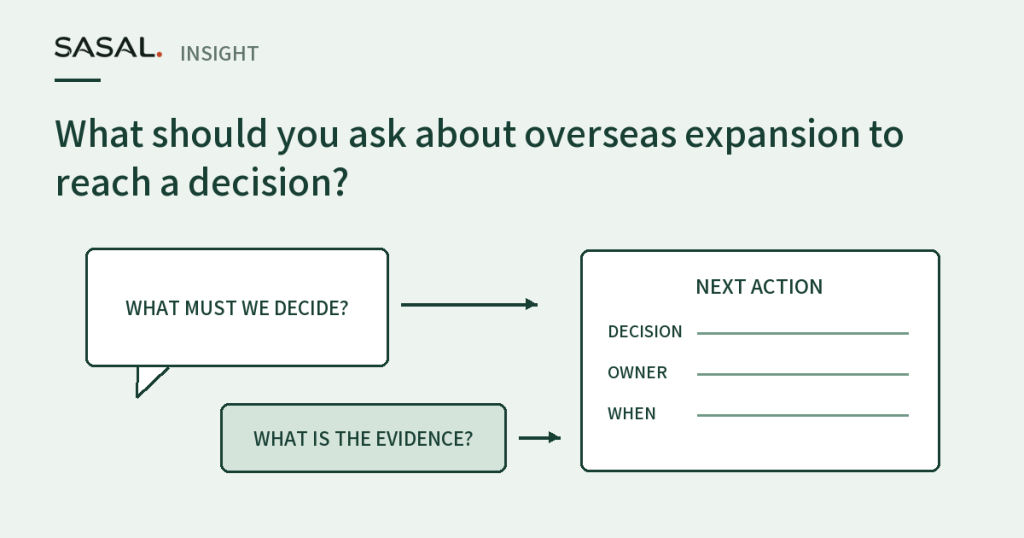
A consultant recommends a target market, but the management team still does not know whether it can serve the buyers there. The next useful question is about the gap between that recommendation and the decision the company must make. Productive questions bring the available evidence, practical constraints and alternatives into the same conversation. They also give the adviser a chance to explain uncertainty and ask for missing information. This article develops a fictional technical-services example to show how questions, answers and follow-ups can lead to a usable decision. It covers difficult conversations about demand, partners, cost, progress and disagreement. Clients do not have to arrive with perfect questions: uncovering the real issue and helping both sides understand it are part of the consultant’s work.
Ask from the decision you need to make
Many overseas consulting discussions start with a topic such as demand, competition or partners. The conversation becomes more useful when it starts with the decision that must be made. Consider a clearly fictional technical-services company assessing a new overseas market. Its leadership team is undecided between testing direct sales to buyers or working through a local channel partner. Before discussing market attractiveness, the team prepares a short decision brief: the decision is whether to fund a three‑month market test; the deadline is the end of the quarter; the budget constraint is a limited exploratory budget; delivery capacity is two implementation specialists who are already partly committed elsewhere; existing work includes several introductory industry conversations; and the decision owner is the regional managing director. That information immediately narrows the discussion from a broad market debate to a choice that can be approved, delayed or rejected.
A weak question in that situation is, "Is there demand in this market?" The answer could easily become a collection of impressions with no clear consequence. A stronger version is, "Given our budget limit, two available specialists and a decision deadline this quarter, is there enough evidence to test direct buyer sales before committing to a local channel?" The client does not need to formulate that question perfectly. A consultant has a professional responsibility to uncover missing context. If the initial request is vague, the consultant can ask about delivery resources, authority to proceed, work already completed and alternative options under consideration. The objective is not to criticise the client for asking an imperfect question but to identify the real decision hidden behind it.
A practical constraint often changes the recommendation more than additional market information. In the fictional example, direct sales and channel sales may both appear attractive. However, if the same two specialists must support onboarding, demonstrations and early delivery, the comparison should be made under those actual operating conditions. Otherwise one option may benefit from optimistic assumptions while the other is evaluated using current resource limits. Comparing alternatives under the same constraints makes disagreements easier to understand because participants can see whether the difference comes from evidence or from assumptions.
A concise meeting record can remain highly practical when written in plain language. For example: the pending decision is whether to test direct buyer sales or begin channel recruitment; the evidence currently available consists of industry conversations and internal capacity estimates; the key uncertainty is whether buyers will engage directly before a local partner is appointed; the next action is a small number of targeted buyer interviews before the deadline. Recording the discussion in that form helps participants revisit the reasoning later without reconstructing the entire meeting from memory.
A fictional exchange shows how the conversation can evolve. A director asks, "Which route to market do you recommend?" The consultant replies, "What commitment are you prepared to make if the evidence is positive, and what capacity is available to execute it?" The director answers that only a limited test is realistic this quarter. The consultant then asks, "If direct buyer interest exists but delivery support is already full, would channel recruitment actually solve the immediate problem?" That question reveals that capacity, not route selection, may be the primary constraint. The resulting decision changes from choosing a channel strategy immediately to determining what evidence is needed before allocating scarce implementation resources.
- DecisionThe choice that requires approval, rejection or postponement.
- ContextConstraints, completed work, capacity and authority affecting the choice.
- EvidenceInformation that could strengthen, weaken or overturn the recommendation.
- ActionThe next investigation, commitment or review triggered by the answer.
Share enough context for an answer to be useful

Consultants can only assess a recommendation against the conditions they actually understand. That does not mean the client must arrive with a perfect briefing or anticipate every relevant question. Part of the consultant’s role is to identify missing context and reformulate vague concerns into answerable questions. However, the discussion becomes more productive when management shares the decision under review, the constraint that matters most and the action being contemplated. A short context note is often sufficient. For example, a management team might say: we are deciding whether to begin direct buyer outreach in a new market this quarter; we have a limited budget for exploratory work; two internal specialists are available part time; several introductory conversations have already occurred; and the regional director owns the decision. That information allows the consultant to evaluate options against real operating conditions rather than generic assumptions. A useful follow-up question is not simply, “What do you recommend?” but, “Given our available capacity and budget, what question should we answer next before committing further resources?”
Confidentiality concerns should be handled deliberately rather than becoming a reason to provide no context at all. Useful evidence can often be shared through summaries, redacted materials and agreed communication channels. A company may explain what buyers reported, what implementation constraints exist and where uncertainty remains without disclosing identities, pricing terms or protected third-party information. In a fictional example, a client initially asks whether local partners should be recruited. Instead of requesting unrestricted access to customer files, the consultant asks for an anonymized summary of recent buyer conversations and any known delivery constraints. The result is enough information to test assumptions while respecting internal controls and existing obligations. Oversharing and withholding everything are both poor operating models because each increases the risk that the recommendation will be based on an incomplete understanding of the decision.
The context should also include expectations about how the consulting engagement will work. Many misunderstandings arise because one side assumes advisory support while the other expects hands-on execution. Early in the engagement, management can ask, “What is your operating model for this assignment?” followed by, “Do you expect to advise our team, perform outreach yourselves, or combine both approaches?” The answer affects staffing, timing and evidence standards. If the company expects the consultant to contact buyers, coordinate interviews or manage local discussions, that expectation should be stated explicitly together with any budget constraint. A consultant may respond that direct execution is possible only for a defined scope because available staff are limited. Another may explain that the engagement is designed primarily for analysis and decision support. Identifying that distinction early prevents later disagreement about responsibilities.
Operational realities frequently change recommendations more than additional market data. Consider a fictional technical-services company comparing direct sales with a channel-led approach. Early conversations focus on demand. Through questioning, the consultant learns that only one engineer can support overseas onboarding for several months and that management expects any market test to remain within a fixed exploratory budget. The analysis changes immediately. The issue is no longer demand alone. It becomes whether the organisation can execute the preferred route under existing resource constraints. If a recommendation depends on capabilities that are unavailable, management can ask what narrower scope, phased approach or alternative sequence would be realistic. That question often produces more useful guidance than requesting another round of broad market research.
Prior work, approval authority and internal disagreement deserve equal attention. If buyer interviews, partner discussions or technical assessments have already taken place, the consultant should understand what was learned and what remains uncertain. If board approval or executive sign-off is required before action can begin, that timing should be visible. A worked fictional example illustrates the point. A client asks whether partner recruitment should start immediately. Further discussion reveals that potential partners have already been identified, legal review capacity is unavailable for several weeks and management is divided about whether direct buyer validation should occur first. The conversation shifts from partner quality to the evidence needed to resolve the disagreement. The UK Consultancy Playbook, in a UK public-sector context, highlights identifying key questions, desired outcomes and information sources. As a limited analogy rather than a rule for private companies, the same discipline helps overseas consulting discussions remain connected to decisions that can actually be implemented.
Turn market potential into a question about a buyer
Questions about market potential often sound decisive while remaining difficult to use. Asking whether a market is attractive can produce extensive descriptions without clarifying what management should do next. A more actionable discussion begins with a buyer, a problem and a pending decision. In the fictional technical‑services company, leadership is deciding whether to test direct sales to buyers or rely on a local channel. Rather than asking, "Is there demand?" the team asks which buyer role experiences the operational problem their service addresses, how that problem is currently handled and what evidence would justify investing in a market test. The conversation immediately shifts from general opportunity to a specific purchasing situation.
A worked conversation shows the difference. The client asks, "Is there demand?" The consultant responds, "Which buyer role do you expect to purchase first?" The client answers, "Operations managers at mid-sized industrial firms." The consultant follows with, "What job are they trying to accomplish, and what happens today when that problem occurs?" After discussing several observations, the consultant says, "There appears to be interest." Instead of accepting that statement, the client asks, "What observed buying action supports that conclusion?" That follow-up matters because interest and purchasing intent are not the same thing. It pushes the discussion toward evidence rather than enthusiasm.
The consultant might then distinguish between friendly feedback and purchasing behaviour. A fictional answer could be: "Several operations managers said the service sounds useful, but those conversations did not include the people who approve budgets. Positive reactions suggest the problem exists. They do not yet confirm that funds would be allocated to solve it." That distinction often prevents premature conclusions. A company can receive encouraging responses from users while discovering later that procurement, finance or executive sponsors evaluate the decision differently. Understanding the purchasing path becomes as important as understanding the operational problem.
Evidence standards benefit from being discussed openly. Customer interviews, demonstrations, pilot activities and observations of existing workflows answer different questions. Management can ask, "What finding would weaken the case for this buyer segment?" If the current hypothesis is that operations managers are the best entry point, contradictory evidence might include repeated indications that budget authority sits elsewhere or that implementation requirements exceed available capacity. Establishing those tests in advance reduces the temptation to treat every positive comment as confirmation.
Incomplete information does not prevent progress. In the fictional example, the discussion concludes with a specific follow-up: conduct interviews that include both operational users and budget owners to map the purchasing path. One manager agrees to arrange the conversations before the next decision date. The decision that may change is explicit. If budget owners confirm the problem and describe a credible purchasing process, direct buyer testing remains under consideration. If they view the issue as low priority, the team may narrow the target segment, seek additional evidence from other buyer groups or defer the initiative until stronger evidence emerges. The value comes from connecting buyer evidence to a defined decision rather than collecting market opinions in isolation.
Ask what would disprove the attractive explanation
Teams often become attached to the most encouraging explanation available. After a handful of positive buyer conversations or an enthusiastic discussion with a potential distributor, the working assumption can quietly shift from “this looks promising” to “this segment should be our priority.” During overseas expansion consulting, a more useful discussion asks what evidence would make the team recommend against that conclusion. The aim is not to create a hostile challenge or a test that is impossible to pass. The aim is to define, in advance, what observations would materially weaken the current recommendation. Without that discipline, additional research often becomes a search for more supporting examples rather than an investigation of whether the explanation is actually robust enough for a decision.
A weak question is, "Do these interviews show strong demand?" A stronger version is, "What would make you recommend against prioritising this segment?" That wording invites the consultant to identify meaningful disconfirming evidence rather than trivial objections. For example, a consultant might answer, "I would reconsider if buyers consistently preferred an established competitor for reasons we cannot realistically address, if adoption depended on a service capability you do not currently provide, or if the expected purchasing timeline extended far beyond your planned market-entry horizon." Those conditions are connected to the decision itself. They are not arbitrary hurdles. By stating them before further work begins, the client and consultant create a clearer standard for interpreting future findings.
A fictional conversation illustrates the difference. An executive says, "Five companies expressed interest in our offering." The consultant replies, "What happened when implementation requirements were discussed?" The executive answers, "We did not reach that stage." The consultant then reframes the issue: "If later conversations show interest but require extensive local support that your team cannot provide, would this still be the preferred segment?" The discussion changes immediately. Instead of treating interest as the conclusion, the team identifies a specific uncertainty about service delivery. The next action becomes gathering evidence about onboarding expectations rather than collecting additional statements of general enthusiasm.
Disconfirming questions are especially valuable when multiple explanations fit the same facts. Positive distributor interest, for instance, may indicate genuine buyer demand. It may also reflect a distributor's desire to expand its catalogue regardless of whether end customers are actively seeking the product. A useful follow-up is, "What evidence would distinguish between those explanations?" The consultant might suggest speaking directly with target buyers, examining how purchasing decisions are currently made, or exploring whether buyers are already allocating budget to similar solutions. The objective is not to prove one explanation immediately. It is to identify observations that would make one explanation more credible than the alternatives.
When evidence remains incomplete, a second follow-up can test a rival explanation rather than merely requesting more of the same information. Imagine a consultant says, "Current feedback suggests this segment is attractive." A productive response is, "What evidence would support a different explanation, such as buyers preferring existing solutions because implementation risk matters more than product features?" That question often uncovers assumptions that neither side had examined closely. Overseas expansion decisions rarely come with certainty, but they improve when both client and consultant agree on what would strengthen the recommendation, what would weaken it, and which unresolved uncertainty is most likely to change the decision.
Compare options under the same practical constraints
Comparisons become misleading when each option is evaluated under different assumptions. In overseas expansion projects, this often happens without anyone intending it. A direct-sales approach may be discussed as if dedicated staff, frequent travel and rapid buyer access are available, while a channel-led approach is assessed using the organisation's actual resource limits. The resulting recommendation can appear decisive even though the alternatives were never examined on equal terms. A more useful consulting question asks how each option performs when the same target segment, support expectations, budget limits and time horizon are applied to both.
Consider a management team choosing between direct sales and a local channel partner for the same buyer group. The initial question is, "Which route should we use?" A stronger version is, "If both routes target the same segment, receive the same level of internal support and are assessed over the same twelve-month period, which route gives us the most credible basis for the next decision?" That reframing matters because it prevents one option from benefiting from hidden advantages. It also reveals whether the recommendation depends on assumptions that have not been discussed openly.
A fictional example shows how the conversation can change. Early analysis suggests direct sales would provide richer buyer insight and stronger control over customer relationships. However, the company can only allocate limited management attention and a small number of market-development trips. The consultant therefore evaluates direct sales and channel development using identical travel capacity, implementation support and decision deadlines. Under those shared constraints, the recommendation may become less about selecting a permanent route and more about learning which route deserves deeper investment. The comparison becomes operational rather than theoretical.
Useful discussions also look for hidden client effort embedded in one proposal but not the other. A manager might ask, "Where does this recommendation assume work from our team that is not being counted in the alternative?" The consultant could respond, "The channel option appears lighter on internal resources, but it assumes your team will spend significant time recruiting, training and supporting partners. The direct-sales option requires more buyer-facing activity but less partner management." That answer helps management compare like with like. Otherwise one route may seem easier simply because part of the workload has been overlooked.
Sometimes the most credible answer is not an immediate route choice. A consultant may say, "Given the evidence available, I would recommend a narrow discovery phase before committing to either model." That recommendation becomes more useful when tested against a practical constraint. A manager might ask, "How sensitive is that conclusion to our travel capacity?" The consultant could explain that if only a small number of market visits are realistic, direct buyer conversations may generate more learning per trip than early partner recruitment, whereas greater travel capacity could support parallel exploration. The value comes from understanding how the recommendation changes when a real-world constraint changes, not from declaring one route universally superior.
Ask who will actually do the work and what it will cost
Recommendations often appear straightforward until the required work is mapped to specific people, time commitments and budget assumptions. During overseas expansion consulting, management should not stop at asking whether a market-entry approach seems attractive. The more useful question is who will perform the activities behind the recommendation and what level of effort has actually been resourced. A proposal to recruit partners, validate demand, adjust pricing or pursue direct sales may sound practical at a strategic level while still containing major delivery gaps. The objective is not to challenge the consultant defensively. It is to understand whether the recommended work can realistically be executed under the conditions being discussed. Both client and consultant have a responsibility to identify foreseeable gaps before a commitment is made rather than discovering them during implementation.
Before commissioning work, management can ask a series of operational questions. Does your team advise or actually perform buyer outreach? Who researches prospects, who makes first contact and who follows up? Which proposal preparation, negotiation support and project-management tasks are included? What staffing and time have been reserved for the engagement? What activities remain with our team? Which travel costs, specialist reviews or external resources are excluded? How are additional requests approved and charged if the scope changes? These questions are useful because they connect recommendations to execution. They also distinguish the service model from the fee mechanism. A monthly retainer does not automatically mean unlimited hands-on support, and a success-fee component does not define every responsibility required to produce the work.
A fictional conversation demonstrates the difference between a useful answer and an unhelpful one. A client asks, “Who will contact prospective buyers if we proceed?” A vague response might be, “Leave that to us; we will handle the market.” That sounds reassuring but leaves ownership unclear. A stronger response could be: “Our team will identify and approach target organisations, but your commercial lead must participate in qualification discussions because technical requirements are product-specific. We have allocated consultant time for outreach and interview coordination. Proposal drafting remains primarily with your team, although we will review it.” The second answer creates an observable operating model. Management can evaluate whether the allocation of work matches internal capacity and whether any critical activity lacks an owner.
Questions become even more important when the scope evolves. Imagine that a project originally focused on market interviews but later expands to include partner recruitment and attendance at buyer meetings. Instead of assuming the original commercial arrangement covers everything, management can ask, “What additional work does this create, what resources are required and how would changes be approved?” A consultant may explain that partner assessment requires additional specialist input or travel not included in the original assignment. That answer does not automatically mean the work should proceed or stop. It provides the information needed to decide whether to expand scope, phase activities or postpone them. The key point is transparency about effort, ownership and commercial consequences before expectations diverge.
Budget constraints should be discussed directly rather than treated as an afterthought. A company might say, “This is the budget available for hands-on support. What level of execution can realistically be staffed within it?” The consultant may respond that full buyer outreach, partner recruitment and ongoing coordination cannot all be delivered within that constraint. In that case, the conversation shifts to prioritisation. Perhaps buyer validation is performed first, with partner recruitment deferred. Perhaps the scope is narrowed to a single segment. The decision is then based on visible trade-offs rather than optimistic assumptions. By the end of the discussion, management should be able to state which activities the consultant will perform, which activities remain internal, what resources have been reserved, what costs or exclusions still matter and how future changes will be approved. That level of clarity creates a stronger foundation than broad assurances about market access or execution capability.
Explore money, timing and uncertainty together
Questions about overseas expansion become harder to use when cost, timing and uncertainty are discussed in separate conversations. A management team may ask for a fee estimate, approve a budget range and only later discover that the recommendation assumes internal work that nobody has capacity to perform. A more effective discussion starts with the decision itself: what commitment is being considered, what must happen before value can be tested and what assumptions could change the decision. In a fictional example, a company is considering whether to begin recruiting local partners in a new market. The immediate question is not simply whether the consulting support is affordable. It is whether the organisation should fund a limited exploratory step, delay action until more evidence is available or proceed with a broader launch effort. Framing the conversation that way allows financial, operational and timing issues to be evaluated together rather than treated as unrelated topics.
A weak question is, "What will this cost?" A consultant can answer with a fee, yet that answer may leave the important assumptions untouched. A stronger exchange might sound like this: "Your fee is within our budget. What cash leaves the business before we know whether the opportunity is viable, what internal labour will we need to provide and what delivery commitments remain even if buyer interest develops slowly?" The consultant might explain that the quoted fee covers market interviews and partner outreach but excludes legal review, travel, product localisation and management time. The follow-up then becomes more useful: "Which costs affect cash immediately, which assumptions affect margin later and what must be approved now rather than later?" That discussion helps management evaluate the funding decision as a whole rather than focusing on the consulting fee in isolation.
The distinction between a bounded pilot and a recurring commitment is particularly important. Imagine the fictional company can afford a short discovery phase but is hesitant to approve an open-ended programme. Instead of asking whether full market entry should begin immediately, management asks what evidence a limited pilot could realistically produce. The consultant responds that a pilot might test buyer engagement, clarify partner requirements and identify operational obstacles, while a larger commitment would involve ongoing partner management and market-development activity. The decision changes because the company is no longer comparing action with inaction. It is comparing a defined learning investment with a longer-term obligation. The evidence expected from each option becomes clearer, as do the consequences if the findings are positive, mixed or inconclusive.
Timing deserves equal attention because overseas opportunities rarely move according to plan. During the same fictional engagement, an executive asks whether partner recruitment should start next month. The consultant replies, "What happens if buyers take twice as long to evaluate the offer as currently assumed?" That question exposes a hidden dependency. If buyer timing slips, the organisation may incur partner-support costs before meaningful demand has been tested. Management can then ask, "Which parts of the recommendation remain sensible if buyer decisions are delayed, and which parts should wait?" The resulting answer often identifies activities that can proceed with limited risk and activities that depend heavily on uncertain assumptions about market response.
A productive conversation closes with a decision-oriented record rather than a prediction. The record might note the commitment under consideration, the cash required before market acceptance is demonstrated, the internal effort expected from the client team, the assumptions most likely to change the recommendation and the evidence that would justify moving from a pilot to a broader commitment. If uncertainty remains, the next step is not another abstract debate about affordability. It is a defined inquiry with a deadline and a reason for existing. That approach does not remove risk, but it helps management understand what is being funded, what remains unknown and how future findings could change the level of commitment.
Follow a vague progress answer to observable evidence
Progress reviews often sound encouraging while revealing very little about whether the underlying recommendation has become stronger or weaker. Statements such as "research is progressing" or "partner discussions are going well" may be accurate, yet they do not explain what has changed since the previous meeting. A more useful review treats progress as evidence connected to a pending decision. In the fictional market-entry case used throughout this article, management is deciding whether to continue direct buyer validation or begin investing more heavily in partner recruitment. Rather than asking for a general update, the team asks what observations have been collected that could affect that choice. The discussion immediately shifts from activity reporting to decision support.
A stronger progress question might be, "What changed since our last discussion, and which new observation altered your recommendation?" Suppose the consultant answers, "We held several buyer meetings." That answer describes effort rather than learning. A constructive follow-up is, "What did those conversations reveal that we did not know before?" The consultant may then explain that buyers consistently asked about local implementation support, creating a concern that had not appeared earlier. The value comes from identifying the observation and its consequence. Management can then evaluate whether the new information strengthens the case for local partners, weakens it or leaves the recommendation unchanged.
The same fictional case can continue into later meetings. Imagine the consultant reports positive engagement from prospective customers. Instead of debating whether the interactions felt encouraging, management asks, "Which next action did a buyer confirm, and what is currently waiting on us?" The answer might reveal that several buyers agreed to review a technical proposal but are waiting for product documentation. That detail matters because it distinguishes curiosity from a concrete step in a purchasing process. It also highlights a client-side dependency. Progress is no longer described as a collection of conversations; it is described as movement through identifiable stages that influence the next decision.
Partner discussions benefit from the same discipline. If the consultant says, "Distributor meetings are progressing," management can respond tactfully by asking to inspect one anonymized opportunity path. The goal is not to audit every conversation. It is to understand how a recommendation is being formed. A useful explanation might show the sequence from initial contact to capability review, commercial discussion and agreed next step. Seeing one example often reveals more than a long list of meetings. It may expose unresolved issues about technical support, market coverage or implementation responsibility that a numerical meeting count would never show.
When evidence remains incomplete, the discussion should narrow rather than expand. A fictional exchange illustrates the point. Management asks, "What uncertainty still matters most?" The consultant replies, "We still do not know whether buyers expect local onboarding support." Management then asks, "What specific observation would answer that question, and how will we obtain it?" The resulting action may be a small number of targeted conversations rather than another broad review meeting. A concise progress note can capture the decision being assessed, the observations gathered since the previous discussion, the recommendation changes those observations prompted and the remaining question that requires investigation. That keeps progress reviews practical without turning them into a comprehensive performance-measurement system.
Handle uncertainty and specialist limits honestly
Overseas expansion decisions often require action before every uncertainty has been resolved. Market information may be incomplete, buyer behaviour may vary across segments and implementation realities may only become visible once exploratory work begins. In that environment, confident language can easily be mistaken for strong evidence. A more productive consulting conversation separates what has been observed directly from what has been estimated or inferred. Rather than asking whether a recommendation is simply correct, management can ask how much of the recommendation rests on observation, how much rests on judgement and which assumptions remain open to challenge. That distinction helps decision makers understand the strength of the reasoning instead of relying on the certainty of its presentation.
A useful question might sound like this: "Which part of this recommendation is based on direct observation, which part is an estimate and which part is professional judgement?" Consider a fictional response. The consultant says, "The buyer interviews are observations. The expected pace of adoption is an estimate based on those conversations. The recommendation to enter through partners first is a judgement that combines the evidence with your current resource constraints." That answer gives management something concrete to evaluate. If disagreement exists, participants can discuss the specific area where uncertainty is highest rather than arguing about the recommendation as a single package. The conversation becomes clearer because different types of information are no longer blended together.
Specialist boundaries deserve the same level of transparency. A consultant may be qualified to analyse market demand and entry options while lacking authority to provide legal, tax or regulatory advice. Instead of assuming one adviser can answer every question, management can ask, "Which parts of this decision fall outside the scope of your expertise, who is qualified to answer them and before which commitment do we need that input?" In a fictional example, a consultant recommends a partner-led market test but notes that the structure of local contractual arrangements requires specialist legal review. That clarification helps the organisation sequence decisions properly. It also reduces the risk that commercial enthusiasm will be mistaken for professional authority in an unrelated field.
An honest answer about limits should lead to a practical follow-up rather than frustration. Imagine the consultant says, "I can explain the commercial implications of different tax scenarios, but I am not qualified to determine the correct treatment." A useful response is, "What information should we obtain from a qualified adviser so that the commercial recommendation can be evaluated properly?" That request keeps the discussion moving. It avoids pressuring the consultant to provide definitive advice outside their competence while still identifying what information is needed before a commitment is made. The objective is not to eliminate uncertainty entirely. It is to understand which uncertainties matter and who is equipped to address them.
Disagreement can then be handled more constructively. Suppose management believes immediate expansion is justified while the consultant recommends further validation. Rather than debating whose conclusion is stronger, both sides can examine the observations, estimates and judgements supporting their positions. If the disagreement depends mainly on an uncertain assumption, the next step may be a focused investigation. If it depends on differing risk tolerance, that can be stated openly. A short decision record might note the recommendation, the evidence supporting it, the assumptions still in question, any specialist input required before a specific commitment and the next review point. Such clarity does not create certainty, but it helps organisations act with a realistic understanding of what is known, what is inferred and what remains outside the current adviser’s scope.
Disagree in a way that improves the recommendation
Disagreement is often treated as something to eliminate quickly, yet overseas expansion decisions frequently improve when the source of disagreement is examined carefully. The key is to connect the disagreement to a specific pending choice. A weak exchange sounds like, "I think we should open a local office" followed by "I don't agree." Neither statement explains what assumption is driving the conclusion. A stronger discussion identifies the decision, the constraint and the belief that separates the two views. For example, a founder may favour establishing an office because local presence appears important for credibility, while an adviser may be concerned that the company lacks enough implementation capacity to support customers once sales begin. The disagreement is no longer about optimism versus caution. It is about whether local presence or delivery capacity is the more important constraint at this stage.
A productive sequence starts by making each side state the reasoning behind its recommendation. The founder might say, "I believe a local office will accelerate buyer trust and shorten market entry." The adviser might respond, "My concern is that demand could increase faster than the support team can handle." The next question is not who is correct. It is, "What assumption differs between these views?" In this example, one side assumes trust is the limiting factor and the other assumes operational capacity is the limiting factor. Once those assumptions are visible, both parties can discuss what evidence would strengthen or weaken them. A recommendation becomes easier to evaluate because the real point of disagreement has been identified rather than hidden inside broad statements about strategy.
Consider a fictional conversation. The founder says, "Several local contacts told us buyers expect a local office." The adviser replies, "What observation would change your view?" The founder answers, "If buyers consistently said they would begin with remote engagement, I would reconsider." The founder then asks the same question in return. The adviser responds, "If we confirm that onboarding can be handled within current staffing levels during an initial pilot, I would be more comfortable supporting the office plan." Both sides have now identified evidence that could change their position. The discussion shifts from defending preferences to testing assumptions. Even if the evidence remains incomplete, the team has a clear direction for further enquiry.
Difficult situations arise when the rationale behind a recommendation remains vague despite repeated requests for clarification. In that case, respectful follow-up is appropriate. A manager might ask, "You have recommended prioritising partners. Which specific observation led you to that conclusion?" If the answer remains general, a second question could be, "What evidence would cause you to recommend a different approach?" If the reasoning is still unclear, the issue can be escalated in a limited way: not as a challenge to authority, but as a request for a documented explanation before a significant commitment is approved. The objective is to improve the recommendation, not to trap the other party into admitting uncertainty.
Not every disagreement ends with consensus, and forcing agreement can sometimes hide important risks. If the founder continues to prefer a local office while the adviser still believes capacity is the primary concern, both views can be recorded explicitly. A useful note might state that the office option remains under consideration, that concerns about delivery capacity are unresolved and that additional buyer and operational evidence will be reviewed before a final commitment. Recording unresolved dissent preserves reasoning that may become important later. It also prevents the meeting from creating the false impression that everyone interpreted the available evidence in the same way.
Close the conversation with a usable commitment
Many consulting meetings end with apparent agreement but little operational clarity. Participants may conclude that a market looks promising, that more validation is required or that a recommendation remains under consideration. None of those statements identify what must happen next. A more useful closing links the discussion to a decision, the evidence still required and the people responsible for obtaining it. This article focuses on dialogue during an engagement rather than provider selection or performance measurement. The purpose of the closing discussion is therefore practical: convert the meeting into a bounded piece of work that supports the next decision. If the remaining uncertainty is not visible, participants should be able to explain exactly what information is missing and why it matters.
An effective closing starts by confirming the unresolved decision and the assumptions behind it. In a fictional overseas expansion project, management is considering a limited channel pilot. The consultant reports encouraging partner interest but uncertainty about buyer approval requirements. Instead of ending with a general instruction to conduct more research, the sponsor asks, “What specific fact are we waiting for before deciding?” The consultant replies, “We need evidence about whether technical review is required before purchase.” The sponsor then asks, “If the answer differs from our assumption, which decision changes?” That question ties the evidence request directly to a business choice. Research is no longer being commissioned for its own sake; it exists because it could alter the recommendation.
A useful record should also identify agreed roles and capacity. For example: decision under review, whether to proceed with a limited pilot. Supporting evidence, initial buyer and partner conversations. Remaining uncertainty, buyer approval requirements and onboarding expectations. Decision owner, project sponsor. Consultant responsibility, conduct targeted validation discussions and document findings. Client responsibility, provide a redacted summary of implementation capacity and current resource commitments. Agreed capacity assumption, only the identified internal specialists are available for pilot support. Change-control condition, any request for additional outreach, specialist input or travel beyond the agreed scope requires explicit review and approval before work begins. Recording these points prevents later confusion about who was expected to do what.
The conversation should also address what happens if new work emerges. A sponsor may ask, “Which activities are included in the current scope, and which would require a separate decision?” The consultant might answer that buyer interviews and evidence synthesis are included, while extensive partner onboarding support or specialist reviews would require additional approval. That distinction matters because scope often expands gradually. Without an explicit discussion, management may assume extra activities are already covered, while the consultant may assume they are outside the assignment. Identifying those boundaries at the close of each decision meeting reduces the risk of mismatched expectations and keeps commercial discussions connected to operational reality.
The meeting should conclude with a concise owner, evidence and deadline record. A practical sequence is: question requiring resolution, evidence needed, owner responsible, due condition and review date. If evidence remains incomplete, the process should return to a defined enquiry rather than another broad status discussion. The objective is not to create administrative overhead. It is to ensure that every follow-up has a reason, an owner and a decision consequence. When participants can explain what evidence will be gathered, who will gather it, what capacity assumptions apply, what changes require approval and when the next decision will be made, the conversation produces a usable commitment rather than a collection of intentions.
- QuestionState the decision, context, constraints and capacity available.
- Evidence-aware answerExplain evidence, assumptions, exclusions and remaining uncertainty.
- DecisionProceed, defer, narrow scope or request targeted investigation.
- Assigned follow-upRecord owner, evidence source, approval conditions and review date.
Build a dialogue that does not depend on perfect questions
Clients do not need to arrive with perfectly framed questions for an overseas consulting engagement to be productive. In practice, many conversations begin with concerns such as "the market feels risky" or "progress seems slower than expected." Those concerns may be genuine, but they are not yet decision-ready. Part of the consultant's professional responsibility is to diagnose the ambiguity, identify missing context and help translate the concern into a question that can actually be answered. The quality of the engagement should not depend on the client already knowing the exact wording of the issue. If that were required, many of the most valuable discussions would never begin.
This responsibility becomes particularly important when information is distributed across different teams, countries or languages. One manager may understand budget constraints, another may know local regulatory requirements and a third may have direct customer feedback. Terminology can also create confusion. A consultant may refer to a distributor, reseller and implementation partner as distinct categories while the client uses a single term for all three. Rather than assuming shared understanding, the consultant can explain unfamiliar language and confirm meaning explicitly. A useful check is, "When we say partner, are we discussing lead generation, sales execution, implementation support or all three?" Clarifying terms early often prevents later disagreements that are caused by interpretation rather than substance.
A short conversation sequence can help structure these discussions. The client begins with purpose and context: the decision under consideration, major constraints and work already completed. The consultant then presents a recommendation along with realistic alternatives. Next comes the evidence supporting each option and the limits of that evidence. Finally, the group confirms the decision that must be made and the next action required. This sequence is simple enough to use in routine meetings, yet it prevents conversations from drifting between unrelated topics. It also gives both parties an opportunity to check whether they are still discussing the same decision.
A fictional example illustrates how reformulation works. A management team asks, "Is this market attractive?" During discussion, the consultant learns that the company can support only one overseas initiative during the next planning period and has already completed buyer interviews. The consultant responds, "Would it be more accurate to ask whether the evidence justifies allocating your limited capacity to this buyer segment now rather than to another opportunity?" The team agrees that this is the real decision. The revised question is narrower, but it produces a clearer recommendation because it reflects actual constraints rather than a general curiosity about market attractiveness.
The UK Consultancy Playbook, in a UK public-sector commissioning context, highlights the value of identifying key questions, understanding desired outcomes and making decisions visible during a project. For private international businesses, that observation is best treated as a limited analogy rather than a rule. The broader lesson is that good consulting dialogue depends on shared understanding. A practical clarification might sound like, "Before we continue, can you confirm that the decision is whether to fund a limited pilot for this buyer segment, not whether the entire market is attractive in principle?" When both sides can answer that question consistently, the discussion is usually focused enough to generate useful next steps even if it began with an imperfect question.