

Assessing expansion consulting: what changed, and what proves it?
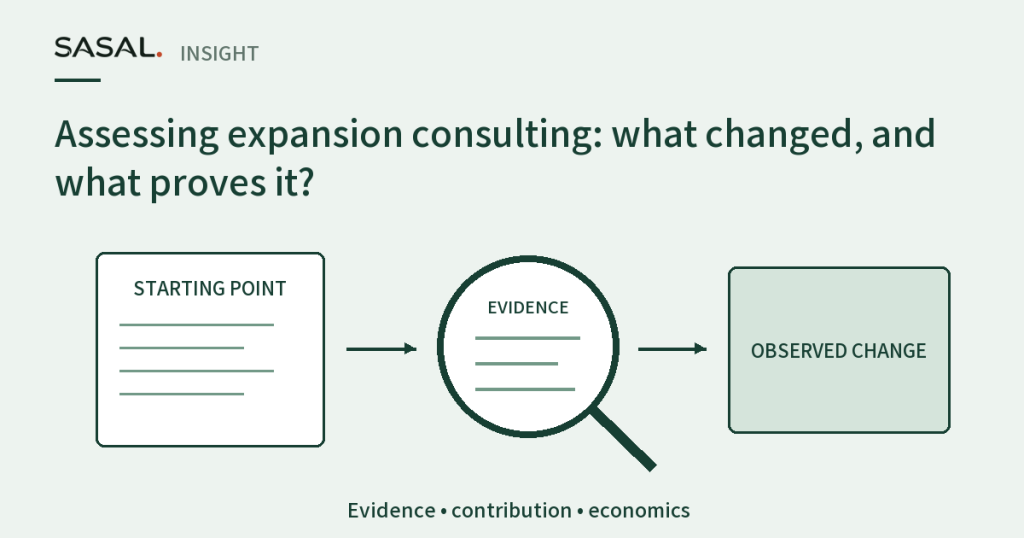
A signed order can look like success while its delivery and support costs remain unresolved. A carefully researched recommendation to stop can be useful even when it produces no sales. Neither conclusion follows from a meeting count or a polished report. To judge an overseas expansion consulting engagement, a company needs to know what change it sought, what evidence was available at the start, what work was commissioned and what happened next. This article explains how to set that assessment up before substantial spending begins, distinguish early evidence from realized commercial results and examine contribution without pretending that a consultant controls the whole business. The aim is an assessment that can support the next commitment of money and management time, including a decision to narrow or stop the work.
Define the result before activity begins
Many overseas expansion engagements begin with requests for market research, introductions, outreach, partner screening or pilot design. Those activities may be necessary, but they are not the result being evaluated. A hypothetical industrial software provider entering a new overseas segment may ultimately want repeatable, profitable deployments. The consulting assignment, however, may be much narrower: determine whether a defined buyer group is willing to progress toward a feasible paid pilot under realistic operating conditions. Evaluation becomes unreliable when activity is allowed to stand in for evidence. A completed interview program, a prospect database or a market report can satisfy an agreed scope and still leave the core commercial question unresolved. The result should therefore be expressed as the change or evidence needed for a future decision, not as the completion of the work itself.
The evaluation record should specify the change sought before substantial spending begins. In the same example, the desired outcome may be evidence supporting a decision about whether further investment in the segment is justified. The record should define the stage-appropriate target, observation method, review date and decision to be made. It should also capture the starting operating conditions. Relevant baseline details may include which internal staff will participate, expected response times for technical questions, availability of subject-matter experts, planned implementation support, and any client commitments required for outreach or buyer meetings. These conditions matter because later results can be affected as much by execution capacity and responsiveness as by the quality of the advice itself.
Responsibilities should be separated carefully from whole-business outcomes. A research adviser, an embedded execution team and an outsourced sales resource control different activities. If the provider was engaged only to conduct research and synthesize findings, assessment should examine whether the research met the agreed standard, whether the methodology was appropriate and whether the evidence was communicated clearly. Acceptance of that report does not prove commercial success. Equally, the absence of sales does not by itself show that a research-only assignment was poorly performed. At the same time, advisory scope should not be presented as though full execution were included. If commercial progress depends on hands-on implementation, buyer follow-up or operational delivery, those expectations should be identified explicitly rather than assumed later.
A practical test is to ask what decision the evidence is supposed to inform. A sponsor might ask whether successful delivery of all requested tasks means the engagement succeeded. The answer depends on the agreed objective. Completed interviews, accepted reports and documented findings can demonstrate that contracted work was performed satisfactorily. They do not automatically demonstrate sustainable demand, profitable deployment or future cash generation. Conversely, evidence showing that a target segment is unattractive may still represent a useful outcome if the possibility of stopping was part of the original evaluation design. The key distinction is that deliverable acceptance, provider performance and business performance are related but separate questions requiring different evidence.
This discipline is consistent with external guidance emphasizing the need to define outcomes, evaluation questions, stakeholders and data sources before assessment occurs. The UK Government's Consultancy Playbook also emphasizes recording responsibilities, assumptions and decision points so that results can be interpreted in context. That guidance does not establish commercial success criteria and does not determine whether any provider met its obligations. Its narrower value is methodological: decide in advance what is being tested, who owns which activities, what evidence will be collected and when a decision will be made. Doing so reduces the risk that a well-written report is relabelled as commercial success or that unmet sales expectations are used retrospectively to judge work that was never scoped as execution.
Record the starting point and the decision date

After defining the result, the next task is establishing a baseline that is detailed enough to support later comparison without pretending to know more than is actually known. Returning to the hypothetical industrial software provider, the baseline might show that the target list contains a mixture of verified and unverified organizations, that only a small number of inbound enquiries have ever come from the region, and that no prospect has yet been assessed against the proposed pilot criteria. Sparse information is still useful when it is recorded honestly. Invented precision is not. A weak baseline should be described as weak rather than expanded through guesswork.
The baseline should also freeze key definitions before evidence starts arriving. If the company already uses sales stages, those stages should be recorded exactly as they exist at the start of the engagement. If a “qualified opportunity” means one thing in month one and something different in month six, later comparisons become unreliable. The same applies to the cohort under review. If the assignment is intended to test a named segment, the initial segment definition should be documented. Expanding or narrowing the group midway through the evaluation may be reasonable, but the change should be visible rather than hidden inside revised reporting.
Operational constraints belong in the starting record as well. An example baseline might note that response delays from overseas prospects are currently measured in weeks rather than days, that only one internal technical specialist is available for pilot discussions, and that the starting pipeline contains no opportunities beyond exploratory contact. Missing data should be identified explicitly. If historical outreach records are incomplete or reconstructed from memory, stakeholders should note that limitation because retrospective records can create false confidence about past conditions.
The decision date deserves the same level of attention as the baseline itself. Evidence should be reviewed on a timetable that reflects the actual buying cycle being tested. If the target segment normally requires several layers of technical review before approving a paid pilot, a review date set too early may confuse normal purchasing delays with lack of demand. Conversely, waiting indefinitely allows activity to continue without a clear decision. The review point should be linked to a specific choice such as continuing the test, refining the offer, expanding investment or stopping the initiative.
An evaluation record can therefore capture the starting condition, frozen definitions, observation methods, known limitations, review date and intended decision. An invented question illustrates the value: “What if our records are incomplete?” A reasonable answer is, “Document what is known, identify what is missing and avoid overstating confidence.” The goal is not perfect measurement. It is creating a credible reference point so that later observations can be compared against an agreed starting position instead of relying on memory, optimism or retrospective interpretation.
Separate work performed from business change
Evaluation becomes distorted when completed work is treated as proof of commercial progress. In an overseas market-test engagement, activity, output quality, behavioral change and economic outcomes answer different questions. The hypothetical industrial software provider may commission interviews, outreach and technical discussions. Completing those tasks demonstrates that work occurred. It does not demonstrate that the target segment wants the product, that buyers will purchase a pilot or that profitable deployments are achievable. Each stage of the chain requires separate evidence and should be evaluated on its own terms rather than collapsed into a single success label.
A traced example shows why the distinction matters. Suppose the consulting team conducts interviews with organizations in the named segment. Those interviews are completed according to the agreed scope and the findings are synthesized into a report. The client reviews the material and accepts it as accurate and usable. At that point, activity has occurred and an output has met the agreed quality standard. The provider may have fulfilled its contractual duty. However, acceptance of the synthesis does not establish demand. The market may still reject the proposed offering despite the quality of the work.
The next observation concerns behavior. Imagine that one prospect, after reviewing the findings and holding technical discussions, agrees to undertake a formal technical assessment. That is stronger evidence than a completed report because someone in the target segment has changed behavior. Yet uncertainty remains. The prospect may later conclude that integration requirements are too burdensome, budgets may change, or internal priorities may shift. The movement from accepted work to observable buyer action is meaningful, but it is not equivalent to a commercial outcome.
A further stage occurs if a paid pilot is contracted, delivered, accepted and paid for. Even then, the evaluation question changes rather than disappearing. A paid pilot demonstrates something different from interview interest or technical engagement. It may provide evidence that buyers will spend money under defined conditions. It does not automatically prove repeatable profitability. Support requirements may be unusually high, deployment costs may exceed expectations, or later customers may behave differently. Each arrow in the sequence can fail, and there is no universal funnel rate that guarantees progression from one stage to the next.
A useful evaluation record therefore separates activity completed, output quality, behavior change and economics. It can show that interviews were conducted, evidence was accepted, a prospect agreed to technical assessment, a pilot was purchased and payment was received, while also recording what remains uncertain. Such a record allows several legitimate conclusions. The provider may have fulfilled agreed duties even if no pilot emerged. The engagement may have generated useful insight without producing revenue. Alternatively, it may have contributed to a realized commercial outcome. Distinguishing those possibilities produces a more credible assessment than treating every completed deliverable as commercial success.
- Activity completedResearch, outreach, interviews, planning and other agreed work are performed.
- Accepted work qualityOutputs are reviewed against agreed standards and considered usable.
- Behavior changeBuyers or internal teams act differently based on the evidence or recommendations.
- Profit or cash effectsLater financial outcomes are examined while recognizing contribution uncertainty.
Choose evidence that fits the current stage
Evaluation works best when the evidence matches the decision that is actually being made. An overseas expansion effort usually moves through different stages, and each stage requires different proof. In an early market exploration phase, the central question may be whether a customer problem exists and whether competing explanations have been examined. At that point, revenue is often the wrong measure because no realistic buying process has had time to occur. Evidence may instead include documented buyer requirements, recurring objections, procurement constraints and observations that challenge the original assumptions. A consulting provider can reasonably claim responsibility for gathering and analysing such evidence if that work falls within scope, but cannot claim that early research has already created commercial success.
The next stage may involve channel building or market access. Here, the decision is no longer simply whether demand might exist. It becomes whether a route to market appears capable of operating in practice. Evidence should therefore focus on independently verified partner capability and completed actions rather than expressions of interest alone. A fictional example illustrates the distinction. Suppose three distributors say they would like to discuss cooperation. That is a useful observation, but stronger evidence would show that partner qualifications were checked, required capabilities were verified, responsibilities were discussed and agreed tasks were actually carried out. The difference matters because enthusiasm and operational capability are not interchangeable.
Once a business is actively delivering products or services in the target market, the evidence standard should change again. At this stage, accepted deliveries, payment behaviour, margins, working-capital demands and cash economics become increasingly relevant. Revenue may form part of the picture, but even then it should not be viewed in isolation. A project generating sales while consuming disproportionate support effort may create a different conclusion from one producing lower sales but healthier economics. Evaluation should therefore examine the financial consequences that are visible at that stage rather than selecting whichever metric produces the most favourable narrative.
An invented dialogue highlights the progression. A sponsor asks, "Why are we not judging this engagement on revenue yet?" The reviewer replies, "Because the agreed decision concerns whether the target segment has a credible route to purchase. Revenue becomes more informative later." Several months afterward, the same sponsor might ask, "Can we keep using interview findings as proof of progress?" The answer may then be no, because once commercial operations begin, interview evidence alone is no longer sufficient. Evidence that was appropriate earlier can become inadequate if it is used indefinitely instead of being replaced by stronger observations.
A review record can make these transitions visible. It may show the starting condition, the change sought, the current stage, the observations collected, the strength of those observations, remaining uncertainty and the next decision. Such a record allows a company to conclude that an early hypothesis deserves further testing, that a channel partner is operationally unsuitable despite initial interest, or that actual deliveries and cash outcomes justify expansion. The key discipline is avoiding two common errors: demanding late-stage commercial outcomes before they can reasonably exist, and hiding behind early-stage indicators forever when stronger evidence should now be available.
Test whether early indicators predict something useful
Early indicators often attract more attention than they deserve because they appear to show momentum before commercial outcomes are visible. Meeting counts, proposal counts, website enquiries and distributor introductions can all look encouraging in a progress report. The difficulty is that many of these indicators contain hidden weaknesses. A count of ten meetings may include repeat conversations with the same contact. A proposal count may include unsolicited offers sent without buyer engagement. The relevant question is not whether the number increased. It is whether the indicator is connected to a later behaviour that matters and whether that connection can be tested over time.
Denominators and selection effects deserve particular scrutiny. Imagine a fictional engagement reporting twenty meetings with potential buyers. The figure sounds substantial until stakeholders ask how many unique organizations were involved, how many meetings were follow-up conversations with existing supporters and how many represented genuinely new opportunities. A similar issue arises with friendly contacts. Positive reactions from people already inclined to engage may tell a different story from responses gathered across the wider target market. Without understanding who is included in the count and who is absent from it, apparent progress may reflect reporting choices rather than genuine market movement.
A stronger approach treats every leading indicator as a hypothesis. Suppose the working assumption is that introductory meetings will lead to buyer-confirmed next steps. The engagement can then record whether those next steps actually occur. One useful threshold is not a universal conversion rate but the presence of a concrete buyer action. For example, a stronger signal may be a buyer who confirms a technical review, identifies internal participants and discusses feasible implementation requirements. A weaker signal may be a buyer who expresses general interest but makes no commitment. Both observations are worth recording, but they should not carry equal weight.
An invented exchange illustrates the difference. A manager asks, "We have five proposals outstanding. Does that prove market traction?" The reviewer answers, "Not necessarily. Were the proposals requested by buyers, and did the buyers confirm a next action if the proposal met their needs?" If the proposals were sent without meaningful engagement, they may provide little evidence about future demand. If they emerged from structured discussions involving relevant decision-makers and realistic delivery requirements, they may deserve greater confidence. The distinction comes from the observed behaviour surrounding the proposal rather than the document itself.
The final test is whether the indicator continues to predict useful outcomes as more evidence accumulates. Some indicators initially appear promising but later prove unrelated to meaningful progress. Others become more credible because repeated observations show a consistent relationship with later buyer behaviour. No fixed benchmark guarantees success, and a positive indicator can still fail to lead anywhere. Equally, a disappointing early signal does not automatically invalidate an opportunity. What matters is maintaining a documented record of the hypothesis, the observations that support or weaken it and the review date at which stakeholders decide whether further spending remains justified.
Check the quality and comparability of observations
Evidence quality should be examined before conclusions are drawn from it. Two reports can contain the same headline totals yet support very different decisions because the underlying information was gathered differently. An overseas expansion project may combine interviews, partner discussions, sales records and operational data from several countries. If stakeholders focus only on the final numbers, they may miss important weaknesses in the way those numbers were produced. Evaluation therefore requires a deliberate audit of how observations were collected, who was included and what limitations affect interpretation.
Sample recruitment is one of the first issues to examine. A fictional market study might report that most interview participants viewed a proposed offering favourably. Before relying on that result, decision-makers should ask how participants were selected and who declined to participate. Nonresponders can matter because people willing to speak may differ from those who ignore invitations. It is also worth checking whether multiple interviewees came from the same organization. Ten interviews do not necessarily represent ten independent viewpoints if several participants work for the same firm and share similar assumptions or incentives.
The design of the information-gathering process deserves equal attention. Interview questions that strongly suggest a preferred answer can create misleading confidence. Stakeholders should review the wording used, whether respondents had an opportunity to disagree and whether interpretations were confirmed in writing where appropriate. Consent for the intended use of information may also matter, particularly when comments are being summarized across jurisdictions. If a conclusion rests on a participant statement, written confirmation or other supporting records can strengthen confidence that the interpretation reflects what was actually communicated rather than what the analyst expected to hear.
Comparability over time is another frequent challenge. Suppose an early report relied on direct interviews with procurement managers, while a later report relied primarily on feedback from distributors. The totals might appear similar, but the sources answer different questions. Source version and date should also be checked. A market estimate drawn from one publication year may not be directly comparable with a later estimate created under different assumptions. Independent records, where available, can help test whether multiple sources point toward a consistent conclusion. Without such checks, apparent changes may reflect methodology shifts rather than real developments in the market.
The strength of a conclusion should match the quality of the underlying observations. Directional qualitative insight can be highly valuable when assessing buyer concerns, procurement processes or partner capabilities. However, it should not automatically be treated as a reliable estimate of market share, future demand or commercial scale. Contribution analysis depends on the same discipline. If revenue, enquiries or conversion rates change during an engagement, stakeholders should examine whether the supporting records are comparable to the baseline and whether alternative explanations remain plausible. The resulting evaluation record should therefore document evidence sources, recruitment methods, limitations, uncertainties and the degree of confidence that the observations genuinely support the conclusion being considered.
Examine contribution without claiming sole causation
One of the hardest parts of evaluating overseas expansion consulting is deciding whether an observed change was influenced by the engagement or by something else happening at the same time. Market entry efforts rarely occur under controlled conditions. Product revisions, pricing changes, staffing decisions, competitor moves and customer budget cycles can all affect outcomes during the same period. The evaluation record should therefore focus on contribution rather than claiming that consulting alone caused a result. The question is whether the evidence supports a plausible contribution pathway that matters to a business decision. That standard is demanding enough to be useful without requiring proof that is usually unavailable in commercial settings.
A stronger contribution assessment begins before major work starts. The expected chain of influence should be written down and linked to observable events. Consider a fictional company testing demand in a new industrial market. During the engagement, three relevant changes occur. The consultant helps reshape the target offer, the client reduces response time to enquiries from several days to a few hours, and some buyers regain access to capital after internal budgets are reopened. If buyer engagement later improves, the evaluation should not immediately assign credit to any one factor. Instead, the record can compare what changed, when it changed and whether the timing is consistent with the observed behaviour. Timestamps, meeting records and documented process changes often provide more value than retrospective opinions.
Competing explanations should be tested rather than acknowledged and then ignored. Suppose buyer requests for technical discussions increase shortly after the offer is revised. That pattern may support the idea that the revised offer mattered. However, if the increase began before the revision and coincided with the client’s faster response process, the explanation becomes less clear. A further complication arises if buyer budgets reopened during the same period. The evidence may show that all three factors contributed in some way. That conclusion is acceptable if it reflects the observations. An uncontrolled comparison such as “sales improved after consulting started” does not identify causal impact because too many rival explanations remain unresolved.
Evidence strength depends on the quality of the link between an intervention and an observable change. Consistent records showing that buyers repeatedly raised a specific objection, followed by a change in positioning and then a measurable shift in buyer behaviour, provide a stronger contribution case than general impressions that market sentiment improved. An invented exchange illustrates the distinction. A sponsor asks, “Can we say the consultant generated the revenue?” The reviewer answers, “We can show a plausible contribution to buyer behaviour. We cannot establish quantified incremental revenue from consulting alone because other changes occurred at the same time.” The difference may appear subtle, but it prevents overstatement.
The resulting evaluation entry should capture the starting condition, the change sought, the observations collected, the strength of the evidence and the remaining uncertainty. It may conclude that consultant input plausibly contributed to improved buyer engagement while leaving open the influence of operational improvements or broader market conditions. It may also conclude that the evidence is too weak to support any contribution claim. Either outcome is useful. What should be avoided is inventing attribution percentages, claiming sole causation without support or treating commercial improvement during the engagement period as automatic proof of consulting effectiveness.
Include profit, cash and the cost of using the advice
Many overseas expansion reviews focus on visible intermediate results because those are easier to observe. Reports are delivered, introductions occur, meetings are scheduled and opportunities appear in a pipeline. Those observations can be relevant, particularly during early validation work, but they do not answer the full commercial question. A complete assessment eventually needs to examine profit, cash and the cost of obtaining the evidence. Otherwise, an engagement can appear successful because activity increased even though the economic consequences remain unclear. The timing of that assessment should match the stage of the project rather than forcing every engagement into the same financial timetable.
A useful way to think about commercial outcomes is as a qualitative cash bridge rather than a single revenue figure. A quotation is not an order. An order is not customer acceptance. Acceptance is not collected cash. At each step, uncertainty remains. A fictional example illustrates the point. A company receives a promising request for proposal after market-entry support. That development may justify further investigation, but it does not yet demonstrate cash generation. If the proposal later becomes an order, stakeholders can update the evaluation. If implementation difficulties prevent acceptance, the commercial picture changes again. The review should follow the sequence of events rather than treating early commercial signals as completed outcomes.
Costs deserve the same level of scrutiny. Consulting fees are only one part of the expenditure. Management attention, travel, localization work, legal review, product adaptation and customer support can consume substantial resources. Consistency matters. If an evaluation includes consulting fees, it should also record major incremental client and delivery costs associated with acting on the advice. At the same time, caution is needed when interpreting internal salaries. Time spent by existing employees may represent an opportunity cost or a capacity constraint, but it does not automatically become a cash saving or cash loss simply because hours were reallocated. Keeping these categories separate produces a clearer picture.
Commercial results can also be misleading if recurring and one-off effects are mixed together. Imagine a fictional sale generated during the evaluation period. Revenue arrives, but extensive customization, travel and support requirements absorb most of the economic benefit. The engagement may still have produced valuable evidence, yet the sale alone does not prove that the expansion route is commercially attractive. The opposite situation can occur as well. No revenue may have arrived by the review date, but buyer behaviour may provide bounded evidence that a defined opportunity deserves a further test. Neither circumstance justifies exaggeration. A sale can fail to recover costs, and the absence of revenue cannot support an unlimited learning programme with no decision point.
The evaluation record should therefore connect expenditure, observations and commercial consequences in a disciplined way. It can note quotations issued, orders received, acceptance status, cash collection, incremental costs and remaining uncertainties. An invented question highlights the approach: “If there is still no revenue, should we continue funding the work?” A reasonable answer is, “Only if the agreed evidence justifies another defined test and review date.” That response recognizes both possibilities: useful evidence may exist before revenue appears, but indefinite spending cannot be defended merely by relabelling every delay as learning.
Judge negative findings and decisions not to proceed
A credible evaluation process must allow for the possibility that the best-supported conclusion is to stop, postpone or redesign an expansion effort. That outcome should not be treated as a reporting failure if it was contemplated from the beginning. The key requirement is that the engagement started with a falsifiable question rather than a predetermined success story. A company might ask whether a defined buyer group will engage in structured commercial discussions under specified conditions. If evidence later shows that the answer is probably no, the evaluation should report that result directly. Otherwise, the process rewards activity while discouraging honest learning.
Negative conclusions deserve the same evidentiary discipline as positive ones. A fictional example illustrates the difference. Suppose a company tests whether manufacturers in a target market will evaluate a specialized product. The agreed review standard is not revenue but verified engagement from organizations matching predefined criteria. Outreach is completed, the intended buyer roles are reached and follow-up opportunities remain consistently absent. If the methods were adequate and the test was carried out as planned, the resulting negative finding may be meaningful. The conclusion is not that the market is impossible. The conclusion is that the tested proposition failed to receive the expected response under the conditions examined.
It is important to distinguish credible negative evidence from an incomplete search. A poor outcome does not automatically mean the underlying hypothesis was wrong. The organization may have targeted unsuitable contacts, failed to reach decision-makers or collected too little information to evaluate the question. In those situations, uncertainty remains high because the test itself was inadequate. An invented dialogue captures the distinction. A sponsor asks, “Should we stop because nobody responded?” The reviewer replies, “First confirm whether the right people were contacted and whether the agreed evidence was actually gathered.” Stopping can be justified by strong negative evidence, but not by evidence that was never collected.
Timing creates another source of confusion. Buyers sometimes delay decisions because budgets, procurement reviews or internal approvals are still pending. A delay does not necessarily indicate negative demand. Equally, it should not be interpreted as proof of future success. The evaluation should record what is known and what remains unresolved. If the agreed milestone was buyer commitment by a certain date and that commitment has not occurred, the milestone has been missed regardless of the reason. The next question is whether additional observation is warranted under the original criteria or whether the test has already generated enough evidence to support a decision.
A rigorous evaluation record preserves adverse findings even when stakeholders choose to proceed anyway. For example, it may document that the starting condition was an untested expansion hypothesis, the desired change was verified buyer engagement, the observations showed repeated rejection of the proposed value proposition and the evidence was direct and consistent. The recommended decision may be to stop a planned investment that has not yet been committed. That does not prove that all future losses were avoided, because the unobserved alternative cannot be known. It does provide a documented basis for deciding whether further spending, redesign or delay is justified by the evidence currently available.
- Strong negative evidenceDirect and consistent observations contradict the expansion hypothesis and may support stopping or redesign.
- Incomplete searchEvidence collection was insufficient, limiting what can reasonably be concluded.
- Delayed buyer decisionTarget behavior has not occurred yet, so timing uncertainty remains.
- Unsupported learning claimA missed target is retrospectively called success without satisfying agreed evidence criteria.
Investigate a missed milestone without rewriting the target
A missed milestone is often the point at which evaluation discipline is tested most severely. Suppose an overseas expansion engagement set an agreed target that qualified buyers would reach a defined review stage by a specified date. When that milestone is missed, stakeholders may feel pressure to count different activities, soften the target or redefine success after the fact. Those reactions make future decisions harder because they obscure what was actually tested. The original target should remain visible. The immediate objective is to determine whether the underlying assumption was supported, contradicted or left unresolved by the evidence available before the review date. Preserving the original commitment is especially important when future spending depends on understanding why progress did not occur.
The review should begin with the dated evaluation record. Examine the baseline, change sought, observation method, review date and documented dependencies. For example, outreach may have depended on approved product specifications, local pricing guidance, technical participation or timely client responses to buyer questions. If those inputs arrived late, the record should show that clearly. The same review should examine whether the provider completed the agreed work, whether intended contacts were reached and whether observations were documented. Both client and provider performance should be assessed against the scope that existed when the milestone was agreed. Evaluation loses credibility when expectations are replaced with newer, broader assumptions after the outcome is known.
Silent scope expansion deserves particular attention. A provider engaged to conduct research and facilitate selected outreach cannot automatically be evaluated as though it had accepted daily sales execution, account management or implementation ownership unless those duties were agreed, staffed and funded. Likewise, a client cannot assume that a limited advisory assignment included ongoing operational execution simply because additional work later appeared necessary. This does not excuse weak performance. If foreseeable gaps existed, the provider should have identified them early and explained their implications. If hands-on work became necessary to test the hypothesis properly, stakeholders should have discussed revised scope, capacity and budget before using the expanded expectation as a performance standard.
Several explanations may fit the same missed milestone, and they should be separated rather than merged into a single conclusion. Buyer rejection, incomplete execution, delayed client approvals, unrealistic assumptions, insufficient staffing and poor-quality advice can produce similar outcomes on a dashboard. Evidence should be used to distinguish among them. Direct records such as outreach logs, dated requests, buyer correspondence and meeting notes generally provide stronger support than retrospective recollections. If those records show that the planned test was only partially executed, stakeholders may not yet know whether the market rejected the proposition. If the records show full execution and consistent buyer resistance, the hypothesis may require redesign or termination.
The outcome of the review should preserve the original target while documenting any proposed next step. If buyer progression by a stated date did not occur, the record should say so plainly. Stakeholders may still decide to continue, but continuation should be tied to a specific uncertainty that remains unresolved. Both parties should clarify the gap, identify what additional evidence is needed and agree any rescoping before further commitments are made. A revised forecast can then specify the new observation, owner and decision date. This approach avoids silent goalpost movement, preserves accountability for the original milestone and keeps future spending connected to evidence rather than to a rewritten narrative of the engagement.
Use an evaluation record to make the next decision
The purpose of an evaluation record is not to archive activity. Its purpose is to support a specific decision about what should happen next. A useful record therefore combines the starting condition, the change sought, observations collected, evidence strength, contribution uncertainty and the decision being considered. It should also distinguish between contracted research, optional execution activities and client responsibilities. Without those distinctions, organizations can struggle to determine whether disappointing results reflect a weak market opportunity, incomplete execution, inadequate evidence or unrealistic expectations about what the engagement was designed to accomplish.
Consider a hypothetical software company exploring an overseas industrial segment. At the start of the engagement, it had no validated buyers, limited understanding of local procurement requirements and no evidence that organizations would allocate resources to technical evaluation. The contracted scope covered market research, buyer interviews and evidence synthesis. Execution support such as ongoing sales management, extensive follow-up campaigns or implementation ownership was identified as optional future work rather than included scope. The client committed to providing technical experts, responding to buyer questions within agreed timeframes and supplying product information needed for evaluation. A review date and decision point were documented before outreach began.
At the review date, the record contains mixed findings. One qualified buyer agrees to a structured technical review and identifies internal participants. Another buyer confirms that a mandatory requirement cannot be met under the current product design. The research deliverables were completed and accepted against the agreed standard. These observations provide stronger evidence than meeting counts because they involve identifiable buyer actions and explicit constraints. However, they do not establish future revenue, sustainable demand or profitable deployment. The evidence supports a conclusion about current buyer behavior, not about the entire commercial opportunity. Recording both positive and negative findings prevents selective interpretation and provides a more reliable basis for the next decision.
The evaluation should then assess contribution and remaining uncertainty. The provider contributed research design, outreach support and evidence synthesis. The client contributed technical expertise, participation in discussions and operational responsiveness. External factors such as buyer priorities, budget timing and procurement processes also influenced outcomes. The record should note that evidence is direct but limited, that attribution remains uncertain and that no reliable conclusion can yet be drawn about profit or cash generation. Funding considerations belong in the same assessment. A budget sufficient for a more hands-on execution phase may be necessary if additional testing requires sustained operational work, but the existence of funding does not guarantee success or justify expansion without evidence.
A worked decision record might therefore read as follows: starting condition, unvalidated market opportunity; change sought, progression of qualified buyers into technical assessment; observations, one confirmed technical review and one requirement-based rejection; evidence strength, direct but limited; contracted research, completed and accepted; optional execution support, not yet commissioned; client technical commitments, largely fulfilled; contribution, shared among provider, client and external conditions; remaining uncertainty, commercial economics and repeatability. Based on that record, stakeholders might authorize a limited next stage focused on testing the identified requirement gap and observing whether additional qualified buyers behave similarly. The next expenditure is supported because it addresses a defined uncertainty, not because activity alone is assumed to represent progress.
Keep the final assessment useful after the engagement ends
The final assessment should remain useful even after the consulting engagement has ended because many overseas expansion outcomes emerge later than the assignment itself. Procurement reviews may still be underway, channel partners may still be implementing agreed actions and commercial consequences may not yet be visible. A final assessment that declares complete success or complete failure at the moment the contract closes can therefore misrepresent what is actually known. Instead, the assessment should identify which conclusions are supported by current evidence, which questions remain open and what future observations would be relevant if they become available through agreed channels.
One important distinction is between delivery acceptance, usefulness, commercial outcome and cost recovery. A report, market test or partner assessment can be accepted as meeting the agreed scope. That answers a delivery question. The same work may also be useful because it informs a business decision. That answers a different question. Commercial outcomes such as sales, margins, cash collection or repeat business represent another category entirely. Cost recovery adds a further layer because positive commercial activity does not automatically mean that all related expenditures were justified. Treating these categories separately prevents a well-executed engagement from being incorrectly described as a commercial success or, conversely, a commercially promising initiative from being judged solely by short-term revenue timing.
Future observations should only be assigned where access, consent and responsibility have been agreed. Some organizations can continue tracking buyer progress after the engagement, while others cannot because data access is restricted or responsibilities transfer to different teams. An invented question illustrates the issue: "Can we ask the consultant to prove whether later sales resulted from the engagement?" A reasonable answer may be, "Only if the necessary information is available and the parties agreed how later observations would be collected." Where follow-up evidence is expected, the assessment should identify who can access it, what can be observed and what uncertainties will remain even after additional data appears.
Knowledge preservation matters because staff and advisers change. The final assessment should therefore retain the raw evidence that can legally and contractually be kept, including buyer feedback, meeting records, assumptions, review dates and the reasoning used to interpret them. Future reviewers should be able to understand why a conclusion was reached rather than relying on a shortened narrative. An independent-use test can help. If a capable person who was not involved in the project reads the assessment, can they distinguish documented observations from interpretations and understand which conclusions were tentative? If not, the record may be too dependent on institutional memory.
A UK public-sector example appears in the Consultancy Playbook, which encourages continuous information sharing and recording key decisions so that knowledge is not lost when a project ends. That guidance is not a universal rule for private-sector international expansion, but it illustrates a useful principle. The final assessment should leave behind a decision history that identifies what was delivered, what evidence was considered useful, what commercial outcomes were actually observed, which costs were visible and which questions remained unresolved. Later teams can then evaluate new developments against the original reasoning instead of reconstructing events from memory or retrospective claims.