

What should you outsource in overseas expansion—and how much?
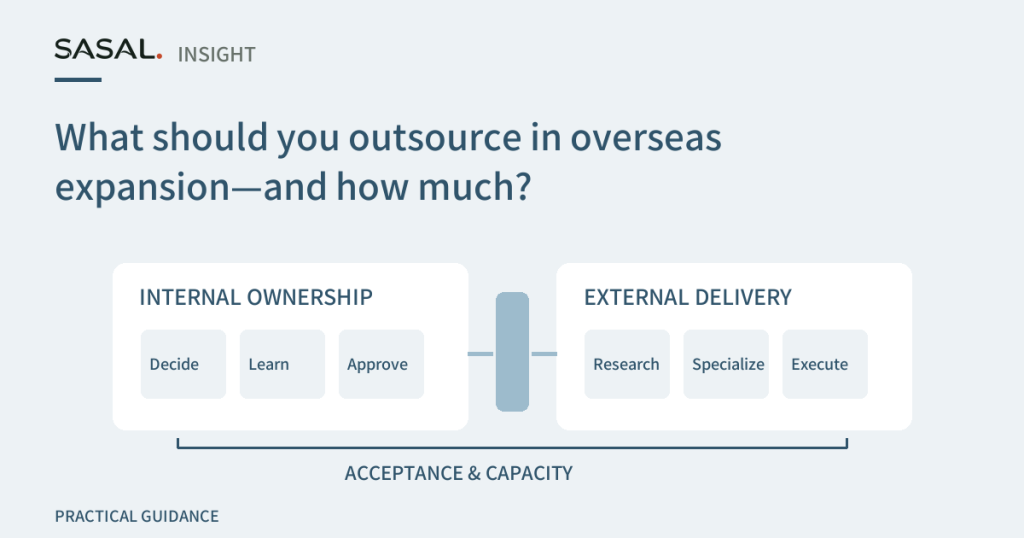
Overseas expansion often triggers a debate about whether work should be handled internally or assigned to outside specialists. That framing can be misleading because the more important question comes first: who owns the decision, the customer understanding and the ongoing responsibility created by the work. External providers can contribute research, local knowledge, specialist analysis and temporary execution capacity, yet a company still needs an internal structure that can interpret findings, make choices and maintain continuity after an assignment ends. A useful division of work therefore begins with ownership, then moves to execution. This approach helps distinguish activities that can be shared from decisions that should remain accountable inside the business, while keeping outsourced effort connected to practical operating needs.
Decide who owns the work before deciding who supplies it

Many outsourcing discussions begin with provider selection, yet overseas expansion is easier to manage when ownership is defined first. Before evaluating consultants, researchers, distributors or specialist advisers, identify the person or team responsible for moving a decision forward. Ownership does not mean performing every task personally. It means maintaining accountability for objectives, reviewing evidence, coordinating contributors and deciding what happens next. When that role is unclear, outsourced activity can accumulate without improving decision quality. Reports, introductions and analyses may arrive, but nobody is clearly responsible for connecting them to commercial choices. Defining ownership first creates a reference point for every later make, buy or shared-delivery decision and helps align external support with business needs.
A company already possesses knowledge that outsiders usually cannot fully replicate. Internal teams understand products, customer history, operational constraints, capacity limits and organizational priorities. External specialists may contribute market comparisons, local customer evidence or technical expertise, but those inputs are most useful when they supplement internal understanding rather than replace it. For that reason, ownership should normally remain with the organization making the investment and management decisions. Outsourcing can then be evaluated activity by activity. Customer interviews, regulatory research, translation, validation support or channel outreach may be assigned externally, while business priorities, resource allocation and commitment decisions remain internal. This distinction reduces confusion between obtaining information and deciding how to act on it.
Ownership should also be separated from authority to perform specialized professional judgments. Expansion projects often require expertise in areas such as legal, tax, certification or customs matters. The company remains responsible for integrating those inputs into its business plan, while qualified specialists remain responsible for their professional advice. Confusion arises when organizations assume that hiring an expert transfers broader business accountability. In practice, specialist conclusions still need interpretation alongside commercial goals, operational realities and customer requirements. A useful governance structure therefore identifies both the specialist responsible for a particular judgment and the internal owner responsible for connecting that judgment to the wider project. This preserves accountability without expecting one person to possess every required skill.
The same principle applies when multiple departments or locations contribute to expansion work. Sales, product, finance, operations and external providers may all influence outcomes, yet responsibility should not become fragmented across them. Clarifying who performs a task and who decides helps maintain progress when priorities compete or personnel change. It also creates continuity because future team members can understand why previous decisions were made. Outsourcing then becomes a sourcing decision rather than a governance substitute. Instead of asking whether a provider should run the project, management can ask which activities benefit from outside support and which activities require direct organizational ownership. That sequence produces clearer expectations, more useful reporting and stronger decision discipline.
Keep business judgment and usable learning inside the company
One of the most important distinctions in overseas expansion is the difference between gathering evidence and exercising business judgment. External contributors can often help collect information, test assumptions or provide perspectives from other markets. Those activities may broaden the range of options available to management. However, deciding which opportunity to pursue, which risks to accept and which commitments to make remains an internal responsibility. A company that delegates judgment too heavily can become dependent on recommendations without developing its own understanding of customers and operating realities. Retaining business judgment internally helps ensure that external research informs decisions rather than replacing them, particularly when conditions change after an engagement has ended.
Learning deserves similar protection because customer understanding accumulates over time. Interviews, validation work, pilot discussions and operational observations often reveal details that become valuable long after an individual assignment finishes. If those insights remain only with an external provider, the company may need to relearn important lessons during future decisions. A more durable approach is to receive not only deliverables but also the reasoning, evidence sources, open questions and customer observations behind them. This creates a usable knowledge base that supports future planning, hiring and execution. The objective is not to internalize every task immediately. It is to ensure that critical learning remains accessible to the organization making long-term commitments.
This principle does not imply that all customer-facing work must stay internal. External researchers may conduct interviews, local specialists may validate assumptions and implementation partners may contribute direct market experience. The key distinction is that customer understanding should be transferred back into the organization in a form that decision-makers can use. Reports that summarize findings without context often limit future value. By contrast, documented observations, unanswered questions and evidence trails can support later reviews, strategy adjustments and handovers. When commissioning work, companies can therefore discuss reporting expectations, handover methods and material-use arrangements alongside the immediate assignment. Knowledge retention becomes part of the scope rather than an afterthought.
A practical way to evaluate outsourcing proposals is to ask what learning will remain after the engagement concludes. Some assignments mainly provide temporary execution capacity. Others generate insights that influence future investments, product changes or market priorities. The second category deserves particular attention because its value extends beyond the immediate task. Internal teams should be able to explain what was learned, why conclusions were reached and which uncertainties remain unresolved. That capability supports continuity even when providers, employees or project structures change. Overseas expansion rarely follows a straight line, so preserving customer understanding and decision rationale can be as important as completing the original assignment. Strong learning transfer therefore complements, rather than opposes, effective outsourcing.
Define an assignment that someone can actually accept
Outsourcing becomes difficult when the requested work is vague. Phrases such as finding customers, entering a market or building partnerships can describe many different activities with different levels of effort, expertise and uncertainty. Before deciding whether work should be external, internal or shared, define a concrete assignment that another party can realistically accept. Clarify the objective, expected output, review process and next decision enabled by the work. A provider can then evaluate whether the request matches its capabilities and resources. Clear assignments also help the commissioning company compare alternatives because proposals can be judged against the same intended outcome rather than against differing interpretations of an ambiguous objective.
Defining an assignment requires attention to boundaries as well as deliverables. Research may include public information gathering, interviews and analysis, or it may stop at data collection. Commercial support may include outreach and meeting coordination, or it may extend further into implementation activities. Different scopes create different demands on both parties. Internal capacity should therefore be considered alongside external capability. A company with dedicated planning, finance and legal functions may commission narrowly defined tasks. A smaller team may need broader coordination support because it lacks capacity to manage multiple specialist relationships independently. Neither arrangement is inherently superior. The useful unit of outsourcing is the one that can be briefed, reviewed and accepted effectively.
Acceptance deserves explicit definition because completed work is only valuable if someone inside the company can review it and act on it. An assignment that generates large volumes of information may overwhelm a small internal team. Faster external output does not automatically accelerate progress when approvals, interpretation and decisions remain internal. For example, if an internal reviewer has twelve available hours during a month, reserves four hours for coordination and plans half an hour per submission, initial planning capacity would be sixteen submissions before additional variation or rework. That illustration is not a universal ratio, but it demonstrates how receiving capacity can become a practical constraint on outsourced volume.
When assignments are clearly defined, outsourcing discussions become more productive because expectations are visible from the beginning. The company can specify the output required, the review effort expected internally and the decision that follows acceptance. Providers can explain methods, exclusions, timing and assumptions using the same framework. This reduces the risk of comparing proposals that appear similar but actually contain different work. It also supports later adjustments because both sides understand what success looks like. Defining an assignment in this way creates a bridge between ownership and execution, helping ensure that outsourced effort contributes directly to usable decisions rather than generating activity that cannot be absorbed.
- BriefState the objective, scope, assumptions and expected output.
- OutputDeliver the agreed research, analysis or execution result.
- AcceptanceInternal owner reviews the work against defined criteria.
- Next decisionUse accepted findings to choose the following action.
Choose external work by specialization, locality and duration
A useful way to decide what to outsource is to examine why external involvement is needed for a specific activity. Three common reasons are specialization, locality and duration. Specialization applies when work requires expertise that the company does not maintain internally, such as regulatory interpretation, certification support or technical market validation. Locality applies when customer conversations, channel checks or operational coordination depend on people close to the market being investigated. Duration applies when a task is important but temporary, making a permanent hire difficult to justify. These categories help frame the discussion around the nature of the work rather than assumptions about what is or is not core. The objective is to match resources to tasks while preserving internal ownership of decisions.
Specialization should not be confused with transferring accountability. A company may commission external research, customer interviews or technical reviews because outside specialists possess relevant experience and methods. However, the company still evaluates how those findings affect priorities, investment choices and operating plans. The most productive arrangements connect expertise to a clearly defined decision. For example, a hypothetical manufacturer might request customer validation interviews from an external team while retaining responsibility for product positioning and commercial commitments. In that arrangement, the external contribution expands evidence rather than replacing management judgment. Linking commissioned work to specific decisions also makes it easier to judge whether a proposal fits the current stage and whether the expected output justifies the required coordination effort.
Locality often matters because evidence gathered close to customers can reveal conditions that are difficult to understand remotely. Customer buying processes, delivery expectations and operational constraints may become clearer through local conversations and observation. Outsourcing locality-sensitive tasks can therefore be practical even when the company has strong internal expertise. At the same time, local execution should not create a barrier between decision-makers and customer understanding. Reporting, handover and discussion processes help ensure that observations remain usable after the assignment ends. A company that receives only conclusions may struggle to evaluate changing conditions later. Receiving the reasoning, context and unresolved questions alongside findings supports future decisions and reduces dependence on a single external source.
Duration provides another reason to use outside support. Some expansion activities require concentrated effort for a limited period rather than a permanent role. A hypothetical project may need six months of market validation, channel outreach or specialist review without creating enough continuing work to justify full-time staffing. External support can provide temporary capacity while avoiding assumptions that every capability must immediately be built internally. However, temporary work still consumes internal management attention. Briefing, reviewing and integrating outputs require time from people inside the company. For that reason, the decision is rarely between external effort and no effort. It is usually a choice about how responsibilities, expertise and limited internal capacity are combined to achieve a defined objective.
State what the outsourcing percentage measures
Discussions about how much to outsource often become confusing because different people use different denominators. One person may describe outsourced work as a percentage of project hours, another as a share of spending and another as a share of activities. These measures answer different questions and should not be treated as interchangeable. A project could rely heavily on external hours while spending relatively little cash, or it could involve limited external time concentrated in highly specialized assignments with significant fees. Before comparing alternatives, define exactly what is being measured, over what period and which tasks are included. Clarity about the denominator prevents false comparisons and helps management understand the practical meaning of any reported outsourcing percentage.
Work-hour measures can be useful when the goal is understanding how effort is distributed. Consider a hypothetical month containing forty internal hours and sixty external hours on defined expansion activities. External work would represent sixty percent of combined hours, while the external-to-internal ratio would be one hundred fifty percent. Neither figure indicates quality, productivity or business value. They simply describe the allocation of recorded effort within the selected scope. Hours also do not imply interchangeable skills. An hour of specialist legal review, customer research or management decision-making may serve different purposes. For that reason, hour-based measures are best used as descriptive planning tools rather than as evidence that one sourcing model is superior to another.
Cost-based measures answer a different question. They focus on spending rather than effort. When using cost shares, compare equivalent categories and avoid mixing external fees with only a portion of internal costs. Internal salary time, coordination effort, supervision and rework may all contribute to the overall economics of a project. External spending should therefore be evaluated alongside the internal resources needed to support it. Comparing an external bill only with direct salary can produce misleading conclusions because important supporting activities remain uncounted. Cost measures become more useful when assumptions are visible and each category is counted once. They describe financial allocation, not automatically the value generated by the work.
A third approach is to describe outsourcing through scope coverage. Instead of focusing on hours or money, management can specify which activities are external, internal or jointly delivered. For example, a hypothetical expansion project might use external support for customer research, internal ownership for commercial choices and joint responsibility for pilot execution. This description often helps stakeholders understand operational reality more clearly than a single percentage. Different measures can coexist, provided each is labelled accurately. The key is to avoid treating one number as a complete representation of outsourcing. Understanding effort distribution, spending allocation and activity ownership together creates a more reliable basis for planning and review.
- Hours ratioCompares internal and external effort allocated to defined tasks.
- Cost shareCompares spending categories while accounting for supporting internal work.
- Scope coverageDescribes which activities are external, internal or jointly delivered.
Limit commissioned volume to what the internal team can receive
The amount of work that can be outsourced is constrained not only by supplier capacity but also by the organization’s ability to absorb outputs. Reports, interviews, market findings and implementation recommendations require review, interpretation and decisions. If external production exceeds internal receiving capacity, a queue develops. Management may then experience delays even when suppliers deliver on time. For this reason, commissioned volume should be evaluated from both sides of the relationship. The practical question is not how much work a provider can produce. It is how much work the company can brief, review, discuss and convert into decisions within a given period. Receiving capacity is therefore an operational resource that deserves explicit planning.
A simple hypothetical illustration demonstrates the principle. Imagine an internal reviewer with twelve available hours during a month. Four hours are reserved for coordination activities, leaving eight hours for reviewing submissions. If each planned submission requires approximately half an hour of review, the initial planning capacity would be sixteen submissions before considering variation, clarification requests or rework. This example is not a recommended ratio and does not predict actual throughput. It simply shows how acceptance capacity can be estimated. The important insight is that review time is finite. Increasing outsourced output without increasing internal review resources may create congestion rather than faster progress.
Receiving capacity also depends on authority and decision structure. A team may be able to review information quickly but still wait for approvals from managers, technical specialists or other departments. In such situations, external providers can continue producing work while internal decisions accumulate in a backlog. Faster supplier performance does not eliminate these constraints. Clear ownership, defined approval routes and agreed reporting formats help reduce delays, but they do not remove the need for internal attention. When planning outsourced activity, companies can therefore estimate not only production effort but also the time required to understand findings, resolve questions and decide the next action.
Commissioning within receiving capacity supports better learning and stronger decisions. Smaller, well-reviewed batches of work may create more value than large volumes that remain unread or unresolved. This approach also makes it easier to identify quality issues early, refine instructions and adjust scope before substantial resources are committed. As conditions change, receiving capacity may expand through additional staffing, improved processes or greater experience. It may also contract when other priorities compete for attention. Reviewing commissioned volume against actual acceptance capability helps keep outsourcing aligned with organizational capacity. The resulting balance is often more important than maximizing the proportion of work performed externally.
Compare the full cost without double-counting internal effort
Questions about outsourcing cost often begin with supplier fees, yet fees alone rarely describe the resources consumed by an expansion project. A more complete comparison includes incremental cash payments, the time of existing employees, coordination effort, supervision, review activity and any expected rework. These elements influence the practical cost of getting work done, even when they appear in different budgets or accounting categories. The objective is not to discourage outsourcing. It is to compare alternatives on a like-for-like basis. If one option requires extensive internal management while another includes more delivery support, the difference should be visible. Cost discussions become more useful when they describe the whole operating arrangement rather than a single invoice.
Internal staff time deserves particular attention because it is often treated inconsistently. A company may compare an external proposal against salary expense while overlooking the time managers, product specialists or operational teams must contribute. Allocating internal effort by person and period can help reveal the true demand created by an assignment. At the same time, that allocation should not be confused with additional cash spending. Existing salary commitments and new supplier payments represent different economic categories. A hypothetical project may require substantial involvement from current employees even if no new hires are needed. Recognizing that contribution improves planning and helps management understand which resources are genuinely constrained during expansion work.
Opportunity cost should also be separated from direct expenditure. If engineers, sales managers or executives spend time supporting an overseas initiative, they may have less capacity for alternative activities. That trade-off can be important, but it should not be counted as though it were the same cash payment already represented by salary expense. Counting the same resource twice can distort comparisons and make one option appear artificially expensive. A clearer approach presents additional cash spending, allocated staff time and forgone alternatives as distinct categories. Decision-makers can then evaluate each effect independently. This structure makes trade-offs visible without creating confusion about whether a particular resource has already been included elsewhere in the analysis.
Full-cost comparison is therefore less about finding a single number and more about making assumptions transparent. A hypothetical company considering external research support might record supplier fees, internal briefing hours, review meetings, coordination work and expected revisions. Another option might involve hiring temporary staff and reducing external support. Neither arrangement is automatically preferable. The useful comparison is whether equivalent work is being evaluated on the same basis. When each category is described clearly and counted once, management can judge how responsibilities, cash commitments and scarce employee attention are distributed. That visibility supports better sourcing decisions than a narrow focus on headline fees alone.
Keep customer knowledge and working records usable
Customer knowledge is one of the most durable outputs of an expansion effort, yet it can easily become fragmented across providers, departments and individuals. Research findings, meeting notes, validation results and operational observations often influence future decisions long after the original assignment ends. For that reason, companies benefit from treating knowledge transfer as part of delivery rather than as an optional extra. A completed report may answer an immediate question, but future teams also need access to the reasoning, assumptions and unresolved issues behind the conclusion. Preserving that context helps later decision-makers understand what was learned, how it was learned and where uncertainty remains.
Usable records are especially important when responsibilities are shared between internal and external contributors. An outside team may conduct interviews, collect evidence or coordinate local activities, while internal managers decide priorities and next actions. Without structured handover, valuable information can remain trapped inside individual relationships. A more resilient approach captures customer observations, supporting evidence and open questions in forms that others can review. The goal is not to document every interaction exhaustively. Instead, it is to ensure that future participants can understand the state of the work without reconstructing months of conversations. This supports continuity when personnel change or when new specialists join the project.
Shared definitions strengthen the value of those records. Different teams may interpret terms such as prospect, customer, order or adoption in different ways, creating confusion when information moves between functions. Agreeing common terminology, reporting frequency and record ownership makes it easier to compare findings over time. It also allows another person to understand what has been settled and what remains unresolved. In overseas expansion, where work may span multiple locations and organizations, consistency can matter as much as the information itself. Records become more useful when they support decisions rather than merely preserving activity histories.
Knowledge retention should also extend beyond immediate deliverables. When commissioning support, companies can discuss access to materials, handover expectations and ongoing usability of working records. Those arrangements should be agreed rather than assumed. A practical objective is to ensure that customer understanding remains available after the engagement concludes. This does not require bringing every activity inside the company. External specialists can continue contributing valuable expertise. The key point is that evidence, observations and decision history remain accessible to the organization responsible for future investments and operations. Maintaining that continuity helps customer learning accumulate rather than being repeatedly recreated.
Test the division of work through a bounded delivery cycle

A proposed division of responsibilities often looks reasonable in planning documents, but practical weaknesses usually emerge during execution. For that reason, companies can test internal, external and shared responsibilities through a bounded delivery cycle before expanding the arrangement. The cycle should involve a defined objective, a limited scope and clear acceptance criteria. Rather than outsourcing a broad overseas initiative immediately, management can examine how information flows, how decisions are made and how outputs are reviewed. This approach turns sourcing assumptions into observable experience. It also helps identify whether the chosen structure supports learning and execution without requiring a large commitment before operational realities become visible.
A hypothetical example illustrates the principle. Customer research could be performed by an external team, while commercial priorities and investment choices remain internal. Pilot activities might then be delivered jointly, allowing both groups to observe how evidence moves into action. During the cycle, managers can evaluate briefing quality, reporting clarity, review effort and decision speed. The objective is not to determine whether one side is performing all valuable work. Instead, it is to examine whether responsibilities are located where they are most useful. Small-scale testing can reveal bottlenecks that are difficult to predict from organizational charts alone, particularly when approval processes and coordination demands become visible.
Acceptance plays a central role in the cycle because completed work only creates value when it can be absorbed and used. Teams should therefore define what constitutes an acceptable output before execution begins. Research findings may require supporting evidence and documented assumptions. Pilot outcomes may require agreed records of observations and unresolved questions. Clear acceptance criteria help both internal and external contributors understand expectations. They also create a practical basis for deciding whether additional responsibility should remain external, become shared or move gradually inside the company. The decision is informed by observed performance rather than by assumptions about what ought to be outsourced.
As capability develops, some activities may become candidates for progressive insourcing, but movement should be deliberate rather than automatic. A new employee does not instantly remove the need for overlap, review or specialist support. Maintaining a temporary fallback arrangement while internal capability matures can reduce disruption. The important review questions are whether ownership remains clear, whether accepted outputs can be absorbed and whether internal receiving capacity matches the volume being commissioned. Changes in workload, expertise or organizational priorities may justify revisiting the division of work. Periodic review keeps sourcing decisions connected to current conditions rather than preserving arrangements that no longer fit the project.
Move work inside gradually when capability is ready
Bringing work inside the company is often discussed as the natural destination after a period of outsourcing, yet the transition deserves the same discipline as the original sourcing decision. The useful question is not whether internal delivery is inherently better. It is whether the organization can now perform the work at an acceptable standard while preserving decision quality and continuity. Capability includes people, time, supervision, documentation and review processes, not only technical knowledge. A newly hired employee may understand the subject matter but still require access to customer history, operating assumptions and established methods. Gradual transfer reduces the risk that important knowledge disappears between teams or that performance becomes dependent on a single individual before the capability is fully established.
A staged approach can help separate readiness from aspiration. For example, a hypothetical company may continue using external support for a limited research assignment while an internal team member shadows the process, reviews outputs and begins handling selected components independently. The objective is not to prove that outsourcing should end. It is to determine which activities can reliably move inside without weakening customer understanding or project momentum. Overlap periods can reveal practical issues that are difficult to identify in planning discussions, such as undocumented assumptions, reporting gaps or approval bottlenecks. Observing those issues before a complete transfer allows corrective action while experienced support remains available.
Acceptance criteria become especially important during insourcing. Internal teams should demonstrate that they can produce outputs that meet the same operational requirements used previously, rather than assuming capability based solely on staffing changes. A hypothetical transition might begin with internal preparation of customer research summaries, followed by independent management of interview scheduling and later ownership of the entire process. Each stage can be reviewed against defined expectations before additional responsibility is transferred. This creates evidence about performance and capacity rather than relying on confidence alone. It also helps managers identify where specialist expertise remains valuable even when most day-to-day execution has moved inside the organization.
Progressive insourcing therefore works best when it is connected to observable capability rather than symbolic milestones. Some activities may move fully inside, others may remain shared and others may continue to benefit from specialist support because of locality, expertise or workload variation. The appropriate balance depends on the work itself. Management can periodically examine ownership, acceptance quality, receiving capacity and continuity arrangements to determine whether the current division remains appropriate. A review may support further internalization, maintenance of a mixed model or renewed external involvement. The goal is a structure that supports decisions and execution effectively, not a predetermined endpoint where every task must eventually become internal.
- ObserveLearn methods, assumptions and customer context from current delivery.
- Execute jointlyShare responsibility while documenting processes and reviewing quality.
- Accept independent workInternal teams perform defined tasks that meet agreed standards.
- Review and retain fallbackAssess readiness and keep continuity options for critical activities.
Repeat when capability or workload changes
Combine internal, external and joint work in one overseas project
Most overseas initiatives do not require a choice between complete internal delivery and complete outsourcing. A mixed model often reflects how work is actually performed. Different activities demand different capabilities, levels of customer proximity and durations of effort. A hypothetical project might use external researchers to gather evidence, internal managers to make commercial choices and a joint team to run a pilot. In that arrangement, responsibility is divided by task rather than by organization. The company retains ownership of decisions, while outside contributors provide specialized execution where appropriate. This structure can make resources more flexible because each activity is assigned according to its requirements rather than to a single sourcing philosophy.
The design becomes clearer when work is mapped at the activity level. Research, customer outreach, technical review, commercial approval and pilot execution involve different forms of expertise and accountability. Some tasks are primarily about collecting information, while others determine how the company will allocate resources or define commitments. Separating those functions reduces confusion about who is expected to do what. It also prevents situations where an external provider is assumed to own decisions that properly belong to management. A practical project structure identifies internal owners, external contributors and shared responsibilities in advance so that reporting and escalation routes remain understandable as the work progresses.
Joint work deserves particular attention because it often generates the most valuable learning. A pilot, validation exercise or channel-development effort may require continuous interaction between company personnel and outside specialists. In those situations, customer observations, operational constraints and commercial implications emerge together rather than in separate stages. Shared execution can therefore support both delivery and capability development. However, joint work still requires explicit ownership. Someone inside the company should remain responsible for deciding how evidence influences future actions. External participants contribute expertise and execution, but management determines whether the findings justify adaptation, continuation or additional investment.
A mixed-function model also makes it easier to adjust sourcing over time. As workloads expand, shrink or change shape, individual activities can move between internal, external and shared delivery without redesigning the entire project. A hypothetical company may initially outsource customer research, later build an internal research capability and continue using external support only for local validation. Another may retain specialist involvement because the work remains temporary or location-specific. The useful measure of success is not how much work sits inside or outside the company. It is whether the arrangement protects customer understanding, supports accountability and allows decisions to be made with appropriate evidence and capacity.
Review the division when workloads and capabilities change
The division between internal and external work should not be treated as a permanent design choice. Overseas projects evolve as customer understanding improves, capabilities develop and operating demands change. An arrangement that fits an early validation effort may become unsuitable once recurring delivery begins. Likewise, a structure built around a small internal team may deserve reconsideration after hiring, reorganization or changes in strategic priorities. Periodic review helps ensure that sourcing decisions remain connected to current needs rather than to assumptions made under different conditions. The purpose of review is not to justify change for its own sake. It is to determine whether the existing arrangement still supports effective execution and decision-making.
Evidence should guide that review. Managers can examine which activities consume the most coordination effort, where approvals are delayed and whether accepted outputs are generating useful decisions. Customer learning, project continuity and receiving capacity all provide practical indicators. If external work consistently waits for internal review, the constraint may lie inside the organization rather than with the supplier. If internal teams repeatedly depend on specialist expertise that they do not plan to build, continued external involvement may remain appropriate. Looking at actual work patterns helps avoid decisions driven only by cost assumptions or preferences about sourcing models. The focus remains on operational effectiveness and organizational learning.
Personnel changes provide another reason to reassess responsibilities. Expansion initiatives can continue through role changes, promotions and staff turnover, making continuity planning important. When new people inherit responsibilities, they need access to decision history, open issues and supporting evidence. Reviews can confirm whether ownership remains clear and whether records allow successors to understand previous choices. They can also identify activities that have become vulnerable because too much knowledge resides with one person or one external relationship. Adjusting the division of work in response to those risks can strengthen resilience without requiring a complete restructuring of the project.
A practical review often concludes with four questions. Who owns the decision? What outputs will be accepted? How much work can the internal team realistically receive and use? What conditions would justify changing the current arrangement? Those questions connect governance, execution and capacity in a way that remains useful as circumstances evolve. The answers may support further outsourcing, additional internal responsibility or continued shared delivery. The important point is that the division of work remains a managed choice rather than an inherited habit. Reviewing ownership, acceptance standards, receiving capacity and change triggers helps keep the expansion effort aligned with present realities and future needs.