

Overseas and new ventures: time to profit and investment budgets
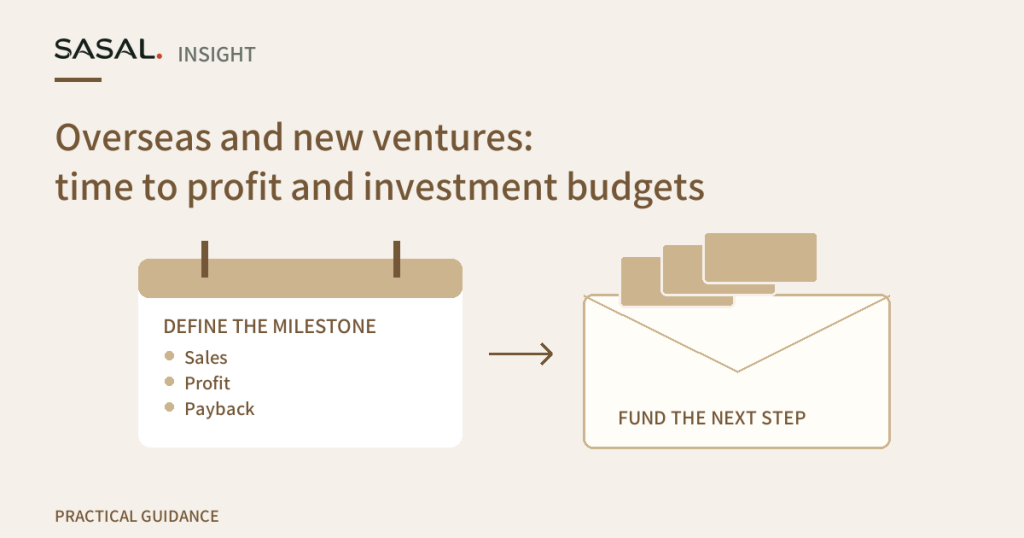
Questions about profit timing and budget often hide a more basic issue: different people are measuring different milestones. A venture can complete research, win a pilot customer, issue an invoice, collect cash, reach operating profit, and recover cumulative investment at very different times. Treating these as the same event creates unrealistic expectations and weak funding decisions. A more useful approach is to define the milestone first, map the work and waiting periods that lead to it, and then connect each spending decision to evidence that supports the next commitment. This article focuses on building that sequence carefully, distinguishing customer validation, revenue collection, operating performance, and eventual investment recovery without assuming any universal timeline or budget level.
Name the milestone before asking how long it takes

Many discussions about a new venture begin with a question such as “How long until it is profitable?” The difficulty is that profitability is only one of several possible milestones. A team may be discussing completion of market research, launch of a new offer, first booked revenue, first cash collected from a customer, operating profit over a defined period, or cumulative cash payback of earlier investment. Each milestone answers a different management question. Research completion indicates readiness for a decision. Revenue booking indicates a commercial commitment. Cash collection indicates money has actually arrived. Operating profit indicates revenues exceeded operating costs during a period. Cash payback asks whether cumulative business-generated cash has recovered earlier outlays.
Choosing the milestone first changes the schedule that follows. If the target is incorporation of a legal entity, the relevant tasks differ from a target of obtaining repeat customer orders. If the target is first customer payment, planning must include customer evaluation, approval, purchasing, invoicing, and collection processes. A launch date can occur before any customer buys. A booked order can occur before any cash arrives. A customer payment can occur before cumulative investment has been recovered. Treating these milestones as interchangeable compresses important differences and can make a venture appear ahead of schedule or behind schedule without a meaningful basis. Clear definitions improve communication between management, investors, project teams, and operating staff.
A practical planning method starts by writing the chosen milestone in precise terms and then identifying what evidence will confirm that it has been reached. For example, a team might define success as receipt of the first customer payment rather than public launch. Another team might define success as achieving sustained repeat orders from a specified customer segment. The evidence required for each differs. Launch may require internal readiness. Payment requires a completed commercial transaction and collection. Repeat orders require continuity of demand across multiple buying decisions. Because different milestones require different evidence, they also require different spending priorities, staffing decisions, and review dates. Defining the milestone therefore becomes a strategic choice, not merely a reporting detail.
The same discipline applies when discussing profit and investment recovery. Positive gross margin is not the same as operating profit, and operating profit is not the same as cumulative payback of all earlier spending. A venture may sell at a positive gross margin while still carrying ongoing operating costs that exceed revenue. It may generate operating profit during a period while cumulative earlier research, development, certification, or launch spending remains unrecovered. Financing received from owners or lenders can provide cash, but it is not business-earned payback. Separating these concepts helps management compare opportunities consistently and decide how much uncertainty, time exposure, and funding commitment the organization is prepared to carry.
Build a schedule from work, waiting and customer decisions
After selecting a milestone, the next step is building a schedule that reflects both activity and delay. Teams often estimate only the work they control, such as research, product adaptation, or sales preparation. In practice, a venture also depends on customer evaluation, procurement reviews, contract discussions, technical assessments, budgeting cycles, and payment processing. These waiting periods can be as important as internal effort. A schedule that ignores them may appear efficient but fail to predict actual timing. The goal is not to forecast a universal number of months. The goal is to identify the sequence of decisions and dependencies that must occur before the chosen milestone becomes possible.
A hypothetical planning scenario illustrates the distinction. Research might occupy months one and two, followed by customer validation activity in months three and four. Pilot work could occur in months five and six, with first customer cash expected in month seven if the commercial process proceeds as anticipated. This example is only a planning structure, not evidence that any venture follows the same timetable. Different industries, customer types, and operating models create different paths. What matters is connecting each stage to observable learning and identifying who must make the next decision. A schedule becomes more useful when it explains why time is required rather than simply assigning dates.
Waiting time deserves the same visibility as active work. Customer organizations may need technical approval, internal sponsorship, procurement review, security assessment, budgeting authorization, or contract negotiation before committing funds. Some activities can proceed in parallel, while others depend on earlier decisions. Mapping these dependencies reveals where delays are most likely to occur and where additional preparation may shorten uncertainty. It also helps estimate funding needs because expenses may continue during periods when no revenue is collected. A venture that appears commercially attractive can still require substantial patience if critical decisions rest with external parties operating on their own timelines and priorities.
The resulting schedule should remain connected to funding decisions. If customer feedback during validation contradicts initial assumptions, the schedule may change because the venture itself changes. New evidence can narrow the target customer group, adjust pricing assumptions, alter delivery requirements, or suggest a smaller pilot before broader investment. These revisions are not planning failures. They are part of learning. The value of a schedule lies in making assumptions visible and linking them to future decisions. When milestones, dependencies, and review points are documented clearly, management can compare continuation, modification, delay, or exit using current evidence rather than relying on optimism or sunk effort.
- LearningResearch customer needs, delivery conditions, and economic assumptions.
- Customer validationTest interest, buying conditions, and willingness to proceed commercially.
- Paid deliveryComplete agreed pilot or initial commercial work under real conditions.
- CollectionReceive customer payment according to agreed invoicing and payment terms.
Connect information gathering to a paid commercial test
Research becomes more valuable when it is connected to a decision rather than treated as an independent activity. Many ventures can gather large amounts of information without improving confidence about whether customers will actually buy. A stronger approach begins by identifying the question that matters most for the next commitment. Research may investigate customer priorities, pricing expectations, technical requirements, channel options, or delivery constraints. The purpose is not to collect facts indefinitely. The purpose is to reduce uncertainty around a specific business choice. When research is linked to a decision, management can judge whether the learning obtained justifies the time, staff effort, and cash invested.
The next step is translating information into customer validation. Validation differs from general market interest because it tests whether a customer is prepared to invest time, attention, reputation, budget, or other resources toward a real purchasing decision. Conversations, interviews, and demonstrations can help identify buying conditions, but they do not automatically establish demand. A paid commercial test introduces stronger evidence because customers must evaluate value against alternatives and commit resources. The exact form varies by business model. What matters is that the activity moves beyond discussion and begins to reveal how actual buying decisions occur under realistic conditions.
Spending decisions should support that progression. Research, specialist advice, technical reviews, and pilot preparation become easier to evaluate when each expense is linked to the next decision. A smaller experiment may provide sufficient evidence to justify proceeding, revising, or stopping. This can help contain exposure while preserving learning value. At the same time, management should distinguish cash spending from internal staff time. Existing employees often contribute significant effort alongside external expenditures. Tracking both separately improves visibility into the true commitment being made and clarifies what alternative work the organization is choosing not to pursue during the same period.
A useful outcome of early validation is not immediate profitability but clearer evidence about what must happen next. Teams can compare customer responses, delivery realities, pricing assumptions, and operational requirements against the original venture thesis. Some opportunities become more attractive because customer behavior confirms key assumptions. Others reveal obstacles that require redesign or a narrower scope. In either case, information gathering has served its purpose when it supports a better decision. The emphasis is not on proving a predetermined outcome. It is on creating enough commercial evidence to decide whether additional investment, time, and organizational attention remain justified.
Separate accounting profit, cash generation and cumulative payback
Many venture plans become confusing because several financial milestones are merged into a single question about profitability. Gross margin, operating profit, operating cash generation, and cumulative payback answer different questions. Gross margin asks whether revenue exceeds the direct cost of delivering what was sold. Operating profit asks whether revenue exceeds operating costs during a defined period. Cash generation asks whether receipts exceed payments during the same period. Cumulative payback asks whether the venture has recovered earlier investment and operating outlays through business-earned cash. A project can pass one milestone while remaining far from another. Treating these measures separately allows management to compare opportunities consistently and communicate expectations more clearly across decision makers.
Positive gross margin is often the earliest encouraging signal, yet it does not establish that a venture is economically successful. A company may sell a product or service at a contribution above direct delivery cost while continuing to spend heavily on customer acquisition, support, administration, technical development, or market entry activities. In that situation, gross margin can be positive while operating profit remains negative. The distinction matters because management decisions depend on what question is being answered. Gross margin helps evaluate transaction economics. Operating profit helps evaluate whether the venture can sustain its activities over a defined period. Neither measure alone reveals whether earlier research, launch, adaptation, or validation spending has been recovered through accumulated business cash.
Cash generation introduces another layer of analysis because accounting recognition and cash movement rarely occur at the same moment. Revenue may be recorded before collection. Inventory, deposits, or prepayments may require cash before related revenue appears. Financing from owners or lenders may increase available cash even though it is not revenue generated by customers. For planning purposes, management should therefore map actual payment dates, expected collection dates, and committed obligations. A venture that appears profitable in accounting terms may still require additional funding if customers pay slowly or if operating requirements consume cash before collections arrive. Cash analysis helps identify exposure that profit measures alone can conceal.
Cumulative payback extends the view beyond individual reporting periods. The question becomes whether business-generated cash has caught up with all earlier venture outlays counted once and only once. Research spending, launch costs, certification work, equipment purchases, and agreed operating expenditures may create a substantial deficit before meaningful receipts arrive. Reaching operating profit does not automatically eliminate that deficit. Equally, receiving external financing does not constitute business-earned recovery because financing and operating performance are different categories. When planning a venture, management can define separate milestones for operating profit and cumulative payback, then evaluate each using explicit assumptions, documented uncertainties, and periodic review points as evidence develops.
- Gross marginRevenue exceeds direct delivery cost for the transaction or service sold.
- Operating profitRevenue exceeds operating costs during a defined accounting period.
- Operating cashBusiness receipts exceed business payments during a period.
- Cash paybackCumulative business-generated cash recovers earlier venture outlays.
Use a worked cash schedule to expose the funding gap
A worked cash schedule helps reveal whether a venture can be funded through the period before meaningful customer receipts arrive. The objective is not to predict the future with precision. It is to make assumptions visible and test whether available resources can support the proposed path. A useful schedule lists expected cash outflows and inflows by period, records when each payment is likely to occur, and separates internal labor, external spending, and financing. By tracing timing rather than relying only on annual totals, management can identify periods where the venture requires support despite apparently attractive economics. This visibility supports more disciplined authorization and review decisions.
Consider a simplified hypothetical illustration. Suppose an initiative requires an initial project outlay of US$120,000. During the first six months, net operating cash is negative US$10,000 per month, with the agreed operating costs and the initial investment counted once rather than repeatedly. At the end of month six, cumulative net cash stands at negative US$180,000. Assume that from month seven onward the venture generates positive net operating cash of US$15,000 per month. Under these simplified assumptions, twelve positive months contribute US$180,000, bringing cumulative net cash back to zero at the end of month eighteen. This illustration demonstrates arithmetic, not a typical commercialization timeline or expected outcome.
Collection timing can materially change that schedule even when sales activity remains unchanged. If customers pay later than expected, the operating model may require funding for a longer period before cumulative recovery occurs. The adjustment should be made through revised cash timing rather than by mechanically adding arbitrary months. Receivables, inventory requirements, deposits, and contractual payment terms each affect the pattern differently. Because timing effects can be substantial, planning should use expected collection dates rather than invoice dates alone. The resulting schedule becomes a decision tool that highlights peak funding exposure, identifies sensitive assumptions, and shows where alternative commercial arrangements might reduce pressure on available resources.
The arithmetic also needs a clear boundary. This simplified schedule assumes the stated monthly operating cash figures already include the cash receipts and operating payments assigned to the project; the initial outlay is additional and counted once. It does not separately model taxes, exchange-rate changes, replacement investment or the time value of money. A real proposal must include applicable cash effects and disclose how shared costs are treated. Month eighteen is therefore the result of these assumptions, not a promised recovery date. Even after cumulative cash reaches zero, the business needs funding for continuing operations. Identify the lowest cumulative balance and the resources needed to fund it, then test slower receipts, lower margins and additional delivery costs before authorizing commitments.
Large-company case: what the Amazon disclosures actually establish
The Amazon records cited here are useful because they illustrate the difference between observable milestones and assumptions that cannot be supported from the evidence. An official Amazon Web Services blog post dated 14 March 2006 states that Amazon S3 was rolled out earlier that day. This establishes a launch milestone for a specific service. It does not establish when related research began, how much investment was committed before launch, when the service first generated profit, or when cumulative investment was recovered. Those questions may be important to management analysis, but they are not answered by the cited launch announcement and therefore should not be inferred from it.
A separate source, Amazon’s 2015 annual report, provides historical financial information for the AWS segment. According to the report, the AWS segment recorded 2013 net sales of US$3.108 billion and 2013 segment operating income of US$673 million. The report also presents later comparative segment results and notes that certain expenses, including stock-based compensation and other operating expense or income items, were not allocated to segments. These disclosures establish that the AWS segment reported positive segment operating income in the historical reporting period shown. They do not identify the profitability of Amazon S3 as an individual service, nor do they establish cumulative cash payback.
The distinction between service-level milestones and segment-level reporting is important for venture planning. Management teams sometimes connect a launch date to a later financial disclosure and then calculate an implied time to profitability. The cited evidence does not support that conclusion. Amazon S3 is one service, while AWS segment reporting covers a broader scope. The annual report does not identify the first profitable year for AWS, the first profitable year for S3, the original research timeline, or the date when cumulative investment was recovered. Sound analysis requires respecting those boundaries. Where evidence does not establish a fact, planners should treat the unknown as an assumption rather than a conclusion.
The practical lesson is methodological rather than company specific. Public success records often highlight visible milestones such as launches, reported revenue, or segment operating income. Less visible ventures that were delayed, reshaped, or discontinued may receive far less attention, creating selection bias if managers study only surviving examples. For that reason, a new venture should be evaluated through its own milestones, assumptions, and funding capacity rather than by borrowing a timetable from a well-known case. Evidence from public disclosures can clarify what happened at a documented point in time. It cannot automatically reveal research duration, investment scale, operating profit timing, or cumulative payback for a different business.
Small-team case: what Basecamp’s revenue milestone does not prove
Basecamp provides a documented example of a transition from a service business toward a product business. According to the founder account, the company originally operated as a design business, built a project-management tool for its own work, observed client interest, refined the product and released it commercially. The account further explains that about a year or so after release, the product generated more revenue than the web-design business, after which the company focused on the product. These facts are useful because they identify observable business milestones. They show a sequence involving internal use, customer interest, product release and later revenue comparison. They do not provide direct evidence regarding operating profit, cash generation or cumulative investment recovery.
The same source should be read carefully when discussing commercialization timelines. A product generating more revenue than an earlier line of business is a revenue milestone rather than a profitability milestone. Revenue alone does not reveal delivery costs, support requirements, ongoing development effort, working-capital needs or prior investment. It therefore cannot establish whether the product had achieved operating profit, whether cumulative project spending had been recovered or whether the company experienced periods of negative cash flow before growth accelerated. Managers evaluating new ventures can benefit from recognizing this distinction. A visible revenue event may be encouraging evidence of demand, yet it remains only one point on a broader path that includes costs, cash timing and investment recovery.
A second limitation concerns the temptation to transform an individual story into a universal timetable. The founder account describes one company’s experience under specific conditions. It does not establish that new products generally surpass an existing business after approximately a year, nor does it demonstrate a typical duration for customer validation, launch, profitability or payback. The company’s description of itself as a small team supports using it as a small-team product-business example. However, it does not establish a specific headcount, statutory business category, spending level or operating structure. Responsible planning therefore separates what the record actually documents from conclusions that would require additional evidence.
For decision makers, the most useful lesson is not the elapsed time between release and the reported revenue milestone. Instead, it is the importance of defining which milestone is being measured and how it will be verified. A hypothetical venture might record customer interest, first paid delivery, recurring revenue, operating profit and cumulative cash payback as separate achievements. Each requires different evidence and may occur at different times. The Basecamp account illustrates that a revenue comparison can be observed and communicated clearly. It does not remove the need to build a venture-specific model covering costs, staff effort, collection timing and funding exposure. Those elements remain necessary before any conclusion about profitability or investment recovery can be justified.
Compare cases without turning company size into a timetable
The Amazon and Basecamp records are valuable precisely because they illustrate different kinds of evidence. The Amazon sources establish a documented launch date for Amazon S3 and later historical AWS segment financial results. The Basecamp sources describe a product diversification journey and a later revenue milestone relative to an earlier business line. Neither record establishes a complete path from initial research through operating profit and cumulative cash payback. Comparing the cases therefore requires caution. The objective is not to discover a hidden formula linking company size to commercialization speed. The objective is to understand which milestones were actually documented and which important questions remain unanswered by the available evidence.
Large organizations and small teams often face different coordination structures, approval processes and resource arrangements, but those differences do not create a predictable schedule. A larger company may possess specialized expertise, established systems and broader funding capacity. It may also require additional reviews, alignment across departments or competing internal priorities. A smaller team may move quickly in some decisions while facing tighter capacity constraints or greater dependence on a few individuals. Because these factors vary widely, company size alone cannot determine how long customer validation, launch, revenue generation, profitability or payback will take. Management analysis becomes stronger when it focuses on observable work, dependencies and resources instead of relying on labels.
Another reason to avoid size-based assumptions is selection bias. Public discussion tends to emphasize ventures that became visible through successful launches, growing revenue or notable business outcomes. Projects that were delayed, narrowed, paused or discontinued frequently receive less attention. As a result, leaders reviewing published examples may encounter a distorted sample that overrepresents surviving ventures. The solution is not to ignore case evidence but to place it in context. Documented milestones can help clarify what happened in a particular situation. They cannot reveal how many alternative initiatives followed different paths or whether the same outcome would have occurred under different operating conditions and commercial assumptions.
A more reliable planning method begins with the proposed venture itself. Managers can map required learning, customer validation, delivery preparation, collection timing and review decisions. They can then estimate the maximum time and cash exposure they are willing to carry before requiring stronger evidence. This approach produces a timetable rooted in the actual work and constraints of the initiative rather than in analogies to companies of a certain size. Public examples remain useful when they demonstrate how to interpret milestones correctly. They become less useful when treated as proof that a small team must move quickly or that a large organization must move slowly. Evidence should inform planning, not replace it.
Use a share of annual sales as a scenario, not a spending rule

Budget discussions often benefit from a reference point, and annual sales can provide one. However, using a share of annual sales is most useful as a scenario-building device rather than a spending rule. Consider an illustrative company with annual sales of US$10 million. In that context, annual spending envelopes of one percent, three percent and five percent correspond to US$100,000, US$300,000 and US$500,000 respectively. These figures simply help management compare magnitudes. They do not indicate what should be spent, what can be afforded or what level of investment is likely to succeed. The decision still depends on available cash, expected obligations, competing priorities and the evidence supporting the proposed venture.
Make the sales reference consistent before using it in discussion. State whether the denominator is company or group revenue, which financial year it covers and whether it is a recorded amount or a forecast. A project team should not compare a subsidiary's spending with group revenue merely because the resulting percentage looks smaller. Likewise, a higher sales forecast should not silently expand an approved allocation before the cash supporting it is available. These are management-comparison choices, not a proposed accounting policy. The purpose is to help decision-makers see the same proposal on the same basis. If the reporting perimeter changes, show the original comparison alongside the revised one and explain the effect instead of presenting a newly reduced percentage as lower exposure.
Keep the authorization period separate from the venture's cumulative commitment. In a hypothetical two-year plan with annual sales held constant at US$10 million, spending US$300,000 in each year produces US$600,000 of cumulative spending. Describing each annual amount as three percent does not make the total commitment three percent of one year's sales. The company may also face obligations after the planned period, such as agreed customer support or the completion of a contracted assignment. Show those separately with their expected payment dates. A proposal should identify both the current-period release and the total exposure that management is considering. This avoids making a multi-year initiative appear small through a sequence of individually modest annual percentages.
Use the percentage as a communication tool after describing the work and cash requirements. For example, management can compare a focused customer test, a broader pilot and a full operating launch, each with its own output, internal effort and payment schedule. The options need not consume the entire illustrative envelope. A smaller commitment may answer the next decision just as well, while a larger one may include unnecessary functions or longer obligations. Conversely, a genuinely required specialist or delivery condition cannot be made affordable merely by selecting a lower percentage. Explain what would be removed, deferred or redesigned. The meaningful choice concerns work that can be funded and evaluated, with the sales ratio helping communicate scale rather than supplying permission to spend.
Check a proposed budget against profit, cash and existing commitments
Before approving a venture budget, compare the proposal with operating profit, available cash and obligations that already exist elsewhere in the business. These measures answer different questions. Profit provides context for the earning capacity of the current operation, while cash determines whether payments can actually be made when due. Existing commitments include payroll, supplier contracts, maintenance responsibilities, reserves and other planned uses of funds. A venture that appears affordable when viewed as a percentage of annual sales may look different when upcoming obligations are included. Reviewing all three perspectives together helps management understand the practical exposure being accepted rather than focusing on a single financial indicator that may hide important constraints.
Look at the timing and flexibility of the proposed commitments as well as their total. An external assignment payable in stages creates a different cash pattern from equipment paid for before customer validation, even if the headline amounts match. Identify which payments are already binding, which depend on a future decision and which estimates may change when the scope becomes clearer. Ask the internal owner to confirm available staff time rather than assuming existing employees are free resources. Separate any allocation of their existing pay from incremental cash payments so the funding plan does not count the same salary twice. This examination may reveal that the affordable first step is a narrower assignment, a different sequence or a pause while a required resource becomes available.
Profit comparisons should also be interpreted carefully. Using the same illustrative revenue figure, a business operating at a five percent operating margin would generate US$500,000 of operating profit before any incremental initiative spending. An annual spending envelope of US$300,000 is therefore equal in magnitude to sixty percent of that profit. If operating margin were two percent, operating profit would be US$200,000 and the same envelope would equal one hundred fifty percent of operating profit. Neither comparison demonstrates affordability. Accounting treatment, payment timing and working-capital requirements can change the practical burden. The purpose of the exercise is to understand scale and sensitivity rather than derive a recommended budget from a formula.
Cash availability often becomes the decisive constraint. Consider an illustrative situation in which unrestricted cash totals US$900,000 while US$600,000 is reserved for existing commitments and protection against foreseeable needs. The remaining US$300,000 represents an upper boundary for considering additional commitments under those assumptions, not a target to spend. Management may decide to use far less or none at all. The comparison becomes useful because it places the venture inside the broader financial reality of the organization. A proposal should therefore be reviewed alongside committed obligations, expected payment dates, internal labor requirements and alternative uses of funds so that existing responsibilities remain protected while new opportunities are evaluated.
Release funding in stages while tracking the cumulative exposure
A staged funding approach can reduce uncertainty without pretending that uncertainty can be eliminated. Rather than authorizing the full potential budget at the beginning, management can approve the resources required to answer the next important question. Research may test customer needs, validation may test willingness to buy, and a pilot may test delivery under real conditions. Each stage produces evidence that supports a further decision. This approach is most effective when the organization defines review dates, learning objectives and maximum exposure before spending begins. The goal is not to make the venture risk free. The goal is to ensure that increasing commitments are connected to increasing knowledge rather than to momentum alone.
Tracking cumulative exposure is essential because many ventures accumulate cost through a series of individually modest decisions. Travel, specialist advice, samples, testing, events, software, internal labor and follow-up activities may each appear manageable in isolation. Over time, however, repeated additions can materially increase total commitment. Management should therefore monitor cumulative cash outlays and staff time rather than evaluating every expense separately. Recording exposure against a predefined cap helps preserve visibility. It also improves decision quality because reviewers can assess what has been learned relative to the total resources consumed. The discussion then focuses on future value and remaining uncertainty instead of on recovering past spending simply because it has already occurred.
Review points should compare continuation, reshaping, waiting and exit using current evidence. Customer behavior may support expansion of the test, reveal the need for a narrower scope or indicate that assumptions require revision. The most useful review questions concern future commitments. What remains uncertain? How much additional cash and staff time would be required? What evidence could realistically change the decision? Framing the discussion around these questions helps avoid allowing previous expenditure to dominate judgment. Existing contractual obligations still need to be honored, but new authorizations can be assessed independently. This distinction encourages disciplined decision making and keeps the venture aligned with organizational capacity as conditions evolve.
Staged authorization also supports comparison of alternative opportunities. A company may be evaluating several initiatives that compete for the same people and funds. When each proposal is expressed as a sequence of learning decisions with cumulative limits, management can compare expected evidence, downside exposure and resource requirements on a consistent basis. Some projects may justify additional funding because critical assumptions have been validated. Others may remain uncertain despite significant effort. The value of the process lies in making these differences visible. Funding becomes a series of deliberate commitments linked to evidence rather than a single irreversible approval that assumes the original plan will remain correct throughout the life of the venture.
- EvidenceCollect customer, delivery and economic information relevant to the next decision.
- AuthorizationApprove only the resources required for the next defined learning objective.
- Delivery and measurementPerform the work and record outcomes, costs, timing and remaining uncertainties.
- ReconsiderationCompare continuation, revision, waiting or exit using current evidence.
Updated evidence for the next decision
Decide the next commitment from evidence and downside capacity
The final decision is rarely whether a venture is good or bad. More often, management must decide what commitment to make next. That commitment might involve extending customer validation, funding a pilot, expanding delivery capability, narrowing scope or stopping additional investment. The quality of the decision depends on evidence and on the organization’s ability to absorb downside outcomes. A promising opportunity can still be unsuitable if the required exposure exceeds available capacity. Conversely, a modest opportunity may deserve further investigation if it can be tested within acceptable limits. Defining the next commitment explicitly helps separate strategic intent from operational reality and creates a clearer basis for accountability.
Evidence should be connected to the questions that matter most. Have customers demonstrated behavior consistent with purchasing? Are delivery requirements understood well enough to estimate future costs? Does the cash schedule remain consistent with available funding? What assumptions remain unverified? Answers to these questions help determine whether further investment is justified. They also help identify alternative paths. A venture may continue in a narrower market segment, a smaller geographic scope or a reduced product range while still generating useful learning. The objective is not to defend the original plan. It is to choose the next action that best reflects what has actually been learned and what remains uncertain.
Downside capacity deserves equal attention. Management can define in advance the maximum additional cash exposure, staff-time commitment and duration it is prepared to accept before requiring stronger evidence. These limits do not predict outcomes. They establish boundaries within which learning can occur. If a venture approaches those limits without producing sufficient validation, leaders can reassess the opportunity while preserving resources for other priorities. Opportunity cost also matters because people and funds devoted to one initiative cannot be used elsewhere at the same time. Comparing alternatives on a common basis improves visibility into what is being chosen and what is being deferred.
A practical decision record can summarize the evidence obtained, the maximum remaining exposure, the proposed next release of resources and the conditions that would trigger continuation, reshaping or stopping. Such a record helps maintain consistency as personnel, market conditions and assumptions change. It also reduces the risk that future decisions will be driven primarily by historical expenditure. The venture then progresses through a series of observable choices supported by documented reasoning. By linking commitments to evidence and to the organization’s actual capacity for downside risk, management can pursue growth opportunities while retaining control over time, cash and operational obligations.