

When to review overseas providers: revenue, stage and capacity
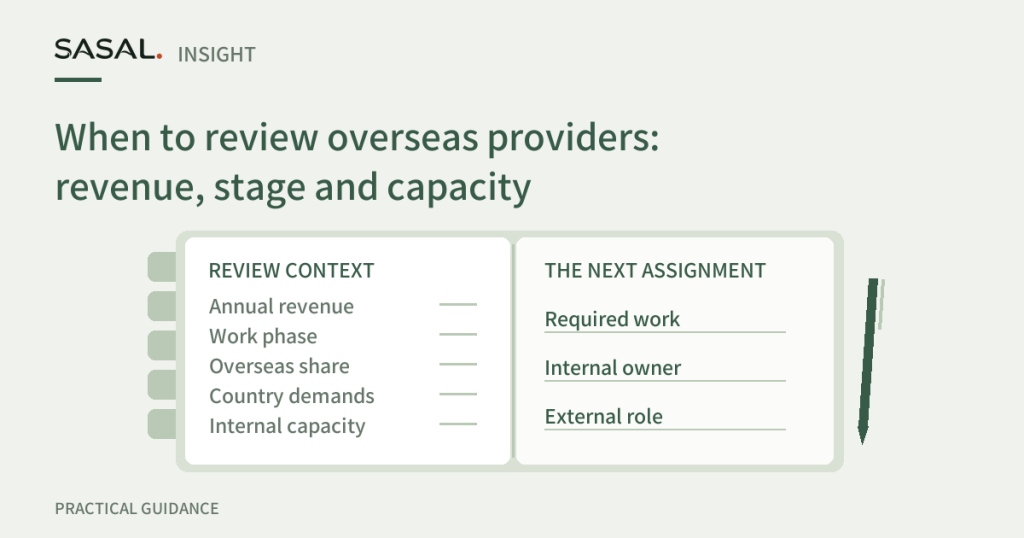
Reviews of overseas advisory, research or implementation providers are often framed as judgments about the provider or about a company’s overall maturity. A more useful approach is narrower. Start with the next assignment that requires a decision, identify what has changed in the work itself, and then examine whether current support still matches that requirement. Annual revenue can help describe context, but it does not determine when a review should occur or what support is appropriate. The more informative signals are the phase of work in each market, the nature of overseas activity, the operating demands involved and the internal capacity available to own decisions. A review may confirm the existing arrangement, adjust responsibilities or identify a different support need without assuming that a switch is required.
Review the next assignment, not a company-wide maturity label

A review of an overseas support provider is most useful when it focuses on a defined upcoming assignment rather than a broad judgment about organizational sophistication. Companies often conduct different kinds of international work simultaneously. One market may still require exploratory research while another involves recurring customer delivery or partner coordination. Applying a single maturity label to the whole business can therefore obscure the practical question that matters most: what work must be completed next, and what support does that work require? By framing the discussion around a specific assignment, management can compare objectives, deliverables and responsibilities more clearly. This approach reduces the risk of changing providers because of general impressions instead of examining the actual demands of the next commitment.
The assignment under review should be described in operational terms. Examples might include validating customer demand, assessing potential partners, supporting a market visit, coordinating implementation activity or preparing evidence for an internal approval process. Each of these assignments creates different requirements for research, communication, specialist input and project management. A provider that was effective during an exploratory phase may still be suitable, or may need a narrower or broader role depending on the changed work. The review therefore begins by identifying the decision the assignment is intended to support. Once that decision is visible, it becomes easier to determine whether existing support capabilities align with what the business now needs rather than what it needed previously.
The same principle applies when internal structures evolve. A company may add personnel, redistribute responsibilities or appoint a clearer owner for overseas activity. Those changes affect how external support fits into the overall process. New internal capacity does not automatically mean that outside support should be reduced, just as limited internal resources do not automatically justify expanding a provider’s role. The practical question is which tasks remain inside the company, who has authority to make decisions and how information will move between participants. A review centered on a defined assignment encourages management to examine these interfaces directly instead of relying on assumptions about organizational growth or complexity.
Reviews are also easier when activity is connected to evidence. Meetings, research outputs, interviews and coordination efforts become meaningful when they help the company decide something concrete. Suggested review questions may include what decision the assignment supports, what evidence is still missing and which responsibilities belong internally. If the current provider contributes effectively to those needs, continuing unchanged may be the most reasonable outcome. If requirements have shifted, adjustments can be discussed from observable work rather than personal preference. The result is a practical evaluation focused on future execution. That keeps the review tied to business needs and avoids treating provider selection as a company-wide identity statement.
Use annual revenue to establish context, not a switching threshold
Annual revenue can help provide context when considering overseas support, but it should not be treated as a trigger for changing providers. Revenue describes part of a company’s scale, yet it does not reveal available management time, funding flexibility, decision authority or operational capacity. Two organizations reporting the same annual revenue may face very different coordination requirements. For that reason, revenue is most useful as background information that helps interpret other signals. It can indicate the general environment in which decisions are made, but it does not establish what type of support is appropriate, whether a review is necessary or whether a provider relationship has become unsuitable. Those conclusions require additional operational evidence.
When revenue is used in comparisons, consistency matters. Management should compare figures from the same reporting perimeter, period and currency definition before drawing conclusions. Even then, revenue remains only one reference point. A company may experience increasing customer commitments while maintaining similar revenue, or it may report higher revenue without adding meaningful capacity for overseas work. Revenue therefore cannot be used as a substitute for examining actual workloads, decision processes and resource constraints. The review conversation becomes more useful when leaders ask what work must be coordinated, who owns it and where bottlenecks appear. These questions reveal operational realities that revenue alone cannot describe with sufficient accuracy.
It is also important to separate revenue from other business conditions. Revenue does not measure profit, available cash or staffing resources. A company with growing sales may still have limited capacity to support new overseas initiatives, while another organization with similar revenue may have established processes and available management attention. Suggested review methods therefore examine the practical environment around the assignment. Management can look at decision speed, ownership clarity, backup coverage and the ability to respond to customer or partner requirements. These observations provide more direct evidence about support needs than assumptions derived from headline revenue figures. They help keep provider reviews grounded in the actual operating situation.
Use the revenue discussion to establish the scale of the business being described, then ask whether that description matches the assignment being commissioned. A group may report substantial consolidated revenue while its new overseas project has only one part-time owner. A specialist subsidiary may have a much smaller revenue base but dedicated people who already manage the relevant customers. In either situation, a useful briefing identifies which organization will buy the support, which team will use the output and which manager controls the project resources. Explain that relationship to the provider. Group scale can affect the stakeholders involved, but it does not tell the provider how much work the project team can absorb or authorize.
Locate the phase of the work in each market
Provider reviews become more precise when managers identify the phase of work being performed in each market. International activity does not always progress through a single company-wide sequence. One country may be at an exploratory stage, another may be validating demand and a third may already involve recurring commercial activity. Different functions within the same market can also be at different phases. Customer development, operational delivery and legal setup may not advance at the same pace. Reviewing support without recognizing these differences can produce misleading conclusions because the required capabilities vary substantially. A provider that is highly effective during one phase may not be the primary resource needed during another, even if performance remains strong.
The phase should be defined by the work being undertaken rather than by assumptions about organizational maturity. Exploration may focus on gathering evidence and identifying unanswered questions. Validation may involve testing whether customer requirements, delivery conditions or partner arrangements can support a larger commitment. Recurring operation introduces a different set of concerns, including coordination, continuity and ongoing decision support. These distinctions help management evaluate whether current support aligns with present objectives. The purpose is not to force every market into a common framework. Instead, it is to understand the specific assignment underway and determine whether the provider’s strengths match that assignment. This keeps reviews connected to observable work rather than abstract classifications.
Different forms of overseas presence can also coexist. A company may sell remotely in one location, work through a partner elsewhere and maintain a local operating structure in another market. These arrangements are not mandatory sequential steps and may overlap according to business needs. As a result, provider requirements should be assessed in relation to the function being performed. Support that is valuable for evaluating a potential partner may differ from support needed to coordinate established operations. Management can therefore review each market according to its current phase and operating objective. This approach avoids assuming that all international activities should receive identical support simply because they belong to the same organization.
A practical review can conclude by documenting the work package under consideration. Suggested elements include the business context, the changed work being requested, available internal capacity, the proposed external role and the evidence needed to confirm whether the current provider remains a good fit. The answer may be to continue unchanged, refine responsibilities or supplement existing support with specialist input. The key point is that phase identification should inform the decision. By locating the actual stage of work in each market, management gains a clearer basis for evaluating support requirements and avoids treating provider reviews as broad judgments about corporate development.
- ExplorationGather evidence, clarify questions and define what decision the work should support.
- ValidationTest assumptions, examine delivery conditions and evaluate whether commitments are practical.
- Recurring operationCoordinate ongoing activity, reporting and continuity across stakeholders.
- Presence developmentAssess which operating functions need support and who will perform them.
Read overseas revenue share with its underlying amounts
Overseas revenue share can be a useful management signal, but only when it is read together with the amounts underneath the percentage. A change in share may reflect growth in overseas activity, a decline in domestic activity, or both at the same time. For provider reviews, the operational question is not whether the ratio looks high or low. The question is what customer commitments, delivery responsibilities and coordination demands the underlying business now creates. Management can therefore begin by confirming how overseas revenue is defined, which reporting perimeter is being used and whether the comparison period is consistent. Without that context, percentage changes can suggest a shift in support needs that has not actually occurred in practice.
The numerator deserves as much attention as the denominator. If overseas revenue rises from additional customers, new service obligations or broader geographic coverage, the workload behind that increase may matter more than the percentage itself. Conversely, a stable overseas share may conceal substantial changes in operational complexity if the absolute volume of work has expanded. When reviewing an incumbent provider, suggested questions include what activities generated the revenue, which commitments require continuing attention and whether new responsibilities have appeared since the previous engagement. This approach connects revenue information to observable business activity. It also helps avoid assumptions that a changing ratio automatically justifies expanding, reducing or replacing external support.
For a hypothetical denominator example, suppose overseas revenue stays at US$4 million while total annual revenue falls from US$40 million to US$32 million on a comparable reporting basis. Overseas share rises from ten percent to 12.5 percent, even though the overseas amount has not grown. The currency and amounts are illustrative, not recommended business-size categories. Before expanding a provider's scope in response, examine whether customer volumes, service obligations or the next assignment actually changed. Management may still need a review because lower overall revenue affects available resources, but that is a different reason from overseas growth. This is a management comparison; use the company's established reporting definitions rather than treating the example as an accounting rule.
Revenue share should therefore be treated as contextual evidence inside a broader review. A small proportion of total revenue may still represent a strategically important dependency if particular customers or commitments require careful support. Likewise, a larger proportion may involve routine repeat orders that place limited demands on management attention. Suggested review methods include mapping the changed work expected during the next commitment, identifying who owns critical decisions internally and determining what evidence would confirm that the incumbent remains aligned with those needs. The outcome may be no change at all. The value comes from understanding the work behind the numbers instead of treating the ratio as a decision rule.
Count different operating demands, not countries alone
Country count is often used as a shortcut when discussing international complexity, yet the number of countries involved does not by itself reveal how much support is required. Some activities can be coordinated through shared processes, common customers or centralized delivery arrangements. Others create genuinely different operating demands because customer expectations, coordination requirements or delivery structures vary. When reviewing an overseas provider, management can therefore distinguish active operations from pilot activity, dormant records or historical relationships that no longer generate meaningful work. This produces a clearer picture of the assignment ahead. The focus remains on what must be managed rather than on how many country names appear in a report.
Different countries can place very different demands on internal teams. A company may support several locations through one recurring model that requires little adaptation. Another may face distinct contracting approaches, approval paths or customer service expectations even with fewer locations. The practical review question is which differences generate additional work for the business. Suggested analysis includes identifying where decisions must be customized, where communication channels diverge and where local coordination affects delivery. This avoids the common assumption that more countries automatically require more external support. Complexity should be demonstrated through actual operating demands. Provider roles can then be evaluated against those demands rather than against a simple geographic count.
The distinction between shared delivery and separate operating requirements is especially important. A business might serve customers in several countries while relying on a common team, a common support process and similar reporting structures. In that situation, additional country records may add limited management burden. By contrast, a smaller geographic footprint may involve multiple customer groups, specialist partners or approval pathways that require substantial coordination effort. Reviewing support through operating demands helps management identify where external assistance contributes most effectively. It also prevents country expansion from being treated as a universal explanation for every capacity challenge. The relevant evidence concerns work performed, decisions made and commitments maintained.
A useful review outcome is a description of the next work package rather than a judgment about geographic reach. Management can specify which markets require exploration, which involve validation activity and which depend on recurring delivery. The proposed external role can then be linked to those operational realities. For example, support may be directed toward coordination across several stakeholder groups, evidence gathering in a new market or maintaining continuity in an established activity. These are illustrations rather than prescriptions. The key principle is that countries are not the unit of analysis. Different operating demands provide a more reliable basis for evaluating whether an incumbent provider remains an appropriate fit for future work.
Measure internal capacity through time, skill, authority and cover
Internal capacity is often discussed in terms of headcount, but provider reviews benefit from a more operational assessment. The critical factors are usually available time, relevant skill, decision authority and continuity when key people are unavailable. A company may have several employees connected to overseas activity while still lacking the capacity to move decisions forward efficiently. Conversely, a small team with clear ownership and appropriate authority may manage substantial responsibilities effectively. When considering whether support remains suitable, management can examine who performs essential tasks, who approves decisions and how information flows between participants. These observations provide direct evidence about capacity. They are often more useful than organizational charts or job titles alone.
Available time deserves particular attention because international work frequently competes with domestic responsibilities. An individual may possess the necessary expertise yet have limited ability to coordinate stakeholders, review evidence or respond to emerging issues. Capacity reviews can therefore distinguish nominal responsibility from practical availability. Suggested questions include how much attention the assignment realistically requires, whether decision-makers can respond within needed timeframes and whether competing priorities reduce execution quality. These questions help clarify the support profile for the next commitment. They also reduce the risk of attributing delays to an external provider when the underlying constraint is insufficient internal availability to review, decide or coordinate required actions.
Authority is equally important. External advisers can produce research, facilitate discussions or coordinate implementation, but progress often depends on internal decisions. If approval rights are unclear, escalation routes are uncertain or local and headquarters responsibilities overlap without definition, additional provider effort may not resolve the underlying issue. Reviews can therefore examine where authority sits and whether the people closest to the work can act within agreed boundaries. Relevant evidence may include decision turnaround times, recurring approval bottlenecks and the clarity of responsibility for customer commitments. Understanding these factors helps determine whether the incumbent's role should remain focused on execution, broaden into coordination support or simply continue unchanged.
Continuity and deputy coverage complete the picture. A capable owner who holds all project knowledge may still represent a capacity risk if absence interrupts progress. New hires can strengthen capability, but they usually require handover, context and access to decision history before they contribute fully. For that reason, reviews should assess whether knowledge is documented, whether another person can follow the work and whether responsibilities can continue through personnel changes. A practical support profile might conclude with a defined deliverable, an internal owner, clear authority boundaries, evidence expected from the provider and an event that would reopen review. Renewal may be one trigger, but operational changes can justify reassessment as well.
Combine the signals into a support profile for one work package

After reviewing revenue context, work phase, overseas revenue share, operating demands and internal capacity, the next step is to combine those signals into a support profile for a specific work package. The objective is not to classify the company. It is to describe the next assignment clearly enough that management can judge whether current support still fits. A useful profile begins with business context. That context may include annual revenue, overseas activity and current market involvement, but only as background. The central question concerns the work that has changed. For example, the assignment may have shifted from gathering market evidence to coordinating a customer validation process. The review should therefore focus on the changed workload rather than on company labels.
The work package can then be described in operational terms. Suggested elements include the decision to be supported, expected deliverables, participating departments and time horizon for action. Once those factors are visible, management can examine internal capacity using the practical signals discussed earlier. Available time, authority, relevant skills and deputy coverage often influence provider fit more directly than organization size. A team may understand a market well but lack time to coordinate interviews, document findings and prepare decision materials. Another team may have capacity to manage research internally but need specialist support for assessment or facilitation. The support profile captures those realities without assuming that any single organizational structure represents best practice.
The external role should be defined only after the changed work and internal capacity are understood. In some situations, the provider may remain responsible for research while internal teams take over coordination. In others, the provider may help connect information from several departments and present options for approval. These are illustrative possibilities rather than recommended outcomes. The key principle is alignment between actual work and actual capacity. If management cannot explain which tasks remain external and which stay internal, reviewing provider fit becomes difficult. A practical profile therefore identifies responsibilities, decision boundaries and expected outputs before discussing continuation, expansion or reduction of external involvement.
Make the profile testable with a small sample of the work being discussed. If the next assignment connects customer validation with an internal approval meeting, ask how the provider would organize unresolved questions, distinguish observations from assumptions and pass a decision to the internal owner. An existing report or a walkthrough of the proposed method may provide evidence without commissioning the whole project first. Agree separately on any new paid trial and its scope. Compare that evidence with the actual brief: does it answer the questions, reach the right decision-maker and leave a usable record? Familiarity with the provider is helpful context, while this examination shows whether the proposed role fits the upcoming assignment.
- Work phaseIdentify whether the assignment concerns exploration, validation, recurring activity or another defined objective.
- Revenue share contextReview underlying customer commitments and workload, not percentages alone.
- Operating demandsExamine distinct coordination and delivery requirements created by the work.
- Internal capacityAssess time, authority, skills and continuity available inside the organization.
Two companies with the same revenue can need different support
Consider two hypothetical companies, each reporting US$20 million in annual revenue and US$2 million in overseas revenue, a ten percent share. Use the same full-year consolidated perimeter and a consistent definition of overseas revenue for this comparison. US dollars are a reference currency for the example, not a threshold for changing support. Company A serves one overseas country through recurring standardized orders. Company B is validating customized delivery in four countries. Both need to decide what to commission next. Their annual revenue and overseas share provide the same starting context, but the phase, operating demands and available people produce different assignments. The comparison concerns those specified facts, not a general claim about firms of this size.
Company A has an internal owner who can coordinate delivery, resolve routine questions within delegated authority and hand work to a deputy during absence. Its next assignment is a focused review of a new customer requirement before accepting an amendment to an existing order. The current provider might supply targeted research or coordinate the relevant specialist's advice, while the internal owner checks delivery implications and obtains any necessary approval. The review question is whether the provider can perform that defined task and explain what remains outside its expertise. Recurring orders do not eliminate the need for specialist support; they make it possible in this example to separate a particular unresolved question from operations already handled internally.
Company B's next assignment is to compare the delivery conditions of several customer pilots before choosing which commitments to take forward. Its product and commercial employees have relevant knowledge, but their available coordination time is limited and exceptions require internal approval. A useful external role could organize customer findings, distinguish shared requirements from genuinely different ones and prepare options for a scheduled decision. Management would still name an internal owner with time to review those options and obtain approvals. Four countries are not automatically harder than one: the specified customized work and limited coordination capacity create the need here. Shared delivery processes or different internal availability could change the proposed role even with the same country count.
Test each proposal by changing a fact in the profile. If Company A loses its internal owner, the narrow assignment may need additional coordination and continuity support. If Company B brings in an experienced owner with available time, part of that coordination may move inside after a verified handover. Neither firm's annual revenue has to change for the appropriate external role to change. Equally, the same incumbent could remain suitable if it can deliver the revised role with the agreed team and capacity. These variations help managers explain the reason for a review: a named responsibility or decision has changed, and the proposed support responds to that change. The figures alone do not provide that explanation.
Shape outside support for exploration and validation
Exploration and validation assignments often require different forms of support even when they occur within the same market. Exploration is typically concerned with identifying questions, gathering evidence and clarifying what decision should follow. Validation focuses more directly on testing assumptions that could justify a larger commitment. Reviewing a provider in these circumstances begins with defining the purpose of the assignment. If the organization is still determining whether an opportunity deserves attention, broad coordination and structured research may be useful. If management already has a working hypothesis, support may instead concentrate on confirming specific customer, delivery or partner assumptions. The distinction matters because provider fit depends on the decision being supported rather than on a generic expansion objective.
External roles should connect clearly to internal decision processes. Suggested questions include who sponsors the assignment, who approves outcomes and what evidence the decision forum expects to review. A provider may contribute research, third-party assessment, facilitation or specialist advice, but those functions should be tied to an identifiable decision. Exploration work that produces extensive information without a clear decision route can create activity without improving clarity. Validation work may face a similar problem if evidence requirements are not agreed in advance. Defining the expected internal use of findings helps management evaluate whether the incumbent's strengths remain relevant. It also makes deliverables easier to compare when alternative support approaches are considered.
When reviewing support during exploration or validation, management can compare the proposed external role with the provider's demonstrated capabilities. Some providers are strongest when structuring uncertainty, coordinating inputs and helping define a sequence of actions. Others may be better suited to specialized assessments or implementation-oriented tasks. No category is inherently superior. The question is whether the assignment requires those capabilities now. Comparative proposals can sometimes help clarify the available options, particularly when the scope remains uncertain. Such comparisons should focus on methods, outputs, exclusions and internal responsibilities. Price alone does not reveal suitability because different proposals may address fundamentally different work. Understanding those differences improves the quality of the review.
A practical outcome is a concise work-package brief. Management might document the context, the concrete change in work, the internal owner, authority boundaries, the proposed external role and the evidence expected from the provider. The brief can also identify an event that would reopen review, such as completion of a validation exercise, a significant change in internal capacity or a new customer requirement. Renewal may be one review point, but it should not be the only one. By linking support decisions to observable assignments and evidence, organizations can review overseas providers constructively. The review may confirm continuation, refinement or another arrangement, but it remains anchored to the needs of the next commitment.
Reshape support for recurring delivery and cross-country coordination
When overseas activity becomes recurring, the review question changes from whether an opportunity exists to how commitments will be coordinated and sustained. Customer support, reporting, quality management, logistics, finance and commercial communication may all require ongoing attention. A provider that previously focused on research can still remain relevant if its capabilities match the new work, but the review should examine the operational tasks now being performed rather than assuming continuity or replacement. Management can map the recurring activities attached to the next commitment and identify which responsibilities require structured coordination. The resulting discussion is about work allocation. It is not a judgment that recurring delivery is inherently more advanced than exploration or validation in another market.
Cross-country coordination should be evaluated through actual operating demands. Several countries may share common processes, customer types and reporting structures, reducing the need for separate external support. In other situations, a smaller number of markets may generate substantial coordination work because approvals, delivery arrangements or customer expectations differ. Suggested review questions include which decisions must be synchronized, which information must be shared and where delays occur when responsibilities cross functions or locations. This analysis helps management distinguish between geographic reach and coordination burden. A provider's role can then be assessed against observable needs such as communication management, evidence consolidation or operational follow-up rather than the simple count of countries involved.
Internal authority becomes particularly important once recurring activity develops. Customer-facing teams may need timely responses, while headquarters or central management retains responsibility for oversight and significant commitments. If decision rights are unclear, external support can become trapped between stakeholders who cannot act. Reviews therefore benefit from documenting who decides, who executes and how escalation occurs when issues arise. A provider may contribute by organizing information and maintaining momentum, but it cannot substitute for missing internal authority. Clarifying decision boundaries also helps determine whether the incumbent should continue in a coordination role, focus on specialized assignments or provide support only when specific issues emerge within the recurring operation.
Continuity deserves attention alongside coordination. Personnel changes, competing priorities and fragmented records can interrupt progress even when demand remains stable. Suggested review methods include checking whether project history, assumptions, open issues and responsibilities are documented well enough for another person to continue the work. A provider may add value by maintaining structured records or supporting handovers, particularly when multiple departments participate. Evidence of fit should therefore relate to continuity outcomes rather than activity volume alone. The practical result is a work package with defined responsibilities, named internal ownership and a clear explanation of how external support contributes to recurring delivery and cross-country coordination.
Check the proposed role with the current provider
After defining the desired support profile, management can test it against the capabilities of the current provider. The objective is not to defend an existing relationship or search for reasons to replace it. Instead, the review asks whether the proposed work matches the provider's actual strengths, delivery model and engagement capacity. Providers operating under similar labels may offer different combinations of research, coordination, implementation support and specialist input. A practical conversation therefore starts with the future assignment. Management can describe the changed work, internal responsibilities and expected outputs, then examine whether the incumbent can deliver that specific role effectively. Evidence should relate to future needs rather than historical familiarity alone.
The comparison becomes clearer when responsibilities are explicit. Suggested topics include which activities remain internal, what information the provider needs, who will approve decisions and how progress will be reported. A provider may be capable of performing a narrower assignment than before, a broader one or a collaborative role alongside another specialist. None of those outcomes automatically indicates success or failure. The key issue is alignment between required work and available capability. By focusing on deliverables, decision support and coordination requirements, management can avoid evaluating the provider through assumptions about company size, revenue or market count. The discussion stays connected to the practical demands of the next commitment.
Where uncertainty remains, comparative proposals may help clarify options. This is particularly useful when the company is entering unfamiliar territory or redefining the scope of support. Comparative proposals should be based on the same objectives, timing assumptions, internal capacity description and desired outcomes. Differences in methods, exclusions and outputs can then be examined meaningfully. The purpose is not to force providers into identical approaches. Rather, it is to improve the company's understanding of what work is actually being commissioned. Even if the incumbent remains the preferred choice, the comparison can reveal assumptions that require adjustment and help management define the assignment more precisely.
Reviews should also consider continuity. If the proposed role depends on project history, accumulated knowledge or established coordination routines, management can ask how that knowledge will be maintained and shared. Personnel changes, internal restructuring and new stakeholders may affect the usefulness of prior experience. Evidence of fit may therefore include the provider's ability to explain past decisions, connect them to current objectives and support orderly handovers when needed. A review can reasonably conclude that the incumbent remains appropriate without modification. It can also support a refined scope. The important point is that the conclusion follows from the requirements of the work package rather than assumptions about loyalty or change.
Set evidence-based review points around the next commitment
A provider review is most useful when it is tied to evidence and future decisions. Rather than waiting for a contract renewal alone, management can define review points around the next commitment being undertaken. The commitment might involve validating a customer opportunity, coordinating recurring delivery, supporting an approval process or implementing a defined operational change. By identifying the decision that follows the work, the company creates a clearer basis for evaluating support. The review then asks whether the required evidence was produced, whether decision-makers could use it and whether responsibilities were fulfilled as expected. This approach keeps evaluation connected to outcomes that matter operationally rather than to the volume of activity performed.
Evidence should be linked to the purpose of the assignment. During validation work, management may ask whether key buying or delivery questions were answered. During recurring operation, the focus may shift toward coordination quality, continuity and the ability to support decisions efficiently. Suggested review questions include what the work enabled the company to decide, what uncertainties remain and which assumptions changed during execution. These questions help distinguish a change in business needs from dissatisfaction with agreed work. They also reduce the risk of interpreting every challenge as a provider problem when the underlying issue may involve internal authority, capacity or changing commercial conditions.
Review points can also be attached to identifiable events. Examples might include completion of a pilot activity, approval of a new operating arrangement, onboarding of a new internal owner or a significant shift in customer commitments. These events often alter the type of support required more directly than the passage of time. Management can therefore document in advance what evidence will be examined when the event occurs. Doing so creates transparency for both the company and the provider. It also supports continuity because future reviewers can understand the basis on which support was assessed rather than relying on memory or informal impressions.
A completed brief might read as follows: the next commitment is a customer pilot; the external assignment is to consolidate buying and delivery questions into options for the internal review meeting; the commercial owner will review the evidence with product and finance; exceptions to delivery promises remain subject to internal approval. The incumbent will explain who performs the work and show how unresolved questions reach that owner. Completion of the pilot, or a change in the owner's availability before then, will reopen the support review. This is an illustrative brief, not a mandatory format. It turns the five reference points into a concrete assignment that both parties can discuss, while leaving the decision to continue, adjust or change support grounded in actual requirements.
- Define commitmentRecord the work package, decision objective and responsibilities.
- Gather evidenceCollect outputs, observations and decision-relevant findings.
- Review fitCompare evidence with the proposed external and internal roles.
- Update support planConfirm, refine or revisit the arrangement for future work.
Next commitment or review-trigger event