

Change expansion providers while keeping a good relationship
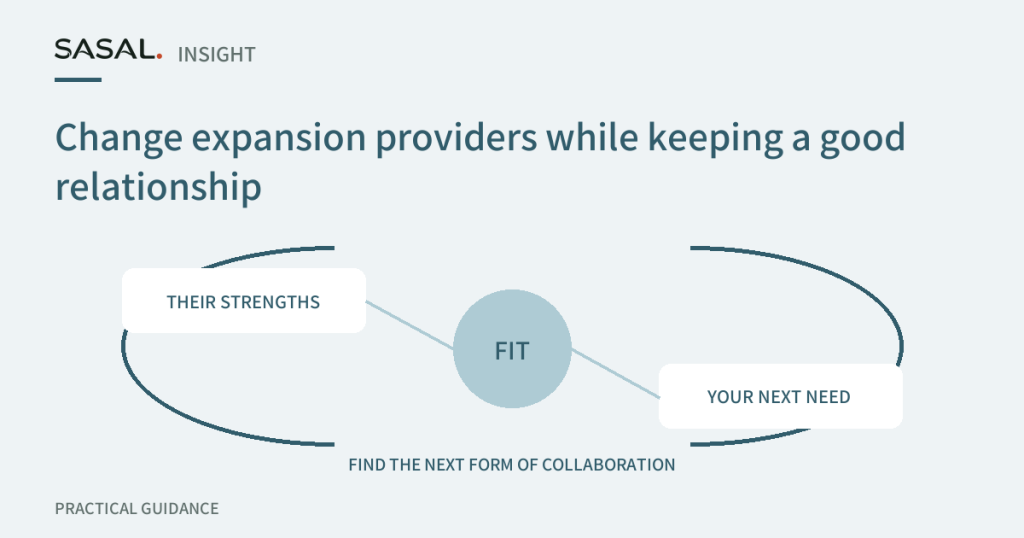
An overseas expansion partnership can help a company reach a new stage and then take a different form. Research may give way to implementation, an internal team may gain capability, or the work may require another specialist. The existing provider can still have valuable strengths, its own growth plans and a clear idea of the work it wants to pursue. A constructive transition starts by understanding those ambitions alongside the client's next needs. Where there is genuine overlap, the companies can explore a focused role, complementary collaboration or an appropriate introduction. Where there is none, they can complete the current role without promising another contract. This article explains how to discover that overlap and turn it into practical arrangements, while recognizing completed work accurately and respecting responsibilities and permissions.
Treat the change as a new shape for the relationship

Many companies approach a provider change as a binary choice between continuing exactly as before and ending the relationship entirely. That framing can create unnecessary tension because it assumes the existing arrangement must either survive unchanged or disappear. A more practical approach is to examine the work that actually needs to be done next. The provider may have helped answer early market questions, coordinate research or support decision making, while the next phase requires different expertise. Treating the discussion as a redesign of responsibilities encourages a forward-looking conversation. It allows both sides to focus on future business needs, real capabilities and useful contributions rather than debating whether past work was successful enough to justify continuation.
The quality of the relationship often depends on whether completed contributions are described accurately. If a provider helped clarify options, organize evidence or support a decision process, that work can be acknowledged without exaggeration. Equally, if certain objectives remain unresolved, those realities should not be concealed. Preserving trust does not require praise that neither side believes. It requires a shared understanding of what was achieved, what remains uncertain and what type of support is now needed. This distinction matters because relationship redesign works best when decisions are grounded in observable work and outcomes. A company that changes providers while accurately describing prior contributions creates a stronger foundation for future interactions than one that rewrites the history of the engagement.
Several relationship outcomes may be legitimate. The existing provider might continue in a narrowly defined specialist role. Both sides might agree to periodic reviews instead of ongoing involvement. A complementary specialist could be introduced if all parties believe there is genuine value and permission is granted. A project phase might simply conclude, with no further work promised and no expectation of future demand. Full separation can also be appropriate. The important point is that none of these arrangements should exist merely to preserve goodwill. They should exist because they serve a real business purpose. If no such purpose remains, an orderly ending may be more respectful than maintaining a role that neither side truly needs.
Continuity supports trust during any change. Information, decisions, responsibilities and permissions should remain understandable when people or providers change. A useful handover focuses on the history of decisions, current objectives, open questions and agreed responsibilities rather than creating dependence on personal memory. Clear boundaries also help avoid confusion about who owns future work. The client retains responsibility for business decisions, while external specialists contribute within defined scopes. When continuity is planned carefully, a provider transition becomes less about replacing individuals and more about ensuring that relevant knowledge, context and commitments remain usable as the business moves into a new phase.
- Provider desired directionAsk what work, strengths and positioning the provider wants to develop rather than assuming motives.
- Client next needDefine the capability or support required for the upcoming stage of activity.
- Real overlapIdentify specific work that creates value for both sides if responsibilities remain clear.
- Boundaries and permissionsConfirm role limits, information use and future contact only where useful.
Ask what kind of work the existing provider wants next
A common mistake is assuming that the provider wants any available work as long as revenue continues. Organizations often have preferences about the types of projects they pursue, the expertise they want to develop and the clients they can serve effectively. Those preferences should not be guessed. Instead, the client can ask directly about the provider’s future direction. Questions might explore which engagements they find most valuable, what strengths they want to apply more often and which types of assignments fit their plans. The purpose is not to negotiate on the provider’s behalf. It is to understand whether there is meaningful overlap between the provider’s desired direction and the client’s evolving needs before any future role is considered.
The answer may reveal opportunities that are narrower than the current engagement. A provider that previously coordinated many activities might prefer a specialist advisory role in a particular area. Another may be interested in periodic reviews rather than day-to-day involvement. Some may indicate that they do not see a strong fit with the next phase at all. Each response provides useful information. The client can then evaluate actual value rather than maintaining assumptions. This approach also avoids treating access to contacts, introductions or market knowledge as obligations that automatically transfer into future work. Any future collaboration should be based on explicit agreement and mutual benefit rather than expectations created by past involvement.
Hypothetically, a company moving from market exploration into operational execution may discover that its current adviser most enjoys helping organizations define priorities and evaluate options. The adviser might have little interest in managing ongoing implementation. In that situation, retaining a focused review role could create value if both sides agree. Equally, the adviser may prefer to conclude the engagement after completing the earlier phase. Neither outcome indicates failure. The useful insight is that role design improves when the provider’s stated preferences are understood directly. Assumptions about what they should want can easily produce arrangements that satisfy neither side and create confusion about expectations.
Future opportunities require particular care. Some companies consider referrals, introductions, case-study references or endorsements as ways to preserve a positive relationship. These possibilities should be approached cautiously and only where genuine fit exists. A referral should not be promised before a suitable opportunity appears. A reference should not be offered without mutual permission and accurate representation of the work completed. Broad introductions should not be treated as a debt owed by either side. By discussing possibilities as optional outcomes rather than commitments, the client can explore mutual value honestly while preserving the freedom of both organizations to make independent business decisions.
Understand the company’s direction as well as the contact’s role
Provider relationships are often managed through one primary contact, but that individual’s interests may not perfectly match the organization’s broader direction. A productive discussion therefore examines both levels. The contact may have particular expertise, career goals or project preferences, while the company may be investing in different services, industries or operating models. Understanding only one side can lead to inaccurate conclusions about future fit. When considering a relationship redesign, it is useful to ask how the organization itself wants to position its services and where it believes it creates the strongest value. This helps distinguish personal preferences from business priorities and reduces the risk of designing a role that lacks support within the provider’s wider team.
The distinction becomes especially important when responsibilities are distributed across several people. As organizations grow, knowledge, authority and delivery work may sit in different functions. A proposal that appears attractive to one contact may require involvement from others who own resources, approvals or specialist expertise. Exploring organizational direction helps reveal whether the provider genuinely wants a particular role and whether it can deliver that role consistently. It also supports continuity if personnel change later. A relationship built solely around one individual can become fragile, whereas a relationship grounded in understood responsibilities and organizational capabilities is more resilient during transitions.
Hypothetically, a client may believe that retaining the existing provider for ongoing coordination would preserve continuity. After discussion, however, the provider might explain that its strategic focus is shifting toward specialist analytical work rather than broad project management. The individual contact may personally enjoy coordination activities, yet the company may no longer prioritize them. Alternatively, the organization may be expanding a specialist service that aligns closely with the client’s future needs. The value comes from discovering these realities through conversation rather than assumption. Decisions become more credible when they reflect what the provider actually wants to build and support, not what the client imagines would be convenient.
Once both organizational and individual perspectives are understood, the relationship redesign map becomes practical. The client can compare its next requirements with the provider’s preferred direction, identify areas of genuine overlap, define role boundaries and confirm permissions regarding information sharing or future contact. Some discussions will reveal a useful continuing role. Others will reveal that a clean ending is the most sensible outcome. Neither result guarantees goodwill, future opportunities or continuing collaboration. The objective is more modest and more reliable: creating an arrangement that reflects real business value, respects continuity requirements and leaves each party free to pursue the work that best fits its objectives.
Connect changing client needs with the provider’s real strengths
A provider relationship can appear misaligned when the client’s next objectives change, even if the earlier engagement was valuable. Rather than beginning with the question of who should stay or leave, it is often more useful to define the work now required. A company moving from market exploration into partner management, customer support, operational delivery or internal capability building may need different forms of assistance than before. That shift does not automatically imply that the existing provider performed poorly. It may simply mean that the decision, evidence and coordination needs have changed. By describing the upcoming work clearly, the client creates a basis for discussing where the provider’s strengths remain relevant and where another specialist may add value.
Many support relationships become strained because capabilities are assumed rather than examined. A provider may be known for broad strategic guidance, but the next phase may require a narrow specialist contribution. Another provider may excel at gathering evidence that supports decisions but have little interest in day-to-day execution. The client can test fit by discussing actual tasks, decisions and responsibilities instead of service labels. Useful questions focus on what the provider believes it does particularly well, where it has confidence creating value and which assignments it prefers to pursue. The purpose is not to persuade the provider into a new role. The purpose is to understand whether genuine overlap exists between future needs and demonstrated strengths.
Hypothetically, a company preparing to support customers in several markets may discover that its current adviser contributed most effectively by organizing uncertain information and helping leadership evaluate options. The company’s next challenge, however, could involve operational coordination across multiple suppliers and internal teams. In that case, retaining the adviser as a periodic reviewer might create more value than expecting it to manage implementation. Equally, discussion could reveal that the adviser wants to deepen its involvement in a specialist area that remains important to the client. Both outcomes arise from examining actual capabilities and future requirements rather than treating continuity as a goal in itself. The relationship evolves because the work evolves.
This approach also helps separate business value from symbolic gestures. A provider should not be retained solely because ending the engagement feels uncomfortable. At the same time, useful expertise should not be discarded simply because another specialist becomes involved. The practical question is whether a defined responsibility contributes to future decisions or execution. If the answer is yes, a focused role may be worth considering. If the answer is no, completion of the engagement may be the most appropriate outcome. Existing contractual obligations, information rights and agreed responsibilities still need to be respected, but those considerations are different from deciding whether future work creates real value for both organizations.
Explore a focused specialist role when both sides need it
A change of provider does not always require complete replacement. In some situations, the most effective arrangement is to narrow the incumbent’s responsibilities while introducing another specialist for new requirements. This option works best when the retained role is specific, useful and understood by everyone involved. Vague expectations often create duplication, conflicting advice or uncertainty about accountability. A focused specialist role should therefore be linked to identifiable decisions, expertise or reviews rather than a general desire to preserve the relationship. Defining the purpose clearly allows the client to evaluate whether the contribution remains worthwhile and helps the provider decide whether the role aligns with its own priorities and capacity.
Periodic review is one possible configuration. A provider that helped evaluate markets, customer questions or expansion assumptions may continue contributing through scheduled reviews of evidence and decisions. Another possibility is specialist support around a defined topic where continuity of knowledge remains valuable. The common feature is that the role serves a practical business function rather than acting as a symbolic connection. The client should avoid assuming that the provider wants such involvement. Some organizations prefer concentrated assignments with clear outputs, while others may welcome an ongoing advisory contribution. Direct discussion is more reliable than inference, particularly when the provider’s direction has evolved since the original engagement began.
Hypothetically, a business entering a more complex delivery phase might appoint a new operational specialist while retaining the original adviser for decision reviews at agreed intervals. The adviser contributes context, historical reasoning and challenge to assumptions, while the operational specialist manages execution responsibilities. Because the roles are distinct, each provider understands its contribution and limitations. Another hypothetical company may explore a similar arrangement and discover that the incumbent has little interest in a continuing advisory role. In that case, the discussion still creates clarity. The value lies not in preserving a role at any cost but in identifying whether a defined contribution benefits both parties under present circumstances.
Boundaries matter as much as the role itself. Responsibilities, information access, communication expectations and decision ownership should remain understandable when multiple specialists participate. The client retains responsibility for business choices, while each provider contributes within an agreed scope. Continuity is strengthened when reasoning, objectives and open issues are documented rather than held only in personal conversations. This reduces dependence on specific individuals and helps future transitions remain manageable. A narrowly defined specialist role can therefore support trust and continuity when it reflects genuine business value. It is not a compromise position between staying and leaving. It is a deliberate operating choice with a clearly stated purpose.
Consider complementary collaboration without forcing a partnership
Complementary collaboration needs a design for how the work fits together. Consider a hypothetical client whose incumbent understands buyer requirements while a new specialist will organize implementation. A useful arrangement could give the incumbent a defined task: explain the observed buying conditions and review whether the proposed implementation addresses them. The new specialist would prepare the implementation plan and identify delivery questions. The client would retain the decision about what it can promise. This distinguishes contributions without requiring either provider to claim expertise it does not have. Describe the boundary through outputs and decisions rather than labels such as strategic partner or local lead, which can mean different things to different organizations. The arrangement should make an actual task easier to complete.
Next decide who combines the contributions. Two useful reports can still leave a gap if nobody is responsible for resolving how their conclusions affect the plan. The client might appoint an internal coordinator to assemble the shared question, obtain each specialist's response and present the remaining choices to the decision owner. Alternatively, one provider might undertake that coordination within an explicitly agreed scope. Neither arrangement should be assumed merely because someone organizes the meeting. For each important question, name who supplies information, who interprets it, who prepares a proposal and who decides. This is a practical working method, not a requirement to add a management layer. In a small team, the same person may perform several of these functions.
Disagreement between specialists also needs a usable route. Suppose the incumbent believes that buyers expect extensive onboarding, while the implementation specialist proposes a narrower service. Ask whether they disagree about the observed buyer requirement, the interpretation of that requirement or the company's delivery choices. The incumbent can explain the research basis; the new specialist can explain what the proposed service includes and excludes. The client can then decide whether further customer investigation or a change in the offer is needed. Do not require the providers to produce artificial agreement simply to keep the relationship comfortable. A well-defined difference can be useful when each party's contribution is visible and the decision owner understands what remains uncertain.
Test the arrangement on a bounded piece of work before assuming that a standing partnership is necessary. The parties could use one implementation question, one proposal review or one planning meeting to establish whether their contributions complement each other. Agree the work, effort, deliverables and permitted information sharing in advance. Afterwards, ask what became clearer, whether responsibilities overlapped unnecessarily and whether either provider was expected to do work outside its remit. The outcome may justify continued coordination, a narrower interface or entirely separate assignments. This gives the client and both specialists evidence about working together. A useful collaboration is one the participants can explain through the work accomplished, without relying on a partnership label or a promise of future projects.
Make introductions only when there is genuine fit and permission
An appropriate introduction can help preserve a good relationship because it responds to something the provider actually wants to develop. After learning which clients, projects or specialist questions interest the provider, the company may recognize a genuinely suitable connection. The value lies in the potential fit for the people introduced, rather than in the act of making an introduction by itself. Ask both sides whether a conversation would be welcome and what information may be shared. There is no need to promise a project or a particular outcome. If no suitable opportunity exists, acknowledging the provider's direction and remembering it for the future can be enough; the client does not need to manufacture an introduction to demonstrate goodwill.
Permission matters as much as fit. A provider may welcome introductions in some circumstances and decline them in others because of capacity, strategic direction or commercial priorities. Similarly, the receiving party may have its own selection process or may not be seeking support at that time. Asking first avoids assumptions about what either organization wants. This approach also respects the distinction between a useful business opportunity and access to a network. Relationships developed during a project are not assets that one side automatically owes to the other. When introductions are discussed openly and voluntarily, they are more likely to be viewed as professional opportunities rather than obligations created by a previous engagement.
A practical method is to separate possibility from commitment. Hypothetically, a client may learn that an incumbent provider wants more work involving market validation while another business is exploring that exact question. The client could ask both parties whether a conversation would be useful. Either side might decline, and that outcome should be acceptable. The value lies in testing potential alignment rather than guaranteeing a result. The same principle applies when a new specialist enters the client’s project. An introduction between providers may help continuity, but only if both organizations believe the exchange serves a defined purpose and understand what information may be shared.
The relationship redesign map can be useful here because introductions work best when they emerge from identified overlap rather than goodwill alone. The client can compare the provider’s preferred direction with current opportunities, define role boundaries and confirm permissions before any connection is made. That process keeps expectations realistic. An introduction does not guarantee collaboration, revenue, endorsements or future demand. It simply creates an opportunity for further discussion if all parties see value. By treating introductions as optional and purpose driven, companies can preserve credibility, avoid implied promises and maintain professional relationships on a foundation of informed consent.
- Identify overlapLook for a specific business need and a provider capability that may fit.
- Ask both sidesConfirm interest, capacity and willingness before sharing details.
- Define limitsClarify what information may be shared and for what purpose.
- Connect if usefulMake the introduction only when all parties see potential value.
Recognize completed work accurately without promising promotion
Recognition is often confused with advocacy. When a provider has contributed meaningfully to an earlier phase, the client may wish to acknowledge that contribution. Accurate recognition can support trust because it reflects what actually happened and what decisions the work enabled. However, recognition does not require future marketing support, endorsements or active promotion. A company can describe completed work honestly while remaining neutral about future opportunities. This distinction becomes important during a provider transition because exaggerated praise may create expectations that the client never intended to fulfill. Credibility is usually stronger when contributions, limitations and outcomes are described with the same level of accuracy.
Mutual permission should guide any public reference to the engagement. A provider may value a case-study mention, a project summary or a reference conversation, but those uses should be discussed rather than assumed. The client may also have confidentiality concerns, internal policies or commercial reasons for limiting disclosure. Where references are considered, the safest approach is to agree what can be said and what should remain private. Recognition should reflect actual work performed rather than implied business results that cannot be attributed solely to one contributor. This protects both parties from misunderstandings and ensures that future audiences receive a truthful account of the engagement.
For a hypothetical example, a company might accurately describe how an adviser clarified market priorities, identified unanswered questions and helped management compare options. If both parties permit that description to be shared, it may help the adviser explain its strengths to a relevant future client. This is a possible benefit worth asking about, not an obligation to provide publicity. Agree what can be said and distinguish the contribution from later work performed by others. Another company may have good reasons to keep the entire engagement private. Accurate recognition can therefore take different forms: a permitted description of completed work, a private factual reference where appropriate, or a clear internal record. The useful question is which form has value and is acceptable to both organizations.
The same discipline applies to future contact. Some projects end with occasional discussions, periodic reviews or later opportunities that genuinely fit the provider’s direction. Others conclude without any continuing role. Leaving the door open does not mean promising referrals, contracts or endorsements. It means preserving the possibility of future communication if circumstances create real value. By separating accurate recognition from promotion, companies can acknowledge meaningful work, respect confidentiality and avoid creating obligations that neither side can confidently support. The result is a relationship based on clear understanding rather than assumptions about what appreciation should require.
A hypothetical relationship moves from lead adviser to specialist

Consider a hypothetical company that originally engaged an expansion adviser to help evaluate overseas opportunities, organize evidence and support leadership decisions. Over time, the business developed clearer priorities and moved toward operational execution involving additional specialists. The client now faces a choice about how responsibilities should evolve. Instead of assuming that the adviser must either remain in charge or disappear completely, the company begins by discussing future needs and the adviser’s preferred direction. Through those conversations, it becomes clear that the adviser is most interested in analytical review and strategic assessment rather than daily implementation management. That information creates the basis for a more focused relationship design.
The client then compares upcoming requirements with the adviser’s strengths. Operational coordination, supplier management and ongoing execution will require capabilities that another specialist is better positioned to provide. At the same time, the adviser retains valuable knowledge about the reasoning behind earlier decisions, unresolved questions and evaluation methods. A specialist review role therefore appears worth exploring. Importantly, the adviser is not retained merely because of history. The proposed contribution is linked to specific decisions that leadership expects to revisit. If either party believed the role lacked value, a clean ending would remain a legitimate option. The relationship continues only because both sides identify a practical purpose.
To support continuity, responsibilities are documented carefully. The company records objectives, open issues, decision history and role boundaries so that knowledge does not depend on personal memory. The new specialist understands which decisions fall within its scope and which discussions may benefit from periodic review by the adviser. Information sharing occurs according to agreed permissions rather than informal assumptions. Existing contractual duties and usage rights continue to be respected, but they do not determine the future structure on their own. What matters most is that each participant understands who performs which tasks and why that allocation supports the company’s current stage of development.
This hypothetical example does not suggest that retaining a specialist role is always preferable. Another company could complete a successful phase, thank the provider through accurate recognition and conclude the engagement with no ongoing involvement. The important lesson is that provider transitions become more constructive when they focus on future value rather than symbolic loyalty. By asking what the provider wants to build, identifying genuine overlap and defining boundaries clearly, the client creates conditions for a professional outcome. Goodwill may follow, but it cannot be guaranteed. The more reliable objective is an arrangement that reflects real needs, real strengths and honest expectations.
A hypothetical project ends well without a replacement contract
Consider a hypothetical company that used an overseas expansion adviser during an exploratory phase. The adviser helped leadership clarify questions, compare options and assemble information needed for decisions. As the project matured, the company discovered that the next challenge was no longer understanding opportunities but operating a defined plan with internal resources. During a review, both sides discussed future requirements and the adviser’s preferred direction. The conversation revealed no obvious continuing role that created practical value for either organization. The adviser did not seek involvement in the next stage, and the company did not need the same support. In that situation, ending the engagement can be a legitimate outcome rather than evidence that the relationship failed.
A constructive ending begins with accurate discussion of completed work. The company can identify which decisions were enabled, what information was gathered and which questions remain open. This approach avoids two common mistakes. The first is minimizing useful contributions simply because future work is not planned. The second is exaggerating achievements to soften the discussion. Neither helps preserve trust. A more durable approach is to describe observable contributions and unresolved issues with equal clarity. Doing so allows both organizations to leave with a shared understanding of what occurred. The relationship is treated as a completed business engagement, not as a story that must be rewritten to justify either separation or continuation.
Continuity remains important even when no replacement contract is expected. A sensible handover records objectives, decisions, open items, responsibilities and agreed permissions relating to information or materials. Future personnel may need to understand why certain choices were made, and that understanding should not depend on personal memory. The purpose is not to keep the adviser involved indefinitely. Instead, it is to ensure that useful context remains available to the client organization after the engagement concludes. Existing contractual obligations, usage rights and confidentiality commitments still apply according to the parties’ agreements, but they should be addressed as part of orderly completion rather than becoming the main focus of the relationship discussion.
Some companies worry that ending a successful phase without creating new work will damage the relationship. That concern can lead to unnecessary promises about future projects, referrals or introductions. A more reliable approach is to avoid commitments that cannot be supported by actual business needs. The company may remain open to future contact if a relevant opportunity appears, yet it does not guarantee one will appear. The adviser may likewise pursue different priorities. The relationship remains professional because both sides recognize the value that was created during the completed phase and accept that a finished engagement does not automatically require another engagement to follow.
Turn shared interests into clear roles and a workable handover
Once a continuing role has been identified, write it as a short assignment that someone outside the conversation could understand. For example, an incumbent might review the buyer assumptions in a new implementation proposal, while the incoming provider owns the delivery plan and the client approves customer commitments. Specify the question to answer, the material available, the expected response and what is outside the assignment. If ongoing involvement is unnecessary, use the same clarity to describe the closing handover instead. This turns a general wish to maintain a good relationship into work with a recognizable endpoint. It also lets the incumbent judge whether the proposed role fits the direction it described, rather than accepting a reassuring title with uncertain responsibilities.
The handover should carry the reasoning needed for the next task, not simply a collection of files. A practical way to organize one open issue is to record the customer observation, the interpretation drawn from it, the decision already made and the question still awaiting an owner. Include where the underlying material can be found and any restrictions on its use. In a hypothetical onboarding issue, the observation might concern a buyer's training needs, while the unresolved question concerns who can deliver the training. Keeping those separate helps the successor avoid mistaking an untested plan for a promise. It also preserves the incumbent's contribution accurately by showing what its work established and where another decision is required.
Use a short working session to test whether the handover can actually support the next action. Ask the receiving team to explain one relevant customer requirement, identify the next decision and locate the material it is entitled to use. The incumbent can correct misunderstandings and mark what remains unknown. If the team still cannot proceed, distinguish a missing explanation from a new request for research or execution. Those are different kinds of work and may require different arrangements. Acceptance should therefore relate to the agreed handover purpose rather than the number of documents transferred. The exercise can be narrow; it does not need to become an indefinite obligation for the outgoing provider to answer every future question.
Finally, identify who will respond to questions once the main responsibility has moved. The receiving provider or internal owner should know which issues belong to it and when a separately agreed specialist contribution is appropriate. If customers or partners need an update, explain the actual change in responsibility through an agreed communication route rather than giving competing descriptions. Keep any remaining incumbent task specific enough to finish or review at an identifiable point. A defined end to the lead role and a clear beginning to a smaller role can coexist. This makes the relationship understandable to everyone who relies on it, while allowing the parties to preserve useful cooperation without leaving an unofficial second project manager in place.
Keep future contact purposeful and leave room for a clean ending
After a provider transition, useful contact need not mean another paid assignment. If both sides welcome it, a relevant market observation, an update on the work their earlier research helped inform, or an occasional conversation about shared professional interests can preserve a worthwhile connection. Ask what kind of contact would be useful and keep its frequency proportionate. The provider may prefer to reconnect when a specific question arises rather than attend regular meetings, or may welcome a concise update after a meaningful milestone. These are options to discuss, not a fixed networking formula. The relationship can remain positive without an immediate business opportunity. It can also end clearly if neither side wants an ongoing connection, without turning that outcome into a judgment on the value of the earlier work.
A useful update gives context without quietly assigning work. For example, a former client might explain that it has begun the next phase informed by earlier research and share an observation relevant to the provider's interests, where disclosure is permitted. It can distinguish a courtesy update from a request for advice: is a reply welcome but optional, or is the company asking the provider to consider a new assignment? Making that distinction explicit helps preserve an easy relationship. Repeatedly sending complex questions under the label of keeping in touch can create expectations of unpaid involvement. A clear request lets the provider decide whether to respond informally, propose a defined piece of work or decline without reopening the whole history of the engagement.
Preferences may change as the provider's business develops. A company that initially welcomed updates on one market may later focus on a different service or client group. An account contact may also move into another role. Periodically check whether the existing contact route and subject matter remain useful rather than treating the original conversation as permanent permission for every kind of approach. This does not require a formal relationship-management system. A brief question in an appropriate conversation may be enough. The point is to keep listening to what the other company wants now. That same attention to changing needs, which helped the client reconsider its own support arrangement, can help the former provider relationship remain relevant on both sides.
Some relationships will become active again, some will remain a respectful connection, and others will end with the completed work. All three outcomes can be compatible with a thoughtful transition. The client can control the clarity of its reasons, the accuracy of its account of earlier contributions, the work it agrees and the care it takes with other people's time and information. It cannot require the provider to want a new role. By understanding the provider's direction and connecting it with genuine opportunities where they exist, the company creates a practical basis for goodwill. The measure is not how many farewell promises were made, but whether the relationship has a form that both parties can understand and choose freely.