

Do you need an overseas office? Discover the inbound option
International growth is often described as opening an office, hiring locally or establishing a legal presence in another market. Those can be valid choices, but they are not the only ways a business can reach customers beyond its home market. A company may be discovered by people living abroad, by people planning a trip, by visitors already in the home market, or by residents whose personal or professional connections span multiple countries. The useful question comes before any decision about foreign operations: which customer contact point, buying situation and offer should the business serve? This article examines international growth through customer relationships, separating location from interest and focusing on evidence that helps a company choose an appropriate route to market.
Define international growth through customers, not office addresses

Many expansion discussions begin with organizational structure rather than customer need. Teams debate whether they require a subsidiary, representative office, distributor or local employee before defining who will buy and why. A more useful starting point is the customer outcome. In this article, international customer reach is a planning lens for serving customer needs connected with more than one market. That may involve buyers located abroad, people visiting temporarily, or residents whose needs connect multiple places. The practical challenge is understanding what the customer is trying to achieve and how discovery, purchase, delivery and support connect. Once those activities are visible, decisions about offices, partners and staffing become easier to evaluate against a real customer requirement.
A customer’s location does not automatically determine the best commercial model. A person based abroad may purchase remotely and receive digital support. Another customer may first encounter the business during a visit to the home market and continue purchasing after returning home. Some residents may value products or services because their work, family or business activities span countries. These situations involve different combinations of customer location, delivery location and support location. Treating them as separate variables helps avoid premature assumptions. The key question is not whether a customer is foreign or local. The key question is where value is created, where commitments must be fulfilled and what capabilities the business needs to maintain a consistent customer experience.
Consider a hypothetical retail business selling specialized outdoor equipment. One customer discovers the product online while living abroad and orders directly. Another encounters the brand during a trip and purchases in person. A third lives in the home market but regularly participates in activities across borders and recommends the product to contacts elsewhere. All three situations may contribute to international customer reach, yet they create different evidence. The first reveals something about remote demand. The second reveals value in a travel context. The third may reveal referral potential. None automatically proves that a foreign office is required. Instead, each interaction provides information about customer needs, delivery expectations and future opportunities.
Before investing in a new presence, map the path from customer discovery to continued use. Identify who explains the offer, who delivers it, who collects payment and who provides support if questions arise later. This exercise often reveals that some functions can be performed effectively from the home-market operation, while others may eventually benefit from partners or additional resources. The purpose is not to avoid international expansion structures forever. It is to ensure that organizational decisions follow customer evidence rather than replacing it. When a business understands the value customers are paying to achieve, it can choose a route that supports that value instead of assuming that geographic presence is the starting requirement.
Here, inbound customers means people visiting the business’s home market from abroad. Residents may share cross-border needs, but their local purchases are not automatically inbound sales. Serving a visitor or resident locally does not by itself mean the business has established an overseas operation, nor does it determine whether a transaction counts as an export for statistical, tax or legal purposes. Those classifications need to be checked separately where relevant. The strategic question in this article is narrower: can the business serve an international customer need through an existing local contact point? Keeping that question separate from reporting categories allows a company to explore the opportunity without overstating what its sales demonstrate.
- Customer needIdentify what outcome the buyer is trying to achieve and why it matters.
- Value deliveryClarify how purchase, delivery and support create that outcome.
- Operating rolesAssign selling, service and payment responsibilities.
- Expansion choiceDecide whether additional presence or partners improve delivery.
Separate customer location from interest and buying intent
A common mistake is treating customer location and customer interest as the same variable. They are separate. Someone living abroad may have no awareness of the offer, moderate curiosity or an urgent purchasing need. A visitor may arrive already intending to buy. A resident may have no relevant interest at all. Thinking in terms of independent dimensions creates a clearer view of opportunity. One dimension describes where the person is located in relation to the home market. The other describes their current interest or buying intent. Neither dimension automatically determines the other. This distinction helps businesses focus effort on relevant customer problems instead of assuming that geography predicts demand.
Interest levels also require careful interpretation. Early curiosity is not the same as active evaluation. A person downloading information, attending a demonstration or asking a question may simply be exploring options. The next useful action is understanding what decision the customer is trying to make. Some may need evidence about performance. Others may need clarification about support, training or integration with existing practices. By identifying the next unresolved question, a company can provide information that supports a genuine decision process rather than measuring activity alone. This approach is particularly important when engaging customers whose circumstances differ because of travel, distance or cross-border use situations.
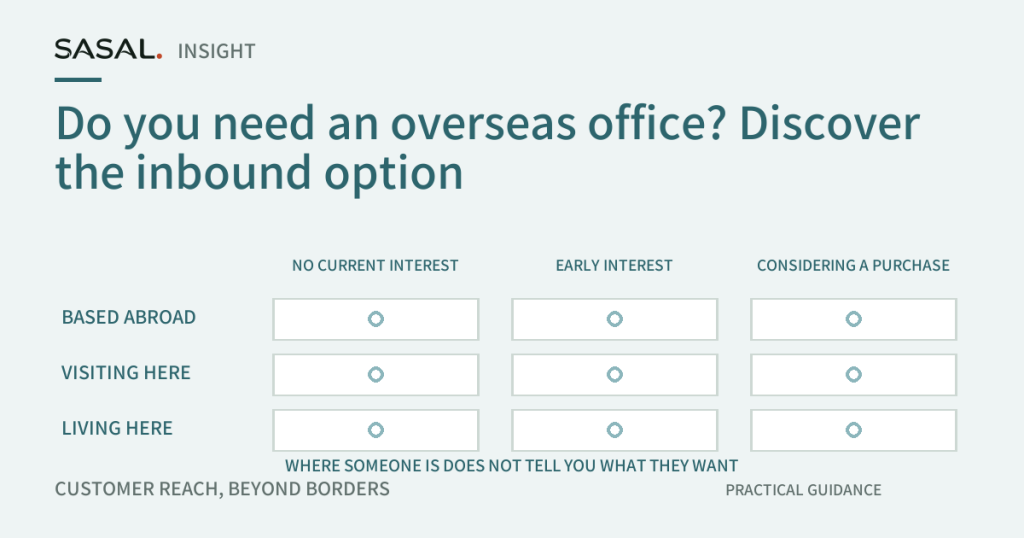
A practical matrix can help organize observations. One axis describes relationship to the home market, such as based abroad, temporarily visiting or residing locally. The other axis describes interest, ranging from no current relevance to active evaluation. The matrix is not a progression and does not rank customers. A traveler may appear in the active-evaluation category immediately, while a resident remains uninterested indefinitely. Likewise, a person living abroad may become a strong prospect because they have already identified a problem that the offer addresses. The purpose of the matrix is to guide questions, evidence collection and resource allocation rather than to predict behavior from nationality, appearance or background.
For example, imagine a people-based advisory service. A professional living abroad might actively evaluate the service because of a project linked to the home market. A visitor might only have exploratory interest despite being physically close to the provider. A resident with international business connections may become a valuable referral source without purchasing personally. These scenarios demonstrate why customer location should be recorded separately from buying intent. When companies keep those dimensions distinct, they can design communication, trials and support around actual customer decisions. The result is a more accurate understanding of demand and a stronger foundation for selecting future routes to market.
- Based abroadNo interest: no relevant need. Early interest: reads a use case. Evaluating: compares the delivered price.
- Visiting the home marketNo interest: walks past. Early interest: asks for a demonstration. Evaluating: checks use during the trip.
- Resident in the home marketNo interest: satisfied with an alternative. Early interest: asks about access. Evaluating: compares ongoing support.
People abroad with no current interest: test relevance before promotion
International growth does not require convincing every person abroad to become a customer. When people have no current interest, the first task is determining whether a relevant problem exists. Broad outreach aimed at everyone in a country or region often produces little useful evidence because it mixes potential buyers with people who have no reason to engage. Instead, define a specific customer situation and examine whether the value proposition addresses a recognizable need. The goal is not awareness for its own sake. The goal is learning whether a particular group experiences a problem that the business can solve under conditions where they would consider purchasing.
Testing relevance begins with customer value rather than product features. Companies naturally focus on what they make, but customers evaluate whether an offer improves an outcome that matters to them. A feature may represent speed, consistency, convenience or reduced effort. The important question is whether those benefits matter enough in the customer’s situation to justify attention. If conversations reveal that the problem is unimportant or already solved satisfactorily, the business has learned something valuable. Lack of interest can indicate a mismatch between the proposed value and the customer’s priorities, not a failure of promotion. That insight helps avoid spending resources pursuing audiences with limited potential fit.
A useful method is framing outreach around the problem rather than the product. Consider a hypothetical equipment retailer exploring demand from customers based abroad. Instead of promoting technical specifications broadly, the business could speak with people who participate in a specific activity where equipment reliability matters. If those individuals do not view reliability as a meaningful concern, additional promotion may add little value. If they recognize the problem but require different evidence before considering a purchase, that information becomes a more productive next step. The purpose of these conversations is to discover decision criteria and alternatives, including doing nothing or continuing with existing solutions.
When evaluating results, separate evidence of interest from evidence of demand. A positive conversation, social interaction or expression of curiosity does not establish purchasing intent. The next question is what decision the customer would need to make and what evidence would support that decision. In some cases a small trial, demonstration or limited offering may answer an unresolved question. In others, the business may conclude that the segment is not currently a priority. International customer reach improves when attention is directed toward people with relevant needs and credible paths to adoption rather than attempting to persuade audiences who have no reason to engage.
People abroad with early interest: identify the next buying question
When people based abroad show early interest, the most useful response is not assuming that demand already exists. Early interest often means a customer has recognized a possible fit but has not yet resolved the question that would allow a purchase decision. That unresolved question may involve performance, suitability, support, delivery, integration with existing practices or simple confidence that the offer applies to their situation. Rather than increasing promotional activity immediately, identify what decision the customer is attempting to make. The conversation becomes more productive when the business focuses on the next buying question instead of treating all interest as equal. This approach helps separate curiosity, investigation and active evaluation without relying on assumptions about geography.
The nature of the next question depends on the customer’s use case. A hypothetical specialty retail product business might discover that interested customers abroad are less concerned with product features than with how the product fits a particular activity. Another customer may already accept the core value but want to understand delivery, returns or ongoing support. The important lesson is that customers compare an offer with current alternatives, including existing products, manual work or simply continuing as they are. Early interest becomes meaningful when the company learns which comparison the customer is making. That knowledge improves explanations, demonstrations and evidence gathering while reducing the temptation to interpret every enquiry as proof of overseas demand.
A practical way to proceed is to match evidence to the decision that follows. If a customer questions whether a product achieves the promised outcome, a focused demonstration may help. If the uncertainty concerns adoption effort, the discussion may need examples showing what the customer must do after purchase. If several people participate in the decision, different evidence may be needed for users, budget holders or operational stakeholders. The goal is not to push customers through a fixed sequence. Different customers can reach similar decisions through different paths. By documenting which questions appear repeatedly, a business gains a clearer picture of which aspects of its offer matter most to a specific customer segment.
Consider a hypothetical people-based service firm receiving enquiries from professionals located abroad. Some prospects may ask about the expertise of the service team, while others may focus on communication methods, scheduling or expected outputs. These questions reveal more than interest alone because they expose the conditions under which value will be judged. They also help distinguish genuine opportunities from conversations that are unlikely to progress. International customer reach grows when the business learns how customers evaluate the offer and adapts its explanations accordingly. The evidence collected at this stage supports future decisions about delivery models, partnerships or additional presence without requiring those investments before customer needs are understood.
Visitors to the home market: design for the actual visit context
People visiting the home market represent a distinct customer situation because their location is temporary while their level of interest may vary widely. Some visitors arrive with no awareness of the business. Others may already be comparing options and planning a purchase. The key mistake is assuming that physical proximity automatically increases demand. Visitors operate under different constraints from residents. Their time may be limited, their schedules uncertain and their opportunities for follow-up reduced after departure. A business can improve results by understanding the actual context of the visit rather than treating every visitor as a standard local customer. The relevant questions concern discovery, evaluation, purchase timing and what happens after the visit ends.
Customer learning from visitor purchases should be interpreted carefully. A sale completed during travel demonstrates value under travel conditions, but not necessarily under the customer’s normal circumstances after returning elsewhere. A visitor may purchase because access is convenient, because the product suits a specific travel need or because the buying experience fits that moment. Those observations are useful, yet they do not automatically establish repeat demand from the customer’s home location. To understand broader opportunity, the business should record what was observed directly and what remains untested. Delivery expectations, ongoing use, support requirements and willingness to repurchase later may require additional evidence before conclusions are extended beyond the visit itself.
A customer-journey map helps clarify where value is created. Discovery may occur before travel, during the visit or after returning home. Purchase may happen in person while delivery occurs later through another channel. Support may be requested from a different location entirely. Mapping these activities prevents the company from assuming that all stages occur in one place. It also highlights which promises must remain consistent across locations. The resulting picture often reveals practical improvements in communication, fulfilment or follow-up that strengthen the customer experience without requiring a foreign operation.
For example, imagine a hypothetical outdoor equipment retailer. One traveler discovers the brand before departure, visits the store while traveling and requests support later from another location. Another visitor learns about the product only after arrival and buys immediately for use during the trip. These customers share a travel context but not the same buying process. Understanding those differences helps the business decide what information to provide before, during and after travel. Follow-up should occur only with permission and for a clear purpose. The objective is to support customer decisions and learn from observed behavior, not to assume that every visitor represents a future overseas market.
- Before travelCustomer discovers information, compares options or identifies a potential need.
- During visitEvaluation and purchase occur within the time and context of the trip.
- After travelUse, support questions and repeat-purchase considerations emerge in a different setting.
- Evidence reviewSeparate observed travel demand from assumptions about future demand elsewhere.
Residents with cross-border ties: serve ongoing local needs
Residents whose personal, professional or commercial activities connect multiple countries are sometimes overlooked because they are physically located in the home market. Yet they can represent meaningful customer situations when their needs involve cross-border movement of information, products, relationships or services. The important point is that they remain ordinary local customers with individual requirements. Their value should not be inferred from nationality, family background, language or appearance. Instead, examine the specific problem they want solved and the conditions under which they would purchase. A resident may have extensive international connections and no interest in the offer, while another may become a highly engaged customer because the offer fits an ongoing need that spans locations.
These customers can sometimes reveal useful information about international customer reach because they experience multiple contexts directly. However, their feedback should not be treated as a substitute for researching every destination market. A resident who regularly works across borders may help identify terminology, usage patterns or referral opportunities, but that individual does not represent all customers elsewhere. The transferable lesson is the decision method. Understand the customer problem, identify alternatives, examine adoption conditions and test willingness to pay. Those principles travel more reliably than assumptions about what a broader population may prefer. The business gains insight when it records which observations are specific to the individual and which questions remain open.
Consider a hypothetical advisory service operating from its home market. Some local clients may coordinate projects involving teams in several countries and therefore value flexible communication, documentation and support arrangements. Others may have entirely domestic requirements and prefer a different service structure. The distinction comes from the work being performed, not from labels attached to the customer. By examining actual use cases, the business can identify which aspects of the service create value in cross-border situations. Those findings may later support remote delivery or partner-led growth, but they are still grounded in observed customer needs rather than assumptions about international demand.
Businesses can also use these relationships to test how discovery, purchase, delivery and support connect across locations. If residents refer contacts abroad, the company can compare the original local conditions with the circumstances faced by referred prospects. Similarities may indicate areas worth exploring further, while differences become research questions. This creates a disciplined evidence trail instead of a narrative that every referral proves broad overseas demand. International growth can emerge from serving residents well, learning from how value is created and then examining which parts of that value remain relevant in other settings. The emphasis stays on customer problems and evidence, not on categories of people.
Map discovery, purchase, delivery and support in different places
International customer reach becomes easier to evaluate when discovery, purchase, delivery and support are mapped as separate activities. Businesses often assume these activities occur in one location because that is how many home-market transactions work. In practice, a customer may discover an offer while living abroad, make a purchase during a visit, receive delivery after returning home and request support from a different location again. Treating these as distinct events prevents premature conclusions about where a company must operate. It also helps identify which commitments actually matter to the customer. The key question is not where the customer first appears, but whether the full promise can be delivered consistently across the locations involved in that customer’s experience.
A practical promise map records where each part of the customer experience happens. Discovery concerns how the customer learns about the offer. Purchase concerns the decision and transaction. Delivery concerns obtaining the value being purchased. Support concerns questions, maintenance, training or other continuing needs. These stages may occur in the same place, but they do not have to. For example, a buyer could compare options remotely, place an order while traveling and continue using the product elsewhere. Understanding these distinctions helps businesses decide whether existing capabilities are sufficient or whether partners, additional processes or new forms of customer communication would improve the experience.
The same approach applies to services. Consider a hypothetical advisory business. A client based abroad may discover the service through professional contacts, conduct evaluation meetings remotely, visit the home market for a workshop and then receive ongoing support online after returning home. The customer's value comes from the outcome achieved, not from forcing every interaction into a single geography. By mapping each activity separately, the provider can identify where customer expectations are already being met and where uncertainty remains. This often reveals that some functions can remain centralized while others require adaptation, without assuming that a foreign office is the necessary next step.
The map should also distinguish customer convenience from business convenience. A process that works during travel may not remain attractive once the customer returns home. Delivery timing, access to assistance, replacement procedures or scheduling flexibility may become more important in a different context. Recording where each activity occurs makes these questions visible. The result is a clearer understanding of which parts of the customer experience are location dependent and which can transfer more easily across borders. That clarity improves decisions about channels, partnerships and future investment because the discussion remains connected to customer value rather than organizational assumptions.
- DiscoveryHow the customer becomes aware of the offer and evaluates relevance.
- PurchaseWhere the buying decision, contracting or transaction takes place.
- DeliveryHow the customer receives the product, service or intended benefit.
- SupportOngoing assistance, training or problem resolution after adoption.
Use inbound sales to learn without overstating overseas demand
Inbound purchases can provide valuable evidence, but the evidence has limits. A sale to a visitor from abroad demonstrates that value was recognized under specific conditions. It does not automatically prove that the same customer would buy in a different context or that many similar customers exist elsewhere. The useful response is neither to dismiss the sale nor to treat it as confirmation of broad overseas demand. Instead, examine the conditions that made the purchase possible. Understanding those conditions helps identify which findings may transfer and which require further testing before additional commitments are made.
An evidence-transfer ledger can help organize learning. One column records observations that actually occurred. Another records assumptions that remain untested. For example, a visitor purchasing a specialized product may demonstrate interest, willingness to pay and confidence in the offer while traveling. However, repeat purchasing after returning home may still be unknown. Delivery expectations, return processes, convenience and ongoing support requirements may change outside the travel context. Separating observed facts from open questions prevents a business from building expansion plans on conclusions that have not yet been examined. It also creates a practical agenda for future customer conversations and experiments.
The same discipline applies to services. Imagine a hypothetical coaching business whose clients occasionally visit the provider's home market. A successful engagement during a visit shows that the service created value under those circumstances. It does not automatically show that clients will continue remotely, recommend the service widely or purchase additional programs after returning home. Those questions deserve separate evidence. By identifying the next adoption decision rather than assuming a linear progression, the business can test specific uncertainties and learn what support, communication or delivery adjustments may be needed for customers located elsewhere.
Inbound activity is therefore best viewed as one learning route among several. It sits alongside remote cross-border delivery, partner-led approaches and other customer contact models. The objective is to connect observed customer behavior with the next business decision. Track enquiries, purchases, repeat engagement and reasons for delay separately rather than combining them into a single success story. This creates a more reliable picture of demand and helps leadership distinguish between evidence gathered in the home-market context and assumptions about future behavior elsewhere. Better decisions emerge when the limits of the evidence are documented as carefully as the positive signals.
A hypothetical product business compares contact points

Consider a hypothetical retailer selling specialized outdoor equipment. The company wants international growth but has not decided whether any foreign operation is necessary. Rather than beginning with organizational structure, it compares customer contact points. One group discovers the products online while living abroad. Another group encounters the products during visits to the home market. A third group lives locally but maintains active personal or professional connections across borders. Each contact point creates different opportunities to learn about customer needs, purchasing conditions and support expectations. The comparison focuses on customer situations rather than assumptions about nationality, residence status or geographic labels.
Customers based abroad may already have strong interest, moderate curiosity or no relevant need at all. The business therefore segments prospects according to the problem they are trying to solve. Some seek equipment durability. Others prioritize convenience, training or compatibility with existing gear. The company examines which messages, demonstrations and support materials help customers evaluate those questions. Instead of assuming that a broad region behaves uniformly, it records the specific use cases associated with genuine engagement. This produces more useful evidence than counting website visitors or general enquiries because it links customer interest to an identifiable buying reason and a potential route to adoption.
Visitors to the home market create a different learning opportunity. They experience the product within the context of travel, limited time and temporary access to local services. A purchase under those conditions demonstrates value, but the business still needs to understand what happens later. Will customers use the product in the same way after returning home? What delivery, replacement or support expectations emerge once the travel context disappears? These questions matter because the company is evaluating future customer reach, not merely documenting transactions. The travel purchase becomes a source of evidence about customer value rather than a shortcut to conclusions about expansion strategy.
By comparing contact points systematically, the retailer can identify where additional learning is most useful. Some customer groups may justify improved remote support. Others may benefit from partner involvement or clearer post-purchase communication. Still others may reveal little evidence of ongoing demand despite initial enthusiasm. The important outcome is not proving that one contact point is superior. It is understanding how discovery, purchase, delivery and support interact for each customer situation. That understanding helps the business choose a route that fits customer behavior and available capabilities, while keeping future options open instead of assuming that international growth must begin with a foreign subsidiary.
A hypothetical service business defines what it can deliver
Consider a clearly hypothetical people-based service firm that helps manufacturing companies improve internal operating processes. The firm receives enquiries from several kinds of internationally connected customers: managers based abroad, professionals visiting the home market for a short period, and locally based decision-makers whose operations involve multiple countries. The leadership team initially assumes that serving these customers requires opening a foreign office. A more useful starting point is defining exactly what the customer is purchasing. Is the value a workshop, an assessment, a training program, ongoing advisory support, or a combination? Clarifying the purchased outcome helps distinguish activities that can be delivered remotely from those that genuinely require local presence, travel or partner support.
Once the service is defined, the company can map customer expectations against delivery responsibilities. Some customers may value expert analysis that can be performed remotely after structured interviews. Others may need on-site observation before recommendations become credible. The distinction matters because customer location alone does not determine delivery requirements. A visitor to the home market might purchase a substantial engagement during a short trip, while a customer based abroad may be comfortable receiving much of the service online. By identifying the specific activities required to create value, the firm can evaluate whether international customer reach depends on additional infrastructure or simply on a well-organized delivery process connected to customer needs.
The same logic applies to after-sales support. A successful initial engagement does not automatically indicate repeat demand from the customer’s home location. The company should examine what part of the experience generated value. Perhaps customers appreciated direct access to specialists during a visit. Perhaps they valued a structured methodology that remains useful regardless of geography. Understanding this distinction helps the business avoid assuming that every positive interaction proves a scalable overseas opportunity. Evidence gathered during delivery should therefore be linked to the conditions under which the service was consumed, the support provided and the customer's decision process.
A practical promise map can help. The company records where discovery occurs, where purchasing decisions are made, where delivery takes place and where ongoing support is provided. These locations may differ. A customer could discover the service abroad, purchase during a visit, receive delivery across multiple locations and continue receiving support remotely. Mapping those activities clarifies what the business can reliably provide today and what capabilities would need strengthening before expanding commitments. The result is a clearer understanding of customer value and operational responsibility, rather than an assumption that international growth must begin with establishing a permanent presence elsewhere.
Choose a narrow test and track evidence across the customer journey
Inbound demand can provide useful learning when businesses treat it as evidence gathering rather than automatic validation of a larger expansion thesis. A narrow test begins with a specific customer group, a defined offer and a clear question. For example, a hypothetical specialty retail business might ask whether visitors who purchase during travel continue using the product after returning home. A hypothetical advisory firm might ask whether customers first engaged during a visit are willing to buy additional services remotely later. These questions focus on behavior connected to future decisions. They avoid assuming that initial interest, positive feedback or a single transaction automatically predicts repeat demand under different conditions.
Evidence becomes more useful when tracked across the full customer journey. Record how the customer discovered the offer, what information influenced evaluation, where the purchase occurred and how the product or service was actually used. Equally important, note what changes after travel ends or after the customer returns to their normal environment. Convenience, urgency and purchasing context may differ substantially. A decision made during a visit can reveal genuine customer value, but it can also reflect temporary conditions that may not exist later. Separating observations by stage allows the company to identify which elements appear transferable and which remain untested assumptions requiring further investigation.
The same discipline applies to commercial experiments such as pilots, limited offers or structured trials. The objective is not merely to demonstrate customer interest. The objective is to answer the unresolved question that affects the next decision. Success criteria should therefore be connected to adoption, continued use, reorders, additional purchases or another clearly defined outcome relevant to the business model. When evidence is collected systematically, leadership can compare customer groups, delivery arrangements and contact points without exaggerating what any single interaction proves. This approach supports learning while keeping commitments proportional to the strength of the available evidence.
An evidence-transfer ledger is a practical tool for separating observations from assumptions. If customers repeatedly purchase while visiting the home market, that is observed demand in a travel context. If those customers later request support from abroad, that provides additional evidence about remote engagement. However, expectations about repeat purchases, referrals or broader market potential remain hypotheses until tested directly. By documenting what has been observed and what still requires confirmation, businesses can make better decisions about customer development, partnerships and future investment. International reach grows through accumulated evidence rather than through assumptions attached to customer nationality or location.
- DiscoveryRecord how the customer first encountered the offer and why it appeared relevant.
- PurchaseIdentify the decision context and evidence supporting the transaction.
- Use and supportObserve actual usage, questions and continuing engagement after purchase.
- Transfer testCheck which findings remain valid in a different location or context.
New findings refine the next discovery and testing activity
Build the route that fits the customer rather than forcing an overseas office
The final decision is not whether international growth is good or bad. It is which route best serves a specific customer while matching the company's capabilities. Some businesses may find that inbound demand creates a sustainable source of internationally connected customers without requiring a foreign operation. Others may discover that remote cross-border delivery is more appropriate. Still others may conclude that local partners provide functions that customers need. The key is choosing the arrangement after understanding customer value, delivery requirements and evidence quality. Starting with the customer journey often reveals options that would remain hidden if the discussion began with organizational structure alone.
Different routes can coexist. A company may serve visitors directly, support customers abroad remotely and use partners for selected activities. The responsibilities attached to each route should be explicit. Who explains the offer? Who handles delivery? Who responds to support requests? Who collects payment? Clarifying these questions helps the business compare alternatives based on operational reality rather than labels. A partnership, e-commerce model or direct relationship may all be viable depending on the work required to create value. The objective is not to identify a universally superior model. The objective is to align responsibilities with customer expectations and business capacity.
As opportunities expand, businesses should continue evaluating evidence from multiple customer situations. A resident customer with cross-border professional connections may reveal useful referral paths. A visitor may demonstrate demand associated with travel. A customer based abroad may reveal the strengths and limitations of remote delivery. None of these individuals represents an entire country, region or customer population. Each provides information about a specific use case and decision context. By examining similarities and differences across those cases, companies can identify which parts of their offer travel well and which require adaptation before broader expansion is considered.
International growth becomes easier to evaluate when customer location, customer interest, delivery location and support location are treated as separate variables. This perspective reduces pressure to follow a single expansion path and encourages decisions grounded in observed customer behavior. An overseas office may eventually become the best option, but it should emerge as a response to demonstrated customer and operational needs. Before reaching that point, many businesses can learn a great deal from inbound demand, remote engagement and carefully chosen partnerships. The most effective route is the one that reliably helps customers achieve the outcome they are paying for while remaining sustainable for the company delivering it.