

Form a company abroad first? Five options for your goals and budget
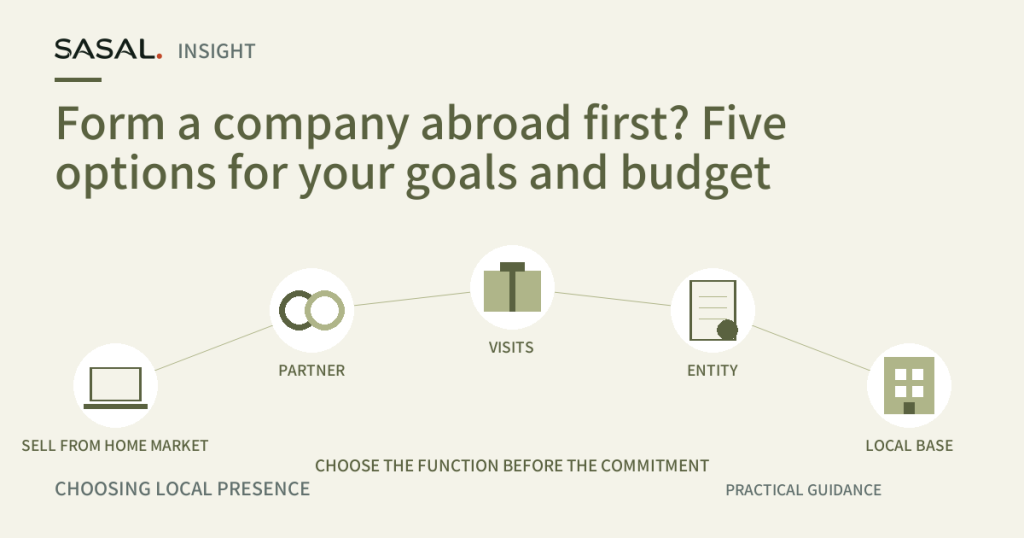
Selling from the home market, contracting with a local partner, making business visits, forming a legal entity and building a staffed local operation are five ways to develop overseas activity. They are different tools, not a compulsory sequence. A business can combine several forms of presence, begin with an entity when a demonstrated customer requirement justifies it, or continue without one where the arrangement is appropriate. The useful question is what additional function the next commitment will provide, what recurring obligations it creates and who will operate it. This article connects each option with the evidence needed to consider it, the resources required to sustain it and the conditions for reviewing it. The aim is to choose a practical commitment that fits customer needs, available funds and operating capacity.
Treat overseas presence as a set of functions, not a fixed ladder
Many discussions about overseas expansion assume that a company progresses through a universal ladder of commitments. That assumption can hide the real decision. Direct sales from the home market, local partners, business visits, incorporated entities and staffed operating locations each perform different jobs. One may help customer acquisition, another may improve service continuity, and another may satisfy a contracting requirement for a particular customer group. A business should therefore begin by identifying the function it needs rather than selecting the next stage because it appears more advanced. The relevant comparison is not whether a company has reached a higher level of presence. It is whether the chosen arrangement improves the company’s ability to create, deliver and support value for customers in a specific target market.
A useful planning exercise is to separate four questions. Who sells to customers? Who delivers the promised outcome? Who supports customers after the sale? Who collects payment under the commercial arrangement? Different answers can produce very different operating models. A local partner may handle customer introductions while the supplier contracts directly. An incorporated entity may exist for contracting purposes while most delivery work remains coordinated from headquarters. A staffed local office may provide service continuity even when contracts are signed elsewhere. Viewing overseas presence through these functional responsibilities helps leadership teams avoid investing in structures that do not solve the operational problem they are actually facing.
The same evidence-based approach also prevents unfair assumptions about what a legal entity can achieve. Establishing an incorporated company can signal commitment, continuity or procurement readiness for some customers. In other situations, however, customers may care more about delivery performance, support responsiveness, technical capability or references. An entity with no people, no clear service process and no defined accountability may fail to address the customer concern that motivated the investment. Conversely, there are situations where forming an entity early is sensible because a specific contracting, procurement or operational requirement is already understood. The key decision remains functional: what job will this commitment perform, and who will operate it day to day?
Rather than asking which stage comes next, ask what uncertainty remains unresolved. If customers are interested but support expectations are unclear, travel or local service arrangements may answer the question. If demand appears repeatable but coordination is difficult, additional staffing may become relevant. If a customer requires a particular contracting structure, an entity may deserve consideration. Review conditions should be defined before each commitment is made. That keeps expansion tied to evidence and helps prevent prestige, momentum or sunk effort from becoming the main reason for increasing local presence.
- Sales accessCustomer acquisition, proposals and commercial discussions.
- DeliveryProviding the product or service promised to the customer.
- SupportAfter-sales assistance, maintenance and issue resolution.
- Commercial administrationContracting, invoicing, payment collection and coordination.
Start with revenue delivered from the home market

Generating revenue from the home market is often the simplest way to learn whether customers in another market value the offer. The main advantage is not lower commitment by itself. It is the ability to connect customer discovery with real delivery activity before adding additional layers of organization. A company can observe what questions customers ask, which parts of the offer matter most and where operational friction appears. Those observations are more useful when they are linked to actual fulfilment, support and payment rather than to expressions of interest alone. Revenue generated from the home market therefore becomes valuable evidence when it reveals how customers obtain value and what work the business must consistently perform.
Remote sales should not be confused with a complete operating model. A company may successfully sign customers while still facing unanswered questions about service delivery, response times, localization or ongoing support. Leadership teams can use early transactions to map those requirements. For example, a hypothetical software provider might discover that customers accept remote onboarding but expect local-language support during implementation. A hypothetical equipment supplier might learn that installation assistance matters more than local invoicing. These findings help determine which function deserves investment next. The objective is not to prove that remote sales are permanently sufficient. It is to understand what customers are actually paying to achieve and which capabilities support that outcome.
Evidence becomes stronger when commercial activity is connected to operational outcomes. A business should review not only enquiries and orders but also delivery performance, support requests, payment collection and repeat purchasing behaviour. If customers continue to buy, recommend the product internally or request broader deployment, those observations may reveal opportunities that a purely sales-focused review would miss. Likewise, recurring service issues may indicate that a different form of presence is required. Reviewing customer outcomes alongside operational effort helps distinguish genuine demand from temporary activity and supports more informed decisions about future commitments.
Companies should also identify who inside the business owns the overseas opportunity while work remains coordinated from the home market. Sales, operations, finance, product and customer support may all contribute to delivery. Without a clear internal owner, learning becomes fragmented and important evidence can be lost. A dedicated manager may work remotely and does not necessarily need to relocate. What matters is accountability for connecting customer feedback, delivery experience and future investment decisions. When home-market operations can consistently support customers and produce useful evidence, the business gains a stronger foundation for deciding whether any additional local presence is justified.
Contract with a partner for a clearly defined local role
A local partner can provide capabilities that are difficult to create immediately from the home market, but the value of the arrangement depends on clarity about responsibilities. The term partner can describe many different structures. One organization may introduce prospects and receive a commission. Another may resell products. A third may provide technical support, logistics or customer service. Because the label alone reveals little, leadership teams should define the actual work that the partner will perform. The goal is not simply to appoint a local representative. It is to assign specific responsibilities that improve customer outcomes and can be reviewed against observable evidence.
One practical method is to map customer interactions and identify where local participation genuinely adds value. A hypothetical business selling industrial equipment may use a partner to provide installation coordination and routine support while retaining direct responsibility for technical design. A hypothetical professional-services firm may use a partner to facilitate introductions and local communication while keeping project delivery under its own control. In both examples, the partner arrangement exists to perform a defined function. If the company cannot explain what operational problem the partner solves, the arrangement may create complexity without improving customer experience or commercial performance.
Clear incentives and information sharing are equally important. If a partner is expected to educate customers, explain the offer and support adoption, the commercial arrangement should reflect that work. Reviews should also include information that helps distinguish customer demand from channel activity. Orders entering a channel may not indicate the same thing as end-customer usage or repeat purchasing. Shared visibility into sales activity, support issues and customer feedback helps both parties improve performance and reduces the risk that decisions are made using incomplete information. The purpose of the relationship is sustainable participation rather than activity that cannot be interpreted later.
Partnerships should be reviewed using the same evidence-based logic applied to other forms of presence. If a partner arrangement consistently answers customer needs, it may remain appropriate for many years. If recurring issues reveal gaps in support, contracting or operational control, another form of presence may become relevant. Importantly, a partner-based model is not a temporary stage that every company must leave behind. It is one possible operating choice. The decision to expand, modify or replace it should depend on the function it performs, the commitments it creates and the evidence available from actual customer and delivery experience.
Use business trips to resolve questions that distance cannot answer
Business travel is often discussed as a sign that an overseas opportunity is becoming serious, but its value comes from the questions it helps answer. A trip should be linked to a specific uncertainty that cannot be resolved adequately through remote discussions, demonstrations or support. Examples might include understanding how customers use a product in their operating environment, observing installation conditions, meeting multiple decision-makers together or clarifying responsibilities across several organizations. When travel is treated as evidence gathering rather than as proof of commitment, the company can evaluate whether the visit improved a decision. The purpose is not to accumulate meetings. The purpose is to reduce uncertainty that affects future commercial and operational choices.
A useful planning method is to define the decision that the visit should support before any itinerary is created. For a hypothetical equipment supplier, the question may be whether local technical support is needed after installation. For a hypothetical service business, the question may be whether customer teams require regular in-person workshops or are comfortable with remote delivery. The visit can then be designed around observations, interviews and demonstrations that directly address those issues. This approach helps avoid broad travel schedules that generate activity but little actionable learning. It also encourages the team to distinguish information that affects customer value from information that is merely interesting to know.
Travel can also reveal coordination challenges that are difficult to recognize from headquarters. Customer expectations, support requests, delivery dependencies and communication bottlenecks often become clearer when employees observe the operating context directly. At the same time, companies should avoid assuming that repeated visits automatically justify a larger local commitment. Frequent travel may indicate growing demand, but it may also indicate unresolved process issues that would remain even if a local office existed. Reviewing what each trip enabled the company to decide helps separate meaningful evidence from routine activity and creates a more disciplined basis for future investment decisions.
Every trip should conclude with a documented review. The team can record which questions were answered, which assumptions changed and what remains uncertain. If the same unanswered issue appears across multiple visits, that pattern may suggest the need for a different form of presence, such as local support resources or delegated authority. If the visits consistently confirm that customers can be served effectively without additional infrastructure, that is also valuable evidence. Business travel is therefore best viewed as a tool for learning and coordination. Its success should be judged by improved decisions and customer outcomes rather than by the number of visits completed.
Establish an entity when its function justifies the obligation
An incorporated local entity is often treated as a milestone in overseas expansion, yet incorporation is only one possible operating tool. Before creating an entity, leadership teams should identify the function it is expected to perform. In some situations, a customer may require a local contracting structure or procurement process that makes an entity useful. In others, an entity may support local hiring, administration or operational coordination. The key question is not whether incorporation appears more established than other arrangements. The relevant question is whether the entity enables work that the business has already determined needs to be performed and whether the company can operate that structure responsibly over time.
The distinction between a legal entity and an operating presence is important. An incorporated company can exist without dedicated local staff, customer support capability or day-to-day operational activity. Customers evaluating a supplier will usually consider practical factors such as delivery reliability, service responsiveness, references and accountability alongside the existence of a legal structure. For that reason, forming an entity should not be expected to create demand automatically or remove concerns that are actually related to execution. If the customer need involves ongoing support or local coordination, the company should examine who will perform that work rather than assuming incorporation alone addresses the requirement.
A fair comparison should include both early incorporation and more gradual approaches. Consider a hypothetical company pursuing customers whose procurement process strongly favors contracting with a local entity. Forming an entity early may support those opportunities if the business also has the capital, management attention and operational plan to use it effectively. By contrast, another company may still be testing customer needs and delivery assumptions. In that situation, creating an entity before understanding its practical role could add recurring obligations without improving customer outcomes. Neither approach is universally correct. The appropriate choice depends on evidence, objectives and execution capacity.
Entity decisions should also account for continuing responsibilities beyond formation. Administration, reporting, management oversight, professional support, operational coordination and potential closure activities all require attention. If circumstances change, the company may still need resources to complete customer commitments, support existing contracts and manage an orderly transition. Reviewing these obligations in advance encourages more realistic planning and reduces the risk that incorporation is treated as a symbolic achievement rather than an operating decision. A useful entity case therefore connects a specific business function with named owners, recurring responsibilities and clear review conditions that can be evaluated as the market develops.
- Identify required functionDefine the contracting, hiring, coordination or customer need the entity would support.
- Confirm supporting evidenceReview customer requirements, delivery plans and operating responsibilities.
- Assess recurring obligationsConsider management attention, administration and continuing commitments.
- Set review conditionsEstablish how performance and future changes will be evaluated.
Build a staffed local base around work that needs continuity
A staffed local base represents a different commitment from incorporating an entity. The defining feature is not paperwork but the presence of people responsible for ongoing work in the target market. Those responsibilities might include customer support, project coordination, technical service, account management or operational oversight. Before hiring or leasing premises, companies should identify which activities genuinely benefit from continuous local coverage. A staffed base should be linked to work that occurs repeatedly and requires continuity, not simply to a desire for visibility. The more clearly the ongoing function is defined, the easier it becomes to determine the required roles, reporting structure and support from headquarters.
One common mistake is assuming that local staffing automatically solves coordination problems. Additional personnel can improve responsiveness, but only when decision rights, reporting definitions and escalation paths are clear. A customer request that requires headquarters approval may still move slowly if authority remains ambiguous. Companies therefore benefit from defining who can make decisions locally and which matters require involvement from headquarters. These arrangements should reflect actual business needs rather than assumptions about geography. A dedicated manager can coordinate customers from a distance, and a local employee can operate effectively without extensive autonomy if responsibilities are clearly documented and supported by appropriate communication processes.
A hypothetical comparison illustrates the point. One company establishes a small local team because customers require regular on-site support and continuity between projects. The staffed presence directly supports delivery and customer retention. Another company creates a local office mainly to demonstrate commitment, yet most customer interactions, technical decisions and support activities continue to be handled elsewhere. The first arrangement has a defined operational purpose. The second may struggle to justify its ongoing effort because the relationship between staffing and customer value remains unclear. The difference is not the number of people involved but the connection between local work and the business outcome being pursued.
As the local base develops, leadership teams should review it using the same evidence-driven approach applied to earlier forms of presence. Track customer support outcomes, delivery quality, coordination efficiency and the ability to sustain commitments over time. Review whether responsibilities remain appropriate and whether the local team has the authority and resources needed to perform its role. If conditions change, the company may choose to expand, redesign or reduce the local operation. Planning those possibilities in advance helps preserve customer service and accountability. A staffed presence is most effective when it is built around continuing work that clearly benefits from local ownership and continuity.
Choose evidence for the next commitment rather than a universal sales target
Many expansion plans fail to identify what evidence should justify the next increase in local presence. Teams sometimes search for a universal sales figure that automatically triggers a new office, a partner agreement or an incorporated entity. The more useful approach is to match evidence to the function being added. If the proposed commitment is intended to improve customer support, evidence should show recurring support demands that cannot be handled effectively through the current arrangement. If the commitment is intended to improve customer acquisition, evidence should reveal a specific access problem. A sales total by itself may not explain which operational constraint is limiting growth or which form of presence would resolve it.
Evidence becomes stronger when it connects customer activity with delivery experience. For example, a company might observe that opportunities repeatedly stall because prospective buyers require local coordination during evaluation. Another company might find that customers are purchasing successfully but need ongoing service continuity that stretches existing resources. These observations point toward different solutions even if revenue appears similar. Leadership teams can review enquiries, orders, delivery performance, support requests, payment collection and repeat business together. Looking across the full operating cycle helps identify whether the next commitment is solving a real customer-facing problem or simply responding to internal enthusiasm for a larger overseas footprint.
A practical worksheet can be built around four questions. What customer requirement remains difficult to satisfy? Which additional function would address it? What recurring obligation would the new presence create? Who will own and operate that responsibility? The answers help compare alternatives fairly. A partner, a dedicated manager working remotely, more frequent visits, an entity or a staffed base may each solve different problems. The objective is not to prove that one option is more advanced than another. It is to determine which commitment most directly addresses the evidence already gathered from customers, operations and commercial activity in the target market.
Review conditions are as important as entry conditions. Before increasing commitment, define what information the business expects to gain and what outcomes would justify continuation, adjustment or a different operating model. A company might decide that a local support arrangement should be reviewed after enough customer interactions have occurred to assess responsiveness and workload. Another might evaluate whether visits are still answering questions that cannot be resolved remotely. Linking commitments to reviewable evidence helps prevent decisions from becoming permanent simply because effort has already been invested. It also keeps resources available for alternative approaches if customer needs evolve.
- Observed constraintIdentify the customer or delivery issue that repeatedly limits progress.
- Needed functionDefine the additional capability required to address that issue.
- New commitmentSelect the presence option that provides the capability.
- Review outcomeAssess whether the commitment solved the original problem.
When starting with a local entity can be a sensible choice

Some discussions present incorporation as something that should happen only after years of gradual expansion. In reality, there are situations where creating a local entity early can be a rational decision. The key question is not whether the entity represents a higher stage of development. It is whether it performs a defined function that customers, partners or operating requirements make relevant. A customer may prefer to contract through a local organization. A procurement process may be easier to participate in through a local structure. A company may also need a formal base for specific operational responsibilities. When those needs are supported by evidence, early incorporation can be worth considering.
An incorporated entity should not be confused with a complete local operation. Customers generally evaluate the ability to deliver, support and remain accountable for commitments. An entity without clear ownership, service processes or operating resources may do little to improve customer confidence. Conversely, an entity connected to defined responsibilities can strengthen continuity. Leadership teams should therefore identify what the entity will actually do. Will it contract with customers, coordinate support, employ staff, manage local suppliers or perform another role? The answer matters more than the legal form itself. The function should be clear before recurring obligations are accepted.
Affordability also extends beyond formation activity. A company should consider management attention, administration, reporting, coordination and the resources needed to maintain customer commitments over time. If the business later changes direction, it may still need to complete existing obligations, support customers and manage an orderly transition. These considerations do not mean that early incorporation is undesirable. They simply mean that the decision should be evaluated as an operating commitment rather than a symbolic milestone. The same discipline applied to hiring, partnerships or facilities should also be applied to establishing an entity in another market.
A useful test is to ask whether the proposed entity solves a specific problem that existing arrangements cannot solve efficiently. If the answer is yes and the company has the resources to operate the structure responsibly, incorporation may be appropriate from the beginning. If the rationale is mainly visibility, prestige or the assumption that customers automatically trust locally registered companies, the case may be weaker. Customers ultimately judge whether promised outcomes are delivered. An entity can support that objective when tied to a defined function, but it does not replace the work of creating value, maintaining service and building accountability.
Compare early establishment with gradual investment in a hypothetical case
Consider a hypothetical company that provides specialized industrial monitoring services to customers outside its home market. One leadership group proposes establishing an entity immediately because several prospective customers have indicated interest. Another group prefers beginning with direct cross-border delivery supported by targeted visits and then increasing commitment later if demand becomes repeatable. Both approaches can be reasonable. The important point is that neither option changes the underlying uncertainty about customer demand. The company still needs evidence about purchasing decisions, delivery requirements and ongoing service expectations. The debate therefore should focus on which arrangement best supports learning and execution rather than which one appears more ambitious.
Under an early-establishment approach, the company might create a local entity because expected customers prefer a local contracting structure and because management is prepared to allocate people, oversight and operating resources from the outset. This route could improve continuity and provide a clear platform for future activities. However, it also creates recurring responsibilities immediately. Leadership must ensure that the organization can support administration, customer communication and service obligations while continuing to operate effectively elsewhere. The benefit comes from enabling a defined operating model, not from the existence of the entity alone. Success still depends on customer value, delivery quality and organizational coordination.
Under a gradual-investment approach, the company might begin by serving customers directly from its home-market operation while using visits and carefully selected partners to address specific local needs. This route may allow the business to gather information before accepting additional obligations. The company can observe which functions create the most friction and which responsibilities genuinely require local ownership. If evidence later indicates that contracting, support or staffing would benefit from a local structure, management can revisit the decision. Importantly, this approach is not inherently more cautious or more intelligent. It is simply a different balance between learning, commitment and operating responsibility.
The comparison becomes more useful when leadership teams define review conditions in advance. For the early-establishment route, the review may focus on whether the entity is performing the intended function and whether resources remain aligned with customer needs. For the gradual route, the review may examine whether recurring operational challenges justify additional local presence. In both cases, customer service continuity should remain central. Any transition between models should include ownership of existing commitments, communication responsibilities and support arrangements. The objective is not to defend a preferred philosophy of expansion. It is to choose the structure that best fits the evidence, capabilities and responsibilities of the business.
Check affordability across continuing obligations and downside conditions
Affordability is broader than the cost of forming an entity, signing a partner agreement or opening a local office. Every additional form of presence creates recurring obligations that consume money, staff time and management attention. A company should therefore map the work required not only to launch the arrangement but also to operate it during ordinary months when sales activity may be uneven. Accounting support, reporting, customer communication, partner management, training, travel, coordination and service commitments all continue after the initial announcement. Reviewing these obligations alongside expected business activity helps leadership teams understand what must be sustained over time rather than focusing only on setup decisions.
A useful assessment starts by tracing the customer promise. If customers expect installation assistance, technical support, regular account reviews or local responsiveness, someone must perform those tasks consistently. The question is not whether a local presence appears impressive. The question is whether the business can fund and manage the work required to keep commitments. Existing employees may absorb some responsibilities, but their available capacity should be examined explicitly. Time allocated to overseas activity cannot simultaneously support other projects. Estimating internal effort together with external spending creates a more realistic picture of affordability and prevents important work from being treated as free simply because it is performed by current staff.
Leadership teams should also examine downside conditions before increasing commitment. If demand develops more slowly than expected, what obligations remain? A leased facility, outsourced service arrangement, employment commitment or exclusivity agreement may continue after commercial assumptions change. The review is not intended to discourage investment. It is intended to clarify what resources remain tied to the initiative under less favorable conditions. A presence model that appears affordable during growth may become difficult to support if sales progress slows. Understanding amendment, handover and completion responsibilities before expansion helps the business make decisions with a fuller view of future commitments.
Consider a hypothetical comparison. One company forms a local entity early because several target customers require a local contracting structure and the company has personnel ready to operate it. Another company begins with direct cross-border sales and partner support while demand is still being tested. Neither choice is inherently superior. The first accepts larger recurring obligations in exchange for a defined operational function. The second preserves flexibility while gathering evidence. The fair comparison is not formation cost versus no formation cost. It is the total package of continuing obligations, management effort, delivery responsibilities and the company’s ability to fulfill existing promises if the chosen arrangement later needs to be reduced, transferred or closed.
Plan transitions without losing customer support or accountability
Changes in overseas presence often receive attention as strategic milestones, yet customers mainly experience them through service continuity. A transition from direct sales to a partner model, from partner support to a local team, or from one operating arrangement to another should therefore begin with customer commitments rather than organizational preferences. Customers need to know who owns communication, who resolves issues and how ongoing work will continue. If those responsibilities become unclear during a transition, confidence can decline even when the new structure appears stronger internally. Preserving accountability helps ensure that expansion decisions improve customer experience instead of disrupting it.
One practical method is to map every recurring activity and assign a named owner before responsibilities move. Sales conversations, implementation work, maintenance obligations, invoicing, technical support and escalation paths should all have clear ownership during the handover period. The internal team should also agree on reporting definitions so that information remains comparable before and after the change. If one group measures shipments while another focuses on end-customer usage, leadership may misinterpret performance. Consistent records make it easier for a replacement owner to understand what has been completed, what remains open and which customer expectations still require attention.
Transitions are equally important when reducing or exiting a form of presence. A company may decide to close an office, replace a partner or consolidate operations into another structure. In those situations, ending new sales activity is only one part of the process. Existing contracts, maintenance commitments, receivables, customer communications and operational records may continue beyond the commercial decision itself. Planning these responsibilities in advance reduces disruption and allows the business to complete commitments in an orderly way. The objective is not merely organizational efficiency. It is preserving trust through reliable execution of obligations that customers already depend upon.
A dedicated local manager can help maintain continuity, but continuity does not always require relocation or a large local workforce. In some situations, a remotely based owner with clear authority and structured communication can coordinate the transition effectively. What matters is visibility and decision ownership. Customers should understand where to seek assistance, employees should understand approval routes and partners should understand their responsibilities. By treating transitions as operational projects rather than symbolic milestones, companies can adjust their overseas presence while maintaining service quality, preserving institutional knowledge and reducing the risk that important commitments become disconnected from accountable owners.
Choose the next form of presence and define its review conditions
The decision to increase overseas presence becomes easier when it is framed as a response to evidence rather than as a reward for effort already invested. Before adding a partner, increasing travel, forming an entity or building a staffed base, leadership teams should identify the specific problem the new commitment is expected to solve. The proposed arrangement should have a defined function, a responsible owner and observable indicators that will reveal whether it is working. This approach keeps attention on customer needs and operating realities instead of assuming that every business must eventually adopt the same structure. Different companies can reach different conclusions while using the same decision method.
A practical review worksheet can connect evidence to commitment. Start by recording what customers need, what obstacle currently limits delivery and what capability the proposed presence will add. Then identify the recurring obligations created by the change and the people responsible for operating it. Finally, define the observations that would support continuation, modification or replacement of the arrangement. These review conditions do not need to rely on a universal sales threshold. They should instead relate to the function the presence was intended to perform, such as service continuity, contracting capability, customer access or operational responsiveness.
Hypothetical examples illustrate the difference. A business may establish an entity early because procurement requirements from target customers are already clear and the company has resources to support the obligation. Another business serving a different customer group may continue successfully through direct sales, purposeful visits and partner support. Both approaches can be reasonable when tied to evidence. Problems arise when decisions are justified primarily by prestige, imitation of competitors or pressure to defend earlier investments. The next commitment should answer a defined operational need and remain open to revision if later evidence suggests a different arrangement would serve customers more effectively.
The review process should continue after implementation. Presence decisions are not permanent verdicts but operating choices that can be refined as conditions change. Scheduled reviews allow leadership teams to compare actual outcomes with the original purpose of the commitment, examine alternative approaches and prepare orderly adjustments if required. By documenting functions, obligations, owners and review conditions in advance, companies create a disciplined framework for expansion that remains flexible. The result is not a fixed ladder from remote sales to a local base. It is a portfolio of presence options selected according to evidence, customer requirements and the company’s ability to operate them responsibly.
- Identify needDefine the customer or delivery requirement that is not being met consistently.
- Select functionChoose the presence option that directly addresses the identified requirement.
- Assign ownershipName who will operate the arrangement and manage ongoing obligations.
- Review outcomesCompare evidence with the original purpose and decide whether to continue or adjust.