

SASAL INSIGHT / DEEP DIVE
Why overseas B2B deals stall—and how to help buyers decide
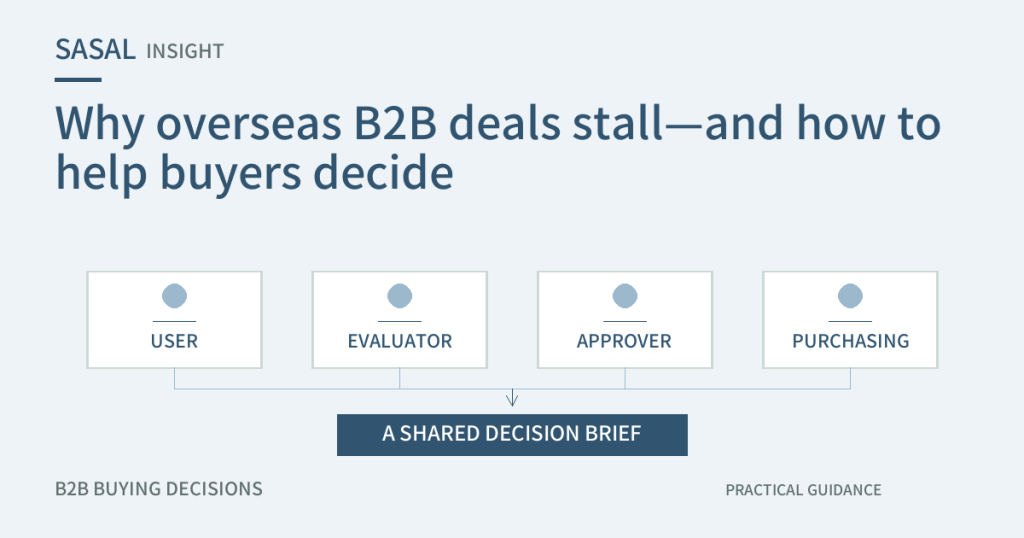
Many overseas opportunities appear promising because meetings are positive, technical interest is genuine and the customer asks detailed questions. Yet interest alone does not create an order. In many organizations, a conversation with one department is only the beginning of a broader internal process involving evaluation, budgeting, procurement, implementation planning and approval. Suppliers often misread activity as progress when they cannot see how decisions are actually made. A more useful approach is to understand who is involved, what questions remain unanswered and what internal steps must occur before adoption becomes possible. This article explains how to distinguish buying progress from meeting activity, support internal sponsors and build evidence that helps a customer move a proposal forward accurately and credibly.
Distinguish a productive conversation from a buying process
A productive conversation and a buying process are related, but they are not the same thing. A meeting can be highly engaged, technically detailed and encouraging without indicating that purchasing has begun. In overseas B2B sales, suppliers often spend significant effort responding to questions from interested users while assuming that an order is approaching. The more useful question is whether the customer is gathering information or actively advancing an internal decision. Understanding that distinction helps avoid unrealistic forecasts and directs attention toward the next decision that must occur inside the customer organization. Instead of treating every positive interaction as progress, examine whether the discussion is connected to a defined evaluation, budget review or approval activity.
A practical way to assess progress is to ask what decision the current discussion is intended to support. If the customer is comparing alternatives, identifying requirements or investigating feasibility, the opportunity may still be at an exploratory stage. If they are collecting information for a proposal, seeking technical confirmation or arranging reviews with additional stakeholders, the process may be advancing. Neither situation is inherently better. What matters is identifying the actual stage rather than assigning an optimistic interpretation. When suppliers understand the purpose of a meeting, they can provide more relevant information and avoid confusing interest with commitment.
Consider a hypothetical software supplier speaking with an operations manager in another country. The manager attends several meetings, requests demonstrations and asks detailed questions. The supplier interprets this as evidence that a purchase decision is near. Later, communication slows because the manager must first justify the project internally and involve finance and IT reviewers. Nothing necessarily went wrong. The supplier simply mistook evaluation activity for purchasing activity. Had the supplier explored the internal path earlier, they could have prepared material suited to the next reviewers rather than focusing only on the initial user conversation.
A useful discipline is to record the purpose, owner and expected outcome of each interaction. Information exchange, evaluation, negotiation and approval are different activities and should not be combined into a single notion of progress. When a meeting concludes, identify what the customer intends to do next with the information provided and who is responsible for that action. This creates a more reliable picture of opportunity development than counting meetings or assuming momentum. It also helps both sides identify missing information before delays emerge.
A practical review routine can make stage assessment more consistent across an account team. After each customer interaction, capture three items separately: what information was exchanged, what internal decision the customer said they were supporting, and what action is expected before the next discussion. This mirrors the distinction between information exchange, evaluation, negotiation and approval described in the source material. For example, a demonstration requested to explore possible fit should not automatically be logged as approval progress unless the customer has connected it to a defined review activity. A useful recommendation is to maintain a simple decision log showing the reviewer or department involved, the question being examined and the status of that question. If no decision owner or review purpose can be identified, the opportunity may still be exploratory even when engagement is high. A hypothetical application would be an exporter noting that several meetings have occurred but recording that all discussions are still focused on feasibility questions from users. That record provides a more reliable basis for forecasting than meeting counts because it documents the customer's stated decision path rather than the supplier's interpretation of enthusiasm.
- Information exchangeBuyer and supplier explore the problem, possible fit and open questions.
- EvaluationRequirements, evidence and alternatives are reviewed by relevant stakeholders.
- Approval activityBudget, procurement or management reviews determine whether to proceed.
- Order readinessNext steps align with confirmed internal decisions and timing.
Identify the people who use, evaluate, approve and pay
Many overseas opportunities stall because the supplier interacts with only one role while assuming that role represents the entire organization. In practice, the person experiencing the problem may not control budget, approve suppliers or manage implementation. Internal buying groups can include users, technical evaluators, managers, finance teams, procurement specialists and executives. The exact structure varies by organization, so it is safer to discover who participates than to assume a standard process. Understanding these roles helps suppliers prepare relevant evidence and anticipate additional reviews before an order can be placed.
An effective discussion explores who will use the solution, who will evaluate its suitability, who will approve expenditure and who will be responsible after adoption. Sometimes one individual performs several functions. In larger organizations, responsibilities may be distributed across departments. Rather than asking for an organizational chart, suppliers can ask practical questions. Who needs to be comfortable with the proposal before it can move forward? Who will review specifications, cost or implementation requirements? Which team would be involved if adoption proceeds? Such questions focus on decisions rather than hierarchy.
Different participants often care about different outcomes. Users may focus on operational improvements, while technical teams examine compatibility, integration or service arrangements. Finance reviewers may seek clarity about costs and payment expectations. Procurement personnel may concentrate on supplier registration or commercial process requirements. Executives may focus on business priorities and risk. A proposal that answers only one group’s questions can encounter delays when it reaches another audience. Mapping concerns by role helps ensure that information remains useful as the proposal moves internally.
The supplier's goal is not to bypass an internal contact but to help that contact navigate the organization effectively. A supportive sponsor can explain who else needs information and what concerns are likely to arise. By understanding the people connected to the problem and purchase, suppliers can create materials that remain relevant beyond the initial meeting. This increases the likelihood that internal discussions accurately represent both the opportunity and the remaining uncertainties.
Role mapping becomes more useful when it is tied to specific decisions rather than job titles. The source material notes that user interest may be followed by reviews from functions such as IT, procurement, quality or executives. A practical method is to build a stakeholder worksheet listing each known participant, the decision they influence and the information they are expected to review. This helps identify gaps early. For example, if the supplier has detailed discussions with users and technical reviewers but has no understanding of procurement requirements, future delays may be more likely once commercial review begins. A useful recommendation is to ask contacts which departments will examine the proposal next and what questions those departments typically raise. This approach keeps the conversation focused on process rather than hierarchy. A hypothetical application would be an overseas supplier learning that quality reviewers must assess operating conditions before procurement can engage. The supplier can then prepare relevant evidence for that review rather than assuming procurement is the next step. Mapping participants in this way also helps distinguish people who provide input from those who ultimately authorize movement to later stages of evaluation or approval.
- UsersAssess whether the proposal helps address the operational problem.
- Technical reviewersExamine specifications, integration and implementation considerations.
- Finance or procurementReview costs, purchasing process and supplier requirements.
- ApproversConsider priorities, risk and organizational fit.
Understand the problem behind the internal proposal

Customers rarely seek internal approval simply because a supplier has presented an attractive offering. Approval efforts usually begin because someone believes a business problem deserves attention. Suppliers therefore benefit from understanding the problem that the internal contact is attempting to solve. Without that context, discussions can become centered on product features while overlooking the reasons the proposal matters. A clearer understanding of the underlying issue helps determine what evidence, implementation planning and stakeholder involvement may be required before a decision can be made.
Useful conversations explore the consequences of the current situation, the intended outcome and the conditions under which the organization would consider change worthwhile. These discussions do not require dramatic business cases or precise financial projections. They simply clarify why the proposal exists. When the problem is well understood, it becomes easier to connect capabilities, service arrangements and adoption requirements to the customer’s objectives. It also becomes easier to identify where additional information is needed before internal discussions can proceed.
Consider a hypothetical manufacturer evaluating a new overseas supplier. The visible request concerns product specifications, but the underlying issue is recurring downtime caused by inconsistent deliveries from existing sources. If the supplier focuses only on technical features, important concerns about support arrangements, contact availability and continuity may remain unanswered. Understanding the broader problem allows the proposal to address the decision that the customer is actually trying to make rather than the narrower request that initially appeared in conversation.
Suppliers should also distinguish confirmed facts from assumptions. An internal contact may believe that a particular outcome is important, while other stakeholders may prioritize different concerns. Asking how the proposal will be presented internally can reveal whether the identified problem is widely accepted or still being evaluated. This understanding helps the supplier support a realistic decision process and reduces the risk of building extensive material around an issue that has not yet been established as an organizational priority.
Understanding the underlying problem is often easier when discussions follow the customer's operational sequence rather than the supplier's product structure. The source material emphasizes connecting company strengths to the prospect's problem and explaining what the discussion can help them assess. A practical method is to ask the contact to describe what happens today, where difficulties appear and what outcome internal stakeholders hope to achieve if a change is approved. Those answers can then be compared with the evidence being requested. If requests for service arrangements, contact availability or implementation planning appear repeatedly, they may indicate that continuity of operations is part of the real problem being evaluated. A useful recommendation is to document confirmed statements separately from assumptions and identify which stakeholders have validated each concern. That record can be shared back with the customer for confirmation before extensive proposal work continues. A hypothetical application would be a supplier discovering that delivery reliability, not product capability, is the issue driving internal discussion. The supplier could then focus future materials on the operational concern actually being reviewed, while clearly identifying any aspects that still require further investigation.
Discover how budget and purchasing decisions connect
Budget availability and purchasing approval are often discussed as though they are the same issue. In reality, they may be connected but separate decisions. A department may recognize a problem and support a proposal while still needing funding approval. Alternatively, budget may exist but require formal evaluation, procurement review or management authorization before it can be used. Suppliers who understand how these activities relate can avoid making inaccurate assumptions about timing or likelihood of purchase.
A useful conversation explores how the organization normally moves from interest to expenditure. The goal is not to obtain confidential financial information but to understand the sequence of decisions. Does a department first establish need and then seek funding? Must a proposal be included in a planning process before purchasing can begin? Are there review stages that occur after budget approval? These questions help reveal dependencies that may affect progress. They also help suppliers identify when additional evidence will be needed and who may request it.
In a hypothetical example, a customer confirms that funds are available for a project. The supplier interprets this as a strong indication that purchasing is imminent. Later, the opportunity slows because technical validation and supplier registration are required before procurement can proceed. Budget was necessary, but it was not sufficient. By understanding the broader path earlier, the supplier could have anticipated these requirements and prepared supporting information before they became bottlenecks.
It is often more useful to track completed and upcoming decision steps than to estimate a closing date. Decision dates, review meetings and required approvals provide concrete evidence of progress. When those activities remain undefined, the opportunity may still be at an earlier stage than the level of interest suggests. Focusing on actual dependencies encourages more accurate forecasting and better collaboration with the customer as they navigate their internal process.
When budget and purchasing activities are separate, suppliers can benefit from tracking them as distinct milestones rather than combining them into a single status update. The source material highlights budgeting, evaluation, tenders, contract review and other review activities as different steps that may affect timing. A practical method is to ask which completed actions are required before the next stage can begin and whether any dates have already been scheduled internally. This does not require disclosure of confidential financial information; it simply clarifies dependencies. A useful recommendation is to maintain a timeline that distinguishes business-need discussion, funding consideration, procurement review and adoption planning. Doing so can reveal situations where strong support for a project exists but formal purchasing activity has not yet started. A hypothetical application would be a supplier learning that funding has been allocated but supplier registration remains outstanding. Instead of treating the opportunity as purchase-ready, the supplier can prepare registration information and clarify any related requirements. Tracking each dependency separately also improves communication because progress can be discussed in terms of completed reviews and upcoming decisions rather than assumptions about whether available budget automatically means an order is approaching.
- Business needA problem and proposed approach are identified and discussed.
- Budget considerationFunding availability or allocation is reviewed internally.
- Purchasing reviewsEvaluation, procurement or approval activities may follow.
- Adoption planningImplementation and support requirements are prepared.
Separate adoption requirements from sales presentation requests
Customer questions are not always requests for sales material. Some questions reflect genuine adoption requirements that must be addressed before a purchase can succeed. Suppliers who treat every request as a presentation opportunity can overlook important implementation concerns. A more productive approach is to determine whether the customer is seeking persuasive information, practical planning information or both. Understanding the difference helps prioritize effort and produces material that supports real decision making rather than creating additional documents with limited internal value.
Adoption requirements can include integration considerations, training needs, workflow changes, service arrangements, supplier registration activities or operational downtime. These issues may influence whether the customer can realistically implement the proposed solution even if they believe it offers benefits. When such concerns remain unresolved, internal stakeholders may hesitate to approve the proposal. Addressing adoption early demonstrates that the supplier understands the customer's environment and is prepared to support practical use after purchase.
A hypothetical buyer may ask for detailed information about support coverage, response arrangements and points of contact. The supplier could interpret these questions as procurement formalities and respond briefly. However, the customer may actually be assessing whether ongoing operations can be supported across languages, locations or time differences. A thorough response addressing post-sale realities may contribute more to internal confidence than another product presentation focused on capabilities already understood.
Suppliers should therefore examine each request in terms of the decision it supports. If a question relates to implementation, adoption or ongoing use, the answer should address those operational concerns directly. This approach helps the customer build a realistic internal proposal and reduces the risk that approval is granted without sufficient planning. It also strengthens trust by demonstrating attention to the practical relationship that follows a successful purchase.
One way to separate adoption requirements from presentation requests is to classify incoming questions according to the stage of use they address. The source material identifies areas such as integration, training, workflow changes, downtime, supplier registration and service arrangements as adoption considerations. A practical method is to review every customer request and ask whether it helps stakeholders understand value, assess implementation or prepare ongoing operations. The answer determines the most useful response format. A useful recommendation is to maintain a checklist of operational topics that have been discussed and those that remain open. If a customer repeatedly asks about support coverage, contact hours, returns, maintenance responsibilities or implementation activities, those questions may deserve dedicated documentation rather than brief answers embedded in a sales deck. A hypothetical application would be an overseas buyer evaluating how time differences affect post-sale communication. In that case, a clear explanation of contact arrangements and responsibilities may support internal review more effectively than additional feature demonstrations. Organizing responses around operational readiness can also help internal sponsors explain how adoption will work in practice, reducing the risk that approval discussions focus only on expected benefits while overlooking implementation realities.
Help the internal contact explain the decision accurately
An interested contact often becomes the internal communicator for a proposal. Even when suppliers participate in meetings with additional stakeholders, someone inside the organization usually explains the opportunity between discussions. Supporting that person effectively can improve the quality of internal evaluation. The objective is not to equip them with sales language. Instead, provide clear explanations of benefits, assumptions, limitations, implementation requirements and unresolved questions. Accurate communication helps internal reviewers reach informed conclusions and reduces misunderstandings that can slow progress later.
Materials should be matched to the decisions different audiences must make. Users may need explanations of intended outcomes and operational impact. Technical reviewers may require information about specifications, environments or integration considerations. Finance teams may need clarity regarding costs and payment arrangements. When the same document attempts to answer every question equally, important details can become difficult to find. Organizing information around actual decision needs makes internal review more efficient and more credible.
A hypothetical sponsor preparing an internal proposal may struggle to explain which claims are already demonstrated and which remain subject to evaluation. If the supplier provides structured evidence, clear assumptions and identified open questions, the sponsor can present a balanced picture. This often improves trust because stakeholders see both what is known and what still requires confirmation. Overstating certainty may create skepticism if reviewers later discover important omissions or unresolved dependencies.
It is also useful to discuss how the opportunity will be described internally. Ask which questions are expected, what concerns have already emerged and what additional information may be required. This collaborative approach helps the supplier support the customer's process without attempting to control it. By making the decision easier to explain accurately, suppliers improve the likelihood that internal discussions remain connected to the real problem, the proposed solution and the practical considerations involved in adoption.
Internal contacts are often asked to summarize a proposal for colleagues who never attended supplier meetings, so information should be easy to reuse in that context. The source material recommends matching materials to departmental decisions and sharing evidence, assumptions and open questions. A practical method is to prepare short audience-specific summaries that answer three points: what decision is being considered, what evidence currently supports it and what uncertainties remain. A useful recommendation is to provide references to the source of important claims, such as demonstrated results, specifications or service arrangements, so the internal sponsor can distinguish established facts from areas still under evaluation. A hypothetical application would be a contact preparing a briefing for finance and technical reviewers. Instead of forwarding a large collection of mixed documents, the sponsor could share separate explanations tailored to cost-related questions and implementation-related questions. This reduces the effort required for reviewers to locate relevant information and helps preserve accuracy as the proposal moves between departments. It also supports more balanced internal discussion because stakeholders can see both the strengths of the proposal and the issues that still require confirmation before later approval decisions are made.
Prepare evidence for each unresolved buying question
When an opportunity reaches internal review, unanswered questions become more important than enthusiastic reactions. A supplier can improve the quality of the decision process by identifying what remains uncertain for the customer and preparing evidence that addresses those uncertainties directly. The key is to focus on the decision being considered rather than assembling the largest possible collection of marketing material. Different stakeholders often need different forms of evidence. A user evaluating operational impact may need examples of intended use, while a technical reviewer may need specifications, integration information or service arrangements. By listing unresolved questions explicitly, suppliers can avoid sending information that is interesting but unrelated to the next internal decision.
A practical method is to review every open issue and ask who needs the answer, why they need it and what evidence would help them assess it. Some questions concern expected outcomes, others concern implementation effort, support capability, purchasing conditions or ongoing use. Organizing evidence around these categories often makes internal review easier than distributing documents by product feature. It also reveals where evidence does not yet exist. In those situations, it is usually better to identify an open question honestly than to imply certainty. Clear assumptions and acknowledged unknowns allow reviewers to evaluate risk more accurately and maintain confidence in the supplier’s representations.
Consider a hypothetical industrial supplier whose contact requests information from quality, operations and procurement teams. Rather than sending identical material to every audience, the supplier prepares separate explanations connected to each decision. Operations receives information about intended use and support arrangements. Quality reviewers receive evidence related to specifications and operating conditions. Procurement receives details about supplier engagement requirements and commercial process considerations. None of these materials guarantee approval, but each helps a different stakeholder assess the proposal according to their responsibilities. The result is a more efficient internal discussion because participants are not required to extract their answers from documents designed for someone else.
Evidence should also distinguish demonstrated facts from areas still being evaluated. Buyers often need to explain not only why a proposal appears attractive but also what questions remain unresolved. When suppliers help them do that accurately, internal reviewers can concentrate on genuine uncertainties rather than debating unclear claims. This approach supports better decisions regardless of the eventual outcome. If the proposal advances, the organization has a clearer understanding of adoption requirements. If it does not advance, the supplier gains a more reliable picture of which questions prevented progress and what evidence may be needed in future opportunities.
- Operational reviewEvidence explains intended use, workflow impact and support arrangements.
- Technical reviewEvidence addresses specifications, integration and implementation considerations.
- Commercial reviewEvidence clarifies costs, payment expectations and purchasing process needs.
- Executive reviewEvidence connects the proposal to organizational priorities and adoption readiness.
Agree a mutual next step with an owner and purpose
Many opportunities lose momentum because the parties leave a meeting with different expectations about what happens next. A supplier may believe the customer will advance an internal proposal immediately, while the customer may still be gathering information. A more reliable approach is to agree a specific next step, identify who owns it and clarify what decision or question it is intended to support. This does not require a complex project plan. Even a simple agreement about responsibilities and purpose can make progress easier to interpret and reduce unnecessary follow-up activity.
Useful next steps are connected to a decision rather than to activity alone. Sending documents, arranging another meeting or introducing a colleague may be appropriate, but each action should help answer a defined question. For example, a technical review meeting may exist to determine implementation feasibility, while a budgeting discussion may exist to assess whether funding can be requested. When the purpose is clear, both sides can prepare effectively and evaluate whether the activity achieved its objective. This creates a more meaningful measure of progress than counting interactions or assuming that additional meetings automatically indicate advancement.
A hypothetical customer contact may agree to present the proposal internally before the next discussion. Rather than ending the meeting with a general intention to stay in touch, the supplier and contact identify what information will be shared, who will review it and what feedback is expected afterward. The supplier commits to providing implementation and support information. The contact commits to gathering responses from the relevant reviewers. Neither party promises an outcome, but both understand the purpose of the next interaction and the responsibilities attached to it.
Mutual commitments are particularly valuable because they reveal whether an opportunity is actively moving through a decision process. If neither side can identify a meaningful next action, the opportunity may not yet be ready for further investment. Conversely, a clear next step with a defined owner often indicates that a real evaluation is occurring. The goal is not to force urgency. The goal is to connect actions with decisions so that progress, delays and remaining uncertainties can be understood more accurately.
- Identify questionDefine the issue that must be answered before progress is possible.
- Assign ownerAgree who is responsible for advancing that question internally or externally.
- Provide inputShare the evidence or discussion needed for review.
- Review outcomeConfirm what was learned and what decision follows next.
Track dependencies rather than assuming a closing date

Forecasting an overseas B2B opportunity becomes difficult when attention focuses on a target closing date instead of the activities that must occur before a purchase can happen. Internal reviews rarely proceed according to a universal sequence, and different organizations involve different stakeholders. Rather than predicting an order date from limited information, suppliers can track dependencies that have been confirmed by the customer. Examples might include technical evaluation, budgeting discussions, procurement review, contract examination or implementation planning. Each completed dependency provides more reliable evidence of progress than a date selected primarily for forecasting convenience.
A dependency-based view encourages better questions. Instead of asking when the customer expects to buy, ask what decisions still need to occur before purchasing becomes possible. This often reveals missing information, unresolved concerns or organizational steps that were previously invisible. It may also uncover activities that are outside the contact’s control. Understanding these dependencies helps suppliers prepare useful material at the appropriate time and reduces the risk of interpreting temporary inactivity as a sign that the opportunity has failed.
Consider a hypothetical service provider whose customer expresses strong interest but cannot estimate a purchase date. An optimistic supplier might interpret the uncertainty negatively or attempt to create an artificial timeline. A more practical approach is to identify the remaining requirements. The customer explains that an internal evaluation, budget review and implementation discussion are still pending. Although no closing date is available, the supplier now understands the path ahead and can support each stage with relevant information. The opportunity becomes easier to assess because progress can be measured against actual decisions rather than expectations.
Tracking dependencies also improves internal forecasting within the supplier’s organization. Opportunities can be categorized according to confirmed activities rather than subjective enthusiasm. A proposal with identified reviewers, scheduled evaluations and agreed next actions is different from one based solely on positive conversations. Neither should be dismissed, but they should not be treated as equivalent. By monitoring the steps that connect interest to adoption, suppliers gain a clearer picture of opportunity quality and can allocate time and resources more effectively.
Interpret silence and delays without inventing explanations
Periods of silence are common in complex B2B opportunities, particularly when multiple internal stakeholders are involved. The challenge is that suppliers often fill information gaps with assumptions. A delayed reply may be interpreted as loss of interest, internal disagreement, budget problems or a competing supplier’s success. Sometimes one of those explanations is correct. Often none of them can be confirmed. A disciplined approach treats silence as missing information rather than evidence for a preferred narrative. This reduces unnecessary reactions and keeps communication focused on facts that can actually be verified.
One useful method is to review what was previously agreed and determine whether any expected action or decision date has passed. If a customer indicated that an internal review would occur during a particular period, a follow-up can refer to that agreed activity rather than speculating about motives. This keeps the conversation professional and relevant. It also gives the customer an opportunity to explain changed circumstances, additional requirements or revised timing without feeling pressured to justify every delay. Respectful persistence is often more productive than repeated requests for updates that provide little context.
Imagine a hypothetical exporter that sends a proposal and receives no response for several weeks. Team members generate competing theories about what happened. Instead of acting on those theories, the exporter reviews previous discussions and notes that procurement and technical evaluation were expected before further feedback. A concise follow-up asks whether those reviews have occurred and whether any additional information would be useful. The communication remains connected to known facts. If the customer responds, the supplier gains better information. If not, the supplier still avoids making planning decisions based on unverified assumptions.
Delays can indicate many different situations, including competing priorities, internal scheduling issues, additional reviews or reduced urgency. They can also indicate declining interest. The difficulty is that the same outward behavior may result from very different causes. Suppliers therefore benefit from separating observation from interpretation. Record what has happened, what was expected to happen and what information remains unknown. This approach supports clearer opportunity management and reduces the tendency to overreact to normal fluctuations in communication.
Decide when to invest more effort or pause the opportunity
Not every opportunity deserves unlimited attention. Suppliers must eventually decide whether additional effort is likely to improve the customer’s ability to make a decision. The strongest reason to continue investing is usually the presence of identifiable progress requirements. If stakeholders are engaged, questions are becoming clearer and specific reviews are occurring, additional support may be worthwhile. In contrast, repeated activity without a connection to any internal decision can indicate that the opportunity is not currently advancing. The goal is not to abandon uncertain opportunities prematurely but to match effort with the quality of evidence available.
A practical review examines whether the customer has a clear problem, access to the relevant decision process and willingness to evaluate the proposal seriously. These factors do not guarantee an order, yet they often provide better guidance than enthusiasm alone. Suppliers can also assess whether new information continues to emerge. When discussions repeatedly revisit the same topics without clarifying responsibilities, requirements or next actions, the opportunity may have reached a natural pause. Continuing to provide more material under those conditions may add workload without improving decision quality.
Consider a hypothetical supplier that has participated in several productive meetings. The customer continues to ask thoughtful questions, but no one can explain who will evaluate the proposal, what approvals are required or what information is still missing. The supplier may decide to focus on clarifying those issues before committing further resources. Alternatively, if internal reviewers have been identified and specific evidence requests are outstanding, deeper engagement may be justified because there is a visible path for the information to influence a decision.
Pausing an opportunity is not necessarily a negative judgment about the customer. Timing, priorities and organizational conditions change. A pause can simply recognize that meaningful progress requires information or actions that are not currently available. Recording the reason for the pause is important because it allows future discussions to resume from known facts rather than from fading memories. Decisions about effort become stronger when they are based on observable conditions instead of optimism or frustration alone.
Create an opportunity brief that survives internal handoffs
Complex opportunities often outlast individual meetings, travel schedules and personnel availability. Information can be lost when responsibility moves between colleagues, departments or external contacts. An opportunity brief helps preserve context by recording the essential facts needed to understand the customer’s decision process. Rather than functioning as a sales summary, the brief should explain the problem being addressed, the people involved, the open questions, the evidence provided and the next known dependencies. This creates a shared reference point that remains useful even when participants change.
The most valuable briefs separate confirmed information from assumptions. A team reading the document should be able to identify what the customer has stated directly, what conclusions the supplier has drawn and what remains uncertain. This distinction becomes especially important when opportunities span several months. Without it, later reviewers may treat old assumptions as established facts. Recording the source of important information also helps preserve accuracy. Notes about who provided a statement and in what context can prevent misunderstandings when circumstances evolve.
A hypothetical exporter experiences a handoff when the original account manager takes on another assignment. Because the opportunity brief contains stakeholder roles, unresolved questions, previous commitments and upcoming review activities, the new manager can continue discussions without forcing the customer to repeat every detail. The customer experiences continuity, and the supplier retains institutional knowledge. The brief becomes even more valuable if multiple departments contribute to the opportunity, since it provides a common understanding of status and responsibilities.
An effective brief is updated whenever meaningful information changes. New reviewers may emerge, assumptions may be confirmed or rejected, and implementation requirements may become clearer. Recording those developments creates a decision history that supports both forecasting and customer support. Even if the opportunity does not result in an order, the organization gains a more reliable understanding of the buying process it observed. That learning can improve future proposals and make subsequent opportunities easier to evaluate and manage.