

Why does overseas expansion stall—even after all the research?
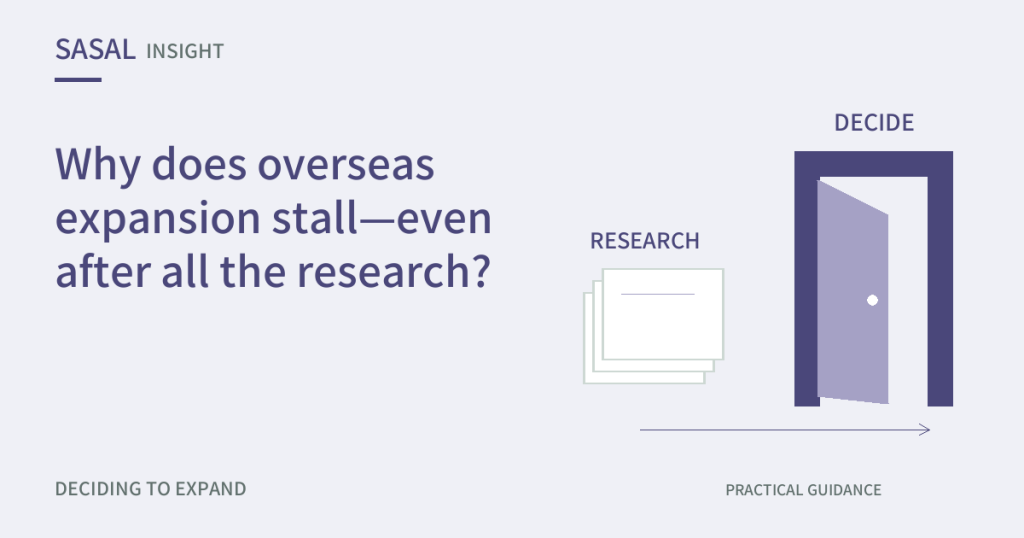
In this article, we introduce, in an interview format, the common challenges faced by companies undertaking overseas expansion. You may find parts of it relatable, so we hope you will read it while comparing it with your own company’s situation.
Phase 1. Interest in Expansion and Anxiety
— We heard that you have recently started considering overseas expansion.
That’s right. It wasn’t so much that there was a clear trigger; it feels more like it gradually started to catch my attention. More companies around us are expanding overseas, and when I look at market trends, I increasingly find myself thinking, “Maybe we’ll have to consider it eventually.” But to be honest, I still haven’t sorted it out in my own mind. Should we do it or not? That’s the first thing I don’t know.
— So you feel there is a need to do it, but you haven’t reached a decision yet.
Exactly. I feel like we probably should. But I can’t say with confidence whether now is really the right time or whether it’s truly necessary for our company. On one hand, I’m worried that we’ll be left behind if we don’t act, but on the other hand, the risks are significant. That’s why I can’t quite take the step forward. In the end, it’s not really a question of “whether to do it or not”—it’s more that I don’t know how I should think about it.
Phase 2. Gathering Information
— From that point, I imagine you’ve gathered quite a lot of information.
Yes. I spent a considerable amount of time on it. I looked at market information, researched expansion case studies, regulations, and specific implementation methods. I also spoke with consulting firms and talked with several local people through personal connections.
— It sounds like you’ve looked at things quite comprehensively. Do you feel you now have enough information to make a decision?
Actually, it’s the opposite. The more I researched, the less certain I became.
— In what way?
Everything seems right. Every market appears to be growing, and every approach sounds reasonable. But when it comes to whether it’s the right choice for our company, I suddenly can’t make a judgment. As a result, I end up in this situation: I’ve spent time and money gathering information, but in the end, I still don’t know what I should do.
— That’s exactly the situation many companies fall into.
I really think that’s true. Even though I have more information, decision-making isn’t moving forward. If anything, I feel less able to act than before.
Phase 3. Organizing One’s Thinking
— At that stage, what do you find most difficult?
The inability to organize everything. I can understand individual pieces of information. For example, I understand the advantages and disadvantages of establishing a local subsidiary, and I can more or less imagine the risks of working with partners. But all of these things are interconnected. The country you choose changes your approach and your organizational structure. The extent to which you handle things internally changes the investment required. As a result, even if I can understand the individual parts, I can’t make a decision about the whole picture.
— So you don’t yet have a framework for making decisions.
That’s exactly it. I don’t know what criteria I should use. While those criteria remain unclear, the number of options just keeps increasing. That’s why I don’t even know at what point I should make a decision.
Phase 4. Looking for Someone You Can Trust
— In that case, does the idea of relying on people from outside the company come to mind?
Yes, very strongly. In fact, at this point, I increasingly feel that it may be risky for our company to make these decisions on our own.
— But at the same time, there are challenges with that approach as well.
Exactly. The biggest problem is not knowing whom to rely on. I’ve spoken with several people, but they all say different things, and none of what they say is necessarily wrong. However, I still don’t know whether their advice is right for our company. I’ve looked at several consulting firms as well, but I haven’t reached the point where I can confidently say, “If I leave it to this person, everything will be fine.”
— There are referrals too, aren’t there?
There are. But it’s the same issue. Whether someone is highly capable and whether they are the best fit for our company are two different things. Ultimately, choosing the right person is difficult in itself. That’s why I don’t know whose advice I should trust. It always comes back to that.
Phase 5. Entrusting It to Someone
— During this process, has your way of thinking changed?
At first, I thought we could handle it ourselves. But the more I’ve thought about it, the more I’ve realized that overseas expansion is not just a single initiative. Market selection, partners, and organizational structure are all interconnected. One wrong decision can affect everything. With that in mind, I’ve come to feel that what we need is not partial support, but someone who can oversee the entire process from beginning to end.
— In other words, it’s close to a feeling of wanting to entrust it to someone.
Yes. Ideally, I’d like someone to think through it together with us from the very beginning. I’d like support in making decisions based on a full understanding of the overall picture. In that sense, rather than saying I want to “entrust it” to someone, it may be more accurate to say I want someone to “make decisions together with us.” Even so, however, the same issue remains in the end. I want to entrust it to someone. But I don’t know whom to entrust it to. That’s where things stop.
- Interest and uncertainty
- Gather information
- Make sense of options
- Choose whom to trust
- Decide together
The next step is to clarify company-specific decision criteria and who can help assess the whole picture.
In Closing
In many cases, consideration of overseas expansion follows this kind of path. It begins with uncertainty, moves into information gathering, leads to an increase in options, makes it even more difficult to organize things, and ultimately arrives at the question, “Whom should we trust?” This process is by no means unusual. In fact, the more carefully a company evaluates its options, the more seriously it tends to confront this stage. And what matters here is not gathering even more information. Nor is it forcing a conclusion. What is truly necessary for overseas expansion isa perspective on how to design the decision-making process itself.
At SASAL, we support this decision-making process itself. Before addressing individual choices such as which country to enter or which method to adopt, we work alongside companies to organize the decision-making criteria—starting with clarifying what overall structure should be used to proceed and which options are realistically viable for the company.
If anything in the discussion so far resonates with you, then it means you have already moved beyond the question of “whether to pursue overseas expansion” and have entered the stage of“how to make decisions.”And that stage is both the most important and the one that has the greatest impact on the outcome.