

North America, Europe or Asia? Five steps to shortlist markets
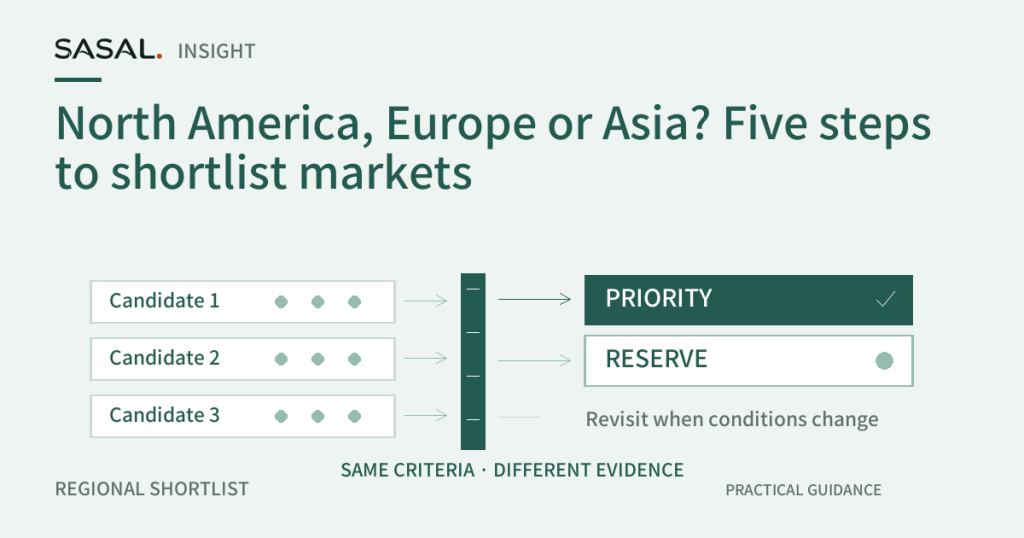
Many expansion discussions begin with a map and end with competing opinions about regions. A more reliable approach starts by defining the decision itself and then narrowing options through comparable evidence. This article explains a five-step method for moving from a long list of possible regions to a priority choice and a reserve option. The focus is not on proving that North America, Europe, Asia or any other region is inherently better. Instead, it shows how to compare alternatives using the same offer, the same customer outcome and the same decision standards. A continuing hypothetical workflow software example illustrates how evidence quality changes as the shortlist becomes more focused and prepares the handoff to later country selection.
Before comparing regions, define the decision you need to make

Regional comparisons often fail because different participants are answering different questions. One person may be seeking near-term revenue, another may be looking for strategic learning, and a third may be trying to support a future product direction. Before naming candidate regions, define the decision that must be made. Clarify the desired outcome, the time horizon and the level of commitment currently under consideration. A decision about where to conduct initial customer research is different from a decision about where to build a sustained business presence. When those choices are mixed together, evidence becomes difficult to compare. A concise decision statement helps everyone evaluate options against the same objective rather than personal preferences or familiarity with particular destinations.
Suppose a hypothetical company provides workflow software supported by human onboarding services. Leadership has identified three broad search areas: North America, Europe and Asia. At this stage, the company is not deciding where to establish operations, hire employees or make long-term commitments. The immediate decision is narrower: which region deserves concentrated investigation over the next phase, and which should remain a reserve option. That distinction matters because the evidence needed for a research priority is different from the evidence needed for a major investment. By defining the decision carefully, the team can avoid collecting information that sounds useful but does not influence the actual choice being made.
The objective should also describe whom the company intends to serve and what value it expects to provide. Discussions about geography become more productive when linked to a specific customer outcome. For example, the workflow software company may believe it can reduce coordination delays for distributed project teams through a combination of software and onboarding support. That customer outcome creates a clearer basis for comparison than a general desire to expand internationally. Regions then become search areas where the company investigates whether comparable customers experience that problem, how they currently address it and whether the proposed offer can be delivered under workable conditions.
A useful practice is to record the decision in a short memo before any regional comparison begins. The memo can identify the offer under consideration, the intended customer group, the expected outcome, the available resources and the unresolved questions. This document does not need to predict the answer. Its purpose is to preserve a common frame of reference as new information arrives. Later, when evidence from interviews, research and market conversations accumulates, the team can ask whether the findings help answer the original decision rather than drifting into unrelated debates about regional reputation, familiarity or anecdotal experiences.
A practical way to keep the decision definition stable is to write a short inclusion-and-exclusion note alongside the decision statement. Record what the current decision will influence and what it will not influence. In the hypothetical workflow software example, the note might state that the regional shortlist will determine where customer discovery efforts are concentrated next, but will not determine future office locations, hiring plans or country selection. That distinction helps evaluate new information consistently. If an interview reveals a potentially interesting partnership opportunity, the team can ask whether it affects the research-priority decision or belongs in a later stage. Recommendations should also be tied to the stated time horizon. A recommendation suitable for a three-month investigation phase may not be suitable for a multi-year expansion commitment. Keeping these boundaries visible reduces the risk that discussions drift toward topics that are important but not yet decision-relevant. As evidence accumulates, update unanswered questions in the memo rather than rewriting the objective itself. This preserves a clear audit trail showing how learning changed understanding while the underlying decision remained consistent.
Step 1: hold the customer outcome and offer constant
The first step in creating a meaningful shortlist is to keep the offer constant across all candidate regions. Many teams unintentionally compare different business concepts at the same time. They imagine one version of the product for one region, a different service level for another and a modified customer group for a third. That approach makes the comparison unreliable because each option is being judged on different assumptions. Instead, define the same customer outcome and the same core offer before evaluating any region. If the offer changes dramatically between candidates, the company is no longer comparing locations. It is comparing entirely different business models.
Returning to the hypothetical workflow software provider, imagine that the company serves organizations that need structured onboarding support in addition to software access. The comparison should begin with that exact proposition in every candidate region. The team should resist the temptation to assume a self-service version in one region, an enterprise version in another and a consulting-heavy version elsewhere. Those variations may eventually become relevant, but introducing them too early obscures the central question. The purpose of the first-stage shortlist is to discover where the same customer problem and the same proposed solution appear promising enough to justify further investigation.
Consistent comparison also improves the quality of demand research. When customer interviews, market observations and published information are gathered against the same offer definition, differences become easier to interpret. A positive response from one customer group can be compared with responses elsewhere because the underlying proposition remains stable. If findings appear inconsistent, the company can investigate whether the difference comes from customer needs, buying conditions or evidence quality. Without a constant offer, it becomes difficult to determine whether variation reflects genuine market differences or simply changing assumptions within the company itself.
As evidence accumulates, record both what was observed and what remains uncertain. An expression of interest, a customer conversation or a request for further information may indicate potential, but each observation should be connected to a specific hypothesis. For example, the workflow software company might hypothesize that customers value guided onboarding more than software features alone. That idea can then be tested consistently across multiple regions. By maintaining a stable offer and customer outcome during the early stages, the company creates a foundation for later decisions that is easier to review, challenge and improve.
To make a constant-offer comparison operational, create a single reference description that every researcher, interviewer and decision-maker uses when collecting information. In the hypothetical workflow software case, that reference could summarize the target customer problem, the software component, the onboarding component and the expected customer outcome in a few sentences. Every observation is then linked back to that same description. If a customer reacts positively, the team records which element of the defined offer generated interest. If a customer raises concerns, those concerns are captured against the same offer rather than against a modified version created during the conversation. A useful hypothesis log can sit beside the reference description. For example, the team may hypothesize that structured onboarding contributes materially to perceived value. Customer conversations, enquiries and requests for follow-up information can then be reviewed against that hypothesis across all candidate regions. This does not prevent future adaptation. Any recommendation to test a different service model should be labeled as a separate hypothetical application and evaluated after the initial regional comparison, preserving comparability during the screening stage.
- Define outcomeState the customer problem solved and the value expected from the offer.
- Fix core offerKeep the same product and service promise across candidate regions.
- Gather evidenceCollect interviews, observations and research against that offer.
- Compare findingsInterpret differences without changing the underlying proposition.
Separate non-negotiable conditions from preferences
After defining the decision and fixing the offer, distinguish non-negotiable conditions from preferences. This step prevents teams from rejecting potentially valuable options for the wrong reasons. Non-negotiables are conditions that must be satisfied before the opportunity can proceed. Preferences are desirable characteristics that may improve the opportunity but are not essential. Mixing the two often leads to confusion because every candidate appears weak when evaluated against a long list of preferences. A smaller set of true requirements creates a clearer basis for eliminating options that cannot currently support the proposed business objective.
For the hypothetical workflow software company, a non-negotiable condition might be the ability to deliver onboarding support in a manner consistent with the customer promise. Another might be the availability of a reachable customer segment that experiences the targeted workflow problem. By contrast, existing management familiarity with a region, convenient travel patterns or previous informal contacts may be useful advantages but should not automatically become requirements. Treating preferences as mandatory can remove options before they have been investigated properly and may distort the shortlist toward familiar territory rather than customer opportunity.
This distinction also helps teams handle uncertainty more effectively. A region should not be rejected simply because information is incomplete. Missing information means that a question remains unanswered, not that the opportunity has failed. When evidence is limited, record the uncertainty explicitly and identify what would need to be learned before a decision could change. This approach preserves potentially attractive options while preventing unsupported assumptions from influencing the shortlist. It also creates a transparent record showing why an option remains active, requires further testing or is temporarily parked.
A practical way to document the discussion is to maintain a simple decision ledger. For each candidate region, list the non-negotiable conditions, the evidence supporting them and the unresolved questions. Separately record preferences and note their influence on the decision. This structure encourages disciplined evaluation because elimination is based on requirements rather than convenience. It also prepares the team for later stages of the shortlist process, where feasible options will be compared using a common decision sheet and evidence confidence will be assessed independently from perceived attractiveness.
Teams often benefit from defining evidence thresholds for non-negotiable conditions before reviewing regions. The thresholds do not need to be numerical scores. Instead, they can describe the minimum evidence required to keep an option active. For the hypothetical workflow software company, a non-negotiable condition such as access to a reachable customer segment could require at least some direct evidence that the target customer group can be identified and contacted for further investigation. If that evidence is absent, the result is not necessarily elimination; it may trigger a test classification because the question remains unresolved. Separately, preferences can be ranked by influence so that desirable characteristics do not gradually become hidden requirements. A decision ledger becomes more useful when each entry identifies whether a statement is an observed fact, an interpretation or an open question. This structure aligns with the source guidance to separate observations from conclusions. When leadership later reviews the shortlist, participants can see whether disagreement stems from different interpretations of the same evidence or from genuinely different facts. That transparency reduces circular debates and clarifies what additional learning is actually needed.
Step 2: build a longlist, then keep, test or park each option
After defining the offer and the non-negotiable conditions, create a longlist broad enough to include every region that could plausibly contain the target customer group. The purpose of this stage is not to identify a winner. It is to avoid narrowing choices before comparable evidence exists. A longlist may include North America, Europe, Asia and other regions if they contain customers who experience the same problem the company intends to solve. For the hypothetical workflow software provider, each region begins as a search area rather than a final destination. The team records what is known, what remains uncertain and whether any non-negotiable condition already appears impossible to satisfy. Most options should remain active until evidence justifies a clearer classification.
A useful next step is to assign every longlist option to one of three temporary categories: keep, test or park. Keep means current evidence suggests the option remains feasible and worth comparing. Test means a specific unanswered question could materially change the assessment. Park means the option is not being pursued now, although it may deserve reconsideration later. These labels reduce the pressure to force an early yes-or-no decision. They also help separate elimination from sequencing. A parked option is not necessarily inferior. It may simply require capabilities, resources or evidence that the company does not currently possess. Recording that distinction preserves future flexibility while keeping present priorities manageable.
Consider the hypothetical software company comparing customer groups across several regions. Early interviews may suggest that organizations needing structured onboarding support can be found in all three candidate regions. However, the team may have stronger evidence from one region, only preliminary conversations in another and almost no direct customer contact in the third. Rather than converting those differences into broad judgments about regional attractiveness, the company can classify the first region as keep, the second as test and the third as park. The decision reflects evidence availability and current feasibility, not assumptions about long-term potential. That discipline helps prevent anecdotal impressions from dominating the shortlist process.
Documenting the reasons behind each classification is as important as assigning the label itself. A short decision memo can record the evidence reviewed, the remaining questions and the conditions that would move a region into a different category. For example, a parked region might return to active consideration if customer interviews later reveal a transferable use case. A test region might become a keep option once a critical assumption has been investigated. By preserving the logic behind each choice, the company creates a transparent path from a broad regional longlist toward a smaller set of candidates that deserve deeper comparison.
A simple longlist review cycle can make the keep, test and park categories more informative over time. For each candidate region, record the current category, the reason for that status and the next event that could justify a change. In the hypothetical workflow software example, a test classification might depend on completing several conversations with one of the identified customer groups, while a parked classification might remain in place until resources become available for additional outreach. The key is that movement between categories is driven by specified questions rather than by general impressions. Another useful practice is to review categories and evidence separately. A region can remain in the keep category even when important uncertainties exist, provided those uncertainties do not currently violate a non-negotiable condition. Likewise, a parked region may still appear attractive; it is simply not the best use of present investigation capacity. Recommendations about where to focus next should therefore reference the unanswered question being prioritized, not a broad judgment about regional quality. This preserves optionality and creates a documented path showing how the shortlist narrows from a broad search area to a manageable set of candidates.
Do not confuse missing information with an unsuitable market
One of the most common shortlist mistakes is treating uncertainty as negative evidence. A region with limited information often appears weaker than a region that has been researched extensively, even when neither has demonstrated stronger customer demand. The difference may simply reflect where the company has spent time gathering information. To avoid this bias, distinguish between what has been observed and what has not yet been investigated. An absence of evidence should be recorded as an open question rather than as proof that the opportunity is unsuitable. This distinction becomes especially important when comparing multiple regions that have received different levels of attention from the team.
The hypothetical workflow software provider offers a useful illustration. Imagine that leadership has completed ten customer interviews associated with one region, three interviews associated with another and none in a third. It would be incorrect to conclude that the first region is inherently stronger simply because it generated more observations. The company may have concentrated its outreach there due to an existing contact network. The proper interpretation is that confidence differs across the options. The first region has more evidence supporting a hypothesis, while the others still contain larger information gaps. Confidence and attractiveness should therefore remain separate concepts throughout the shortlist process.
A practical method is to maintain an evidence ledger beside the keep, test and park classifications. For every observation, record the source, date, scope and question being addressed. Customer interviews can help explain buying reasons, while public information may reveal how potential buyers describe their needs. Each item should be linked to a specific hypothesis rather than collected as general background information. When leadership reviews the shortlist, the discussion becomes clearer because participants can identify which conclusions are supported by direct observations and which remain interpretations awaiting further validation. The quality of evidence becomes visible instead of being assumed.
This approach also prevents overreaction to isolated findings. A single positive conversation does not establish broad demand, and a single rejection does not invalidate an entire region. Both are observations that require context. The objective is to understand what each piece of evidence can legitimately support. As the evidence ledger grows, patterns become easier to evaluate because the company can compare similar findings across regions. The result is a more balanced shortlist in which unknowns are managed through targeted learning rather than being mistaken for proof that a market opportunity does not exist.
An evidence ledger becomes easier to interpret when observations are grouped by the decision question they address rather than by source alone. In the hypothetical workflow software example, entries can be organized under questions such as customer problem relevance, onboarding acceptance, customer access and delivery feasibility. Interviews, enquiries and public information related to the same question are reviewed together, making it clearer what is known and what remains uncertain. Each entry should also note its scope so that reviewers understand how far the observation can reasonably be applied. This supports the source guidance that different evidence types answer different questions. A practical review meeting can focus first on unanswered questions with the greatest potential to change the shortlist. If several observations point in the same direction, confidence may increase. If findings conflict, the result is not necessarily a negative conclusion; it may indicate that the underlying hypothesis needs further investigation. Recommendations should therefore distinguish between actions aimed at increasing confidence and actions aimed at evaluating attractiveness. Treating those goals separately helps prevent additional research from becoming unfocused background gathering.
Step 3: compare the remaining regions on one decision sheet
Once clearly infeasible options have been removed or parked, compare the remaining regions using a single decision sheet. The purpose is consistency rather than mathematical precision. Every candidate should be evaluated against the same questions, using the same definitions and the same evidence standards. For the hypothetical workflow software company, the sheet might include customer access, evidence of the target problem, ability to deliver onboarding support, resource requirements and major unanswered questions. Importantly, the sheet should not attempt to predict every future outcome. Its role is to organize what is currently known so that competing options can be reviewed on comparable terms rather than through separate narratives.
When leadership discussions become complex, a simple structure helps separate attractiveness from confidence. A region may appear attractive because customer interviews suggest a strong need for the proposed solution, yet confidence may remain low because only a small number of interviews have been completed. Another region may appear moderately attractive but supported by broader evidence. Recording those dimensions independently avoids false certainty. The team can then discuss whether the next decision should prioritize apparent opportunity, stronger evidence or further investigation. This distinction becomes especially useful when several regions remain plausible candidates and none has demonstrated a decisive advantage.
In the running hypothetical example, imagine that North America, Europe and Asia all remain under consideration after initial screening. The decision sheet does not assign universal regional scores. Instead, it compares the evidence collected for the same workflow software offer and the same customer outcome. One region may have more interview evidence, another may show easier access to the target customer group and a third may require fewer unresolved assumptions before a later country-selection exercise can begin. The comparison therefore focuses on the company’s specific hypothesis rather than on generalized beliefs about entire regions.
A useful final check is a sensitivity test. Ask whether a change in business priorities would reverse the provisional ranking. For example, if leadership placed greater emphasis on rapid learning rather than near-term customer access, would a different region become the preferred option? If the answer is yes, the decision is sensitive to strategic assumptions and should be documented carefully. If the answer is no, the shortlist may be relatively robust. Either outcome is informative because it clarifies why one region currently leads and what circumstances would justify revisiting the conclusion later.
Before completing the decision sheet, define the wording of each comparison criterion so every region is assessed consistently. In the hypothetical workflow software case, customer access, delivery fit and evidence confidence should each have a short written definition and examples of acceptable supporting evidence. This reduces the risk that participants interpret the same criterion differently when reviewing North America, Europe and Asia as candidate search areas. A useful companion document is a rationale column that explains why a provisional assessment was assigned. Rather than recording only a conclusion, the team notes the observations that support it and the unanswered questions that could change it. This approach complements the sensitivity test described later because reviewers can identify exactly which assumptions drive the ranking. A hypothetical application might involve comparing how the ranking changes if leadership emphasizes learning speed instead of broader customer access. Because the underlying rationale is documented, the team can see whether the change resulted from different priorities or from new evidence. The decision sheet therefore functions as a transparent comparison record rather than a scoring exercise that hides the reasoning behind the shortlist.
- Customer fitEvidence that the defined customer outcome matters to the target group.
- Delivery fitAbility to provide the proposed offer under workable conditions.
- Evidence confidenceQuality and quantity of observations supporting current conclusions.
- Open questionsUnknowns that could materially change the shortlist decision.
Work through a hypothetical North America, Europe and Asia shortlist
Consider a hypothetical company that sells workflow software with human onboarding. For this exercise, it compares the same customer group in North America, Europe and Asia: professional services firms coordinating work across several teams. Other customer groups can be researched separately, but their reactions do not enter this comparison. The observations below are invented solely to demonstrate the method. They are not findings about these regions, forecasts of demand, or accounts of SASAL projects. Each regional label refers to a small set of potential customers, not every business within that geography. The company uses a shared worksheet with five fields: the customer problem observed, the proposed onboarding arrangement, the unresolved buying question, the confidence in the evidence, and the next action. The purpose is to make differences in available evidence visible without turning a familiar region into an automatic winner.
In the North American candidate group, assume that relevant operating managers describe the coordination problem in their own words and agree to explore an onboarding schedule the supplier can currently support. That gives the team a useful basis for further investigation. However, the managers have not yet confirmed who controls the purchase budget, so their interest is not evidence of an approved order. In the European candidate group, assume that initial contacts describe a similar problem, but discussions have not yet established whether the customers will allocate staff time to onboarding. This option remains plausible, with a narrower evidence base. These differences arise from the hypothetical conversations, not from claims about regional buying behavior. The worksheet therefore records stronger evidence on one issue for the first group and an open participation question for the second, while preserving the same offer in both.
In the Asian candidate group, assume that a relevant buyer and budget owner have joined an initial conversation, but the supplier has not confirmed whether its team can deliver the requested onboarding in the required working language. The unanswered language question belongs to these particular customers and this supplier; it does not describe Asia as a whole. The option receives a test status. A practical next action is to agree a sample onboarding agenda and check who can deliver it, before treating the gap as either manageable or disqualifying. The same test would apply if this question arose in Europe or North America. All three candidates remain commercially unproven. One has a clearer delivery arrangement, another needs better evidence of participation, and the third needs a specific capability check. None deserves a universal regional score based on these limited observations.
The worksheet now supports an actionable shortlist. If the company currently prioritizes learning with its existing team, it might investigate the North American customer group first, retain the European group as a reserve and keep the Asian group on a narrowly defined test track. That allocation is a hypothetical management choice, not a recommendation to prioritize North America generally. If the onboarding capability check in the Asian group succeeds and the buyer confirms a workable purchasing process, that option could become the priority. If the initial North American contacts cannot identify a viable purchase path, their early interest may carry less weight. Record these possible reversals alongside the initial decision. This shows precisely what new information would change the allocation of effort and prevents a provisional shortlist from becoming a fixed belief about regional attractiveness.
- North American candidateObserved need and a workable onboarding schedule; purchase authority still unconfirmed. Next: clarify the buying path.
- European candidateSimilar customer problem; willingness to allocate onboarding time remains unknown. Next: test participation.
- Asian candidateRelevant buyer reached; required onboarding language coverage is unconfirmed. Next: check delivery capability.
Separate an attractive opportunity from confidence in the evidence

A common mistake during regional shortlisting is to combine attractiveness and confidence into a single judgment. An opportunity may appear attractive because customer conversations suggest a meaningful problem and a good fit for the offer. Confidence, however, concerns how strongly that conclusion is supported by evidence. Treating these concepts separately improves decision quality. The workflow software company therefore reviews each candidate region using two questions. First, if the assumptions prove correct, how attractive would the opportunity be? Second, how much confidence does the company currently have in those assumptions? This approach prevents an exciting but weakly supported hypothesis from being confused with a well-tested opportunity, while also preserving potentially valuable options for further investigation.
Consider a hypothetical situation in which interview feedback from one region is enthusiastic but based on only a few conversations. Another region may show slightly less enthusiasm yet provide evidence from a broader range of customer discussions. Neither finding automatically determines the shortlist. Instead, the company records attractiveness and confidence separately. A region can therefore be classified as highly attractive but low confidence, moderately attractive and high confidence, or another combination. These distinctions clarify what action should follow. Low confidence does not necessarily mean the opportunity is weak. It may simply indicate that the next research activity should focus on validating the most important assumptions before larger commitments are considered.
The team also documents the source, timing and scope of every important observation. An inbound enquiry is recorded differently from a structured customer interview. Publicly available information is distinguished from direct customer feedback. This discipline helps future reviewers understand what each piece of evidence can and cannot support. When a conclusion is proposed, the company links it to the underlying observations and explicitly states the remaining hypothesis. By doing so, the reasoning process becomes easier to challenge and improve. The result is not a perfect forecast. It is a transparent explanation of why the current shortlist exists and what information could reasonably alter it.
Evidence can be visualized through a simple comparison that avoids premature scoring. The goal is not to generate precise rankings but to clarify where confidence and attractiveness differ. That distinction often reveals the most useful next action. A region with strong attractiveness and weak confidence may deserve targeted validation, while a region with strong confidence and moderate attractiveness may become the reserve option. Separating these dimensions allows leadership to discuss uncertainty openly rather than disguising it within a single composite judgment.
- High attractivenessCustomer problems and offer fit appear promising if assumptions hold.
- High confidenceEvidence comes from multiple relevant observations with clear context.
- Low attractivenessCurrent findings suggest limited value even if assumptions are correct.
- Low confidenceImportant conclusions depend on unanswered questions or sparse evidence.
Step 4: investigate the question that could change the choice
When leading candidates remain close, the next step is not broad research across every topic. Instead, identify the single unanswered question most capable of changing the decision. The workflow software company reviews its shortlist and asks what uncertainty separates the top options. Perhaps customer interest appears similar across the remaining regions, but the team lacks clarity about whether organizations will engage with the onboarding component that differentiates the offer. Rather than expanding research in every direction, the company focuses on that specific issue. Concentrating effort on a decision-changing question makes better use of time and resources than collecting large volumes of information with little influence on the final outcome.
The investigation method should match the question being tested. Customer interviews may clarify buying reasons, while a limited trial discussion may reveal whether the onboarding process fits customer workflows. The company defines the hypothesis before gathering additional evidence. For example, it may hypothesize that customers who experience coordination delays value structured onboarding enough to support adoption. The objective is not to demonstrate that the product works in general. It is to learn whether a specific assumption affecting the shortlist is valid. A narrowly defined investigation creates findings that can be interpreted more easily and linked directly to the pending decision between candidate regions.
Another useful technique is a sensitivity test. The team asks whether a change in business priorities would reverse the shortlist. Imagine that management places greater emphasis on near-term learning rather than immediate commercial potential. Would the preferred region remain the same? If a modest shift in priorities completely changes the outcome, the decision may be less robust than it appears. Recording these scenarios does not require predicting the future. Instead, it helps leadership understand which assumptions drive the recommendation and where additional evidence would have the greatest impact on confidence.
At the end of this step, the company prepares a concise decision memo. The memo identifies the current priority region, the reserve option and the specific conditions that would trigger reconsideration. It also records why other options were parked rather than eliminated permanently. This documentation creates a clean handoff to the next phase, where attention shifts from broad regional search areas to individual countries, customer segments and delivery conditions. By preserving the reasoning behind the shortlist, the company reduces the risk of repeating earlier debates and ensures that future country selection begins with a clear understanding of what evidence already supports the chosen direction.
Test whether a change in business priorities reverses the shortlist
A shortlist is stronger when it survives changes in emphasis. Before selecting a priority region, test whether a reasonable shift in business priorities would reverse the ranking. This is not an attempt to force a different answer. It is a way to understand how dependent the current choice is on a small number of assumptions. For example, a company may currently value speed of customer learning above all other factors. If management later places greater weight on operational simplicity or the ability to support onboarding with existing staff, would the preferred region remain the same? A shortlist that collapses after one minor change may require more investigation before resources are committed.
In the hypothetical workflow software example, imagine that North America, Europe and Asia remain under consideration after earlier screening. Customer interviews suggest attractive opportunities in more than one region, but the evidence is still developing. The team therefore tests several alternative priorities using the same decision sheet. One version emphasizes customer learning, another emphasizes ease of delivering onboarding support with existing resources, and a third emphasizes building knowledge that could support future expansion. The objective is not to produce mathematical certainty. Instead, the team examines whether different strategic priorities consistently point toward one option or whether the apparent leader depends entirely on a single assumption.
This exercise also helps separate elimination decisions from tradeoffs. If a region fails a non negotiable condition, changing preferences should not restore it automatically. By contrast, when multiple feasible regions remain active, a shift in priorities may legitimately change their order. Recording these effects clarifies the nature of the decision. The team can then explain whether a region was excluded because it could not currently support the offer, or whether it remains a viable alternative that simply ranked lower under the chosen priorities. That distinction becomes valuable later if circumstances change or new evidence emerges.
A useful output is a short sensitivity note attached to the regional shortlist. The note records which assumptions were tested, what changed and what remained stable. If the preferred region remains first under several reasonable scenarios, confidence in the direction increases. If rankings change repeatedly, the company gains a different insight: the next research task should focus on the assumption causing the instability. Rather than debating regions in the abstract, leadership can investigate the specific question most likely to change the decision. This keeps research connected to action and prevents additional information gathering from becoming unfocused or open ended.
Step 5: choose a priority region, a reserve and review triggers
The final regional decision should produce more than a single winner. A practical outcome is a priority region, a reserve option and a set of review triggers. The priority region receives focused attention because current evidence supports further investigation there. The reserve remains active but does not receive the same level of effort. This structure acknowledges uncertainty without delaying action. It also prevents the team from treating all non selected options as failures. A reserve region may later become more attractive if customer evidence changes, resources increase or previously unresolved questions are answered. The decision therefore reflects current knowledge rather than a permanent verdict on every alternative.
Under the hypothetical learning-first objective described earlier, the North American customer group becomes the initial priority because the proposed onboarding schedule appears workable with the existing team. The European group remains a reserve while willingness to participate is clarified. The Asian group receives a bounded capability check rather than being labeled unsuitable: the company needs to establish whether it can provide the requested onboarding. If that check cannot be completed within the current investigation window, the option can be parked with an explicit reopening condition. This is a provisional allocation of effort across three specific customer hypotheses, not a verdict on their regions. A different objective or better evidence could change the order. The decision memo should record that possibility, together with what each team member needs to do next.
Review triggers are equally important. A shortlist should not remain unchanged simply because it was approved once. Define the conditions that would justify reconsideration. Examples might include new customer interviews that contradict the current hypothesis, a significant change in available staffing, or evidence that onboarding requirements differ from expectations. Triggers should be specific enough to guide future decisions but not so numerous that they create constant instability. The purpose is to establish a disciplined process for revisiting the shortlist when genuinely decision relevant information becomes available rather than reopening the debate after every new conversation.
A concise decision memo can capture the outcome. The memo records why the priority region was selected, why the reserve remains active and why other options were parked. It should distinguish observed evidence from interpretation and identify the most important remaining uncertainties. This document becomes a handoff tool for the next stage of market investigation. Team members joining later can understand the reasoning without reconstructing months of discussions. More importantly, future decisions can be compared against the original logic, making it easier to recognize whether a change in direction reflects new evidence or simply a change in opinion.
- PriorityReceives concentrated research and planning because current evidence best supports further investigation.
- ReserveRemains active with limited monitoring while the priority option is explored.
- ParkedHeld for future review because evidence is insufficient or timing is unsuitable.
Turn the regional shortlist into a focused country-selection brief
A regional shortlist is not the final destination. Its purpose is to narrow the search area so that country level investigation becomes more focused and efficient. Once a priority region and reserve have been identified, the next task is to translate the regional decision into a practical country selection brief. This brief should preserve the same customer outcome, offer definition and non negotiable conditions used throughout the shortlist process. Starting over with different assumptions undermines the value of the work already completed. The regional decision should therefore act as a filter that concentrates attention rather than as a signal to abandon the original logic and begin an entirely new evaluation.
The country selection brief should describe the customer group to investigate, the buying problem being addressed and the evidence gaps that still matter. In the workflow software example, leadership might instruct the next team to identify specific countries, customer segments and buying environments within the selected region that resemble the interview evidence already gathered. Broad regional interest now becomes a more targeted investigation. The goal is to move from a search area to concrete customer situations where demand, delivery conditions and adoption questions can be examined in greater detail. This transition connects strategic direction with practical research activities that can be assigned and reviewed.
The brief should also record what has already been learned and the limits of that learning. Evidence gathered from one customer group or jurisdiction should not automatically be treated as representative of an entire region. By documenting the source, scope and context of previous findings, the company creates a more reliable foundation for future comparisons. Country level researchers can then identify where conditions appear similar and where new questions must be tested. This approach prevents teams from overextending conclusions while still benefiting from knowledge gained during the regional screening process.
A strong handoff concludes with a small set of decision oriented questions. Which specific customer groups should be investigated first? What evidence would strengthen or weaken the regional hypothesis? Which assumptions remain most uncertain? Framing the next phase around these questions helps maintain momentum and continuity. The company has already reduced a long list of possibilities into a manageable shortlist. The country selection brief ensures that the next stage builds directly on that work, creating a clear path from broad regional exploration to focused market investigation and, eventually, to country level decisions supported by comparable evidence.