

Must you build abroad alone? An ecosystem approach to expansion
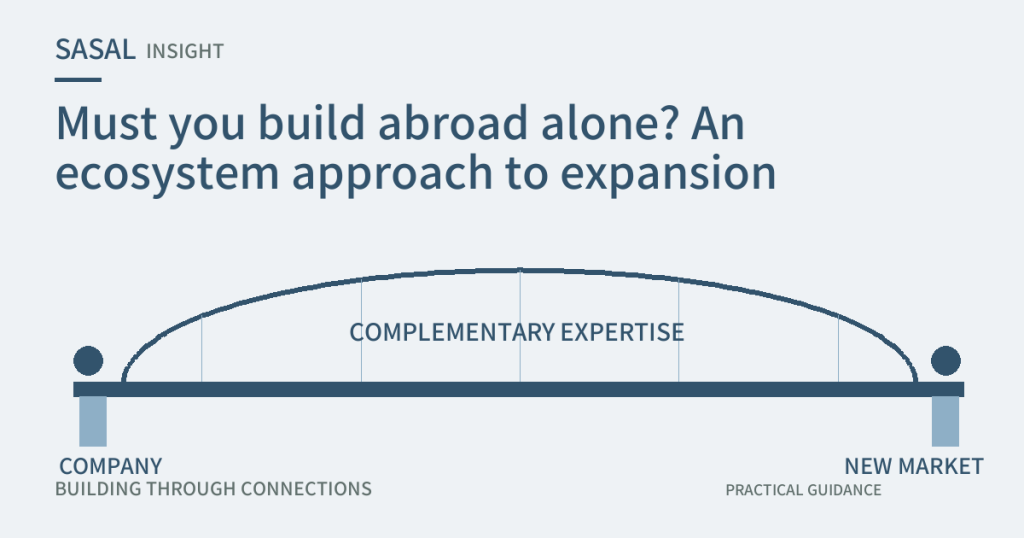
This article draws on research and examples concerning Japanese companies to discuss international business support involving companies and specialists. Japanese survey findings describe their surveyed population, not worldwide outcomes or success rates. Consider the division of responsibilities in relation to your own home market, target market and stage of business.
Many companies have likely considered international expansion at least once. Against the backdrop of a maturing domestic market, population decline, and growth in emerging economies, overseas markets are increasingly being discussed not as an option but as a premise that should be considered. However, when companies actually try to move forward with overseas expansion, many encounter obstacles such as, “We don’t know where to start,” or “Is this really the right decision?” This article focuses on the “initial design” stage, where many companies first stumble, and organizes practical ways of thinking that can help move international expansion forward in a realistic manner.
The Market Environment for International Expansion


The State of International Expansion by Japanese Companies
The overseas operations of Japanese companies have already become part of their management structure.The overseas operations of Japanese companies are no longer merely supplementary initiatives. According to the Ministry of Economy, Trade and Industry’s Basic Survey of Overseas Business Activities, Japanese companies have 25,325 overseas subsidiaries, and approximately 5.69 million employees work at overseas locations. The combined sales of these overseas subsidiaries amount to approximately ¥303 trillion, while net income for the fiscal year exceeds ¥14 trillion, indicating that overseas markets have already expanded to a scale comparable to the domestic market. A particularly noteworthy point is that the expansion of overseas business is not limited to manufacturing. The same survey shows that non-manufacturing companies account for approximately 14,000 overseas subsidiaries, representing a majority, confirming that overseas business activities have progressed across industries including IT and telecommunications, wholesale and retail, services, and healthcare. International expansion is not an issue confined to specific industries; it has become part of the actual business activities of many companies.
The Difficulty of International Expansion for Japanese Companies
International expansion is still considered a highly challenging undertaking. While overseas business activities have expanded, that does not mean the level of difficulty has decreased. Long-term studies concerning overseas assignments and overseas business indicate that failure rates have remained at around 40%. Furthermore, analyses suggest that, when looking at global expansion as a whole, the majority of cases do not fully achieve the results originally anticipated. [envestnet.com] [firmex.com] What is important is that these failures are not concentrated in specific industries or company sizes. Similar challenges arise regardless of whether the company is in IT, services, B2B, or B2C. It can be said that what determines the success or failure of international expansion is not the industry itself, but the way it is carried out.
Characteristics of Support for Japanese Companies’ International Expansion
Traditionally, the international expansion of Japanese companies has been based on a self-contained model. Establishing a local subsidiary, dispatching company personnel, and building full operations offers easier control, but it also involves substantial upfront investment and makes adjustments or withdrawal difficult. In recent years especially, exchange rates, geopolitics, and regulatory environments have been changing rapidly, and it is no longer uncommon for assumptions that were valid only a few years ago to become obsolete. In this environment, an approach that takes on everything internally from the outset is increasingly becoming a high-risk choice regardless of industry.
Success Rates of International Expansion by Japanese Companies
According to a survey by JBIC (Japan Bank for International Cooperation), the overseas sales ratio of Japanese companies has reached approximately 41%, while corporate interest is shifting from simply expanding locations to designing risk management and flexible forms of involvement. [github.com]
This should be viewed not as a sign that companies are refraining from international expansion, but rather as a movement toward designing their approach with greater precision. The difference between successful cases and unsuccessful ones often lies not in market selection, but in the manner of involvement and organizational design.
Methods of International Expansion

Engaging with Overseas Markets Is Not Limited to Establishing Local Offices
JETRO surveys show that there is no single form of international expansion. Many companies engage with overseas markets through exports, cross-border transactions, digital services, and business partnerships without maintaining a physical presence abroad. In fact, according to JETRO’s Survey of Japanese Companies Expanding Overseas, companies that export directly to the United States account for less than 30% of the total, indicating that many companies maintain contact with overseas markets in gradual and limited ways. [efinancial…areers.com]. This demonstrates that international expansion is no longer a simple binary of being “present” or “not present” overseas, but has evolved into a process with varying degrees of involvement along a continuum.
Reframing International Expansion as a Design Issue Rather Than an Execution Issue
Against this backdrop, it becomes clear that international expansion is not a contest of execution capability but of design capability. In which areas can your company create value overseas? What should be handled internally, and where should collaboration with external partners begin? What levels should be set for investment, risk, and scope of responsibility? By organizing these matters in advance, international expansion becomes not a matter of momentum, but a process that is adjustable and reversible.
Design and operation of the overseas business
- Your companyPurpose and value proposition
- Local companiesMarket understanding and local execution
- SpecialistsLegal, accounting and other expertise
- SASALSupport for overall design and coordination
The roles and form of collaboration depend on the company and its business plan.
A Practical Approach: Ecosystem-Based International Expansion
An approach based on this design-oriented thinking is ecosystem-based international expansion. In this context, an ecosystem-based model refers to advancing international expansion not as a self-contained effort by a single company, but by combining functions such as business design, local networks, legal and accounting services, talent, and operations with specialized players in each area. Research in international business has also shown that when companies engage with overseas markets as part of an ecosystem, they can reduce the liability of foreignness associated with unfamiliar markets and accelerate local adaptation. [efinancial…areers.com]
What SASAL Provides

SASAL’s Positioning in Overseas Expansion Support
SASAL supports the overseas activities of Japanese companies through a cross-industry, ecosystem-based approach. A key characteristic is that discussions do not begin with the assumption of overseas expansion. The starting point is not ‘whether to go overseas,’ but rather ‘what form of engagement with overseas markets is rational.’ Based on that premise, SASAL works with experts and companies in Japan and abroad to design the most suitable approach to international expansion for each company. Rather than carrying out everything itself, SASAL focuses on building and operating the ecosystem.
An Ecosystem That Can Be Joined Free of Charge
The ecosystem operated by SASAL is free to register for and join. It is designed as a place where companies considering international expansion and professionals involved in international business can gather information and build relationships. There is no need to request support immediately; one of the ecosystem’s distinguishing features is that participants can get involved from the consideration stage. In addition, because its objective is to help companies develop the capability to conduct business locally, it generally does not provide support in local languages and instead promotes initiatives centered on English. This is designed to help companies move away from a situation in which they can only gain a foothold for expansion through dependence on support providers.
International Expansion Is Determined by Design, Not Momentum
There is no universal method for international expansion. However, one point applies across industries: the quality of preparation and design has a significant impact on outcomes. More important than deciding which country to enter is determining by what method, with whom, and in what way to engage with overseas markets. Addressing those questions is the true starting point for international expansion going forward.