

How did a founder from rural Japan build global connections?
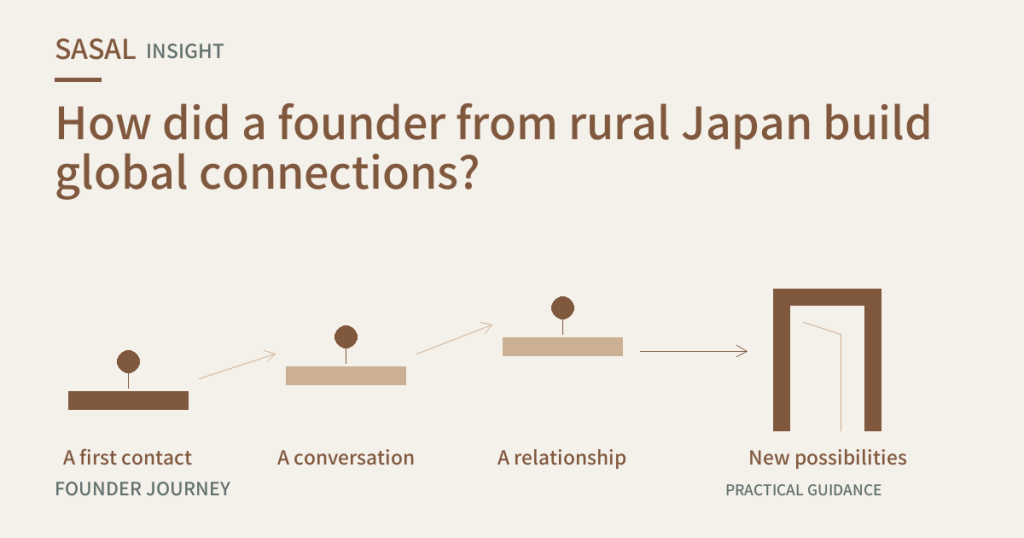
For many people, the idea of expanding overseas may feel somewhat distant. Language barriers, differences in business customs, and a lack of local connections or information—none of these are easy challenges, and there are many companies that feel, “We want to do it, but we can’t take the first step.”
At the same time, when you take a closer look at people who are actually doing business overseas, there are many cases where they did not start with a particularly special environment or strong advantages. Rather, you can see a process that began with small points of contact and gradually built familiarity, eventually leading them into a position where they were naturally “working internationally.”
This time, we speak with the founder of SASAL, INC. We will take a detailed look at how a Japanese individual born in Miyazaki Prefecture and raised in Kumamoto came to develop a global business centered on overseas clients.

Thank you for the introduction. I’m Sakamoto from SASAL. I manage the Cross-Border Business Infrastructure.
Among people who do business internationally, many were either born overseas or grew up abroad from an early age, placing them in international environments from the start. In contrast, I do not come from that kind of background. I was born and raised in a regional area of Japan and have progressed through repeated trial and error in what would be considered an ordinary environment. Because of that, I believe I can break down and explain, to some extent, questions such as “How can you connect with overseas markets?” and “In what order should you proceed to move closer to being able to do business locally?” In this interview, I hope to discuss a process of becoming accustomed to international business in a reproducible way that anyone can challenge themselves with, rather than something dependent on a special environment or exceptional talent.
I hope this interview will be helpful to the companies reading it.
Introduction: Expanding Overseas Is a High Hurdle for Anyone, but You Gradually Become Accustomed to It Through Experience
—First, as a premise, expanding overseas is a significant hurdle for many people, isn’t it?
Yes. Whenever people challenge themselves in unfamiliar areas, including overseas expansion, there is usually fear at the beginning. In the case of international business, many people are particularly concerned about differences in language, business customs, conversational pace, and assumptions behind decision-making.
I was the same way. In the early stages, I was cautious, so I consistently avoided “making a huge leap all at once” in order to reduce risk. You gradually become accustomed to it through experience, but I believe the most realistic way to create that sense of familiarity is to break actions down into steps and build them one stage at a time.

The Starting Point: Even Growing Up in a Regional Area, Overseas Did Not Feel “Too Distant”
—Please tell us about your background.
I was born in Miyazaki Prefecture and raised in Kumamoto. I did not grow up in an environment connected to overseas markets; it was an ordinary life in a regional area within a typical family. However, one of my father’s cousins was American, and seeing him speak English when I was young naturally sparked my interest in foreign languages and other countries. As a result, although I had never been abroad, even before founding SASAL I made a conscious effort to visit places in Japan where international people gathered.
The First Step: Attending “International Business Events” in Japan and Becoming Comfortable with the Environment
—How did you create your first point of contact?
SASAL first established a Japanese corporation and later established a U.S. corporation. After setting up the Japanese entity, before going overseas right away, I made a point of attending international business events in Japan. The reason was simple: to become familiar with international information while still in Japan. Depending on the type of event, many attendees were people from overseas who had come to live in Japan, and I used those opportunities to communicate with them and gather local information while remaining in Japan.
Working in Parallel: “Working” with Local Companies Through Online Networking Events in New York
—How did you approach the overseas side?
I participated in online networking events based in New York. The key point was not just to “listen,” but to create opportunities to do actual “work” together with local companies. Casual conversation alone often ends with simply becoming acquainted, but when you collaborate on something, even briefly, the relationship is more likely to continue. SASAL also continues creating online points of contact, including events that are announced as regularly held online (on the 20th of every month, for example).
The Order of Building a Local Network: First a Japanese Foundation, Then Local Connections
—Was your local network centered on local contacts from the beginning?
No. First, I built connections with Japanese people on the ground. Entering local networks immediately is a high hurdle and takes time. So I first built relationships with Japanese contacts, and only afterward developed connections with local people. The sequence was to connect with the local side through introductions and events. By doing this, overseas expansion—which can appear monolithic—becomes more gradual and easier to adapt to.
One Month in New York Once a Year: When People Remember Your Face, the Next Door Opens
—How did you become accustomed to the local environment?
At first, I spent about one month in New York once a year to become familiar with the city. Rather than relocating, I chose the realistic unit of “one month” to experience both daily life and business. As the number of interactions increases, people begin to remember you. As I developed more connections in New York, I increasingly heard things like, “Let me know when you come next time.” That is significant. Overseas, trust often develops through repetition more than through ability. It is important not to end things after a single interaction but to create a structure that leads to the next one.
- International events in Japan
- Online networking in New York
- From Japanese connections to local networks
- Repeated stays in the market
- Turn connections into work
A summary of the founder’s own experience described in the article.
After Starting Local Business: There Comes a Moment When a Network Becomes “Work”
—At what point did things start functioning as a business locally?
At first, it does not immediately turn into business. Even if you meet people at events, it is common for communication to stop or for follow-up messages to go unanswered. But you do not stop there. If you continue turning small points of contact into the next point of contact, there comes a moment when relationships transform into pathways, taking forms such as, “I’ll introduce you to this person,” or “Why don’t we do business together?” Today, I work with some of those connections and support our clients through those relationships.
Supporting the Overseas Expansion of Companies Worldwide as a “Cross-Border Business Infrastructure”
SASAL operates primarily with overseas companies, especially those centered in New York, as a Cross-Border Business Infrastructure. As a result, the volume of information within our company is actually greater for English-speaking businesses. If you have become familiar with our Japanese-language articles, we encourage you to take a look at our English-language articles as well, as they may help you gather information from the perspective of local companies. We also welcome you to register for and make use of our ecosystem.