

Before expanding abroad: what should a Japanese company decide?
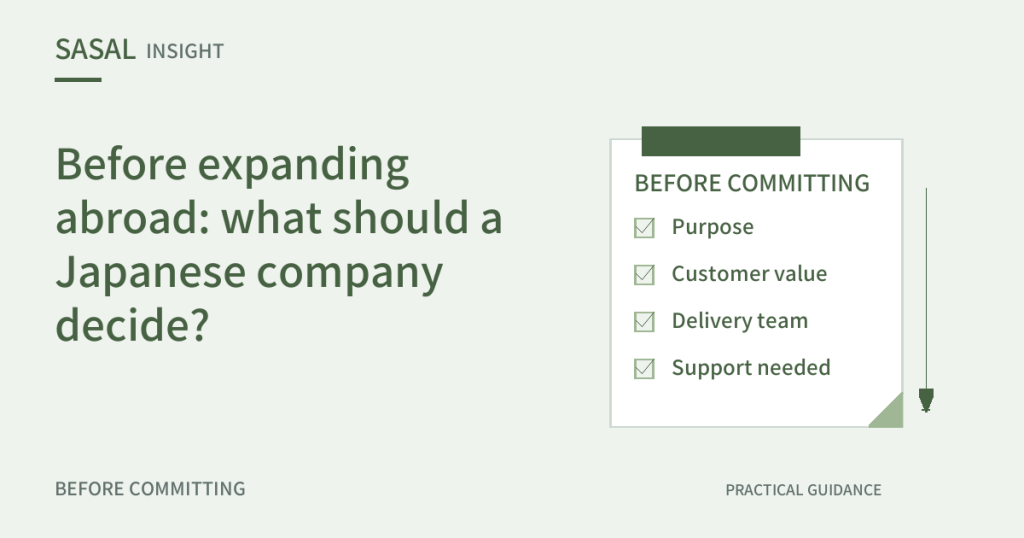
This article discusses international expansion through the context of Japanese companies; “domestic” in this account refers to Japan. Readers based elsewhere can apply the questions about customer value, delivery capability and investment decisions to their own home and target markets. Check institutions and business practices for the specific countries involved.
When companies begin considering overseas expansion, the first obstacle many encounter is not knowing where to start. Should they begin with market research, look for local partners, or first build an internal structure? While information is abundant, the assumptions required for decision-making differ from company to company, and the reality is that simply copying someone else’s success story rarely works.
What makes the situation even more difficult is the widespread belief that overseas expansion is inherently “the right thing to do” or “necessary for growth,” which can sometimes rush decision-making. However, going overseas is not a goal in itself. For some companies, continuing to succeed domestically is the optimal solution, while for others, their value can only be maximized by expanding abroad. What matters is clarifying whether overseas expansion is necessary for your company right now and, if it is, determining the most rational way to achieve it, so that you can move forward while reducing the likelihood of failure.
In this article, we organize, as realistically as possible, the key decision-making criteria and process that Japanese companies should understand when considering overseas expansion. It is structured so that by the time you finish reading, you will have a clear understanding of what your company should think about first, what it should avoid doing, and whom it should consult.
1. Is Overseas Expansion Really Necessary? Key Assumptions to Confirm First
Before considering overseas expansion, there is one thing you should confirm first: whether overseas expansion is being treated as a means for growth. If you begin moving forward simply because a competitor expanded overseas, because the domestic market feels uncertain, or because overseas markets seem likely to grow, your decisions are likely to become inconsistent along the way, resulting in mounting time and costs.
What is important here is to calmly consider whether there is a path to success that can only be achieved overseas and whether expanding abroad can create a structure that increases corporate value more than remaining domestic. For example, if your competitive advantage depends on domestic regulations, business customs, or distribution structures, that strength may weaken the moment it is taken overseas. On the other hand, if your product aligns closely with global standards, customer challenges are clearer in overseas markets, and pricing is accepted, international markets can become a major tailwind.
You do not need to treat overseas expansion as a simple choice between doing it and not doing it. Decision-making becomes more practical when framed in terms of when to do it, what form to start with, and which countries to test first. If you would like to organize your thinking on this stage more deeply, reading the following article as well may help you reach a decision more quickly.
[Related Article: Is Overseas Expansion Really Necessary?]

2. How to Approach Overseas Expansion | Getting the Sequence Wrong Makes Failure More Likely
Many failures in overseas expansion begin not with a lack of capability but with mistakes in sequence. For example, starting to look for local companies before deciding on a country, establishing a legal entity before determining a sales approach, or beginning recruitment without having an operational structure in place. Individual actions may seem correct, but if you move forward without an overall plan, contradictions will inevitably emerge.
If we simplify the process as much as possible, the basic flow is as follows.
First, clearly define for the overseas market whose problems you will solve, what those problems are, and what value you will provide. If this is vague, both country selection and partner selection will become unstable. Next, compare multiple countries and narrow the focus to those where you have the highest probability of success. What matters here is not large figures such as population or GDP, but the intensity of customer pain points, the speed of purchasing decisions, barriers to entry, the density of competitors, and alignment with your company’s strengths.
Once the direction becomes clear, only then should you determine the execution model. Will it be direct sales, distributors, partnerships with local companies, or a joint venture? After deciding on the execution model, you can then design legal entities, hiring, contracts, and operations as needed. In other words, overseas expansion is not about “going abroad first”; it is important to “design first, then expand.”
- Customer and valueWhose problem will you solve?
- Compare marketsAssess the fit with your strengths
- Choose the operating modelDirect sales, distributors, partnerships or joint ventures
- Build the required setupEntity, hiring, contracts and operations
Consider incorporation and hiring after choosing the operating model you need.
3. Common Failure Patterns for Japanese Companies Expanding Overseas
Failures in overseas expansion tend to occur structurally rather than as isolated mistakes. Here, we organize the typical patterns Japanese companies often fall into in a way that is as reproducible and practical as possible.
The first is choosing a local partner based solely on a referral. Referrals themselves are not bad. However, if you trust a partner simply because they were introduced to you, without thoroughly examining their business incentives, decision-making structure, financial resources, personnel, execution capabilities, and long-term alignment of interests, the consequences can be difficult to reverse later. Overseas, it is common for business not to progress even when relationships are good. Relationships are a necessary condition, but not a sufficient one.
The second is treating overseas expansion as merely a contractual issue. Partnerships and joint ventures, in particular, do not succeed simply because the contracts are properly drafted. More important are the day-to-day decision-making processes, the division of responsibilities, KPI definitions, exit conditions, and who decides what when unexpected situations arise. If these remain unclear, the project will inevitably stall.
The third is allowing decision-making authority between headquarters and overseas operations to become unclear. Overseas business requires speed, but if headquarters tries to approve every detail, progress slows; if local operations act independently, control breaks down. To resolve this contradiction, it is necessary to determine in advance how much authority will be delegated locally and establish a clear decision-making framework.
The fourth is allowing the value proposition overseas to become merely an extension of the domestic market. If the reasons a product sells in Japan depend on attentive sales practices, excessive quality standards, or uniquely Japanese business customs, those strengths may not resonate overseas. Conversely, Japanese strengths may be highly valued abroad. What matters is restructuring how value is presented and sold based on the value perceived by overseas customers.
4. How to Choose an Overseas Expansion Support Company or Consultant | Key Criteria to Evaluate First
Many aspects of overseas expansion cannot be completed internally, and it is reasonable to seek assistance from external support companies and specialists. However, if you choose a support provider simply because they offer a wide range of services, have many achievements, or were recommended to you, mismatches are likely to emerge later.
The first thing to examine is whether the support focuses on strategy, execution, or both. Strategy improves the quality of decision-making, but it does not replace execution. Execution, on the other hand, provides the ability to move things forward, but if the direction is unclear, the outcome may not be optimal. What matters in overseas expansion is the connection between strategy and execution. In other words, whether the designed direction has been translated into something that can realistically be operated.
The next point to consider is whether the support is tied to a specific method from the outset. For example, support that starts with conclusions such as “establish a legal entity no matter what,” “hire locally no matter what,” “use distributors no matter what,” or “form a joint venture no matter what” may not be optimal for the company. In overseas expansion, the choice of method significantly affects results. That is why support that helps design the approach before deciding on the method provides real value.
Finally, it is also important to consider whether consulting the provider automatically results in a recommendation to expand overseas. Depending on the situation, choosing not to expand internationally may be the better decision. The key question is whether the external advisor can also make the judgment to advise against expansion when appropriate. This is where trust is established.
5. The Ecosystem-Based Support Approach | Going Beyond the Limits of Standalone Support
Overseas expansion simultaneously brings a wide range of issues, including country-specific business customs, industry-specific regulations, legal, tax, and accounting matters, recruitment, marketing, sales, and operations. In practice, it is often difficult for a single company to provide all of these services at a consistently high level of quality.
This is where an ecosystem-based support model becomes practical: bringing together multiple areas of expertise and assembling the optimal team according to the situation. What matters is not simply having specialists in separate fields. It is the ability to integrate those diverse specialties into a single flow of decision-making and execution. As the number of issues increases in overseas expansion, the ability to design and manage the whole system becomes increasingly valuable.
This concept and the objectives of ecosystem-based support are explained in greater detail in the following article.
[Related Article: Ecosystem-Based Overseas Expansion Support – Cross-Border Business Infrastructure]
6. Common Characteristics of Companies That Should Seek Advice First | Should You Act Now or Wait?
Whether a company should seek advice on overseas expansion depends on its stage of development. Here, we outline the characteristics of companies that would benefit from early consultation and those that do not need to rush yet.
Companies that should seek advice early are those that have a clear view of the specific customer problems they can address overseas. They may already be receiving inquiries from abroad, have seen positive responses at trade shows, or have identified use cases that resonate internationally. For such companies, accelerating decision-making reduces missed opportunities. Companies whose objective for overseas expansion is linked not only to revenue but also to enhancing corporate value or redesigning their business portfolio will likewise benefit from investing time in careful planning.
Conversely, companies that do not need to rush are those that have not yet established a clear path to success domestically or those without individuals capable of making key decisions internally. Expanding overseas will certainly increase the burden of internal decision-making. If a company has not yet succeeded domestically, expanding abroad often only makes its problems more complex. The important thing is not to treat overseas expansion as an escape route.
There are only three things worth organizing before seeking advice. First, whom do you want to sell to overseas? Second, what do you want to achieve overseas? Third, how much responsibility can your organization realistically take on to achieve that goal? Having clarity on just these three points dramatically improves the quality of discussion.
7. Interview with the Company Representative | For Those Who Want to Understand the Origins of Our Support and the Vision We Aim to Create
Overseas expansion support is not determined by methodology alone. The values, decision-making standards, and priorities of the support provider ultimately influence the quality of the project. If, when choosing a support company, you want to understand the stance they take toward clients and the vision they are pursuing, an interview with the company representative is the most useful reference.
[Related Article: [Representative Interview] The Origins of SASAL’s Client Support for Overseas Expansion and Its Perspective on the Ecosystem Approach]
8. Contact Us
If this article has led you to wonder whether your company is at a stage where it should consider overseas expansion or whether it would be beneficial to discuss and organize your thinking with someone, please contact us. Overseas expansion is not inherently the right choice in every situation. Depending on a company’s phase and circumstances, concentrating on the domestic market may be the more rational decision.
We believe it is important not to start with a predetermined solution, but first to clarify what the best decision is for the current situation. It is perfectly fine if your plans are still unclear. We can help you work through the necessary assumptions and planning from the beginning. We look forward to hearing from you, starting with a free ecosystem registration.