

Why is the quote still missing? Two ways to approach pricing
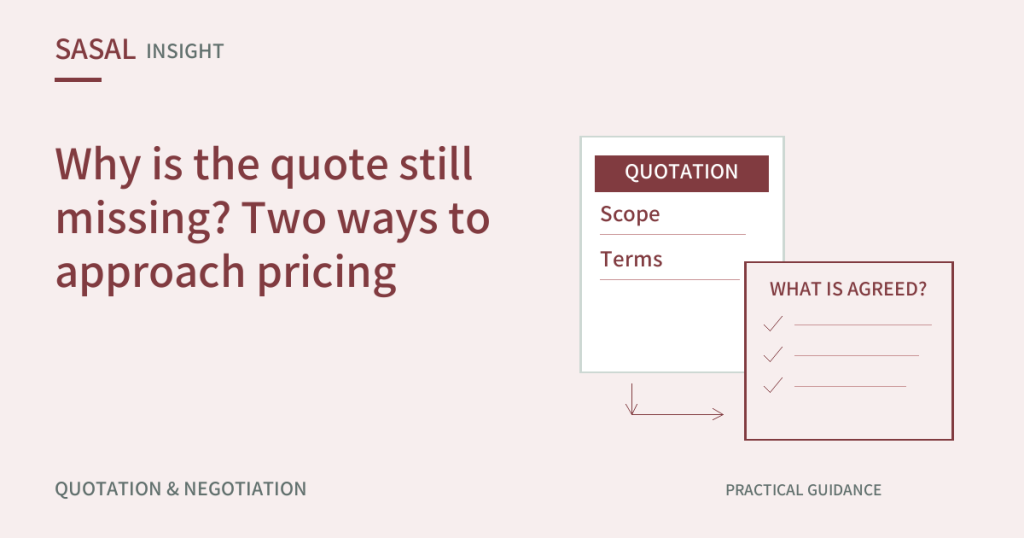
This article examines pricing and internal approval through cross-border transactions involving Japanese companies. Its practical comparison is between defining terms before quoting and starting evaluation with an indicative quotation. “Overseas” in this account is relative to Japan, rather than a category that defines all other companies. In a live opportunity, establish the particular buyer’s approval process and commercial conditions.
Introduction: The Source of the Sense of Discomfort Felt in Practice
When conducting business globally, one often encounters a common sense of discomfort. It is generally explained as “overseas companies make decisions quickly, while Japanese companies are slow,” but when actually driving deals on the ground, a phenomenon emerges that is clearly different from that impression. One particularly notable example is the timing of price quotations. When dealing with overseas companies, discussions themselves may proceed smoothly, yet the crucial price is frequently not presented until the very end. Japanese companies, on the other hand, tend to provide estimates at a relatively early stage and attempt to advance discussions around those figures. This difference is not merely a matter of speed or sales style; it arises from differences in the underlying philosophy of deal design itself. Behind it lie deep differences in how pricing is positioned, how decision-making is structured, and even how risk is perceived. What is especially important is that, overseas, transaction values are often large, making each pricing decision highly consequential, and therefore price quotations themselves are handled with great caution. Without understanding this premise, the question “Why are overseas companies so slow?” can only lead to superficial answers.

Overseas Companies: Price as a Carefully Handled “Final Decision”
For overseas companies, price is not merely a quotation; it is an extremely important decision directly tied to the company’s overall profitability and risk. Particularly in the B2B sectors of Europe and North America, it is not uncommon for a single deal to be worth hundreds of millions to billions of yen, and at this scale, pricing errors have a direct impact on corporate profits and losses. Even a small pricing mistake can have an impact amounting to millions or tens of millions of yen, and if there are misunderstandings regarding specifications or deficiencies in setting conditions, there is also the risk of significant additional costs arising after the contract is signed. In such an environment, price is not simply a question of whether to provide it, but a strategic question of when and under what conditions it should be presented. In practice, multiple processes are layered before a price is quoted, including customer needs analysis, definition of value provided, ROI validation, assessment of competitors, internal profitability evaluation, and review of contract terms. These processes are not linear; they are reconstructed according to the unique conditions and assumptions of each deal, so creating a quotation is often treated as a project in its own right. It has also been pointed out that delays in quotations may be influenced by ambiguous specifications, insufficient information, and confirmation work spanning multiple stages. Furthermore, from a negotiation perspective, price functions as an “anchor,” and once a number is presented, it establishes the benchmark for subsequent negotiations. For this reason, the timing of a price quotation must be designed with extreme care. Presenting a price too early carries the risk of fixing an unfavorable benchmark based on incomplete information. As a result, the more meticulous and risk-conscious an overseas company is, the later its price quotation tends to be. The important point here is that this delay is not inefficiency but rather the result of rational risk avoidance.[prezi.com]
Japanese Companies: Price as the Starting Point That Drives Decision-Making
In contrast, the role of price within Japanese companies is fundamentally different. In Japanese companies, price is not the final output of negotiation but rather functions as the starting point for discussion. In many cases, a quotation is presented first, and internal comparison and evaluation proceed based on that figure. This is closely related to the fact that decision-making in Japanese companies is carried out at the organizational level rather than by individuals. Because multiple departments and stakeholders are involved, specific numerical figures are indispensable as a common basis for judgment, making it necessary to present pricing at an early stage. In practice, Japanese companies commonly compare multiple options and comprehensively evaluate cost, quality, and risk, with quotations serving as a prerequisite for discussion. In addition, in Japan, presenting a price does not merely provide information; it also functions as an important signal of sincerity and willingness to respond. Rather than proceeding under ambiguous conditions, presenting an approximate figure can demonstrate intent to engage and transparency to the other party. Against this cultural and structural backdrop, Japanese companies tend to present prices early and then refine the final terms through subsequent adjustments and negotiations. In other words, for Japanese companies, price is not a “completed conclusion” but a “hypothetical starting point” for advancing discussion.
Define terms, then quote
- Value, terms and risk
- Present the price
- Move toward a decision
Start with an indicative quote
- Present a quotation
- Compare and align internally
- Agree final terms
Compare the sequence of quotation and approval. These are process patterns, not national categories; establish how the particular buyer operates.
Differences in the Use of Time
Ultimately, these differences can be reduced to a single question: where is time spent? Overseas companies spend time on external negotiations, defining value, and organizing risk, while Japanese companies spend time on internal consensus-building and coordination. Overseas companies concentrate time in the earlier stages of the process in order to solidify external conditions as much as possible before presenting a price, but once those conditions are set, decision-making proceeds quickly. Japanese companies, by contrast, present prices early and then advance internal approval processes and consensus-building, resulting in a longer latter half of the process. This difference creates the asymmetrical impression often felt in practice: “Overseas companies are slow to provide prices but quick to decide,” while “Japanese companies are quick to provide prices but slow to make decisions.” This distinction is not about which side is faster; it reflects differences in where the center of gravity in decision-making is placed, and both approaches have their own rationality.
Misunderstandings That Arise in Cross-Border Business
These structural differences create typical misunderstandings in cross-border business settings. The Japanese side may perceive the absence of a price quotation as a lack of transparency or sincerity and wonder, “Why is this taking so long?” Meanwhile, the overseas side may feel uncomfortable with Japanese companies providing prices early and think, “How can they present figures before the underlying assumptions have been finalized?” Although this disconnect often appears to be a cultural issue, it is actually rooted in differences in deal design philosophy. Both sides are acting according to their own rational logic, and neither side is wrong. However, because the underlying structures they assume are different, the same action ends up carrying different meanings.
Conclusion: Price Quotation Is a Matter of Structure, Not Speed
Ultimately, what matters is not treating the speed of a price quotation as a simple evaluation criterion. Price is not merely a number; it is a complex element encompassing value definition, risk management, profit design, and negotiation strategy. Particularly overseas, as transaction values grow larger, each individual decision carries management-level risk, making pricing something that must be handled carefully. This is not inefficiency but rather the result of a rational decision-making process. At the same time, the speed with which Japanese companies provide price quotations is also based on a rational structure designed to move internal decision-making forward. In other words, overseas companies operate under a structure of “finalizing value and risk before presenting a price,” while Japanese companies operate under a structure of “building agreement starting from a price.” Understanding this difference is the key to finally seeing the essential answer to the question, “Why are overseas companies slow and Japanese companies fast?” And this understanding itself becomes the starting point for designing deals in global business.