

SASAL INSIGHT / DEEP DIVE
How to plan an overseas PoC that informs a business decision
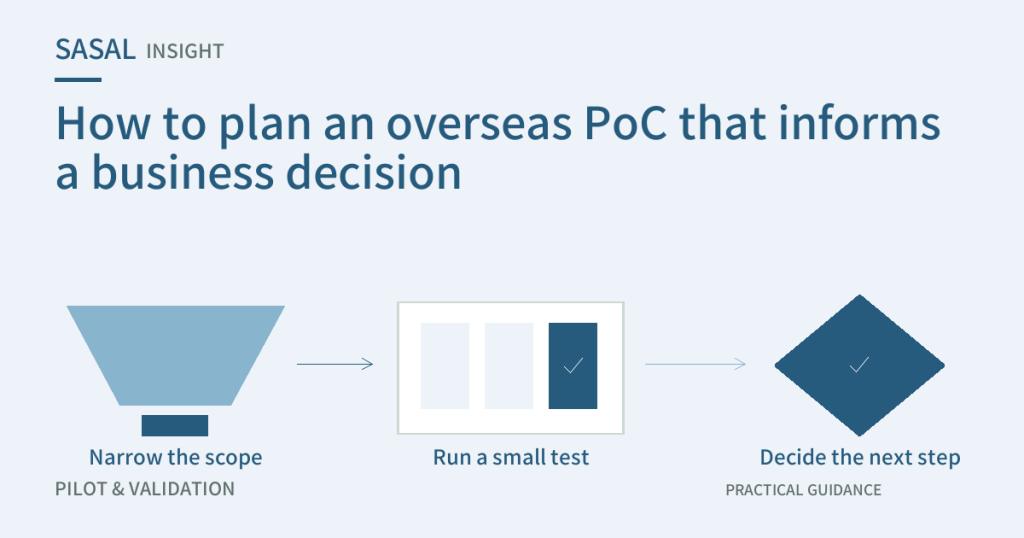
An overseas proof of concept should define the offer, the participating customer, the test boundary and the decision that follows. Its purpose is to answer a specific question before a larger commitment. Checking whether technology works locally is different from checking whether a customer can use it in everyday operations. Agree what the test needs to reveal, who will interpret the evidence and what they can decide afterwards. A focused experiment becomes useful when its result informs the next action, rather than simply demonstrating that an activity took place.
Choose the question before choosing the test
A broad question such as whether a product will sell mixes several uncertainties: performance, usability, price and purchasing procedures. Start with the uncertainty that most affects the next investment decision. If compatibility with local equipment is unknown, a technical demonstration may be appropriate. If the question concerns sustained use by staff, a trial closer to normal operations may provide more relevant evidence. The test should follow the question.
PoC, minimum viable product and pilot are not compulsory stages in a fixed sequence. A minimal offer can help a team learn from customer behaviour, while a limited operational pilot can examine delivery under more realistic conditions. Organisations also use these terms differently. State the actual scope and expected learning in plain language, so that participants do not assume they share expectations merely because they use the same abbreviation.
Check whether answering the proposed question would change an action. A plan to learn whether people like an offer leaves the next step unclear. A condition such as approaching another buyer if ordinary delivery terms work connects learning to a choice. If the answer would not affect the current decision, another uncertainty may deserve priority. Distinguish what interviews can establish from what requires actual provision before defining the experiment.
When technical and commercial questions both matter, preserve separate results for them. A demonstration can provide an opportunity to discuss purchasing, but successful operation does not replace a buying decision. Equally, commercial interest does not establish compatibility with the customer’s environment. Keeping the findings distinct makes it easier to explain why further work is required and which unresolved question that work would answer, without overstating the meaning of an encouraging result.
One practical way to prioritise the question is to list the decisions currently waiting for evidence and then identify which uncertainty blocks the most important near-term commitment. A team considering overseas expansion might be unsure about local operation, user adoption, implementation effort and purchasing approval. Rather than combining these into a single trial, it can rank them by consequence. If a negative answer to one question would stop further investment regardless of the others, that question may deserve attention first. A clearly hypothetical example illustrates the approach: suppose a company can already demonstrate technical operation in a controlled environment but does not know whether staff at a participating organisation can incorporate the product into routine work. In that situation, adding more technical demonstrations may generate activity without reducing the key uncertainty. The test could instead focus on actual use under defined conditions while recording technical observations separately. A suggested review method is to ask, before approving the trial, “What decision would we make if the answer is yes, and what decision would we make if the answer is no?” When different answers lead to the same action, the proposed question may not yet be the one that most usefully informs the business decision.
- List decisionsRecord investments or commitments awaiting evidence.
- Rank uncertaintiesIdentify which unknown most affects the next choice.
- Design testCreate activity that addresses that specific uncertainty.
- Link outcomeDefine the action for positive and negative results.
Write a test brief that connects an assumption to a decision
A practical test brief can begin with four statements: the assumption, the situation in which it matters, the evidence to collect and the decision that evidence will inform. The distinction between these statements is useful. An assumption describes what the team currently believes, while the evidence describes what it will observe. The decision describes what it could do afterwards. Writing all four makes it easier to notice a trial that produces activity without resolving a business question. It also gives a customer a clearer explanation of why participation is being requested and what the exercise is intended to establish.
For a hypothetical service, the assumption might concern whether participants can apply a defined piece of training in their work. The test would need to describe the task, the circumstances of use and the information participants can provide afterwards. A favourable opinion about the trainer could still be useful feedback, but it would not, by itself, answer the application question. Keep that distinction in the brief. The example does not prescribe a universal measure of training effectiveness; it shows how to connect the evidence collected with the specific claim the provider wants to examine before committing to a broader offer.
Review the brief with the people expected to act on the result. If the customer sees a technical demonstration while your team expects a purchase decision, resolve that difference before starting. If the commercial decision requires information the trial cannot supply, identify the additional work rather than quietly expanding the trial's promise. A narrow test can still be valuable when its limits are understood. The brief is ready when the parties can explain the same question in ordinary language and distinguish a useful finding from a conclusion that would go beyond what the proposed activity can support.
A useful addition to the test brief is a short interpretation section describing what the evidence will and will not support. Teams often define assumptions and observations but leave room for disagreement when results arrive. For example, a hypothetical overseas service provider might assume that users can complete a defined task after training. Evidence could consist of observations from that task under stated conditions. The interpretation section would clarify that successful completion supports the claim that participants applied the training in that context, while not automatically supporting broader conclusions about organisation-wide adoption, future purchasing decisions or long-term outcomes. This extra step helps prevent later pressure to extend the meaning of the results beyond the original question. A suggested method is to review the brief from the perspective of a colleague who has never seen the project before and ask what conclusion they would reasonably draw from the planned evidence. If their interpretation exceeds the intended scope, the brief can be revised before work begins. This approach is particularly helpful when several teams, countries or functions will review the findings, because it reduces the chance that different readers attach different meanings to the same observations.
Limit the product, customer and delivery scope
A narrow test involves more than selecting one country. Define the product, use case, customer group and work included. Changing several dimensions together makes it difficult to understand what influenced the outcome. Specify what falls outside the test, too. When additional requests arise, the team can choose whether to change the scope or save them for a later experiment, with the effects on effort and interpretation made visible.
For a service delivered by people, describe what the customer receives as clearly as you would describe a physical product. A training offer might specify the participating department, sessions, working language, materials and follow-up support. Avoid an open-ended promise to do whatever becomes necessary. A defined offer makes it possible to compare customer experience with the preparation and delivery effort required, and to decide what could be repeated for another buyer.
Describe the conditions of the participating customer as well as the product. Special equipment, unusually intensive support or a particularly cooperative contact can affect how broadly a result applies. It is reasonable to start with an accessible participant, provided those differences remain visible. Before using the findings with another buyer, distinguish the conditions the company can repeat from those that need further validation under a more ordinary delivery arrangement.
If the scope changes during the trial, record the change rather than continue interpreting results as if the original conditions remained intact. Additional features, support, participants or scheduling changes may affect what can be learned. Agree who approves an alteration and how the extra effort is handled. Flexibility and traceability can coexist: a clear change record lets the team respond to a customer while preserving an explanation of what the experiment actually tested.
Scope definition becomes more reliable when each boundary is expressed in operational terms rather than general descriptions. Instead of stating that the trial covers a customer segment, specify which participants, activities and support interactions are included. A hypothetical example could involve a service tested with one department of an overseas organisation. The scope might include a defined set of sessions, designated contacts and agreed follow-up activities, while excluding additional departments and unrelated support requests. Recording boundaries in this way helps later reviewers understand whether results emerged from the offer itself or from circumstances unique to the participant. Another useful practice is to maintain a separate list of requested additions that were not incorporated into the trial. These requests may reveal future opportunities without altering the current experiment. When reviewing outcomes, the team can compare the original scope with actual delivery and identify where extra effort accumulated. That comparison is often valuable because it highlights which elements appear essential to customer value and which arose from ad hoc accommodation. A narrowly defined trial does not limit learning; it can make learning easier to interpret because the conditions under which observations occurred remain visible and easier to explain to future customers or internal decision-makers.
- OfferProduct or service elements included in the test.
- CustomerParticipants, department or use context involved.
- DeliverySupport, preparation and operational activities provided.
- ExclusionsRequests and conditions intentionally left outside scope.
Plan a record that makes the observations interpretable

Decide how the trial will be recorded before asking people to participate. The record should connect the activity performed, the conditions under which it occurred and the observation relevant to the original question. For a service, this could mean recording what was provided, what the customer attempted and what follow-up was needed. For a technical check, it could mean identifying the agreed operating conditions and the outcome observed under them. Select the fields needed for the particular decision rather than create a large reporting exercise whose information nobody will use when deciding the next step.
Be explicit about comparison conditions. If the trial is meant to show a change from the current method, establish what is known about that method before describing the trial as an improvement. A missing baseline does not make every observation useless, but it limits the comparison that can be made. Record limitations in the result rather than remove them from the final presentation. If a change in environment or extra assistance affected delivery, include it. This helps another reader understand whether the finding concerns the product itself, the way it was provided or a combination of those conditions.
Allocate responsibility for maintaining the record and agreeing what can be shared. The relevant arrangements depend on the information and activity involved, so do not collect material merely because it might be interesting later. Clarify the required permissions and handling conditions as part of trial preparation. Where information cannot be shared, explain how that affects the question the trial can answer. A useful evidence record is one the team can interpret and use under the agreed conditions, not simply the largest possible collection of customer information or the most detailed set of observations.
When planning the record, consider how a future reviewer who was not involved in the trial will reconstruct what happened. Evidence is often collected gradually, and details that seem obvious during delivery may become unclear months later. A practical approach is to attach each observation to three pieces of context: what activity occurred, under what conditions it occurred and why that observation matters to the original question. In a hypothetical operational trial, an observation that a participant completed a task may be less informative without noting the support received, the environment used and whether the task matched the planned scenario. Another consideration is consistency. If different team members record information in different ways, later comparison becomes difficult even when the underlying observations are valid. A suggested method is to define examples of acceptable entries before the trial starts so that everyone understands the expected level of detail. This does not require a complex reporting system. The objective is simply to create a record that preserves enough context for interpretation. A concise, structured record often provides stronger decision support than a larger collection of notes that lacks clear links to the original business question or the conditions under which the activity occurred.
Agree success criteria and the commercial decision route
Set success criteria before the trial, linking them to the question being tested. Record the comparison, the observations needed and the person responsible for evaluating the result. A successful technical test and an approved purchase are different milestones. Identify who can authorise broader adoption and what evidence that person needs. This keeps the team from treating acceptance by a participating user as confirmation of the whole purchasing decision.
Where experimental funding and commercial funding have separate approval routes, understand both. A successful trial may still leave contractual or purchasing conditions to resolve. Agree the allocation of trial costs, the treatment of outputs and rights, and what happens when the work ends. The required safety, legal and contractual conditions depend on the activity and must be checked before it starts; calling the activity a test does not remove those obligations.
Identify who can provide the observations needed for evaluation. A claim about the customer’s work may require customer-side information alongside your own delivery record. If the starting position is unknown, do not present a favourable impression afterwards as a measured improvement. Establish what comparison is possible and, where it is limited, describe what the trial can still reveal. That makes the scope of the eventual conclusion clearer before anyone starts writing a report.
Agree what happens when criteria are not met as well as when they are. Possible responses include examining the cause, changing the offer or ending the current test. Do not make extension automatic: place a decision before further expenditure and effort. For a budget owner, knowing how evidence will inform the next commitment is more useful than receiving only a success label. It connects the experiment to the wider business objective and available resources.
Success criteria are most useful when they identify both the required observation and the threshold for advancing to the next decision stage. Even where precise measurements are not appropriate, the team can still define what type of evidence would justify further investment and what type would suggest caution. A hypothetical overseas trial might require confirmation that a defined process can be completed under agreed conditions before a proposal for broader deployment is prepared. Separately, the commercial route may require information from purchasing, procurement or budget owners before any order can be considered. Keeping these routes visible reduces the risk that operational enthusiasm is mistaken for commercial readiness. It can also be helpful to create a simple decision register showing who evaluates the evidence, who approves the next commitment and what information each person requires. During review, the team can compare the evidence actually obtained with the evidence originally expected. Any gaps become visible before resources are committed to expansion. This approach supports disciplined decision-making because the discussion shifts from whether participants generally liked the trial to whether the agreed criteria were satisfied and whether the people responsible for the next approval received the information they said they needed.
Map the work between a successful trial and an order
Before the trial ends, identify the decisions that remain even if the agreed criteria are met. The customer may need to confirm the commercial scope, arrange internal approval or resolve conditions for ordinary delivery. Ask which information the trial is expected to provide and which information must come from a separate discussion. This avoids treating success as an automatic order while still giving the customer a practical route forward. The purpose is not to force a purchase commitment before evidence exists; it is to understand how the evidence will be used if it supports continued consideration.
Distinguish the participants in that route. The person using the product may explain the operational benefit, while another person decides whether to allocate resources or authorise a supplier relationship. Identify the questions each person needs answered and who will provide the response. If the experimental budget and the commercial budget are separate, record the transition between them. The company should be able to explain the outstanding decision without relying on a participating contact to represent every internal role. A clear route also helps your own team prepare the right material instead of repeatedly presenting the same general benefits.
Make the proposed next step proportionate to the findings. A successful test of a limited feature might justify a further operational check rather than an immediate broad deployment. A successful operational trial might support a commercial proposal, provided the remaining terms can be resolved. Record the basis for choosing that step and the conditions that still apply. If there is no current route to a purchasing decision, retain the learning but reflect that limitation in the sales plan. This keeps technical progress, customer interest and commercial readiness visible as related but separate aspects of the opportunity.
Mapping the path from trial completion to a possible order can reveal dependencies that are invisible during delivery. Many overseas initiatives focus heavily on proving value but devote less attention to understanding how a customer converts that value into a purchasing decision. A suggested exercise is to create a step-by-step description of the process that would occur if the trial achieved its intended result. The description might include internal review, scope confirmation, supplier assessment, budgeting discussions or other customer-specific activities. The purpose is not to assume these steps will happen; it is to understand which questions remain unresolved even after favourable evidence is obtained. In a hypothetical example, a participating user may confirm that the offer fits operational needs, while another stakeholder requires additional information before considering broader adoption. Recording these separate requirements helps the provider prepare relevant material rather than repeating the same presentation to every audience. It also improves forecasting because the team can distinguish between technical progress and commercial progress. A successful trial therefore becomes one input into a wider decision route rather than a standalone event expected to produce an order automatically. That distinction often leads to more realistic planning and clearer communication with both customers and internal stakeholders.
- Trial resultEvidence collected against agreed criteria.
- Stakeholder reviewRelevant parties assess the findings.
- Commercial evaluationScope, terms and approvals are considered.
- Next commitmentProposal, further test or other agreed action.
Distinguish positive feedback from purchasing behaviour
Comments such as useful or interesting help reveal what the customer values. Ask what prompted the reaction and what would be required to buy or continue using the offer. A willingness to participate free of charge is different from a decision to pay under stated terms. Record the price, support provided, discounts and the respondent’s role so that feedback can be interpreted in the context in which it was obtained.
An order or payment provides more concrete evidence, but one transaction does not establish demand across a market. Examine whether special support or customisation helped secure that order and whether ordinary conditions could work for other buyers. Record rejection and deferral as well as positive responses. Silence can leave several explanations open, including timing, contact quality and communication. Keep those questions available for investigation rather than assigning a single explanation without evidence.
Record when feedback was given. A reaction to an initial explanation, a response after use and a decision after receiving price and terms have different contexts. Distinguish a person expressing enthusiasm from a person initiating the purchasing process. This does not dismiss positive feedback; it clarifies how the information can inform a sales plan. Keep unresolved intentions and confirmed orders in separate categories when discussing progress with colleagues.
Where possible, ask why a participant declines to proceed. An unnecessary product, unsuitable timing, unacceptable terms and missing approval information suggest different next steps. Some reasons will remain unknown, and the record should say so instead of filling the gap with an assumption. Where use or purchasing continues, note whether ordinary terms were sufficient or extra support was needed. That distinction helps shape the offer for subsequent customers rather than simply count positive outcomes.
A useful interpretation technique is to classify responses by the action associated with them rather than by their positivity. Comments, participation, requests for information, budget discussions and completed purchases all provide different forms of evidence. Treating them as equivalent can obscure what has actually been learned. Consider a hypothetical situation in which several overseas participants express strong interest after using an offer. Those comments may indicate perceived value, but additional questions are still required to understand timing, purchasing authority and conditions for adoption. Recording the respondent’s role is particularly helpful because enthusiasm from an end user and enthusiasm from someone responsible for allocating resources may have different implications for the next step. It can also be useful to note what prompted the response. Interest following a demonstration may reflect a different level of commitment than interest expressed after reviewing proposed terms. By preserving these distinctions, the team creates a more accurate picture of demand-related evidence. This does not reduce the importance of positive feedback; rather, it allows feedback to contribute appropriately to planning. Over time, comparing expressed interest with subsequent actions may help identify which signals most reliably precede purchasing behaviour in the specific market or customer group being explored.
Interpret mixed feedback without selecting only the favourable parts
A trial can produce several different reactions at once. Users may value the outcome while finding the preparation difficult; a commercial contact may support the idea but be unable to approve the current terms. Organise these observations around the conditions they describe instead of compressing them into one positive or negative label. The aim is to understand what works, for whom and under which circumstances. A mixed result may suggest a narrower use case or a different delivery arrangement, but that interpretation should remain a hypothesis until the relevant conditions have been checked.
Include responses that are inconvenient for the original proposal. If a participant did not use the offer, record that fact and any confirmed explanation. If the reason is unknown, leave it unknown. A lack of use could have several causes, and selecting the most reassuring explanation would make the next decision less reliable. Similarly, a purchase made with exceptional support should retain that context in the record. The team can recognise a real commercial action without assuming that it demonstrates demand under every future set of terms or that it can immediately be repeated at a larger scale.
At the review, distinguish changes that respond to evidence from changes that simply protect the original idea. A proposed revision should explain the observation it addresses and what another test would establish. If two interpretations remain plausible, identify the information that would help distinguish them. Avoid adding an extensive new scope just to prevent the current trial from ending without a simple success story. A useful conclusion can be that one part of the offer deserves further development while another assumption remains unsupported. That conclusion gives the next owner a clearer task than a general instruction to keep trying.
When feedback appears contradictory, organise it by stakeholder, condition and timing before drawing conclusions. Mixed results often become easier to understand when separated into these categories. A hypothetical trial might generate positive comments from users, implementation concerns from operational staff and unanswered questions from commercial reviewers. Combining those reactions into a single verdict would hide important distinctions. Instead, the review can document what each group observed, the circumstances under which those observations occurred and which business question remains open. Another useful method is to maintain competing interpretations rather than selecting one immediately. If low usage could reasonably be explained by scheduling constraints or by limited perceived value, both possibilities can remain active until additional evidence becomes available. This approach reduces the risk of building the next phase around an assumption chosen mainly because it is encouraging. During planning, each proposed change should be linked to a specific observation. If the team recommends simplifying onboarding, for example, the review should identify the evidence suggesting onboarding difficulty affected participation. The result is a more transparent decision process in which modifications respond to documented observations rather than broad impressions. Such discipline can be especially valuable when several stakeholders are invested in different explanations of the same outcome.
Review delivery effort alongside customer value

Imagine a hypothetical training provider testing an offer with one overseas department. It agrees the materials and schedule, asks whether participants can apply the content at work and identifies the person who would approve continued use. This example illustrates trial design; it is not a description of a real customer or a SASAL result. Its value is in connecting a defined service with an explicit customer decision.
Good feedback can arrive alongside more preparation or follow-up work than expected. Record that effort instead of excluding it from the assessment. The provider can then decide which support belongs in the standard offer and which requires a separate scope. It might revise the service before approaching another customer, or test an operational question with the same buyer. Satisfaction and repeatable delivery are considered together, rather than assuming one automatically establishes the other.
For the hypothetical training provider, organise the review into customer use and provider work. The first concerns where the material was applied and what continued use would require. The second covers preparation, delivery, explanation and coordination. Looking at them together helps identify ways to retain the valued elements while adjusting the workload. If reusable materials are proposed, their suitability should still be checked against the customer’s use case rather than assumed from the desire to save effort.
Make the changes in a follow-up test explicit. Altering materials alone and changing both participants and delivery method allow different interpretations of the next result. Even when several adjustments are necessary, state what each is intended to improve. Reduced effort is useful only alongside an offer that still provides the required value. Repeated testing should therefore build decisions about a workable service, rather than accumulate trial activity without a clear reason for each iteration.
Reviewing delivery effort can be strengthened by separating recurring work from one-time preparation. A trial sometimes appears demanding because the team is creating materials, procedures or internal knowledge for the first time. In other cases, high effort results from activities that would be required for every future customer. Distinguishing these categories helps decision-makers assess repeatability more accurately. Using the hypothetical training example, preparation might include creating resources that could later be reused, while coordination with a particular department might remain customer-specific. Recording effort in this way supports a more nuanced discussion than simply concluding that delivery was easy or difficult. It also helps identify where process improvements may have the greatest impact. If participants received value primarily from elements that required substantial custom work, the team can evaluate whether that customisation belongs within the intended offer. Conversely, if a reusable component generated most of the value, scaling the service may be more practical than initially expected. The objective is not to produce precise forecasts from a single trial but to understand how customer benefit and provider effort relate under the tested conditions. That understanding can guide the design of future experiments and help determine which aspects of the service deserve further refinement before broader deployment.
Make the price and support conditions visible in the trial offer
A trial offer is easier to interpret when the customer understands both what is being provided and the conditions attached to it. State the work included, the support available and how additional requests will be considered. Where a special price or free participation is offered, preserve that information in the results. An enthusiastic response under one arrangement does not establish willingness to buy under another. This does not make a subsidised or free test inherently unhelpful; it means the team should be precise about whether it is investigating use, purchasing behaviour or another question.
If the next stage would involve different terms, discuss those terms as a separate commercial proposition rather than quietly carrying the trial's interpretation forward. Ask what the customer would need to assess the ordinary offer, including the relevant scope and support conditions. Record the response without treating an informal expression of interest as a confirmed order. Where special assistance was important to the trial outcome, consider whether it belongs in the standard service, requires a separately defined assignment or indicates a condition that needs redesign. The decision should reflect both customer value and the resources needed to provide it.
For the hypothetical training provider, this might involve separating the agreed sessions from additional preparation for a particular organisation. The provider would need to understand which elements participants found useful and which extra tasks were necessary to obtain that outcome. The example does not establish an appropriate price or imply that the customer will purchase a revised package. It shows why a trial record needs the commercial and delivery context alongside feedback. That context allows the company to design a subsequent offer deliberately, instead of discovering after another sale that the customer's expectations and the planned workload differ.
Making commercial conditions visible also helps interpret customer requests that emerge during the trial. Participants may ask for additional support, expanded scope or modifications that were not part of the original arrangement. These requests can provide useful information, but only when linked to the conditions under which they arose. A suggested method is to document whether each request relates to adoption, convenience, compliance with local processes or another identified reason. In a hypothetical service trial, some extra assistance might be essential for effective use, while other requests could reflect preferences unique to that organisation. Preserving that distinction helps the provider decide how future offers should be structured. It can also support more informed conversations about the transition from trial conditions to ordinary delivery. When discussing a subsequent proposal, the team can explain which services were included specifically for evaluation purposes and which are intended to remain part of the ongoing offer. This transparency benefits both parties because expectations are easier to align before commercial discussions progress. Over time, comparing requests across multiple trials may reveal patterns that justify changes to the standard package, but those changes are easier to evaluate when the original support conditions and their relationship to customer outcomes have been recorded clearly.
Hand the learning to the next team without losing its limits
A trial can outlast the involvement of the people who designed it. Prepare a handover that allows a new colleague to understand the original question, the agreed scope, the observations and the decision still required. Include the reasons for changes during the work, not only the final version of the plan. Without that history, a later team may interpret a result under special conditions as evidence for ordinary delivery. A short, organised account of what was tested and what was not tested is often more useful than a collection of meeting notes without a clear decision record.
Separate reusable material from customer-specific commitments. A presentation, operating procedure or training resource may contain assumptions tied to the participating customer. Before using it elsewhere, identify what needs to be adapted and what rights or sharing conditions apply. Keep unresolved commercial questions with the handover, including any promised follow-up and the person responsible for it. The goal is not to make every new engagement identical. It is to avoid repeating work unnecessarily while ensuring that lessons are not applied beyond the circumstances they actually describe or beyond the terms under which the information can be used.
Close the handover with a specific next action and a decision point. Identify the work authorised now, the evidence it should produce and the person who can approve a further commitment. If the trial is paused, explain what would justify reopening it and how remaining customer obligations will be handled. This preserves useful learning even when the immediate commercial opportunity does not proceed. It also allows an external adviser to contribute to the next phase without reconstructing the entire initiative from incomplete recollections or assuming that an earlier success label answers every current question.
A strong handover document can include a concise evidence map showing how observations relate to decisions still pending. Rather than presenting findings as a collection of disconnected notes, the map links each important observation to the question it addressed and any limitations that remain. For example, a future team member should be able to identify which assumptions were examined, what evidence was gathered and which assumptions remain untested. This structure is particularly useful when opportunities develop over long periods or involve colleagues in different countries. A hypothetical successor reviewing the file should not need to infer whether a positive outcome resulted from ordinary delivery conditions or from special support arrangements. Another useful practice is to record open questions separately from completed conclusions. Open questions often disappear during handovers because attention focuses on achievements and outcomes. However, unresolved issues frequently determine the next investment decision. Including them explicitly helps the receiving team avoid repeating completed work while recognising where additional investigation is still required. The overall aim is continuity of understanding rather than merely continuity of information. A well-organised handover allows future participants to build on existing learning while respecting the limits of what the trial actually demonstrated and the context in which those findings were obtained.
End with a choice and a named next action
Structure the final review around the original question. Compare the findings with the agreed criteria, identify unresolved issues and record the conditions still needed for purchase. Include the cost and effort of delivery. Use this evidence to compare wider adoption, a revised test and deferral. If the result remains unclear, explain what another investigation would establish and why the additional commitment is justified before extending the work.
Separate facts, interpretation and recommendations in the closing report. Describe what the customer did and the work involved, explain what those observations support, then propose the next activity and resources. State uncertain assumptions in the interpretation. Sharing unresolved questions as well as favourable results gives the next owner a practical starting point for investigation. It also helps decision-makers assess the recommendation without confusing what happened with what the team hopes will happen next.
Include work that remains after the trial ends: sharing results, completing agreed follow-up and handling outputs or information according to the agreed terms. If a new proposal follows, identify what each party will check and when they will respond. Ending the experiment is not necessarily ending the relationship. Whether continuing or pausing, clear remaining responsibilities support a more orderly next discussion and reduce ambiguity for the customer and internal team.
Assign an owner and a deadline to the chosen next step. Internally, describe what the team now understands and what decision that enables, rather than reducing the result to a success label. For a consultation with SASAL, bring the proposed offer, possible participants, question to test and available internal resources. These provide a starting point for defining a manageable scope and a decision process that continues after the trial ends.
The final choice becomes easier when alternative actions are evaluated against the same evidence base. After reviewing findings, the team can compare options such as broader deployment, a revised trial, a focused investigation of a remaining uncertainty or temporary deferral. A practical method is to state for each option what evidence supports it, what assumptions remain and what additional commitment would be required. This encourages a discussion about decision quality rather than about whether the trial felt successful. In a hypothetical overseas PoC, evidence might support continued exploration of a specific use case while leaving questions about broader implementation unresolved. Recording that distinction helps stakeholders select a proportionate next step. It can also be valuable to document why alternatives were not chosen at the time, particularly when multiple reasonable paths were available. Future reviewers then understand the context behind the decision rather than seeing only the outcome. The review should conclude with a named owner, a defined action and a clear point at which new evidence will be assessed. Whether the project proceeds immediately or pauses, this approach preserves accountability and ensures that the trial contributes to an identifiable business decision rather than becoming an isolated activity whose learning gradually loses context.