

SASAL INSIGHT / DEEP DIVE
How to package a service for overseas customers
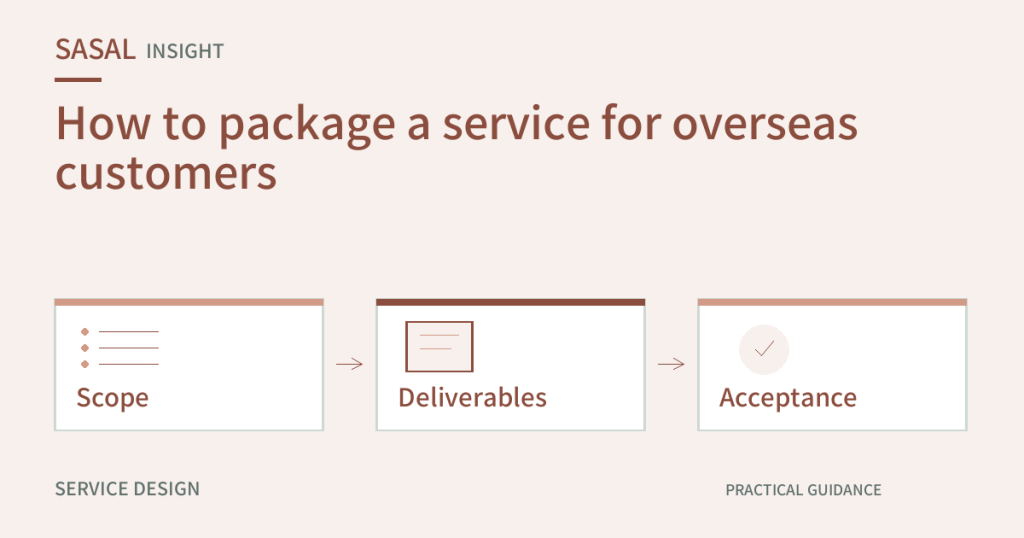
A clearly defined service package can help overseas customers evaluate what they are buying and prepare for a purchase. A useful service package defines the unit being purchased, the customer problem addressed, the work included, the deliverables provided, the inputs required from the client, and the criteria used to accept completed work. It also separates the service provider’s commitments from business results that depend on the customer’s own decisions and execution. A well defined offer helps customers compare alternatives, supports internal approval processes, and connects quoting, contracting, delivery and quality control. The practical goal is not to describe everything your team can do, but to define a repeatable service that can be understood, purchased and delivered consistently across international engagements.
Start by defining the product being sold
Many service companies describe capabilities rather than products. Overseas buyers, however, often need a defined purchase that can be evaluated, approved and compared with alternatives. The first task is to specify who the customer is, what problem is being addressed and what work will be provided. A training service, advisory engagement or operational support arrangement can each become a saleable product when its contents are described clearly. Defining the product before expanding sales activity creates a consistent basis for proposals, contracts and delivery planning across different customers and markets.
The service name alone rarely explains what is being purchased. A buyer may interpret advisory support, coaching or implementation assistance in different ways. Packaging requires translating a broad category into a specific unit of work. That unit may be a project, a recurring monthly service or a defined series of sessions. The customer should be able to understand the scope without relying on informal explanations. Internal teams should also be able to recognize where the service starts and ends, reducing confusion during quoting and delivery.
Hypothetical example: an overseas advisory offer could be defined as a six week market entry guidance service for business managers. The package might include scheduled workshops, analysis summaries and a final decision document. The example does not guarantee any commercial outcome. Instead, it defines the work that will be delivered. By describing the service as a specific package rather than general expertise, the provider creates a clearer purchasing decision and a stronger connection between sales discussions and operational delivery.
A useful test when defining a service product is to ask whether two different team members would describe the purchased work in the same way after reading the package. If their explanations differ significantly, the product definition may still be relying on personal interpretation rather than a shared specification. One suggested method is to document the customer type, problem addressed, included activities, deliverables, duration, client inputs and acceptance criteria on a single page before preparing proposals. This creates a reference that can be reused across markets while still allowing customer-specific adjustments. Consider a hypothetical provider that offers operational guidance to overseas managers. During packaging, the team discovers that some staff assume implementation assistance is included while others view the service as advisory only. By resolving that difference before selling, the provider reduces the risk that customers receive inconsistent descriptions. The same exercise can reveal hidden assumptions about response times, staffing or workshop participation. Defining the product at this level does not remove flexibility; it establishes a repeatable starting point from which variations can be evaluated deliberately. The result is a clearer purchasing unit that supports quoting, contracting and delivery with fewer avoidable misunderstandings.
- Identify customerSpecify who the service is designed for and the problem addressed.
- Define workDescribe included activities, deliverables and duration.
- Confirm boundariesClarify inputs, acceptance criteria and limits of scope.
- Use consistentlyApply the same definition across proposals and delivery.
Translate strengths into customer value

A service package becomes easier to buy when its features are translated into customer value. Buyers typically evaluate how an offer helps them solve a problem rather than how the provider describes its internal capabilities. A specialist method, experienced team or structured process should therefore be expressed in terms that relate to customer needs. The connection between work performed and practical benefit helps prospects understand why the service matters. This also creates a foundation for positioning against alternatives that may appear similar at first glance.
Customer value should be described in a way that reflects the customer’s situation. Different organizations may compare a service against internal effort, manual processes, outsourcing arrangements or simply continuing with their current approach. A package should therefore explain not only the work delivered but also why that work may be preferable under certain conditions. Clarity about adoption effort, training needs or workflow adjustments supports more informed decisions. Buyers often need this information when presenting a proposal internally for evaluation by several stakeholders.
Hypothetical example: a training service might emphasize that participants receive structured learning sessions, practical exercises and implementation guidance. The value statement would not claim guaranteed performance improvements. Instead, it could explain that the service is designed to support more consistent execution when participants apply the material within their own operations. This distinction keeps the offer credible. The provider describes the intended value of the service while avoiding promises that depend on actions beyond the provider’s control after training has been completed.
Translating strengths into customer value often requires separating internal language from buyer language. Providers commonly describe methods, qualifications or processes because those features are familiar internally. Customers, however, may be comparing the offer with internal effort, outsourcing arrangements or maintaining their current approach. A practical approach is to map each service feature to a decision question a buyer is likely to ask. For example, a structured process may help a prospect understand how work will be organized, while defined training requirements may help managers estimate the effort needed from their own teams. In a hypothetical comparison, two advisory packages include similar analysis activities. One package explains the expected customer participation, implementation considerations and workflow implications, while the other focuses mainly on the provider’s expertise. The underlying capability may be comparable, yet the first description can be easier for stakeholders to evaluate because it connects service features to adoption decisions. This does not require promises about business results. Instead, it helps customers understand why the service may be useful under particular conditions and what responsibilities remain with them. Clear value translation supports internal reviews because different stakeholders can assess the offer using criteria relevant to their own roles.
Define deliverables in concrete terms
Deliverables are often the most visible element of a service package because they show what the customer receives. Clear deliverables reduce ambiguity and make acceptance discussions easier later. Depending on the service, deliverables may include reports, workshops, recommendations, assessments, training materials or operational outputs. Each deliverable should be described with enough detail that both parties share the same expectations. The objective is not to document every task but to define the tangible results of the agreed work. Consistency here improves repeatability across multiple engagements.
When drafting deliverables, it is useful to specify quantity, format and timing. A package might include a fixed number of workshops, a written report or recurring support sessions during a defined period. These descriptions help customers understand what is included and help delivery teams allocate resources. They also create a practical reference point when new requests arise later. Without clear deliverables, scope discussions can become subjective because different participants remember different verbal commitments from the sales process.
Hypothetical example: an advisory package could include three online workshops, one comparative analysis document and one executive briefing presentation. The package description would state that these items are the agreed outputs. Additional analysis requests would be considered separately rather than assumed to be included. This approach protects both parties. Customers know what they will receive, while the provider can maintain delivery quality by focusing resources on the agreed work rather than continuously expanding the scope through informal expectations.
When defining deliverables, it can be helpful to distinguish outputs from activities. Customers often remember workshops, interviews and meetings because they are visible events, but acceptance discussions usually become easier when the package also specifies the outputs produced from those activities. A workshop may generate materials, summaries or recommendations, while interviews may contribute to an analysis document. Describing those connections gives customers a clearer picture of what they will receive at the end of the engagement. In a hypothetical advisory assignment, a provider plans to conduct several stakeholder interviews. Rather than listing interviews alone, the package explains that information gathered will be synthesized into a comparative analysis and executive presentation. This clarification helps stakeholders evaluate the value of the work and reduces uncertainty about the purpose of each activity. Another useful practice is to state the intended format of deliverables where relevant, such as presentation materials, written summaries or assessment documents. Format descriptions do not need to be excessively detailed, but they help establish shared expectations before work begins. Deliverables become a practical management tool when customers, sales personnel and delivery teams can all identify the same outputs and understand how they relate to the agreed scope of work.
Set clear boundaries around scope
A strong service package explains not only what is included but also what is excluded. Boundaries help customers understand the intended use of the service and prevent misunderstandings after work begins. Scope limits are especially important for knowledge based services because requests can expand naturally during discussions. A package with defined boundaries remains easier to price, schedule and deliver consistently. Customers also benefit because they can identify early whether additional services may be required to achieve their broader objectives.
Scope boundaries should be written in operational language rather than legal language alone. If a service includes strategic recommendations but not implementation support, that distinction should be explicit. If a training package covers participant workshops but not ongoing coaching, that should also be stated. Practical boundaries help delivery teams maintain consistency and help customers plan their own responsibilities. The clearer the limits, the easier it becomes to determine whether a future request belongs within the original agreement or requires a separate discussion.
Hypothetical example: a provider offers overseas sales readiness training. The package includes workshops, participant materials and post session summaries. It excludes recruitment activities, contract negotiation support and customer prospecting. Those exclusions do not reduce the value of the offer. Instead, they clarify its purpose. Buyers can evaluate the service based on what it is designed to accomplish. If related needs emerge later, the parties can address them through additional services rather than stretching the original package beyond recognition.
Scope boundaries are often most effective when they are connected directly to decision making during delivery. Rather than treating exclusions as a separate legal concept, providers can explain how boundaries will be used to evaluate future requests. This makes the package easier for customers to work with because they can see how additional needs will be handled if circumstances change. A suggested method is to categorize requests into three groups: work clearly included in the package, work clearly excluded and requests that require review against the original definition. In a hypothetical training engagement, participants begin asking for detailed implementation support after scheduled workshops have been completed. Because the package already states that implementation assistance is outside scope, the provider can discuss options without debating what was originally purchased. The conversation becomes a commercial and operational decision rather than a disagreement about expectations. Boundaries also help customers identify gaps before signing an agreement. If they know they will need recruitment support, technical integration or ongoing coaching, they can evaluate those requirements early instead of discovering them midway through delivery. Well-defined limits therefore support planning on both sides while preserving the integrity of the original service package.
- Included workActivities and deliverables defined in the package.
- Review requiredRequests compared with scope before commitment.
- Excluded workNeeds identified as outside the service purpose.
Identify required client inputs
Identifying required client inputs means defining the customer’s contribution as part of the service package, not treating it as a later operational detail. A buyer should be able to see what information, access, participation and decisions are needed before delivery begins. Useful descriptions specify the input, the person or team expected to provide it, and the stage of the engagement when it is required. This helps customers evaluate the service against alternatives because adoption effort becomes visible alongside deliverables and intended value. Inputs may include operational context, interviews, attendance at workshops, document access, workflow information, training participation, integration details or approvals. By documenting these items in the offer, the provider defines the conditions under which the agreed work can be performed and reviewed consistently.
Client inputs should be written in practical language that supports coordination across the customer organization. In many purchases, the person approving the service is different from the people supplying information or participating in activities. For that reason, a package can identify required contacts, expected response points and any materials needed before specific deliverables are produced. Adoption considerations are also relevant. If the service requires training sessions, workflow changes, supplier registration steps or access to existing systems and processes, those expectations should be stated early. When comparing service options, customers can then assess not only what will be delivered but also the work their own teams must complete. This creates a more informed buying process and reduces reliance on assumptions formed during sales conversations.
Hypothetical illustration: an overseas advisory and training package includes discovery interviews, two workshops and a recommendations report. The offer states that the customer must nominate a project contact, provide existing process documents before analysis starts, arrange attendance by key managers and identify any workflow changes relevant to the review. The package also explains that workshop scheduling depends on timely confirmation of participants. A customer comparing alternatives can see that one provider requires extensive internal data collection while another relies mainly on interviews. Neither approach is automatically better; the choice depends on the customer’s situation and available resources. By defining required inputs clearly, the service remains understandable, coordination improves and delivery expectations are aligned before work begins.
Required client inputs can also be organized according to when they are needed during the engagement. This timing perspective is valuable because some delays occur not from disagreements about scope but from uncertainty about who must provide information and at what stage. One practical method is to separate inputs into preparation, participation and review categories. Preparation inputs may include existing documents or operational context. Participation inputs can involve attendance at workshops or interviews. Review inputs may include feedback on draft materials or confirmation that deliverables have been received. In a hypothetical overseas advisory project, analysis cannot begin until process information is provided, workshops cannot proceed until participants are confirmed and recommendations cannot be finalized until key assumptions are reviewed. By making these dependencies visible, the provider helps the customer plan resources internally. This approach is especially useful when the approving manager is not the same person responsible for supplying information. Documented inputs allow responsibilities to be distributed across departments without relying on informal verbal instructions. Customers gain a clearer understanding of adoption effort, and delivery teams obtain a more reliable basis for scheduling work. The service package therefore communicates not only what will be delivered but also how customer participation contributes to successful execution of the agreed activities.
Separate commitments from business outcomes
One of the most important elements of service packaging is distinguishing service commitments from business outcomes. Providers can commit to specific activities, deliverables and service levels. They generally cannot control every factor influencing a customer’s commercial results. Clear separation protects credibility and helps buyers evaluate the offer realistically. It also reduces future disputes because both parties understand which aspects of success depend on the provider’s work and which depend on customer execution after recommendations or training have been delivered.
A package should therefore describe the work performed and the evidence of completion. If the service includes analysis, recommendations or training sessions, those commitments can be defined and verified. Revenue growth, operational improvement or organizational change may remain possible goals, but they involve variables outside the provider’s direct control. Presenting this distinction openly supports informed purchasing decisions and aligns expectations. Customers often appreciate clarity because it allows them to assess their own role in achieving desired results.
Hypothetical example: a training provider commits to delivering a structured curriculum, facilitating workshops and supplying learning materials. The provider does not promise that every participant will implement the lessons successfully. Application depends on management support, available resources and follow through within the customer organization. By separating deliverables from business outcomes, the package remains transparent. Customers know what they are buying, while still understanding how their own actions contribute to any broader operational or commercial improvements they seek.
Separating commitments from outcomes becomes particularly important when customers are under pressure to justify a purchase internally. Stakeholders may naturally ask what results they can expect, yet a credible package distinguishes between the provider’s obligations and factors controlled by the customer. One suggested approach is to document completion evidence alongside each commitment. If the provider commits to workshops, reports or analysis, the package can explain how completion of those items will be recognized. Desired business goals can still be discussed, but they remain distinct from the provider’s contractual or operational commitments. Consider a hypothetical organization seeking support for overseas expansion. Management hopes the project will improve future decisions, but actual outcomes will depend on market conditions, internal execution and follow-through after recommendations are delivered. The provider therefore commits to defined research, structured discussions and documented findings rather than to specific commercial achievements. This distinction often improves trust because customers can see exactly what is being purchased. It also creates a more useful basis for evaluating service quality. Instead of debating results influenced by many variables, both parties can assess whether agreed work was performed as described. The package remains transparent, measurable and aligned with factors that the provider can reasonably control during delivery.
Create practical acceptance criteria
Acceptance criteria define how both parties recognize that agreed work has been completed. Without acceptance criteria, discussions may become subjective because different participants use different standards to judge success. Effective criteria focus on deliverables, milestones and agreed service commitments. They should be understandable to both commercial and operational stakeholders. The purpose is not to create unnecessary administration but to provide a shared reference point that confirms completion and supports a smooth transition between project stages or final closure.
Acceptance criteria are often strongest when linked directly to deliverables. A report may be considered delivered when submitted in the agreed format. A workshop may be considered completed when scheduled sessions occur and supporting materials are provided. Criteria should be realistic and observable. Overly vague standards create uncertainty, while excessively detailed standards may be difficult to manage. The objective is practical clarity that can be applied consistently across engagements and understood easily by customers in different countries.
Hypothetical example: an advisory package includes a final recommendations document and a presentation session. Acceptance occurs when the document is delivered and the presentation is completed according to the agreed scope. The customer may later decide whether to implement the recommendations. That implementation decision remains separate from acceptance of the service itself. This distinction helps maintain fairness. The provider is evaluated on the agreed work performed, while the customer retains responsibility for subsequent decisions and execution activities.
Acceptance criteria are most useful when they are discussed before delivery begins rather than after deliverables are submitted. Early discussion allows both parties to confirm that completion standards are observable and practical. A suggested method is to link each major deliverable to a corresponding acceptance event. For example, a workshop can be accepted when the agreed session is conducted and supporting materials are provided, while a report can be accepted when it is submitted in the agreed format. In a hypothetical project, a customer expects recommendations to be implemented before accepting the engagement. The provider, however, has packaged the service as advisory work rather than implementation management. By reviewing acceptance criteria at the outset, both parties can clarify that acceptance relates to delivery of the recommendations, not to later operational decisions. This distinction helps avoid disputes created by differing assumptions about what completion means. Acceptance criteria can also support project governance by creating clear milestones for reviews and approvals. When stakeholders from finance, operations and management are involved, a shared definition of completion reduces confusion and improves coordination. Effective criteria therefore serve both operational and commercial purposes by connecting deliverables to a practical and mutually understood standard of completion.
Design a structured change request process
Design a structured change request process by defining how new requests are identified, documented, reviewed and either accepted or declined after delivery starts. The purpose is not to restrict useful collaboration but to ensure that additions are assessed against the service package already purchased. A practical request record can capture the proposed work, the customer problem it addresses, the affected deliverables, and any implications for duration, staffing or acceptance criteria. Because the service package already defines scope, boundaries and client inputs, both parties have a reference point for comparison. This supports informed decisions rather than relying on memory from sales conversations. It also helps maintain consistency between proposals, contracts, delivery planning and quality control by linking requested changes back to the originally defined service product.
When evaluating alternatives, compare the request with the existing package rather than considering it in isolation. Some requests may fit within agreed deliverables and require only clarification. Others may introduce new work, different participants, additional service hours or new outputs that were not part of the original offer. Information needed for review can include the objective of the request, the timing required, the customer inputs needed and the relationship to current commitments. Documenting these elements helps customers prioritize what matters most and understand tradeoffs between options. Delivery teams gain a clearer basis for planning because decisions are recorded before work proceeds. This approach reduces the risk of informal commitments that create conflicting expectations between customer contacts, sales personnel and operational staff.
Hypothetical illustration: a provider sells a defined overseas advisory package that includes discovery interviews, workshops and a recommendations report. Midway through the engagement, the customer asks for an additional assessment covering a separate business unit. The provider logs a change request describing the new analysis, identifies the extra deliverables, notes any revised timing and confirms whether additional customer interviews will be required. The review also checks whether the existing acceptance criteria remain suitable or need adjustment to reflect the expanded work. The customer can then compare two alternatives: continue with the original package or approve the additional scope as a separate change. The original agreement remains understandable, while the expansion is evaluated transparently and documented for delivery handover.
A structured change request process works best when it is introduced as a normal part of service management rather than as an exception used only when problems arise. Customers often discover new priorities after work begins, especially when analysis, workshops or interviews reveal information that was not available during initial discussions. The purpose of the process is to evaluate those requests consistently. One practical approach is to assess every proposed change against the original customer problem, defined deliverables and required inputs. In a hypothetical engagement, a customer asks for additional workshops because new stakeholders want to participate. The provider reviews how the request affects timing, deliverables, customer participation and acceptance criteria. If the change aligns with the customer’s objectives but introduces additional work, it can be documented and considered separately from the original package. This transparency benefits both sides. Customers gain visibility into implications before making a decision, while delivery teams maintain a clear record of what has been approved. The process also supports quality control because revised commitments are documented rather than communicated informally. Over time, reviewing change requests may reveal recurring needs that could justify creating a separate packaged service, improving future offers without altering the clarity of existing engagements.
- Request identifiedCustomer proposes additional or different work.
- Compare to packageReview scope, deliverables, inputs and acceptance criteria.
- Decision recordedApprove, modify or decline with documented rationale.
- Update deliveryReflect agreed changes in planning and communication.
New information may generate further requests requiring the same review process.
Support the customer’s buying process

A service package should help prospects navigate their internal approval process. Interest from one contact may not be sufficient to secure a purchase, particularly in business to business environments. Different stakeholders often evaluate different aspects of the proposal. Users may focus on outcomes, while finance teams review payment considerations and technical teams examine integration or implementation requirements. Packaging should therefore provide information that supports the actual path from initial interest to final approval within the customer organization.
Understanding who proposes, evaluates and approves a purchase helps shape supporting materials. Customers often need documents they can share internally. Clear explanations of benefits, deliverables, assumptions and implementation steps make internal discussions easier. Packaging is therefore not only a delivery exercise but also a purchasing support exercise. The more effectively the offer answers stakeholder questions, the easier it becomes for the customer to advance the opportunity through internal reviews without repeatedly requesting basic clarifications.
Hypothetical example: a department manager supports an advisory engagement but must obtain approval from finance and executive leadership. The provider supplies a concise service description, implementation outline and explanation of customer responsibilities. These materials do not guarantee approval. They simply help stakeholders evaluate the proposal using relevant information. By anticipating the approval path, the provider reduces friction and improves communication. The service package becomes a practical tool for decision making rather than only a description of expertise.
Supporting the buying process often means anticipating questions from stakeholders who were not present during initial conversations. A service package can therefore function as an internal communication tool as well as a commercial offer. One suggested method is to organize supporting information around the decisions different groups must make. Users may want to understand how the service will be applied. Finance personnel may need clarity about the purchased unit of work. Technical or operational reviewers may focus on implementation steps, training needs or workflow implications. In a hypothetical organization, a department manager supports an advisory engagement but must present it to senior leadership and administrative reviewers. A package that clearly describes deliverables, customer responsibilities, adoption considerations and assumptions enables those stakeholders to evaluate the proposal without reconstructing earlier discussions. This reduces repeated requests for clarification and helps maintain consistency in how the opportunity is described internally. It can also make timing easier to manage because participants understand what information is still required before approval. Supporting the buying process does not guarantee a purchase, but it helps prospects move from interest to evaluation using documented information. The package becomes a practical aid for internal decision making rather than a document intended only for sales conversations.
Build a labelled hypothetical service offer
Hypothetical example: Overseas Operations Advisory Package. Intended customer: managers preparing to coordinate overseas operational activities. Customer problem: uncertainty about implementation requirements and organizational readiness. Included work: discovery interviews, structured workshops, analysis and a recommendations report. Deliverables: interview summary, workshop materials and final advisory document. Duration: six weeks. Customer inputs: designated contacts, operational information and participation in scheduled sessions. Acceptance: delivery of the agreed outputs. This example is illustrative only and should be adapted to specific circumstances before use in a real commercial setting.
The hypothetical package demonstrates how different components fit together. The unit being purchased is defined clearly. Deliverables are specified. Client responsibilities are visible. Acceptance criteria are linked to outputs rather than future business performance. Scope boundaries can also be added, such as excluding implementation management or recruitment support. By organizing information in this format, a service provider creates a repeatable offer that can be explained consistently across sales conversations, proposals and delivery activities in multiple overseas markets.
A useful review question is whether an uninvolved colleague could understand the service solely from the package description. If the answer is no, additional clarification may be needed. Buyers should not have to infer essential details. The package should explain what is provided, what is required from the customer and how completion will be assessed. This structure reduces dependency on individual sales presentations and supports more reliable delivery quality when multiple team members participate in customer engagements.
After creating a labelled service package, it can be useful to test it using a hypothetical customer scenario. The objective is not to predict outcomes but to determine whether the package contains enough information for evaluation and delivery. Reviewers can ask a series of practical questions. Is the customer type clearly identified? Are deliverables described in concrete terms? Are required client inputs visible? Can acceptance be assessed without referring to future business performance? In a hypothetical exercise, a provider gives the package to a colleague who has not participated in its design. The colleague is asked to explain what is being purchased, what the customer must contribute and how completion will be recognized. Any areas of uncertainty reveal opportunities to improve clarity. This form of testing is particularly valuable when services are sold across different countries because assumptions that seem obvious internally may not be obvious to external buyers. The exercise can also identify whether boundaries are sufficiently clear to support future change request decisions. A labelled package becomes more robust when it can be understood independently of the salesperson who created it. That consistency supports training, proposal development and delivery planning while keeping the service focused on a defined and repeatable unit of work.
- Customer and problemDefines who the service is for and why it is needed.
- Work and deliverablesExplains activities and outputs provided.
- Inputs and boundariesClarifies customer responsibilities and limits.
- Acceptance and changesShows completion standards and handling of new requests.
Create a sales to delivery handover
A service package becomes operationally useful when it creates a structured handover from sales to delivery rather than relying on informal conversations. The handover record should transfer the information needed to deliver the service exactly as sold, including the customer problem being addressed, agreed objectives, scope boundaries, deliverables, acceptance criteria, customer responsibilities, duration and any assumptions discussed during evaluation. A defined product provides a practical checklist because the same elements used in proposals and contracts can be reviewed before work begins. Delivery personnel should be able to understand what was purchased without reconstructing the sales process from emails or meeting notes. This continuity helps customers avoid repeating information and supports consistent execution across different team members, locations and stages of the engagement.
A useful handover distinguishes confirmed commitments from items that remain unresolved. During evaluation, customers and sales teams may discuss assumptions, pending information requests or possible future additions before all facts are available. Recording these separately helps delivery teams validate them early and prevents assumptions from being mistaken for agreed work. Information worth capturing can include required customer participants, documents still needed, expected review dates and any open questions affecting delivery. Comparing the handover record with the defined service package is a practical way to identify gaps. If a request falls outside the agreed scope, deliverables or acceptance criteria, it can be reviewed through the change request process rather than becoming an undocumented commitment. This reduces conflicting interpretations and improves coordination.
Hypothetical example: an Overseas Operations Advisory Package includes discovery interviews, three workshops, an analysis document and a final recommendations report. The sales team prepares a handover summary listing the agreed deliverables, named customer contacts, required operational information, acceptance criteria and any outstanding assumptions. One open question concerns access to a regional manager whose input is needed for the analysis. Before kickoff, the delivery team reviews the summary against the packaged offer and confirms that all commitments match what was sold. If the customer also mentions a new request for an assessment of another business unit, that request is documented separately and evaluated as additional work rather than assumed to be included. The handover therefore links commercial commitments, delivery planning and quality control.
A well-structured handover can also serve as an early quality check before delivery activities begin. Because the service package already defines the customer problem, scope and deliverables, the handover meeting provides an opportunity to verify that all participants share the same interpretation. One suggested method is to review each commitment and identify its source in the proposal, contract or packaged service description. This reduces the risk that informal statements made during discussions are treated as confirmed obligations. In a hypothetical advisory engagement, the delivery team notices that a proposed workshop topic appears in meeting notes but not in the agreed package. Rather than assuming inclusion, the team raises the issue for clarification before scheduling begins. This approach protects both the customer and the provider by ensuring that expectations are aligned. The handover can also highlight operational dependencies such as required documents, customer participants or planned review dates. Capturing these details in a structured format makes it easier to manage coordination across teams and locations. When delivery personnel understand exactly what was sold and what remains unresolved, they can begin work with greater confidence and provide customers with a more consistent experience throughout the engagement lifecycle.
Prepare for a consultation with a defined package
Before a consultation, convert the service into a draft product that another person could evaluate without additional explanation. Bring together the intended customer, the problem addressed, included work, deliverables, scope boundaries, client inputs, duration and acceptance criteria in one document. Also record assumptions, evidence supporting those assumptions and any open questions that still require validation. This preparation gives the discussion a concrete reference point and helps participants compare alternatives. For example, if a prospect is choosing between a workshop-based service and an advisory project, the consultation can focus on differences in deliverables, customer responsibilities and adoption effort rather than broad claims about expertise. A defined package also makes it easier to identify where additional work would fall outside the original scope and may require separate review.
Prepare supporting material from the customer’s perspective, not only from the provider’s perspective. Consider who may propose, evaluate and approve the purchase, and what information each group may need to review the offer. Useful consultation inputs can include a description of expected implementation steps, training requirements, workflow changes, integration considerations and customer responsibilities. Customers often compare a service with internal effort, outsourcing or continuing with their current approach, so include information that helps them make that comparison. Where facts are uncertain, document them explicitly instead of leaving them implied. Sharing assumptions and open questions encourages productive review and allows later revisions to be tracked. The objective is to support informed evaluation rather than relying on verbal explanations that may be interpreted differently by different stakeholders.
Before presenting the package externally, review it with sales, delivery and customer communication personnel to confirm a shared interpretation. Check that the deliverables described by sales can be delivered consistently, that acceptance criteria are observable and that client inputs are clearly stated. A useful consultation agenda is to test whether participants can explain the service in the same way and identify any gaps. Hypothetical illustration: a labelled advisory and training package includes discovery interviews, two workshops and a recommendations report. During internal review, the team realizes that access to certain customer documents is assumed but not documented. Adding that requirement before the consultation improves clarity. The result is a package supported by defined commitments, visible assumptions and a stronger connection between evaluation, purchasing discussions and delivery.
Preparation for a consultation is often stronger when the team deliberately identifies uncertainties alongside confirmed information. Prospects may appreciate seeing which assumptions have been validated and which still require discussion because this helps them participate in shaping the final scope. A practical method is to divide consultation material into three categories: confirmed elements of the package, assumptions requiring verification and open questions affecting implementation or adoption. In a hypothetical review meeting, a provider presents a defined advisory service with specified workshops, deliverables and customer responsibilities. The team also notes that access to certain operational information has not yet been confirmed and that scheduling depends on participant availability. By documenting these points openly, the consultation focuses on resolving real decision issues rather than revisiting basic descriptions of the service. Internal review before the consultation remains important because sales, delivery and communication personnel may notice different risks or ambiguities. If all groups can explain the package consistently, customers are more likely to receive a coherent message. The result is a consultation built around documented scope, visible assumptions and practical next steps. This supports informed evaluation and creates a stronger foundation for any later proposal, contract, handover or change request discussion.