

SASAL INSIGHT / DEEP DIVE
Managing overseas distributors beyond the first shipment
Many channel problems appear after the first shipment rather than before it. Initial enthusiasm can hide unanswered questions about who owns customer development, who explains the offer, who holds inventory, and what information will be available when performance is reviewed. A distributor arrangement becomes easier to manage when the commercial job is defined before margins, territories or exclusivity are discussed. The practical objective is not simply to appoint a local intermediary. It is to build a channel that can repeatedly reach customers, support purchasing decisions, deliver the agreed responsibilities and provide evidence that helps both parties improve. This article explains how to define responsibilities, assess a partner’s capability, interpret channel performance and turn reviews into practical improvements.
Define the commercial job the channel must perform
Many exporters begin channel discussions by asking who can sell their product in a target market. A more useful starting point is identifying the commercial job that must be performed from first contact through customer purchase and early use. Different products require different levels of explanation, education, inventory, support and coordination. If those activities are not identified explicitly, both parties may assume the other side will perform them. A distributor relationship can then appear promising during negotiation while remaining difficult to operate in practice. Before discussing territory coverage or expected volume, describe the activities required to create and support a sale. This creates a practical foundation for evaluating whether a proposed channel structure matches the work customers actually need.
The commercial job should be described in operational terms rather than broad labels. For example, a company may need someone to identify prospects, explain the offer, prepare quotations, maintain stock, coordinate delivery and answer post-sale questions. Another product may require very little local explanation but significant inventory management. A third may depend on technical education before customers can make a purchasing decision. By identifying the tasks directly, the exporter can compare potential channel partners against real requirements instead of marketing claims. This approach also helps avoid confusion created by titles such as distributor, reseller, representative or agent, because those labels do not automatically describe the work being performed in the market.
A useful exercise is to map the path from customer interest to repeat purchase and note which activities influence success at each stage. Consider a hypothetical industrial component supplier entering a new country. Customer awareness may depend on local prospecting, while purchasing may depend on technical explanation and rapid quotation response. Repeat orders may depend on inventory availability and reliable handling of enquiries. The company can then assess whether one partner can perform all activities or whether responsibilities should be divided across several parties. The goal is not to create complexity. The goal is to understand which activities must happen consistently for customers to obtain value and continue buying.
Once the commercial job is visible, channel decisions become easier to evaluate. Discussions about margins, training, performance targets and reporting can be tied to specific responsibilities rather than assumptions. This reduces the risk of disagreements later because both parties can relate expectations to identified work. It also provides a basis for future performance reviews. If sales fall below expectations, the discussion can examine whether prospecting occurred, quotations were delivered, inventory was available or explanations reached the right buyers. A channel relationship is therefore easier to manage when it begins with a shared understanding of the practical commercial activities required to support customer adoption.
Recommendation: after mapping the commercial job, convert it into a simple responsibility checklist that can be used during partner evaluation and later performance reviews. The checklist should follow the customer path already identified and record who is expected to perform each activity, who provides support and what evidence would show the activity occurred. For example, prospecting might be evidenced by identified target accounts, explanation by completed customer discussions or demonstrations, transaction support by quotations and order coordination, and ongoing use by responses to customer enquiries. This does not require a complex system. Its value is that it links channel design to observable work. A hypothetical exporter comparing several distributors could ask each candidate to explain how it would perform the same defined set of activities. Differences then become easier to evaluate because the discussion remains focused on customer-facing tasks rather than general statements about market reach. The same checklist can later help diagnose problems. If repeat purchases are weaker than expected, both parties can review whether the activities associated with awareness, evaluation, ordering and ongoing support were actually completed and by whom.
Separate reseller, agent and direct-customer roles
Channel structures are often discussed using familiar labels, yet the operational reality behind those labels can differ significantly. A company described as an agent may simply introduce customers, or it may perform substantial selling activity. A reseller may purchase inventory and resell it independently, while another reseller may rely on frequent replenishment and minimal stock. Rather than relying on terminology alone, examine what each party actually does. Identify who contracts with the customer, who receives payment, who owns inventory at different stages and who provides customer support. These questions reveal how information, incentives and responsibilities move through the channel. The answers are usually more useful than the title attached to the relationship.
Role clarity matters because performance data can otherwise become difficult to interpret. If an intermediary purchases products for inventory, the exporter may record revenue before products reach end users. In an agency arrangement, customer purchases and intermediary compensation may follow a different path. Without a clear understanding of who performs each role, managers may confuse channel activity with market demand. Separating contractual relationships, inventory ownership and customer interaction helps prevent incorrect conclusions. It also supports better planning for training, reporting and performance reviews because each activity can be assigned to the party that actually controls it.
Consider a hypothetical software-enabled equipment supplier. In one market, a reseller purchases inventory, conducts demonstrations and invoices customers directly. In another market, an agent introduces prospects while the exporter contracts with customers and manages delivery. Both arrangements may generate orders, but they provide different access to customer information and require different management approaches. The reseller model may require stronger inventory visibility, while the agency model may require closer coordination around customer development activities. Neither structure is automatically superior. The appropriate choice depends on the commercial job identified earlier and the capabilities available in the market.
Role mapping should be documented before broader commitments are made. A practical record can identify the contracting party, payer, inventory holder, customer-facing seller and support provider. When these elements are visible, future discussions about incentives, exclusivity and performance become more grounded. The exporter can also identify information gaps that might limit future decision-making. For example, a structure that creates strong sales activity but little visibility into end customers may require additional reporting arrangements. Separating roles clearly does not eliminate channel risk, but it makes the relationship easier to understand, monitor and improve over time.
Recommendation: create a role map that traces a single customer order from initial interest through payment and support. For each stage, identify the party that interacts with the customer, the party that contracts, the party that receives payment and the party that holds inventory where relevant. This practical exercise often reveals assumptions that remain hidden when channel labels are used alone. A hypothetical example illustrates the benefit. A company may describe a partner as a reseller, yet discover that important product explanations are still being provided directly by the exporter while customer support questions are handled by another organization. In that situation, sales results and customer feedback may be distributed across several participants rather than residing with the contractual seller. Recording these distinctions early helps determine what information can realistically be collected and who is responsible for improvement actions. It also supports future discussions about training, reporting and incentives because responsibilities are connected to the party that actually controls the activity. The result is a clearer separation between company revenue flows, inventory ownership and evidence of customer adoption.
- Reseller modelIntermediary may hold inventory, resell products and manage customer transactions.
- Agency modelIntermediary may introduce or support buyers while contracts follow another route.
- Direct customer modelExporter manages customer relationship, contracting and information flow directly.
Assess access to the customers who will use the product

A channel partner can only create value if it can reach the customers who are likely to use the product. Access should therefore be examined directly rather than inferred from company size, reputation or years in operation. Ask how the partner currently reaches relevant buyers, how opportunities are identified and what type of conversations occur before a purchase. The objective is not to demand confidential customer lists. Instead, seek evidence that the partner regularly interacts with the people involved in evaluation, approval and use. A channel arrangement becomes more credible when customer access is demonstrated through practical activity rather than broad claims about market coverage.
Customer access should also be evaluated in relation to the product being sold. A partner may have strong relationships in one segment but limited relevance in another. For example, access to procurement teams does not necessarily mean access to technical users, and access to technical users does not guarantee influence over purchasing decisions. The exporter should therefore identify which customer contacts matter most and assess whether the partner reaches them consistently. This approach helps avoid selecting a partner whose network is substantial but poorly aligned with the actual buying process. Relevance is generally more useful than breadth when building an effective channel.
Hypothetically, a manufacturer of specialized equipment may meet two potential distributors. The first operates a large catalogue of products and serves many industries. The second serves a narrower segment but regularly educates the exact customer group expected to use the equipment. The second partner may offer more effective access despite appearing smaller. By focusing on actual customer interaction rather than organizational scale, the exporter gains a better understanding of how the offer may reach end users. This perspective also supports more realistic forecasts because channel potential is linked to identifiable customer engagement activity.
Assessment should include how information flows back from the market. Customer access is valuable not only because it can generate orders, but also because it creates learning. Partners who interact closely with buyers can provide insight into objections, questions, competing alternatives and purchasing conditions. Those observations help refine messages, training and support. When evaluating access, therefore, consider both the ability to reach customers and the ability to communicate market feedback. A channel that provides customer visibility can support improvement even when early sales volumes remain modest.
Recommendation: assess customer access by examining recent patterns of interaction rather than relying on aggregate coverage claims. Ask prospective partners to describe how they typically identify opportunities, which customer roles they meet during evaluation and how information from those conversations is communicated internally. The purpose is not to request confidential customer details. It is to understand whether the partner regularly reaches the people who influence purchase and use. A hypothetical exporter could compare two candidates by discussing a representative customer journey and noting where each candidate participates. One may engage mainly after a buying decision is largely formed, while another may be involved earlier when explanations and education affect outcomes. Those differences matter because customer access is linked to both selling activity and market learning. Partners who maintain relevant conversations can often provide useful feedback about buyer questions, competing alternatives and purchasing conditions. Reviewing access in this operational way helps align partner selection with the commercial job previously defined. It also creates a stronger basis for forecasting because expectations are tied to identifiable customer engagement activities rather than broad assumptions about market presence.
Test operational capability before making broad commitments
Channel discussions often focus on future potential, yet operational capability is usually revealed through observed behaviour. Before granting extensive territory rights or making long-duration commitments, test whether the proposed partner can perform the activities required by the commercial model. The test does not need to be large. It can involve a limited number of target customers, a defined sales effort, agreed reporting and specific responsibilities. The purpose is to evaluate execution rather than enthusiasm. A partner that can perform a small, clearly defined assignment may provide stronger evidence than a partner that offers ambitious forecasts without demonstrating operational discipline.
Capability testing should examine the activities that matter most for success. Depending on the product, this may include prospecting, explanation, quotation handling, inventory management, customer communication or support coordination. The exporter should observe how work is organized, how questions are handled and whether commitments are completed reliably. Practical execution often reveals strengths and limitations that are difficult to identify during negotiation. This process also allows both parties to refine responsibilities before larger investments are made. Small-scale observation can therefore reduce uncertainty more effectively than relying solely on promises about future performance.
A hypothetical exporter of technical products might ask a prospective distributor to pursue a defined group of target accounts over a limited period. The exercise could include training, opportunity reporting and review meetings. Results would not be judged only by orders received. The exporter could also evaluate whether customer meetings occurred, whether product explanations were accurate and whether information was shared consistently. Even when immediate sales are limited, the exercise can reveal whether the partner has the operational habits needed for longer-term cooperation. Such learning supports more informed channel decisions than volume projections alone.
Testing capability before broad commitments also creates a factual basis for future discussions. If responsibilities later expand, both parties can refer to observed experience rather than assumptions. This reduces the likelihood of disagreements about what support is required or what performance is realistic. It also helps determine where additional training or resources may be necessary. A channel relationship becomes more robust when commitments are based on demonstrated capability. Limited-scope testing cannot eliminate uncertainty, but it can transform unknowns into specific operational questions that are easier to address.
Recommendation: define success criteria for a capability test before the trial begins and ensure those criteria include execution evidence, not only order volume. The article already distinguishes channel activity from outcomes, and the same principle applies during evaluation. A hypothetical trial might specify target accounts, reporting intervals, product-explanation responsibilities and information-sharing expectations. At review, both parties could examine whether agreed customer contacts occurred, whether quotations or proposals were handled as expected and whether questions from prospects were addressed accurately and consistently. This approach is particularly useful when sales cycles are uncertain because a lack of immediate orders does not automatically indicate poor capability. Conversely, isolated orders do not necessarily demonstrate repeatable execution. By documenting the required activities in advance, the exporter gains a clearer view of how the partner organizes work, follows through on commitments and communicates market information. The trial also helps identify where additional training or support may be needed before responsibilities expand. Using observable operating behaviour as evidence makes later decisions about territory scope, incentives or longer-term commitments more grounded in demonstrated performance.
Map work before discussing partner margins
Margin discussions are often easier when both parties first understand the work being funded. A reseller that maintains inventory, educates customers and manages enquiries performs a different set of activities from a partner that only introduces buyers. If margins are negotiated before responsibilities are mapped, expectations may diverge significantly. One side may expect extensive market development while the other assumes limited involvement. By identifying the required activities first, the parties can discuss economics in relation to actual effort and cost. This approach supports more sustainable cooperation because compensation is linked to defined responsibilities rather than general expectations.
Work mapping should cover the entire customer journey and the supporting operational tasks behind it. Consider prospecting, demonstrations, explanation, quotation preparation, inventory holding, delivery coordination, customer communication and maintenance responsibilities where relevant. Not every channel will perform every activity, and that is acceptable. The key is to identify ownership clearly. Once responsibilities are allocated, the parties can evaluate whether the proposed economics reflect the work being undertaken. Visibility into both sides of the arrangement helps create practical expectations and reduces the likelihood of future disputes about contribution and reward.
A hypothetical exporter may discover that a proposed distributor wants significant exclusivity while planning only limited promotional activity. Another prospective partner may request a different economic structure but commit resources to prospecting, training and inventory. Mapping work allows these alternatives to be compared on a more meaningful basis than percentage margin alone. The discussion shifts from abstract negotiation to operational design. Both parties can examine what must happen for customers to buy and how those activities will be supported. This perspective often leads to more constructive channel planning.
Responsibility mapping also provides a foundation for performance management. If sales objectives are later translated into customer visits, proposals, training sessions or other activities, managers can assess whether agreed work is actually occurring. When results differ from expectations, the discussion can focus on observable actions rather than assumptions about effort. A channel relationship generally benefits when incentives, responsibilities and performance reviews are connected to the same operational framework. Mapping work first creates that connection and helps align commercial expectations over time.
Recommendation: when discussing economics, review each assigned responsibility individually and ask what resources are required to perform it consistently. This keeps the conversation tied to the commercial job rather than to a single margin percentage. A practical method is to start with customer-development activities, then move through transaction support and any ongoing obligations already allocated between the parties. A hypothetical comparison may reveal that two potential distributors request similar commercial terms while intending to perform very different levels of prospecting, explanation, inventory management or customer support. Looking only at the requested margin could make those proposals appear equivalent when they are not. Mapping responsibilities first allows both sides to explain how they expect the channel to operate and where effort will be invested. It also helps identify activities that have not yet been assigned to anyone. If a required task lacks clear ownership, future disagreements become more likely regardless of the economics agreed. Connecting compensation discussions to defined responsibilities therefore supports more sustainable participation and creates a clearer basis for later performance reviews and adjustment discussions.
Agree which data will make performance interpretable
Channel performance is difficult to manage when parties rely on different definitions of success. Before reviewing results, agree what information will be collected, how terms will be defined and which activities will be measured. Reporting should support decision-making rather than exist only as an administrative requirement. Useful information often includes target customers, proposals, opportunity status, training activity and reasons buyers did not proceed. These observations help determine whether challenges relate to the offer, pricing, communication or channel execution. Without agreed definitions, similar numbers may be interpreted in different ways, leading to unnecessary disagreement and slower improvement.
Data design should reflect the chosen channel structure. In a reseller arrangement, shipments from the exporter to the distributor may not represent final customer purchases. Inventory movement therefore becomes important context. In an agency model, customer purchases and intermediary activity may be recorded differently. The objective is not to create extensive reporting burdens. It is to collect enough information to understand what is happening in the market. Information that cannot support a decision has limited value, while carefully selected data can reveal whether problems stem from demand, execution or channel design.
Consider a hypothetical case in which distributor purchases increase significantly over one period. At first glance, the exporter may conclude that demand is growing. However, if inventory also rises while end-customer purchases remain unchanged, a different interpretation may be required. Additional shipments alone do not necessarily indicate increased adoption. By agreeing definitions and reporting methods in advance, both parties can evaluate developments using comparable information. This reduces the risk of reacting to incomplete signals and supports more evidence-based discussions about channel performance.
Performance information should encourage learning and improvement. Reports become more useful when they connect activity, outcomes and observed customer feedback. Information about objections, purchasing delays or support requirements can help refine training and sales approaches. The goal is not merely to count transactions. It is to understand how the market is responding and which actions may improve future results. When data definitions are agreed early, performance reviews become more productive because discussions focus on evidence, interpretation and next actions rather than debates about what the numbers mean.
Recommendation: document reporting definitions with examples before regular reviews begin. The goal is to ensure that both parties interpret the same information in the same way when assessing channel performance. A practical template can define each measure, the reporting period, the unit used and the party responsible for providing the information. Consistency is especially important where shipments, inventory and final customer sales are different events. A hypothetical distributor might increase purchases in one period because inventory is being built, while end-customer demand remains unchanged. Without agreed definitions, one party may view the result as market growth and the other as a stock-position change. Recording definitions in advance reduces that risk and helps keep reviews focused on interpretation and action rather than terminology. Recommendation: include selected activity information alongside outcome measures where relevant, such as target-customer engagement, proposals or reasons opportunities did not proceed. These data points align with the article’s emphasis on diagnosing whether issues relate to demand, execution, communication or channel design, making performance discussions more useful over time.
Read sell-in, inventory and sell-through together
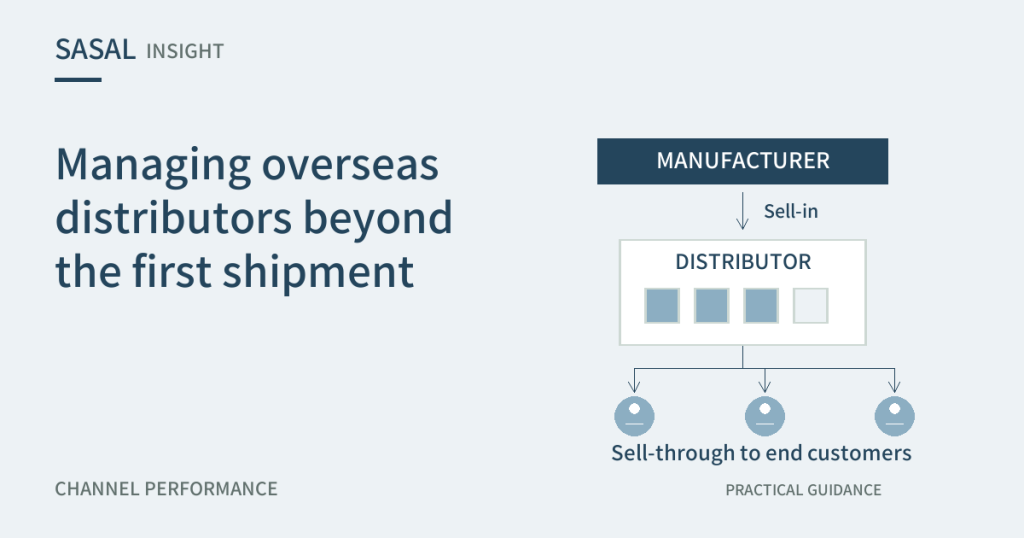
One of the most common channel-management mistakes is treating distributor purchases as proof of customer demand. Distributor orders can indicate confidence, planned promotions or inventory replenishment, but they do not automatically show that end customers are buying and using the product. For that reason, exporters should review sell-in, inventory and sell-through together. Sell-in describes shipments into the channel. Inventory reflects stock currently held by the intermediary. Sell-through refers to sales to end customers. Looking at only one of these measures can produce misleading conclusions. A growing shipment volume may appear positive until inventory data reveals stock accumulation. Likewise, stable distributor orders may mask healthy customer demand if inventory levels are falling because products are moving efficiently through the market.
The practical objective is not to build a complex reporting system. It is to create enough visibility to interpret performance correctly. Comparable periods and units matter because inconsistent measurement makes trends difficult to understand. A monthly review that combines shipments, inventory changes, end-customer sales, returns and reorders often provides a clearer picture than a larger collection of disconnected figures. The discussion should focus on relationships between measures rather than individual numbers in isolation. If inventory falls while end-customer purchases rise, the exporter may need to discuss replenishment planning. If shipments increase without corresponding sell-through, the conversation should shift toward demand generation, customer qualification, pricing, explanation quality or other operational factors influencing market adoption.
Consider a hypothetical manufacturer working through a reseller network. During two consecutive quarters, the reseller increases purchases from the manufacturer. A shipment-only view could suggest strong growth. However, inventory reports show that much of the stock remains unsold. Customer purchase records reveal limited movement to end users. In that situation, sending additional stock may not solve the underlying problem. The exporter and reseller may instead review target customers, sales explanations, competitive alternatives, proposal quality, returns and seasonal factors. The important point is that the evidence changes the management discussion. Rather than rewarding channel loading, both parties can focus on understanding whether customers are actually adopting the offer.
Reading these measures together also improves forecasting and operational planning. Reorder patterns become more meaningful when interpreted alongside inventory position and customer purchasing behaviour. Performance reviews can then separate demand questions from inventory questions. This distinction reduces the risk of overestimating market traction or underestimating customer interest. It also creates a stronger foundation for future decisions about training, incentives, exclusivity and territory coverage. A channel relationship becomes easier to manage when both parties agree that shipments, inventory and customer purchases are related but distinct indicators, each providing a different perspective on how the market is responding.
- Sell-inProducts shipped into the distributor or reseller channel.
- InventoryStock held within the channel after shipments arrive.
- Sell-throughProducts purchased by end customers from the channel.
- ReordersSubsequent purchases interpreted using inventory and demand context.
Design training around actual selling and support tasks
Training is most effective when it reflects the responsibilities assigned to the channel rather than presenting generic product information. A distributor responsible for prospecting, education and quotation support needs different preparation from a partner focused primarily on logistics or inventory management. Before creating training materials, revisit the agreed allocation of work and identify the tasks that influence customer decisions. This helps ensure that training supports execution instead of becoming an isolated event. When responsibilities are clearly defined, both parties can connect learning objectives to practical activities that occur in customer conversations, proposal development, product explanation and post-sale support. The result is a more useful investment of time for everyone involved.
Many exporters emphasize product features while spending less time on how those features are explained to prospective buyers. Yet channel partners often succeed or fail based on their ability to answer questions, handle objections and connect the offer to customer needs. Training should therefore include the information required to perform agreed responsibilities competently. Depending on the channel model, this may involve qualification criteria, explanation methods, proposal support, inventory processes or customer-enquiry handling. The aim is not to script every interaction. It is to provide enough understanding that the partner can execute assigned tasks consistently while communicating accurate information to the market.
A hypothetical example illustrates the difference. Imagine a distributor selling a technical product that requires customer education before purchase. Product specifications alone may not help sales staff explain why a buyer should change existing behaviour. Training could instead focus on typical evaluation questions, common misunderstandings, documentation requirements and the path from initial interest to order placement. If support obligations are also assigned to the distributor, the training plan may include escalation procedures and information-sharing routines. By connecting education directly to operational responsibilities, the exporter creates a stronger link between learning activity and channel performance.
Training should also evolve as evidence accumulates. Reporting systems that capture buyer questions, objections and reasons opportunities do not proceed can identify areas requiring additional support. This creates a feedback process between market activity and capability development. Rather than repeating the same presentation each year, both parties can adjust training to address observed challenges. Such adaptation helps maintain relevance as products, customers and competitive conditions change. Training becomes a management tool when it is linked to actual channel responsibilities, customer interactions and performance evidence instead of being treated as a standalone administrative requirement.
Make exclusivity a bounded operating decision

Exclusivity is often discussed as a reward for appointing a distributor, but it is more useful to treat it as an operating decision linked to specific responsibilities and performance expectations. Granting exclusive rights can encourage investment in selling activity, education and inventory. However, exclusivity also limits alternative channel options. The decision should therefore be connected to the commercial work expected from the partner rather than to enthusiasm expressed during negotiations. A practical arrangement identifies the territory, customer scope, review process, duration and conditions under which the relationship may change. By defining boundaries clearly, both parties gain a better understanding of the commitment being made and the evidence required to assess progress.
A common challenge arises when exclusivity is granted before the required operating activities are demonstrated. The exporter may then find it difficult to encourage market development if expectations were never translated into observable actions. Linking exclusivity to defined responsibilities helps reduce this risk. If prospecting, education, inventory support or reporting are expected, those expectations can be documented and reviewed. The discussion becomes less about abstract promises and more about whether agreed work is occurring. This approach supports cooperation because performance conversations are grounded in identifiable activities rather than assumptions about effort or intent.
Imagine a hypothetical company appointing an exclusive distributor for a defined region. Instead of focusing only on sales volume targets, the parties agree how customer development will be conducted, what information will be shared, how reviews will occur and what happens if the arrangement changes. Such clarity allows both sides to plan resources with greater confidence. It also provides a framework for evaluating whether exclusivity continues to support market development. The arrangement remains linked to operating realities rather than becoming a permanent status independent of performance or market conditions.
Exclusivity discussions should also consider practical exit requirements. Customer information, inventory, warranty obligations and related operating matters can become significant if the relationship ends. Addressing these topics early helps avoid confusion later. The objective is not to anticipate conflict but to ensure continuity for customers and transparency between the parties. When exclusivity is treated as a bounded operating choice with defined scope, review conditions and handover expectations, it becomes easier to manage over time and easier to compare against alternative channel structures that may also support market access.
Use performance reviews to diagnose the right problem
A useful performance review seeks to understand causes rather than assign blame. Channel results can be influenced by many factors, including customer targeting, sales activity, product explanation, pricing, inventory availability and broader market conditions. When reviews focus only on top-line outcomes, important signals may be overlooked. Instead, begin by confirming what sale is being counted and which measures are under discussion. Distributor purchases, end-customer purchases and product usage can describe different realities. Clarifying definitions helps ensure that participants are evaluating the same evidence before discussing conclusions. This creates a more productive environment for identifying actions that may improve future performance.
Diagnosis becomes easier when operational activity is reviewed alongside commercial outcomes. If opportunities are being generated but few customers proceed, the issue may relate to positioning, explanation or buyer requirements. If customer interest appears limited from the outset, targeting assumptions may need adjustment. Inventory information can provide additional context. Rising stock combined with weak sell-through may indicate a demand challenge, while low inventory and delayed replenishment may point to supply or planning issues. Looking across multiple indicators helps prevent premature conclusions based on a single data point. The objective is to understand what is happening before deciding how to respond.
Consider a hypothetical distributor reporting disappointing sales. A superficial review might conclude that the partner is underperforming. A deeper review reveals that customer meetings occurred, proposals were submitted and interest was generated, but buyers repeatedly requested information that sales staff could not provide confidently. In that case, additional training or support may be more appropriate than changing targets. Conversely, if little customer-development activity occurred despite agreed responsibilities, the discussion may focus on execution. The value of the review comes from distinguishing between different possible causes rather than assuming one explanation fits every situation.
Performance reviews become more useful when they support learning. Information about lost opportunities, customer objections, returns and support requests can help both parties improve. The goal is not merely to collect reports but to make decisions using them. Reviews should therefore end with agreed actions, responsibilities and follow-up timing. Over time, this approach helps build a channel relationship grounded in evidence rather than anecdote. By diagnosing the right problem, exporters and distributors can allocate resources more effectively and avoid repeatedly addressing symptoms while underlying causes remain unresolved.
- Confirm definitionsVerify what sales, inventory and activity measures represent.
- Review activityAssess prospecting, proposals, training and customer engagement.
- Identify causesSeparate demand, execution, pricing or support issues.
- Choose actionsAdjust responsibilities, training, messaging or channel design.
Plan customer and inventory handover if the channel changes
Channel relationships sometimes change because strategies evolve, responsibilities shift or performance expectations are no longer aligned. When that happens, customer continuity becomes an important operational consideration. Planning for handover before problems arise can reduce disruption and preserve useful information. The discussion should cover what customer-related information may be shared, how inventory will be handled and which obligations continue after the relationship ends. Addressing these issues during contract design is often easier than attempting to negotiate them during a period of disagreement. Clear expectations create a more stable foundation for long-term cooperation while also preparing both parties for potential transitions.
Customer relationships frequently involve accumulated knowledge about enquiries, purchasing history, support requests and ongoing opportunities. If access to that information is unclear, future channel management can become difficult. Exporters should therefore consider how customer information will be maintained and transferred where permitted under applicable arrangements and requirements. The objective is not to centralize every interaction. It is to ensure that essential operating knowledge does not disappear if a distributor exits the channel. Planning in advance helps support continuity for customers and reduces uncertainty during organisational changes.
Inventory deserves similar attention because stock already in the market can affect future sales and customer support. A transition plan may need to address remaining inventory, outstanding orders, warranty obligations and communication with affected customers. A hypothetical exporter replacing one distributor with another may discover that inventory remains in multiple locations. Without a defined process, confusion can arise regarding availability, support responsibilities and future replenishment. Early planning helps identify such issues before they become urgent. The resulting process can then be documented and reviewed as part of normal channel governance.
Thoughtful handover planning does not imply an expectation of failure. Instead, it reflects the reality that business arrangements can change over time. Both parties benefit when responsibilities and information flows remain understandable throughout the relationship lifecycle. Customers also benefit because continuity receives attention before disruption occurs. By treating handover as an operational topic rather than an afterthought, exporters can protect customer experience, preserve important knowledge and maintain clearer control over channel transitions when circumstances require change.
Build a practical distributor-management brief
A distributor-management brief can help convert channel strategy into a document that guides daily decisions. The most useful briefs are operational rather than promotional. They summarize the commercial job the channel is expected to perform, the responsibilities assigned to each party and the information needed to evaluate performance. By consolidating these elements in one place, managers reduce the risk that important assumptions remain undocumented. The brief becomes a reference point for onboarding, reviews, training and future channel adjustments. It also helps new team members understand how the relationship is intended to function without relying entirely on informal explanations from colleagues.
The brief should describe channel structure clearly. Identify who sells, who contracts, who collects payment, who holds inventory and who supports customers after purchase. Include the target customer profile, agreed activities and reporting expectations. If incentives or margins are linked to particular responsibilities, that relationship should be visible as well. The objective is not to create a legal contract. Rather, it is to create an operational summary that helps people understand how the arrangement works in practice. This distinction is valuable because channel success often depends on everyday execution rather than on contractual wording alone.
Performance information deserves dedicated attention within the brief. Define the measures that will be reviewed, including any agreed treatment of shipments, inventory, sell-through, returns and activity reporting. Specify how reviews will occur and what information supports diagnosis when results differ from expectations. A hypothetical exporter might include example interpretations showing why increased distributor purchases do not automatically indicate increased customer demand. Such guidance helps maintain consistent analysis when personnel change. It also reinforces the principle that channel activity and market adoption should be evaluated using multiple sources of evidence.
Finally, include provisions covering training, exclusivity boundaries, customer-information handling and transition planning. Bringing these topics together creates a practical management tool rather than a collection of disconnected decisions. The brief does not eliminate uncertainty, but it provides a shared operating framework for addressing it. As experience accumulates, the document can be updated to reflect lessons learned and changing responsibilities. A well-constructed distributor-management brief supports clearer communication, more consistent reviews and better-informed decisions throughout the life of the channel relationship.
- Roles and responsibilitiesSelling, inventory, contracting, payment and support ownership.
- Performance informationDefinitions, reporting and review measures.
- Capability supportTraining, activity expectations and information sharing.
- Change managementExclusivity boundaries, handover and transition planning.