

SASAL INSIGHT / DEEP DIVE
Headquarters and subsidiaries: aligning decisions and goals
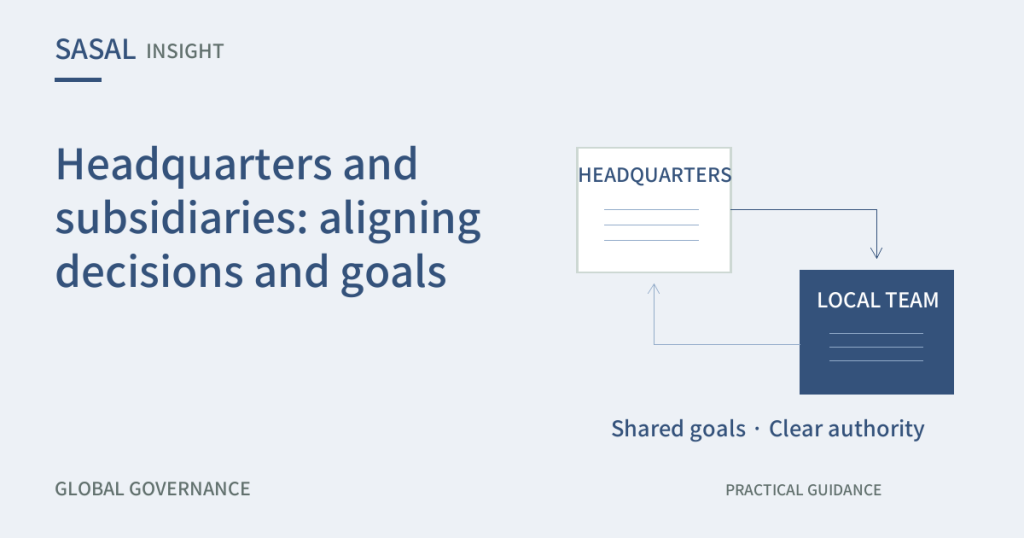
Effective headquarters and subsidiary alignment comes from agreeing outcomes, decision rights, communication routines and accountability before day-to-day issues arise. Shared goals do not require identical operating methods in every country, but both sides should understand which customers they serve, what value they provide and what results they seek. Local teams need authority close to customers so learning can become action, while headquarters retains responsibility for oversight, support and significant risks. Clear escalation paths, common performance definitions and structured discussion of facts, interpretations and requests help disagreements become evidence-based decisions. The result is not centralized control or unrestricted autonomy, but a practical division of responsibilities that supports responsiveness and group accountability.
Start with shared outcomes rather than identical methods
Alignment begins when headquarters and the subsidiary can explain the same intended outcomes in similar terms. Both sides should understand which customers are being served, what value is being delivered and what goals are expected within a defined period. This creates a common reference point for later decisions. Without that shared understanding, disagreements about pricing, hiring, service levels or investment often become arguments about preferences. A clearly stated destination helps participants evaluate alternatives against business objectives rather than personal assumptions or organizational habits developed in different operating environments.
Shared goals do not mean every country follows identical operating practices. Local conditions, buying behavior, competition and delivery realities can differ significantly from one market to another. A subsidiary may therefore use methods that vary from headquarters expectations while still contributing to the same broader objective. The key requirement is agreement on intended results and regular discussion of why local adaptations are being used. When outcomes remain visible, differences in execution can be assessed on their merits instead of being rejected simply because they depart from established headquarters routines.
A practical management approach is to document objectives in language that both sides can repeat consistently. The document can identify target customers, expected value, timing and key assumptions. During reviews, participants can compare current decisions against those agreed outcomes. If circumstances change, the objective can be updated through discussion rather than through informal interpretation. This creates continuity when personnel change and reduces confusion about whether a proposal represents a change in strategy or merely a different method of pursuing the same agreed result.
Why local authority matters in international operations
Authority close to the customer allows information from the market to influence action before opportunities disappear. Customers rarely wait for long approval cycles when comparing suppliers, negotiating terms or requesting adjustments. If every operational decision requires headquarters involvement, response times can slow and local learning may lose value. Delegating selected decisions enables the subsidiary to react to conditions that headquarters cannot observe directly. This is particularly important when market dynamics, customer expectations or competitive actions evolve more quickly than formal reporting cycles can capture.
The need for local authority becomes clearer when examining everyday decisions. Pricing adjustments, hiring priorities, service delivery choices and competitive responses often depend on current information. Headquarters may provide direction and boundaries, yet the subsidiary usually possesses more immediate context. Delays created by repeated approval requests can affect customer experience and operational efficiency. Defining areas where local teams can act independently allows organizations to benefit from local knowledge while maintaining consistency with broader company objectives. Delegation therefore serves execution, not organizational separation from the parent company.
Granting authority should be intentional rather than informal. Organizations benefit from specifying which decisions can be made locally, under what limits and with what reporting requirements. This avoids uncertainty for employees who might otherwise hesitate to act. It also reduces the risk that headquarters assumes control over matters already assigned to the subsidiary. A clear framework helps both sides distinguish between routine operational choices and decisions that require wider organizational consideration. Local responsiveness improves when employees know not only what they can decide, but also where authority ends.
Autonomy and accountability are not opposites
A common misunderstanding is that delegating authority means headquarters relinquishes responsibility. The source guidance describes a different model. The subsidiary manages day-to-day execution within agreed authority, while headquarters continues to provide oversight, resources and support. Accountability therefore remains shared, although responsibilities differ. Local teams make operational decisions because they possess relevant information. Headquarters reviews direction, significant risks and issues beyond local capability. This division allows decisions to occur at an appropriate level without creating ambiguity about who remains responsible for the broader success of the business.
For delegated authority to function, headquarters must provide more than permission. Local teams need access to people, budgets and information required to make decisions effectively. If authority exists on paper but resources remain unavailable, execution will still depend on repeated escalation. The parent company's role includes enabling local decision making through practical support. Reviews should therefore examine not only subsidiary performance but also whether headquarters delivered the agreed resources and assistance necessary for local execution. Accountability operates in both directions under this arrangement.
Organizations often achieve balance by separating operational decisions from strategic oversight. Routine matters stay with the subsidiary, while significant risks and major directional questions move to headquarters. This distinction preserves local initiative while protecting group interests. Reviews can focus on outcomes, context and emerging risks rather than reapproving every operational action. When both sides understand the purpose of delegated authority, discussions become less about control and more about ensuring decisions are made by the people best positioned to evaluate available information at the relevant moment.
A hypothetical decision-rights table described in prose
Hypothetical example: imagine an organization describing decision rights through categories rather than a visual table. Routine pricing adjustments within agreed limits could be decided locally and reported afterward. Hiring within an approved staffing plan might also remain a subsidiary decision. Larger budget increases, major contractual commitments or changes that create significant risk could require headquarters approval before action. Material developments affecting business performance would not necessarily require approval, but would require prompt sharing. The purpose is clarity about authority, information flow and escalation rather than concentrating every decision at one organizational level.
In this hypothetical structure, each category would include boundaries and response expectations. Local teams would know the financial limits, operational conditions or risk indicators that trigger headquarters involvement. Headquarters would commit to identified response times and alternate contacts. Such definitions help prevent delays caused by uncertainty about who owns a decision. They also reduce the likelihood that urgent matters remain unresolved because a single individual is unavailable. Explicit criteria support consistency even when personnel change or responsibilities shift between functions.
The most useful decision-rights descriptions are specific enough to guide action yet flexible enough to accommodate changing conditions. Organizations can review the framework periodically to determine whether authority remains appropriately assigned. If recurring requests consistently receive approval, greater local discretion may be justified. If unexpected risks emerge, escalation criteria may require adjustment. The framework becomes a management tool rather than a static governance document. Its value lies in helping people act confidently while maintaining visibility and accountability across the organization.
Build communication around context, not only results
Communication becomes more useful when it explains why decisions were made rather than reporting outcomes alone. Headquarters benefits from understanding local developments, customer reactions and competitive conditions that shaped a decision. The subsidiary benefits when headquarters shares strategic priorities, constraints and concerns that may not be visible locally. Ongoing dialogue reduces the risk that each side interprets events through incomplete information. Context allows participants to evaluate whether performance reflects execution quality, changing market conditions or assumptions that no longer hold true.
Regular communication also helps identify differences in understanding before they become larger disagreements. Two groups may support the same objective while interpreting local conditions differently. Discussing assumptions openly enables adjustment of plans based on emerging information. This process is particularly valuable during periods of change, when historical expectations may no longer reflect current realities. Rather than waiting for quarterly reviews, organizations can use recurring conversations to compare observations, clarify priorities and identify areas where further investigation is needed before significant decisions are made.
Effective communication routines are usually defined in advance. Participants can agree what information will be shared, how frequently updates occur and who attends key discussions. Consistent practices make reporting less dependent on individual personalities. They also create expectations that important developments will be discussed promptly rather than held until a formal review. Communication supports alignment most effectively when it is treated as an operational process connected to decision making, not simply as a reporting obligation completed after decisions have already been implemented.
Why bad news often travels slowly
The guidance notes that subsidiaries may find some matters difficult to report. Language differences, time zones, performance evaluation concerns and hesitation about challenging headquarters can all discourage early communication. These obstacles matter because emerging problems are usually easier to address when identified quickly. If employees believe difficult messages will be poorly received, reporting may be delayed until options become limited. Organizations therefore benefit from examining not only information quality but also the conditions that influence whether information is shared in the first place.
Encouraging earlier reporting requires attention to how messages are received. When local teams believe that context will be considered and differing views welcomed, they may be more willing to raise concerns before complete answers exist. This does not mean lowering performance standards. It means recognizing that uncertainty is often present when important issues first emerge. Waiting for perfect information can delay useful action. Constructive responses to early warnings help create a culture where communication supports problem solving rather than blame avoidance.
Leadership practices influence reporting behavior significantly. Questions that explore assumptions, evidence and implications can generate better discussion than immediate judgments about outcomes. When difficult information is raised, participants can focus on understanding facts, identifying unknowns and determining next actions. Over time, consistent handling of challenging messages helps establish trust in the communication process. That trust increases the likelihood that opportunities, risks and disagreements reach decision makers while there is still sufficient time to respond effectively.
Create a structured escalation process
Escalation works best when participants share a common format for discussion. The source guidance recommends organizing communication around confirmed facts, the local team's interpretation, the decision or support requested and the response deadline. This structure helps separate observation from conclusion and prevents discussions from becoming unclear. Decision makers receive the information needed to evaluate a request, while the subsidiary can communicate concerns without waiting for a fully developed report. The format creates momentum because it identifies both the issue and the action required from the recipient.
Including unknowns within the escalation process is equally important. Organizations sometimes delay discussion because information remains incomplete. Yet significant business decisions frequently occur under conditions of uncertainty. Identifying what is known and what remains uncertain allows dialogue to begin earlier. Headquarters can contribute resources, analysis or guidance while additional information is gathered. This approach reduces the risk that issues become urgent before relevant stakeholders become aware of them. Early engagement can improve both decision quality and response speed.
A well-designed escalation process also assigns ownership. Headquarters names the person handling the request and communicates the next response time. The subsidiary continues providing updates as circumstances develop. Discussions conclude with agreed owners and next actions. These practices reduce ambiguity about responsibility and timing. Participants know who is expected to act and when further communication will occur. Consistent ownership prevents important matters from remaining unresolved because everyone assumes another person is managing the issue.
How KPIs can unintentionally constrain local capacity
Performance measures help organizations allocate attention and resources, yet they can also create unintended constraints. The guidance highlights situations where parent-company KPIs and budget practices may leave local potential underused. A subsidiary might identify demand and possess opportunities for growth, but still struggle to secure approval for hiring, inventory or other investments. If short-term profitability receives overwhelming emphasis during an early market stage, proposals that support future growth may appear unattractive despite their strategic rationale. Metrics influence behavior, making KPI design an important governance consideration.
Evaluating a subsidiary solely through revenue or profit can obscure operational realities. Results may reflect resource limitations, approval delays or investment constraints rather than weak market demand. Decision makers therefore benefit from examining opportunities and internal restrictions together. Understanding whether growth is limited by customers, capacity, staffing or funding leads to more accurate conclusions. Performance reviews become stronger when they explore the relationship between outcomes and organizational conditions. This perspective helps distinguish execution issues from constraints created elsewhere within the company structure.
Organizations can improve alignment by examining whether current measures match the subsidiary's stage of development. Metrics designed for mature operations may not suit launch activities or market expansion efforts. The objective is not to abandon financial discipline but to ensure evaluation reflects intended outcomes. Reviewing both business results and organizational support can reveal improvement opportunities on each side. KPI discussions become more productive when participants ask whether measures are encouraging the behaviors required to achieve agreed strategic objectives.
Choose measures that fit the business stage
The guidance recommends jointly defining outcomes and measures suited to local circumstances. This approach recognizes that different stages of development require different indicators. During a launch period, organizations may need evidence that customers are adopting the offering before expecting mature financial performance. Measures should therefore reflect what success looks like at the current stage. Agreement on evaluation criteria reduces confusion later because both headquarters and the subsidiary understand how progress will be assessed and which indicators carry the greatest weight.
Examples mentioned in the source include paying customers and repeat purchases alongside traditional financial measures. Such indicators can provide evidence supporting future investment decisions. They help participants assess whether customer acceptance is developing as expected. Importantly, these measures do not replace revenue, profit or collection performance. Instead, they complement financial indicators by providing context about market development. A balanced view can improve investment decisions by connecting current performance with the longer-term objectives originally agreed between headquarters and the subsidiary.
Evaluation frameworks become more useful when they include defined investment periods and conditions for future action. Participants can agree in advance what results support additional investment, a change in direction or reduced scope. This creates transparency around expectations and reduces the likelihood of disputes driven by differing assumptions. Reviews can focus on evidence relative to agreed criteria rather than revisiting fundamental questions each time performance is discussed. The process strengthens accountability because decision standards are visible before results are evaluated.
Establish common definitions before comparing performance
Alignment depends not only on goals but also on shared definitions. Different locations may interpret common business terms in different ways. The guidance notes that a report indicating something was sold could refer to shipment to a distributor or purchase by the final customer. Those events have different implications for demand and inventory. Without consistent definitions, performance discussions may compare unlike situations. Organizations can therefore improve decision quality by agreeing what key metrics mean before using them to evaluate results or allocate resources.
Consistency should extend across operational and financial reporting. Definitions for prospects, orders, stock, receivables, defects and losses influence how performance is interpreted. If locations report similar figures using different criteria, comparisons become unreliable. Agreement on reporting frequency further improves transparency because stakeholders know when information will be updated and how current it is. Shared understanding reduces unnecessary debate and allows discussions to focus on business implications rather than reconciling inconsistent reporting practices after the fact.
Shared records also support continuity. When information, decisions and outstanding issues are documented consistently, another person can understand the current situation if a key owner becomes unavailable. This capability is particularly valuable across time zones and geographically distributed teams. Continuity reduces delays and prevents repeated analysis of matters already addressed. Reporting systems therefore serve a broader purpose than performance measurement alone. They create organizational memory that supports coordination, accountability and informed decision making across headquarters and subsidiary operations.
Turn disagreement into decision criteria
Disagreement between headquarters and a subsidiary does not automatically indicate poor alignment. Different perspectives can reveal important information when managed constructively. The guidance recommends connecting views by sharing objectives and examining issues through common questions involving demand, cost, quality and capacity. This approach moves discussion away from positions and toward evaluation criteria. Participants can compare alternatives using factors relevant to the business objective. The result is a more structured decision process that accommodates differing viewpoints without treating disagreement as organizational conflict.
When a subsidiary proposes a change, the rationale should be explained clearly. Customer requests, purchasing implications, costs, timing and alternatives all contribute useful evidence. Headquarters, in turn, should clarify fixed requirements, responsible decision makers and response dates. Transparency from both sides improves decision quality because assumptions become visible. Discussions are less likely to stall when participants understand what information is required and who holds authority. Clear criteria help distinguish legitimate business concerns from misunderstandings about expectations or process.
The objective is not to eliminate differences of opinion. Instead, organizations benefit from creating a framework where competing interpretations can be examined systematically. Some disagreements will involve facts requiring further research. Others will involve choices assigned to a designated decision maker. Separating these categories prevents endless debate. Evidence gathering can proceed where knowledge is incomplete, while accountable leaders make decisions where judgment is required. This disciplined approach enables progress even when complete consensus does not exist.
Use limited-scope trials when uncertainty remains
Use limited-scope trials when uncertainty remains. When headquarters and a subsidiary agree on objectives but disagree about a proposed change, a narrowly defined trial can convert assumptions into evidence. The source’s hypothetical same-day support situation illustrates the approach: instead of deciding immediately whether the service should become permanent, the parties first define which customers are included, what incidents qualify and which response hours apply. Those definitions make alternatives comparable. A trial should be designed around the original question rather than becoming a broad operational experiment. Information needed before launch may include expected customer demand, operational capacity, likely quality implications and possible effects on response speed. By clarifying what will be observed and why, both sides create a common basis for evaluating results while preserving headquarters accountability and local initiative.
Hypothetical illustration: a subsidiary argues that faster support will help retain customers, while headquarters is concerned about cost and staffing requirements. Rather than debating preferences, they agree to test the idea with a limited group of customers under predefined conditions. Before implementation, both sides document assumptions, identify decision owners and establish evaluation criteria linked to demand, cost, quality and capacity. During the trial, information is collected consistently so interpretations do not rely on anecdotal feedback alone. The review then focuses on evidence relevant to the disagreement. If customer response is positive but quality suffers, modification may be appropriate. If benefits appear limited, the proposal may be discontinued. If evidence supports the concept, expansion can be considered. The key point is that uncertainty is investigated rather than merely argued about.
Effective trials require governance that is explicit from the start. The guidance recommends agreeing scope, duration, budget, approvers and continuation criteria before the exception begins. These decisions prevent a temporary arrangement from becoming an informal permanent practice without review. Ownership should also be clear: who gathers information, who reviews results and who makes the final decision after the trial period. Organizations can further improve learning by separating questions that require additional facts from matters that depend on management judgment. A trial does not remove the need for decision rights; it supports those decision rights with better information. When headquarters and subsidiaries use this method consistently, disagreements become structured evaluations of alternatives. The result is a more disciplined process for balancing local insight, organizational oversight and evidence-based decision making.
Prepare for a productive headquarters–subsidiary review
A useful review begins before participants enter the meeting. Both headquarters and the subsidiary can gather evidence related to agreed objectives, performance measures and decision-rights boundaries. Information should distinguish confirmed facts from interpretations and identify unresolved questions. Reviewing previous commitments also helps determine whether promised actions were completed. Preparation focused on evidence creates a stronger basis for discussion than relying on general impressions. Participants arrive ready to evaluate progress, address obstacles and make decisions rather than spending most of the meeting establishing basic context.
Organizations may also benefit from preparing a concise record of current authority arrangements. The review can examine whether decision rights remain appropriate, whether response times are being met and whether escalation processes are functioning as intended. Attention should be given to both operational outcomes and the support provided by headquarters. This reflects the source guidance that accountability exists on both sides. Evaluating only subsidiary execution may overlook organizational constraints that influence performance and decision quality.
For a productive internal review, assemble the materials needed to discuss alignment concretely. Prepare current objectives, KPI definitions, delegated authority rules, the escalation process and examples of recurring disagreements. Identify where approvals slow action, where information is difficult to share and which measures may not fit the local business stage. A proposed way to use these materials is to distinguish changes that need better evidence from choices that require an accountable decision-maker. Agree who will return each answer and when, so the review ends with a practical route to action.