

SASAL INSIGHT / DEEP DIVE
AI and field research for overseas market decisions
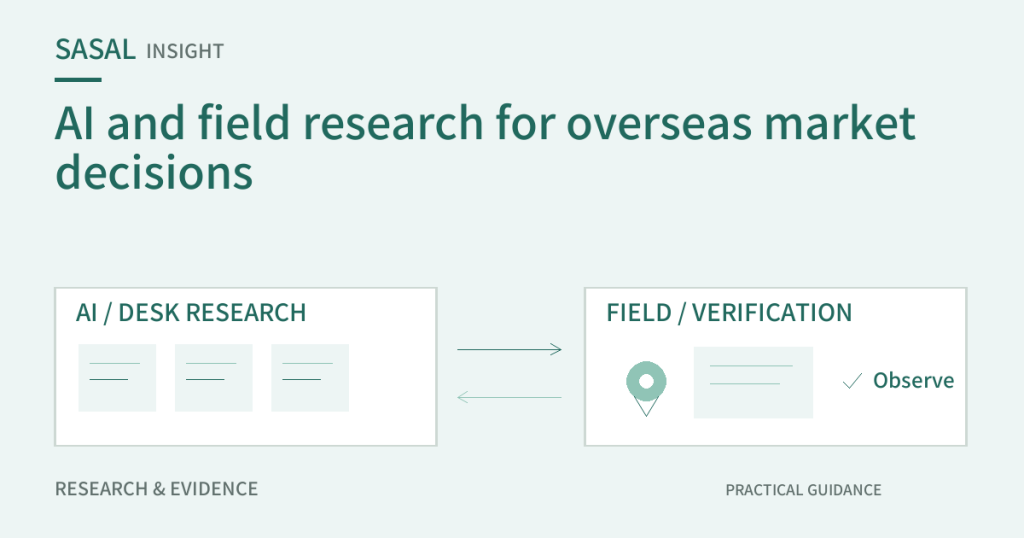
AI is most useful in overseas market research when it is treated as a tool for organizing information, testing hypotheses and preparing questions rather than as a substitute for evidence from the field. A practical decision process begins by defining what you believe may be true about a market, identifying which sources can answer which questions, recording provenance and dates, and then checking assumptions through local observation and conversations. The goal is not to prove an initial idea correct. The goal is to discover where published information, customer discussions and conditions on the ground agree or conflict. When findings are documented clearly and returned to the planning process, research becomes more useful for investment and operating decisions.
Start with a business hypothesis, not a search result
Overseas market research becomes easier to manage when the team begins with a specific hypothesis. Rather than collecting every available fact, define a statement that can be examined. A hypothesis might concern customer demand, purchasing behavior, pricing assumptions or operating conditions. AI can help organize information related to that statement and identify supporting and conflicting evidence. This approach creates a clear link between research activity and business decisions. It also reduces the risk that large volumes of information will be mistaken for understanding or treated as evidence without sufficient examination.
A useful hypothesis should connect to a future decision. If the finding would not influence investment, staffing, delivery or market entry planning, it may not deserve priority. Teams often benefit from writing the hypothesis in plain language, listing assumptions separately and identifying what evidence could challenge the idea. AI can assist by summarizing available public information and highlighting areas where information appears incomplete. The important point is that the hypothesis comes first and the information gathering process follows from it rather than the reverse.
Hypothetical example: a company assumes buyers will prefer a premium service because similar products appear expensive in public listings. That assumption can be converted into questions about actual purchasing behavior, competing offers and decision authority. AI may organize competitor information and prepare interview questions, but it cannot establish whether buyers will purchase. The hypothesis remains provisional until it is examined through evidence. Treating it as a working proposition encourages investigation rather than confirmation and creates a stronger foundation for subsequent field research.
A practical way to evaluate a hypothesis is to define in advance what result would cause the team to revise it. This creates a decision criterion before evidence is gathered. For instance, if the hypothesis concerns demand from a particular customer group, the team can specify which observations would strengthen confidence, which would weaken confidence and which would indicate that the question remains unresolved. Recording these possibilities helps separate investigation from advocacy. In a hypothetical application, a company considering a new overseas market writes three columns beside its hypothesis: expected observations, contrary observations and unknowns. Public information summarized by AI suggests favorable conditions, but customer discussions reveal purchasing considerations not visible in published material. Because the team documented possible contradictory outcomes from the start, the new information is incorporated rather than dismissed. The exercise also improves coordination across researchers. Different participants can collect evidence against the same decision question while using a shared interpretation framework. When findings are later reviewed, the discussion is less likely to focus on which source seems most impressive and more likely to focus on whether the original business proposition still appears reasonable, requires refinement or should be investigated through a different hypothesis altogether.
- State hypothesisWrite the proposition and related assumptions in plain language.
- Gather evidenceUse appropriate sources and organize findings around the hypothesis.
- Compare outcomesAssess supporting, conflicting and unresolved observations.
- Inform decisionRefine planning based on what the evidence can establish.
Match evidence sources to specific questions
Different sources answer different questions, and confusion often begins when teams expect one source to explain everything. Market statistics may help estimate scale, public information may reveal competitor positioning, and interviews may explain purchasing considerations. Before collecting material, list the questions that matter and identify which source type is most likely to answer each one. This simple exercise prevents overreliance on a single category of evidence. It also makes later conclusions easier to evaluate because the reasoning path remains visible and linked to identifiable sources.
AI can support this stage by grouping questions and organizing available information according to topic. A team may create categories such as market conditions, competitor activity, customer motivations and operating requirements. The resulting structure helps reveal gaps that still require investigation. Some questions may already have reasonable evidence, while others may depend on future interviews or site visits. Distinguishing between these categories keeps the research process focused. It also reduces the tendency to draw broad conclusions from information that addresses only part of the decision.
Hypothetical example: published data may suggest a sizable market, while customer interviews reveal hesitation about switching suppliers. Neither finding invalidates the other because they answer different questions. The market may exist, yet customer adoption may still require additional effort. Recording which source addressed which issue allows the team to compare findings appropriately. When evidence is categorized in this way, contradictions become opportunities for learning rather than reasons for confusion. The resulting picture is often more nuanced and more useful for decision making.
Teams often improve research quality by creating a question register before collecting information. The register lists each decision-relevant question, the source most likely to answer it and the level of confidence currently available. This method helps distinguish questions about market scale from questions about customer behavior or operating conditions. In a hypothetical case, a company exploring overseas expansion wants to understand demand, competitive positioning and implementation requirements. Market statistics may contribute to the first question, public competitor information to the second and interviews or site visits to the third. AI can organize the register and group related material, but the team still decides whether a source genuinely addresses the question being asked. An operational benefit of this approach is that it highlights evidence gaps early. If several important questions depend on interviews that have not yet occurred, planners can see immediately that the research remains incomplete. It also prevents false certainty created by extensive information in only one category. During review meetings, participants can examine each question individually, identify what evidence exists and determine whether further investigation is warranted. The result is a clearer chain between the original business issue, the evidence collected and the eventual recommendation.
- StatisticsUseful for scale, trends and market descriptions.
- Public informationUseful for competitor terms and positioning.
- InterviewsUseful for purchasing considerations and decision processes.
- Field observationUseful for practical operating and buying conditions.
Record provenance, dates and definitions
Research becomes more reliable when every important finding is linked to its origin. Teams should record where information came from, when it was published, how it was collected and what definitions were used. AI can summarize material efficiently, but summaries are difficult to evaluate if the underlying sources are not retained. A conclusion that appears convincing may rely on outdated information, a narrow sample or a definition that differs from the one relevant to the business. Provenance records make these issues visible before decisions are made.
Dates deserve particular attention because market conditions change. Information gathered during one period may not represent current conditions. A team comparing multiple sources should note reference periods and avoid treating all figures as if they describe the same moment in time. AI can assist by extracting dates and organizing documents chronologically, creating a clearer timeline of evidence. This process helps researchers identify whether differences between sources reflect actual disagreement or simply different periods, methods or scopes of observation.
Definitions also matter because similar terms can describe different realities. A reported customer category, market segment or competitor grouping may not match the company’s intended focus. Hypothetical example: a report discusses enterprise buyers while the planned offering targets smaller organizations. The apparent relevance disappears once definitions are examined carefully. Recording provenance, dates and definitions therefore serves a practical purpose. It protects the decision process from hidden assumptions and enables future reviewers to understand exactly how conclusions were reached.
A useful operational practice is to maintain a short evidence record for every significant finding, even when the information appears straightforward. The record can include the source, publication or collection date, scope, method and any definitions that affect interpretation. This habit becomes especially valuable when findings are reviewed months later or by people who were not involved in the original research. In a hypothetical scenario, two reports appear to describe the same customer segment. A closer review shows that each uses a different definition and covers a different period. Without provenance details, the reports might be combined incorrectly and treated as direct confirmation of one another. AI can help extract dates and organize records, but preserving the original context remains important. Teams may also benefit from flagging findings that depend heavily on a particular definition or timeframe so those limitations remain visible during planning discussions. Another advantage is that provenance records make it easier to revisit assumptions when conditions change. If a conclusion relied on information from a specific period, researchers can quickly identify which evidence should be updated. The discipline may seem administrative, yet it directly supports decision quality by reducing misunderstandings about what the evidence actually represents.
Use AI to organize evidence for and against the hypothesis
One of the most useful roles for AI is helping teams compare evidence that supports a hypothesis with evidence that challenges it. Research projects often accumulate large numbers of notes, documents and meeting records. Organizing these materials manually can be difficult, especially when multiple people contribute findings. AI can help classify information, group similar observations and surface areas where evidence appears inconsistent. This creates a more balanced review process and encourages researchers to examine conflicting information rather than overlooking it.
A practical method is to maintain separate categories for observations that strengthen the hypothesis, observations that weaken it and unresolved questions. The purpose is not to produce equal numbers in each category but to create visibility. Teams can then discuss the quality and relevance of each item. Some evidence may appear strong but have limited applicability. Other evidence may be weaker individually yet reveal a recurring pattern. AI can assist with organization, but human judgment remains necessary when interpreting significance and implications.
Hypothetical example: several public sources suggest favorable pricing conditions, while interviews reveal concerns about implementation effort. Both findings may be true simultaneously. By reviewing evidence in structured categories, the team can investigate whether the pricing advantage offsets the operational challenge. The exercise also prevents selective attention. Instead of searching only for supporting material, researchers develop a habit of actively examining uncertainty. That habit often produces more robust conclusions than collecting additional information without a framework for comparison.
When organizing evidence, teams may find it helpful to assess not only whether a finding supports or challenges the hypothesis but also how directly it relates to the business question. Some observations are closely connected to the proposed decision, while others provide useful background without materially affecting the outcome. A hypothetical example illustrates the distinction. Public information suggests favorable pricing conditions, several interviews describe implementation concerns and a few observations relate only indirectly to the purchasing process. By categorizing relevance separately from direction, the team avoids giving equal weight to every item collected. AI can assist by grouping notes and identifying recurring themes, making it easier to review large volumes of material. An effective review meeting might examine three categories: evidence that strengthens the hypothesis, evidence that weakens it and evidence that remains ambiguous. Participants can then discuss whether apparent conflicts arise from differences in scope, timing or source type. This process encourages disciplined interpretation rather than simple vote counting. A large number of supportive observations does not automatically outweigh a smaller number of highly relevant contradictory findings. By focusing on relevance, source context and unresolved questions, researchers create a more balanced assessment of what the available evidence can reasonably support.
- Supporting evidenceObservations consistent with the current hypothesis.
- Contradictory evidenceObservations that challenge key assumptions.
- Unresolved questionsAreas where evidence remains incomplete.
- Relevance reviewAssess how directly each item affects the decision.
Identify what requires field confirmation

Not every important question can be answered through desk research. Published information may describe a market, but practical buying and operating conditions often require direct observation. Teams should identify which assumptions depend on local experience and prioritize those areas for field investigation. Examples may include customer behavior, delivery realities, neighborhood differences, distributor capability or everyday working practices. Recognizing these limits early helps allocate time efficiently. It also prevents misplaced confidence in conclusions that have not yet been tested against conditions on the ground.
AI can help identify likely areas of uncertainty by comparing available evidence and highlighting topics with limited verification. Once those areas are visible, the team can design field activities around them. A visit should not be treated as a general exploration. It becomes more productive when linked to specific questions arising from prior research. This connection ensures that local observation builds directly on earlier work rather than repeating information already available through public sources or internal discussions.
Hypothetical example: desk research indicates strong commercial activity in a district. The remaining question concerns how buyers actually evaluate suppliers. A field visit might therefore focus on customer conversations, store observations or discussions with local operators. The goal is not to confirm the district’s potential automatically. The goal is to understand how decisions are made in practice. That distinction turns local visits into targeted investigations and increases the value of the time invested in field research.
Field confirmation becomes more efficient when the team ranks assumptions according to potential decision impact. Not every uncertainty deserves the same level of attention. A practical method is to identify which assumptions, if proven incorrect, would significantly alter investment, timing, staffing or operating plans. Those assumptions can then receive priority during visits and interviews. In a hypothetical application, researchers already possess substantial public information about a target market but remain uncertain about how buyers compare suppliers and who influences purchasing decisions. Rather than repeating desk research during a visit, they focus field activities on those unresolved questions. AI can assist by compiling earlier findings and highlighting topics supported by limited evidence. The resulting field agenda is narrower but more valuable. Teams may also prepare specific observation objectives for each location or meeting so participants know what information they are seeking and why it matters. After the visit, findings can be compared against the assumptions identified as high impact. This approach reduces the risk that fieldwork becomes a collection of interesting anecdotes disconnected from decision needs. By concentrating on assumptions with the greatest planning consequences, organizations make better use of limited time and gain more actionable insight from direct observation.
Translate desk hypotheses into observation plans
Translate each desk hypothesis into a small set of observations that could realistically confirm, challenge or complicate it during fieldwork. Start by writing the hypothesis in plain language, then identify what people, places, processes or interactions could provide relevant evidence. For every question, note what source can answer it: direct observation, customer discussions, operator conversations or review of existing records. A practical visit brief can include the hypothesis, the expected observation if it appears correct, alternative explanations, recording methods and remaining unknowns. AI may help organize these elements and prepare consistent materials for multiple researchers. The purpose is not to predict outcomes but to create a shared framework so participants investigate the same business question while remaining open to unexpected findings encountered on the ground.
An observation plan becomes more useful when it specifies how alternatives will be compared. If researchers expect a particular buying factor to matter, they should also record evidence for other possible influences and compare reasons for buying with reasons for declining. This reduces the risk that attention focuses only on information supporting the original idea. Record the source, date, scope and method for each important finding so later reviewers can understand what was actually learned. Observed facts and interpretations should be documented separately. For example, a customer statement, a delivery process witnessed during a visit or a competitor term identified in public information can be recorded as facts, while broader conclusions remain hypotheses requiring further validation. AI can help organize these categories without determining their meaning.
Hypothetical illustration: a team develops a desk hypothesis that delivery speed is a major purchasing consideration. Their visit brief lists customer discussions, observation of delivery routines and comparison of competing offers as evidence sources. The verification log includes columns for the question tested, observations, alternative explanations and next hypotheses. During fieldwork, several buyers mention delivery timing, but some also emphasize support arrangements and existing relationships. The factual record notes exactly what was said, who provided the information, when it was collected and under what circumstances. Interpretation occurs later, when the team reviews whether delivery speed alone explains the pattern. The resulting analysis may strengthen, weaken or refine the original hypothesis, and the remaining questions are returned to the research plan for additional investigation.
Observation plans are often strongest when they define both what researchers will look for and how findings will be recorded. Consistency matters because different team members may interpret similar situations differently. A suggested method is to create a standard observation template that includes the question being examined, the source of the observation, factual notes, possible interpretations and follow-up questions. In a hypothetical overseas market visit, several researchers attend different meetings with customers and operators. Because they use the same template, their observations can later be compared more easily. AI may help consolidate notes and identify recurring patterns across locations, but the original observations remain visible for review. Another useful practice is to document observations that complicate the hypothesis rather than only those that support or challenge it. Real-world conditions frequently reveal mixed outcomes that require refinement rather than simple acceptance or rejection of an idea. By anticipating this possibility, teams avoid forcing nuanced findings into binary categories. The observation plan therefore serves not only as a guide for fieldwork but also as a framework for later analysis. It creates continuity between desk research, field evidence and subsequent planning decisions while preserving the context needed for careful interpretation.
Avoid confirmation bias during interviews and visits
Avoid confirmation bias during interviews and visits by designing the research process to look for disconfirming evidence as well as supportive evidence. Teams often arrive with a desk hypothesis that already feels plausible, especially after reviewing organized research. Before meetings, prepare an interview guide that includes questions capable of weakening the hypothesis, not only strengthening it. AI can be used to suggest alternative explanations and organize questions around competing possibilities, helping researchers compare different interpretations of the same observation. A practical visit brief can list the hypothesis, what evidence would support it, what evidence would challenge it, and which unknowns remain unresolved. This structure keeps conversations focused on learning rather than validation and encourages researchers to treat unexpected answers as useful information rather than exceptions to be explained away.
The quality of evidence depends on how findings are recorded and reviewed. Interview notes should capture what participants actually said, along with the source, date, scope and method of collection, rather than summaries filtered through existing expectations. After each meeting, researchers can examine whether they recorded both supportive and contradictory observations. Comparing reasons for purchasing with reasons for declining is particularly valuable because the contrast often reveals conditions that affect the business hypothesis. AI may help organize meeting records into categories such as evidence for the hypothesis, evidence against it and unanswered questions, but interpretation still requires human judgment. When contradictory comments appear, the response should be further investigation rather than immediate dismissal or selective weighting of favorable statements.
Hypothetical illustration: a team believes buyers will welcome a new offering and several interviewees express interest during visits. That observation is a fact within the scope of those discussions. However, some of the same interviewees also describe approval processes, support expectations or switching concerns that could limit adoption. A balanced verification log records both elements separately. The existence of interest does not automatically establish broad demand, and the obstacles do not automatically disprove demand. The team can return these findings to the business hypothesis, identify what remains uncertain and plan follow-up field observation around the unresolved questions. By distinguishing observed facts from interpretation and actively examining conflicting evidence, researchers reduce optimistic conclusions that extend beyond what the available evidence can support.
One operational safeguard against confirmation bias is to compare answers across different participant groups rather than relying on a single perspective. Customers, operators, distributors and internal stakeholders may describe the same process differently because they experience different parts of it. In a hypothetical example, customer interviews suggest strong interest in a proposed offering, while operator discussions emphasize implementation complexity. Neither viewpoint necessarily invalidates the other. Instead, the contrast helps identify questions requiring additional investigation. AI can support this process by grouping comments according to theme and source type, making differences easier to detect. Researchers may also schedule periodic evidence reviews during fieldwork rather than waiting until all interviews are complete. These reviews can focus specifically on observations that challenge prevailing assumptions. If contradictory findings repeatedly emerge, the team can adjust later interviews to explore those issues in greater depth. This approach treats inconsistency as a signal for learning rather than a problem to be removed from the analysis. Over time, the accumulated record becomes more balanced because supportive and contradictory evidence receive deliberate attention. The resulting conclusions are generally easier to defend because they reflect an examination of competing explanations rather than a search for validation alone.
Create a practical verification log
A verification log provides a structured way to connect hypotheses, evidence and next actions. Each entry can include the hypothesis under examination, the source consulted, the date, the observation recorded and the remaining uncertainty. AI can help maintain and summarize the log, especially when information comes from many documents and meetings. The value of the log lies in transparency. Anyone reviewing the research can understand what has been learned, what remains uncertain and why additional investigation may still be required.
An effective log distinguishes facts from interpretations. A customer enquiry, a published figure or an observed operating condition can be recorded as factual inputs. Interpretations should be noted separately so that future reviewers can evaluate the reasoning. This structure becomes especially useful when responsibility changes hands or when research continues over an extended period. Rather than relying on memory, the organization retains a documented chain of evidence that supports ongoing decision making and future planning.
Hypothetical example: an entry records that three operators described delivery delays during peak periods. That observation is a fact within the scope of those discussions. A broader conclusion that nationwide logistics constraints exist would remain an interpretation requiring additional evidence. By documenting both elements separately, the team identifies the next question to investigate. The verification log therefore acts as a bridge between individual findings and the broader business decisions that eventually depend on them.
A verification log can become a practical management tool when entries are linked to ownership and next steps in addition to evidence records. Beyond documenting what has been learned, the log can identify who is responsible for investigating remaining questions and when those questions will be reviewed. In a hypothetical research project, several findings appear promising, but important uncertainties remain regarding customer behavior and operating conditions. Rather than leaving these uncertainties as general observations, the team records specific follow-up actions beside each entry. AI can help summarize themes across the log and highlight recurring issues, yet the value of the system comes from traceability. Future reviewers can see not only the evidence collected but also how the organization responded to it. Another useful feature is a status field distinguishing validated observations, open questions and items requiring field confirmation. This prevents unresolved assumptions from being mistaken for established facts during planning discussions. As research expands, the log becomes a central reference connecting hypotheses, sources and decisions. The result is greater continuity between individual observations and broader business planning, especially when multiple teams contribute evidence over an extended period.
- Record findingCapture source, date, scope and observation.
- Assess meaningSeparate fact from interpretation and uncertainty.
- Assign actionPlan interviews, visits or further review.
- Update evidenceAdd new findings and revise open questions.
New evidence returns to the log for re-evaluation
Involve decision-makers in field learning

Involve decision-makers in field learning by giving them a direct role in answering the business questions identified during desk research. Reports and summaries remain useful, but people who will approve budgets, set priorities or oversee implementation often gain additional understanding when they observe customers, operators and local teams firsthand. Before a visit, the research team can use AI to organize prior evidence, identify unknowns and prepare a visit brief linked to specific hypotheses. The brief might list the question being tested, the evidence already available, observations expected if the hypothesis is correct and alternative explanations that could challenge it. This approach connects field activity to decisions under consideration and helps participants focus on learning rather than collecting impressions without a clear purpose.
Field learning is most valuable when observations are compared with existing evidence instead of being treated as stand-alone proof. Decision-makers can examine whether what they see helps explain, strengthens or raises questions about earlier findings. AI may assist by organizing meeting records, visit notes and public information into categories such as evidence supporting the hypothesis, evidence challenging it and unresolved questions. Researchers should continue recording provenance, dates, scope and methods so that later interpretation remains transparent. A useful review asks not only what was observed but also what that observation can actually establish. Direct exposure often reveals practical details about purchasing discussions, delivery work, decision authority or daily routines that were not visible in published sources yet are relevant to planning and execution.
Hypothetical illustration: headquarters planners arrive with a hypothesis that distribution operates smoothly because reports describe strong network coverage. Their visit brief includes questions about coordination steps, timing and everyday operating conditions. During customer and operator discussions, they observe additional activities required to achieve the reported outcomes. The finding does not automatically invalidate earlier research; instead, it adds context about how results are produced in practice. A verification log records observed facts separately from interpretations, noting sources, dates and remaining uncertainties. After returning, decision-makers compare the field observations with the original hypothesis and identify what still requires confirmation. The lessons are then returned to planning, where ownership, next investigations and future decisions can be linked directly to the evidence collected.
Decision-makers can contribute more effectively to field learning when they arrive with clearly assigned questions rather than a general expectation to observe. A practical approach is to allocate responsibility for specific uncertainties before travel begins. One participant may focus on purchasing behavior, another on operating conditions and another on implementation considerations. In a hypothetical market assessment, headquarters leaders review existing research and identify a small number of unresolved questions that could influence future planning. AI helps organize previous findings into a concise briefing package, allowing participants to spend more time investigating gaps than reviewing background material. During visits, each person records observations related to their assigned topic and compares them with earlier assumptions. Afterward, a structured debrief links observations directly to planning implications and remaining uncertainties. This process can reveal where published information and local experience align, as well as where they diverge. It also improves organizational learning because insights are tied to decision responsibilities rather than remaining as informal impressions. By involving decision-makers in a disciplined evidence-gathering process, companies strengthen the connection between research activity and subsequent action while maintaining transparency about what has and has not been established.
Use field observations to refine the plan
Field research should lead to changes in understanding, not simply additional documentation. After visits and interviews, teams should compare observations with the assumptions developed during desk research. Areas of agreement may strengthen confidence in the current plan. Areas of disagreement deserve careful examination because they often identify the most important risks or opportunities. AI can help organize findings and highlight differences between expectations and observations. The purpose is not to judge whether the original assumptions were right or wrong but to improve decision quality.
A useful review process considers which business questions have been answered and which remain unresolved. Some findings may clarify customer behavior, while others may raise new operational concerns. Teams can prioritize unresolved questions according to their potential influence on investment decisions. This prioritization prevents endless research and directs attention toward uncertainties that genuinely matter. The result is a more focused planning process that uses field learning to improve action rather than accumulate information indefinitely.
Hypothetical example: customer conversations confirm interest in a solution, but field observations reveal a more complex purchasing process than expected. The company may retain its overall market interest while adjusting timelines, staffing assumptions or engagement methods. Such refinements represent successful learning rather than failure. Research creates value when it informs better decisions. Returning field observations to the planning process ensures that lessons gathered through direct experience shape future actions and resource allocation.
After fieldwork, teams often benefit from conducting a structured comparison between expectations and observations. A simple method is to revisit the original hypotheses one by one and note whether each was strengthened, weakened, refined or left unresolved. This prevents findings from being discussed only at a general level. In a hypothetical case, customer interest appears stronger than expected, but the buying process proves more complex. Rather than treating these findings as contradictory, the team examines how each affects planning assumptions. AI can assist by organizing interview records, observation notes and previous research into a single review framework. Researchers can then identify which issues have been answered sufficiently for decision purposes and which still require further investigation. Another useful criterion is practical significance. Some discrepancies between expectations and reality may have little influence on the plan, while others could alter resource allocation or implementation timing. Distinguishing between these outcomes helps focus attention where it matters most. The review should conclude with clear updates to assumptions, open questions and proposed next actions. In this way, field observations become an active input to planning rather than a separate body of information that sits alongside existing decisions without influencing them.
Interpret findings in decision context
Interpretation starts by linking every finding to a pending choice rather than treating research as a collection of interesting facts. A statistic may influence whether additional investigation is justified, while an interview pattern may affect timing, staffing or operating assumptions. Organizing evidence by decision category can help teams see which findings matter most. For example, separate material that affects investment scope from material that affects delivery planning or customer engagement. AI can be used to group notes, documents and meeting records around these decision areas, but researchers still need to judge relevance. A useful review asks: what decision could change if this finding is accepted, challenged or left unresolved? Evidence that cannot influence a real choice may deserve lower priority than evidence tied directly to action.
Context should remain visible whenever conclusions are discussed. Findings gain meaning when considered alongside sample size, prices, support arrangements, scope, dates and collection methods. Comparing alternatives is often easier when these conditions are recorded consistently. A customer comment gathered during a targeted visit may answer a different question from a published market figure, so they should not be weighed as if they represent the same type of evidence. Teams can compare observations by noting what each source can actually establish and where uncertainty remains. AI may help summarize conditions attached to findings, but decision-makers should review the original records and definitions. This prevents narrow observations from being generalized beyond their demonstrated scope and keeps confidence aligned with the quality of available evidence.
Hypothetical illustration: a verification log shows interviews indicating interest from a specific buyer group. Before recommending any change to the plan, the team reviews how many interviews occurred, who participated, the prices discussed, any support expectations mentioned and whether contradictory evidence exists. The visit brief for follow-up fieldwork then focuses on the remaining questions rather than repeating what is already known. One item might be confirming whether expressed interest translates into actual buying conditions observed locally. Another might examine reasons some prospects decline. The resulting interpretation is not simply that demand exists or does not exist. Instead, the team records what is supported, what is uncertain and which unanswered questions could still change an investment, timing or operating decision.
Interpretation is often improved by examining how conclusions would change under different reasonable readings of the evidence. Rather than asking whether a finding is simply positive or negative, teams can explore multiple implications and determine which decisions are sensitive to those differences. In a hypothetical example, interview feedback suggests interest from a specific customer group. One interpretation is that demand may justify further investigation. Another is that interest depends on conditions that still require validation. By considering both possibilities, researchers avoid overstating certainty. AI can help assemble the supporting records and summarize themes, but the evaluation should remain tied to the documented scope and context of the evidence. A practical review can classify findings according to their potential effect on investment decisions, operating plans or customer engagement approaches. This makes it easier to prioritize additional research where uncertainty remains consequential. Teams may also record confidence notes explaining why a conclusion is tentative or relatively well supported. Such transparency helps later reviewers understand the reasoning process rather than only the outcome. Interpretation becomes more useful when it clarifies not just what has been observed but also how those observations should influence pending business choices.
Prepare for specialist consultation and next actions
The final stage is turning research findings into a focused agenda for specialist consultation and further field activity. AI-assisted research, evidence assessment and local observation often reduce uncertainty without eliminating it entirely. Remaining questions should be documented clearly and linked to the decisions they may influence. Specialists, local advisors and industry participants can then address issues that require practical experience or jurisdiction-specific knowledge. A targeted consultation is usually more productive than a broad discussion because prior research has already clarified the central questions.
Teams can prepare a consultation brief that summarizes the hypothesis, key findings, conflicting evidence, field observations and unresolved issues. AI may help organize this material, but the team should review source references and assumptions carefully. Including both supporting and contradictory findings encourages balanced discussion and helps specialists focus on areas where their expertise can add the most value. This preparation also improves continuity between research, consultation and subsequent planning activities.
Hypothetical next step: assemble a verification log, a visit summary and a list of remaining questions that could affect investment or execution decisions. Identify which issues require specialist input, which require additional customer conversations and which require further observation in the field. Present evidence together with its provenance, dates and limitations. By entering consultation with a structured record of what has been learned and what remains uncertain, the organization can use expert discussions more effectively and continue refining a practical overseas market plan.
Preparation for specialist consultation is most effective when remaining questions are framed in terms that experts can evaluate directly. Instead of presenting a large volume of raw research, teams can organize unresolved issues according to the decisions they may influence and the evidence already collected. In a hypothetical application, researchers complete desk analysis and field observation, then identify a limited number of questions requiring specialist review. Each question is accompanied by supporting observations, contradictory evidence, source references and the assumptions that remain uncertain. AI can help compile this material into a concise consultation brief, making it easier for specialists to focus on areas where their experience adds value. Another useful practice is to document what outcome from the consultation would change the plan. This keeps discussions connected to practical decision needs rather than general information gathering. Following the consultation, the organization can update its verification log, refine hypotheses and assign responsibility for any additional investigation. The process creates continuity from initial research through field learning and specialist input. By approaching consultation with a structured record of evidence, limitations and unanswered questions, teams improve the likelihood that expert discussions produce actionable guidance for the next stage of planning.