

Overseas expansion: How to release your budget in stages
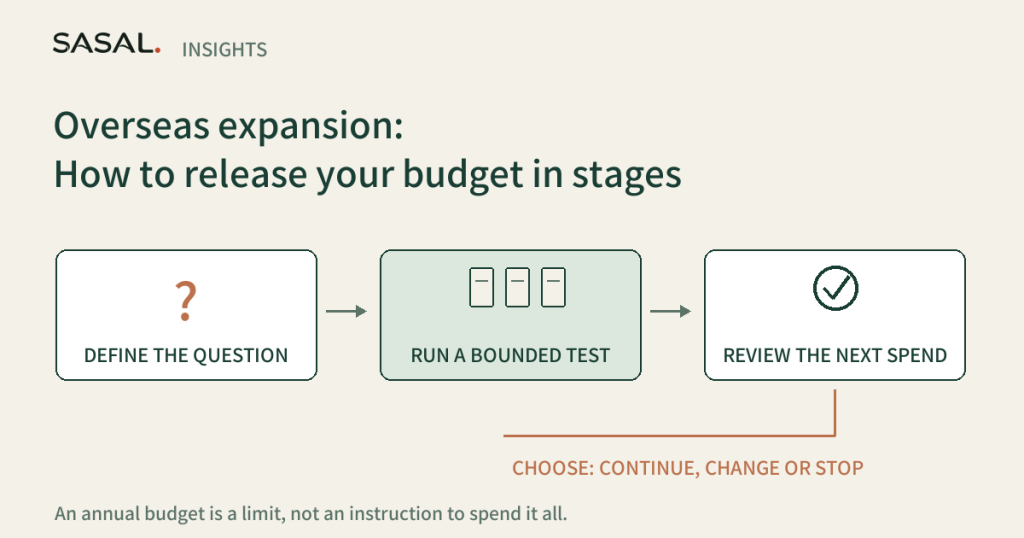
Overseas expansion competes with other uses of money, management attention and operational capacity. A promising enquiry, a well-known destination or a positive meeting sequence may justify further investigation, but none of them automatically justifies larger commitments. A disciplined approach is to release resources in stages, with each stage designed to answer a specific uncertainty that affects a real decision. The focus is not on predicting success or building a universal budget formula. It is on deciding whether the next limited investment deserves approval, while preserving the ability to stop, change direction or postpone further activity. This approach can be used by owner-led businesses, small teams and larger organizations alike, provided responsibilities, evidence requirements and commitment exposure are made explicit before additional spending is authorized.
Ask whether overseas expansion is the best use of the next investment
An overseas enquiry can feel like proof that expansion should move to the front of the queue, especially when it arrives unexpectedly or comes from a market the team has discussed for years. The more useful question is narrower: what problem would the next overseas investment solve, and is that problem more important than the alternatives competing for the same money and management attention? Consider a hypothetical owner-led B2B service firm that receives an enquiry from abroad while several domestic customer renewals are approaching. The owner has limited time. One option is to spend that time exploring the foreign opportunity. Another is to focus on retaining existing customers and improving delivery. A third is to strengthen a product or process already serving current demand. Each path consumes attention that cannot be used elsewhere, so the comparison is not between overseas growth and doing nothing. It is between several possible uses of scarce resources.
A practical discussion compares consequences rather than aspirations. If overseas work is delayed, what opportunity may be missed? If domestic improvements are delayed, what risks increase? Strategic diversification can be a legitimate reason to explore another market, but it is different from pursuing an opportunity because competitors appear active overseas, because travel seems attractive, or because international activity carries prestige. Those motivations do not automatically make the next investment the strongest choice. The decision should be tied to a specific uncertainty whose resolution could change what the business does next.
The International Trade Administration of the United States asks export planners to consider questions such as what personnel and company resources will be dedicated to exporting, what the cost in time and money will be, how results will be evaluated, and what other development plans may compete for attention. Those questions are useful planning prompts. They do not prescribe a staged-investment method, but they help reveal tradeoffs that are easy to ignore when a foreign enquiry arrives with apparent urgency. A small team may discover that the limiting factor is not funding but the founder’s availability. A larger organization may discover that key specialists are already committed to other initiatives.
Once the opportunity cost is visible, the next investment can be framed as a decision rather than a destination. Instead of asking whether overseas expansion is attractive in general, ask whether a defined amount of effort should be authorized to answer a defined question. For example, the team may need to learn whether a particular buyer group has a purchasing process compatible with the company’s current offer. If the answer is yes, one path follows. If the answer is no, resources may be better directed elsewhere. The value comes from reducing uncertainty, not from accumulating activity.
A review at this stage may support moving forward, postponing the work, or allocating resources elsewhere for now. None of those outcomes is a failure. The purpose of releasing a budget in stages is to keep later choices open until better evidence exists. A foreign enquiry can be worth investigating, yet still lose when compared with a more urgent customer-retention effort, an operational improvement, or another development project competing for the same attention.
Turn foreign interest into a question you can actually test

Foreign interest often arrives in a form that sounds promising but leaves critical facts unanswered. An email may come from a referral partner, a reseller, a consultant representing a client, or a potential end customer. Those situations can lead to very different decisions. Before approving spending, translate the interest into a question that can be tested. A useful question is specific enough that the result could change a real choice. One example is: will a defined buyer type and the person controlling the budget seriously evaluate the current standard offer under conditions the business could realistically support? That question is narrower than asking whether an entire country is interested, but it is far more actionable.
The initial message rarely provides enough information to answer it. Who would actually use the product or service? Who approves spending? Is the enquiry exploratory research, a procurement exercise, or an immediate purchasing need? Is the contact seeking a reseller arrangement rather than becoming a customer? In some situations the company may also need to confirm whether it can legally discuss or supply the proposed offering in that market before committing further resources. Clarifying these points prevents the team from treating curiosity as evidence of demand.
Consider a hypothetical enquiry from a business that wants to distribute your service to its own clients. The message describes an attractive market and asks for an exclusive arrangement. Before treating it as customer demand, establish whether the sender expects to buy the service, earn a referral fee or obtain rights to sell it. Ask what customer problem it has actually observed, whether prospective users have been consulted and what work each party would perform. A distributor’s interest may be useful, but it answers a different question from an end customer’s willingness to purchase. An exclusivity request also creates a decision about future freedom to work with others; it is not simply another positive lead.
The first investigation can be small: clarify the proposed relationship, confirm the intended buyer and examine whether the offer matches a current need. Record what the contact actually said separately from the team’s interpretation. “They asked for a proposal” is an observation; “this market is ready for a launch” is a conclusion that still needs support. If the contact cannot yet identify the use case or purchasing route, the next action may be another focused conversation rather than paid promotion or a local representative. If the opportunity is outside the company’s ability to serve, declining promptly can preserve attention for a better fit.
End this initial clarification with a question that could change an investment choice. For the hypothetical distributor, that might be whether its intended customers will evaluate the standard service without granting exclusivity first. Decide what information is needed to answer that question and what commitment is under consideration if it is answered. A clear question does not guarantee a favorable result. It makes an unresolved assumption visible before the company starts paying to act as though it were true.
Separate the annual ceiling from permission to commit money
An annual expansion envelope sets a maximum allocation, but it does not automatically authorize every commitment that could fit inside that limit. Treating the ceiling as blanket permission can obscure how much capacity remains for future decisions. A staged approach separates the overall allocation from approval of the next specific commitment. That distinction matters because new information may emerge after each test, making it sensible to continue, revise the plan, postpone activity, or stop. The envelope is therefore a planning boundary rather than an instruction to spend everything within it.
To make the remaining capacity visible, separate four categories. First is money already spent. Second is outstanding non-cancellable commitments that have been approved but not yet fully paid. Third is an uncommitted reserve held for potential closeout needs. Fourth is genuinely unallocated capacity that could support a future decision. These categories should not be merged. Otherwise the same exposure can be counted twice or hidden entirely. The objective is management clarity, not an accounting classification or a statement about cash held in the bank.
A hypothetical management-allocation illustration shows the mechanics. Start with a USD 100,000 envelope. Assume USD 10,000 has already been spent, USD 18,000 is tied to unpaid non-cancellable commitments, and USD 12,000 is held as an uncommitted closeout reserve. That leaves USD 60,000 of unallocated capacity. If the next test is authorized at USD 8,000 and management also decides to add a separate USD 3,000 closeout reserve related to that test, unallocated capacity becomes USD 49,000. The reserve is not part of the USD 18,000 obligation category and does not duplicate the USD 8,000 authorization. It exists because management wants room to address potential closeout needs if circumstances change.
The categories should continue to be tracked consistently as the work progresses. When part of the USD 18,000 commitment is paid, it moves from unpaid obligation to spent amount, but that payment does not create new capacity because the exposure was already counted. If a supplier agreement is partially cancelled, capacity is released only to the extent that the remaining obligation is genuinely removed. Similarly, a reserve should remain reserved until the relevant need has ended; only then can any unused portion return to unallocated capacity. These distinctions help avoid the mistaken impression that capacity has increased merely because money changed categories.
The reserve also needs a defined basis. In this illustration, it covers possible closeout work that has not already been purchased or included in an outstanding obligation. If a confirmed termination charge is already part of the USD 18,000 commitment, it must not also remain inside the USD 12,000 reserve. If the new test’s USD 8,000 authorization already includes its completion and handover work, the additional USD 3,000 must cover a different, genuinely incremental exposure or be removed. Review the underlying items whenever the plan changes. These amounts illustrate the calculation only; they are not recommended budgets, supplier prices or standard reserve levels.
- Already spentAmounts already used. They explain past decisions but do not create new capacity.
- Binding commitmentsOutstanding non-cancellable obligations that remain part of exposure until removed or fulfilled.
- Closeout reserveUncommitted capacity set aside for potential wind-down or completion needs not already obligated.
- Unallocated capacityCapacity remaining for future decisions after spending, commitments and reserves are considered.
Design a test whose result can change the next decision
A useful expansion test starts with a single decision that is genuinely waiting to be made. Suppose prospects have engaged with an offer but discussions repeatedly stall. The team believes the obstacle may be language, yet procurement requirements are another plausible explanation. Those possibilities lead to different investments. Translating an entire website, rebuilding marketing materials and hiring local support make little sense if the real issue is that buyers need vendor-registration documents or internal approvals before they can proceed. Before spending, write down the specific uncertainty and the exact next action that would follow if the uncertainty were reduced. In this example, the question is not whether the market likes the product. It is whether language appears to be preventing serious evaluation by the intended buyer.
A bounded experiment can then be designed around that question. Rather than translating every asset, the company might prepare a limited localized sample of material for a defined group of prospects while keeping the standard material available for comparison. Feedback should come from people participating in the actual evaluation process, not only from friendly contacts. The aim is not to prove that language alone causes a particular outcome. The aim is to observe whether prospects can review the offer, ask informed questions and advance the discussion under conditions that resemble a real buying process. If conversations remain blocked despite improved comprehension, the next decision may shift toward investigating procurement requirements instead of funding broader localization.
The review criteria should be agreed before the test begins. A result that supports additional localization spending may include evidence that buyers can now evaluate the offer and that language was previously creating confusion. A result that supports pausing may show that prospects understand the proposal but still cannot move it through their organizations. An inconclusive result is also possible. For example, some prospects may engage more deeply while others do not, leaving the team uncertain whether the issue is language, buyer type or something else. Defining these interpretations in advance reduces the temptation to change the goalposts after money has been spent.
Unexpected lessons often emerge during execution. A prospect may mention a distribution partner, a trade event or a different customer segment. Those observations can be valuable, but they should be recorded separately from the original question. Discovering a new opportunity does not automatically expand the approved scope. Once the planned experiment has answered its initial question as far as reasonably possible, the work should stop and move to review. A new question deserves its own decision and its own authorization rather than being quietly added to the existing budget.
The discipline comes from linking evidence to a specific next choice. If the findings support broader localization, that action can be considered. If they suggest procurement barriers are the real constraint, resources can be redirected. If the evidence remains ambiguous, postponement may be more sensible than escalation. A well-designed test creates room for continuation, revision or a halt. Its value lies in improving the quality of the next commitment, not in creating momentum toward a predetermined expansion path.
Distinguish customer enthusiasm from evidence of a viable purchase
Positive reactions from overseas contacts can be encouraging, but different forms of interest carry very different decision value. A technically knowledgeable contact may praise the product, request demonstrations and introduce colleagues. That information shows engagement, yet it does not automatically indicate purchasing intent. One of the first review questions is whether the person expressing enthusiasm can influence a buying decision, approve spending or merely provide technical input. Mistaking one role for another often causes teams to overestimate the strength of an opportunity and authorize commitments before the commercial path is understood.
The next conversation should therefore focus on evidence rather than excitement. Practical questions include: Is there a current budget associated with this problem? What decision route would a purchase follow? What solution is being used today if no purchase occurs? Who signs off on expenditure? These questions are not designed to pressure a prospect. They clarify whether the opportunity is moving through a real commercial process. A contact who cannot answer every question may still be valuable, but uncertainty should remain visible rather than being converted into assumed demand.
Documents can also be misunderstood. A nonbinding letter of intent may indicate serious interest, yet it does not carry the same evidential weight as an agreed commercial order. Even an order requires interpretation. Conditions, implementation requirements, acceptance procedures and payment arrangements may still affect whether the expected transaction actually occurs. For budgeting purposes, the important point is not to collapse every positive signal into the same category. Each signal answers a different question, and some leave critical uncertainties unresolved.
Sampling bias deserves equal attention. Early international interest often arrives through the founder's network, an existing customer relationship or an unusually motivated organization. Those contacts may provide useful insight, but a larger volume of feedback from the same channel does not necessarily strengthen the case. A more informative test is whether a buyer outside that original network reaches a similar conclusion under ordinary conditions. Independent interest does not guarantee recurring demand, yet it can reveal whether the opportunity extends beyond a narrow set of relationships.
Paid pilots sit somewhere between conversation and repeatable demand. They demonstrate willingness to commit under agreed conditions, which is more informative than compliments or exploratory discussions. However, the pilot validates only those specific conditions. It does not automatically establish that future buyers will behave similarly, that the same economics will hold, or that demand will recur without unusual support. When evidence points in different directions, give greater weight to information that improves the next decision: purchasing authority, decision pathways, independent buyer behaviour and actual commitments. Enthusiasm remains useful context, but it is not a substitute for understanding how a purchase would really happen.
Check what delivery will cost before treating a pilot as success
A pilot can produce valuable evidence about market interest while concealing the effort required to deliver the result. Before using a pilot as justification for further expansion, break the work into categories that can be examined separately. One category is first-time setup that may be reusable later, such as creating documentation or configuring a process. Another is recurring effort required for every customer. Additional categories may include customer-specific changes, support and rework, and any compliance or review activities relevant to the offering. Looking at these components individually helps determine whether the pilot revealed a repeatable approach or depended on exceptional circumstances.
Consider a hypothetical concierge-style pilot. The founder personally joins meetings, translates discussions in real time, resolves misunderstandings immediately and coordinates every handoff. The customer is satisfied and the project appears promising. The critical question is not whether the founder can make one pilot work. It is whether the same outcome can be achieved when those tasks are performed by the people who would handle them during normal operations. If translation, issue resolution or coordination depends on unusual founder involvement, the pilot may have demonstrated demand while leaving delivery capability uncertain.
A practical review examines who performed each task, how frequently it occurred and whether the activity would be needed again. Reusable setup work should not be confused with recurring service effort. Likewise, customer-specific adaptations should be distinguished from standard delivery. If extensive customization was accepted purely to learn about the market, that should be recorded explicitly rather than folded into assumptions about future business. The purpose is not to reject experimentation. It is to understand which parts of the result can reasonably be repeated and which parts were exceptional learning investments.
Contribution should also be assessed consistently. For this management view, contribution means revenue less the variable and delivery costs that are relevant to serving the customer. Allocated overhead is a separate consideration and should not be hidden inside the calculation. Cash position is another separate topic. Keeping those concepts distinct prevents confusion about what the pilot actually demonstrated. Contractor expenses should be counted where they relate to delivery, while internal labour should not be treated as free simply because no external invoice was issued. The opportunity cost of staff time deserves visibility, but it should not be counted twice by placing the same effort in multiple categories.
After the worksheet is complete, management can identify what has been confirmed, what remains unknown and what requires another test. A pilot may show that customers are willing to engage while still leaving uncertainty about support requirements or repeatability. It may reveal that most of the effort came from one-off setup work, making expansion more plausible. Or it may show that success depended on intensive interventions that cannot easily be repeated. Those distinctions matter because the next decision is not whether the pilot felt successful. It is whether the evidence justifies a further commitment, a redesign of the approach, a pause or a stop.
Fund the next stage only after reviewing the evidence
A stage gate is a decision point, not a status meeting. The question on the table is whether the evidence collected since the last authorization is strong enough to support a specific next commitment. Consider a hypothetical expansion effort where a team has been testing commercial interest from buyers in another country. The review should not begin with how many meetings occurred or how much activity was completed. It should begin with the uncertainty that justified the previous spend. Was the concern buyer access, purchasing authority, delivery feasibility, payment behaviour, or something else? Evidence is useful only when it reduces uncertainty that could change a real decision. If the central question remains unresolved, authorizing a larger commitment may simply increase exposure without improving decision quality.
The review works best when findings are separated into three categories: what has been confirmed, what has been contradicted, and what remains unknown. A hypothetical example illustrates the distinction. A company may learn that operational staff at several prospective customers are enthusiastic about the offer. That could confirm technical relevance. At the same time, the review may reveal that budget approval sits with a different decision maker who has not yet engaged. In that case, technical interest is evidence, but not evidence for the same decision. Treating every positive signal as proof of commercial viability can cause the next commitment to be approved for the wrong reason. The review should identify which findings matter to the pending choice and which findings merely provide context.
Some uncertainties are tolerable while others block progress. If delivery capacity is still unknown but the next proposed activity is a limited commercial test, management may decide that uncertainty can remain open temporarily. By contrast, if a critical requirement has been disproven, such as the ability to reach the actual purchasing authority, a larger market-development commitment may no longer be justified. Ambiguous outcomes deserve particular caution. A test that produces mixed signals may support a bounded follow-up investigation, but only if the missing information has clear decision value. Funding additional work simply because the answer was unclear can turn a staged process into an open-ended one.
Ownership of evidence and authority to spend are related but not identical. In a small owner-led business, the same person may gather information and approve the next release of funds. In a larger organization, the people running the test may present findings while a different budget holder authorizes the next commitment. Either way, the approval should focus on evidence rather than forecasts. A sales projection may help frame possibilities, but it is not bankable proof of future demand. Observable behaviour, documented constraints, delivery findings, payment experience and identified risks deserve greater weight than optimistic scenarios.
Before ending the review, state the decision and its immediate consequence. A decision to pause should stop new instructions within the relevant authority while allowing already approved obligations to be fulfilled. A revised test should identify the specific uncertainty still worth investigating. Continuation should authorize only the defined next scope. Recording an outcome prevents an ambiguous meeting from being interpreted by one team as permission to launch and by another as a request for more information.
- QuestionDefine the uncertainty that could change the next expansion decision.
- Bounded testRun a limited investigation designed to answer that uncertainty.
- Evidence reviewAssess confirmed findings, contradictions and remaining unknowns.
- DecisionContinue, redesign, pause or stop based on evidence and priorities.
Only continue or a revised test begins another cycle; pause or stop exits.
Protect the ability to stop when negotiating commitments
The ability to stop is often determined long before a project succeeds or fails. It is shaped during negotiation, when commitments are being structured. A company exploring overseas demand may focus on securing resources quickly, yet the form of the commitment can matter as much as the price. A hypothetical team evaluating a new market might need specialist support, localized materials or implementation assistance. If those needs are packaged into a single long commitment, future flexibility can disappear before the underlying commercial uncertainty has been resolved. Structuring work in stages can preserve decision options without assuming that the project will be abandoned.
One practical negotiation choice is whether work can be divided into approved phases with clear deliverables instead of being tied to a broad annual minimum commitment. The tradeoff is straightforward. Suppliers may prefer longer commitments because they provide planning certainty. Buyers may prefer narrower commitments because they allow evidence reviews between stages. Neither position is automatically right. The useful question is whether the commitment reflects what has actually been learned. If a major uncertainty remains unresolved, it may be difficult to justify obligations that assume the answer is already known. When discussing terms, it can also be valuable to clarify cancellation notice requirements, applicable fees, treatment of unfinished work, and access to data or work product if the project ends.
Not all exposure appears on the primary invoice. A seemingly modest purchase can trigger downstream obligations that become visible only later. For example, a hypothetical market test could require software licences, training, specialist personnel availability or reserved supplier capacity. Those linked commitments may continue even if the original experiment is paused. Before approving the next stage, decision makers should identify which obligations arise automatically from proceeding and which remain optional. The goal is not to eliminate commitment. It is to understand the full chain of consequences created by a decision.
Capacity deserves the same scrutiny as money. A founder who personally manages overseas relationships may reserve substantial time for a project that is still experimental. A larger company may allocate specialist staff whose availability becomes difficult to recover once schedules are rearranged. Sometimes reserving capacity is justified because opportunities are time-sensitive. In other cases, the organization may retain more flexibility by keeping resources available until stronger evidence emerges. Comparing the real need for reserved capacity against the ability to rebook or redeploy those resources can reveal risks that are hidden in financial summaries.
There is no universal right to cancel every commitment, and some irreversible investments may be appropriate once evidence and risk authorization support them. The important point is that stopping should remain a deliberate option rather than an accidental impossibility. Before accepting a commitment, decision makers should know what would need to happen for the project to continue, what circumstances would justify a pause, and what costs or obligations would remain if the work ended. That clarity reduces the chance that future decisions will be driven primarily by the existence of prior commitments instead of current evidence.
Manage the cash calendar as carefully as the spending limit
A budget allocation describes how much exposure the organization is willing to authorize. A cash calendar describes when money is expected to move. Confusing the two can create avoidable pressure during overseas expansion. A project may fit comfortably within an approved allocation while still creating operational strain because payments become due before customer funds arrive. Reviewing only the spending limit can therefore hide important timing risks. The decision at each stage gate should include both questions: is the commitment authorized, and can the timing of cash movements be supported alongside existing obligations?
A hypothetical scenario illustrates the issue. A company secures interest from a prospective overseas customer and agrees to a pilot. The customer pays a deposit, which appears encouraging. However, a local service provider must be paid before the customer formally accepts the work, and the customer's procurement process delays the final invoice. On paper, the project may still look attractive. In practice, the timing of payments and collections becomes critical. The deposit should not be treated as proof of profitability, and projected receipts should not be treated as cash already available. Taxes, refunds, processing delays or acceptance conditions may still affect what ultimately remains with the business.
Currency timing can introduce another layer of uncertainty. Imagine that a quotation is issued in one currency while settlement occurs later after exchange rates have moved. Someone bears that change, either the buyer, the supplier or the company running the expansion effort. The review should identify where that exposure sits rather than assuming favourable outcomes. Instead of relying on a fixed percentage buffer, management can examine a small set of plausible scenarios and consider whether the project remains workable if exchange movements occur before collection. The objective is visibility into sensitivity, not precise forecasting.
Collection behaviour deserves attention separate from sales activity. A prospect that signs quickly may still pay slowly. A pilot that generates revenue on paper may not yet have generated collected cash. During evidence reviews, teams should distinguish confirmed receipts from expected receipts and avoid counting unconfirmed funding as available for future commitments. Existing obligations also matter. Cash that appears available may already be needed to support current customers, fulfil prior commitments or complete wind-down activities if a test is discontinued. Looking only at projected inflows can create a misleading picture of flexibility.
The most useful cash review asks what happens if timing changes. If customer collection is delayed, which obligations still become payable? If acceptance takes longer than expected, how much capacity remains to serve existing customers? If a supplier invoice arrives before a procurement process finishes, what actions become necessary? These questions do not require complex accounting models, and they are not legal or accounting advice. They are practical management checks designed to prevent a promising overseas initiative from creating avoidable strain because cash timing was treated as an afterthought rather than a decision factor.
Use an approval process that fits the people making the decision
The approval process should match the people who must live with the consequences of the commitment. In an owner-led business or a team of one to five people, a formal committee can consume more effort than the decision itself. A lighter approach is usually sufficient: the owner records the key assumption being tested, the exposure being accepted and the evidence expected from the next step. If another trusted reviewer is available, that person can challenge blind spots, ask whether the evidence would actually change a future decision and point out overlooked obligations. The reviewer does not need veto power and does not have to be an external consultant. The important distinction is that authorizing spending and executing payment are separate actions. A supplier invoice should not become approval by default simply because it has arrived. When an urgent inbound request appears, a predefined authority limit can allow a fast response, but only within boundaries already agreed rather than through improvised exceptions.
Larger organizations face a different risk. Sales may see encouraging discussions, operations may be assessing delivery effort and finance may be tracking contractual exposure. If each function approves only its own portion of the work, the organization can unintentionally accumulate a larger commitment than anyone intended. A staged approval process should therefore review aggregated exposure across functions before releasing the next investment. That includes direct spending, management time, supplier commitments, delivery capacity and any downstream obligations that would be triggered by proceeding. Contract splitting to stay below an approval threshold undermines this purpose because it hides the true scale of the decision. Authority should follow actual company policy and the real commitment being created, not the size of an individual invoice.
The review itself should focus on a specific decision. Consider a hypothetical situation in which an overseas prospect requests rapid customization before evaluating the offer. The commercial team believes agreeing quickly could accelerate discussions. Operations believes the requested work would consume scarce specialist time. The approval conversation is not about whether the opportunity sounds attractive. It is about whether the proposed commitment is justified by the evidence available today and whether the expected learning is worth the resources being tied up. If the next step cannot resolve a meaningful uncertainty, postponement may be more sensible than immediate action even when the prospect appears enthusiastic.
A practical approval record can remain brief. It should state the question being tested, the exposure being accepted, the person with authority to approve and the event that will trigger review. What matters is that the decision is made before obligations are created. Teams sometimes discover that work has effectively been committed through verbal assurances, purchase requests or supplier preparation activities before formal approval occurs. Once that happens, the review risks becoming a rubber stamp for work already underway rather than a genuine decision point.
Keep the process proportionate, but make approval visible before anyone communicates a binding commitment. A lightweight written decision can be enough for a small team. In a larger organization, the same decision needs to reach every function whose spending or capacity it affects.
Respond to weak evidence without chasing the money already spent
Weak evidence becomes most difficult to judge after substantial effort has already been invested. Research may have been completed, meetings held, materials localized and pilot activities delivered. Those actions often create pressure to keep moving because stopping can feel like abandoning progress. Yet the relevant question is always forward-looking: does the evidence now available justify the next commitment when compared with alternative uses of money and management attention? The amount already spent cannot answer that question. A review should focus on expected future benefit, future cost and remaining uncertainty rather than on recovering effort that has already been consumed.
The first task is identifying why the evidence is weak. Different problems call for different responses. A market may contain genuine demand, but the wrong customer segment was targeted. Delivery may be possible, yet only through an operational approach that cannot realistically be repeated. Or there may simply be insufficient demand under workable conditions. Treating all disappointing results as a single category encourages endless retries. A more useful review asks what specific uncertainty remains unresolved and whether another bounded test could distinguish among the competing explanations. If no realistic next test would materially improve the decision, further spending may not be warranted.
Consider a hypothetical pilot that generated interest from prospects but required extensive customization and unusually intensive founder involvement. The result does not necessarily prove lack of demand. It may indicate a delivery constraint. A different test might examine whether customers remain interested when the offer is delivered through a more standard process. By contrast, imagine that prospects consistently understand the offer, have access to budget authority and still choose existing alternatives. In that scenario, another round of similar conversations may add little value because the central demand question has already been explored. The review should be driven by what information is missing, not by a desire to improve the appearance of previous investments.
Past spending should also be distinguished from remaining obligations and avoidable exit costs. Rejecting sunk-cost logic does not mean pretending that all future costs disappear. A business may still need to close a pilot properly, honour existing commitments, cancel renewals according to agreed terms or complete limited wind-down work. Those actions are future decisions with real consequences. They should be evaluated on their own merits rather than being bundled together with the argument that expansion must continue because money has already been spent. Preserving useful learning records, customer communications and operational findings can also have value even when the expansion effort is paused or stopped.
A decision to revise, postpone or stop is not automatically a positive outcome, and continuation is not automatically a mistake. The quality of the decision depends on the evidence available. If a revised test can answer a meaningful question at a reasonable level of exposure, it may deserve authorization. If the evidence continues to point in the same direction without reducing uncertainty, repeating the same activity may simply consume resources that could be applied elsewhere. Staged budgeting works because it keeps those options open. Each review asks what should happen next, not what would justify what has already happened.
Write the next-spend decision before authorizing the next payment
Many expansion efforts become harder to control because the real commitment is made before anyone documents the decision. A supplier starts work, travel is booked, a contract is circulated or resources are reserved, and only afterward does the organization discuss approval. By that point, saying no may be difficult even if important questions remain unanswered. Writing the next-spend decision before entering the commitment creates a practical checkpoint. The purpose is not paperwork for its own sake. It is to make sure the business can explain what question is being answered, what evidence is required and what level of exposure is being accepted before obligations are created.
A useful next-spend memo can be short, but it should be specific. Imagine a hypothetical company exploring demand from manufacturers in a new market. Before committing to a localized sample test, the commercial director writes a brief decision note. The question is whether procurement managers at the target buyer type will seriously evaluate the existing offer when key sales materials are provided in a localized format. The evidence sought is observable participation in a genuine evaluation process by the intended buyer group rather than positive comments alone. The proposed activity is a limited localized sample, not a full market launch. Known exposure is restricted to the approved commitment and the management resources already allocated to the test. A cash check confirms that existing obligations and customer commitments can still be met if the test produces no follow-on work. The commercial director is named as the approval authority under company policy. The review event will occur after the agreed evaluation activity has concluded. The predefined outcomes are continue, change or stop. A further limited commitment may be considered if the intended buyers engage in evaluation and the resource and cash limits still hold. A different obstacle calls for a changed test; failure to support the assumption can justify stopping. Resolving an uncertainty alone does not require more spending—the answer may remove the reason to proceed.
The value of documenting this logic is practical. If later discussions become enthusiastic but do not involve the intended buyer group, the review can compare the outcome with the original question. If the localized materials reveal a procurement issue rather than a language issue, the next decision can address that discovery instead of automatically funding broader localization. Because expectations were written down in advance, the organization is less dependent on memory, personal optimism or selective interpretation when the evidence arrives.
The memo is also a living decision tool. New facts may emerge before the commitment is finalized. A supplier may propose additional work, a prospect may request a broader scope or an operational constraint may become visible. If those changes alter the exposure the organization is willing to accept, the memo should be revised and reapproved before the commitment expands. Updating the decision logic is different from creating another register or process layer. It simply keeps the documented decision aligned with the commitment actually being made.
The final test is straightforward. Before signing, ordering, booking or otherwise committing resources, ask one immediate question: what specific future decision will this spending help us make, and what evidence would cause us to continue, change course or stop? If the answer is unclear, the organization may not yet be ready to authorize the commitment, regardless of how promising the opportunity appears.