

When do firms consider overseas expansion? Triggers by size
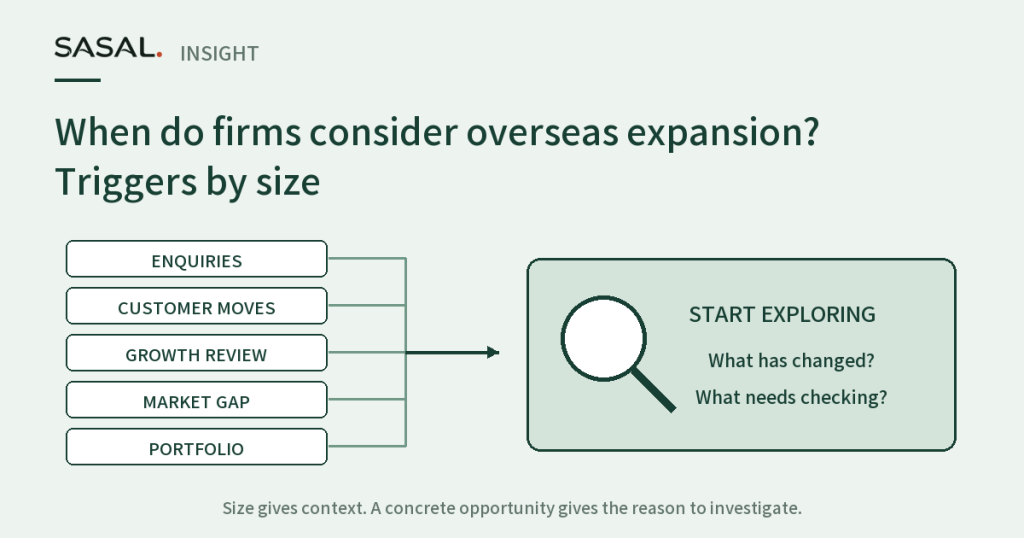
Overseas expansion can start as a management question before it becomes an operating plan. A customer enquiry, a distributor approach, a specialist request from another country or a portfolio review can all raise the possibility. The key decision at that moment is not whether to expand. It is whether the signal deserves a bounded investigation. Revenue size can help explain how information reaches decision-makers and what resources are available to examine it, but it does not create a mandatory starting point or a readiness threshold. Very small firms may receive international demand early, while large businesses can remain focused on domestic customers for years. A useful discussion separates the event that attracted attention, the evidence still missing and any later decision to accept orders, allocate resources or invest in operations.
What puts overseas expansion on the agenda?
A company can begin considering overseas expansion before it has a proposal for a new market. An enquiry arrives from a buyer abroad, a current customer asks for support at a foreign facility, or a planning discussion exposes an unmet need outside the home market. Each event brings a different question to management. For a business that has already chosen international growth, planning may lead the process instead: leadership identifies a customer problem and commissions research rather than waiting for an unsolicited approach. Neither route requires a particular company size. The useful starting point is the change that has made the question worth examining now.
The most useful early distinction is between noticing a signal, investigating a possibility and authorizing a commitment. These are separate management decisions. An inbound enquiry can justify learning more about a customer's requirements without committing to supply them. A customer request can justify interviews, capability reviews or market conversations without requiring investment in a local operation. Treating every enquiry as a market-entry decision can force premature conclusions, while ignoring credible signals can leave useful information unexplored.
Different triggers establish different facts. A verified overseas buyer enquiry establishes interest from an identifiable organization. It does not establish how many similar buyers exist, how they purchase or whether the opportunity can be served profitably. A current customer's request for support abroad establishes that the customer is examining a need in another location. It does not prove demand beyond that customer. A distributor approach establishes that an intermediary sees potential value in representing an offer. It does not prove customer demand, distributor capability or commercial fit. Each trigger therefore requires different verification questions.
Management teams can encounter pressure signals at the same time. Domestic sales may slow. Competitors may announce overseas activity. Government support programs may become available. These developments can justify examining international options, but they do not themselves demonstrate foreign demand. A disciplined inquiry keeps those pressures separate from evidence about customers, channels and purchasing needs. Otherwise, teams risk treating urgency as proof.
The timing of consideration is therefore earlier than the timing of commitment. A firm can put an issue on its agenda while deciding that it will not accept an order, recruit locally or enter a distribution agreement until specified questions are answered. This distinction creates room for early learning without presenting every promising conversation as an approved expansion. It also protects a sensible decision to remain focused at home: management can keep a record of an opportunity without treating that record as an instruction to pursue it.
The US International Trade Administration’s export-planning guidance similarly highlights the value of examining where enquiries have already been received before committing resources. Within that export-planning scope, the guidance supports using existing signals as inputs to planning rather than assuming demand exists because expansion is desirable. The broader management principle applies more widely: begin by understanding what the trigger actually establishes and what it does not establish.
- Signal noticedAn enquiry, customer request, specialist demand pattern or portfolio review attracts management attention.
- Bounded inquiryThe company gathers evidence about the specific opportunity and unresolved questions.
- Operating commitmentManagement separately decides whether to accept orders, allocate resources or invest.
Use company size to read the situation, not to set a starting line

Revenue bands can help executives interpret context, but they should not be treated as development stages or permission levels. A business below US$10 million in annual revenue may receive credible international enquiries. A business above US$1 billion may have divisions that have never served overseas customers. The relevant question is what happened, who is affected and what evidence is needed next. Size helps explain organizational circumstances; it does not answer the opportunity question by itself.
The illustrative revenue bands are best used as lenses for understanding how information reaches decision-makers. In a founder-led business, a customer email may go directly to the person who can approve further investigation. In a larger organization, the same signal may move through account teams, regional managers or business-unit reviews before it reaches a decision forum. The underlying trigger can be identical even though the organizational path differs substantially.
Asking whether the company has become large enough to expand abroad leaves the commercial reason unresolved. A more useful question is whether a specific event now justifies learning activity. In this article, consideration begins with a specific business question, independently of the revenue band. That distinction matters because waiting for a revenue milestone can delay learning that could have been conducted at modest cost and limited commitment.
Another useful distinction concerns business perimeter. A group with substantial revenue may contain a business unit whose customer base, products and capabilities resemble those of a much smaller standalone company. Conversely, a small specialist firm may possess highly differentiated expertise that attracts international interest early. Comparing situations requires a consistent view of the business being assessed rather than relying on headline group revenue alone.
The five bands used below are annual revenue below US$10 million; US$10 million to below US$50 million; US$50 million to below US$250 million; US$250 million to below US$1 billion; and US$1 billion or more. They are editorial reading aids, not official definitions of small and medium-sized enterprises or empirically observed stages. Use the same reporting period and business perimeter when locating a company within them. Annual revenue describes sales, not profit, cash on hand or a budget available for overseas investment. A high-turnover company with slow collection may have less room for an experiment than a smaller company with more flexible cash and capacity.
Business models also alter the starting point. A specialist software firm might design an offer for international users from its first release, while a locally delivered service may build its initial operations around one city. Neither is obliged to follow the other's sequence. For an internationally oriented firm, a new signal may concern a particular market rather than its first foreign customer. For a domestic-focused firm, the question may be whether to examine foreign demand at all. The following situations illustrate these differences; any one of them can occur outside the revenue band where it is discussed.
Below US$10 million: a concrete request reaches the people running the business
For a founder-led business in the smallest illustrative band, an overseas request may reach the person who also handles domestic customers, pricing and delivery. That makes the question tangible: a named prospect asks for an item, an industry contact offers an introduction, or an existing customer recommends the business to an affiliate abroad. The firm can start considering the opportunity when the request concerns a problem it understands and there is a credible person with whom to clarify it. A mass-distributed email asking for a catalogue carries less information than a buyer explaining an application and asking about a specific requirement.
At this scale, repeated specialist demand can be particularly informative. If inquiries from different locations concern the same capability, management may begin to test a hypothesis that the expertise solves a problem extending beyond the home market. Even then, the evidence remains limited. Several similar requests justify investigation into buyer needs, purchasing processes or support requirements. They do not yet establish a broad market opportunity.
One practical challenge is distinguishing a one-off transaction from a reason to investigate further. An isolated request can sometimes be served successfully without changing company strategy. For example, a customer may require a specialist component or service unavailable elsewhere. Management may choose to fulfill that requirement while explicitly treating it as a single-customer matter. The decision consequence is important: operational effort focuses on that customer's needs rather than on building a wider market thesis.
Distributor approaches require a different evaluation. A distributor's interest demonstrates that an intermediary believes there may be commercial potential. It does not confirm end-customer demand. Before treating the approach as an expansion trigger, management can seek evidence about customer segments, purchasing patterns and the distributor's intended role. The missing fact is different from the missing fact behind a direct customer enquiry, so the inquiry process should differ as well.
Very small firms should not assume that international investigation must wait until domestic growth is complete. Equally, they should not assume that one overseas order justifies investment commitments. The advantage of a bounded inquiry is that learning can begin while commitments remain limited. Conversations with prospective buyers, reviews of delivery requirements or assessments of support expectations can clarify whether a larger question exists.
Consider a hypothetical workshop asked to supply a replacement part to one overseas customer. The owner first needs to know whether the customer wants an existing product or a modification, who will install it, and what support the buyer expects after delivery. A request for a catalogue product may remain one transaction; a request for installation and continuing maintenance raises a different business question. The moment to investigate is when those requirements become concrete enough to assess, before promising support. The owner can ask for a specification and clarify the application without treating the enquiry as proof that a foreign subsidiary is needed. If the same problem later appears independently in other enquiries, that creates a separate reason to examine a broader customer group.
US$10 million to below US$50 million: repeated signals suggest a wider opportunity
For a growing company in this illustrative band, several previously separate requests may begin to resemble one another. The question then changes from whether to respond to an individual enquiry to whether there is a repeatable opportunity. Repetition is informative only when the requests are genuinely comparable. Five contacts generated by the same intermediary are different from enquiries from unrelated buyers who independently describe the same problem. Management can begin considering a wider initiative when it can explain the common need and identify what remains uncertain about it. The revenue figure itself adds no demand evidence.
An established customer relationship can provide a concrete starting point when the relevant buyer and application are already understood. A customer may open a facility abroad, expand procurement into another jurisdiction or ask whether current suppliers can support a new operation. Such a request establishes a known customer's need. It does not establish a broader market. A useful inquiry therefore focuses first on the customer's specific requirements, decision process and expected support model. Management can learn whether the request concerns one location, a regional rollout or merely exploratory planning. The consequence of skipping this step is that a customer-specific issue may be mistaken for evidence of widespread demand.
Repeated demand for a specialist offer can justify a different type of investigation. Imagine a company that repeatedly receives enquiries about the same technical capability from organizations in several countries. The repeated topic may indicate that the capability addresses a problem encountered beyond the domestic market. The missing fact is whether those organizations share similar purchasing criteria and operational requirements. A bounded learning exercise might involve structured customer conversations, review of past enquiries and examination of how buyers discovered the company. The objective is not immediate expansion but understanding whether the pattern reflects a coherent opportunity.
Distributor approaches should be interpreted carefully. Distributor interest can be valuable because it may reveal local market knowledge, but the signal differs from direct customer demand. An intermediary approaching the company establishes that representation may be commercially interesting to the intermediary. It does not establish customer adoption, purchasing volume or alignment with the company's operating model. Management therefore needs evidence about end users, not only enthusiasm from a prospective channel partner. The reviewer assigned to the inquiry may compare distributor claims with actual customer conversations before deciding whether further work is justified.
Domestic repeatability creates another reason to open the discussion. Suppose a hypothetical specialist service has moved from bespoke founder-led assignments to an offer that a team can deliver consistently. A manager may now ask whether a customer problem addressed at home also exists elsewhere, even without an overseas enquiry. The trigger is a change in the company's offer or way of delivering it, not a claim that the home market has been exhausted. Investigation should test what travels and what changes: the problem being solved, the buyer's decision process, the delivery method and the support expected. A repeatable domestic service creates a candidate to investigate; it does not prove overseas fit.
US$50 million to below US$250 million: customer and channel choices prompt a strategic review
For a company reviewing a customer segment or channel in this revenue band, overseas expansion may become a question when the next domestic growth option looks materially different from the last one. A defined segment may be approaching saturation, new domestic customers may require a changed offer, or one anchor customer's choices may strongly influence the order book. Such observations can justify comparing potential sources of future demand. They do not require a conclusion that international expansion is preferable. Specify the segment or customer exposure involved so that a broad statement about domestic slowdown does not substitute for a business diagnosis.
Customer concentration can be a particularly important trigger because it changes the questions executives ask. If a major customer expands internationally, management may evaluate whether supporting that customer abroad strengthens an existing relationship or introduces operational complexity disproportionate to the opportunity. The actionable fact is the customer's identified requirement. The missing fact concerns the company's ability to meet that requirement consistently. An inquiry may therefore involve operations leaders, account managers and product specialists rather than only business development staff.
A channel invitation deserves closer attention when an intermediary can identify a relevant buyer group and explain what is currently missing from the local offer. Its proposal still reflects its own incentives. Ask whether it is seeking a complementary product, testing a new line, or asking for exclusivity before producing evidence. Those situations imply different reasons for engaging. A hypothetical manufacturer might investigate interviews with end customers while declining a request for territory-wide exclusivity at this stage. The useful timing distinction is between opening a commercial inquiry and restricting future channel choices. A ready contact is an opportunity to learn, not an obligation to select the route it proposes.
An existing customer's invitation can also expose a concentration problem rather than solve it. If the proposed foreign work depends on the same buyer, following that buyer abroad expands geography while leaving customer dependence intact. That may still be an attractive assignment, but the company should describe its purpose accurately. A decision framed as customer retention needs different evidence from one framed as diversification. Before approving research into an additional market, the account lead can clarify whether the buyer expects continuation of an existing service, participation in a competitive procurement or merely an expression of interest. Each answer changes the question management is considering.
A proprietary capability can provide a more proactive trigger. An internal review might reveal that a process, design or service developed for domestic customers addresses a specialized need with few obvious domestic users left to approach. At that point, the commercial team can investigate where the underlying activity exists and who has the relevant problem, without assuming that similarity of industry means similarity of demand. Distinguish the application from the company label: two buyers in the same sector may operate differently, while a buyer in another sector may face the same technical problem. This shifts the initial inquiry toward the use case that could justify international attention.
US$250 million to below US$1 billion: a gap in the business footprint becomes visible
A business with an established customer base and several operating locations may encounter the overseas question during capacity planning or a review of account coverage. A customer asks for support in an unserved location, a procurement discussion reveals a regional requirement, or an adjacent market appears relevant to a product already being delivered elsewhere. In this illustrative revenue band, the lens is the difference between the firm's present footprint and a specific business need. A blank space on a map is insufficient. The fact that makes the question worth investigating is the work a customer needs done there, or a clearly stated hypothesis about that work.
Where account relationships span several locations, procurement requirements can make a geographic gap commercially relevant. A customer may not request immediate expansion, yet procurement teams may seek greater consistency across regions. Management should distinguish between evidence of a defined customer need and assumptions about future demand. A planning discussion can therefore focus on identifying which requirements already exist, who owns the customer relationship and what service expectations would accompany broader geographic support. The inquiry remains bounded even when conducted through formal planning processes.
Regional gaps also become visible through operational reviews. For example, executives may notice that the company can support customers effectively in several neighboring markets but lacks a practical approach for an adjacent area where similar customer profiles exist. Such a gap does not automatically justify expansion. It does justify investigation into whether customer requirements, delivery expectations and organizational capabilities align sufficiently to warrant further consideration. The key is that the review begins with an identifiable business question rather than a generalized desire to grow internationally.
Technology shifts can create another trigger. A change in product architecture, service delivery model or industry practice may cause management to reassess where customers need support. The trigger remains actionable only when connected to specific customer situations or identifiable operational requirements. A technology trend alone does not establish market demand. The inquiry should therefore examine how the shift affects customer behavior and whether the company's capabilities address a documented need in the relevant geography.
Planning cycles can create a useful window for this investigation. If management is choosing between additional capacity at an existing site, a different delivery arrangement and support in another region, an unresolved overseas question may affect the options still available. Begin gathering relevant customer and operational information before an internal decision makes the alternatives expensive to revisit. This is a company-specific decision window, not a universal timetable for expansion. The planning team should identify which choice depends on the overseas finding and how late the finding can arrive while still being useful. If no near-term choice depends on it, a lighter monitoring exercise may be sufficient.
US$1 billion and above: a business unit or portfolio decision opens the question
In a large group, the overseas question can emerge within a business-unit or portfolio review even when the group already operates internationally. One division may serve a narrow home-market customer base while another has established regional operations. Leadership could be reviewing future growth options, a capability developed in one division or a proposed acquisition. The relevant trigger is the specific observation that changes the unit's available choices. Group revenue does not make the unit ready, and existing overseas assets are not automatically suitable for its products, customers or operating needs. Define which business is considering which additional commitment before interpreting the group's scale.
Portfolio discussions can create actionable questions when management notices a mismatch between where a business unit solves customer problems and where those customers increasingly operate. For example, a unit may have strong relationships with manufacturers, healthcare providers or industrial operators that are expanding procurement or operations into additional jurisdictions. That observation establishes that existing customers have a wider footprint. It does not establish that the unit should enter those markets. Management still needs evidence about customer requirements, service expectations and whether the identified need concerns a single customer, a defined customer segment or something broader.
Technology shifts can also open the question. A business unit may develop a capability that changes how customers deploy a product or service. During strategic planning, executives may ask whether the capability addresses problems experienced by customers in locations not currently served. The technology change itself is not evidence of overseas demand. The actionable fact remains a customer need connected to the technology. An inquiry therefore focuses on documented customer situations rather than assuming that a technical development automatically creates international opportunities.
Acquisition reviews sometimes produce a similar trigger. Management may examine a potential acquisition because it offers access to capabilities, channels or customer relationships in another geography. At the investigation stage, the relevant question is not whether international expansion sounds attractive in principle. The question is whether the acquisition hypothesis solves a clearly identified customer or business-unit issue. If that issue remains unclear, the inquiry may reasonably stop before any commitment is considered.
An existing group network may make an inquiry feasible before a standalone project would be justified. A business-unit leader could ask a regional team whether a proposed customer problem appears in its work and whether it can arrange a discussion with an appropriate contact. That access reduces the work needed to start learning; it does not establish demand or commit the regional team to delivery. Clarify whether local colleagues are contributing information, sponsoring an investigation or proposing to operate the activity. Otherwise, an exploratory conversation can become an assumed operating mandate as it moves between headquarters and regional management.
US export-planning guidance includes questions about management commitment and resource allocation when export activity is being considered. Within that planning scope, those questions become relevant after an opportunity is being examined. For a large organization, the existence of resources does not itself justify expansion. The starting point remains evidence tied to a customer need, a business-unit issue or a portfolio question that can be investigated in a bounded and accountable way.
The same customer invitation can arrive at different business moments
A useful way to interpret company size is not as a starting line but as context for the same trigger. Consider a hypothetical situation in which a current customer invites a supplier to support an overseas facility. The invitation itself establishes a defined customer request. It does not establish a market-wide opportunity, and it does not require immediate investment. What changes across revenue bands is the decision context surrounding the request.
In a founder-led specialist company below US$10 million in annual revenue, the invitation may arrive directly with the owner or managing director. The company may have limited prior international activity, yet possess expertise that is difficult to source elsewhere. The most important question could be operational: what exactly does this customer require, and can the company support that requirement without changing its overall strategy? Management may decide to investigate the request while explicitly treating it as a customer-specific matter rather than evidence of a broader expansion opportunity.
Now consider a company in the US$50 million to below US$250 million range receiving the same invitation. The customer request still concerns one customer, but management may already have several related signals. There may have been repeated enquiries from similar organizations, approaches from distributors or indications that the same customer segment faces comparable problems in other locations. The invitation therefore becomes one piece of a larger investigation. The missing fact is whether the observed pattern reflects a repeatable opportunity rather than a collection of unrelated events.
A larger organization above US$1 billion may receive the invitation through a global account team. Existing regional operations, business-unit priorities and portfolio reviews may already shape how the request is evaluated. Management could examine whether the invitation aligns with existing customer commitments, whether another unit already serves similar needs elsewhere and whether the issue belongs within a broader customer strategy. The invitation remains the same. The organizational consequences and information pathways differ.
These examples should not be interpreted as typical behavior for any revenue band. A very small company can investigate international demand early. A very large company can decide that a request remains too isolated to justify broader inquiry. The decisive factor is the evidence attached to the event, not the size category used to describe the organization.
Change one fact in this hypothetical example: the customer has announced a possible foreign facility but has not decided how it will procure the service. The small supplier may seek a requirements conversation. The middle-sized supplier may examine whether the same need exists among other current customers. The group may ask an existing regional team to clarify procurement responsibilities. All three can begin learning, but none can yet treat the announcement as an order. If the customer later requests a priced proposal with a defined scope, the decision moves toward assessing a delivery commitment. What changes the stage is the new commercial evidence, not movement into a higher revenue band.
Separate a market opportunity from pressure to do something
Management teams can encounter international questions during periods of pressure. Domestic growth may slow, competitors may announce activity abroad or external support programs may encourage exploration. These developments can legitimately bring overseas expansion into discussion. However, they do not establish foreign customer demand. Treating pressure as evidence can blur the distinction between a reason to investigate and proof that an opportunity exists.
Buyer demand provides a different type of signal. An overseas enquiry demonstrates that at least one organization has expressed interest. A current customer requesting support in another jurisdiction indicates a need that can be clarified with that customer. A distributor approach demonstrates that an intermediary believes representation could be commercially worthwhile. Each signal establishes something real, but each leaves different questions unanswered. The investigation should therefore focus on the specific missing fact created by the trigger rather than on generalized enthusiasm about international growth.
Domestic slowdown illustrates the difference clearly. If sales weaken in the home market, management may reasonably ask whether overseas opportunities deserve attention. That question is valid. Yet a slowdown does not reveal who the foreign customers are, how they buy or whether the company's capability solves a recognized problem. The pressure signal explains why leaders are looking. It does not answer what they will find.
Competitor activity requires similar caution. A rival's expansion may indicate that another company sees value in a market, but it does not establish demand for a different company's offering. Executives still need evidence tied to their own customers, channels and capabilities. Otherwise, the organization may confuse another firm's decision with proof of its own opportunity.
Available support introduces a different timing pressure. A grant deadline, subsidized exhibition or introduction program may lower the cost of examining a question that already matters to the business. It can also encourage a firm to select an activity before identifying the question. Compare what the company would learn, the internal effort still required and whether the finding could change a decision. An attractive offer of support may reasonably be declined if it consumes the team needed to investigate a stronger opportunity. Treat eligibility, availability and conditions as facts to verify for the specific program; they are not evidence that customers want the firm's offer.
The US International Trade Administration’s export-planning guidance includes questions about whether exporting is being viewed as a quick response to weak domestic sales and asks where enquiries have already been received. Within that planning context, the guidance reinforces a broader management principle: begin with observable customer signals and test assumptions with evidence. The inquiry can be worthwhile even when the answer remains uncertain, but the reason for investigating should not be mistaken for proof that a market opportunity exists.
- Buyer demandAn enquiry shows interest from at least one organization. The missing question is whether similar buyers exist and share comparable needs.
- Current-customer expansionA known customer has a requirement in another location. The missing question is whether demand extends beyond that customer.
- Domestic pressureA slowdown or concern creates a reason to investigate. The missing question is whether foreign demand exists at all.
- External encouragementDistributor interest or support programs attract attention. The missing question is whether end-customer demand and fit are verified.
Begin learning before making an operating commitment
A company does not need to decide on overseas operations before it starts learning about an overseas opportunity. The practical distinction is between investigation and commitment. A manufacturer receiving an enquiry from another country can examine product requirements, delivery expectations and buyer qualifications without promising ongoing supply. A service business can discuss customer needs and support arrangements without opening a local office. The trigger justifies gathering information about a defined situation. It does not automatically justify accepting orders, allocating major resources or changing the operating model.
Keep the first learning activity close to the unresolved question. A buyer conversation can clarify an application and purchasing timetable. Reviewing past enquiries can reveal whether apparently separate requests came through one common source. A discussion with an existing customer's headquarters can establish who decides at the proposed foreign location. These activities create different information, so choose the one capable of changing the next decision. A large report is not inherently more useful than a precise answer. Conversely, a quick conversation is inadequate when the missing fact requires technical review or specialist assessment.
A bounded inquiry is often more useful than a broad market study. Suppose a specialist engineering firm receives repeated questions about the same technical problem from organizations in several countries. The first objective may be to determine whether those organizations are encountering a similar operational issue and whether purchasing decisions are made in a comparable way. If the answer is unclear, management may conclude that additional learning is needed before discussing any market-entry strategy. If the answer is clearer, the company can decide whether further investigation is warranted. In either case, learning precedes commitment.
The US International Trade Administration's guidance asks both where enquiries have been received and what personnel, capital and other resources would be dedicated to exporting. Those are export-planning questions, not a prescribed sequence for establishing foreign operations. For the early investigation described here, they help connect an apparent opportunity to the resources needed to understand it. Agree what time and spending may be used for learning, who will review the result, and what would need separate approval. A small research budget is still a commitment of resources; keeping it bounded means making its purpose and limits explicit.
Some activities cross that boundary even when called a pilot. Accepting a paid order, making a delivery promise or signing a distribution agreement can create obligations beyond information gathering. Before taking such steps, confirm the applicable commercial, operational and specialist requirements for the actual transaction. Discussing a customer's needs does not authorize the sales team to promise a service the business has not assessed. A clear handover from inquiry to proposal review helps preserve that distinction: state what has been learned, what would now be promised, and which unresolved matters prevent approval. The point is to make consideration possible early while recognizing when the company is about to undertake real work.
Bring the signal into a useful management conversation
Signals become more valuable when they are translated into a management discussion that focuses on evidence rather than assumptions. An overseas enquiry, a customer request or a portfolio review can easily generate enthusiasm or concern, yet neither reaction answers the central question. Executives need a shared understanding of what happened, why it matters and what remains unknown. A useful conversation therefore begins with the observable event and avoids treating speculation as fact.
The trigger-to-inquiry memo is one way to structure that discussion. Instead of asking whether the company should expand internationally, the memo asks narrower questions. What event occurred? Which customer, customer segment or business issue is affected? What hypothesis is being examined? Which fact is missing? What learning action could reasonably close that gap? Framing the issue this way allows managers from sales, operations, finance and strategy functions to evaluate the same situation without assuming that a commitment has already been made.
The person who first sees a signal may lack the information needed to assess it alone. Sales can explain the buyer's request, but operations may recognize an unusual service obligation and finance may identify a collection or funding question. Bring the people needed for the particular uncertainty into the discussion. A smaller company may combine these roles in one or two people; a group may need a business-unit review with selected functions. Avoid requiring a full expansion plan simply to gain attention. The initial submission can state the event and the decision needed about further inquiry.
For example, a useful submission could say: an existing customer asked last week whether the company could support a proposed foreign location; the account team has the contact and a preliminary application; the customer has not yet identified who will choose the supplier or defined ongoing support. The hypothesis is that the current offer might meet the requirement. The requested next step is a requirements discussion, followed by an operational review of what the customer actually wants. The submission asks permission to investigate those questions, not approval for a local entity. These details allow management to decide whether the proposed work is proportionate without inventing an expected return.
Record the decision in language that the next person can use. 'Explore Asia' does not identify a customer, problem or question. 'Clarify this customer's required service and who approves the purchase at the proposed location' does. Name the reviewer, the information expected back and any limits on what may be offered during the conversation. Include evidence that would weaken the opportunity as well as strengthen it: the buyer may already have an adequate supplier, require a capability the company does not offer, or have no confirmed project. A useful discussion can end with a narrower inquiry or no further work, without forcing a positive market story.
Choose a next action and an event that will reopen the question
An investigation does not always end with a decision to proceed. Sometimes the most useful outcome is a clearly documented decision to wait for better evidence. That result is easier to manage when the company identifies both a next action and a future event that would justify revisiting the issue. Without that discipline, overseas opportunities can drift in and out of discussion without any shared understanding of what information would change the conclusion.
The next action should be tied directly to the missing fact. If a company has received a single overseas enquiry, the next step may be a structured discussion with that prospective buyer to understand requirements, timing and decision processes. If an existing customer is expanding abroad, the next step may be clarifying whether the request concerns one location or a broader procurement need. If repeated demand for a specialist capability has appeared, the next step may be comparing those requests to determine whether they reflect a common problem. Each action is designed to answer a specific question rather than to produce a general expansion plan.
Equally important is identifying the event that would reopen a deferred issue. A company may conclude that one enquiry alone does not justify further work. Management might choose to reopen the question when another independent, comparable buyer describes the same problem; that is an illustrative review condition, not a required number of leads. Another business may defer a regional opportunity until a current customer formally requests support in that geography. A larger organization may link reconsideration to a portfolio review, technology shift or acquisition assessment. The reopening event creates continuity and reduces the risk that decisions are revisited arbitrarily.
US export-planning guidance emphasizes planning as a flexible management tool that can be updated as information and experience are gained. Within that export context, the principle supports periodic reassessment when new evidence appears. Applied more broadly, it encourages companies to treat overseas expansion questions as evolving investigations rather than one-time judgments. New information can strengthen, weaken or redefine the original hypothesis.
A well-maintained record therefore becomes part of organizational memory. It captures why management looked at the opportunity, what evidence was available, what remained unresolved and who was responsible for review. When a reopening event occurs months later, decision-makers do not need to reconstruct the original reasoning from memory. They can compare the new evidence with the earlier assessment and decide whether a more extensive inquiry is now justified. This approach allows companies of any size to learn from signals systematically while keeping investigation separate from operational commitment.