

How do overseas expansion challenges change as revenue grows?
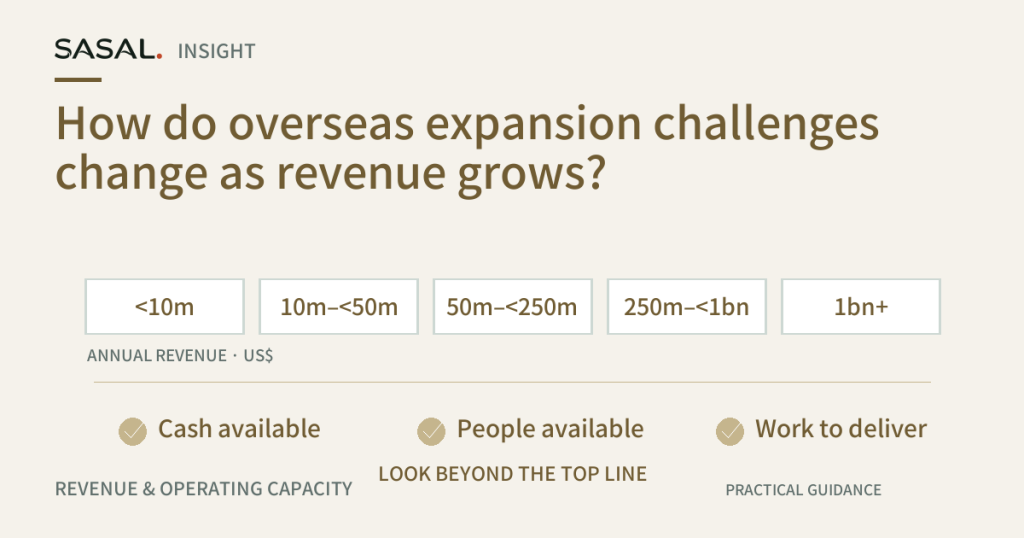
Annual revenue is often used as a shorthand for business scale, but it does not determine whether a company should expand internationally or whether it can do so successfully. This article uses five editorial illustrative revenue bands as a practical way to examine capacity questions that leadership teams may encounter while pursuing opportunities beyond their home market. The bands are not official business categories, and they do not prescribe when expansion should begin. A company may face concerns in any of these bands depending on its structure, customer mix, margins, cash timing, ownership and operating model. The goal is to locate the current bottleneck and identify the next capability worth strengthening, rather than treating revenue as a readiness score.
Use annual revenue as an entry point, not a readiness verdict
Revenue can be a useful starting point because it often reflects the amount of activity a company coordinates, but it is not a verdict on expansion readiness. A business with annual revenue below US$10 million may already serve customers in several markets and have a disciplined operating model. Another company with revenue above US$1 billion may still struggle to align decision making across functions and locations. The five revenue bands used in this article are editorial illustrations that help organize questions about capacity, ownership and execution. They are not growth stages, official definitions or recommended targets. Their value comes from helping leaders identify where responsibility is concentrated and what kind of organizational support may be needed next.
When leaders discuss overseas expansion, the most productive question is often not whether a company belongs in a particular revenue band but which constraint currently limits progress. In some organizations, a founder personally handles key customer conversations, partner relationships and major decisions. In others, the challenge is coordinating multiple departments that all influence delivery. Revenue can provide clues about where such issues may emerge, yet the actual bottleneck depends on how work is organized. The same revenue level can support very different operating realities. A capacity-focused review therefore examines decision ownership, workload concentration, continuity risks and execution demands before drawing conclusions from financial scale alone.
The boundaries in this article should also be read as overlapping areas of investigation rather than sequential milestones. A company with annual revenue of US$30 million may still rely heavily on one individual for overseas opportunities, while a company with lower revenue may already use documented processes and distributed authority. Likewise, concerns about governance, handoffs or regional coordination can appear earlier than expected if expansion activity accelerates. The practical benefit of the revenue-band approach is that it encourages structured observation. Instead of asking whether the business is large enough, leadership teams can ask which capabilities are reusable, which responsibilities remain dependent on individuals and which activities require new preparation before growth continues.
A useful exercise is to map current overseas work against the people responsible for advancing it. Include market learning, customer discussions, contracting, delivery, support and internal approvals. Then examine where delays, uncertainty or repeated escalation occur. This shifts attention from abstract ideas of readiness to observable operating constraints. The result may reveal that the next requirement is not a larger budget, a new country or additional market research. It may instead be a clearer handoff process, more defined ownership or dedicated time from a function already carrying too many responsibilities. Those findings create a more actionable basis for expansion decisions than revenue alone.
A practical extension of the capacity review is to separate activities that can be reused across markets from activities that require new preparation. The source material notes the value of distinguishing reusable capabilities from new preparation, and this can be applied directly to overseas work. For example, leadership can inventory current customer-development methods, contract-review practices, reporting routines and delivery processes, then identify which already operate consistently and which would need adaptation for an additional country, customer group or channel. This exercise helps explain why two companies with similar revenue may face different constraints. One organization may already have documented ownership and shared records, allowing work to transfer between people. Another may still depend on informal coordination even at a larger scale. Recommendation: assign an owner to each major overseas activity and record whether that activity is currently repeatable, dependent on a specific individual or still being designed. The objective is not to create a maturity score. It is to identify where expansion work would stop if demand increased or responsibilities shifted. By connecting ownership, continuity and reusability, leaders gain a clearer view of which capability is most likely to remove the next bottleneck.
- Revenue bandUse scale as an entry point for questions, not a readiness score.
- Capacity reviewExamine ownership, workload, coordination and continuity.
- Current bottleneckIdentify the factor most limiting overseas progress.
- Next capabilityStrengthen the capability that removes the constraint.
Compare the same business perimeter and separate revenue from cash

Before comparing companies by annual revenue, ensure the reporting perimeter and period are consistent. A group-level figure and a single subsidiary figure can describe very different businesses. Likewise, comparing different reporting periods may create misleading impressions about scale. Revenue is most useful when it refers to a clearly defined company or group over a consistent period. Even then, it remains only one indicator. It does not reveal profit, cash availability, debt obligations, project funding capacity or management attention. Expansion decisions become clearer when leaders understand exactly what the reported revenue represents and what important factors it does not capture.
Revenue should also be separated from cash. Overseas expansion often requires commitments that occur before customer payments arrive. Internal staff time, coordination effort, specialist support and operational preparation can all consume resources regardless of when revenue is recognized. A company may report healthy sales while experiencing significant pressure on available cash because payment timing, inventory commitments or receivables create funding demands. Conversely, another company with similar revenue may have stronger cash availability because of different commercial arrangements. Understanding these distinctions helps explain why two businesses at the same revenue level can make very different expansion choices without either decision being inherently more ambitious or more conservative.
Consider a hypothetical company reporting annual revenue of US$30 million. One version of the business sells services with relatively predictable payment timing and maintains substantial flexibility in allocating management attention. Another version reports the same revenue but supports larger delivery commitments that require significant working-capital planning before customer payments are received. The revenue figure is identical, yet the overseas constraint differs. The first company may be limited by leadership bandwidth and customer-development capacity. The second may be more concerned with execution risk and funding commitments associated with growth. Treating both companies as equally positioned for expansion simply because they share a revenue number would overlook important operating realities.
For expansion planning, it is therefore helpful to track several views simultaneously. Revenue indicates commercial scale. Cash planning helps assess funding capacity. Resource mapping shows who performs critical work. Decision ownership clarifies who can approve commitments. Looking across these dimensions often reveals a more accurate picture than any single measure. Teams can then link spending, preparation and staffing choices to the next decision they need to make, rather than assuming revenue growth automatically creates expansion capacity. This approach supports more grounded discussions about priorities and avoids confusing business size with organizational readiness.
Another useful planning view is to connect anticipated expansion activities to both internal effort and external spending before commitments are made. The source material emphasizes budgeting for outsourced work together with the work delivered by the company’s own team and tracking accounting expense separately from cash movement. Applied to expansion decisions, this means mapping research, customer discussions, coordination, approvals, delivery preparation and after-sales support alongside any specialist or external services. A hypothetical example could involve two companies with identical revenue considering the same overseas opportunity. If one company relies heavily on existing staff who already support current customers, its constraint may be management attention rather than reported sales. The other may face greater pressure from payment timing and operational commitments. Recommendation: review major expansion tasks and identify whether each primarily consumes cash, staff time or decision-making capacity. This creates a more complete picture than revenue alone because some constraints appear first in workload while others appear in funding requirements. Linking activities to resource demands also supports clearer allocation decisions by showing which proposed actions answer a specific operational question and which simply add work without addressing the current limitation.
Below US$10 million: examine dependence on a few key people
In the illustrative band below US$10 million in annual revenue, one useful question is whether overseas activity depends on a very small number of people. This is not a claim that all companies at this scale operate the same way. Some have mature processes and distributed responsibilities. Others rely heavily on founders or a small leadership group. When expansion opportunities emerge, these individuals may simultaneously manage sales, partnerships, product decisions and operational oversight. The issue is not company size itself. The issue is whether important knowledge, customer relationships and approvals remain concentrated in ways that limit sustainable growth or create continuity risks if priorities suddenly change.
Founder involvement can be a significant advantage during early expansion efforts. Customers, partners and employees often benefit from direct access to decision makers who understand the business deeply. Problems arise when every important action requires the same person. A founder may become the default owner of market research, customer discussions, contract review and strategic choices, causing opportunities to compete with existing responsibilities. In that situation, expansion is constrained less by market demand and more by available attention. Reviewing where decisions originate, how information is recorded and whether another person could continue the work provides a practical way to assess capacity without assuming that additional hiring is automatically required.
A useful method is to list the recurring activities needed to support an overseas initiative and identify both the performer and the decision owner for each task. Include customer communication, proposal preparation, delivery coordination, financial review and follow-up support. The objective is not to create bureaucracy but to reveal where a single absence could halt progress. If one person carries multiple responsibilities, leadership can decide whether documentation, training, outsourcing or role clarification would improve resilience. Small organizations often benefit from making ownership visible early because expansion work tends to introduce new coordination requirements before additional resources become available.
Another consideration is preserving the existing business while exploring opportunities elsewhere. A company may receive encouraging overseas enquiries yet still depend on a small team to serve established customers in its home market. In that context, the question is not simply how to pursue growth but how to allocate capacity without weakening current commitments. Leaders can define which responsibilities must remain protected, which activities can be delegated and which expansion tasks are exploratory rather than operational. This distinction helps prevent a promising international initiative from disrupting the revenue base that currently supports the company.
A further practical check at this scale is to test whether overseas work could continue if a key person became unavailable for a limited period. The source material highlights identifying who performs each task and who decides, as well as maintaining records that allow another person to understand what remains open. A hypothetical exercise is to select one active overseas opportunity and trace every responsibility attached to it, including customer communication, pricing discussions, approvals, delivery coordination and follow-up. Then note where information exists, who can access it and who could act if the primary owner were absent. Recommendation: where a single individual performs and decides multiple critical activities, document the current status, decision criteria and next actions in a shared location. This does not require additional management layers. Its purpose is continuity. Small organizations often gain resilience by making existing knowledge visible rather than by immediately adding headcount. The review can also reveal which responsibilities truly require senior involvement and which could be delegated with agreed criteria. That distinction helps preserve founder or leadership attention for decisions that genuinely need it while reducing avoidable bottlenecks in day-to-day expansion work.
US$10 million to below US$50 million: turn individual effort into a team process
In the illustrative revenue band from US$10 million to below US$50 million, a common question is whether overseas activity still depends on an individual champion. The issue is not that one person leads the effort. Leadership ownership can be valuable. The concern is whether customer conversations, market learning, proposal development and internal decisions remain difficult to transfer when that person becomes unavailable. If early international progress depends on persistence and personal relationships, the company can identify which activities need to become transferable. As opportunities increase, however, the organization benefits from making those activities visible and repeatable. The practical objective is not to reduce initiative. It is to ensure that expansion work can continue without depending entirely on one person’s memory, availability or informal network.
A useful review starts by tracing how an overseas opportunity moves through the business. Identify who researches the target market, who speaks with prospective customers, who approves commitments and who coordinates delivery. Many organizations find that information is scattered across email threads, meetings and individual notes. This can slow progress when additional employees become involved. Rather than immediately adding management layers, teams can document decision points, define ownership and create shared records. The goal is to support handoffs. When responsibilities become easier to understand, a company gains the ability to involve sales, operations, finance or product specialists without requiring constant intervention from the original project sponsor.
Consider a hypothetical company with annual revenue of US$30 million. One employee has developed several promising overseas relationships and is widely viewed as the person who understands the initiative. Growth appears encouraging, yet every important question still returns to that individual. If a customer asks for clarification, a contract requires review or a delivery issue emerges, others hesitate to act. The challenge is not revenue size. The challenge is organizational dependence. A constructive next step may be creating shared customer histories, assigning defined owners for recurring tasks and establishing review routines. These changes help convert individual effort into a process that more people can support without weakening accountability.
This transition also affects spending decisions. When leaders consider travel, research, specialist support or hiring, it becomes easier to evaluate those commitments if they are linked to a documented process. Instead of funding activity because a champion believes it is important, the business can connect each allocation to a specific decision or operating requirement. That discipline improves continuity and learning. It also helps leadership distinguish exploratory work from ongoing responsibilities. Companies at this scale often gain more from strengthening coordination and ownership than from immediately pursuing a wider geographic footprint. The next capability is frequently a reliable handoff mechanism rather than a larger expansion plan.
As organizations move from individual-led efforts toward team-supported execution, it can be helpful to define a standard path for overseas opportunities before expanding the number of initiatives. The article already discusses documenting handoffs; an additional step is to identify the evidence needed at each decision point. The source material recommends linking expenses to the next decision, which can also be applied to coordination. Recommendation: for each opportunity, record the question being evaluated, the person responsible for gathering information and the person authorized to decide what happens next. A hypothetical company in this revenue band may discover that research, travel, specialist advice or customer meetings are occurring without a shared view of what decision those activities are intended to support. Clarifying that connection improves learning and reduces dependence on informal updates from a single champion. It also helps new participants contribute because they can see the purpose of the work rather than only the activity itself. Over time, the organization develops a repeatable process in which customer history, assumptions, approvals and outcomes remain visible across functions. That continuity supports growth without requiring every issue to be routed back through the original overseas lead.
US$50 million to below US$250 million: coordinate capacity across functions
For the illustrative band from US$50 million to below US$250 million, this section examines coordination across functions as one possible constraint, rather than a stage every company must pass through. Sales activity may be progressing, but customer commitments increasingly depend on product, operations, logistics, finance, quality and support teams. A useful question is whether these groups share the same view of priorities and capacity. Expansion can stall even when demand appears promising if critical functions are making different assumptions about timing, ownership or resource availability. The challenge is rarely solved by asking one department to work harder. It usually requires clearer coordination of responsibilities that already span multiple parts of the organization.
As overseas work expands, leadership teams can benefit from separating learning activities from execution activities. Researching a new target market, evaluating customer requirements and testing commercial assumptions may require different resources from operating an established business. When these activities compete for the same people, progress becomes difficult to interpret. A delay may reflect uncertainty about the opportunity, a shortage of operational capacity or both. Creating visibility around who is learning, who is delivering and who is deciding helps the organization allocate resources more deliberately. This approach also preserves flexibility because learning can continue without automatically committing the business to a larger operational footprint.
A practical method is to map overseas responsibilities across functions and identify where capacity constraints appear first. One team may be able to support additional customer conversations while another struggles to review contracts, manage inventory implications or coordinate after-sales obligations. The most important bottleneck is not always customer acquisition. In some cases, support functions determine how much additional activity the business can absorb. Looking at the entire chain of work helps leadership avoid solving the wrong problem. Expansion decisions become more effective when the organization understands which capability limits progress and whether that constraint can be relieved through process changes, reassignment or targeted support.
Companies in this range may also face decisions about how broadly to pursue opportunities. Several countries, customer groups or channels can appear attractive at the same time. The temptation is to advance all of them simultaneously. Yet capacity is still finite, even in a larger organization. Focusing resources where learning and execution can reinforce each other often produces clearer results. Teams can identify which capabilities transfer across opportunities and which require new preparation. This allows leadership to allocate people and funding intentionally while retaining the option to expand further once evidence and capacity support the next commitment.
When overseas activity spans several functions, a useful addition to capacity mapping is to distinguish learning responsibilities from execution responsibilities. The source material notes that learning and execution can be allocated separately to retain options, and this distinction can clarify why expansion slows. A hypothetical example might involve a sales team generating strong customer interest while operations, finance or support teams are still assessing the implications of delivery. If all of these activities are treated as one combined workload, leaders may struggle to identify whether the bottleneck lies in market uncertainty or operational capacity. Recommendation: create a cross-functional review that records which teams are gathering information, which teams are supporting current delivery and which decisions depend on their input. This approach helps reveal whether the next constraint sits in customer development, contract review, inventory planning, support obligations or another area of execution. It also supports more deliberate allocation of people and funding because leadership can see where additional work would reinforce existing priorities and where it would create competing demands. The result is a clearer connection between expansion opportunities and the capabilities required to support them sustainably.
- Market learningResearch, customer feedback and opportunity assessment inform priorities.
- Decision layerLeaders allocate people, funding and authority based on evidence.
- Execution functionsSales, operations, product and delivery teams perform the work.
- Support systemsFinance, quality, legal and reporting sustain ongoing activity.
US$250 million to below US$1 billion: manage competing regional demands
For the illustrative band from US$250 million to below US$1 billion, a useful issue to examine is competing demand across a portfolio, where multiple activities already exist. Different regional operations, customer groups or growth initiatives may all present credible cases for additional support. The question becomes less about launching an overseas effort and more about allocating finite organizational attention. A proposal can be attractive on its own merits while still competing with other opportunities for the same people, funding and management focus. Leadership teams therefore benefit from examining expansion decisions within the context of the wider portfolio rather than evaluating each initiative in isolation.
At this scale, regional priorities can overlap in ways that create hidden coordination burdens. Technical specialists, product experts, commercial leaders and support functions may be shared across several initiatives. One region’s growth plan can affect another region’s ability to execute. A useful review examines which resources are genuinely dedicated and which are already supporting multiple commitments. Mapping these dependencies often reveals that the limiting factor is not market interest but access to specialized capabilities. Understanding those relationships helps leaders avoid overcommitting shared teams and improves the quality of allocation decisions across the organization.
Decision processes also become more important because proposals may require support from several functions before they can proceed. The challenge is not bureaucracy for its own sake. The challenge is ensuring that investments, operational changes and customer commitments remain aligned. A proposal for additional expansion may depend on evidence gathered by one team, implementation support from another and approval from a separate leadership group. Clarifying how those elements connect helps reduce delays and misunderstandings. It also creates a more transparent basis for comparing alternatives when multiple regions request resources at the same time.
A practical next step is to create a portfolio review that links each expansion proposal to the capability it requires, the decision it supports and the resources it may displace. This approach shifts discussion away from which region argues most persuasively and toward which allocation best fits current priorities and capacity. Some initiatives may proceed, others may continue learning and some may pause without being rejected. The objective is not to maximize the number of active projects. It is to direct organizational effort where it can be supported consistently while preserving flexibility for future opportunities as conditions change.
At this scale, portfolio decisions often benefit from a common description of resource requirements across regions. The source material emphasizes connecting evidence to investment approvals and aligning regional and local responsibilities. Applied practically, this means evaluating proposals not only by expected opportunity but also by the specialist support, leadership attention and shared capabilities they require. A hypothetical situation could involve several regions requesting assistance from the same product experts, legal specialists or operational teams. Each proposal may appear reasonable when reviewed independently, yet the combined demand may exceed available capacity. Recommendation: require expansion proposals to identify the shared resources they depend on, the decision they are intended to support and any existing commitments those resources already carry. This makes tradeoffs more visible and helps leadership compare alternatives on a consistent basis. It also reduces the risk that one initiative proceeds without recognizing its effect on other regions. By linking regional requests to organizational dependencies, companies can allocate support more transparently, continue learning where evidence is still developing and focus execution resources where commitments can be sustained across the wider portfolio.
US$1 billion and above: connect group decisions with local action

The illustrative band of US$1 billion and above highlights coordination complexity as one possible issue. Resource scarcity can remain important at this scale too. This does not mean capacity is unlimited, nor does it imply that every large organization faces the same challenges. A common area to examine is how decisions move between group leadership, regional structures and local operating teams. Expansion opportunities may involve existing products, new customer groups or additional countries, yet progress can slow when authority, accountability and information are not aligned. The practical question becomes whether the people closest to customers can act quickly enough while still operating within the governance expectations of the wider organization. Revenue scale alone does not resolve that tension.
Large organizations frequently possess specialist knowledge across legal, finance, product, operations and market functions. The challenge is often connecting that expertise to decisions that can be accepted across departments and locations. A proposal may appear attractive to a local team because it addresses a customer need, while group leadership requires additional evidence before approving investment or policy changes. Neither perspective is necessarily wrong. The expansion constraint may instead be the process used to reconcile them. Reviewing who prepares evidence, who approves commitments and how local experience influences group decisions can reveal whether delays originate from risk management, unclear ownership or fragmented communication rather than from the opportunity itself.
A useful assessment focuses on decision rights and continuity. For example, a hypothetical business operating across several regions may discover that customer-facing teams can identify opportunities rapidly but must repeatedly escalate routine commercial decisions. Another organization may have extensive delegated authority yet lack common reporting definitions, making it difficult to compare performance across locations. In both cases, the next capability is not necessarily more market research or a larger budget. It may be a clearer authority framework, shared performance definitions or a process that allows local teams to act within agreed boundaries while maintaining group oversight and visibility.
At this scale, overseas expansion can also involve overlapping initiatives across multiple markets at the same time. Portfolio allocation becomes important because leadership attention, technical specialists and implementation resources remain finite even in very large organizations. Teams benefit from distinguishing reusable capabilities from location-specific preparation and from documenting how learning moves across the group. The objective is to ensure that local action contributes to broader organizational knowledge rather than remaining isolated within one operation. When governance and execution reinforce each other, expansion decisions become easier to evaluate and sustain over time despite the complexity that accompanies larger organizational footprints.
The same US$30 million revenue can hide very different constraints
A company reporting US$30 million in annual revenue may appear straightforward to categorize, yet the figure alone says little about the people and organizational capacity available for expansion. One business may have a profitable offer but concentrate customer relationships and decisions in a small leadership team. Another may have more departments while much of their capacity is already committed to existing customers. Available cash also matters, and collection timing can be one factor in that availability, but it is not a rule attached to a revenue band. For this comparison, the main task is to identify who can take on the overseas work, which responsibilities can be shared and what resources are genuinely uncommitted.
Consider two hypothetical firms with the same annual revenue. The first has healthy margins but depends heavily on one executive who manages key customer relationships, partner discussions and major approvals. Its immediate concern is leadership bandwidth and continuity. The second has a broader management structure but thinner margins, while the functions needed for overseas delivery are fully occupied with domestic commitments. Its immediate concern is agreeing priorities and creating room in the existing delivery schedule before promising additional work. Neither situation is visible from revenue alone. The firms may therefore need different support: one may benefit from clearer delegation and handovers, while the other may need a coordinated resource plan and a narrower initial scope.
The distinction matters because the next organizational investment should address the actual constraint. If leadership attention is limiting progress, documenting responsibilities, creating handoff processes or distributing customer ownership may have more impact than adding another market initiative. If delivery commitments are the primary pressure, management may need stronger planning around obligations, resource allocation and funding timing before increasing expansion activity. In both cases, the decision concerns capability development rather than simply spending more. Revenue provides context, but understanding the relationship between commitments, people and available capacity produces a more actionable picture of what the organization can sustain.
When reviewing a business at this scale, it is often helpful to compare the work required for overseas activity with the work already supporting existing customers. Map research, customer development, contracting, delivery, support and internal coordination responsibilities. Then identify where delays occur and why. The answer may reveal that expansion is constrained by one recurring issue rather than by overall company size. Leadership teams can then define the next capability to strengthen and assign ownership for it. This approach creates a practical basis for decision making and avoids drawing broad conclusions from revenue figures that may conceal very different operating realities.
Find the bottleneck before choosing the next capability
The most useful outcome of a revenue-band comparison is not deciding which band describes the company. It is identifying the constraint that currently limits overseas progress. Businesses often respond to expansion challenges by adding activities, pursuing more opportunities or commissioning additional research. Those actions can be valuable, but they may not address the underlying bottleneck. A company dependent on a single decision maker, for example, gains little from generating more leads if approvals remain delayed. Another company may have customer interest but struggle to coordinate execution across departments. The practical objective is to locate the point where work consistently slows, accumulates or requires repeated escalation, then focus improvement efforts there rather than everywhere at once.
One method is to trace a potential overseas opportunity from initial learning through execution. Include market investigation, internal review, customer discussions, contracting, delivery and ongoing support. For each stage, identify who performs the work, who approves the next step and what information is required. Patterns often emerge quickly. Delays may cluster around a particular function, a recurring approval requirement or an overloaded individual. Once the constraint is visible, leadership can evaluate whether the next capability should involve delegation, documentation, coordination routines, additional staffing or clearer decision criteria. The goal is not organizational complexity but smoother movement from opportunity to action.
A second consideration is protecting the existing business while allocating capacity to growth. Expansion work competes with current commitments for attention, specialist knowledge and management time. If leaders focus only on new opportunities, service quality or delivery reliability can suffer. Reviewing both existing obligations and expansion demands on the same map helps reveal tradeoffs that might otherwise remain hidden. Capacity allocation then becomes a deliberate choice rather than an unintended consequence of enthusiasm. This perspective is especially useful because businesses in any revenue band can experience shortages of attention even when financial resources appear sufficient.
The next capability should therefore be selected according to the bottleneck it removes. Some companies benefit most from clearer authority and handoff structures. Others need stronger cross-functional coordination, better continuity planning or more disciplined allocation of specialist resources. The appropriate answer depends on the observed constraint, not on revenue level alone. By connecting capacity decisions to specific operational obstacles, leadership teams can build expansion support that reflects how the organization actually works. That approach encourages steady progress, preserves flexibility and helps ensure that future growth rests on capabilities that can be repeated rather than on temporary individual effort.
- Map the workTrace learning, approvals, delivery and support responsibilities.
- Locate delaysIdentify recurring escalation points or overloaded owners.
- Define constraintDescribe the specific factor limiting progress.
- Choose capabilityInvest in the capability that removes the constraint.
Assign capacity without weakening the existing business
A common expansion mistake is treating overseas work as an addition that will somehow fit around existing responsibilities. In practice, every market investigation, customer discussion, contract review and delivery commitment competes with work already supporting current revenue. The capacity question changes across the illustrative revenue bands, but the underlying decision remains similar: which activities deserve protected attention and which responsibilities can be reassigned without reducing service quality elsewhere. Revenue size alone does not answer that question. A company with substantial sales may still have limited available capacity, while a smaller organization with focused operations may have more room to experiment. The practical task is to identify which commitments are already consuming critical people and which expansion activities require dedicated ownership.
One useful approach is to separate learning work from execution work. Learning includes customer interviews, market investigation and testing assumptions. Execution includes delivering products or services, supporting customers and maintaining operational commitments. When these activities are blended together, leadership teams can struggle to see where capacity is actually being consumed. A company may believe it is underinvesting in expansion when the real issue is that the same individuals are expected to manage both exploration and delivery. By distinguishing the two categories, managers can allocate time more deliberately and preserve options. This also makes it easier to decide whether additional support should strengthen research, operational delivery or coordination rather than assuming all capacity shortages are identical.
Consider two hypothetical firms with annual revenue of US$30 million. One has relatively flexible staffing and predictable customer commitments. The other must coordinate inventory, receivables and operational delivery that require close oversight. Although the revenue figure is identical, the expansion bottleneck may differ substantially. The first company may need clearer ownership of overseas opportunities. The second may need stronger cross-functional coordination before taking on additional commitments. Looking only at revenue could suggest similar capacity. Examining actual workload, decision ownership and timing reveals a different picture. This is why capacity planning should begin with operational realities rather than assumptions tied to a particular revenue band or perceived stage of development.
The objective is not to build the largest possible overseas initiative. It is to allocate resources in a way that protects the existing business while creating room for growth. Leadership teams can review which activities generate current obligations, which activities support future opportunities and which individuals are carrying both categories simultaneously. From there, they can choose the next organizational capability to strengthen. That capability might be a project owner, a clearer approval process, a documented handoff or a shared reporting structure. The correct choice depends on the current bottleneck rather than on annual revenue alone.
- Learning workResearch, customer discovery and testing assumptions before larger commitments.
- Execution workDelivery, support and operational obligations tied to current customers.
- Shared ownersThe same people cover both areas, creating potential bottlenecks.
- Dedicated ownershipResponsibilities are allocated so growth work does not weaken existing delivery.
Build continuity as the overseas work grows
As overseas activity expands, continuity becomes increasingly important. Early progress often depends on a small number of motivated individuals who maintain customer relationships and coordinate decisions. Over time, however, reliance on personal memory and informal communication creates risk. Continuity does not require a large organization. It requires making information, responsibilities and decisions visible enough that another person can understand the current situation when priorities change, staff members are absent or responsibilities shift. This issue can appear in any revenue band. Even very large organizations can experience delays if information is fragmented across departments, regions or reporting structures.
A practical starting point is agreeing who performs each task and who decides when exceptions occur. Overseas business often involves sales, operations, finance, logistics, legal review and customer support. When ownership is unclear, teams may repeatedly escalate routine issues or wait for unavailable decision makers. Clear authority helps maintain responsiveness while preserving oversight. The goal is not to centralize every decision. Instead, it is to define which actions can be handled locally, which require broader approval and how unresolved issues are escalated. This clarity supports continuity because work can continue even when specific individuals are unavailable or priorities shift temporarily.
Shared reporting also contributes to continuity. Different teams may interpret performance indicators differently unless definitions are agreed in advance. A report of sales activity, for example, may refer to different stages of customer progress depending on the function preparing it. Consistent records allow managers to understand what has happened, what remains unresolved and where action is required. This becomes particularly important when expansion activity spans multiple departments or locations. Continuity improves when information is recorded in a form that another responsible person can review and use without needing extensive informal explanations from the original owner.
At larger scales, continuity also supports governance. Leadership teams need confidence that delegated authority aligns with business objectives and that local actions remain visible to the wider organization. Effective continuity therefore connects operational execution with reporting, decision rights and accountability. Rather than waiting until overseas operations become complex, companies can strengthen continuity gradually by documenting responsibilities, clarifying authority and improving shared visibility. These steps help preserve momentum during growth and reduce dependence on any single individual regardless of company revenue.
Turn the revenue-band comparison into a practical support brief
The revenue bands in this article are intended as prompts for investigation rather than classifications. A practical support brief begins by identifying the current constraint that is limiting overseas progress. For some businesses, that constraint may be founder bandwidth. For others, it may involve cross-functional coordination, competing regional priorities or governance complexity. The purpose of the comparison is not to determine where the company belongs. It is to reveal which capability should be strengthened next. A useful brief therefore summarizes the expansion objective, the current bottleneck and the evidence supporting that assessment. This creates a more actionable foundation than broad assumptions about scale or organizational maturity.
The next step is linking proposed actions to decisions. Additional spending, hiring, external support or process changes should each answer a specific question or remove a clearly identified constraint. Rather than funding activities because they seem generally useful, leadership teams can define what outcome will become possible if the capability is strengthened. This approach encourages disciplined allocation of people and resources. It also makes alternatives easier to compare because each proposal is connected to a decision rather than treated as a stand-alone initiative. Expansion planning becomes more transparent when effort, ownership and expected outcomes are described in the same document.
External support can also be evaluated through this lens. The most useful contribution is often not simply providing information but helping connect evidence to decisions that must be accepted across the organization. A support brief can therefore specify who will use the work, what decision is being considered and how the findings will influence allocation choices. This reduces ambiguity and helps ensure that research, analysis or coordination activities contribute directly to the next decision rather than creating additional reports with unclear ownership or purpose.
Once prepared, the brief can be reviewed periodically as conditions change. Revenue may grow, customer demand may shift or organizational responsibilities may evolve. The same company can move from one bottleneck to another without changing revenue bands at all. Regular review keeps attention focused on the constraint that matters now rather than the one that mattered previously. Used in this way, the revenue-band framework becomes a practical diagnostic tool that supports better allocation decisions and more sustainable overseas growth.