

Listed or private: what changes when expanding overseas?
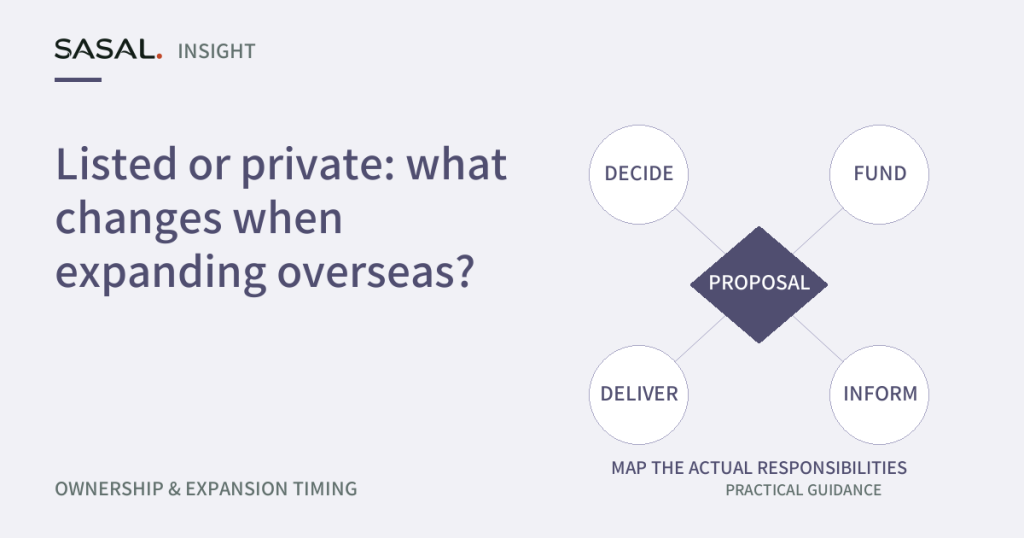
Companies often ask whether overseas expansion becomes easier or harder once a business is listed. The more useful question is what changes in the decision process. Listing status can influence who must be informed, how evidence is reviewed and how internal coordination is organized, but it does not create customer demand, operating capacity or delivery readiness by itself. A private company may face extensive board, lender or parent-company oversight, while a listed company may have clearly delegated authority for bounded decisions. This article focuses on governance and coordination rather than securities compliance. The aim is to help leadership teams separate market evidence, approval requirements and execution readiness so expansion timing is chosen on the basis of real conditions rather than assumptions attached to a corporate label.
Listing status changes the coordination problem, not the customer need
When evaluating an overseas opportunity, the customer problem should remain the starting point regardless of ownership structure. A buyer may consider listing status when assessing a supplier, but that status does not establish a need for the offer. Uncertainty about demand also remains when a company is privately owned. Governance affects how decisions are reviewed and communicated, not whether the underlying commercial opportunity exists. For that reason, teams benefit from separating evidence about customers from evidence about internal readiness. Customer interviews, enquiries, trials and purchasing discussions answer one set of questions. Internal approvals, funding allocation and reporting obligations answer another. Treating them as distinct workstreams prevents organizational activity from being mistaken for market validation.
A common planning mistake is to assume that listing status predicts the quality of an expansion opportunity. In practice, two companies can examine the same overseas proposal and reach different conclusions because their governance arrangements differ, even when the market evidence is identical. One organization may require several functions to review assumptions before resources are committed. Another may permit a smaller leadership group to approve an initial investigation. Neither approach proves that the opportunity is stronger or weaker. The useful comparison is whether the chosen process helps the company evaluate risk, coordinate responsibilities and preserve accountability while still learning enough about customers to support the next decision.
Consider a hypothetical software provider receiving enquiries from buyers outside its home market. The enquiries are facts. The interpretation that they represent broader demand remains a hypothesis requiring further investigation. Whether the company is listed or private, leadership still needs to determine what the enquiries reveal and what remains unknown. The team might review who made contact, what problem they described, how purchasing decisions are made and what evidence would justify additional investment. Governance enters the picture when deciding who authorizes research, who allocates funding and who communicates progress internally. Those activities support the decision process but do not replace market learning.
Timing decisions become clearer when expansion is viewed as a coordination challenge rather than a status question. A company may delay action because key decision-makers are occupied with another priority, because evidence is incomplete or because delivery capability is not yet ready. Those constraints can appear in both listed and private businesses. Instead of asking whether one category is inherently faster or more credible, map the actual approval path and identify what information each participant requires. The resulting discussion becomes more practical. Teams can focus on removing uncertainty, clarifying responsibilities and selecting a decision point that matches the organization’s capacity to review, approve and execute the proposal.
Map who can decide, fund, operate and communicate

An overseas initiative often involves more participants than the initial business case suggests. Someone may approve spending, another group may deliver the work, a different function may communicate with stakeholders and local personnel may manage customer interactions. Confusion arises when these responsibilities remain implicit. A practical first step is to identify who decides, who provides resources, who carries operational responsibility and who manages communications. This exercise is useful in listed and private organizations alike because formal ownership labels rarely explain how decisions actually move. The resulting map can reveal approval bottlenecks, missing owners or areas where authority has not been clearly delegated.
The same review should distinguish market evidence from approval authority. A team gathering customer information may be able to recommend action without possessing authority to commit funding. Conversely, a decision-maker may approve a budget while depending on specialists for the underlying analysis. Clarifying these distinctions helps proposals reach the appropriate forum with the right information attached. It also reduces the risk that people assume someone else is responsible for an unresolved issue. When expansion discussions cross headquarters and local operations, documenting responsibilities becomes even more valuable because participants may be working across different functions, reporting lines or geographic locations while contributing to the same initiative.
A useful planning method is to connect each proposed expense to the next decision rather than treating all preparation activities as equally important. Research, hiring, external advice or pilot activity should be linked to a specific question that management needs answered. If the purpose of an expenditure is unclear, approval discussions often become longer because participants evaluate different objectives. By contrast, a proposal that explains the evidence sought, the decision it informs and the owner responsible for review is easier to assess. This approach supports disciplined learning without requiring arbitrary deadlines or assumptions about how quickly an organization should move.
In larger organizations, external specialists can contribute to overseas initiatives, but responsibility for decisions remains internal. Advisors may provide market evidence, comparisons or coordination support that helps different functions evaluate a proposal consistently. Their work becomes more valuable when the intended decision forum is identified in advance. For example, an investment committee, regional leadership group or subsidiary review process may each require different forms of evidence. Understanding who will use the information and for what purpose helps ensure that external input strengthens internal decision-making rather than creating additional layers of uncertainty.
- Market evidenceCollect facts and test customer hypotheses relevant to the opportunity.
- Decision reviewConfirm who has authority to approve funding or further investigation.
- Operating readinessCheck people, processes and delivery responsibilities needed to execute.
- Communication planIdentify who must receive updates and how information will be shared.
Look beyond the label: four possible ownership settings
Discussions about listed and private companies often overlook the variety of governance arrangements that exist within each category. A more useful framework is to examine the actual ownership and decision structure involved. Four useful examples to examine are a publicly listed company, a founder-owned private company, an investor-backed private company and a private subsidiary within a larger group. These are not the only possibilities, nor do they predict behavior by themselves. Their value lies in reminding decision-makers that authority, funding and reporting obligations can differ significantly even among organizations that share the same broad label. Understanding the specific arrangement provides better guidance than relying on stereotypes.
A publicly listed company may have formal review processes because multiple stakeholders require consistent information and accountability. At the same time, some listed businesses delegate bounded decisions to management teams so routine expansion activities do not require repeated escalation. The practical question is not whether the company is listed, but which decisions are delegated and under what conditions. Teams considering overseas initiatives should therefore identify the applicable approval path, communication responsibilities and review expectations rather than assuming a uniform process. Where uncertainty exists, the responsible internal functions and specialist advisers can help determine which requirements are relevant to the specific proposal being evaluated.
Founder-owned private businesses are often described as flexible, but flexibility depends on actual governance arrangements. A founder may centralize decisions, maintain detailed oversight of spending or require extensive evidence before authorizing new commitments. Investor-backed private companies can face additional reporting expectations linked to financing arrangements, board oversight or growth objectives. In both cases, overseas expansion competes with other priorities for leadership attention. A proposal that fits available decision capacity may progress smoothly, while one that requires extensive coordination may need to wait for a more suitable review window. The determining factor is organizational reality rather than a presumed private-company advantage.
Private subsidiaries provide another useful illustration. A local management team may appear operationally independent while still requiring approval from a parent organization for certain commitments. Authority can vary by spending level, contract type, hiring decision or strategic importance. As a result, an overseas proposal may need support from both local operators and group-level reviewers. Mapping these relationships early helps avoid delays caused by incomplete submissions or unclear ownership. Across all four governance settings, the transferable lesson is consistent: identify who decides, who funds, who operates and who communicates. Once those responsibilities are visible, expansion timing can be assessed using evidence, capacity and decision readiness rather than ownership labels alone.
Keep market evidence separate from corporate approval
Overseas proposals become easier to evaluate when market evidence and approval status are tracked separately. A leadership team may have strong authority to commit resources yet still possess limited evidence about customer demand. The opposite situation also occurs: customer interviews, enquiries and trials may provide useful signals while internal approval remains incomplete. Combining these questions can create confusion because participants start debating governance when the unresolved issue is actually market uncertainty. A practical approach is to maintain two records. One documents what has been observed in the target market, the sources used and the remaining hypotheses. The other records who must review the proposal, what decisions are pending and which conditions must be satisfied before resources are committed.
The distinction matters because facts and interpretations play different roles in decision-making. A series of meetings with prospective customers is an observable event. The conclusion that those meetings indicate broad demand remains an interpretation requiring further validation. Governance does not change that distinction. Whether the company is publicly listed, founder-owned, investor-backed or part of a larger group, decision-makers still need clarity about what evidence exists and what assumptions remain open. Recording source, timing, scope and method helps preserve reasoning as proposals move between departments or review forums. It also allows later reviewers to understand how conclusions were reached without repeating every previous discussion from the beginning.
A hypothetical example illustrates the difference. Imagine a manufacturer considering entry into a new target market. Several customers request demonstrations and technical discussions. The commercial team believes this justifies a larger commitment. Before agreeing, leadership can ask two separate questions. First, what have we actually learned about purchasing intent, delivery requirements and adoption barriers? Second, what approvals are required before people and funding are allocated? If evidence remains incomplete, a smaller validation activity may be approved even when a larger investment is deferred. The market uncertainty has not changed. What changes is the scale of the decision being requested and the evidence needed to support it.
Separating evidence from approval also improves review quality after activity begins. Teams can evaluate whether research, visits or trials answered the questions they were intended to address. If a key uncertainty remains unresolved, the next decision may be to narrow the proposal, gather additional information or pause further commitments. This creates a more disciplined process than treating every completed activity as proof that expansion should continue. The objective is not to slow progress. It is to ensure that each stage produces information useful for the next decision, while approval discussions remain focused on resource allocation, accountability and readiness rather than assumptions about demand.
Build a proposal that fits the actual decision forum
Many overseas initiatives struggle because the proposal is designed around what the project team wants to do rather than what the decision forum needs to evaluate. An investment committee, executive leadership group, board committee or parent-company review process may all require different information. Before preparing recommendations, identify who will use the proposal and what decision they are expected to make. Some forums authorize research. Others allocate operating resources or approve larger commitments. A proposal that matches the intended decision is easier to assess because participants can focus on the questions within their authority. This approach also reduces the risk of requesting broad approval when only a limited exploratory decision is currently justified.
The most useful proposals connect each requested expense to the next decision it enables. Research, customer interviews, technical reviews, hiring plans or pilot activities should not appear as isolated tasks. Instead, explain which uncertainty each activity addresses and how the results will influence future choices. If a smaller investigation can answer the same question as a larger commitment, decision-makers may prefer the narrower option while uncertainty remains high. This does not indicate a lack of ambition. It reflects a structured method for building evidence. By linking spending to learning, teams create a clearer path from observation to review, revision or expansion without assuming that every proposal requires immediate scaling.
A helpful way to organize the discussion is to separate three gates. The first concerns market evidence and asks whether the customer opportunity is sufficiently understood. The second concerns delegated authority and asks who can approve the next commitment. The third concerns readiness to deliver and asks whether the organization can execute successfully if approval is granted. Treating these as distinct questions prevents debates about operations from obscuring market uncertainty, or approval discussions from being mistaken for evidence of demand. The same proposal may pass one gate and fail another, which often suggests revising scope rather than abandoning the initiative entirely.
When external specialists contribute research or comparative analysis, their work should be connected to the forum that will use it. A market study intended for a regional management review may differ from one prepared for a group-level investment discussion. The objective is not to outsource judgment but to provide decision-makers with information suited to their responsibilities. Clarifying the audience in advance improves relevance and reduces unnecessary detail. It also helps internal teams explain why certain evidence was collected and how it supports a specific decision. As overseas initiatives become more complex, this alignment between evidence, proposal design and decision forum becomes increasingly valuable.
- Market evidenceWhat has been observed, what remains uncertain and which hypothesis is being tested next.
- Decision authorityIdentify who can approve funding, scope changes or further investigation.
- Delivery readinessConfirm people, processes and responsibilities needed if the proposal proceeds.
Align internal decisions and external communication responsibilities
Approval of an overseas initiative is only one part of coordination. Companies also need clarity about who communicates progress, who answers questions from different stakeholders and how information is shared across functions. Communication responsibilities can become more complex when multiple departments contribute evidence, funding or operational support. A proposal may be approved internally while updates still need to be coordinated among headquarters, local operations, finance teams and other participants. Defining these responsibilities early reduces the likelihood of conflicting messages and helps ensure that decisions remain connected to the evidence on which they were based. Good coordination depends as much on information flow as on formal authority.
A practical method is to map four responsibilities separately: who decides, who funds, who operates and who communicates. The same person or team may hold more than one role, but making the distinctions visible helps prevent gaps. For example, a local team might manage customer interactions while headquarters retains authority over larger commitments. Finance may monitor funding allocation without directing daily execution. Communication ownership becomes especially important when information moves across time zones or organizational boundaries. Participants can then understand not only what has been decided but also how updates, requests and concerns should be routed through the organization as conditions change.
Consider a hypothetical investor-backed private company preparing an overseas pilot while simultaneously evaluating a financing process. Neither activity automatically determines the correct timing of the other. However, both compete for management attention, review capacity and communication effort. Leadership may decide that market learning should continue while larger commitments wait for a clearer decision window. Alternatively, the pilot scope may be narrowed so evidence gathering continues without overloading the organization. The useful question is not whether financing or expansion should always come first. It is whether the business can support both streams of work while preserving decision quality, operational focus and clear communication among those involved.
Review points should also be communicated in advance. Teams benefit from knowing when progress will be assessed, what evidence will be examined and which outcomes could support proceeding, narrowing, waiting or revising the plan. This creates a shared expectation that decisions may evolve as new information becomes available. It also helps distinguish activity from achievement by focusing discussions on what the company has learned and what it can now decide. By aligning communication responsibilities with decision ownership, organizations improve continuity, reduce misunderstanding and create a more reliable basis for choosing expansion timing according to evidence, capacity and governance readiness.
Compare the same overseas proposal under two governance settings
Consider a hypothetical proposal to investigate demand for a specialized business service in a new target market. The proposed activity, customer uncertainty and expected learning are identical in both examples. In the first governance setting, the company is publicly listed and management must present the proposal through an established review process before resources are committed. In the second setting, the company is privately owned by a founder and a small board reviews the proposal. The important observation is that the customer question has not changed. Potential buyers still need to be identified, interviewed and understood. The same unknowns remain regarding purchasing priorities, delivery requirements and the evidence needed to justify a larger commitment later.
In the listed-company example, the proposal may need a clearer explanation of assumptions, responsibilities and communication plans because more stakeholders are involved in understanding why resources are being allocated. The team may prepare a document showing what has been observed, what remains uncertain and which next questions could influence future investment decisions. None of this proves that demand exists. It simply creates a structure through which decision-makers can evaluate whether learning is worth funding. If authority for exploratory work has already been delegated, management might proceed within agreed limits. If not, additional review may be required before the same market-learning activity can begin.
In the founder-owned example, fewer people may participate in the approval discussion, yet the proposal still benefits from discipline. A founder may ask how the research supports future decisions, what operational effort is required and whether current commitments leave enough capacity to act on any findings. The market uncertainty is exactly the same as in the listed-company case. The difference lies in how the decision is examined and documented. A smaller forum can sometimes simplify communication, but it can also concentrate responsibility in a limited number of individuals whose attention is divided across multiple priorities. Governance affects coordination effort, not the underlying customer reality.
The practical lesson is to compare governance settings while holding the opportunity constant. When teams confuse approval complexity with market attractiveness, they risk making poor timing decisions. A difficult approval process does not mean customers are uninterested, and a simple approval path does not validate demand. Useful proposals therefore separate evidence, authority and execution. They explain what has been learned, identify the next decision and show who will own delivery if the initiative proceeds. This comparison allows organizations with different governance arrangements to evaluate the same opportunity consistently. The focus remains on learning about customers while ensuring that internal decision processes are respected and clearly understood.
Plan business learning, approval and delivery on separate calendars
Overseas initiatives often slow down because different activities are forced onto a single timeline. Customer learning, internal approval and operational preparation each answer different questions and may move at different speeds. Business learning focuses on understanding buyers, testing assumptions and identifying what evidence could change a decision. Approval activity focuses on obtaining authorization from the people or forums responsible for allocating resources. Delivery preparation focuses on the practical work required if the opportunity progresses. Combining these into one schedule can create confusion because progress in one area does not automatically indicate readiness in the others. Separate calendars help leadership understand what has advanced and what still requires attention.
A useful method is to define the next decision before defining the next task. Research activities should be linked to questions that could affect investment choices. Approval milestones should identify who reviews findings and under what authority. Delivery milestones should clarify which functions must be ready if customers move forward. For example, customer interviews may continue while a proposal awaits review, or operational planning may begin before final expansion approval is granted. The value of separate calendars is visibility. Teams can see whether delays come from unresolved market questions, scheduling constraints within governance processes or practical delivery preparation rather than treating all delays as the same issue.
Hypothetically, a company may discover encouraging interest from prospective customers while still lacking approval to commit larger resources. In another situation, approval could be available but important customer questions remain unanswered. A third scenario may involve positive evidence and authorization, yet operational teams need time to prepare support processes. Each situation requires a different response. Reviewing them through separate calendars helps management decide whether to continue learning, narrow the proposal, pause activity or move toward implementation. This approach also improves communication because stakeholders can discuss facts within the correct context instead of assuming every milestone represents equal progress toward market entry.
Organizations benefit when review points are attached to decisions rather than arbitrary dates. Instead of requiring activity simply because time has passed, teams can revisit the proposal when specific evidence, approvals or readiness conditions have been met. This creates a clearer connection between effort and decision quality. It also supports more transparent discussion when circumstances change. New information may justify additional learning, revised delivery plans or a different level of commitment. By keeping business learning, approval work and operational preparation visible as distinct streams, companies gain a more accurate picture of readiness and can choose timing based on evidence and capacity rather than momentum alone.
- Business learningCollect evidence, test assumptions and identify remaining customer questions.
- Approval activityReview findings through the appropriate authority and funding process.
- Delivery preparationAssign operational owners and prepare execution responsibilities.
Consider expansion alongside financing or IPO preparation

Companies sometimes evaluate overseas expansion while also preparing for financing activity, ownership changes or an initial public offering. These situations create an additional coordination challenge because management attention becomes a shared resource. The key point is that neither expansion nor financing automatically takes priority. Both require evidence, planning and communication. Leadership teams therefore benefit from viewing them as competing workloads rather than assuming one should always happen before the other. An overseas proposal that appears attractive may still require adjustment if critical decision-makers are occupied with another major initiative. Conversely, a financing process does not eliminate the need to evaluate customer opportunities when credible evidence emerges.
A practical approach is to map dependencies and identify where the same individuals, committees or functions are needed. Finance teams, executives, legal specialists and operating leaders may all contribute to multiple initiatives at once. Understanding these overlaps helps determine whether a proposal should proceed unchanged, be narrowed to a smaller learning exercise or wait for a more suitable decision window. Importantly, delaying a larger commitment does not necessarily mean stopping all learning. Customer conversations, evidence collection and hypothesis refinement can continue if they remain aligned with available capacity and support a future decision. The objective is coordination, not inactivity.
The same principle applies to private companies seeking new financing and to listed companies managing significant corporate projects. Governance structures differ, but attention remains limited. A useful proposal therefore explains not only the opportunity but also the organizational effort required to evaluate it responsibly. Teams can compare proceeding, narrowing, waiting or declining using a common framework that considers evidence quality, resource needs and review capacity. This comparison reduces the temptation to treat expansion as an isolated initiative. Instead, it becomes one candidate for management attention among several important priorities competing for the same organizational resources.
When timing remains uncertain, narrowing the scope of the proposal can preserve momentum without creating commitments the organization cannot support. A smaller research effort, targeted customer interviews or a limited validation activity may answer an important question while requiring less coordination. Later, when financing work, IPO preparation or another major project reaches a suitable milestone, leadership can review the accumulated evidence and decide whether broader expansion activity is justified. This approach maintains strategic flexibility. It acknowledges that governance and corporate priorities affect scheduling while keeping customer learning visible and preserving the ability to make better-informed decisions when organizational capacity allows.
Give local teams useful authority with clear review conditions
When an overseas initiative moves from investigation to execution, local teams often need authority to respond to customers without waiting for every decision from headquarters or a parent organization. The question is not whether authority should exist, but which decisions can be made locally and under what conditions. Listing status does not answer that question. A listed company may delegate substantial operational decisions, while a private company may require extensive central review. A practical approach is to identify recurring decisions such as contract adjustments, customer commitments, hiring requests or spending approvals and define where authority sits. This reduces delay while preserving oversight, because participants know which matters require escalation and which can be resolved close to the customer.
Delegation becomes more effective when review conditions are agreed in advance. Rather than asking local teams to seek approval for every action, leadership can define boundaries linked to economics, capacity, risk or strategic importance. For example, a hypothetical company entering a new target market might allow local managers to approve limited customer-facing activities within a defined scope while requiring review before larger commitments are made. The same market uncertainty exists regardless of governance structure. The difference is that decision rights are documented. This helps local teams act quickly when circumstances fit agreed conditions and ensures that more significant commitments receive broader review before resources are allocated.
Clear reporting matters as much as delegated authority. A local team may report that sales activity is increasing, but decision-makers still need common definitions to understand what that means. Are customers making enquiries, requesting proposals, conducting trials or placing orders? Consistent reporting allows headquarters, boards or parent entities to review progress without repeatedly reopening settled questions. It also supports continuity when responsibilities change. If an overseas initiative depends on one individual’s interpretation of events, decision quality can suffer when personnel change. Shared definitions and records help authority remain usable because future reviewers can understand what has been observed and what remains uncertain.
Governance discussions sometimes focus on who can approve a decision while overlooking who must evaluate the outcome. Useful authority therefore includes review mechanisms. A local team may be authorized to conduct a pilot, engage potential customers or adapt implementation details, but should also know when results trigger a reassessment. If evidence weakens, the initiative can be narrowed or paused. If evidence strengthens, broader investment can be considered. This approach helps both listed and private organizations avoid false choices between complete central control and unrestricted autonomy. Authority becomes a tool for learning and delivery, supported by agreed review points rather than assumptions about organizational labels.
- Decision boundariesDefine which operational choices local teams may make without escalation.
- Shared reportingUse common definitions so results can be interpreted consistently.
- Review conditionsIdentify circumstances requiring reassessment or higher-level approval.
- Oversight forumBoards, executives or parent entities review larger commitments and changes.
Use external expertise without transferring internal responsibility
External specialists can help an overseas initiative progress when internal teams need additional research, comparison, coordination or market insight. Their contribution is often strongest when a company already knows which decision must be supported. For example, leadership may need evidence for an investment review, clarification of differing headquarters and local perspectives, or an assessment of operating options in a target market. These inputs can improve the quality of discussion. However, they do not remove the organization’s responsibility for deciding, funding, operating or communicating the initiative. Governance structures may influence how outside input is reviewed, but responsibility for the final choice remains with the company and its designated decision-makers.
A common mistake is to treat external advice as a substitute for internal alignment. An advisor may identify customer questions, compare approaches used in different contexts or organize evidence, yet internal stakeholders still need to determine how that information affects priorities. Consider a hypothetical investor-backed private company evaluating overseas expansion while also preparing a financing process. An external assessment may clarify tradeoffs, but management and the board must still decide whether the initiative fits current capacity. The same principle applies to listed businesses, founder-owned companies and subsidiaries. Outside expertise can inform a discussion, but it cannot resolve disagreements about organizational priorities that only internal decision-makers can address.
External support is most useful when assignments are defined precisely. A request for broad market research may generate information that is difficult to connect to a decision. By contrast, a request framed around a specific approval forum and a specific question tends to produce more actionable output. A company might ask for customer interviews to test assumptions, comparisons to support a review of subsidiary authority rules or evidence needed for a proposed investment stage. The value comes from linking the work to a decision. This reduces the risk that research accumulates without changing actions and helps participants understand how findings will be used once they are delivered.
Organizations also benefit from documenting the distinction between external findings and internal interpretations. Evidence gathered from interviews, public information or comparative analysis should be recorded alongside scope, timing and remaining uncertainties. Decision-makers can then evaluate what has actually been learned and which assumptions still require testing. This discipline is particularly important when governance involves multiple review layers, because information may pass through several hands before a decision is reached. Preserving the reasoning behind recommendations helps future participants understand why conclusions were drawn. As responsibilities shift, the organization retains a usable record rather than depending on personal recollection or informal summaries.
Choose the timing from evidence, capacity and decision readiness
The timing of an overseas initiative is often discussed as though governance status provides the answer. In practice, timing becomes clearer when three separate questions are evaluated together. First, what evidence exists about customer demand and remaining uncertainty? Second, does the organization have the operational capacity to act on what it learns? Third, are the required decision-makers ready to review and authorize the next commitment? A listed company and a private company can face identical market uncertainty while reaching different scheduling decisions because their current workloads differ. Separating these factors helps leadership avoid interpreting governance labels as explanations for every delay or acceleration.
Evidence should be examined according to what each source can actually demonstrate. Customer enquiries, interviews, trials and public information contribute different forms of knowledge. An enquiry may show interest. A purchasing discussion may reveal evaluation criteria. Neither automatically proves broad demand. Recording sources, methods and remaining questions allows teams to identify which uncertainties matter most. A hypothetical overseas proposal may therefore advance because key buying questions have been answered, or pause because one unresolved issue could materially change the investment decision. The timing choice becomes linked to learning progress rather than optimism, urgency or assumptions about how quickly a particular governance model ought to move.
Capacity deserves equal attention. An organization may have encouraging evidence yet still decide to wait because critical personnel are committed elsewhere, because delivery systems require preparation or because another strategic project is consuming management attention. IPO preparation, financing activity, major product launches or restructuring efforts can all compete for the same leadership resources. This does not mean expansion should always happen before or after those events. The appropriate sequence depends on actual capacity and priorities. Sometimes narrowing the proposal to a smaller test preserves momentum. In other situations, waiting for a clearer decision window may produce better execution and more reliable review of the opportunity.
Decision readiness is the final element. Before requesting approval, teams can summarize the purpose of the proposal, the evidence gathered, the effort required, the alternatives considered and the conditions for future review. Comparing options such as proceeding, narrowing, waiting or declining encourages a broader discussion than a simple yes-or-no request. It also helps decision forums evaluate future commitments rather than defending past effort. Whether the organization is publicly listed, founder-owned, investor-backed or a subsidiary, expansion timing is strongest when market learning, operating capacity and governance readiness are aligned. Those factors provide a more reliable guide than ownership labels when determining when to move forward.