

Asia or Europe: where should your next growth come from?
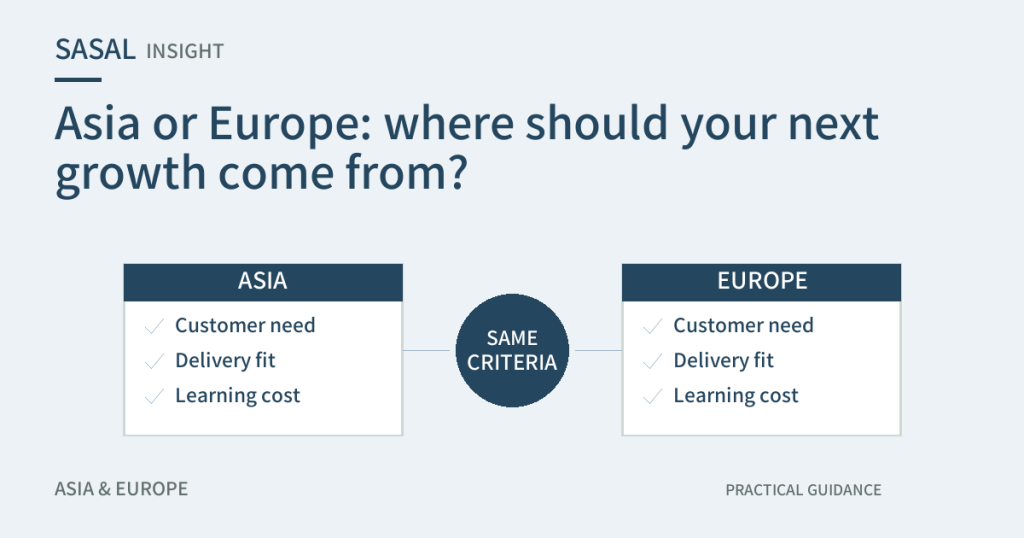
When a company already has traction in its home market, the next strategic question is often where additional revenue might come from. At that stage, comparing Asia and Europe as broad growth hypotheses can be more useful than immediately ranking individual countries. Neither region is automatically the better choice. Each can support growth under certain conditions, and each can disappoint if the underlying assumptions are weak. A stronger approach is to examine the same customer problem, the same offer and the same business objectives through two regional lenses. By comparing evidence quality, customer access, delivery implications and learning requirements on a consistent basis, leadership teams can decide which thesis deserves deeper investigation and which assumptions still need testing.
Frame the choice around the next source of revenue
Many regional discussions begin with assumptions about market attractiveness, familiarity or general economic narratives. A more useful starting point is the revenue objective itself. Clarify whether the business is seeking additional customers for an existing offer, a new customer segment for a proven capability, or a partner-supported route to market. The answer changes which regional opportunities deserve attention. A company looking for a broader customer base may evaluate Asia and Europe differently from a company seeking specialist buyers or collaborative development opportunities. Before discussing geography, define the intended commercial outcome, the expected time horizon and the level of people, funding and management attention available for exploration.
The same regional destination can support very different growth theses. One leadership team may view Europe as a place to reach a specific professional customer group, while another sees it as a route to diversify revenue sources. Likewise, one company may explore Asia to extend a successful offer into additional customer environments, while another may seek closer access to users whose requirements could influence product development. These are distinct objectives. If they are mixed together, the discussion often becomes a comparison of unrelated benefits. Defining the desired revenue mechanism first creates a common standard for evaluating both regional options.
A practical decision brief can begin with three connected questions. Who is expected to buy? What value are they expected to purchase? How will the company deliver that value? Those questions create a direct link between commercial ambition and market selection. They also make later evidence easier to interpret. A customer interview, pilot discussion or distributor introduction becomes more useful when it can be assessed against a clearly stated growth objective. Without that context, encouraging conversations may create activity without improving the quality of the regional decision.
Consider a hypothetical software provider with strong demand in its home market. Leadership is debating whether to investigate Asia or Europe next. Instead of asking which region is larger, the team defines its objective as securing a new source of recurring business from medium-sized organizations that share a particular operational challenge. That framing immediately narrows the investigation. The question becomes which regional hypothesis offers more credible access to those buyers under conditions the company can support. The discussion moves from regional reputation toward customer evidence and execution feasibility.
A useful extension to the decision brief is an assumptions register linked directly to the revenue objective. For each regional hypothesis, document the expected buyer, the expected value purchased, the delivery approach and the evidence currently supporting each point. Then classify every assumption as observed, inferred or untested. This creates a clearer distinction between customer evidence and management belief. For example, a hypothetical company may already know that medium-sized organizations purchase the offer for a specific operational outcome in its home market, but may only infer that similar buyers exist within either regional hypothesis. Recording that difference prevents discussions from treating both statements as equally reliable. Recommendation: assign an owner and a target date to the most important unknowns rather than attempting to research everything simultaneously. Questions that directly affect revenue generation, such as whether the intended buyer can be reached and whether the current offer solves the same problem, should generally be investigated before lower-impact topics. This approach keeps the regional comparison tied to commercial outcomes and available resources. It also makes later findings easier to interpret because every interview, partner conversation or exploratory meeting can be connected to a documented assumption rather than evaluated in isolation.
- Revenue objectiveDefine the commercial outcome the expansion should support.
- Customer and valueIdentify who buys and why they would choose the offer.
- Regional hypothesesTest Asia and Europe against the same customer logic.
- Evidence planGather information that could confirm or challenge either thesis.
Use the same customer problem in both regional hypotheses
Regional comparisons become unreliable when the underlying customer problem changes between options. A company may unconsciously compare one strong use case in Europe with a completely different opportunity in Asia. The result appears balanced but actually measures unrelated opportunities. A stronger method is to hold the customer problem constant. Start with a specific reason customers buy today, then ask how that same problem might appear in each regional hypothesis. This approach does not assume that customers behave identically. Instead, it creates a consistent basis for evaluating whether the company’s existing strengths remain relevant across different environments.
The discipline of using one customer problem often reveals where evidence is missing. A business may have detailed knowledge of purchasing conditions for one region but only broad assumptions for the other. Rather than filling those gaps with generalizations, record them as open questions. If a particular buyer type values the offer because it reduces operational complexity, investigate whether similar buyers exist in both regional hypotheses and how they currently address the issue. The purpose is not to prove that demand exists everywhere. The purpose is to understand where the same problem creates a credible buying reason.
Hypothetically, an industrial services company may help manufacturers reduce downtime during maintenance planning. When comparing Asia and Europe, the company should not switch from a maintenance-focused use case in one region to a cost-reduction narrative in the other simply because different stories sound appealing. Keeping the maintenance challenge constant allows the team to compare customer access, delivery requirements and purchasing conditions on a common basis. Any differences discovered become useful evidence rather than artifacts of an inconsistent comparison.
Using the same customer problem also improves internal communication. Finance, sales and operations teams can evaluate the same opportunity rather than debating different interpretations of growth. Evidence gathered from interviews, industry contacts and exploratory discussions becomes easier to organize because each finding relates back to a single commercial question. The resulting regional assessment is not a prediction of success. It is a structured examination of whether a proven customer problem appears accessible, important and solvable under the conditions being investigated.
One practical way to keep the customer problem consistent is to create a single problem statement that must be used across both regional hypotheses. The statement should describe the customer situation, the consequence of leaving the problem unresolved and the outcome customers currently seek. Evidence can then be organized against that same statement regardless of region. For instance, a hypothetical company might record customer observations under common headings such as current workaround, urgency, decision participants and desired result. Doing so reduces the temptation to reinterpret the offer when entering a new discussion. Recommendation: when customer interviews uncover a different challenge than the one originally defined, record it separately rather than folding it into the primary comparison. The purpose of the regional assessment is to determine whether the same buying reason remains relevant, not to combine multiple opportunities into a single conclusion. This discipline also improves comparability across functions. Sales teams can evaluate buying conditions, operations teams can examine delivery implications and leadership can assess strategic fit using the same underlying customer logic. The result is a cleaner evidence trail showing whether the proven problem appears sufficiently important and accessible within each regional growth thesis.
Compare access to buyers rather than the size of a region

Large regional labels can hide practical differences in customer access. Asia and Europe each contain many distinct markets, industries and purchasing environments. For an early-stage strategic choice, the critical question is often not how large a region appears in aggregate but whether the company can reach relevant buyers efficiently enough to learn and sell. Access includes channels, introductions, visibility, language coverage, relationship networks and the ability to sustain meaningful customer conversations. A smaller reachable opportunity may provide better evidence than a much larger opportunity that remains difficult to investigate.
Customer access should be examined through the specific segment identified in the growth thesis. If a company serves technical buyers, for example, it can evaluate whether industry events, partner ecosystems, direct outreach or existing customer relationships create pathways to those decision makers. The same exercise should be applied consistently to both regional hypotheses. A comparison based on identical criteria often reveals that one option offers clearer routes to customer conversations even when broader market narratives suggest otherwise.
A hypothetical business software provider may discover that several existing customers operate across both regions. Those relationships could provide introductions into one regional hypothesis more quickly than the other. That does not automatically determine the final decision, but it affects the quality and speed of learning. Access to informed conversations can be strategically important because it improves understanding of buying conditions before larger commitments are made.
Leadership teams sometimes treat customer access as a sales question only. In practice, it is also a learning question. Regions that enable structured customer dialogue may reduce uncertainty faster than regions where evidence is harder to obtain. The objective is not to count potential buyers from a distance. It is to determine how the business can engage with the people most likely to evaluate, purchase and use the offer. That perspective keeps attention on actionable opportunity rather than abstract scale.
Customer access becomes easier to evaluate when it is converted into a series of observable learning steps. Instead of asking whether buyers are reachable in general, identify the actions required to move from no contact to a meaningful commercial discussion. Those actions may include obtaining introductions, securing interviews, validating use cases or receiving feedback on a proposed scope. A hypothetical company could compare Asia and Europe by mapping how many practical pathways exist to these conversations through current customers, partners, industry contacts or direct outreach efforts. The objective is not to predict future sales volume but to understand how evidence can realistically be gathered. Recommendation: track access indicators separately from demand indicators. A region may provide many opportunities to speak with relevant buyers while still producing weak evidence of purchasing interest, and the opposite can also occur. Keeping those measures separate prevents strong networking activity from being mistaken for validated demand. This method aligns with the article’s emphasis on learning quality. Regional hypotheses improve when leadership can explain not only who the target buyers are, but also exactly how the business expects to reach them, test assumptions with them and continue those conversations long enough to evaluate the opportunity properly.
Separate a recognizable strength from a transferable advantage
Companies often begin regional discussions by listing strengths that contributed to success in their home market. That inventory is useful, but it does not automatically reveal what will create value elsewhere. Some strengths are genuinely transferable because customers choose them directly. Others depend on conditions that may not exist in a new environment. Distinguishing between those categories helps prevent overconfidence and improves the quality of regional comparisons. The goal is not to diminish existing achievements. It is to identify which elements of success can travel and which require rebuilding under different operating conditions.
A recognizable strength is something the organization can clearly describe, such as specialist expertise, a delivery method, a technology capability or a customer support process. A transferable advantage exists only when those strengths remain meaningful to buyers in the target context. The distinction matters because a company can possess impressive capabilities that solve a problem customers do not prioritize. Regional evaluation therefore requires examining not only what the business does well but also how that capability connects to customer decisions in each hypothesis.
Imagine a hypothetical consulting firm known for helping organizations coordinate complex projects. The underlying capability may be transferable, but the path to demonstrating that value could differ between regional opportunities. One hypothesis may allow the firm to reach buyers already familiar with similar approaches, while another may require additional education before customers can evaluate the offer. The capability remains the same. The commercial advantage depends on customer recognition and adoption conditions.
This perspective encourages evidence-based adaptation rather than blind replication. Teams can document which aspects of the operating model appear reusable and which need investigation. They can also avoid assuming that success in one market proves future demand elsewhere. By separating capability from customer recognition, leadership creates a more realistic view of what expansion requires. The result is a clearer comparison of Asia and Europe as environments where strengths may or may not become practical advantages.
A practical test for transferability is to trace the path from company capability to customer decision. Start by listing the strengths that contributed to success in the home market. Then ask which of those strengths customers actively recognize when choosing the offer and which operate mainly in the background. A hypothetical firm may have efficient internal processes, strong technical expertise and a well-developed support model. All are strengths, but customers may purchase primarily because of one outcome those capabilities create. Recommendation: evaluate regional hypotheses using customer-facing value rather than internal descriptions of excellence. Evidence becomes more useful when teams can show how a capability influences buyer behavior, adoption or retention instead of simply documenting that the capability exists. This distinction can also reveal preparation requirements. If customers in a regional hypothesis are unfamiliar with the outcome being offered, additional explanation or proof may be needed before the strength becomes commercially relevant. By documenting where customer recognition is already evident and where it remains uncertain, leadership gains a more realistic view of what must be transferred, demonstrated or adapted. The comparison shifts from organizational self-assessment toward evidence about how buyers perceive and evaluate the proposed value.
- Recognizable strengthCapability, expertise or process the company can demonstrate.
- Customer relevanceEvidence that buyers care about the outcome created.
- Transferable advantageStrength and customer need align under workable conditions.
Read price potential alongside the work required to deliver
Revenue opportunities should be evaluated together with delivery requirements. Discussions about price potential can become misleading when separated from the effort needed to create, support and retain customers. A region may appear attractive because buyers seem willing to consider a higher-value offering, yet the organization may need substantial adaptation, support resources or partner coordination to deliver consistently. Another region may offer more modest pricing expectations but fit existing delivery capabilities more closely. Neither outcome is inherently superior. The question is how commercial opportunity and execution effort interact.
A practical assessment traces the work behind the customer promise. Consider customization, onboarding, service coverage, account management, technical support and communication requirements. Then examine whether those activities can be performed using current capabilities or whether new arrangements are necessary. This exercise often changes the perception of regional attractiveness because it connects commercial assumptions with operational reality. The comparison becomes less about theoretical revenue and more about the complete business model required to capture it.
Hypothetically, a business may identify strong interest from specialist customers in both Asia and Europe. In one regional hypothesis, customers expect extensive support before adoption. In the other, buyers are comfortable with a more standardized delivery approach. The first option may still be attractive, but the resource implications differ. Understanding that difference early helps leadership evaluate opportunity on a realistic basis rather than relying on revenue expectations alone.
This analysis is especially useful before major investment decisions. Early conversations frequently focus on demand signals because they are easier to observe than delivery burdens. Yet long-term performance depends on both. Comparing price potential alongside delivery work encourages balanced planning and reduces the risk of selecting a regional thesis that appears compelling only because part of the operating requirement remains invisible.
Delivery analysis becomes more actionable when it is linked to specific stages of the customer relationship rather than treated as a single operational question. Consider the work required before purchase, during onboarding or implementation and after adoption. Each stage can generate different demands on people, funding and management attention. A hypothetical provider may find that attracting customers appears straightforward in both regional hypotheses, while ongoing support requirements differ significantly. Looking only at projected revenue would hide that distinction. Recommendation: build a simple delivery map showing the activities promised to customers, the teams responsible for those activities and any assumptions that remain untested. The purpose is not to produce a detailed operating plan at an early stage. Instead, it is to identify where execution complexity could materially affect the attractiveness of the opportunity. This also improves conversations between commercial and operational teams because both groups evaluate the same customer promise. When evidence from interviews or exploratory discussions is added to the map, leadership can compare not just what buyers may pay, but what the organization must consistently do to earn and retain that revenue. The resulting assessment is more complete than a pricing discussion alone.
Compare the burden of adapting the operating model
Expansion rarely involves moving an existing business model unchanged into a new environment. Even when the customer problem remains consistent, operating conditions may require adjustments. The key question is how much adaptation is needed and whether that adaptation supports the expected opportunity. Comparing Asia and Europe at a regional level therefore includes examining the burden of change rather than only the attractiveness of demand. The effort required to adjust delivery, communication, staffing, partnerships or support can influence which hypothesis deserves further investigation.
Some adaptations create reusable learning that benefits future expansion. Others are highly specific to a particular market context. Distinguishing between the two can improve investment decisions. If a proposed change strengthens capabilities that the company can use elsewhere, the cost of adaptation may produce wider strategic value. If the change serves only a narrow circumstance, leadership may require stronger evidence before committing resources. This does not mean avoiding adaptation. It means understanding what type of organizational learning is being purchased.
Consider a hypothetical technology provider comparing two regional hypotheses. One appears promising but would require substantial modification of customer onboarding, service workflows and internal coordination. The other demands fewer changes but offers less immediate commercial excitement. Rather than judging either option emotionally, the company can map the specific operating adjustments, identify responsible teams and estimate how much uncertainty remains. The discussion becomes practical and evidence-oriented.
Before narrowing the choice to specific countries, a useful outcome is a regional decision brief that records assumptions, evidence gaps and conditions that could change the preference. Such a document helps leadership retain optionality while directing research efficiently. The objective is not to declare Asia or Europe the universal winner. It is to identify which regional growth thesis currently rests on stronger evidence, more manageable adaptation requirements and a clearer path to meaningful customer learning.
An additional way to assess adaptation burden is to separate changes into temporary learning activities and permanent operating requirements. Some adjustments are needed only to investigate the regional hypothesis, such as exploratory research, partner discussions or limited trials. Others may become enduring parts of the business model if expansion proceeds. Distinguishing between these categories helps leadership avoid treating every adaptation as a long-term commitment. A hypothetical technology company could discover that testing customer interest requires relatively modest changes, while delivering at scale would eventually demand broader coordination across teams. Recommendation: document adaptations according to their expected duration, responsible owner and relationship to customer value. Changes that directly improve the ability to solve the customer problem should be evaluated differently from changes that exist mainly to support internal coordination. This framework also improves decision reversibility. If a regional hypothesis proves weaker than expected, temporary learning investments can often be concluded with limited disruption, whereas permanent structural changes are harder to unwind. By identifying which adaptations purchase knowledge and which create ongoing obligations, leadership can compare regional opportunities more clearly and decide where additional investigation is justified before larger commitments are considered.
Distinguish a commercial market from a coordination base
A regional discussion becomes clearer when leadership separates two different functions that are often combined. A commercial market is where customers buy, renew and recommend the offer. A coordination base is where people organize delivery, partnerships, support activities or regional management. Sometimes both functions exist in the same place. Sometimes they do not. When comparing Asia and Europe, avoid assuming that the most attractive customer opportunity must also become the center of operations. The regional growth thesis should first identify where value is expected to be purchased. Only then should the company evaluate where coordination work can be performed effectively. Keeping those questions separate improves strategic clarity and preserves flexibility while evidence is still developing.
This distinction matters because operational convenience can influence decisions more than customer evidence. A leadership team may prefer a region where communication, travel or existing relationships appear easier. Those factors deserve consideration, but they do not automatically indicate stronger demand. Likewise, a region with promising customer access may require a different coordination model than the company currently uses. Evaluating commercial potential and operating coordination as separate decisions helps avoid rejecting opportunities for the wrong reasons. It also encourages the business to consider hybrid arrangements rather than treating expansion as a single all-or-nothing commitment tied to one regional footprint.
Consider a hypothetical provider of industrial software. Customer interviews suggest a compelling opportunity in one regional hypothesis, while existing service partners make operational coordination appear easier in the other. Rather than forcing a combined decision, the company can investigate whether customers can be served effectively without immediately relocating management attention or building extensive local infrastructure. That approach preserves learning opportunities. It also prevents the organization from confusing operational familiarity with market validation. The strongest regional opportunity may emerge from a combination of customer access in one place and delivery support organized through another structure.
At an early stage, the objective is not to design the final operating model. It is to understand whether the company is evaluating customer opportunity, coordination convenience or an unexamined mixture of both. A decision brief can therefore record separate assumptions for customer acquisition, customer support, partner management and internal governance. When evidence is organized in this way, leadership can see which elements truly depend on geography and which are simply management preferences. The result is a more disciplined comparison of regional growth hypotheses and a clearer understanding of what must be tested next.
- Customer demandEvidence that buyers value and may purchase the offer.
- Market accessChannels, relationships and outreach that reach buyers.
- Delivery coordinationPeople and processes that support execution.
- GovernanceDecision-making and resource allocation across the business.
Balance regional diversification with shared dependencies

One argument for exploring a new region is diversification. Additional revenue sources can reduce reliance on a single customer environment. However, diversification should be examined carefully because two revenue streams may still depend on the same underlying capabilities, suppliers, specialists or leadership attention. The practical question is not whether sales occur in different places. The question is whether the business becomes meaningfully less exposed to the same risks. Comparing Asia and Europe therefore requires looking beneath customer geography and examining what resources actually support delivery. Regional expansion can improve resilience, but only when dependencies are understood rather than assumed away.
Shared dependencies often remain hidden during strategy discussions. A company may believe it is diversifying because customers are located in different regions, yet critical expertise still sits with one small team. Inventory, product development capacity, technical support or key partnerships may also remain concentrated. If those resources become constrained, customer diversification alone may not protect the business. Mapping dependencies alongside revenue opportunities creates a more realistic picture of strategic benefit. It also helps leadership identify where additional investment may be required if expansion proceeds beyond the investigation stage.
A hypothetical business services firm illustrates the issue. Leadership expects a second region to broaden revenue sources, but customer onboarding, specialist delivery and account management all rely on the same experts. In that situation, regional diversification may increase opportunity while simultaneously increasing operational concentration. Recognizing that tension is useful. It encourages the company to evaluate staffing, knowledge transfer and delivery capacity as part of the regional thesis rather than after customers have already been acquired.
The most useful outcome is not a numerical score. Instead, create a dependency map showing which capabilities are shared across both regional hypotheses and which would become independent over time. Such a map allows leadership to compare the strategic value of diversification more accurately. It also highlights where future growth could become constrained. A region may remain attractive even with shared dependencies, but decision-makers should understand the trade-off explicitly rather than assuming geographic spread automatically creates organizational resilience.
Ask what evidence would reverse the initial preference
Many regional decisions become weaker because the investigation is designed only to confirm an existing preference. A stronger approach identifies what evidence could change leadership's mind before research begins. If the team currently favors Asia, what findings would make Europe the more compelling hypothesis? If Europe appears stronger today, what observations could reverse that conclusion? Defining these conditions creates a more balanced process and reduces the influence of internal momentum. It also improves the quality of customer interviews, partner discussions and market research because the team knows which assumptions are genuinely important to test.
Reversal criteria should be specific enough to influence decisions. Examples may include customer accessibility, willingness to engage in evaluation conversations, evidence of repeatable use cases, delivery feasibility or the amount of adaptation required. The criteria do not need numerical thresholds. They simply need to identify the facts most capable of changing the regional ranking. This discipline prevents leadership from collecting large volumes of information that sound interesting but have little bearing on the actual choice being made.
Imagine a hypothetical company that initially favors Europe because several industry contacts are already available there. During planning, leadership records a condition that would reverse the preference: credible evidence that the same customer problem can be investigated more quickly and repeatedly through existing networks in an Asian market. That statement transforms a vague preference into a testable proposition. Research efforts become more focused because the team understands exactly what would constitute a meaningful challenge to the current view.
Documenting reversal evidence also improves communication among stakeholders. Different departments often support different regional hypotheses for legitimate reasons. By agreeing in advance what information could alter the decision, the company creates a shared standard for interpreting results. Discussions become less about defending a favored region and more about evaluating evidence. The resulting recommendation is usually more durable because everyone understands why the preferred hypothesis survived testing or why the original preference changed.
Compare the cost of learning before the cost of scaling
Before debating large-scale expansion budgets, leadership should examine the cost of learning. At an early stage, the objective is not to build a regional business immediately. The objective is to reduce uncertainty. Customer interviews, limited outreach, focused trials and exploratory partnerships often provide more decision value than discussions about future scale. When comparing Asia and Europe, ask which regional hypothesis can be investigated effectively with available people, funding and management attention. A region that enables faster, clearer learning may deserve priority even if long-term expansion requirements remain uncertain. Learning is itself an investment decision and should be evaluated explicitly.
The distinction between learning and scaling is important because the resources required are different. Learning activities are designed to answer questions. Scaling activities are designed to support ongoing delivery and growth. Companies sometimes reject an attractive regional opportunity because they mentally combine both stages and focus immediately on future operating complexity. Separating them allows leadership to explore possibilities without prematurely committing to a final structure. It also supports a more reversible decision process because evidence can be gathered before significant obligations are created.
Consider a hypothetical software company evaluating two regional hypotheses. One offers relatively straightforward access to customer conversations and pilot discussions. The other may ultimately become attractive but requires more effort to obtain reliable feedback. The first hypothesis may therefore deserve investigation first, not because it is guaranteed to become the winning market, but because it can improve decision quality at lower learning cost. Better information often changes the ranking of later options.
A practical planning exercise is to list the assumptions that matter most and then estimate the activities needed to test them. Customer interviews, partner conversations, proposal discussions and limited commercial trials can all contribute evidence. Leadership can then compare Asia and Europe according to the effort required to answer critical questions. This shifts the conversation from speculative growth projections toward a disciplined assessment of how the business will learn enough to make a stronger decision.
- AssumptionsIdentify beliefs that most affect the regional choice.
- Targeted researchGather evidence through interviews and focused investigation.
- Interpret findingsAssess what the evidence supports or challenges.
- Refine priorityAdjust the preferred regional hypothesis if needed.
New assumptions emerge and are tested in the next cycle
Decide whether to investigate one region or retain two options
The purpose of an early regional comparison is not always to eliminate one option immediately. In some situations, evidence clearly favors a single investigation path. In others, the available information may support continued exploration of both Asia and Europe. The decision depends on resource constraints, uncertainty levels and the quality of existing evidence. A company should not force a narrow choice simply because a meeting requires one. Retaining two plausible options can be a rational outcome when the information needed to separate them has not yet been collected.
A useful criterion is whether additional research would meaningfully improve the decision. If one regional hypothesis already shows stronger customer access, clearer demand signals and more manageable delivery requirements, concentrating effort may accelerate learning. Conversely, if both hypotheses remain credible and rely on different assumptions, maintaining parallel investigation can reduce the risk of prematurely abandoning a valuable opportunity. The key is to manage the process deliberately rather than drifting into unfocused exploration across multiple regions.
Imagine a hypothetical industrial solutions provider. Customer discussions reveal encouraging signals in both regional hypotheses, but the buying process and delivery requirements remain unclear. Leadership chooses to continue investigating both options for a limited period while defining the evidence required for a final recommendation. This approach preserves flexibility without creating indefinite analysis. The investigation remains focused because the team understands what information is still missing and how it will be evaluated.
Whether the company selects one region or retains two, ownership should be explicit. Someone should be responsible for gathering evidence, recording assumptions and reporting findings. Clear accountability prevents regional exploration from becoming a collection of disconnected observations. It also creates a transparent record of why options were advanced, paused or deprioritized. The resulting process supports disciplined expansion planning without pretending that uncertainty can be eliminated entirely.
Prepare a regional decision brief for the next conversation
The final output of this stage should be a decision brief rather than a verdict about an entire region. Asia and Europe are broad categories that contain many different markets, customer groups and operating conditions. The immediate objective is therefore to summarize what has been learned, what remains uncertain and which regional hypothesis deserves the next level of investigation. A concise document helps leadership compare evidence consistently and prevents future discussions from repeating earlier assumptions. It also creates a shared reference point for teams that were not directly involved in the initial evaluation.
An effective brief records the customer problem being examined, the proposed value of the offer, the rationale behind each regional hypothesis and the evidence gathered so far. It should also identify important unknowns. Missing information is not a weakness if it is clearly documented. In fact, transparent uncertainty often strengthens decision-making because it prevents speculation from being treated as established fact. Recording open questions also makes future research more efficient because the next tasks are already visible.
Hypothetically, a business may conclude that Europe currently provides stronger access to a specific customer segment while Asia presents promising long-term possibilities that require further validation. Another company may reach the opposite conclusion using the same framework. The method remains transferable because it evaluates customer access, delivery implications, evidence quality and learning requirements rather than relying on regional reputation. Different companies can therefore reach different conclusions without contradicting the underlying approach.
The next conversation should focus on commitment, not abstraction. Leadership can decide whether to conduct customer interviews, pursue a focused trial, engage potential partners or investigate a narrower set of markets within the preferred region. By ending with defined actions, owners and open questions, the regional comparison becomes a practical planning tool. The goal is not to prove that one region is universally superior. The goal is to identify which growth thesis currently deserves the next investment in learning and why.