

SASAL INSIGHT / DEEP DIVE
Grow, adapt or exit? Choosing the next move for an overseas business
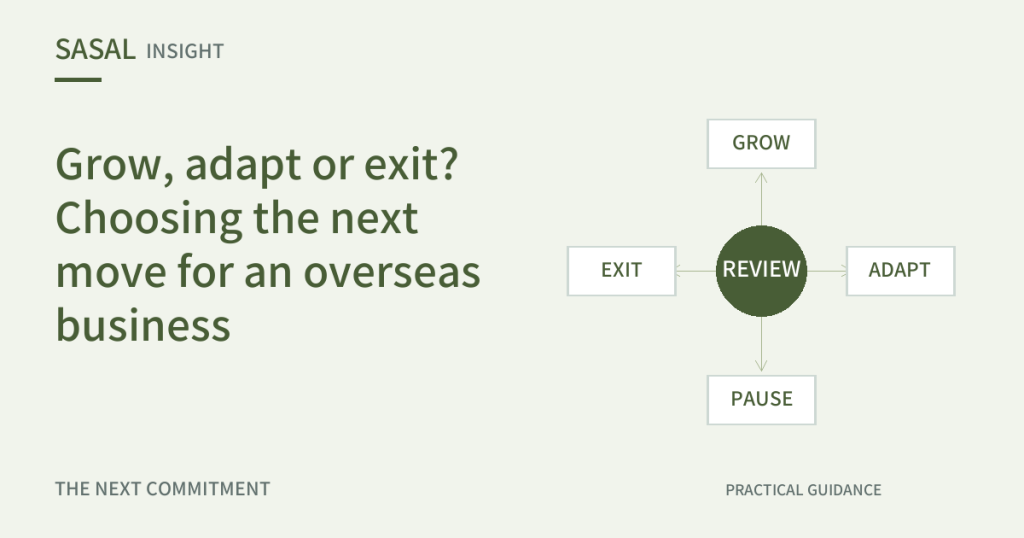
A strategic review is most useful when it clarifies the next commitment rather than revisiting every past decision. An overseas business that is already operating creates new choices: invest for growth, continue with changes, reduce activity, pause further commitments or complete an orderly exit. The quality of that choice depends on current evidence, not on assumptions that were reasonable months or years earlier. Leadership teams can improve review outcomes by separating future decisions from sunk expenditure, identifying which obstacles are actually changeable, comparing realistic alternatives on a common basis and recording the conditions that would justify further action later. The objective is not to defend a previous plan. It is to allocate people, funding and management attention to the option that now makes the most sense.
Define the next commitment the review will decide
Many reviews become difficult because participants discuss performance, strategy, budgets and market conditions at the same time. A more useful starting point is to define the specific commitment that will be decided at the end of the review. That commitment might be approving additional hiring, entering a new customer segment, maintaining the current operating model, reducing activity, pausing expansion or beginning an orderly exit process. When the decision is stated clearly, evidence becomes easier to evaluate because every discussion can be linked to the practical question of what the business should do next rather than whether past actions were justified.
The commitment should be framed in terms of future allocation of resources. Management attention, staffing, inventory, travel, marketing effort and cash all represent commitments that can be increased, maintained or reduced. A review focused on future allocation encourages constructive discussion because it shifts attention toward expected outcomes and available alternatives. It also makes it easier to compare competing uses of the same resources. An overseas operation may be one opportunity among several, so the review should clarify what additional commitment would be required and what benefit that commitment is expected to support.
A helpful working method is to write a short decision statement before collecting evidence. For example, a leadership team might define the review question as whether to expand into additional customer groups using existing capabilities, or whether to narrow activity to the segment already producing the strongest demand signals. Such a statement does not predetermine the answer. Instead, it creates a common reference point for interpreting evidence. Information that cannot influence the decision may still be interesting, but it should not dominate the review process.
Consider a hypothetical manufacturer with an operating presence in one overseas market. Revenue exists, customers are active and delivery is functioning, but management is considering additional investment. Rather than asking broadly whether the market is successful, the team could ask whether conditions justify committing more people and funding during the next operating period. That narrower question immediately identifies the evidence required. Demand, delivery capability, economics and organizational capacity become relevant because they affect the next commitment rather than because they explain historical activity.
A practical recommendation is to define not only the decision statement but also the specific evidence categories that could change the answer before the review begins. For example, if the commitment under consideration is additional hiring, the team can record that demand evidence, delivery performance, cash availability and management capacity will be examined because each could justify approval, modification or rejection of the commitment. This creates a useful screening mechanism during information gathering. Meeting notes, market observations and historical reports can be reviewed against a simple question: would this information alter the next allocation of people, funding or management attention? If not, it can be retained as background rather than becoming a central review topic. A hypothetical application is to prepare a one-page decision brief listing the proposed commitment, the alternatives being compared and the evidence still required. Review participants can then attach findings directly to the relevant decision area. This approach helps prevent discussions from drifting into explanations of past performance and keeps attention on choices that remain available. It also makes later comparison easier because every piece of evidence has already been linked to the future commitment it is intended to inform.
- Decision definitionState the future commitment that will be approved, changed or declined.
- Evidence reviewAssess demand, delivery, economics and operating conditions relevant to that commitment.
- Option comparisonCompare realistic alternatives using the same decision criteria.
- Next commitmentApprove growth, adaptation, continuation, reduction, pause or exit.
Update demand evidence before relying on past expectations

Demand assumptions often survive longer than the evidence that originally supported them. Customer needs change, competitors adjust, purchasing priorities shift and internal contacts move into different roles. A review should therefore refresh demand evidence before relying on earlier expectations. The objective is not to restart market research from the beginning. It is to verify whether the reasons customers were expected to buy still appear credible in current conditions. Recent customer discussions, purchasing activity, proposal outcomes and operational experience can all contribute to this assessment.
Teams sometimes place too much weight on effort already invested in learning a market. Time spent attending meetings, conducting visits or presenting proposals may demonstrate activity, but activity alone does not establish current demand. More useful evidence shows what those interactions enabled the business to learn or decide. Did customer conversations clarify buying requirements? Did proposals reveal pricing concerns? Did operational experience uncover adoption barriers? Reviews become stronger when interactions are connected to decision-relevant learning rather than treated as achievements by themselves.
A practical approach is to revisit the customer problem that the business intended to solve and examine whether that problem remains important. If the original value proposition still matches customer priorities, the review may support continued investment. If customers consistently focus on a different issue, adaptation may be more appropriate than expansion. In some cases, demand may exist but be concentrated within a narrower segment than originally expected. That finding can support a focused operating model rather than a broad growth plan.
Imagine a hypothetical software provider that expected demand from large organizations but has received stronger engagement from smaller specialist firms. The review should not automatically conclude that the original strategy failed. Instead, it should evaluate current evidence and determine whether concentrating on the segment showing clearer demand would produce a better next commitment. Updated demand evidence helps leadership distinguish between a market with limited opportunity and a market where the opportunity is simply different from initial expectations.
A practical recommendation is to organize refreshed demand evidence according to what it reveals about customer behavior, buying requirements and segment fit rather than by the volume of activity completed. Recent discussions, proposal outcomes and operational experience can be grouped into themes that either strengthen or weaken the original demand assumption. For example, customer conversations may consistently identify a particular requirement, while proposal feedback may repeatedly highlight a concern about pricing, scope or implementation. Recording these patterns allows leadership to distinguish isolated comments from recurring signals. A hypothetical application is to review the most recent interactions and note what decision each interaction enabled. Some may confirm that the original customer problem remains important, while others may indicate that demand is concentrated in a narrower segment than expected. Evidence can then be compared across segments using the same questions: does the customer problem remain relevant, are buying requirements understood and has operational experience supported or challenged earlier expectations? This method keeps the review focused on current conditions. It also helps identify whether adaptation should target customer focus, value communication or operating scope before additional investment is considered.
Read economics together with capacity and remaining cash
Financial performance is essential in a review, but economics should not be examined in isolation. A business may identify attractive opportunities while lacking the capacity to deliver them. Conversely, a business may possess capable people and operational infrastructure but insufficient demand to justify further investment. Remaining cash, available staff time and operational readiness all influence the practicality of the next commitment. Reviewing these factors together provides a more realistic picture than examining revenue or costs alone.
One useful question is whether the business can support additional commitments if expected sales take longer to arrive than planned. Growth frequently increases obligations before benefits are realized. New hires, equipment, inventory, marketing activities or expanded support requirements may all create demands on resources. The review should therefore consider both expected outcomes and the ability to sustain commitments while those outcomes are still uncertain. This approach encourages resilience and helps prevent expansion plans from depending on overly optimistic assumptions about timing.
Capacity also includes management attention. An overseas operation may require coordination across sales, delivery, support, finance and leadership functions. If those responsibilities are already stretched, growth can amplify operational strain even when demand appears promising. A review should therefore assess whether existing teams can carry additional workload or whether growth would require further organizational preparation. In some situations, adaptation or staged expansion may be more practical than immediate scaling.
Consider a hypothetical company evaluating a larger overseas sales effort. Customer interest appears encouraging, but delivery specialists are already operating near capacity and cash plans assume timely customer payments. The review may conclude that demand justifies further investment, yet still recommend a phased approach. By reading economics together with capacity and available cash, leadership can choose a commitment that the organization can realistically support rather than one that appears attractive only under ideal conditions.
A practical recommendation is to review proposed growth commitments alongside the obligations they create under less favorable timing assumptions. The article already emphasizes demand, capacity and cash; the additional step is to map each planned commitment to the resources required before expected benefits arrive. Hiring, equipment, inventory or expanded support may generate ongoing obligations even when sales take longer than anticipated. Reviewing these obligations together helps leadership judge whether the organization can sustain the commitment while outcomes remain uncertain. A hypothetical application is to create a staged expansion plan in which each stage is linked to evidence from the current operation. Demand indicators may support moving forward, but delivery workload, support requirements and available management attention can determine the pace. The review can also compare whether existing capabilities are sufficient or whether further preparation is required before scaling activity. This does not require forecasting exact results. Instead, it clarifies the relationship between expected revenue, operational readiness and funding needs. By examining these elements as one system rather than separate reports, leadership can select a commitment that remains practical across a range of plausible operating conditions rather than only when execution proceeds exactly as planned.
Distinguish past spending from avoidable future commitments
One of the most important disciplines in a strategic review is separating past spending from future commitments. Resources already spent cannot be recovered simply by continuing an activity. Yet teams sometimes allow previous investment to influence future decisions more than current evidence warrants. A review should focus on whether additional commitments are justified now, based on expected future value and future obligations. This perspective encourages rational allocation of resources and helps preserve capacity for stronger opportunities.
Past spending remains relevant as a source of learning. Research, customer engagement, operational experience and previous investments may have produced valuable knowledge. The review should capture and use that learning. However, learning value is different from a requirement to continue investing. The question is not whether the organization worked hard to reach its current position. The question is whether committing additional resources today represents the best available course of action based on current evidence.
A practical method is to list future commitments separately from historical expenditures. Future commitments may include salaries, support responsibilities, inventory, leases, service obligations, travel, specialist assistance or contractual payments. Once these commitments are visible, decision makers can compare them against expected outcomes. This comparison often creates a clearer discussion because it focuses attention on choices that still remain under management control rather than on decisions that have already been made.
Imagine a hypothetical exporter that spent considerable time and funding establishing overseas distribution relationships. If current evidence suggests that demand remains weak despite repeated adjustments, the review should evaluate future commitments on their own merits. The existence of prior expenditure does not automatically support additional investment. Equally, previous spending does not require withdrawal if current evidence supports continued operation. Separating past expenditure from avoidable future commitments improves decision quality regardless of which option is ultimately selected.
A practical recommendation is to document historical expenditure and future commitments in separate review sections so that learning is preserved without allowing prior spending to determine the decision. Historical expenditure can be summarized as context: what research was completed, what operational experience was gained and what customer knowledge was acquired. Future commitments can then be listed independently, including staffing, support responsibilities, travel, inventory, contractual obligations or other ongoing requirements that remain subject to current choice. A hypothetical application is to evaluate several alternatives—proceeding, narrowing activity, waiting or declining further investment—using the same future-focused comparison. For each alternative, leadership can review the expected outcomes, timing and obligations that would follow from the decision. This structure keeps discussion centered on choices that can still be influenced rather than resources that have already been spent. It also improves transparency because participants can see exactly which commitments would be avoided, reduced or accepted under each option. The result is a review process that captures the value of prior learning while assessing future actions according to current evidence and expected future value rather than historical effort.
- Historical expenditurePrevious spending provides learning and context but cannot be recovered through future decisions.
- Future staffingPeople commitments create ongoing obligations that should be evaluated from today forward.
- Future operating costsSupport, inventory, travel and related commitments remain subject to current choices.
- Expected outcomesFuture value should be compared against future commitments rather than past effort.
Diagnose whether the obstacle can be changed
Before deciding to grow, reduce or exit, leadership should identify the primary obstacle limiting progress and assess whether it is changeable. Some challenges arise from execution and can be improved through adjustments in positioning, pricing, customer focus, channels or operations. Other obstacles may reflect conditions that the business cannot realistically influence. The distinction matters because growth may be sensible when a fixable problem has been identified, while further investment may be less attractive when the barrier appears structural and persistent.
Diagnosis requires evidence rather than assumptions. Reviews should examine customer feedback, sales activity, delivery performance and operational experience to identify patterns. A recurring issue may reveal a specific weakness. For example, customers may understand the product but struggle with adoption. Alternatively, strong interest may exist but delivery requirements exceed available capacity. These findings point toward adaptation rather than abandonment. The objective is to locate the factor most likely to change outcomes if addressed effectively.
It is also useful to distinguish between a narrow problem and a broad one. A challenge affecting one customer segment, one product variation or one sales channel may not invalidate the entire opportunity. In some cases, reducing scope allows the organization to concentrate resources where evidence is strongest. Focused adjustments can reveal whether the underlying opportunity remains attractive once the specific obstacle is addressed.
Consider a hypothetical company receiving positive customer reactions but inconsistent purchasing decisions. A deeper review might reveal that value communication is unclear rather than demand being absent. If improved communication is a realistic and testable change, adaptation may deserve consideration before reduction or exit. By diagnosing whether the obstacle can be changed, leadership improves the chances of selecting a response proportionate to the actual problem rather than reacting to symptoms alone.
A practical recommendation is to convert suspected obstacles into specific, evidence-based questions before selecting a response. Rather than describing a problem broadly as weak demand or poor progress, the review can identify the point in the customer, delivery or operating process where outcomes appear to change. Customer feedback, proposal results, delivery experience and channel performance can then be examined for recurring patterns. A hypothetical application is to compare several possible explanations for the same outcome. If purchasing decisions are inconsistent, the cause might relate to customer targeting, value communication, pricing, scope or channels. Each explanation implies a different action, so the review benefits from testing which one is most consistent with available evidence. It is also useful to assess whether the obstacle affects the entire opportunity or only a particular segment, product variation or operating approach. A narrow issue may support adaptation or focused reduction rather than broad withdrawal. By defining the obstacle precisely and evaluating whether management can realistically influence it, leadership gains a clearer basis for comparing growth, adaptation, pause or exit. The emphasis remains on selecting the response most closely matched to the actual constraint identified in the evidence.
Compare growth, adaptation, reduction, pause and exit
A strong review compares multiple realistic options rather than treating growth as the default outcome. Growth, adaptation, reduction, pause and exit each represent different commitments, risks and opportunities. Comparing them on a common basis encourages disciplined decision making. The comparison should examine future spending, expected outcomes, operational implications and the evidence supporting each path. Leadership can then evaluate alternatives as competing uses of resources rather than as emotional judgments about success or failure.
Growth may be appropriate when demand evidence is strengthening, delivery capability is functioning and additional commitments appear supportable. Adaptation may be preferable when the opportunity remains attractive but important aspects of the operating model require adjustment. Reduction can preserve customer relationships and learning while lowering commitments. A pause may be useful when key questions remain unanswered and further evidence is needed before major investment. Exit becomes relevant when future commitments no longer appear justified by expected outcomes or strategic priorities.
When comparing options, it helps to identify the conditions under which each choice would be reconsidered. A pause, for example, should not be an indefinite state. The review can record what evidence would justify reopening the opportunity. Similarly, a growth decision can include review conditions that trigger reassessment if circumstances change. This approach supports adaptability without creating unnecessary uncertainty for operating teams.
Imagine a hypothetical business that has achieved moderate demand but faces competing opportunities elsewhere in the company. The review may conclude that immediate expansion is not the strongest use of resources even though the overseas operation remains viable. In that case, adaptation or a structured pause could outperform aggressive growth. By comparing all major options directly, leadership increases the likelihood that the selected path reflects current evidence, organizational capacity and future priorities rather than habit or momentum.
A practical recommendation is to compare options using a consistent evaluation format that records future commitments, expected outcomes, operational implications and the evidence supporting each path. Applying the same structure to growth, adaptation, reduction, pause and exit reduces the risk that one option receives more detailed scrutiny than the others. A hypothetical application is to prepare a comparison summary for each alternative, noting the people, funding and management attention required, the evidence currently available and the key uncertainties that remain. The review can then examine the options as competing uses of resources rather than as judgments about past success. Another useful step is to record what future evidence would justify changing the decision. For example, a pause can include defined reopening conditions, while a growth decision can include review conditions that would trigger reassessment if demand, delivery or organizational capacity changes. This creates continuity between the current decision and future reviews. It also helps teams understand that each option is being selected because it best fits current evidence and priorities. Consistent comparison improves transparency, supports resource allocation and makes the reasoning behind the chosen commitment easier to review later.
Set the boundary for one more round of learning
When a review does not yet support a clear grow, reduce, pause or exit decision, leadership may choose one further round of learning. The important discipline is defining the boundary of that learning before new activity begins. Additional research should answer a specific question that affects the next commitment. Without that boundary, teams can continue gathering information indefinitely while delaying a decision. A useful review therefore identifies the uncertainty that matters most, the evidence required to reduce it and the decision that will follow. Learning becomes an investment in decision quality rather than a substitute for decision making. This approach also helps preserve resources because effort is directed toward unresolved questions instead of broad exploration that may never influence the operating plan.
The most valuable learning questions are often linked directly to customer behavior, delivery feasibility or the conditions required for sustainable operation. For example, a company may need to understand whether a customer segment can be served profitably with existing capabilities, whether local purchasing practices require adaptation or whether demand remains concentrated within a narrower use case. Each question should connect to a future choice. If the answer would not change the next commitment, it may not justify additional research. Reviews become more practical when learning tasks are selected according to their decision impact rather than their general interest. This keeps the organization focused on evidence that can genuinely alter the direction of the overseas business.
A bounded learning phase also benefits from separating research resources from execution resources. The team responsible for answering the question may not need the same level of inventory, staffing or long-term commitment required for full expansion. By allocating learning and execution separately, leadership retains flexibility while preserving the ability to act later. This distinction is especially useful when uncertainty remains meaningful but the opportunity still appears promising. The review can authorize targeted investigation without automatically committing to broader growth. As evidence improves, the next operating decision becomes easier to evaluate because the purpose of the learning effort was defined in advance and measured against the original question.
Consider a hypothetical company deciding whether to expand beyond its current customer group. Rather than approving a larger sales program immediately, leadership could authorize a limited learning phase focused on understanding buying requirements in the adjacent segment. The review would record what information must be collected, who owns the work and what outcome supports proceeding, revising or pausing. Once that evidence is gathered, the company returns to the decision rather than opening a new cycle of undefined investigation. The result is a disciplined process in which learning supports action, resources remain controlled and uncertainty is reduced only where it matters most.
- Decision questionDefine the uncertainty preventing a clear commitment.
- Targeted learningCollect only the evidence needed to answer that question.
- Evidence reviewAssess whether the findings support proceeding or revising.
- Next commitmentChoose growth, adaptation, pause, reduction or exit.
Test whether expansion would multiply an unresolved problem
Growth is often discussed as if it automatically improves business performance, yet expansion can also magnify weaknesses already present in the operating model. A review should therefore examine whether the problem limiting progress would become larger under growth conditions. If customer acquisition is inconsistent, delivery quality is unstable or internal coordination is strained, additional scale may increase complexity faster than value. The question is not whether the business can become larger. The question is whether larger activity would strengthen the business or simply extend existing difficulties across more customers, products, channels or countries. Testing this assumption can prevent costly commitments that create additional obligations before the underlying issue is understood.
One useful method is to trace the path from customer demand through delivery, support and collection. At each stage, identify the points where delays, misunderstandings or operational bottlenecks already occur. If expansion would increase activity at those same points, the review should consider whether corrective action is required before growth. This does not mean every imperfection must be eliminated. Instead, leadership should distinguish between manageable limitations and issues likely to undermine a larger operation. Understanding that difference allows growth plans to be sequenced appropriately, with preparation occurring before commitments become difficult to reverse.
The review should also distinguish reusable capabilities from new preparation requirements. An operation may have developed a successful approach with one customer group while still requiring substantial adaptation for another. Additional countries, products or channels can create new demands related to service, inventory, pricing, regulation or customer communication. Growth becomes easier to assess when leadership identifies which elements are transferable and which require new investment. This comparison helps determine whether expansion extends a proven model or introduces challenges that remain unresolved. The answer influences both the pace and scope of future commitments.
Imagine a hypothetical exporter considering entry into additional markets while still experiencing recurring delivery coordination problems in its existing operation. Strong demand signals may exist, yet expansion could increase the burden on the same teams already facing strain. The review might conclude that improving coordination first creates a stronger foundation for future growth. In that scenario, adaptation becomes a step toward expansion rather than a rejection of it. Testing whether growth multiplies an unresolved problem helps leadership avoid confusing opportunity size with operational readiness and encourages investment in the factors most likely to improve long-term performance.
Map obligations that remain when work is reduced or stopped
Reducing activity or exiting an overseas business does not eliminate every responsibility immediately. A review should therefore identify the obligations that remain after new sales are reduced, paused or stopped. These obligations may include customer commitments, service responsibilities, contractual arrangements, inventory management, receivables collection, data retention activities or other ongoing duties. Understanding them in advance allows leadership to evaluate the true effort required for reduction or exit. It also encourages orderly planning rather than assuming that ending growth automatically ends operational responsibility. A realistic assessment of remaining obligations supports better resource allocation and more credible timelines for implementation.
The review benefits from mapping obligations by owner, funding requirement and expected completion path. This exercise transforms a broad idea such as exiting a market into a series of practical tasks. Customer commitments may need completion. Contracts may require notice or amendment. Inventory may need to be sold, transferred or managed. Outstanding payments may still require collection. By documenting these activities explicitly, leadership gains a clearer picture of what reduction or exit actually involves. The objective is not to discourage change but to ensure that decisions reflect the responsibilities that continue after commercial activity begins winding down.
A common mistake is treating the end of new sales as the end of the business process. In reality, customer support, warranty obligations, maintenance activities and contractual commitments may continue beyond that point. Reviews should therefore distinguish between stopping new business development and completing existing obligations. This distinction helps avoid operational surprises and supports communication with customers, employees and internal stakeholders. It also allows management to allocate sufficient resources to closure activities rather than assuming those duties will resolve themselves automatically over time.
Consider a hypothetical service provider that decides to stop pursuing new opportunities in a market. Existing contracts remain active, several invoices are still outstanding and customer handover activities are required. The review should account for these commitments when estimating effort, timing and funding needs. An orderly transition protects relationships and preserves organizational credibility even when the strategic decision is to reduce activity. Mapping obligations creates visibility into what remains to be done and ensures that reduction or exit is managed as a planned business process rather than an abrupt withdrawal.
- Customer commitmentsComplete agreed delivery, support, warranty or maintenance responsibilities.
- Commercial agreementsManage contracts, notices, amendments and related obligations.
- Financial activitiesCollect receivables and retain required funding for remaining duties.
- Closure administrationHandle records, communication and planned completion tasks.
Align the decision with the people who must carry it out

A review decision creates value only when the people responsible for implementation understand and support the chosen direction. Leadership may agree on growth, adaptation, reduction, pause or exit, but the practical outcome depends on teams translating that choice into action. Alignment begins by clarifying what the decision means operationally. Which activities will continue, which will change and which will stop? Who owns the next actions? What resources are available? Clear answers reduce confusion and help teams focus on execution rather than interpretation. This is especially important in overseas operations where responsibilities may be distributed across functions, locations and external partners.
Implementation becomes easier when the review explains the reasoning behind the decision. Teams often need context to prioritize effectively. If growth is approved, they should understand which evidence justified additional commitment. If adaptation is selected, they should know which obstacle the changes are intended to address. If activity is reduced, they should understand the future priorities that influenced the choice. Providing this context supports better day-to-day decisions because people can connect their actions to the strategic objective. It also reduces the risk that different groups interpret the review outcome in conflicting ways.
Ownership should be explicit. Reviews frequently identify actions such as customer research, operational improvements, contract management or resource reallocation. These tasks become more likely to happen when responsibility, timing and decision authority are clearly assigned. Recording owners also improves accountability during the next review cycle because progress can be evaluated against agreed commitments. A decision without ownership often becomes a discussion topic rather than an operating plan. Leadership should therefore convert strategic conclusions into practical responsibilities that can be tracked and updated as evidence develops.
A hypothetical company may decide to continue operating while narrowing its customer focus. Sales teams need guidance on target segments, delivery teams need clarity on priorities and management needs visibility into progress. By aligning the review outcome with the people carrying out the work, the organization creates a direct connection between strategy and execution. The review then becomes a tool for coordinated action rather than a document that records conclusions without influencing behavior.
Record conditions for reopening a paused opportunity
A pause can be a deliberate strategic choice rather than a sign of failure. In some situations, the evidence does not support immediate expansion, yet the opportunity may remain attractive under different conditions. The value of a pause increases when leadership records the circumstances that would justify reopening the opportunity later. Without those conditions, a paused initiative can become difficult to evaluate because future discussions rely on memory rather than documented reasoning. Recording reopening criteria preserves learning and helps ensure that future decisions are based on evidence rather than assumptions about why activity was suspended.
Useful reopening conditions should be observable and relevant to the original decision. Examples may include evidence of customer demand, availability of required resources, resolution of a delivery constraint or completion of specific preparation work. The review should avoid vague statements such as waiting for conditions to improve. Instead, it should describe what evidence would indicate that improvement has occurred. This creates a practical reference point for future evaluation and reduces uncertainty about when leadership should reconsider the opportunity. The objective is not to predict future events but to define how they would be interpreted if they occur.
Documenting reopening conditions also helps preserve organizational knowledge when personnel change. Overseas opportunities often develop over long periods, and future decision makers may not have participated in the original review. A written record explaining why activity was paused and what would justify renewed investment allows the organization to revisit the opportunity efficiently. It prevents the need to repeat earlier discussions and makes previous learning easier to use. This can be especially valuable when market conditions evolve gradually rather than through a single obvious event.
Imagine a hypothetical business that pauses expansion into a new customer segment because operational capacity is currently committed elsewhere. The review might record that expansion will be reconsidered once specific resources become available and targeted customer evidence is updated. Months later, leadership can compare current conditions against those criteria rather than starting from the beginning. Recording reopening conditions turns a pause into a managed option that remains available while resources are directed toward higher-priority activities.
Write a review decision that guides the next operating period
The final output of a strategic review should be a decision that guides action during the next operating period. A useful decision document summarizes the chosen direction, the evidence supporting it, the commitments being approved and the conditions that will trigger future review. This written record helps ensure that participants share a common understanding of what was decided and why. It also creates a reference point for evaluating progress later. Without a clear conclusion, reviews risk becoming collections of observations that generate discussion but provide limited operational guidance.
The document should focus on future commitments rather than historical justification. If growth is approved, specify the activities, resources and assumptions involved. If adaptation is selected, identify the changes to be tested and the outcomes expected. If reduction, pause or exit is chosen, describe the obligations that remain and how they will be managed. This structure keeps attention on execution and accountability. It also helps leadership compare actual developments against the expectations recorded at the time of the decision rather than relying on retrospective interpretation.
Review timing should be included. Conditions change, and even well-supported decisions benefit from later evaluation. Recording review dates, responsible owners and relevant evidence requirements creates continuity between one decision cycle and the next. The objective is not to create bureaucracy. It is to establish a disciplined process in which decisions can be updated as new information emerges. By defining when and how progress will be assessed, leadership supports adaptability without creating uncertainty about current priorities.
Consider a hypothetical overseas operation where leadership chooses adaptation instead of immediate expansion. The written review might state the specific obstacle being addressed, the actions assigned, the evidence expected and the date for reassessment. Months later, the team can evaluate results against those documented expectations. Whether the next decision is growth, continuation, reduction or exit, the organization benefits from having a clear record of what was intended. A review decision becomes most valuable when it functions as a practical operating guide rather than a summary of past discussions.