

SASAL INSIGHT / DEEP DIVE
Turn overseas learning into improvements across the business
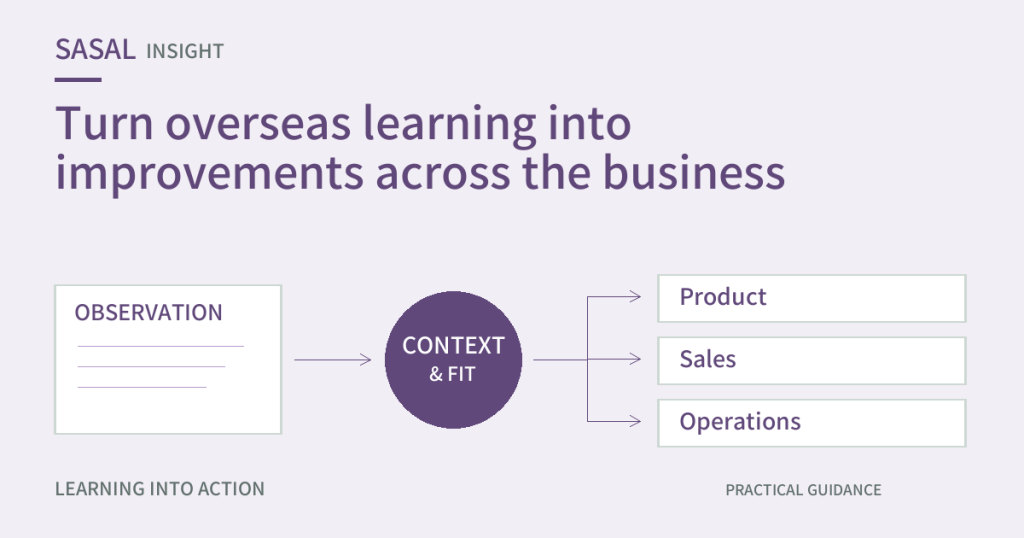
Overseas activity generates a steady flow of information from customer discussions, delivery work, support requests, buying decisions, declines, returns and operational surprises. The value of that information depends on whether it helps someone make a better business decision later. A useful learning process begins by identifying the decision that the learning should influence, then recording what happened, under what conditions, and who should review it. Context matters because a lesson that worked with one customer or market may not apply elsewhere without adaptation. By separating observations from interpretations, including unsuccessful outcomes alongside successful ones, and directing learning to the teams responsible for future decisions, a company can turn experience into practical improvements rather than a growing archive of disconnected reports.
Decide which business decision the learning should inform
Many overseas reports fail to create improvement because they describe events without identifying the decision that the information should influence. Before recording a lesson, define the future choice it is meant to support. The decision may involve product specifications, sales messaging, support processes, pricing discussions, delivery methods or management priorities. Framing the learning around a decision gives reviewers a practical reason to engage with it. Instead of collecting every detail from a customer interaction, focus on evidence that can help someone choose between alternatives. The same conversation can produce different records depending on whether the intended recipient is a product team, a sales manager or an operations leader. Decision-focused learning is easier to review, compare and reuse than a general narrative of events.
A useful method is to complete a simple statement before documenting findings: “This learning may help decide whether we should change X.” That statement does not predetermine the answer. It simply clarifies the purpose of recording the information. For example, if several overseas buyers ask similar questions before purchasing, the relevant decision may concern sales materials rather than product design. If users struggle after purchase, the decision may concern onboarding or support. Defining the decision first reduces the risk that teams later interpret the same information in conflicting ways. It also helps separate observations that matter from details that are merely interesting. The result is a record that supports action rather than passive storage.
Consider a hypothetical manufacturer selling into a new overseas market. During customer visits, the team notices that buyers repeatedly ask for clarification about operating conditions. One interpretation is that the product requires redesign. Another is that the documentation does not explain usage clearly enough. If the learning record identifies the target decision as improving pre-sale explanations, reviewers can assess evidence against that question directly. If the decision remains undefined, different departments may reach different conclusions from the same experience. The issue is not who is right initially. The issue is creating a record that enables structured evaluation of alternatives rather than encouraging assumptions.
Learning can also influence decisions beyond the original market. However, expansion of a lesson should not occur automatically. A finding from one customer or country does not prove broad applicability. Recording the intended decision creates a traceable link between evidence and later action. When teams review outcomes months later, they can see why the learning was captured and whether it informed a real choice. This discipline helps organizations avoid accumulating large collections of anecdotes that are difficult to use. Instead, knowledge becomes connected to specific business decisions, making later review, adaptation and improvement substantially more effective.
A practical way to maintain decision focus is to add a small set of fields to every learning record: the decision question, the available options being considered, the evidence observed, the review owner and the date when the decision is expected to be revisited. This structure helps prevent information from being stored without a clear path to use. For example, feedback from overseas customers about product use can be linked to a future specification review, while buying reasons can be linked to a sales proposal review. The same observation may legitimately support more than one decision, but each link should be stated separately so reviewers understand the intended use. A recommendation is to reject records that cannot identify a future decision owner, because the source material emphasizes delivering learning to the teams making the next decisions. A hypothetical application is maintaining a decision register that groups records by pending product, sales, operational and management choices rather than by country or trip. That approach makes it easier for reviewers to compare evidence relevant to a specific choice and later determine whether the recorded learning actually influenced the decision it was intended to support.
Capture the customer context with the observation
An observation becomes far more useful when it includes the circumstances in which it occurred. Customer feedback without context can easily be misunderstood by people who were not present. When documenting overseas learning, record the conditions surrounding the event. Relevant context may include how the customer used the offer, what problem they were trying to solve, what stage of evaluation they had reached, and which constraints affected their choices. The goal is not exhaustive detail. The goal is preserving enough information so future readers can understand why the observation mattered. Without context, teams may apply lessons incorrectly or assume that customer behavior reflects a broader pattern than the evidence actually supports.
Context is particularly important when feedback relates to pricing, adoption, quality or support. A comment about cost may arise from budget timing rather than dissatisfaction with value. A support request may reflect unusual operating conditions rather than a general product weakness. Recording the surrounding situation allows later reviewers to interpret the observation more accurately. This approach also reduces the risk that information changes meaning as it moves through different departments. The people making future decisions are often far removed from the original interaction. Context helps them evaluate evidence on its own merits instead of relying on assumptions about what happened.
Imagine a hypothetical software provider receiving feedback that implementation took longer than expected. If the record only states that onboarding was slow, reviewers may conclude that the process needs redesign. However, if the record explains that the customer postponed key internal approvals and changed requirements during deployment, the learning becomes more nuanced. The observation remains important, but the explanation changes. Future teams can compare similar cases and determine whether delays result from internal processes, customer actions or a combination of factors. The context transforms a simple complaint into evidence that can support a more informed decision.
Preserving context also supports later adaptation. As companies gain experience in additional countries, they often compare learning across markets. Those comparisons are only meaningful when the conditions behind each observation are visible. A note stating that a customer preferred a particular feature is less useful than a record explaining who used the feature, why it mattered and under what circumstances it created value. Detailed context does not guarantee correct conclusions, but it improves the quality of future analysis. It allows teams to compare like with like and reduces the chance that isolated experiences become overgeneralized business rules.
Context becomes easier to preserve when teams record it at the time of the interaction rather than reconstructing it later from memory. Useful context can be organized around a consistent set of questions: what the customer was trying to achieve, what constraints affected the situation, what stage of evaluation or use they had reached, and why the observation appeared relevant to a future decision. This does not require lengthy reports. The source material stresses preserving conditions around pricing, adoption, quality and support, so a concise record that captures those conditions may be more valuable than a detailed narrative with little decision relevance. A recommendation is to record context and observation in separate fields so future reviewers can compare similar situations across customers without losing the surrounding circumstances. A hypothetical application is reviewing several support requests that appear related, then comparing the operating conditions attached to each record before concluding that a common issue exists. When context is captured consistently, teams can distinguish between recurring patterns and isolated situations, reducing the risk that a finding from one customer is interpreted as evidence of a broader market trend.
- Customer objectiveWhat the customer was trying to achieve.
- Operating conditionsConstraints, timing and usage circumstances.
- Observed eventWhat was seen, heard or measured.
- Decision relevanceWhy the observation matters to a future choice.
Keep interpretation separate from what actually happened
One of the most valuable habits in learning transfer is separating observations from interpretations. An observation describes what happened. An interpretation proposes what it may mean. Both can be useful, but they serve different purposes and should not be merged into a single statement. For example, “the customer delayed the order for six weeks” is an observation. “The customer lost interest in the offer” is an interpretation. If the two are combined, future readers may mistake an assumption for a fact. Keeping them separate allows others to review the evidence independently and consider alternative explanations.
This distinction becomes increasingly important as learning moves between teams. Product managers, sales personnel, operations leaders and executives often view the same event through different lenses. A well-structured record gives them access to the underlying facts before presenting conclusions. Teams can then evaluate whether the interpretation is supported by the available evidence. The objective is not to eliminate judgment. Business decisions require interpretation. The objective is to make judgment visible so that reviewers understand where factual reporting ends and analysis begins. Clear separation improves accountability and helps prevent misunderstandings from spreading through the organization.
A practical approach is to use distinct sections within a learning record. One section captures observable events, customer statements, actions taken and outcomes achieved. Another section records possible explanations, open questions and hypotheses. Suppose a customer stopped using a feature shortly after implementation. The observation is the decline in usage. Possible interpretations might include insufficient training, poor fit with the workflow or changing business priorities. Recording these separately allows future investigation rather than prematurely selecting a single explanation. It also creates a useful history showing how understanding evolved as additional information became available.
Organizations that maintain this distinction often find it easier to compare experiences across markets. Observations can be grouped and reviewed consistently, while interpretations can be tested against broader evidence. Over time, some hypotheses gain support and others are discarded. This process strengthens learning quality because conclusions remain connected to documented events. It also reduces the temptation to build major decisions around a persuasive story that lacks sufficient evidence. By preserving what happened and what people think it means as separate elements, companies create records that remain valuable long after the original interaction has passed.
To keep facts and analysis distinct, teams can require every learning record to contain two clearly separated entries: one for observable evidence and another for possible explanations. Observable evidence may include customer statements, documented actions, timing of events, support requests or measurable outcomes. Interpretations can then be recorded as hypotheses, assumptions or questions that require further review. This approach aligns with the source guidance to distinguish observations from interpretations and helps later reviewers understand which parts of a record are directly supported by experience. A recommendation is to allow multiple interpretations when the evidence does not clearly support a single conclusion. For example, a delayed purchase decision may have several plausible explanations, and documenting alternatives can prevent premature agreement around one narrative. A hypothetical application is a cross-functional review in which sales, operations and development teams examine the same observation and contribute different interpretations while leaving the original evidence unchanged. Over time, additional records may support some explanations and weaken others. Preserving that distinction creates a stronger basis for comparison across markets because the underlying observations remain stable even when organizational understanding evolves.
Include losses, returns and pauses alongside wins
Companies naturally pay attention to successful overseas outcomes, but a learning system focused only on wins creates blind spots. Decisions become stronger when records include losses, returns, delays and pauses alongside positive results. A declined proposal may reveal buying criteria that sales materials fail to address. A returned product may highlight an unmet expectation. A stalled discussion may expose uncertainty that customers are unwilling to overlook. These outcomes do not automatically indicate failure in the offer. They provide additional evidence about how customers evaluate, use and experience it. Capturing a broad range of outcomes helps organizations understand patterns that success stories alone may conceal.
Recording unsuccessful outcomes requires the same discipline used for positive ones. Context should be preserved, observations documented and interpretations identified separately. The objective is not to assign blame. The objective is to understand what happened and whether it suggests an opportunity for improvement. When losses are ignored, organizations lose access to information that may explain future challenges. When they are documented carefully, they become part of a more complete picture of customer behavior and operational performance. This balanced approach supports learning because it reflects actual experience rather than a selective version of events.
Consider a hypothetical exporter reviewing six overseas opportunities. Two became customers, one resulted in a return, one paused indefinitely and two selected alternative suppliers. Focusing only on the successful sales might encourage confidence, but it would overlook valuable evidence from the other four outcomes. Perhaps several prospects struggled to understand implementation requirements. Perhaps buyers who declined cited concerns unrelated to the product itself. By reviewing all outcomes together, the company gains a richer understanding of where improvement efforts may produce the greatest benefit. The lesson comes from the entire set of experiences rather than a single favorable result.
Balanced records also help organizations avoid overestimating the significance of isolated successes. A win can demonstrate possibility without proving widespread demand or universal applicability. Likewise, a loss does not necessarily invalidate the overall approach. Recording wins, losses, returns and pauses together encourages evidence-based evaluation. Teams can compare outcomes, identify recurring themes and investigate whether apparent patterns truly exist. This practice supports more reliable decision making because conclusions emerge from a broader base of information. The result is a learning process that values completeness over confirmation and improvement over self-congratulation.
Including all outcome types becomes more practical when organizations review them together using the same recording standard. Wins, losses, returns and pauses should each capture the decision involved, the customer context, the observation and any interpretations that remain uncertain. Using a common format makes comparisons easier and reduces the chance that unsuccessful outcomes receive less attention or less detail than successful ones. The source material specifically recommends recording wins, losses, returns and pauses together because each contributes different evidence. A recommendation is to examine groups of outcomes periodically and look for themes that appear across categories rather than reviewing only successful transactions. A hypothetical application is finding that both customers who proceeded and customers who delayed asked similar implementation questions. That pattern may indicate an opportunity to improve explanations even though the final outcomes differed. Reviewing the complete set of experiences also helps teams assess whether a result reflects a broader issue or a single circumstance. By treating unfavorable outcomes as decision-relevant evidence instead of exceptions, organizations create a more balanced picture of customer behavior and operational performance.
Route learning to product, sales, operations and management

Learning becomes useful when it reaches the people responsible for future decisions. Different departments need different forms of information. Product teams may need details about usage, specifications and customer requirements. Sales teams may benefit from understanding why customers bought, delayed or declined. Operations teams may require information about delivery challenges, incidents and process improvements. Management may need visibility into commercial economics and broader business implications. Sending every report to everyone can create overload, while failing to direct information appropriately can leave important lessons unused. Effective routing connects each finding to the group best positioned to act on it.
A practical learning process identifies recipients before information is distributed. The question is not who might find the report interesting. The question is who can make a decision based on it. This distinction helps prevent learning from becoming a passive communication exercise. A sales observation that repeatedly reaches only operational teams may never influence customer-facing activity. Likewise, an operational issue that never reaches management may remain unresolved despite recurring costs or delays. Routing should therefore be intentional, linking findings to responsibility rather than broad circulation lists.
Imagine a hypothetical situation where overseas customers discover an unexpected use for a product. If the learning remains within the local sales team, the wider organization may never benefit. When routed to development teams, however, the information may influence future specifications, documentation or support resources. Similarly, recurring questions during purchasing discussions may help sales teams improve proposals, while incident records may help operations refine procedures. The value of learning increases when recipients have both the authority and the mandate to evaluate possible changes. Information without ownership often produces little practical improvement.
Routing also supports adaptation across markets. As experience accumulates, organizations can compare findings from multiple countries and identify lessons worth further investigation. This does not mean copying every practice from one market to another. It means ensuring that relevant teams are aware of observations that may affect their decisions. Structured delivery of learning strengthens organizational memory because knowledge reaches the people responsible for action. Over time, the company develops a more connected system in which experience from one customer, project or country contributes to improvements elsewhere without losing its original context or limitations.
Routing is more effective when every learning item includes a named review owner and a stated reason for delivery. The source material links different types of learning to different decision makers: customer uses and specifications to development, buying reasons to sales, work and incidents to operations, and economics to management. Building those categories into the recording process helps ensure that findings arrive where action is possible. A recommendation is to allow secondary recipients only when they have a clear role in evaluating the information, reducing the risk of broad circulation without accountability. A hypothetical application is an overseas delivery issue that is sent first to operations because it concerns work and incidents, while a summarized commercial impact is also provided to management for consideration in broader business decisions. Routing can also include a feedback step in which reviewers indicate whether the information led to further investigation, a proposal or no action. That response creates visibility into whether learning is being used and helps maintain a traceable connection between observations and later decisions. The result is a process centered on responsibility rather than information distribution alone.
- Customer use and needsSend to development for review of specifications and value.
- Buying decisionsSend to sales to improve proposals and explanations.
- Work and incidentsSend to operations for process improvement.
- Commercial economicsSend to management for broader business decisions.
Turn a finding into a specific improvement proposal
A finding alone rarely changes a business. Improvement usually requires a proposal that explains what should change, why the change may help and who should evaluate it. After learning has been recorded and routed, convert it into a practical suggestion. The proposal should connect evidence to a defined action without overstating certainty. For example, rather than stating that a process must be redesigned, propose testing a revised procedure because several observations indicate a recurring issue. This approach keeps the relationship between evidence and action transparent. It also allows reviewers to assess whether the recommendation fits the available information.
Specific proposals are easier to review than broad aspirations. A statement such as “improve customer onboarding” provides little guidance. A proposal to add a particular explanation to onboarding materials or to change the sequence of implementation steps gives reviewers something concrete to evaluate. The recommendation should identify the intended outcome, the responsible owner and any assumptions that remain uncertain. Doing so turns learning into a manageable decision rather than an open-ended discussion. It also creates a record that can later be revisited to assess whether the change produced the expected benefit.
Consider a hypothetical exporter that repeatedly hears questions about delivery responsibilities during overseas negotiations. The finding itself is useful, but improvement occurs only when someone proposes a specific response. One proposal might be revising proposal documents to clarify responsibilities earlier in the sales process. Another might be creating a standard explanation used during initial discussions. Both options can be reviewed, assigned and tested. The key point is that evidence becomes actionable when translated into a defined change rather than remaining as a general observation stored in a report.
Improvement proposals should remain connected to ongoing adaptation. Experience from overseas markets often reveals opportunities to refine products, support, communication and operational methods over time. Because learning continues after sales begin, proposals should be recorded with sufficient detail to explain their origin and rationale. This creates a traceable link between observation, interpretation and action. When future teams review outcomes, they can understand why a change was made and whether it improved subsequent work. In this way, learning becomes part of a continuing cycle of adaptation rather than a collection of isolated reports.
An improvement proposal is easier to evaluate when it explicitly states the observation that prompted it, the intended change, the expected benefit and any uncertainties that still require review. This structure reflects the source guidance to assign both the review and the intended change so that reporting becomes improvement. A recommendation is to describe proposals in terms of actions that can be assessed later rather than broad goals. For example, a proposal may suggest revising a sales explanation, updating support material or testing a different operational step because specific observations indicate a recurring issue. A hypothetical application is creating two alternative responses to the same finding and asking the responsible team to evaluate which option better addresses the evidence. Recording assumptions is also important because future reviewers may discover that an expected benefit depended on conditions that were not widely present. Linking the proposal to its originating observation preserves traceability and helps later teams understand why the change was considered. When proposals are documented in this way, organizations can review outcomes against the original rationale and build a clearer connection between learning, decision making and practical improvement.
Check whether the same problem exists elsewhere
A useful lesson from one overseas customer should be treated as a hypothesis rather than a universal conclusion. Before extending an improvement across products, teams or countries, investigate whether the underlying problem appears in other situations. The objective is not to dismiss the original finding. The objective is to determine whether it reflects a broader pattern or a condition unique to a specific customer, buying process or operating environment. A change that solves a genuine shared problem may create value across the business. A change based on a narrow circumstance may add complexity without delivering meaningful benefit. Testing applicability therefore becomes an important stage between learning and implementation, especially when the proposed change would affect multiple functions or markets.
One practical method is to compare the original observation with evidence from other buyers, projects or support interactions. Look for similarities in customer goals, usage conditions, purchasing questions or operational constraints. If the same issue appears repeatedly under different circumstances, confidence in its broader relevance may increase. If the issue appears only in a highly specific situation, a targeted response may be more appropriate than a company-wide change. The process should remain evidence driven. Teams should avoid assuming that repetition of a story proves repetition of a problem. Instead, compare documented observations and contexts before deciding whether a lesson deserves wider application.
Consider a hypothetical company that learns from one overseas customer that installation instructions caused confusion. Before rewriting all documentation, the company reviews records from other customers and discovers that most completed implementation successfully without similar questions. Further investigation reveals that the original customer operated under unusual constraints and relied on a different internal approval process. The finding remains valuable, but the appropriate response may be a supplemental guide for comparable situations rather than a complete redesign. By checking whether the same problem exists elsewhere, the business allocates improvement effort more effectively and avoids solving a problem that is not widely shared.
This review process also supports later international growth. Experience in one country can reveal possibilities in another, but transfer should occur through examination rather than assumption. Learning becomes more reliable when organizations test whether products, explanations or operational practices face comparable challenges elsewhere. A shared-problem hypothesis should be investigated before it becomes a standard operating change. Doing so preserves flexibility while improving decision quality. Over time, the organization develops a clearer understanding of which lessons represent recurring business issues and which reflect local circumstances that require a more limited response.
Adapt a useful lesson without copying its original conditions
Even when a lesson appears relevant beyond its original setting, direct copying can create new problems. Overseas learning emerges from particular customers, institutions, business practices and operating conditions. A practice that works well in one market may depend on assumptions that do not exist elsewhere. The goal is therefore adaptation rather than replication. Identify what created value in the original situation, then evaluate how that principle might fit a different context. This approach preserves the substance of the lesson while recognizing that customers and markets often differ in meaningful ways. Adaptation allows organizations to benefit from experience without treating one successful outcome as a template for every future situation.
A useful question is whether the improvement depends on local conditions or on a more transferable business need. For example, a support process developed in one country may succeed because customers require detailed onboarding. In another market, customers may already possess the relevant expertise, making extensive onboarding unnecessary. The transferable lesson may not be the exact process. Instead, it may be the importance of matching support resources to customer readiness. By focusing on the underlying purpose rather than the visible form, teams can carry learning forward while adjusting execution to local realities and operational constraints.
Imagine a hypothetical equipment supplier that discovers overseas customers value scheduled post-delivery reviews. A direct copy would require the same review structure everywhere. An adaptive approach would ask why those reviews were useful. Perhaps they helped customers understand product use during the first months of operation. Another market might benefit from a different format, timing or communication channel while pursuing the same objective. The lesson remains valuable because the company understands the customer need behind it. Adaptation converts experience into a flexible capability rather than a rigid procedure that may lose effectiveness when circumstances change.
Ongoing international activity continually generates opportunities for this kind of refinement. As businesses deepen relationships and enter additional markets, learning returns to headquarters and other countries. The strongest organizations treat this flow of experience as a source of evolving improvement rather than a collection of instructions to duplicate. Lessons should be examined, adjusted and retested in their new environment. Through this process, the business model develops a shared foundation while remaining responsive to local conditions. Adaptation therefore becomes a practical mechanism for turning overseas experience into sustainable organizational learning.
- Direct copyingReuses the original practice without examining local conditions.
- Adapted transferKeeps the purpose of the lesson while adjusting execution.
- Local context reviewConsiders customers, institutions and business practices.
- Retested applicationEvaluates performance in the new environment.
Preserve permission and ownership boundaries when sharing
Learning becomes more useful when shared, but sharing should occur within agreed boundaries. Customer names, drawings, data, specifications and jointly created outputs may be subject to contractual, privacy or intellectual property conditions. A valuable lesson does not automatically grant permission to distribute every supporting detail. Before circulating information, determine what can be shared, with whom and for what purpose. This protects relationships while ensuring that improvement efforts remain consistent with existing obligations. The objective is not to restrict learning unnecessarily. The objective is to separate reusable knowledge from information that should remain limited to approved audiences or uses.
A practical approach is to distinguish between the lesson itself and the identifying material attached to it. Teams often need to understand a customer problem, buying reason or operational issue without knowing every confidential detail. Aggregation or anonymization may allow a finding to support internal improvement while reducing unnecessary exposure of sensitive information. Similarly, information appropriate for internal decision making may not be suitable for sharing with other customers, partners or external parties. Establishing these distinctions early helps prevent confusion later and allows knowledge transfer processes to operate more smoothly across departments and countries.
Consider a hypothetical situation where an overseas customer provides detailed feedback about product usage. Development teams may need access to the technical lesson, while broader circulation of customer-specific documents may exceed the intended sharing scope. By extracting the relevant learning and documenting permissions, the company preserves value without creating avoidable risks. This method also improves trust because customers and partners can see that information is handled according to agreed purposes rather than treated as unrestricted organizational property. Responsible handling supports both learning and long-term relationships.
Ownership boundaries matter internally as well. Teams should know who maintains records, who can authorize wider distribution and who is responsible for reviewing requests for additional use. Clear accountability reduces uncertainty when new opportunities for learning transfer arise. As organizations accumulate experience across markets, disciplined handling of permissions helps ensure that valuable knowledge remains accessible while sensitive material remains appropriately controlled. The result is a learning system that supports improvement without losing sight of contractual, privacy and intellectual property considerations.
Keep current versions and the reasons behind changes
Learning records lose value when teams cannot determine which version is current or why a previous conclusion changed. As findings evolve, organizations should maintain clear records of updates, review dates, authors, sources and unresolved questions. This does not require preserving every draft indefinitely. It requires enough history for future readers to understand how decisions developed. When a recommendation changes, the reason for that change should be visible. Without that explanation, teams may repeat earlier debates, misunderstand the basis of current practices or rely on outdated information. Version discipline therefore supports both continuity and accountability in knowledge sharing.
The challenge becomes greater when learning passes between distant teams or across long periods of time. People who were not involved in the original discussions still need to understand the status of a finding. A record that clearly identifies the current version allows readers to focus on the most relevant information. At the same time, retaining the rationale behind important revisions provides context for future evaluation. If evidence later changes again, reviewers can trace how understanding evolved instead of treating each update as an isolated event disconnected from earlier learning.
Imagine a hypothetical exporter that modifies its sales proposal process after receiving overseas feedback. Months later, additional customer interactions suggest a different approach. If the organization records only the latest recommendation, future teams may not understand why the first change occurred or what evidence challenged it. By maintaining a documented history of versions and reasoning, the company creates a learning trail that supports better decisions. Reviewers can compare assumptions, evaluate evidence and avoid reintroducing previously rejected approaches without understanding the circumstances behind them.
Good records are ultimately designed for future decision makers rather than current participants. Information from everyday operations and unexpected events becomes more valuable when it remains understandable over time. Current versions help people act efficiently, while explanations of change help them act intelligently. Together, these practices strengthen organizational memory and make learning easier to reuse across projects, departments and markets. The result is a knowledge base that remains practical because both the present conclusion and the path to that conclusion are visible.
Review whether the change actually improved the next task
Implementing a change should not mark the end of the learning process. After an improvement is introduced, review whether it helped the next task, decision or customer interaction. The purpose of this review is not to defend the original proposal. It is to evaluate results using new evidence. A recommendation may appear sensible when first developed yet produce little benefit in practice. Conversely, a small adjustment may create meaningful operational improvements. By examining outcomes after implementation, organizations close the gap between learning and performance. This step ensures that changes remain connected to real business activity rather than becoming permanent simply because they were approved once.
A useful review compares the original observation, the intended improvement and the outcome that followed. Did the revised process address the issue it targeted? Did customer discussions become clearer? Did operational incidents decrease in comparable situations? These questions should be assessed with the same discipline used when capturing the initial lesson. Observations should be distinguished from interpretations, and conclusions should remain proportional to the available evidence. The review does not require perfect measurement. It requires thoughtful examination of whether the change improved the next piece of work in a meaningful way.
Consider a hypothetical company that updates onboarding materials after recurring customer questions. Several months later, the team reviews new implementations. Customers now require fewer clarifications, but some still struggle with a specific step. The original change appears beneficial, yet additional refinement may be needed. This outcome is more useful than either assuming complete success or declaring failure. Reviewing results reveals where progress occurred and where further adaptation remains appropriate. The organization gains a clearer understanding of the relationship between action and outcome.
International business development is an ongoing process of learning and adaptation. As experience accumulates, improvements should be revisited rather than treated as final answers. New customers, changing expectations and additional markets may reveal fresh challenges or opportunities. By reviewing whether a change improved subsequent work, companies create a feedback loop that keeps learning active. This discipline helps ensure that lessons continue to generate value long after the original observation was recorded.
- ObservationA learning opportunity is documented.
- Change implementedA specific improvement is introduced.
- Next task reviewedResults are examined in comparable work.
- Learning updatedRecords and practices are refined using evidence.
Updated learning informs future observations and changes
Create a reusable learning record for the next market

A reusable learning record should help future teams understand what happened, why it mattered and where its applicability may begin or end. The goal is not to create an archive of isolated reports. The goal is to build knowledge that can support later market activity without losing context. Useful records typically connect observations, customer conditions, interpretations, decisions taken and unresolved questions. They also identify recipients and owners so that future users know who reviewed the information and what actions followed. By organizing learning in a consistent structure, organizations make it easier for later teams to locate relevant experience when evaluating new opportunities.
Reusability depends on preserving enough detail to support interpretation while avoiding unnecessary clutter. Future readers should be able to understand the customer situation, the business decision involved and any limits on broader application. Records become particularly valuable when they include outcomes from wins, losses, returns and pauses because those experiences together provide a richer view of customer behavior. A later market may differ substantially from the original one, yet the underlying questions, challenges or operating patterns may still offer useful guidance. Well-structured records allow teams to explore those connections thoughtfully rather than relying on memory alone.
Imagine a hypothetical business preparing to enter a second overseas market after gaining experience in the first. The team reviews prior learning records and discovers recurring questions about implementation, support expectations and purchasing approvals. Because the records preserve context and later outcomes, the team can distinguish lessons that appear broadly relevant from those tied to unique local circumstances. This preparation does not eliminate uncertainty, nor does it prove that customers in the new market will behave the same way. It simply provides a stronger starting point for investigation and planning based on documented experience rather than assumptions.
Over time, reusable records become part of a wider organizational learning system. Experience from one country informs activity in another, while new findings continue to refine earlier understanding. Records make information from daily operations and unexpected events available for future decisions, allowing learning to travel beyond the individuals who originally encountered it. When maintained carefully, they help transform overseas experience into a durable asset that supports adaptation, decision making and continuous improvement across the business.