

SASAL INSIGHT / DEEP DIVE
When to appoint a dedicated overseas business lead
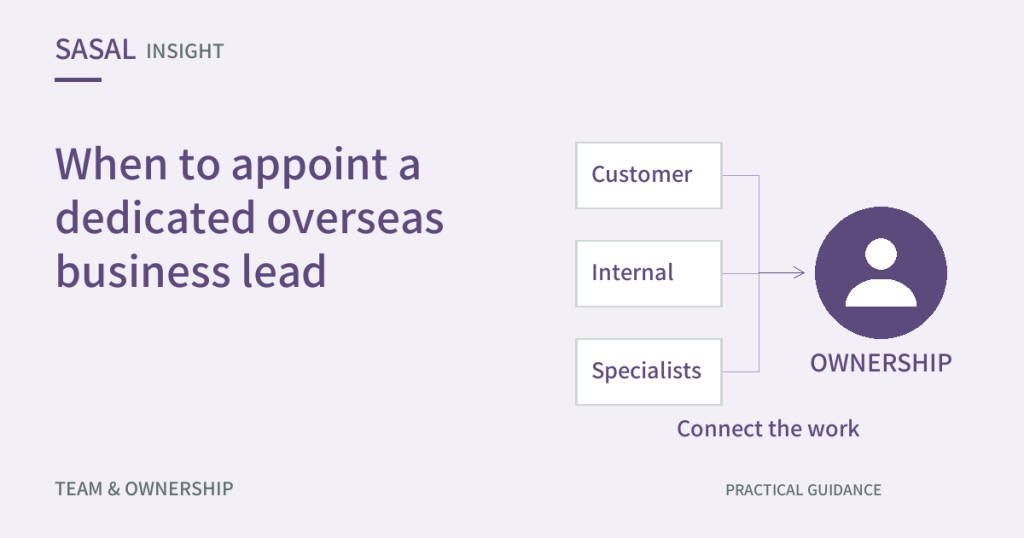
A dedicated overseas business lead becomes useful when the work required to move decisions forward can no longer be handled reliably through shared responsibilities. The strongest indicators are growing coordination demands, recurring customer and validation activity, delayed responses, decision bottlenecks, and rising continuity risks across departments, countries or external specialists. Naming an accountable owner and making that role dedicated are separate decisions. Many initiatives begin successfully with part-time ownership. The question is not how long the project has existed or how much revenue is expected. Instead, compare the actual work that must be coordinated, the speed required, the available capacity, and the need to maintain consistent project leadership through key milestones and personnel changes.
Start with accountability before full-time ownership
An overseas initiative benefits from having a clearly identified internal owner from the moment expansion is first considered. That owner gives research, market comparisons and early validation a route toward the next decision. However, assigning accountability does not automatically require a dedicated position. In many situations, early work can be handled alongside existing responsibilities if the scope is understood, time is available, and management decision paths are clear. The practical question is whether the assigned person can continue advancing the project without creating delays, confusion about responsibility, or uncertainty about who must return decisions.
Shared ownership can work effectively during exploration because activities are often intermittent rather than continuous. Teams may be comparing markets, reviewing assumptions, gathering information and discussing possible approaches. Those tasks can often be coordinated through existing roles when expectations are explicit. Problems tend to emerge when responsibility becomes diffuse. If several people contribute research but nobody is responsible for moving findings toward a decision, progress may stall even when useful information exists. An accountable owner helps maintain momentum and ensures that work leads toward specific management choices rather than remaining an open-ended investigation.
A dedicated lead becomes more relevant when accountability alone no longer provides enough execution capacity. If the owner repeatedly struggles to balance existing duties with overseas requirements, the company should examine workload rather than relying on job titles. The decision should be based on actual responsibilities, deadlines and coordination demands. This approach avoids appointing a dedicated lead too early while also reducing the risk of waiting until commitments have already exceeded available capacity. The role exists to sustain progress and decision-making, not simply to create another organizational position.
Assess coordination load rather than fixed thresholds
There is no universal threshold that determines when a dedicated overseas business lead becomes necessary. A more useful approach is to examine coordination load. Overseas initiatives often require communication among headquarters teams, local contacts, specialists, managers and potential customers. Each participant may have different information, deadlines and responsibilities. When keeping those activities aligned begins consuming substantial effort, the organization should evaluate whether current staffing remains sufficient. Coordination load is often visible through missed follow-ups, unresolved questions, delayed approvals or repeated requests for information that has already been discussed elsewhere.
Coordination becomes particularly important when decisions depend on contributions from multiple functions. Commercial, operational and regulatory considerations may all influence the next step. Someone must maintain a common view of objectives, responsibilities, open issues and deadlines. If that work is distributed informally, important dependencies can be overlooked. A dedicated lead can provide continuity by connecting separate streams of work into one decision process. The value of the role comes from integrating information and keeping progress visible rather than from exercising authority over every contributor.
A practical review compares required coordination effort with available capacity. Consider how often information must be exchanged, how many stakeholders are involved, and whether responses arrive quickly enough to support planned activities. If the project consistently depends on extraordinary effort from part-time contributors, capacity may be insufficient. At that stage, appointing a dedicated lead can improve execution by creating a stable point of contact who tracks commitments, follows open items and ensures that dependent activities move forward in a coordinated manner.
Watch for recurring customer and validation activity
One practical point for considering a dedicated role is the appearance of recurring customer discussions and ongoing validation work. Early exploration may involve occasional conversations, but active engagement creates a different operating environment. Customer replies, proposal revisions, pilots, contract discussions and internal reviews can occur simultaneously. These activities often require rapid follow-up and consistent communication. As overlap increases, the effort required to maintain progress rises significantly. A dedicated lead can help ensure that opportunities are not lost because important responses are delayed or responsibilities become unclear.
Validation work frequently creates chains of dependent actions. A customer question may require technical clarification, commercial review and management input before an answer can be provided. Several similar requests arriving together can quickly overwhelm part-time ownership. Delays may not indicate poor performance by individuals. Instead, they may signal that the initiative has reached a stage where sustained attention is required. The company should focus on actual workload and responsiveness rather than assuming that existing arrangements will continue functioning as activity grows.
Hypothetical example: assume a company is running customer discussions in one overseas market while evaluating pilot requirements and internal approval needs. The owner spends increasing amounts of time coordinating proposal updates, arranging meetings and obtaining answers from specialists. Responses begin taking longer and customer commitments start overlapping. Under those assumptions, management could compare a dedicated lead, shared staffing or external support. The key issue would be whether available capacity can reliably support current obligations and upcoming commitments without creating avoidable delays.
Identify decision bottlenecks early
Decision bottlenecks often reveal the need for stronger ownership. Overseas initiatives generate questions that require clarification from multiple stakeholders. If answers regularly wait for someone to gather information, organize discussions or present options to management, the process may depend too heavily on ad hoc coordination. A dedicated lead can reduce friction by maintaining visibility over pending decisions and ensuring that relevant information reaches decision-makers in a timely manner. The objective is not to centralize every decision but to keep decisions moving through the organization effectively.
Bottlenecks can appear even when management remains supportive. The challenge may be that information arrives from different sources at different times. Without a coordinator, teams can reach conflicting assumptions about responsibilities, timelines or execution requirements. Decisions may be postponed simply because nobody has assembled the necessary context. A dedicated lead can help create a consistent view of facts, open questions and recommended next actions. This supports faster evaluation while preserving the company’s established approval authorities.
The need for a dedicated lead becomes stronger when delays begin affecting external commitments. Customers, partners and specialists often work to their own schedules. If internal decisions repeatedly arrive after expected dates, confidence may decline and opportunities can become harder to maintain. Reviewing decision speed provides a practical way to evaluate whether current ownership arrangements remain adequate. The assessment should focus on execution realities rather than organizational preferences or assumptions about what overseas projects are supposed to look like.
Separate project leadership from approval authority
A common source of confusion is the assumption that a dedicated overseas lead must also hold final approval authority. The sources distinguish coordination from management and investment decisions. A lead can be responsible for moving work forward, organizing information and obtaining internal answers while senior decision-makers retain formal approval responsibilities. This separation helps preserve governance while ensuring that daily execution receives sufficient attention. The role exists to support progress between decisions as much as to support the decisions themselves.
Clarifying authority is particularly important when transitioning from shared ownership to a dedicated position. Teams should understand which matters the lead can decide independently and which require escalation. Ambiguity can create delays because contributors hesitate to act or repeatedly revisit issues that already have direction. A clear mandate reduces uncertainty and allows specialists to contribute efficiently. It also provides a practical framework for measuring whether the role is improving execution and coordination across the initiative.
When companies create a dedicated position without defining authority, expectations often become inconsistent. Some participants may assume the lead controls budgets or approvals while others expect only administrative coordination. Establishing decision boundaries at the outset helps align behavior. The dedicated lead becomes accountable for advancing work, maintaining visibility and preparing decisions. Management continues exercising the approval powers assigned under company processes. This distinction supports both accountability and effective oversight as the overseas initiative develops.
Compare dedicated and shared-duty models
A shared-duty model can remain appropriate when overseas work is periodic, predictable and manageable within existing responsibilities. It allows organizations to use existing expertise while limiting disruption to established structures. The model works best when responsibilities are clear, response expectations are realistic and coordination requirements remain modest. Regular reviews can help confirm that ownership remains effective. Shared responsibility should not mean uncertain responsibility. One person should still be accountable for maintaining direction and ensuring that important tasks lead toward identifiable business decisions.
A dedicated model becomes more attractive when the initiative requires sustained attention across multiple workstreams. Continuous customer engagement, frequent coordination, active validation and overlapping deadlines can create demands that exceed part-time capacity. In those situations, concentrating responsibility in a dedicated role can improve responsiveness and continuity. The benefit comes from protected time and focus rather than from status. The organization gains a person whose primary responsibility is connecting activities, removing obstacles and ensuring that commitments receive timely attention.
Neither model is inherently superior. The appropriate choice depends on workload, timing and organizational context. Companies should compare actual effort against available capacity and evaluate whether commitments are being met reliably. A dedicated role may be justified before revenue appears if coordination demands are already substantial. Conversely, a shared-duty arrangement may remain effective even after market entry if the required effort stays manageable. The evaluation should remain grounded in execution needs rather than assumptions about business stage, company size or expected outcomes.
Use continuity as a decision criterion
Use continuity as a decision criterion by examining how much progress depends on retaining context over time. Overseas initiatives often involve several departments, countries, specialists and management reviews, with important activities continuing through personnel changes, rotations or shifting priorities. In that environment, continuity is not only about preserving documents; it is about preserving understanding of decisions, assumptions, relationships, validation results and unresolved issues. A dedicated lead becomes more useful when reconstructing project history starts consuming meaningful effort. Management can compare alternatives by asking whether shared-duty ownership still provides stable project leadership or whether frequent changes in coordinators create delays. The key consideration is not project age or business stage, but whether sustained involvement is needed to connect decisions and execution across milestones without repeatedly rebuilding context.
The sources emphasize continuity in overall coordination rather than repeatedly changing the person guiding the work. Stable involvement helps connect local relationships, task dependencies, validation learning and pending decisions into a coherent process. When ownership shifts often, contributors may spend time explaining previous choices, revisiting assumptions or locating information that was never consolidated. A dedicated lead can act as a consistent reference point while approval authority remains with the appropriate decision-makers. Hypothetical illustration: assume customer validation, specialist reviews and internal approvals are all underway at the same time. If coordination passes between several part-time owners, each transition may require re-explaining commitments and priorities. Management could compare that arrangement with dedicated ownership by evaluating which approach better maintains momentum, visibility of open items and continuity of execution.
Continuity can therefore be evaluated as a requirement of the work, rather than treated as a general preference for keeping the same person. A useful question is which upcoming decisions depend on interpreting earlier evidence and relationships. If most tasks are independent and readily bounded, stable coordination may require less protected time. If customer commitments, validation findings and several internal decisions must be interpreted together, repeatedly changing the coordinator may create additional work. Management can compare those conditions with the capacity available in the current role. This reasoning helps explain why dedicated ownership may be justified before revenue appears in a complex initiative, while a simpler assignment may still be manageable through a clearly designated part-time owner.
Define the mandate when making the role dedicated
Define the mandate before treating the role as dedicated. The title alone does not create capacity or accountability. The sources indicate that previous duties should be reassigned at the same time decision authority is defined, otherwise the person may continue carrying competing responsibilities and gain little protected time for overseas execution. A useful mandate specifies what decisions the lead can make independently, which issues must be escalated, what information they can access and which outcomes they are expected to advance. It should also clarify how the role interacts with management approvals, since day-to-day coordination and final investment or management decisions are not the same responsibility. Clear boundaries help contributors know when to involve the lead, who returns answers and how work moves from research and validation toward company decisions.
The mandate should reflect the actual coordination work required. Depending on the initiative, responsibilities may include obtaining internal answers, establishing buying conditions, coordinating validation activities, maintaining visibility of open issues and turning findings into recommendations for decision-makers. When comparing a shared-duty model with dedicated ownership, focus on workload and continuity rather than status. In a shared arrangement, these activities remain alongside other responsibilities; in a dedicated arrangement, protected time is assigned to them. Management can compare alternatives by reviewing whether responses, coordination and follow-up remain reliable under current capacity. A practical mandate also identifies required support, such as access to specialists, budget resources where applicable and backup coverage, so accountability is matched with the ability to execute.
Hypothetical illustration: a company gives its overseas lead responsibility for preparing customer proposals, but keeps changes to product specifications and major spending with existing approvers. The mandate could allow the lead to gather buying requirements, request internal estimates and present alternatives without committing the company to an unapproved change. It would also identify the people who must return technical and financial decisions. If the lead is expected to respond to customers while those decision-makers remain unspecified, the mandate contains an execution gap. Resolving that gap does not necessarily mean granting unlimited authority. It means giving the lead a workable route to the answers needed, along with clear limits on what can be promised before approval.
Coordinate specialists without losing internal ownership
Overseas initiatives often depend on input from specialists covering different jurisdictions, functions or review topics. Their work can clarify specific questions, but someone inside the company still needs to connect those answers into a single decision process. A dedicated lead becomes useful when coordinating assumptions, open items, dates, responsibilities and dependencies starts requiring sustained attention. In a shared-duty model, that integration work is handled alongside other responsibilities; in a dedicated model, protected time is assigned to keeping information aligned across contributors. When comparing the two approaches, review the actual effort needed to gather internal answers, maintain a common view of current facts and move recommendations toward management decisions. Specialist expertise supports execution, but internal ownership remains responsible for priorities, decisions and overall direction.
Effective coordination requires more than collecting reports. Information about products, channels, contracting entities, delivery arrangements and ownership may affect several workstreams at the same time. A coordinator helps ensure that changes are visible, assumptions are recorded and relevant participants receive updated information. This reduces the risk that separate contributors work from inconsistent understandings of the project. Hypothetical illustration: one specialist reviews importer eligibility while another works on contract preparation, and both rely on assumptions about who will import and deliver. If those assumptions change without being shared, useful specialist output may no longer fit the broader plan. A dedicated lead can maintain a shared view of responsibilities, owners and timing, while management continues to exercise the approval authority assigned under company processes.
The company should also distinguish a completed specialist assignment from a resolved business decision. In the hypothetical transaction above, a tax or import adviser might answer a narrowly defined question using the current contracting arrangement. That answer does not automatically settle the commercial choice between alternative delivery models. The internal lead can identify which assumptions support the advice, which questions remain open and whether the sales proposal reflects the same arrangement. A practical next step is to ask the relevant specialists to confirm the effect of any proposed change, while assigning the commercial decision to the appropriate internal authority. In this way, external expertise informs a connected transaction without asking one adviser to take responsibility for matters outside the assignment.
Plan handover before it becomes necessary
Plan handover before a change is required, not after one is announced. When a dedicated overseas lead coordinates customer discussions, validation work, specialists and internal stakeholders, that person often becomes the main connection between decisions and execution. The sources recommend making handover part of normal project management by sharing objectives, scope, schedules, responsibilities, approvers, decision points and the reasons behind decisions. This information allows a successor to understand not only what was agreed but also the assumptions and validation that supported it. Companies comparing shared-duty and dedicated ownership can use the same principle: if continuity would be difficult because critical knowledge exists mainly in one person’s memory, stronger documentation and knowledge sharing may already be needed regardless of which ownership model is chosen.
A useful handover process combines written records with direct discussion. Documentation can capture plans, open work, validation results, deadlines, contacts and authority arrangements, while conversations help explain local developments, stakeholder expectations and unresolved questions. Organizations should identify the information a successor would need to continue execution without reconstructing project history from scratch. This includes current commitments, escalation contacts, access rights and upcoming decision requirements. Hypothetical illustration: assume a dedicated lead is scheduled to move to another role during an active validation phase. A structured review of decisions, reasoning, customer commitments and pending approvals would help the incoming coordinator maintain progress while management approval authority remains unchanged. The objective is continuity of execution, not transferring final decision rights.
Before a handover is considered complete, the incoming person can demonstrate that the information is usable by explaining the next customer commitment, the next internal decision and the person responsible for each response. This is a proposed practical check, not a fixed organizational rule. It can reveal missing access, outdated contacts or uncertainty about whether an idea was approved or merely discussed. Where an overlap period is possible, the outgoing and incoming leads can resolve those gaps together and introduce the new contact to relevant participants. A personnel change should not itself erase the reasons for the existing plan. Subsequent changes should be linked to new information or an explicit management decision, with the reasoning recorded for the next person.
Hypothetical first-month agenda for a new lead
Hypothetical example: assume a company decides that coordination demands justify a dedicated overseas business lead. During the first month, the lead could begin by assembling a clear picture of objectives, stakeholders, current commitments and pending decisions. Existing research, validation findings and customer discussions would be reviewed to identify open questions. The goal would not be to redesign strategy immediately. Instead, the priority would be creating visibility into what is already known, what remains uncertain and which actions require attention in the near term.
Under the same assumptions, the lead could map responsibilities across headquarters teams, local contacts and external specialists. Open items, dependencies and target dates could be recorded so contributors share a common understanding of priorities. Particular attention could be given to recurring customer interactions and decision bottlenecks. Where delays exist, the lead could identify whether they result from missing information, unclear authority, competing workloads or coordination gaps. This creates a practical basis for improving execution without assuming that structural changes are automatically required.
Later in the first month, the lead could review continuity arrangements and confirm how knowledge will be retained. Existing decisions, assumptions and validation results could be documented with supporting reasoning. A deputy or backup contact could be identified where appropriate. The lead could then provide management with a concise view of progress, risks and upcoming decisions. This hypothetical agenda focuses on visibility, coordination and continuity rather than prescribing specific staffing ratios, timelines or organizational structures.
Review results and prepare for consultation
After appointing a dedicated lead, organizations benefit from reviewing whether the role is addressing the issues that prompted the change. Useful areas for review include decision speed, validation progress, customer responsiveness and coordination effectiveness. The objective is not to justify the role automatically but to understand whether capacity now aligns better with project demands. Responsibilities may evolve as the initiative develops. Regular evaluation helps ensure that ownership structures continue supporting execution rather than becoming fixed assumptions.
Preparation for a consultation is often easier when internal ownership is already clear. Companies can assemble current objectives, project scope, stakeholder maps, validation findings, open decisions and known constraints. It is also useful to identify where coordination challenges occur and which responsibilities currently create delays. This information provides context for discussing options and allows external advisers to understand the initiative without replacing internal decision-making. Clear preparation supports more productive conversations and more focused recommendations.
A practical next step is to document the current workload, coordination requirements, decision path and continuity risks surrounding the overseas initiative. Compare those demands with available capacity and identify where progress depends on sustained attention. If recurring customer activity, overlapping responsibilities, decision bottlenecks or continuity concerns are becoming difficult to manage, a dedicated overseas business lead may be worth considering. Bringing that assessment, together with existing plans and responsibilities, creates a strong foundation for a SASAL consultation focused on execution needs and ownership design.